fine gael

Random entry RSS

  • Posted in:

    Independent Living

    2016 marks another anniversary, the 20th anniversary of a ‘Strategy for Equality’. This was the report of the Commission on the Status of People with Disabilities. Their task was to establish what life was like for people with disabilities in Ireland and to prepare a roadmap to equality for people with disabilities. Before deciding on the appropriateness of any celebrations, it is timely to ask a question: has Ireland become more equal for people with disabilities? The Commission took what it described at the time as “the unusual step” of consulting with people about their ‘lived’ experiences. It reported that people with disabilities experienced outdated social and economic policies and public attitudes, and pointed to “justifiable anger” felt by people with disabilities and their families. In the intervening years a multitude of laws and policies have been introduced but the question remains. Let me state it again: has Ireland become more equal for people with disabilities? A cursory look at the Strategy and subsequent developments would suggest that quite a lot has been achieved on many of its recommendations. A National Disability Authority (NDA) has been established, a Disability Act was passed into law, a National Advocacy Service was established, and a swathe of legislation was brought into force on equality, assisted decision-making and education. However, if you dig a little deeper, there is a different story to be told. Most of these measures were poorly thought out or half-implemented. The Disability Act 2005 created little by way of the rights-based legislation envisaged. Instead it provided a basic right to a person with disabilities to an assessment of need. However, no rights to services follow on from that assessment. Even this limited ‘right’ to an assessment has been only partly commenced and currently just caters for children. The Strategy envisaged an independent advocate for people with disabilities. In 2007 the Citizens Information Act was passed. This provided for “Personal Advocates” with statutory and wide-ranging powers. Four years later a limited non-statutory service called the National Advocacy Service was commenced. A total of 35 advocates operate across a country where there are an estimated 600,000 people with disabilities. The Education for People with Special Educational Needs Act 2004 has been stalled indefinitely. This means that children in mainstream schools struggle to get educational supports. Successive Governments have failed to address the issue of the cost of disability. Many of the manifestos for the recent election used the term “cost of disability” to describe plans to give people an extra ten euro on their welfare payment. This is a regrettable approach. Cost of Disability demands than an increase in welfare payments. It requires a genuine recognition that having a disability can be expensive and moving to alleviate that additional expense. The Strategy recommended that the Department of Environment develop a policy with “the right of people with disabilities to live as independently as possible” as its aim. In 2011 the ‘Congregated Settings’ report was published by the HSE, the agency responsible for care services. This was premised on moving people with disabilities back into the community. Progress on this ambition has been unacceptably poor. The Fine Gael manifesto for the recent election includes a target for 1/3 of residents to move back into the community by 2021, three years after the initial deadline for moving all residents. This is an acknowledgement that the policy has failed and that a generation of people will probably die in institutions. The Strategy stated that ful lment through relationships and sexuality is a basic right. Since 1993, the criminal law has cast a legal shadow over sex and people with disabilities, particularly those with intellectual disabilities or mental illness. The law has provided an easy excuse to opt-out of providing sex education that would strengthen their ability to protect themselves and possibly open the door to a ful-filling, intimate relationship. This is a bleak landscape, but it’s not all negative. We are beginning to win the ideological battle. Concepts of person-centredness, independent living and autonomy are creeping into the parlance of the body politic. The battle now must be to get our partially commenced legislation fully implemented. This will involve resources in many cases and a change in culture in others. Any marking of this 20th anniversary of the ‘Strategy for Equality’ must reflect that not much has changed and must pose the challenge to find the political will for equality. We have all the tools at our disposal. Sarah Lennon Sarah Lennon is Training and Development Of cer with Inclusion Ireland

    Loading

    Read more

  • Posted in:

    Post-election 2016

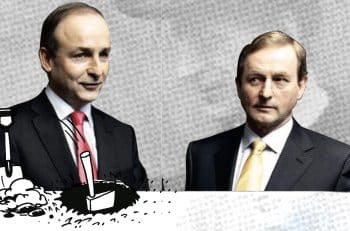
    The general election was tedious and it’s not really clear what message it purveys. The electorate seemed jaded and the politicians delivered no memorable new policies, apart from Renua’s utterly regressive at tax proposal. Village believes that elections should be all about ideas, ideology, policy (and how best to implement them). In these terms the election and its participants were a two-out-of-ten failure. Commentators from the equally idea-free media have interpreted the results in heterogeneous ways. Every sort of theory and cleverality was deployed to describe the drearily and precariously hung Dail: a triumph of democracy, a triumph of social democracy, the end of the civil war, the end/beginning of the beginning/end of the civil war. The perennial smart view that the electorate has failed the parties got several outings. If the second-rate sages had been able to they would have loved to interpret it as a triumph of angry white men. They couldn’t. Some saw it as a victory for the small parties and independents. But the Social Democrats did not increase, Renua was wiped out, the Greens gained only two seats in an era of climate-apocalypse. The People Before Profit/ Anti-Austerity Alliance finished up with only one more seat than they had before the election, and Direct Democracy did not gure. Before the election these were the only small parties. The truth is that this election was a triumph of the interchangeable FF/FG (FG/FF) duopoly, though its trajectory has been definitively defined as downward. Ideology is what political parties apply when they run out of policies. Since most of the parties’ manifestos are short and the events to which policies must be applied are unpredictable it is reasonable to expect that your candidate will have an ideology to guide her. Village for example favours an agenda of equality of outcome, sustainability and accountability. The ideology is comprehensive, it provides a solution for any situation, and a template against which policy formulation can be benchmarked. Candidates shouldn’t have to reflect Village’s ideology, but they’d be better having some sort of one. Neither civil-war party has an ideology. It is impossible to know what they will do once elected. How, therefore, could anyone who does not live under a stone be enthusiastic about a government of FF and FG? FF is a conservative party that believes in so little that it surrendered its entire ethos to a culture of provincialism and cronyism, last time it was in government. It believes in no more now so, though it is touting a centre-left agenda there is every danger it will return to populism, short-termism and promoting the only agenda it understands – the interests of the people its representatives actually know – a cronyist populism that always finishes up favouring those who shout loudest. It is naïve to think of FF as Micheál Martin and when it is the movement it has always known itself to be, of Eamon OCuív, of Barry Cowen, of Pat ‘the Cope’ Gallagher; and tens of marginally more presentable sons and daughters of best-forgotten FF dynasts. Kevin O’Keeffe, son of Ned O’Keeffe, anyone? FG is a conservative party currently dressed up as a Christian Democrat party. The ethos is exible enough that under Garret FitzGerald it was in effect Social Democrat. In its latest incarnation it has been right of centre, at a time when most people want fairness and an improvement in services. It failed to deliver an agenda of accountability and its representatives seem to believe in little beyond sound money, ‘Europe’ and law and order. Having once appeared to be purer than FF it is now tainted by the Moriarty Tribunal report and a perceived ongoing proximity to Denis O’Brien, Ireland’s richest man, as well as by its large number of low-grade County Councillors, whose corruption record is a hairsbreadth from as bad as FF’s. Though essentially conservative, both FF and FG contain some social democrats and liberals in their midst. These aberrations and those who vote for them are delaying the day a real Social Democratic party with coherent left-of-centre platform can become a force that could anchor a government. On the other hand it is clear that more people than is desirable voted FG in 2011 to get FF out and then FF in 2016 to get FG out. These people need to acknowledge that they are forces forconservativism. The incarnation of this is the dangerously articulate Éamon Dunphy who apparently voted FF in 2016 because he really believes in People Before Profit (or Sinn Féin. It isn’t clear). Anyone who thinks that FF was the solution to our problems in 2016 is part of the problem. So what next? FF and FG should merge as a conservative party though even coalition is for the moment some way off. FF is tactically sharper than FG and FG is in retreat so it is likely FF will tantalise FG to weaken and demoralise it during this Dáil. Nevertheless the (non-)ideological compatibility of the parties has been exposed and will generate its own momentum. While allowing this momentum its space the Left of all hues must use the logic of the momentum against FF and FG, and social democrats must colonise some of the space the dinosaur parties have occupied for tragically long.

    Loading

    Read more

  • Posted in:

    Election Times

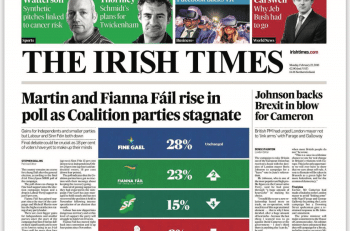
    The story of an election is much more than a few headlines, but the Irish Times front pages mercifully, if languidly, devoid of the kind of blatantly partisan positioning seen elsewhere, provide in hindsight a neat narrative of the campaign, with the slow realisation that Fine Gael was in trouble, the lack of a clear alternative emerging, and of course, “events, dear boy”. While its columnists and editorials may have declaimed preferences in the run-up to the general election, the Irish Times‘ front page generally affected a more neutral stance, certainly by comparison with the anti-Sinn Féin headlines which dominated the Irish Independent and its Sunday sister during the February campaign. The ‘newspaper of reference’ (formerly “of “record”) began the month in ‘phoney war’ mode, leading on Monday 1 February with coalition plans to “target home buyers and parents in poll pledges”. On the Tuesday, with still no election date declared, the story was “Taoiseach prepares Fine Gael ministers for election”. Perhaps ominously, on both days the below- the-fold story concerned the revelations regarding “Grace” a young woman with intellectual disabilities abused while in HSE care in a foster home. The story would feature again several times during the month and, by the end of the campaign, would threaten to inculpate Michael Noonan. Wednesday’s paper finally brought the official election notice, leading with Fine Gael ministers outlining their election promises, but the shine was short lived. Thursday, and the first election poll, brought “disappointing news for Coalition parties”. Much of the remainder of the campaign was spent trying to push back against those low poll numbers, which stubbornly refused to rise. By the first weekend, Fine Gael had announced a “tax U-turn to hit voters earning €100K” (the top 10% of all earners, though Irish Times readers would be better paid than the average). The election narrative was dominated at first by Fine Gael (at least on the front page) but it changed dramatically in the second week. The murderous Regency Hotel rampage called attention to cuts in Garda numbers and resources and Fine Gael, which prides itself as a law and order party, found itself on the back foot. At one point Sinn Féin’s Mary Lou McDonald attacked the government for being soft on crime during an RTÉ radio debate. By the end of the week, the lead story that Garda “may be issued with new weapons” helped to restore marginally Frances Fitzgerald’s battered image, but you know you (we?) are in trouble when Sinn Féin are attacking you from the right on crime. Meanwhile, bubbling below the fold, the news was no better. Lowry, Drumm and Luas strikes festered, and the Times awarded the first TV debate to Micheál Martin. Week Three began with Labour striking out to create a separate identity, promising “an abortion vote in any new deal” – definitely a plus for liberal Irish Times readers. Smaller parties got their first acknowledgement the following day, as the lead reported they did best in the previous night’s debate. For the rest of the week, it was almost as if the Irish Times tired of the “boring” election campaign, with more conventional “newsy” lead stories on an HSE inquiry into baby deaths, welfare benefits for migrants, and Brexit. Week Four began with the writing on the wall, summarised in a single Monday headline “Martin and FF rise in polls as Coalition stagnate”. Tuesday the paper reported Kenny and Martin had “equal backing in race for Taoiseach”, and the final TV debate failed to resolve anything for this hard-to-please newspaper as “leaders fail to land killer punch”, before Kenny’s “last-ditch call for vote in favour of stability.” Below the fold on the same day, the first mention of Sinn Féin in a front-page headline volunteered no favours: “Canvasser for Adams owns hay shed where ‘Slab’ Murphy cash was found”. ‘Slab’ was also the subject of one of the few passionate editorial columns (now perhaps self-deprecatingly titled “the Irish Times view”). Others quite reasonably despaired of the “short election, short of vision”. But while front pages covered national trends, debates and polls, and columnists inside the paper from Una Mullally (who, surprisingly for someone with a political agenda, gave up interest) to Breda O’Brien (vote for people of conscience, if you know what I mean) via Fintan O’Toole (who in the end detected an unlikely victory for social democracy) and Noel Whelan (who again somehow spotted the Fianna Fáil revolution implausibly early) ventilated partisan viewpoints, perhaps the most concise reportage on what happened on election day was by religious affairs correspondent Patsy McGarry, who on the day of the count reported from the north inner city, less than ten minutes from Tara St in a neighbourhood where few read the Irish Times, and fewer would share its editorial concerns: one, a hooded man, was picking up rubbish and putting it in a black plastic bag.“I didn’t vote. I don’t have a voting card. I was abroad for five years. It’s not important at all”. Gerard Cunningham

    Loading

    Read more

  • Posted in:

    FF won’t see coalition as an ideological issue and FG is glued to stability

    The most extraordinary coalition formed in Ireland was the first one, in 1948. It involved Fine Gael and a then-new party headed by Sean McBride, Clann na Poblachta. The Clann was a lively mixture of liberals, left-wingers and Republicans with a deep immersion in the IRA. The surprise with the Clann was that its youthful enthusiasm and vigorous campaigns against partition very nearly toppled De Valera from his then hegemony over Irish politics. McBride himself was a former IRA Chief of Staff who subsequently cut out a career for himself as an international eminence becoming a Nobel Prize laureate and founding member of Amnesty International – the campaigning global Human Rights body. Because of lingering republican bitterness against General Richard Mulcahy’s role in the civil war, Mulcahy, the Fine Gael leader, stood aside to facilitate a coalition with the Clann and its tooth and claw republican militants. John A Costello became Taoiseach in the coalition instead. The point of all of this is to illustrate that, from the very outset, coalition formation in Ireland has been a pragmatic business where big parties and small ones dispense with ideological or philosophical differences in order to provide an alternative government and run the country. Down the years few, if any, Fine Gael or Labour leaders worried too much about the differences of left and right when it came to forming a government designed to extract Fianna Fáil from prolonged periods in power. In 1989 Charles Haughey led Fianna Fáil for the first time ever into a coalition arrangement with the Progressive Democrats, stating cheerily: “Sure, it was only me that could have done it”. His party colleagues resisted it furiously believing non-participation in coalition an absolute core value for the party up to that point. The bitterness of doing this coalition was magnified by the presence of Des O’Malley and his new party – composed of individuals who had fought Haughey, then split from him to create their own party. For Haughey it was just another deal but for the Progressive Democrats, who claimed to be policy-focused, it was about taxation and other precious policy items, including a public Tribunal into the goings on in the Beef Industry. Haughey worked hard to save his own skin and persuade his ministerial colleagues of the merits of going into coalition. Apparently at one stage in the discussions around the cabinet table he held out his arms sideways demanding in relation to the opposition: “D0 you want to give them all of this?”. Shortly afterwards the new Taoiseach Albert Reynolds formed a coalition with the Labour Party which followed an election in 1992 which featured advertisements generated by Fianna Fáil scaremongering about a left-wing takeover of the country by Labour. This was no small tactic and involved giant billboards and full-page newspaper adverts in a bid to frighten voters in a move that was redolent of the ‘red scare’ tactics of the 1950s and 1960s. During the actual campaign my father, the late Brian Lenihan Senior. When all about him were these banner advertisements called for an alignment with Labour rather than the PDs. His rationale was that Labour were more compatible with FF than what he viewed as the “Thatcherite ” Progressive Democrats. He was dismissed by the party bosses during the campaign only to find himself instrumental, behind the scenes, after the election in putting the coalition deal with Labour together. Albert Reynolds, a businessman, proved to be very pragmatic when faced with the post-election numbers and getting back into power. My father had key relationships and friendships within the Labour Party and within the labour movement generally. These relationships and ability to communicate became vital to the formation of this government. When people set out to cross party divides there is a need for credible and dependable intermediaries who can give assurances on policy and how the share out of ministries will play out when the negotiations get real. This was my own experience when I set out, at the request of Bertie Ahern, to put in motion the process of having a coalition with the Green Party in 2007. In fact the groundwork had begun in the immediate aftermath of the 2002 election. Ahern was already entertaining doubts about the future sustainability of the PD coalition because of problems with both policy and numbers. I knew a number of the key figures in the Green Party, including Trevor Sargent and had been in university with both Eamon Ryan and John Gormley. Part of the reason for having a coalition with the Greens was a concern within the party about the right-of-centre nature of the PD coalition, as well as a fear that the party was already becoming too visibly identified with the building industry and big capital. It was also made easier by the overarching atmosphere of mainstreaming environmental or green issues. When the post-election numbers showed a Green coalition was necessary Bertie pressed the buttons and appointed a skilled and experienced team of negotiators so that his own ministers were locked into the items agreed with the Greens. The government itself worked well together though it has to be said it was much more difficult for the Greens to get the coalition deal past their activists than it was for Bertie to get it past his parliamentary party. Rural TDs were the most resistant regarding Green policies on farming incentives as tantamount to treason. In the event they overcame their difficulties. As with the previous Labour Coalition, outside of the main negotiations, a series of reliable and discreet intermediaries were on hand to smooth out any issues that arose in the talks. Ahern himself was a very accomplished negotiator. General Election 2016 has been dominated by speculation of a grand coalition between the once very dominant big parties of Fianna Fáil and Fine Gael. The fact that both parties combined now count for slightly less than 50% of the popular vote has hastened a frenzy of speculation about such a

    Loading

    Read more