government

Random entry RSS

  • Posted in:

    UN scrutinises Children’s rights

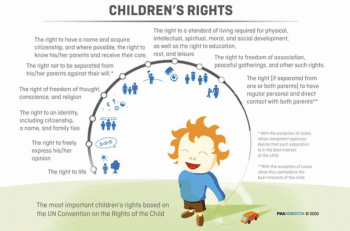
    For the first time in a decade, the Irish government defended its record on children’s rights before the United Nations in Geneva, on 14th January 2016. Poverty and homelessness, the rights of children in direct provision, the rights of Traveller and Roma Children and education issues were dominant themes, raised from different perspectives. The UN Committee on the Rights of the Child also asked about the incorporation of children’s rights into Irish law, the duty to hear children in legal proceedings, complaints and monitoring mechanisms, and the child’s right to identity in the context of surrogacy. Child protection was an important focal point throughout the discussions and the UN Committee members asked a range of questions about the extent of services and supports available to protect children from harm and to support families. Children’s rights in healthcare – obesity, smoking, alcohol and mental health – were queried. The rights of children with disabilities and in alternative care, in detention and in the immigration system were all scrutinised. The hearing was part of the process of monitoring implementation of the Convention on the Rights of the Child, a treaty binding on Ireland since 1992. The government delegation was led by Minister for Children and Youth Affairs, Dr James Reilly, TD. It was a measure of the political importance of the process that the Minister was accompanied by a large delegation of civil servants and officials from all major government departments. The hearing is an important opportunity to put pressure on Government in a public, international forum. For many of the non-governmental organisations present like the Children’s Rights Alliance, – and for the Ombudsman for Children – this is the culmination of a decade of advocacy. The Irish Human Rights and Equality Commission participates in all UN treaty-monitoring hearings. The Convention on the Rights of the Child is a particularly wide-ranging treaty, making both its implementation and its monitoring challenging. Mainstream issues of education and health sit alongside the concerns of children who are especially vulnerable or whose rights are breached by their particular circumstances. Guidelines ensure that all matters of importance are covered in the six-hour dialogue with the Government delegation. The hearing is a probing, constructive dialogue, rather than an adversarial process. The Government delegation is obliged to provide information in almost immediate response to detailed questioning from the Committee members. Answers demonstrated that the Government delegation was well prepared and few questions threw them off guard. Responses were generally succinct and direct although the Committee regularly interrupted if answers were too long-winded or off-point, creating genuine accountability. Civil society representatives were able to clarify any issues with the responses given by Government. They were able to point out that the status of the School Admissions Bill 2015, presented by Government, was at best uncertain, for example. When the Committee asked about the legislative amendments required to address the issue of school discrimination to protect school ethos, the Government’s commitment to change the Equal Status Act was welcomed, if with some surprise. The Committee’s rapporteurs were clearly well informed and able to convey with authority their understanding of the Irish context. Their probing questions sought clarity about the true state of child poverty, questioned why children in direct provision could complain to the Committee on the Rights of the Child but not to the Ombudsman for Children and wondered why many of the Government’s policies in this area remained on the shelf, and why law reform takes so long. A contrasting style emerged between some civil servants and the Minister, who on occasion brought humility and humanity to issues like child poverty and homelessness. Overall, with the many advances made on constitutional reform, the cabinet-level Ministry, family-law reform and the removal of children from adult prison, the Government can be satisfied that it avoided the worst criticism. At the same time, there is little doubt that the impact of austerity on children and the particular suffering of very vulnerable children will loom large when the Committee completes its analysis of Ireland’s children’s rights record. For those who work with and for children, the Committee’s Concluding Observations will provide a blueprint for children’s rights advocacy and activism in the years to come. Given the impact that such Concluding Observations have had on Ireland’s children’s rights record to date, this is clearly where children’s rights advocacy can make a difference. Ursula Kilkelly Ursula Kilkelly is Professor of Law in the School of Law, University College Cork.

    Loading

    Read more

  • Posted in:

    Revive Sex Offences Bill

    The Criminal Law (Sexual Offences) Bill 2015 had passed through the Seanad and was before the Dáil. However, unfortunately the Bill will not be passed through the Dáil before the 2016 General Election. It is now vital to ensure that it is restored to the Dáil at the same stage it had reached very early in the term of the incoming government. The Bill represented groundbreaking reform of sexual-offences law. The Bill contains welcome changes to criminal-evidence rules in sex-offence cases, for example by setting out precise criteria restricting disclosure of victims’ counselling records to the defence, a practice which currently causes great distress for victims. Other important changes protect child witnesses from being cross-examined in person by defendants in sex offence trials; and prevent judges and barristers from wearing wigs and gowns when a child witness is giving evidence in such trials. The sections that have received most attention are those dealing with prostitution law. These sections would criminalise the purchaser of sexual services (the client), while decriminalising the seller (the person engaged in prostitution). This change is based on a law introduced in Sweden in 1999. It would radically reform our deeply awed prostitution law, under which both prostitutes and clients are criminalised. By criminalising buyers of sex, it will pave the way for an approach to regulating prostitution that recognises the lived reality of those in prostitution, and that genuinely seeks to tackle sexual exploitation of women. Current Irish law focuses on prohibiting the visible manifestation of prostitution through criminalising offences of ‘loitering’ and ‘soliciting’. While these offences are gender-neutral, most prosecutions in practice are brought against women, who will typically be convicted of ‘soliciting’ and ordered to pay a ne (which many will go back to prostitution to pay). This model clearly has not succeeded in reducing the numbers of those engaged in prostitution; or in addressing the real exploitation experienced by many of these women. The Oireachtas Joint Committee on Justice, Defence and Equality recently conducted a review of prostitution law in recognition of the problems with our current law. We received 800 written submissions, 80% of which favoured the Swedish approach. These submissions were drawn from a broad cross-section of civil society, including trade unions, frontline medical workers, service providers and those working with migrant women. We heard evidence from Sweden that their law has been effective in reducing prostitution levels, and has had a positive normative effect on social attitudes to sexuality. The Committee also held a series of public hearings, with input from those both for and against the Swedish approach, and from those directly engaged in prostitution. We heard that women enter prostitution in Ireland at a young age, many under 18. Many people are trafficked into prostitution and the vast majority are subject to control by a third party, or pimped. The report of the Committee, published in 2013, concluded that prostitution is widely available across Ireland. It is highly organised, highly profitable, highly exploitative and largely controlled by organised crime interests. That is the actual reality of prostitution. Current Irish law has failed to tackle this. We unanimously recommended a radical change with the adoption of the Swedish approach to criminalise only the client, the purchaser of sex. This Swedish law is based on a view of prostitution as inherently exploitative, amounting to gender-based exploitation. Laws based on this approach have already been introduced in other countries, including Canada, Norway, Iceland and most recently Northern Ireland. The changes we recommended were supported by a wide range of organisations, including the Immigrant Council of Ireland, the National Women’s Council and the Turn Off the Red Light campaign. Ultimately, they were adopted by the Government and included in the 2015 Bill. The Bill was debated at length in the Seanad over December and January. The campaign for this Bill must now continue into the next Dáil. Its offer of important changes to sex-offences law generally, its provisions to decriminalise those engaged in selling sex and to criminalise those purchasing sex, and its promise to tackle sexual exploitation, particularly of children and those engaged in prostitution must be defended and realised without delay. Ivana Bacik

    Loading

    Read more

  • Posted in:

    Skewed Irish Times asylum coverage

    The received narrative in a democracy is that there is an inherent adversarial relationship between politicians and civil servants on one side and journalists on the other. The job of the diligent journalist is to pursue transparency by scrutinising policy; they should hold government to account through critical engagement in order to arrive at the truth, or at least an approximation of the truth. The citizen is then properly informed on government policy by the journalist acting in the public interest as a watchdog on power. Well, that’s the theory at least. In Ireland and elsewhere however an incestuous nexus between media and government exists. Journalists frequently rely on anonymous sources—who are often Cabinet members and senior civil servants—to the detriment of real transparency and accountability. One story that illustrates this point well is coverage over the past year in the Irish Times of attempted reforms of the Direct Provision system and, more recently, the governmental response to the so-called ‘migrant’ crisis. Following months of protest in Direct Provision centres last summer, the Minister for Justice set up a working group, chaired by retired High Court Justice Bryan McMahon, to look into reform of the system. The group was an ‘independent’ vehicle comprising members from various NGOs and representatives from the relevant state departments including the Department of Justice (DoJ). A week after the announcement of the group, an article by Conor Lally headlined ‘Asylum claims increase for the first time in over a decade’ was published in the Irish Times. The article, apparently sourced from the DoJ, reported – accurately but well before official statistics were due to be announced – a 40% year-on-year increase in asylum applications. Lally, who is the Irish Times’ crime correspondent, had not written about statistics on asylum since 2006. In December of that year, Lally delivered another article, headlined ‘Asylum claims up 45% in first rise since 2000’. In this second piece, which again included accurate statistics before their official publication, Lally allowed anonymity to a “senior justice source” who said that “the fact the Republic was regarded internationally as recovering from its recessionary years may be a contributory factor for some of the increase”. In other words, the implication is, the increase in asylum-seeker numbers is down to crafty economic migrants falsely claiming asylum in Ireland to take advantage of our growing economy. At the time of the article, a number of “senior justice” officials were involved in the working group. The DoJ, in an attempt to limit the potential reforms being discussed by the group, had an incentive to push the narrative that the increasing numbers of asylum claims were due to an influx of ‘economic migrants’. Was Lally’s senior source involved in negotiations on the working group at the time? We may never know because Lally granted him or her anonymity for no clear reason except, perhaps, in the source’s interest. Fast forward to June 2015. Barring a couple of contentious resignations, the working group successfully completed its task and produced a report which called for minor reforms of Ireland’s Direct Provision and asylum systems. On the morning after the report was delivered to government, the front page of the Irish Times featured a story entitled ‘Minister Raises Concerns over Immigration Spike’. This article, by Fiach Kelly, was based entirely on anonymous sources. Before covering the McMahon report, Kelly gave his source prominence to say that “an estimated 700 migrants had entered the country in the space of one month”. Unlike for Lally’s statistics, there is no evidence to back up this ‘700’ figure. When he finally mentions the working group report, Kelly quotes “concern in the Coalition” that improving Direct Provision could make Ireland “a destination country for immigrants”. As a journalist, Kelly has a duty to ensure his reporting is in the public interest. It is not clear that the public interest is best served by granting anonymity to senior government sources so that they can engender and promote, using unverified figures, a concocted anxiety about welfare-seeking migrating hordes. It’s not clear if the public interest is served by contrasting the release of a long-awaited report with anonymous ‘concern’ that any change to the status quo would lead to increased immigration by people “who are in essence illegal immigrants”, as another anonymous source said in the article. What is clear, though, is that some within government and the DoJ had an interest in controlling, directing and containing the immediate political and media discourse surrounding the publication of the McMahon report. Kelly’s article allowed his sources to do that; in effect he let certain figures distort the release of the report under cover of anonymity. The intricate and incestuous nexus between government and media in this instance, you could say, trumped the democratic theory, and the imaginary adversarial relationship which we are told exists. After the release of the report, events in the Mediterranean and beyond overshadowed any Direct Provision reforms. The huge numbers of refugees arriving in Europe suddenly became big news after a number of tragedies including the death of three-year-old Aylan Kurdi in September. The EU slowly moved towards a response, finally agreeing to two refugee-relocation programmes in addition to a previous resettlement programme. Ireland agreed to take in around 4,000 under these programmes, and the government set up the Irish Refugee Protection Programme (IRPP), led by the DoJ, to deal with the logistics. The Irish Times’ coverage of the ‘migrant’ crisis on the fringes of Europe has been good. If you want to find out what’s happening in Serbia or on the Greek island of Lesbos, the Times will inform you. However, their coverage of the IRPP leaves a lot to be desired. The government is setting up, as part of the IRPP, a series of Emergency Reception and Orientation Centres (EROCs) to host and process the relocated refugees yet to arrive. Kitty Holland has produced some excellent reports on the first orientation centre (for resettled, as opposed to relocated, refugees), the Hazel Hotel in Monastarevin,

    Loading

    Read more

  • Posted in:

    If we can borrow it, we will spend it

    Two recent events highlight the true nature of the ongoing Irish economic recovery. Firstly, ahead of the infamous Ireland-Argentina Rugby World Cup match, the press office of the main governing party, Fine Gael, produced a rather brash infographic. Charting projected growth rates in real GDP for 2015 across all Rugby World Cup countries, the graph put Ireland at the top of the league with 6.2 percent forecast growth. “FACT: If the Rugby World Cup was based on economic growth, Ireland would win hands down”, shouted the headline. Having put forward a valiant performance, the Irish team went on to lose the game to Argentina, ending its incipient ascendancy. Secondly, within weeks of publication, Budget 2016 – billed by the Government as a programme for the ‘New Ireland’ – has been discounted by a range of analysts, including those with close proximity to the State, as representing the return of a fiscal policy of …electioneering. Worse, judging by the public opinion polls, even the average punter out there has been left with a pesky aftertaste from the political wedding cake produced by Merrion Street on October 13th. Tasteful or not, the public gloating about headline growth figures and the fiscal chest-thumping that accompanied Budget 2016 did not stretch far from reality. Official growth is roaring, public finances are in rude health, and the Government is back in the business of handing out candies to kids on every street corner. The air is filled with the sunshine of recovery and talk about the Celtic Tiger Redux is back on the menu for South Dublin along with the fennelised lamb. Ireland by the numbers On budget day the government projected full-year 2015 inflation-adjusted growth of 6.2 percent followed by 4.3 percent in 2016. Extraordinarily optimistic, “one minister acknowledged that the growth figure for this year is likely to end up nearer to 10% than the 6.2% estimated just 6 weeks ago”, according to a story on the front page of the Sunday Business Post in late November. Much less optimistic, the IMF has the figures at 4.9 percent and 3.8 percent, respectively. Still, this ranks Ireland at the top of the advanced economies’ growth league, with second place Iceland at 4.8 percent and 3.7 percent, respectively. The only other advanced economy expected to post above 4 percent growth in 2015 is Luxembourg. Which is dramatically telling: of all euro-area member states, the two most exposed to tax optimisation schemes are growing the fastest. Though only one has a Government gushing publicly about that fact. No medals for guessing which one. The problem is: the headline official GDP growth for Ireland means preciously little as far as the real economy is concerned. The reason for this is the composition of that growth by source and, specifically, the role of the Multinational Corporations trading from Ireland. We all know this, but keep harping on about the said ‘metric’ as if it mattered. Based on the figures for the first half of 2015 (the latest available through the official national accounts), the Irish economy grew by €6.4 bn or 6.9 percent in real GDP compared to the first half of 2014. Gross National Product, or GDP accounting for the officially declared net profits of multinational companies, expanded by a more modest 6.6 percent over the same period. Other distortions arising from this structural anomaly at the heart of the Irish economic miracle are the effects of foreign investment funds and companies on the capital side of the National Accounts. Back in 2014 the European Union reclassified R&D spending as investment, superficially inflating both GDP and GNP growth figures. Since then, our investment has been booming, outpacing both job creation and domestic public and private sector demand. In more recent quarters, capital investment has been outperforming exports growth too. Which compels a question: what are these investments about if not a tail sign of corporate inversions past and a forewarning of the changes in the pattern of economic output in anticipation of our heralded ‘Knowledge Development Box’? Beyond this, the legacy of the financial crisis has compounded the artificiality of growth statistics. Irish ‘bad bank’, Nama, and its vulture-fund clients are aggressively disposing of real estate loans and other assets bought at regrettable cost to the taxpayer. Any profits booked by these entities are counted as new investment here. Once again, GDP and GNP go up even if there is virtually nothing happening to buildings and sites which are being flipped by these investors. And while we are on the subject of the old ways, last month Ireland was announced as the domicile of choice for an upcoming merger between Pfizer and Allergan – two giants of the global pharma world. Despite numerous claims that Ireland no longer tolerates so- called ‘tax-driven corporate inversions’ (a practice whereby US multinationals domicile themselves in Ireland for tax purposes), it appears that we are back in the old game. Just as we are apparently back revenue shifting (another corporate tax practice that sets Ireland as a centre for the booking of global sales revenues despite no underlying activity taking place here), as exemplified by the Spanish Grifols announcement earlier in October. Just when we thought we were out they pull us back in! All of these growth sources also benefit from the weaker euro relative to the dollar and sterling, courtesy of ECB printing presses. Looking at the national accounts for January-June 2015, Gross Fixed Capital Formation accounted for €3.8 bn or almost 60 percent of total GDP growth over the last 12 months, and nearly three quarters of total GNP growth. In simple terms, the real economy in Ireland has been growing at closer to 3.5 or 4 percent annually in 2015 – still significant, but less impressive than the 6-percent-plus figures suggest. exchequer kindness Still, the above growth has worked well for the Irish Government. In the nine months up to September 2015, Irish Exchequer total tax receipts rose a strong €2.75 bn, or 9.5 percent year-on- year.

    Loading

    Read more

  • Posted in:

    Portuguese parallels

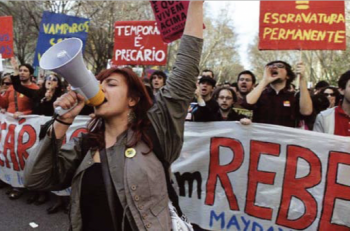
    In 2011 Portugal was at the forefront of Europe’s anti-austerity movement. Yet, four years later, as elections approach in the Autumn, there is no chance of a Left government to ally with Greece’s Syriza or the recent municipal victories in Spain. What went wrong? And can Portugal return to the frontlines? Village’s Ronan Burtenshaw interviews Bloco de Esquerda’s Catarina Príncipe. Q. First, can you tell me how Bloco de Esquerda [the Left Bloc] came about? Several events happened at the end of the 1990s that played into our foundation. The anti-globalisation movement, centred around Seattle in 1999, was important. There was a growing conclusion that we need to find new ways to work together and build projects. Some of these were forums, others were political parties. That was the international moment we were in. Then there was the Indonesia-East-Timor war and occupation. The Portuguese population had its own anti-war movement and sided with Timor against Indonesia. This managed to bring different sections of the Left together to discuss war and campaigning. Finally the failure of the abortion referendum in 1998 was also an influence. There was a referendum to overturn laws banning abortion in Portugal but no broad campaign by progressive or left-wing forces; instead every little group ran their own one. Some of these ran against each other or had clashing strategies. The Yes vote lost, so abortion was illegal in Portugal until 2007. This was the last straw for many on the Left. Q. So how did Bloco form out of these conditions? The definition of Bloco, in its first statute, is a party-movement. It is a broad party that engages with other movements without substituting for or controlling them. It is built up by this grass-roots strength and given a voice in institutions, with a political programme that unites those two domains. Therefore it manages to build strategy together with people who come from very different perspectives, activist histories and traditions. We grew steadily from 1999, when the party formed, until 2011. From 2005 Portugal had a liberal government under the Socialist Party [Portugal’s Labour Party] which had been applying austerity measures for some time before the crisis hit. They used the crisis as an excuse to escalate this. In 2009 we had elections and a broad social mobilisation against austerity. The Socialist Party still won these elections but they didn’t achieve a majority and formed a minority government. Bloco de Esquerda had 10%, the Portuguese Communist Party had 8%, so the radical Left was on almost 20%. Q. What was the result of this growth in support for anti-austerity alternatives? It didn’t mean anything in terms of the programme of the Socialist Party government. In fact, from 2009 onwards they began to impose what they called the “four pacts”, which were packages of austerity measures. The first one cut public spending, the second cut social security, and so on. In parallel they introduced continual measures liberalising the labour market. This produced social mobilisations. We had important Euro May Day demonstrations in 2010. Euro May Day parades are structures we inherited from Milan – colourful, anti-union, involving precarious/ zero-hours workers, quite creative and young, talking differently about labour. Some parts have very Negrian theories, others go with Guy Standing’s idea of the precariat. Our version of this, in contrast to those in Italy, didn’t adopt an anti-union discourse about precarious work but rather tried to ‘add struggles to the struggle’ and forge links with the unions, joining them on the May Day march. We developed a theoretical framework called “precarity in life”, which was a new form of labour discourse. We weren’t just talking about conditions at the point of production – contracts, wages and so on. We talked about the way labour instability affects different spheres of life, and affects you differently if you are a woman, a migrant, or LGBt. We were exploring the relation between exploitation and oppression, developing the particularities of these, but framing it in a new and accessible way. This allowed us to bring together the feminist, anti-racist and LGBt movements with the anti-precarity movement to form the Euro May Day. Euro May Day fed into the first really big demonstration occurring on March 12th 2011 called Geração à Rasca, Generation with No Future. It was started by a call on Facebook by four people, all of whom had some previous involvement in politics but had not been particularly active. It grew exponentially. This was the time of the Arab Spring with all the discussions about the role of new media in facilitating protests so the Portuguese media took this up as our own little experience of it. The organisers were on television almost every day. Soon they realised that they could not organise this phenomenon themselves so they put a call out to social movements and those involved in Euro May Day to help them out. In the end the demonstration had 500,000 people in various places, in a country of around ten million. Q. Was it mostly young people? We were expecting that it would be but in the end it was intergenerational. This proved our thesis in the anti-precarity movement that the issue couldn’t be dealt with in generational terms. There is a particularity to how young people experience insecurity but almost half of the Portuguese working population is precarious right now so you can’t talk about it as generational. The movement was very broad so it was quite apolitical. At the time it was correct to do this but it had limitations. there were no demands, which was necessary because it would not have brought out many people if it was too concrete, but the right-wing also used this space. Two months after the big demonstration they won the snap elections. This was then followed by the arrival of the Troika and the signing of its memorandum by the two right-wing parties who were in coalition [the PSD and People’s Party] and the Socialist Party, who had lost the election.

    Loading

    Read more