• Posted in:

    Sinn Féin alone

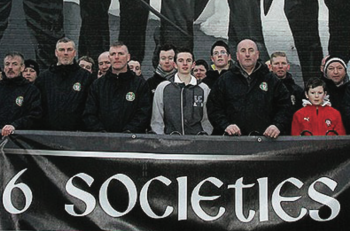
    Republicanism is fragmenting. That was  seen on Easter Sunday, when at least eight Republican groups held commemorations on Belfast’s Falls Road. At protests in the North, it is common for various ‘dissident’ groups to have more presence that mainstream Sinn Féin. That party has a much smaller activist base than a decade ago. Paradoxically, as that base has shrunk, the vote has increased. The exodus of members has not affected the vote. That was seen most starkly in last year’s assembly election for North Antrim. A councillor and 17 other activists resigned in protest when the party forced assembly Member Dáithí McKay to resign. Monica Digney, an able and respected former councillor, and one of those who had resigned, stood as an Independent. Sinn Féin’s vote increased by just under 3%. Digney polled just 435, lagging behind the Green Party. That is a stark version of trends across the north. A few years ago, even Sinn Féin strategists believed the vote had plateaued, and might even fall back. In last year’s Westminster election, Sinn Féin took 29.4% of the vote. That was a 4.8% increase in a year. The terminal decline of the SDlP has been hastened. Sinn Féin took the SDlP’s two perceived strongholds: South Down and, of greater importance, Derry. That is not to deny the importance of the exodus. There is a disillusionment with Sinn Féin. An Easter statement from Óglaigh na hÉireann prisoners sums up the dissidents’ problems: “It’s clear that presently the revolutionary Republican community appear to be facing challenging times and lack strategic direction in response to these events”. The largest single non-Sinn Féin grouping are the 1916 societies. There have spread out of their initial base in East Tyrone across the North, and into the South. They have a sizeable membership, mostly of an older generation, but they also have a small but significant membership from the post-IRA generation. They are an excellent symptom of how widespread the malaise in Republicanism is. They have engaged in some co-ordinated activity, such as calling for an all-Ireland Referendum on unity. However, their main activity is commemorations. This is the only activity on which all non-Sinn Féin Republicans can agree. They certainly cannot on a central debate for Republicans: whether or not there should be an armed campaign. Most are opposed. some, mostly from the anti-armed-campaign cohort, are becoming involved in community issues as individuals or through different organisations. There is no issue about which ‘dissidents’ can coalesce. In 1969-70, the Republican movement split into ‘official’ and ‘Provisional’ wings. (The ‘Provisionals’ became today’s Sinn Féin, while the remnants of the ‘officials’ are the Workers Party). The ‘Provisionals’ derived from the anger of many young Catholics, and a belief that the IRA had spent too much time on left-wing politics rather than preparing to defend catholic areas. This time, there is no single big issue to divide Republicans. There is a generalised unhappiness at Sinn Féin’s acceptance of Stormont and the PSNI. In some cases, unhappiness has spilled over into demoralisation. Some in Sinn Féin dismiss ‘dissidents’ as criminals. That is not to say there are not criminals using dissident groups as a cover; and others who, their war over, have turned to criminality but it is not the central case. The dissident groups are fragmented. The new IRA and the continuity IRA are continuing their campaign, while Óglaigh na hÉireann has called a ceasefire. All armed groups are riddled by infiltration by security-force agents. However, they have found a certain niche in carrying out punishment attacks. These grew by 60% between 2013 and last year. They are popular among a significant layer of the population in Catholic working-class areas. Part of the reason is the traditional hostility between the catholic minority and the police in the Northern state. Part is also that punishment attacks offer ‘quick x’ justice, without the necessity to take the time taken by a formal court system. Police seem willing to let punishment attacks continue, as long as the victims are perceived ‘hoods’. Vigilantism, though, is not a basis for building organisations that will be a serious alternative to Sinn Féin in Catholic areas. Sinn Féin could probably benefit from a bit of coherent opposition from people whose political premises, at least viscerally, it identifies with. Anton McCabe

    Loading

    Read more

  • Posted in:

    Villager May 2018

    No Catholics or bastards please, we’re British Villager despises royalty, as anyone who believes in equality, merit or good taste, must. Interesting though that new-born Prince whatsit will come in fifth in line to the “throne”. Time was the new “Prince” would have been advanced to it over his older sister (Princess whatsit), as a male. The Bill of Rights 1689 and the act of settlement 1701, restrict succession to the legitimate Protestant descendants of Sophia of Hanover, of which there are over 5000, who are in “communion with the Church of England”. Spouses of Roman Catholics were disqualified from 1689 until the law was amended in 2015. The succession to the Crown Act 2013 leaves succession to the Crown no longer dependent on gender for lucky heirs born after 28 october 2011. With such incremental progress it will only be a few aeons now before the monarchy passes for democratic. INMajor trouble 23 years ago Vincent Browne got €90,000 in a private settlement with the state because the Garda tapped his phone over an eight-year period in part believing he was talking to IRA leaders for Magill Magazine. a decade earlier journalists Geraldine Kennedy and Bruce arnold were awarded £20,000 in the high court after their phones were tapped for a short period, for absolutely no reason. So how much will the around 200 lucky victims of Leslie Buckley’s version of phone-tapping – data breach – collect? INM has a cash pile of €90m but a stock-market value of only €110.9 million valuing INM in effect at less than €20 million, plus the cash. The problem is that 200 complaints of data breaches could easily hoover up most of that sum. O’Brien has spent €500m building up his stake, partly to show the O’Reilly family what good management looked like and er partly to boost his popularity, but his holding is now worth only €33m and shares are down 40% over the last year. This is an investment even worse, though not nearly as predictably so, as one in Village Magazine over the last decade. STabbing the competition On 22 april The Sunday Times (Irish edition) unkindly editorialised that the INM group was leaking selective extracts from the 240-page affidavit of the ODCE on which it has grounded its application for the appointment of high court inspectors who would examine various allegations against the media group and its former chairman, leslie Buckley. In particular, The Sunday Times claimed that INM was strangely silent on the allegations leaked from the affidavit that the largest shareholder, Denis O’Brien, had access to sensitive commercial information, courtesy of communications minister, Denis Naughten, before other shareholders. But ironically The Sunday Times is part of the Rupert Murdoch stable, news International, which was forced to close down its News of the World brand in 2011 in the light of damning revelations that some of its senior editorial staff had condoned the widespread tapping of phones and other criminal offences. At one point former Taoiseach, Bertie Ahern, soon after his inelegant departure from office in 2008 amid evidence of financial wrongdoing, graced a TV advertisement for the News of the World from inside a kitchen cupboard, his most ignominious television appearance until the recent Tim Sebastian interview. The Sunday Times was famously less than wholehearted in pursuing the politician for failing to account for over £200,000 unexplained in various bank accounts while he was Minister for Finance in the 1980s. ahern cultivated Murdoch whose sky division famously obtained rights to cover the Ryder cup in Ireland under Bertie’s premiership. Equally intriguing is the insistence by O’Brien that the leaks to INM from the affidavit came from the ODCE rather than from the copy provided to the newspaper organisation in which he is the largest, though – significantly – non-controlling, shareholder. The leaks came from people close to the non- O’Brien wing of INM. Radio Caroline ended party early Chris Donoghue, Niall O’Connor and Ed Carty have joined the ranks of independent journalists who now advise government. Government Press advisor Nick Miller once toiled for regional titles such as the Kerryman, Tullamore Tribune and Evening Echo. Now the one-time series producer of RTÉ’s ‘The Sunday Game’, and regular voice of ‘It says In The Papers’ on ‘Morning Ireland’, Caroline Murphy, has become press advisor to Minister for Justice Charlie Flanagan. She is of course married to Sean O’Rourke, presenter of RTÉ Radio 1’s flagship current affairs programme, the ‘Today show’. The formidable Murphy described some years ago to the Irish Times how she fell for the uncontroversial presenter: “We met around 1983, when I had a singles BBQ in a house I’d bought in Killiney: everyone invited had to bring a friend of the same sex and Fintan Drury (later chairman of the RTÉ authority who resigned because of a conflict of interest over rights to cover the Ryder cup) brought Seán. He was still there with Fintan at 2am when I threw them out – Seán was shocked. I couldn’t believe anyone would think it wasn’t my right to say the party’s over”. Murphy told the Irish Independent her work at the national broadcaster has been “marginal” in recent years. Neutering neutrality Cosying up to NATO is now de rigueur inside ‘modern’ Fine Gael. Four of the party’s MEPs, Seán Kelly, Brian Hayes, Deirdre Clune and Máiread McGuinness, advocate a policy which would see us dilute neutrality by falling in line with deepening EU military co-operation. In a statement issued to accompany the launch of a discussion paper ‘Ireland and the EU: Defending our common european home’, by Brian Hayes on 9 March, the MEPs stated, “We want to make it clear that we do not support the creation of an EU army. However, Ireland can do so much more in collaboration with our EU partners in the area of security and defence”. These MEPs have not gone off on a frolic of their own volition. This is now FG and Varadkar’s euro-military policy. Ironically, the Taoiseach is known to

    Loading

    Read more

  • Posted in:

    From Naughten to Neachtain: nothin’ worth notin’

    It is not a question of whether, but how many, more people will become embroiled in the developing row between Independent News and Media and the Office of the Director of Public Enforcement (ODCE). The battle should more accurately be described as one between the biggest shareholder in INM, Denis O’Brien, his appointed chairman to the company and confidant, Leslie Buckley, and Ian Drennan the director of the ODCE who is seeking to appoint High Court inspectors to examine aspects of the media corporations’ governance. In the latest twist to the saga the Minister for Communications, Climate Action and the Environment, Denis Naughten was almost forced to fall on his sword after it emerged that he gave commercially sensitive information to lobbyist, Eoghan O Neachtain, indicating a probable referral of the attempted media purchase of Celtic Media Group by INM to the Broadcasting Authority of Ireland (BAI). Heneghan PR for whom O’Neachtain works, was acting for INM when the lobbyist made the call to Naughten in November 2016, and company boss, Nigel Heneghan, promptly informed his client Leslie Buckley about the news that a referral to the BAI was likely. Buckley immediately passed it on to O’Brien, who controls 29.9% of INM, but apparently did not extend the same courtesy to other board members at the time. When asked about a possible referral by him of the Celtic Media purchase proposal to the BAI by Independent TD Catherine Murphy and Brian Stanley of Sinn Féin three weeks after the phone call with the lobbyist, Naughten had refused to confirm his likely course of action to the Dáil. In the normal course of events, in a normal democracy, a minister passing on such market-sensitive information to a company, or in this case to its largest shareholder, would precipitate a thorough investigation and probably a ministerial head on a plate. Not so in this case. Incredibly, the independent minister insisted that he was only expressing a ‘personal opinion’ to O’Neachtain, whom he said he knows socially from Connacht rugby circles. He confirmed that he had taken no notes of the call. He also said that he met Buckley at an event organised by INM in May 2017 just a month before INM cancelled the acquisition of Celtic Media and just before the minister was to determine whether the deal should proceed. He told the Dáil that he was “trying to recall the detail of that but I do not recall him (Buckley) raising with me at that stage” the issues pertaining to the Celtic Media purchase. In his affidavit to the High Court, heavily leaked, Drennan has suggested that the minister’s action may have breached corporate governance rules insofar as commercially sensitive information was provided to just one shareholder of INM in advance of the likely referral of the Celtic Media purchase to the BAI. By fully supporting the minister, Leo Varadkar may well find himself the focus of criticism further down the road by the corporate watchdog for pre-empting an investigation by the High Court inspectors he is seeking to have appointed to investigate a string of alleged serious, including criminal, behaviour in INM. Varadkar has until now managed to avoid any entanglement in the uncomfortable and controversial relationship between O’Brien and Fine Gael, going back to the mid-1990s when the businessman won the hugely lucrative second mobile phone licence with the assistance of then communications minister, Michael Lowry. The party managed to clear its debt within a few years and although its main fundraiser, Lowry, was forced out in the wake of the Moriarty tribunal investigation, the links between O’Brien and senior party figures, including former leader Enda Kenny and current EU commissioner, Phil Hogan, has long persisted. The main opposition parties have concentrated on this potential exposure of the Taoiseach to the ongoing dispute between the INM and the ODCE, which is investigating an alleged data breach by the company affecting senior staff, journalists, lawyers and others as well as issues over the, since abandoned, attempt by Buckley to get INM to buy Newstalk, the radio station controlled by O’Brien. According to a protected disclosure by former INM chief executive, Robert Pitt, Buckley tried to get the board to pay substantially more for Newstalk than he and his advisors thought it was worth. O’Neachtain, of course, is a former press officer for Fianna Fáil and once toiled day and night to defend Bertie Ahern as he sought to explain his inexplicable financial arrangements to the Mahon Tribunal during the period he was a finance minister, without a bank account. No doubt he knows where other Fianna Fáil skeletons are buried and indeed must be aware of a thing orf two about Fine Gael having advised Enda Kenny during his term at Taoiseach. But Fianna Fáil is also holding fire because it does not want to provoke a general election which would edge closer if Naughten were forced out of cabinet and government, potentially weakening the wafer-thin voting balance in the current Dáil. Besides, following the next election the party may need the support of independents like Naughten. Sinn Féin is reluctant to do anything which could jeopardise the stability of government in advance of the referendum to repeal the 8th amendment in late May. Frank Connolly

    Loading

    Read more

  • Posted in:

    Villager March 2018

    Cut off Villager is in favour of water charges so he doesn’t see why the water in the Village building was cut off for three days after the snow, even though next door is like Niagara/Poulaphouca. And why are they cutting it off anyway: it was snow not drought. Whatever, a hand hasn’t been washed in the office since the beginning of March. Tarmac on the hillsides Villager likes to bound around the hills and mountains of Wicklow when he can get out of the waterless dust and smoke of the Village office, particularly of a Sunday. Favourites are Luggala and the forgotten Kilruddery area between Bray and Greystones. He was shocked recently to see that many trees in the foothills near Kilruddery, where the Earls of Meath own the famous house, have been cut down. Just as bad, some of the verdant hillside has been tarmacked over, apparently for film studios, whose activities, being artistic you see, clearly do not concern Wicklow County Council. The same grey movie lorries and vans collected until recently on lands adjoining the JB Malone walk up above Garech de Brun’s land over Luggala, again with tarmacking the favoured terrain. Luggala Of course the Luggala estate is for sale and Denis O’Brien who famously liked to jog there with his so-called mates has been linked to a purchase, though it seems he has not bitten. Now there seem to be signals that Department of Culture and Heritage discussions with the trust that owns it may be going somewhere. An elusive Minister Josepha Madigan told Richard Boyd Barrett in the Dáil that the sticking point is price. Unfortunately it’s probably a mistake to think the State would improve this wilderness – it would probably install car-parks and other sterilising paraphernalia, though – despite Boyd Barrett’s fears – since the right of way down to Lough Dan is longstanding, any mogul buying the estate would have to observe it. Siteselfserving Taxpayers face a potential €100m bill for the investigation into the sale of building services group Siteserv to a Denis O’Brien company, according to a statement released by Mike Aynsley former IBRC chief executive – according to reports in the Irish Independent, Irish Times and RTE.ie. A commission headed by Judge Brian Cregan, apparently aided by up to 30 lawyers, is investigating the sale of Siteserv to the Denis O’Brien-controlled Millington in 2012 for €45.5 million. The State-owned Irish Bank Resolution Corporation (IBRC) wrote off a €110m loan to the company following the deal. According to, Aynsley, the inquiry’s spiralling legal costs could leave taxpayers with a €100m tab. Aynsley was CEO of IBRC when it sold Siteserv. His views seem utterly self-serving. It is a tribute to press paranoia over Denis O’Brien that anyone would even report his comments. Aynsley now runs a consultancy called Prospera Associates in London. There’s a history of this sort of agenda-driven tribunal-mongering. In February 2007 the Irish Times reported that then Minister for Justice Michael McDowell was predicting the planning tribunal would cost “€1bn”. In fact the best current guess is that it cost €159 – not of course that it was worth it. More of the same an INM The new chairman of INM, whose largest shareholder is Denis O’Brien, is Glaswegian Murdoch MacLennan, former CEO (2003-2017) of Britain’s Telegraph group. Among other baubles, MacLennan is chairman of the Scottish Professional Football League and served on the Commission on Scottish Devolution. At the Telegraph he had a reputation for speaking the jargon: “smart working”, hot-desking” and “employee-friendly working practices” while pursuing a ruthless cost-cutting and employee-shedding agenda on behalf of the avaricious Barclay Brothers who own the newspapers. He made over 100 journalists redundant in 2006, nearly, but not quite, provoking a strike. The Sunday Telegraph editor Dominic Lawson was sacked and replaced by Sarah Sands in June 2005, but she lasted just nine months. They may miss Leslie Buckley yet. Hypocr/Tical The Irish Times castigated the dubious expediture of €1.5m by the Government’s Strategic Communications Unit on ‘Project 2040’. However, it has questions to answer about its own coverage under headlines including ‘National Development Plan’, ‘A Special Report in association with Project Ireland 2040, an initiative of the Goverment of Ireland’ and (in one small-print reference, ‘A Special Report’, over a page). Readers will make their own minds up as to whether the type sizes implied complicity. Certainly the usual Irish Times smugness masked a dollop of impurity. Change in Italy Just as Germany cobbles together an unexcited national unity government, a hung parliament seems likely in Italy. The Five Star Movement (M5S) secured an impressive victory in its parliamentary elections in early March. Everyone inVillage is drilled with the mantra of equality, sustainability, accountability: Five Star’s version and the agenda underpinning it is: public water, sustainable transport, sustainable development, right to Internet access, and environmentalism – the ‘five stars’. Purporting to be neither left nor right and Euro-sceptic, it won more than 30% of the vote as the traditional centre-left and centre-right political parties flopped: Matteo Renzi’s Democratic got 19% of the vote, Silvio Berlusconi’s Forza Italia 14% though it is tied to several other right-wing parties, notably the anti-immigrant and anti-EU League, with 18%. It falls to the president, Sergio Mattarella, to knock heads together. Macau: Miaow Speaking to Parliament’s extraordinarily named ‘Exiting the EU select committee’ in Westminster, Pascal Lamy, former Director General of the WTO, the global capitalists’ trade union, said the UK’s decision to leave the customs union and single market, “will necessitate a border”. Lamy told MPs the idea the UK could operate an invisible border on the island of Ireland while also having different trade tariffs with the EU was unworkable. Lamy shot down the Government’s plan for a “virtual border”, saying such a customs arrangement does not exist anywhere in the world. He suggested one solution would be for the UK to give Northern Ireland the power to operate its own trade policy. He cited the example of

    Loading

    Read more

  • Posted in:

    Capitalisteracy

    Ireland has a dreadful, inequitable, dangerously failing healthcare system. The State’s answer is the likes of healthy Ireland, which runs a public campaign that, in essence, throws the responsibility for health on to individuals – who seemingly just need help from an initiative to ‘empower and motivate them’. February saw the launching conference – hosted by the Broadcasting Authority of Ireland (BAI) at Facebook Ireland HQ – of a new network, Media Literacy Ireland (disclosure: I’m in it). From the conference stage there was lots of talk about empowerment and not much talk exploring from whom it might be necessary to take power away. There was even a speaker from healthy Ireland, lest the analogy be missed. Don’t be surprised, then, to encounter an Irish campaign in the next year or two imploring you to the media equivalent of ‘eat your vegetables, get some exercise, don’t smoke cigarettes’. Something along the lines of ‘read the Irish Times, trust in Miriam, don’t tweet fake news’. Or maybe not. Media Literacy Ireland potentially has some of the hallmarks of industry-friendly campaigns like Drink Aware and Gamble Aware, plus the involvement of a regulator, the BAI, which might like a campaign that implicitly justifies light-touch regulation abetted by ‘greater public awareness’. On the other hand – and credit to its organisers for this – Media Literacy Ireland has come into being as a genuine network of interested researchers, activists, community-media practitioners and others. And most of us in it are not disposed to frame the problem with Irish media as one of public credulousness, to be addressed by offering tips for spotting ‘extremism’ online. Regular readers will know my view: that media (like healthcare) have a capitalism problem, and that everything from fake news to clickbait to inadequate investigative resources to Denis O’Brien ows from that basic source. But you don’t have to agree with me and name the underlying problem as capitalism to understand that there are structural causes for crises such as the one that erupted recently over Government ‘advertorial’. “I believe the Government is attempting to exploit the difficulties many local and regional titles are facing to promote their party interests”, said no less a media critic than Fianna Fáil’s Timmy Dooley, the party’s spokesman on communications. (How sweetly old-fashioned that word ‘communications’ can sound as it grapples with the changing world.) Media literacy, if it is to be of any use, has to do more than implore us to look for the little ‘special feature’ tag on the top of a piece of paid corporate or government puffery, then to regard the ‘journalism’ below with due scepticism. It must mean understanding ‘the difficulties’ for all journalism that operates in the current market, especially one in which technological change has accelerated existing trends toward blurred lines, and in which advertisers have alternatives to local and regional newspapers when it comes to reaching eyeballs. If the most poignant aspect of that brief, quickly snowed-under ‘Ireland 2040’ crisis was the image of the Taoiseach issuing guidelines for labelling advertorial content – guidelines of which the most callow intern in a local newsroom should surely already be aware – we shouldn’t lose sight of the fact that media have been operating at the edges of such guidelines for decades, for the benefit of advertisers looking to buy a little ersatz editorial credibility. How can this fail to be a lesson about how fragile, at best, any such credibility has become ? As the media may or may not have told you, global research shows trust in media is in tatters – media are less trusted than governments, NGOs, businesses – and Irish people are at the mistrustful end of the distribution. In this context, media literacy can hardly consist of legacy media saying ‘trust us, not them’. What can be done ? (Yes, short of getting rid of capitalism.) Anyone who has worked in a newsroom knows what a frightening prospect it would be to try to earn the public’s trust with transparency and accountability about our editorial practices. On a daily basis, contingent and incomplete information is transformed into definitive statements of ringing certitude. That’s one sausage factory we don’t want you to see inside, especially since the work often consists of sticking our label on someone else’s meat. The irony is that the technology often over-simplistically blamed for creating the journalism crisis has long offered tools for remarkable transparency, tools that most journalists have chosen to use only in limited ways. What if hyperlinks in journalists’ stories led not to dull pages of cross-references or to Wikipedia, but rather to images of documents and notebook pages, audio of interviews, pictures of the journalist in the field ? It can be done and has been done, but the experiments in transparency of the early web – notably the extraordinary 1996 investigative series by the aptly named Gary Webb in the San Jose Mercury news, about the CIA’s involvement in the cocaine trade – have rarely been repeated, let alone built upon. Such transparency would foster media literacy without the onus being placed on the audience. Whether it would foster trust is, of course, a matter of what audiences thought of the practices revealed by transparency. Interactivity and social media mean we have some tools whereby that reaction could be tested and gauged. Dublin Institute of Technology, thankfully, is prepared to put its money where my media-literacy mouth is: it’s funding a project that will will use the Liberty, a student- produced ‘hyperlocal’ newspaper and website for Dublin’s Liberties area, to innovate in the area of journalistic transparency. We’ll employ social media as a forum for sharing ‘the story behind the story’, with tweets, Facebook updates, Youtube videos and Instagram posts that unveil aspects of the production of journalism, from notebook pages to editing history, from who-was-interviewed to who-refused. A doctoral-level researcher will be responsible for implementation, monitoring, community engagement and evaluation of this project, which should help readers to understand better the process of news construction, and help journalists-in-training become accustomed to

    Loading

    Read more

  • Posted in:

    Villager February 2018

    Listen up around what they’re at Villager likes nothing more than a shafted preposition. Most of the articles that come in to this magazine are from academics writing ‘around’ their subjects. They go into Village’s file of death along with cover letters for CVs that sign off cheers. So he was thrilled to see the Irish Times say of Nama that is lending €384m to allow developers to “build out projects”. Zagantagonism It’s been a bad month for Rugby schools. Paddy Jackson, the Kiely’s set-to, the illicit publication of the letter from Eunan O’Carroll. And now Frank Armstrong. The editor and half the Champagne socialists/ environmentalists whose whimsies fill the pages of Village have been taken aback by young Armstrong and his piece in the current edition ripping apart Gonzaga College, alma mater to non-conformist and unbulliable egos of all sorts, from Ranelagh right as far as Bray. Hypocrisy on Equality Talking of which it was amusing to see Michael McDowell bemoaning inequality – “the rich getting far richer” in the Sunday Business Post where he ties down an, unpaid, column. When he had power he was largely an agent for liberalism – and inequality, even claiming the economy “demands inequality in some respects”. In 2004 he told the Eonomist Survey of Ireland that he “sees inequality as an inevitable part of the society of incentives that Ireland has, thankfully, become”. He was quoted by The Economist magazine as offering a robust defence of the gap between rich and poor in Ireland. And he told the Irish Catholic that “a dynamic liberal economy like ours demands flexibility and inequality in some respects to function”. It was such inequality “which provides incentives”. He said: “As far as I am concerned liberal politics and liberal economics go together. In a liberal society, equality of opportunity is an equal opportunity to become unequal. A society which legislates and controls in every way to create some sort of mathematical equality just doesn’t work”. In his pomp he believed: “Driven to a complete extreme, the current rights’ culture and equality notion would create a feudal society”. McDowell sat at the Cabinet table for a decade while the country was run – to disastrous long-term effect – in the interests of elites and cartels, including the legal one he still feeds off. McDowell pulled the plug on the Citizen Traveller campaign when it dared to be controversial. He delayed and censored the reports of his department’s own inspector of prisons, Judge Dermot Kinlan. Dodgy Donegal There is still no sign of a date for the High Court case being taken by Michael McLoone, former County Manager in Donegal, represented by barrister Michael McDowell, over a 2014 Village article titled ‘Dodgy Donegal Planning’, alleging improper behaviour in Donegal County Council’s treatment of planning matters. Nor is there any sign of the Department of the Environment’s report into the activities detailed in the impugned Village article, though it has been promised for years. Loughinisland threats Village has received correspondence from the Hawthorns, Ronnie and Hilary saying they will take legal action over the naming, in these pages, of Ronnie as chief suspect for the Loughinisland massacre in 1994 when six Catholics watching a world cup match were gunned down in a pub. The Hawthorns’ concern vacillates between defamation and privacy. But they seem to be having trouble getting anything beyond a few emails together. Colgan threats And Michael Colgan has apparently initiated proceedings against Village for “defamation of character”, though Village hasn’t been served with anything so we’re not really sure. Colgan alleges a recent editorial implied he was guilty of serious crimes and rape. Village claims it was accusing him of harassment. Unthreatening After all that hassle Villager often wonders if it isn’t better to just say nothing. Then you can become as popular as William and Kate, Royal heirs in waiting, who have literally never saidanything anyone can remember. Kith and Quinn Villager never gets cross, never raises his voice. But he hates those Quinns. Complaints by Sean Quinn jnr and his wife Karen Woods about a recent failure to pay some of their €100,000 annual living expenses should be seen in the context of a “scheme of misappropriation on a grand scale”, the High Court has been told. Some €10m has been extracted from a company in India “and we don’t know where that has gone”, Barry O’Donnell SC, for the special liquidators of Irish Bank Resolution Corporation, said. Documentation from India and Hong Kong showed “a scheme of misappropriation” was executed, over time and especially in 2010, at the instigation, and for the benefit, of members of the Quinn family. The transactions at issue “have never been explained” and while the family maintain they had no idea what was going on, that is “wholly implausible”, he said. This, and the fact Quinn and his wife are receiving close to €100,000 annually in living expenses, was of concern to the bank and it was “imperative” the matters were addressed. Villager absolutely begrudges them their 100k. If he had his way the radical left would have picketed the likes of the Quinns instead of faffing around harassing water-meter installers. And he wants to know where Peter Darragh Quinn, a nephew of the bankrupt former billionaire, on the run five years after an arrest warrant was issued for him, is. Ireland biggest environmental mess by a landslide In July 2008, the Court of Justice of the European Union (CJEU) ruled that Ireland had failed to carry out a proper assessment for the 70 turbine Derrybrien wind farm which was built in the early 2000s. The Government has yet to carry out the assessment on the site. The construction work on the wind farm led to a 2km landslide in October 2003, which the Commission itself has called “environmentally devastating”. The incident caused 450,000 cubic meters of peat to slide down the mountainside, which was washed into the local river systems. The European Commission has now requested that the

    Loading

    Read more

  • Posted in:

    Classholes

    Last month the early departure of another Garda Commissioner drew much media attention – probably more than it deserved, given that the wheels keep turning, the Gardaí still show up for work, and the ship of state creaks on. The change, if any, will be largely cosmetic. But the week before the Commissioner “retired”, a man was shot by a garda in Dublin city. The garda was off-duty. The man was unarmed. This came in the wake of revelations that have seriously damaged the credibility of An Garda Síochána, from the conspiracy to smear whistleblower Maurice McCabe, to the penalty-points fiasco, to doctored drink-driving stats. But there were no signs of concern in our media about the shooting of an unarmed man. Our journalists, instead of querying the chain of events that led to an unarmed man being shot by an off- duty garda, swallowed and regurgitated the Garda line without question. The victim of this shooting was smeared as “known to gardaí” before any inquiry, let alone court case. Due process, but not for the working-classes m’lud. The Sun asserted the victim was a “close associate of well known gangster”. Of course no source was cited for this information. Crime reporting still operates to a standard of citation that would not be acceptable in an undergraduate essay. One can only assume this information came from the Garda, but are they to be trusted? Forgetting the recent scandals that led to the “resignation” of the previous Commissioner, and calls for the current Commissioner to step down also, there are other serious questions about credibility. The Judge in the Jobstown trial, for instance, had to instruct the jury to disregard all Garda evidence . This is all well-known and on the public record, and should counsel caution when it comes to trusting versions of events put forward by our police force. In the case of a shooting, it is folly to accept without question an account that comes solely from the person doing the shooting. This is elementary, self-evident. There is far too much motivation to paint a picture that exonerates them. And unsurprisingly that is the picture that has been painted. Worse, this is the second time in just over a year this has happened. Last summer an unarmed man was shot in the face. This was similarly reported as an “accident”, before any inquiry, and without the remotest semblance of investigative reporting, or even critical thinking on behalf of our journalists. That very day, RTÉ News reported the victim of that shooting was a suspect in a spate of burglaries. This is not some tabloid, this is the national broadcaster. Similar stories were published in a other media. How did they know this to be true? Why do they feel justified in applying uniquely low probative standards? They didn’t say but one can assume they heard it from the Garda, the same organisation whose member carried out the shooting. So, before any inquiry the shooter was exonerated (it was “accidental”) and before any court case the victim was implicated (“known to gardaí”). Despite the fact An Garda Síochána are supposedly being subjected to an ever increasing level of scrutiny by politicians and media both, precisely the same events had played out again. The message this sends is that gardaí can shoot young men without any criticism from our press. Our media remain beholden to the Garda in a sort of dysfunctional symbiotic relationship. Gardaí continue to give them stories at individual discretion, which risks leaving journalists in thrall to a police force that has, we know, been compromised by scandal after scandal, many relating to honesty and veracity. The feudal bestowing of stories on favoured journalists makes a mockery of the concept of independent journalism. It is disgraceful that this situation persists given the ongoing revelations about An Garda Síochaná. No better is the near-silence of the liberal commentariat on this issue. Those who paid easy and empty lip service to the ‘Black Lives Matter’ movement couldn’t seem to care less when the poor people getting shot are from closer to home. Class remains one of the biggest predictors of life outcomes in this country. More people die of economic inferiority in this country every year than died in 30 years of the Troubles. Even when our police force are shooting unarmed men, Irish liberals side with the establishment, in untypical silence. This “must have deserved it” mentality is a mirror image of the prejudice which allows innocent black men to be killed in their droves in America. In Ireland, those who shout loudest for equality for races, genders and sexualities are hypocritically squeamish about…class. Frankie Gaffney

    Loading

    Read more

  • Posted in:

    Village October 2017

    Gratuitous Trump Image Section   Bean and Bucket Theresa May is the most inelegant British leader since Gordon brown. It’s funny how the same person can be perceived as utterly unrecognisable in terms of elementary human characteristics, just by the unfair elapse of time. In office, these two leaders managed to entirely lose their reputations for frugal good sense. If brown was Mr Bean, May is surely Hyacinth bucket (pronounced ‘bouquet’, if that’s not French). The bill for their party Villager likes to consider how much the bailout cost us all, when he’s counting out the five-cent pieces from the jar at the end of the month, in a quest to find the price of a miserable cheese sandwich down at the Capel St Spar. Sometimes he swoons unmanfully. At the end of 2016 the cost of bailing out our domestic banks stood at €39.9 billion, with an annual cost of servicing the associated debt of over €1 billion. €66.8 billion was used to recapitalise the banks and €14.8 billion went in servicing debt. by the end of 2016, the State had recouped €25.1 million in income from the disposal of investments, income from the guarantee scheme, and other means. Subtracting one from the other yields a figure of €56.5 billion. The C&AG has estimated the residual value of our remaining investments in AIB (a 71 per cent shareholding), bank of Ireland (14 per cent) and Permanent TSB (75 per cent) at €13.6 billion. name is projecting a €3 billion surplus. It all comes to €16.6 billion. Irish bank resolution Corporation (Anglo Irish bank and Irish nationwide building Society) cost us €35.8 billion. you mean on judges Most of the money that might have been sprayed around in budget 2018 has gone on reinstating public-sector pay. Villager will be reading a good book when the unexcitable Paschal Donohue rises to his feet. Nothing to see here. Socks and Swimming pay off with undiscerning youth According to Irish Times/Ipsos/MRBI pollsters, satisfaction with Varadkar’s performance as Taoiseach is – for some reason – high, at 49 per cent. 31 per cent are dissatisfied and 20 per cent, presumably people who – like Villager – don’t know what to make of hipsters, are undecided. Varadkar is the most highly rated leader, ahead of Micheál Martin (down two points since May, to 37 per cent), Gerry Adams (down one point, to 30 per cent) and Brendan Howlin (down two points, to 20 per cent).   Jayz, not another Healy-Rae on the Today programme Villager favours urban life and doesn’t like the rural perspective. nevertheless, Ireland’s most ostensibly serious broadcaster, Sean O’Rourke, continues to celebrate rural Ireland to the detriment of the capital and sport to the detriment of the arts. He is also the world’s leading user of the word wonderful. Villager caught it 15 times in one show, before the dial spun off the wireless. Women’s place Noel Whelan, barrister and political pundit, is a gentlemanly influence in the discourse but he has decided his schtick now is being unimpressed with the ephemeral machinations of the political process. Fresh from denouncing the serious attempt to impose identity cards for public-service users, as “silly season nonsense” over the summer, the second un-angriest man in Ireland (Colm McCarthy in this as so many other things remains unassailable) is dissing the attempt to visit a rake of referenda on an uninterested electorate as “a political stunt” from “a weak government trying to prove it has vision and durability”. but the man who found his progressive side during last year’s Marriage equality referendum campaign is surprisingly derisive of the likes of the attempt to remove purported acknowledgement of the special place within the home of (all women) from the constitution. Like the invocation of the Holy Spirit at the opening of bunreacht na Éireann the kinked vision of women taints the whole legal system. If you don’t get that you either don’t get equality, don’t get the point of the twentieth century or are from the ‘Fianna Fáil gene pool’. Arthur’s pay day Villager just loves development. And multinationals. When the two come together he loses control of his thesaurus. Diageo has announced plans to transform 12.6 acres at its St James’s Gate site in Dublin City to create a new mixed-use development, which will include residential units, and Villager says it is awesome. The maker of Guinness said that after “significant” investment since 2011 at St James’s Gate and advances in technology, it can now brew more second-rate beer with less, valuable, space. To this end it wants to transform 12.6 acres of the nearly 50-acre site it has been degrading for a generation to create a mixed-use development “a third residential, a third commercial and a third leisure”. called, inevitably, the St James’s Gate Quarter. During the boom Guinness talked of relocating to Leixlip where land was allegedly to be purchased from the ancient Guinness family for a “super brewery”. Oliver Loomes, country director for Diageo Ireland, told the Irish Independent that “it will be many, many years before a sod is turned on this site” for this latest development salvo. Villager therefore predicts it will not happen. parable of the Apple Villager is suggesting everyone should do in their own private and business lives what the Irish government is doing with our €13bn Apple loot. resist the pressure of the rich and powerful – the elite of Europe – to use if for ourselves. Give it back, we don’t need it. It’s Christianity in action and it’s endorsed by those always-just forces of global capitalism, the IT multinationals. Ireland is proving it is post-materialism. It just now needs to widen the ambit of its new strategic love for neighbour. beyond its stance on multinationals, to others. Neo-goldmanism Atavistic xenophobic populism has returned to German national politics with a ‘Knall’, in the unlikely form of a 38-year-old lesbian investment-banking economist, Germany’s own version of Ann-Marie Waters who once worked for Goldman Sachs. Alice Weidel is the

    Loading

    Read more