Archives

OK

Random entry RSS

Loading

  • Posted in:

    Cerberus conflicts are biggest financial and political issue facing NI Executive

    An investigation by BBC’s ‘Spotlight’ programme broadcase on, 29th February, into the sale of NAMA’s huge property portfolio in Northern Ireland has revived an embarrassing issue for the outgoing government. Village readers will recall how distressed commercial and residential properties, previously valued at £4.5 billion, were sold to US vulture fund Cerberus, for just £1.2 billion in April 2014. An article in December documented how the sale was now the subject of investigations in the US and the UK and by the Law Society and the Stormont finance committee in Northern Ireland. At the centre of the controversy is former NAMA official, Ronnie Hanna, who resigned as the agency’s Head of Asset Recovery six months after the sale of the portfolio known as ‘Project Eagle’. Hanna was named in the Dáil by independent TD, Mick Wallace, as one of a small group of people who met multi-billion-dollar-backed US investment funds to promote the sale of the portfolio, accompanied by Frank Cushnahan, a former member of NAMA’s Northern Ireland Advisory Committee. It was also sensationally claimed at the Stormont hearings in September last that Cushnahan; Belfast accountant, David Watters; former partner in Tughan’s solicitors, John Coulter; property developer, Andrew Creighton; and former DUP leader, Peter Robinson, were to receive substantial sums from the Project Eagle sale. All denied the allegations. Cushnahan and Coulter, along with US law firm Brown Rudnick, were to take €15 million in fee payments from another US investment fund, Pimco, if its bid for the property portfolio was successful. Pimco withdrew from the process in early 2014 after its compliance officers advised that such payments would be illegal, under US law. In March 2014, NAMA informed finance minister, Michael Noonan, of the dodgy fee arrangements being offered in connection with what is the largest ever disposal of public assets in the history of the state. Instead of calling an immediate halt to the bidding process the finance minister advised NAMA to plough ahead with the sale. Noonan seemed implicitly to consider that the ethical problems were at the other end, in Belfast. And that the Belfast office didn’t really reflect on the Dublin office. The problem for Noonan and NAMA is that if Hanna is involved in wrongdoing that brings the culpability right back into the Dublin office and the remit of the Irish government. Cushnahan and Coulter then encouraged Cerberus to enter the race in the clear expectation that fee payments would be made if its bid was successful. The Spotlight programme revealed that Cushnahan misled his former colleagues in NAMA by continuing secretly to work on the Cerberus deal without their knowledge. Cushnahan confirmed in a clandestinely recorded discussion last year with Belfast property developer, John Miskelly and accountant David Gray, associate of Waters, that he was due to get a “ fixer’s fee” from the Cerberus deal. He said that he and Coulter had done “all the work on the deal” but his role was kept secret because of objections from NAMA to his involvement. Cushnahan said that Coulter moved £6 million into a holding account for him so he could be paid. During the recorded discussion, reference is made to assistance provided by Ronnie Hanna to distressed developers. There is also a description of how Peter Robinson’s son Gareth advised Miskelly to go to Cushnahan about his NAMA-controlled debts. Miskelly confirmed to the BBC that the recordings were an accurate reflection of the lunch meeting with Cushnahan and part of an effort by him to expose the financial misconduct surrounding the sale of the Project Eagle portfolio which is under investigation by the US Securities and Exchange Commission and the National Crime Agency in Britain. Miskelly claims he has handed evidence of wrongdoing to both. Cerberus has denied any wrongdoing in respect of the purchase, while refusing to provide answers to detailed queries due to the ongoing criminal inquiries. Similarly, Cushnahan; Hanna who runs a private consultancy in Belfast; and Robinson, have declined to comment further. Robinson surprised many when he announced his retirement as first minister as hearings into the Project Eagle sale were taking place last Autumn. Village documented in January how Gerry Adams had in effect telegraphed Robinson on his need – in the context of ethical issues relating to the NAMA debacle of which Adams was apprised – to reinstitute the then suspended Northern Executive. Robinson and former finance minister, Sammy Wilson, were involved in discussions with Noonan and NAMA to try to minimise the exposure to personal guarantees of a number of prominent developers in Belfast and across the North in respect of their debts taken on by the agency. Last year, it emerged that Robinson held meetings with former US president Dan Quayle, chairman of Cerberus, and had discussions on the sale with Noonan, without disclosing them to his deputy first minister, Martin McGuinness. It now transpires that Cushnahan was on three sides of the deal having worked for NAMA, some of the bidders as well as for the distressed developers. The latest explosive revelations prompted Sinn Féin leader, Gerry Adams, to repeat a call for a Commission of Investigation into the NAMA sale. Frank Connolly

    Loading

    Read more

  • Posted in:

    Villager March 2016

    LAUNDERING HISTORY Deep in the heartland of Donnybrook, hidden in a crescent behind the fire station, surrounded by houses and leafiness there sits, intact, a building which embodied part of our cruel social history. Known locally as the Donnybrook laundry, but more widely known in subcultures and State reports as the Magdalene laundry of the Sisters of Charity. No mention is made in the Colliers’ brochure for sale of the site of its former use. No mention of the many women who toiled there, scrubbing shirts, washing socks, endlessly ironing, endlessly starching, endlessly washing. Nor of the clients that came from the affluent families in the surrounding areas, nor that Áras an Úachtaráin was a client too. The labelled basket that carried the laundry – pressed, starched, immaculate spotless – now lies discarded with a pile of others, rotting and abandoned. According to Dublin City Councillor, Mannix Flynn, who served time in an industrial school in Letterfrack which has been turned into a wood-turning school (to eradicate the memories he says), this is the real thing. If ever there was to be a memorial, a gesture, an acknowledgment – this is it. This is a place of anger and atonement. A place of loss and maybe a place to be found. “FAILURE”? So last month Villager predicted there’d be a hung Dáil: “Fine Gael and Fianna Fáil will struggle to work out whether they should coalesce risking their exposure as ideological charlatans and the long-term growth of Sinn Féin. Another election within a year”. Village’s twitter account now features two dinosaurs, rutting. But what is the correct term for a coalition of Fianna Fáil and Fine Gael? We’ve seen Fianna Gael and Fine Fail. We’ve seen Tweedlegael and Tweedlefail. Tweedle Dummer. And what about an election slogan for them? “Let’s keep the doing going”. FAMOUS Bargaintown is a faintly tacky furniture store on Queen’s Street Bridge on the quays in Dublin. The late Terry Wogan (much missed by the TV generation) once voiced an ad with the stage-Irish slogan, “the prices are only famous”. The tightarses in Bargaintown used his recording for a decade or more. Anyway Bargaintown which was once in fact a cinema, the Phoenix picture house, is now the name of a movie which showed at the Irish Film Centre before Christmas. It’s an evocation of Dublin in the 1980s, a meditation on urban decay made by then teenage German film-maker, David Jazay, in Dublin in 1988. Featuring interviews with antique dealers, barbers and barmen – it is a record of the lives and opinions of a vanished Dublin, before the Celtic Tiger overhauled its fabric and its atmosphere. Highlights include an animated auction at Tormey Brothers, a night of song and dance at the old Workingmen’s Club on Wellington Quay, and performances by out-of-key blues-man Frank Quigley. The highlight for Villager was the piece on Dick Tynan, featured playing jazz drums in a run-down building on Ormond Quay and bemoaning the fire in his building that precluded re-opening his Essex guest-house. There once was a famous picure on the gable wall of the Ormond Hotel with a picture of Tynan looking like a 1970s Elvis proclaiming “I can get it for you wholesale”. When the sign was removed in the 1990s it revealed a picture of Tynan delivering the same message, but this time as Elvis circa 1960. Villager’s interest was piqued because Tynan is shown playing the drums in what is now the Village office. The only difference is seems to have been in better shape in 1988. MISINFORMATION DRIP, DRIP The abolition of Irish Water by a new government would cost the State up to €7bn over the next five years, according to its own – unreliably inflated – internal estimates. Losses are envisaged under four heads: cash costs, sunk costs, benefits forgone and the lost possibility of getting its debts off the exchequer’s books. The actual cash costs, it says, would be around €100m, and largely involve paying off staff who would not be transferred to local authorities. It would also include the cost of breaking leases and contracts, and the costs of transferring back the property already put into Irish Water ownership. The concept of a one-stop shop for Water is a good one – it works in Scotland and, though Simon Coveney and the EU, among others, seem to have seen it as a vehicle that could be privatised that need not have been the case. It is also desirable to spread the tax base, to see what your lifestyle costs, and to pay the environmental and economic costs of water, partly on the basis of the polluter-pays principle. The Social Democrats unwisely proposed its abolition and stated it would cost nothing as the administrative costs were greater than the revenue from the charge. This failed to account for legal and logistical difficulties. Now as part of its hermaphrodite mating ritual it seems Fine Fáil may simply suspend payments for a few years. CLIMATE DEBATES An Taisce has complained to RTÉ and the Broadcasting Authority of Ireland that the recent ‘Prime Time’ programme on climate change gave a voice to Ray Bates, a professor of meteorology whose expertise is weather – day-to-day climate events, not climate which deals with the long-term. An Taisce says it is aware of at least two academic specialists who were invited to participate in the panel, but who declined to do so citing concerns that the presence on the panel of Bates, who chairs the Royal Irish Academy’s climate committee, would very likely result in a “false balance”, so undermining public understanding and “promoting a perception of doubt around what are, in fact, extremely strongly established, robust, results from state-of-the-art climate science”. At the time of writing RTÉ was late in replying to the complaint. LABOUR LEADER Alan Kelly went ape went he won the last seat in Tipperary. Villager wonders how he’ve have taken it if he’d lost. PRESIDENTIAL Miriam O’Callaghan dodged dealing with her

    Loading

    Read more

  • Posted in:

    Post-election 2016

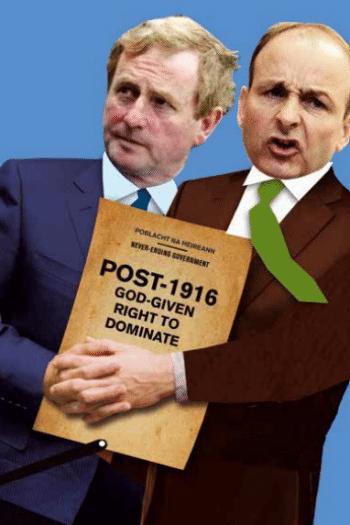
    The general election was tedious and it’s not really clear what message it purveys. The electorate seemed jaded and the politicians delivered no memorable new policies, apart from Renua’s utterly regressive at tax proposal. Village believes that elections should be all about ideas, ideology, policy (and how best to implement them). In these terms the election and its participants were a two-out-of-ten failure. Commentators from the equally idea-free media have interpreted the results in heterogeneous ways. Every sort of theory and cleverality was deployed to describe the drearily and precariously hung Dail: a triumph of democracy, a triumph of social democracy, the end of the civil war, the end/beginning of the beginning/end of the civil war. The perennial smart view that the electorate has failed the parties got several outings. If the second-rate sages had been able to they would have loved to interpret it as a triumph of angry white men. They couldn’t. Some saw it as a victory for the small parties and independents. But the Social Democrats did not increase, Renua was wiped out, the Greens gained only two seats in an era of climate-apocalypse. The People Before Profit/ Anti-Austerity Alliance finished up with only one more seat than they had before the election, and Direct Democracy did not gure. Before the election these were the only small parties. The truth is that this election was a triumph of the interchangeable FF/FG (FG/FF) duopoly, though its trajectory has been definitively defined as downward. Ideology is what political parties apply when they run out of policies. Since most of the parties’ manifestos are short and the events to which policies must be applied are unpredictable it is reasonable to expect that your candidate will have an ideology to guide her. Village for example favours an agenda of equality of outcome, sustainability and accountability. The ideology is comprehensive, it provides a solution for any situation, and a template against which policy formulation can be benchmarked. Candidates shouldn’t have to reflect Village’s ideology, but they’d be better having some sort of one. Neither civil-war party has an ideology. It is impossible to know what they will do once elected. How, therefore, could anyone who does not live under a stone be enthusiastic about a government of FF and FG? FF is a conservative party that believes in so little that it surrendered its entire ethos to a culture of provincialism and cronyism, last time it was in government. It believes in no more now so, though it is touting a centre-left agenda there is every danger it will return to populism, short-termism and promoting the only agenda it understands – the interests of the people its representatives actually know – a cronyist populism that always finishes up favouring those who shout loudest. It is naïve to think of FF as Micheál Martin and when it is the movement it has always known itself to be, of Eamon OCuív, of Barry Cowen, of Pat ‘the Cope’ Gallagher; and tens of marginally more presentable sons and daughters of best-forgotten FF dynasts. Kevin O’Keeffe, son of Ned O’Keeffe, anyone? FG is a conservative party currently dressed up as a Christian Democrat party. The ethos is exible enough that under Garret FitzGerald it was in effect Social Democrat. In its latest incarnation it has been right of centre, at a time when most people want fairness and an improvement in services. It failed to deliver an agenda of accountability and its representatives seem to believe in little beyond sound money, ‘Europe’ and law and order. Having once appeared to be purer than FF it is now tainted by the Moriarty Tribunal report and a perceived ongoing proximity to Denis O’Brien, Ireland’s richest man, as well as by its large number of low-grade County Councillors, whose corruption record is a hairsbreadth from as bad as FF’s. Though essentially conservative, both FF and FG contain some social democrats and liberals in their midst. These aberrations and those who vote for them are delaying the day a real Social Democratic party with coherent left-of-centre platform can become a force that could anchor a government. On the other hand it is clear that more people than is desirable voted FG in 2011 to get FF out and then FF in 2016 to get FG out. These people need to acknowledge that they are forces forconservativism. The incarnation of this is the dangerously articulate Éamon Dunphy who apparently voted FF in 2016 because he really believes in People Before Profit (or Sinn Féin. It isn’t clear). Anyone who thinks that FF was the solution to our problems in 2016 is part of the problem. So what next? FF and FG should merge as a conservative party though even coalition is for the moment some way off. FF is tactically sharper than FG and FG is in retreat so it is likely FF will tantalise FG to weaken and demoralise it during this Dáil. Nevertheless the (non-)ideological compatibility of the parties has been exposed and will generate its own momentum. While allowing this momentum its space the Left of all hues must use the logic of the momentum against FF and FG, and social democrats must colonise some of the space the dinosaur parties have occupied for tragically long.

    Loading

    Read more