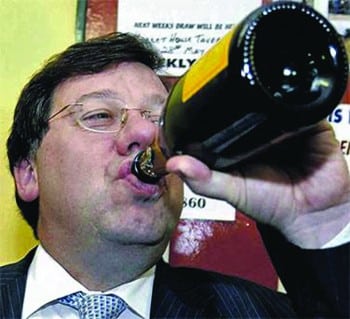
“The options were narrowing down the nationalisation plus a guarantee or simply a guarantee of the system itself” – Brian Cowen in evidence to the Banking Inquiry. He shows no evidence of having digested the evidence of Central Bank governor, Patrick Honohan, that any guarantee “should not have included subordinated debt nor existing senior-term debt”. What is the point of Inquiries if the protagonists refuse to learn even the basic lessons?
Dear Dermot, I woke up in Haiti on the morning of April 29th,to a phone message saying that RTÉ had sent me a letter with questions regarding my confidential banking arrangements with Anglo Irish Bank/ IBRC. My immediate reaction was astonishment – astonishment – that RTÉ could be used in such a way, so deliberately, to set out to damage me. Sitting over breakfast in Haiti I knew I had an immediate decision to make. I was obliged to take a stand to protect privacy and confidentiality in relation to my financial affairs. In brief. Court. Morrissey. Denis v RTÉ. Win. Delight. Denis v the People. Shut down Parliamentary reporting. Spineless media collapse. Lose (ring of steel) and experience abuse, venom, hatred. More Morrissey. National ignominy and revulsion. Problem is it has been suggested that my banking affairs are of public interest. Maybe I’m old-fashioned but I refute that. Where does public interest begin or end? I am a private citizen, and an old-fashioned one. Can I presume my medical records will be sought, twisted and turned for public consumption next, just as happened with my wife’s medical records at the Moriarty tribunal in 2002? Deputy Catherine Murphy mysteriously obtained copies of files about my banking arrangements. Since then, she has repeatedly made erroneous and untruthful statements (Morrissey says don’t say lies, and he would know) about my banking relationship. Totally SIPTU. Not for one minute did I ever allow eternal access to anyone to my private banking files. The only conclusion is that they were taken from Anglo Irish Bank/ IBRC without the permission of the liquidator. In other words, there were stolen. Stolen in a different way from how journalists on INM which I nearly control obtain leaks, mind. Miserable Michael McDowell always has something to say about me. But underlying everything you have to look at his agenda, which he always fails to declare. It’s almost like he’s holding something against megrim the time of Professor Moriarty’s inquisition. In his Irish Times article he in fact fudged the parliamentary privilege issue, noting: “We are in dangerous territory where the alleged privacy rights of the powerful call into question… seem to cast doubt on the efficacy of Article 15.12 of our Constitution”. Morrissey laughed – it gave us a pass. Doubt on the efficacy of the Constitution? Brilliant. RTÉ, the Irish Times and the Journal.ie removed the material from their websites or were not broadcasting it. It was like taking candy from kids. Nobody seemed to notice the Guardian and New York Times published without taking breath. Philip Bouchier Hayes tweeted that the constitutional privilege was “qualified” for the media. Morrissey hooted with laughter. Before, that is, Michael Martin destroyed him. Amazed to see the profile of Morrissey in the Irish Times: ‘Denis O’Brien’s cornerman: He must have been a boxer in his former life’. How about a fucking moron in his former life? Micheal Martin rammed a pitchfork up his overpaid, loyal, thick arse. Now, perhaps the Fianna Fáil leader would like to lead the way elsewhere and encourage all Fianna Fáil Tes to make public their banking files since 1990 to RTÉ and then have them distorted? Over time I do really hope that the anger and nastiness which fuels the current discord will abate and be replaced by a positive and constructive outlook for the country. I don’t mind its outlook on me, it’s the outlook for the country I’m about. Green jersey. Still. Anyway the main thing is we’ll be back in court. And I know you’re with me, Dermot. For years the media have largely spinelessly ignored your affairs – the Glackin report and all that stuff about funding of former Taoiseach Charles Haughey in the Moriarty Tribunal. You’re the gold standard in defamation successes over the years, with bars for Vincent Browne, Matt Cooper and the Sunday Times. That’s all I want. Privacy, confidentiality, fear and silence. Back to the real world and Alex White playing in Rabbittesque blinder on media ownership. Not looking at the existing status quo – just the implications of future acquisitions. Ha. It’s not, he says, a question of being “averse” to questioning the current situation, but “rather that I believe it would be fraught with constitutional risk”. Alex noted that the retrospective nature of the nursing home charges led to the Supreme Court striking down an Act as repugnant to the Constitution. Sounds good to me. According to top man, Nick Webb, in the Sindo, I’m changing the focus of Digicel as it prepares to float in New York in what could be the most valuable IPO of an Irish-linked company ever. Some industry estimates, Webb notes dutifully, have suggested that the company could have an enterprise value of around $1.3bn, including its $6.5bn in debt. Tom Lyons and Ian Kehoe in the Business Post on the other hand talked of $10bn and only if it can move beyond mere mobile phone to become a rounded high-growth communications company. If I don’t own the Business Post, I should. In the past three full financial years, Digicel has paid me $1.1bn in dividends. I receive a quarterly payment of $10 million each year. Pays Morrissey, legal fees and pints after the match for Macker, Biffer and the Bulldozer. In addition, I was paid special dividends of $650 million in February 2014 and $300 million in June 2012. Digicel is “evaluating” an approach to buy its $90 million mobile-phone mast business in Myanmar. We made an unsuccessful bid to land one of the two mobile-phone licences which were put up for auction by the Myanmar authorities in 2013. Groups involving Norway’s Telenor and Qatar’s Ooredoo prevailed. Meanwhile I see you’ve bought a few more diamonds, or is it diamond mines? No-one cares. Influence waning. At Banking Inquiry (sans Denis, note) Kevin Cardiff claims someone, referred to in his notes as “DD”, made an approach to John Hurley, Governor of the Central Bank, about the market. I see things
In Ireland philosophy rarely features in mainstream discourses. We seem more comfortable in either the narrow empiricism inherited from our former colonial overlords or the lyrical engagement found in poetry. The unflinching analysis of concepts found in philosophical enquiry is not part of secondary educations: it still does not figure as a Leaving Certificate subject. It remains a specialist course in university. Philosophy of education is a subject in the education of teachers but again is treated in a rather desultory fashion by institutions and students alike. Those who pursue scientific study at third level are given no philosophical grounding which might explain a lack of nuance among cheerleaders of science. It only figures in the study of law as jurisprudence – rather than being seen as the foundation for all positive as it ought. Arguably the general lacuna tilts society towards a conservatism born of failure to interrogate widely held assumptions. In a cogently argued and accessible work, TCD philosopher Luna Dolezal discusses the concept of body shame through a number of lenses. She arrives from a phenomenological perspective especially identified with Maurice Merleau-Ponty who emphasised that we encounter the world through the lived experience of our bodies and not simply our conscious minds. He rejected the dualist view which dominated European thought from Plato right through to Descartes and beyond. Dolezal engages with the writings of Jean-Paul Sartre who conceived of an “Other” that generates a self-reflection intimately connected to a feeling of shame. According to Sartre: “By the mere appearance of the Other, I am put in the position of passing judgement on myself as an object, for it is an object that I appear to the Other”. This can lead the alienation or estrangement from what Dolezal refers to as “the possibilities of the self”, This recurring evaluation of how we are perceived has become a more pressing concern in a world of intrusive social media. Dolezal argues that other thinkers have advanced on Sartre’s ideas to show that objectification is experienced to a greater extent among marginalised groups. In The Second Sex Simone de Beauvoir argued that in our patriarchal societies women experienced this feeling far more than men. Another layer was added by Frantz Fanon who observed the alienation caused by perceived racial hierarchies. Fanon argued: “This is because the white man is not only the Other but also the master, whether real or imaginary”. It is probably a fair generalisation that women, racial minorities, as well as gays and people with disabilities, are more subject to shame than straight white men with full physical capabilities. Dolezal also explores the socio-cultural and political framework in which power relations are embedded, drawing on the insights of Michel Foucault and Norbert Elias. Perhaps Foucault’s most useful idea was his revival of Jeremy Bentham’s Panopticon as a metaphor for the constant surveillance of modern life. The Panopticon was a prison made of glass allowing every action to be observed, in theory leading to the observance of all rules. The inmate would be shamed into conformity. It is reflected in today’s latent perception that our every move is subject to the unrelenting gaze of cameras leading to sense, especially among women, that her physical appearance is constantly being assessed. In his seminal work ‘The Civilising Process’ Elias traces the evolution of manners and other forms of personal comportment. The story of the fork is particularly informative. It arrived in Europe with the Byzantine bride to a Dodge of Venice and its use was initially dismissed as a prissy affectation. But soon courtiers succumbed to its utility and it became such a fixture across Europe that by the nineteenth century one writer described people who ate with their hands as cannibalistic. Elias shows that such quotidian habits are socially constructed. Shame has been used immemorially to enforce conformity. But Dolezal is emphatic that shame plays a critical role in how we learn and socialise among our peers. She argues that it plays a key role: “in skill acquisition, self-presentation, bodily management and the formation of the body shame”. Put simply, without experience of shame there would be a little inducement for self-improvement in a range of spheres. This feeling may however lapse into a chronic condition where we feel ourselves, especially our physical bodies, to be the source of that shame. Chronic body shame: “can lead to a diminished bodily experience where a constant preoccupation with the body affects one’s self esteem and self-worth”, This seems to be the plight of many women today: look at the weight of column inches and advertising devoted to beauty ‘treatments’, an interesting choice of words ascribing pathology to deviations from conventional notions of beauty. Thus, according to Dolezal: “Women; compared with men, spend more time, energy and material resources in trying to achieve a socially pleasing body that conforms to prevailing normative standards”. Further, “Women far outnumber men in incidents of eating disorders, chronic dieting and cases of cosmetic surgery industry which preys on these insecurities, inducing women to alter bodies to conform to societal expectations. Yet, as she points out, this is increasingly impossible as the body ideal found in the innumerable forms that flash before us are often digitally-enhanced or surgically-altered. Unfortunately according to Dolezal: “Beauty regimes are becoming more punishing, more painful, more expensive, more intrusive, more extreme and, as a result, more disempowering”. In the United States alone over eleven million cosmetic procedures included injectables such as Botox, laser skin resurfacing and chemical peels are deployed daily. Americans spent almost $12bn on cosmetic procedures in 2013 alone. Our own Celtic Tiger spawned a cosmetic surgery boom. The next generation faces ever more sophisticated marketing techniques that position these illusory forms in increasingly ineluctable ways. The Internet is increasingly used for this marketing, and beleaguered parents cannot possibly keep track of their children’s engagements. The changes that are made to bodies through cosmetic surgery have profound philosophical implications, for as Dolezal points out it “presupposes some sort of
Deputy Catherine Murphy: I move: That leave be granted to introduce a Bill entitled an Act to amend the Comptroller and Auditor General (Amendment) Act 1993 in order to make an addition to the First Schedule, to expand the areas under which an examination under section 9 may be conducted, and to provide for related matters. The Comptroller and Auditor General (Amendment) Bill 2015 proposes to extend the functions and powers of the Comptroller and Auditor General to cover IBRC. It was the Taoiseach who first suggested that the Comptroller and Auditor General review the Siteserv sale process at which time it was pointed out to him that the IBRC does not come within the Comptroller and Auditor General’s remit. With this Bill, I am attempting to address that problem by broadening the remit of the Comptroller and Auditor General. The reason I anticipate the need to involve the Comptroller and Auditor General, if not a full commission of inquiry which latter might well be a better option, is that the Government has got this matter badly wrong. That is not least because most of the key players in the Siteserv saga have links with KPMG and the eventual purchaser and vice versa. It is a web of connections and conflicts that requires outside eyes to unravel. I have no doubt that the special liquidator is more than capable of carrying out such a review, but his direct involvement in the sale process, his relationship with the eventual purchaser of Siteserv and his current actions in the High Court in supporting Mr. Denis O’Brien against RTÉ place him in a position where there is, at the very least, a perceived if not an actual conflict of interest. The review is not confined to Siteserv, but that is the transaction that prompted a review in the first instance. I worry about the transactions that have been excluded from the review given what that we now know that in the final months before prom night, the relationship between the Department and IBRC had completely broken down. If deals were being done without the knowledge or input of the Minister, we must know what those were. We are now aware, for example, that the former CEO of IBRC made verbal agreements with Denis O’Brien to allow him to extend the terms of his already expired loans. We also know that the verbal agreement was never escalated to the credit committee for approval. I am led to believe and would welcome clarification by the Minister that the rates applicable to the extension were extremely favourable. I understand that Mr. O’Brien was enjoying a rate of approximately 1.25% when IBRC could, and arguably should, have been charging 7.5%. Given that we are talking about outstanding sums of upwards of €500 million, the interest rate applied is not an insignificant issue for the public interest. We also know that Denis O’Brien felt confident enough in his dealings with IBRC that he could write to Kieran Wallace, the special liquidator, to demand that the same favourable terms extended to him by way of a verbal agreement be continued. We now have Kieran Wallace, who has been appointed by the Government to conduct the IBRC review, joining with IBRC and Denis O’Brien in the High Court to seek to injunct the information I have outlined from coming into the public domain. Surely, that alone represents a conflict. In documents released to me under freedom of information, the Minister, his officials, the Central Bank and even the Troika acknowledge that IBRC – the former Anglo Irish Bank – is no ordinary bank and that there is a significant public interest as the bank was fully nationalised and was in wind-down mode. They all accept that this is the people’s money we are dealing with and that there can be no dispute regarding the public interest in this. The same materials obtained under freedom of information detail instances where the Minister can specifically intervene and issue a ministerial order that material matters have a significant public interest. Included in these material matters are instances that are outside the ordinary course of business. I argue that what I have outlined here regarding verbal deals and extensions etc. are outside the normal course of business and ask the Minister to exercise his right to intervene in the current proceedings to defend the public interest. I have a motion on the Order Paper signed by the majority of Opposition Members calling for a debate on the proposed review. I note that 45 Members have signed and more are welcome to. When I tried to raise the matter on the Order of Business, I was silenced and told to take it up with my Whip. I am the Whip of the Technical Group and I had raised the matter at the weekly Whips’ meeting. The Government Chief Whip told me that the Government would not be altering the KPMG review and that it would not provide time to debate this issue. He suggested that we use Private Members’ time. This is not just an Opposition issue; it is an issue for the whole House. It is an issue of serious public concern involving public money. If the Minister opposite, Deputy Paschal Donohoe, got his hands on an extra €20 million, he would not have to think too hard about how to spend it. I urge the Government to reconsider this matter and to give the Bill and the motion the time they deserve. It is in the public interest to do so. An Leas-Cheann Comhairle: Is the Bill opposed? Minister for Transport, Tourism and Sport (Deputy Paschal Donohoe): No. Question put and agreed to. An Leas-Cheann Comhairle: Since this is a Private Members’ Bill, Second Stage must, under Standing Orders, be taken in Private Members’ time. Deputy Catherine Murphy: I move: “That the Bill be taken in Private Members’ time.”
In 2011 Portugal was at the forefront of Europe’s anti-austerity movement. Yet, four years later, as elections approach in the Autumn, there is no chance of a Left government to ally with Greece’s Syriza or the recent municipal victories in Spain. What went wrong? And can Portugal return to the frontlines? Village’s Ronan Burtenshaw interviews Bloco de Esquerda’s Catarina Príncipe. Q. First, can you tell me how Bloco de Esquerda [the Left Bloc] came about? Several events happened at the end of the 1990s that played into our foundation. The anti-globalisation movement, centred around Seattle in 1999, was important. There was a growing conclusion that we need to find new ways to work together and build projects. Some of these were forums, others were political parties. That was the international moment we were in. Then there was the Indonesia-East-Timor war and occupation. The Portuguese population had its own anti-war movement and sided with Timor against Indonesia. This managed to bring different sections of the Left together to discuss war and campaigning. Finally the failure of the abortion referendum in 1998 was also an influence. There was a referendum to overturn laws banning abortion in Portugal but no broad campaign by progressive or left-wing forces; instead every little group ran their own one. Some of these ran against each other or had clashing strategies. The Yes vote lost, so abortion was illegal in Portugal until 2007. This was the last straw for many on the Left. Q. So how did Bloco form out of these conditions? The definition of Bloco, in its first statute, is a party-movement. It is a broad party that engages with other movements without substituting for or controlling them. It is built up by this grass-roots strength and given a voice in institutions, with a political programme that unites those two domains. Therefore it manages to build strategy together with people who come from very different perspectives, activist histories and traditions. We grew steadily from 1999, when the party formed, until 2011. From 2005 Portugal had a liberal government under the Socialist Party [Portugal’s Labour Party] which had been applying austerity measures for some time before the crisis hit. They used the crisis as an excuse to escalate this. In 2009 we had elections and a broad social mobilisation against austerity. The Socialist Party still won these elections but they didn’t achieve a majority and formed a minority government. Bloco de Esquerda had 10%, the Portuguese Communist Party had 8%, so the radical Left was on almost 20%. Q. What was the result of this growth in support for anti-austerity alternatives? It didn’t mean anything in terms of the programme of the Socialist Party government. In fact, from 2009 onwards they began to impose what they called the “four pacts”, which were packages of austerity measures. The first one cut public spending, the second cut social security, and so on. In parallel they introduced continual measures liberalising the labour market. This produced social mobilisations. We had important Euro May Day demonstrations in 2010. Euro May Day parades are structures we inherited from Milan – colourful, anti-union, involving precarious/ zero-hours workers, quite creative and young, talking differently about labour. Some parts have very Negrian theories, others go with Guy Standing’s idea of the precariat. Our version of this, in contrast to those in Italy, didn’t adopt an anti-union discourse about precarious work but rather tried to ‘add struggles to the struggle’ and forge links with the unions, joining them on the May Day march. We developed a theoretical framework called “precarity in life”, which was a new form of labour discourse. We weren’t just talking about conditions at the point of production – contracts, wages and so on. We talked about the way labour instability affects different spheres of life, and affects you differently if you are a woman, a migrant, or LGBt. We were exploring the relation between exploitation and oppression, developing the particularities of these, but framing it in a new and accessible way. This allowed us to bring together the feminist, anti-racist and LGBt movements with the anti-precarity movement to form the Euro May Day. Euro May Day fed into the first really big demonstration occurring on March 12th 2011 called Geração à Rasca, Generation with No Future. It was started by a call on Facebook by four people, all of whom had some previous involvement in politics but had not been particularly active. It grew exponentially. This was the time of the Arab Spring with all the discussions about the role of new media in facilitating protests so the Portuguese media took this up as our own little experience of it. The organisers were on television almost every day. Soon they realised that they could not organise this phenomenon themselves so they put a call out to social movements and those involved in Euro May Day to help them out. In the end the demonstration had 500,000 people in various places, in a country of around ten million. Q. Was it mostly young people? We were expecting that it would be but in the end it was intergenerational. This proved our thesis in the anti-precarity movement that the issue couldn’t be dealt with in generational terms. There is a particularity to how young people experience insecurity but almost half of the Portuguese working population is precarious right now so you can’t talk about it as generational. The movement was very broad so it was quite apolitical. At the time it was correct to do this but it had limitations. there were no demands, which was necessary because it would not have brought out many people if it was too concrete, but the right-wing also used this space. Two months after the big demonstration they won the snap elections. This was then followed by the arrival of the Troika and the signing of its memorandum by the two right-wing parties who were in coalition [the PSD and People’s Party] and the Socialist Party, who had lost the election.
If Colonel Gadaffi were still running Libya there would not be mass migration across the Mediterranean, with thousands drowned because of unscrupulous traffickers. Gadaffi was guilty of the sin of all those secular dictators. He was too independent of ‘the West’. Britain and France, backed by America, bombed him out of existence. Their excuse was that he intended assaulting civilians in a provincial town. They got the cover of a UN Security Council resolution, which a weak Russia failed to veto. Now Libya is a failed state racked by civil war. Where do these Mediterranean migrants come from? Many are from Syria, another state afflicted by civil war encouraged by the West. Since 2011 the Syrian rebels against the Assad regime have been covertly financed and armed by Saudi Arabia, Qatar and Turkey, with the CIA and Israeli intelligence overseeing the details. Recall the House of Commons vote which denied Tory Premier David Cameron permission to bomb Syria by 285 votes to 272 in 2013. Encouraged by the US, Cameron and France’s Hollande wanted to repeat in Syria the regime- change they had brought about in Libya two years before. It was surely Ed Miliband’s finest moment as Labour leader that he refused to go along. 30 Tories and nine Lib Dems voted against Cameron too. This House of Commons No in turn gave the US Congress the impetus to stop Obama’s impending assault on Assad. In Syria the pretext was to be that Assad used chemical weapons against his foreign-financed rebels. If these rebels succeed in overthrowing the Assad regime, the country’s Christians, Alawites and many Shia Muslims are likely to have their throats cut. The paradox now is that support for the Assad regime in Syria and its Shia-backed counterpart in Iraq looks like being the best hope of holding back the ISIS monster which these ‘rebel’ groups with their dubious sources of arms and finance have spawned. America needs Iran and its clients as allies, not opponents, in the region. Najibiullah in Afghanistan, at the time of the Russian intervention there, was the first of the secular dictators America sought to overthrow by backing the mujahideen fundamentalists against him. Osama Bin Laden was on the US payroll then. Najibullah was executed by the Taliban in 1996. Saddam Hussein was the second, overthrown by Bush and Blair in their 2003 invasion of Iraq. When Saddam ruled Iraq, Sunni, Shia and Christians lived peaceably side by side. Now Iraq too is well on the way to being a failed state, racked by the Shia-Sunni conflict which America encouraged until the tormented politics of the region spawned ISIS. Najibullah, Saddam Hussein, Gadaffi and Assad were certainly dictators but the West did not realise that worse could follow. Since Bush invaded Iraq the USA has become self-sufficient in oil because of the fracking revolution. America no longer needs Saudi oil as it once did. This is the basis of Obama’s turn towards Iran, which in turn causes consternation among the Saudis and Israelis. The Saudi-Israeli response is to try to up Sunni-Shia antagonism further, building on what the Americans had started, seeking thereby to undermine Iran’s clients in the Iraqi and Syrian governments and in the Lebanese Hezbollah, in the hope of stymying a US-Iran deal. A seminal book on the historical background to the region’s current anguished politics, is James Barr’s ‘A Line in the Sand: Britain, France and the Struggle that shaped the Middle East’. The catastrophe in the Middle East is rooted in Western power-grabbing for the provinces of the Ottoman Empire a century ago in World War 1. Iraq, Syria, Lebanon, Palestine and Jordan were all Ottoman provinces then. The different religious communities had lived peaceably side by side in them for centuries. Getting hold of them was one of the war aims of imperial Britain and imperial France in 1914. It was why Britain and France pushed Turkey into an alliance with Germany in the first months of the Great War. What was presented to British and French public opinion as a war to defend the rights of small nations and to prevent ‘poor little Belgium’ from falling under German rule, was seen by these countries’ Governments as an opportunity to expand their empires in the Middle East at the expense of the Turks. Britain particularly wanted to gain control of Palestine and with it the eastern approaches to the Suez Canal, that vital route to Britain’s empire in India. The Bolsheviks published the secret treaties between the Entente Powers within a month of the 1917 Revolution, while simultaneously repudiating them and announcing Russia’s withdrawal from the War. The British were embarrassed, the Arabs dismayed and the Turks delighted. The most important secret treaty was the agreement in March 1915, just one month before the Gallipoli operation, promising Russia control of Constantinople and the Dardanelles after the war, in return for Russian agreement to support British interests in Persia, next to India. Britain had fought the Crimean War in 1854 to prevent Russia taking Constantinople and establishing itself on the Mediterranean. For the same reason Disraeli risked war with Russia in 1878 and sent the British Mediterranean fleet through the Dardanelles at the time. In the lead-up to World War 1, however, a century of British rivalry with Russia – the “Great Game” that was given literary form in Kipling’s novel ‘Kim’ – was abandoned in order to induce Russia to join France in encircling Germany. Russia and France together were the only European land powers that could crush Britain’s rising commercial rival, Germany. As a seapower Britain could help in that defeat, but only land power and large armies could ensure a decisive victory. In early 1915, with stalemate on the Western Front based on static trench warfare from the Channel to the Swiss border, the British and French Governments were worried that Russia might pull out of the war altogether in view of the pasting its armies were taking at the time from
Robert O’Byrne is an aesthete – possibly Ireland’s only one, a writer specialising in the fine and decorative arts. He is the author of more than a dozen books, among them ‘Luggala Days: the Story of a Guinness House’; a biography of Sir Hugh Lane; ‘A History of the Irish Georgian Society’; a ‘Dictionary of Living Irish Artists’ and ‘the Last Knight: A tribute to Desmond FitzGerald, 29th Knight of Glin’. In addition to really loving things that relate to the Guinness and FitzGerald Families and the Irish Georgian Society (IGS) which they have led, he writes a monthly column for Apollo magazine and also contributes to the quarterly Irish Arts Review. He publishes a blog called “The Irish Aesthete. This is not an oxymoron”. Tragically for O’Byrne, of course, it is. But this is the least of the issues currently challenging his sensibility. The ascent to pure aestheticism inevitably took some time. After an international childhood and schooling in Gonzaga, during its own aesthetic epoch, he served in a Jesuit novitiate in the early 1980s. In 1986 O’Byrne became the first director of a pilot project in music promotion, Music Network, which some years ago scooped a U2 funding jackpot. In the 1990s he worked as a staff journalist for the Irish Times, often writing about fashion: “Robert O’Byrne’s three-part series on major trends for the season ahead: think long, think luxuriant, think languorous”. He scraped an extended niche for himself arbitrating style more generally: “the most shocking feature of the cluster of Carrickmines houses sold in Dublin last month for some £1 million each was not the price paid nor the speed with which the properties were reserved, but the unrelieved banality of their design”. At the height of the debate on one-off housing debate in the early 2000s he wrote – reflecting his peculiar if consistent focus – ignoring considerations of good planning or sustainability that: “the debate needs to be not about whether development should take place, but about the design and character of that development”. And sometimes he took his taste out of the stuffy walls of journalism onto the streets. In September 1998 he could be found launching ‘Dublin Style: An Insider’s Guide to Shopping’. In the mid to late 1990s he impurely served as the Times’ gossip columnist, hosting a horrible page at the back of the Weekend supplement that mirthlessly celebrated the country’s nouveaux glitterati. He also covered antique and art sales for the Irish Times, with some style. The Irish Times still indeed allows him the occasional essay such as a recent erudite sashaying review of a book on the history of Irish wallpaper, for which all proceeds go to the IGS, though neither O’Byrne nor the Irish Times felt the need to declare his connection to the IGS. O’Byrne’s prose is often original and the judgement sharp, in his columns and on his blog. The blog has a cohort of fans, often genuinely double-barrelled, who outdo one another in obsequiousness. Not unrepresentatively, during 2015 the Irish Aesthete will be visiting one Irish town every month – to berate its architectural neglect. O’Byrne has lots of considered opinions. In a recent collection of essays concerning the FitzGeralds of Carton House, he was hammered by Dr Terry Dooley of Maynooth for criticising its late housing-estate strewn incarnation as one of those “ill considered conversions into spa hotels and golf resorts”. However, his usual percipience can let him down as when he equivocated in the controversy over the recent removal of sculptural busts from the entrance hall at Bellamont Forest House in Cavan, despite the evidence proving them to be integral to the design of this internationally important house by Sir Edward Lovett Pearce. Crucially, O’Byrne himself moved to the rarefied setting of Palladian Ardbraccan House near Navan where he lodges in one of the wings. As befits an aesthete whose oeuvre so often touched on its members, and its causes, O’Byrne is Vice President of the Irish Georgian Society (IGS), a membership organisation whose purpose is to promote awareness and the protection of Ireland’s architectural heritage and decorative arts. A fully illustrated book by Robert O’Byrne on the society’s first 50 years was published in 2008 and he has comprehensively ingratiated himself. If anything all had been looking well for his further elevation. O’Byrne was until recently the IGS’s representative on the board of the Alfred Beit Foundation which owns the Palladian Russborough House in Co Wicklow. Sir Alfred Lane Beit, honorary Irish citizen, was a British Conservative Party politician, art collector and philanthropist – nephew of Alfred Beit, a South African mining millionaire from whom he inherited a vast fortune including a large number of Old Master paintings. In 1952, he and his wife, Clementine Mitford, moved the art collection to Ireland. It comprises many of the paintings assembled by the Beit family from the late nineteenth century. While he eventually presented the major works to the National Gallery of Ireland, the remaining collection, along with Russborough itself, was bequeathed to the Alfred Beit Foundation (ABF) which was established in 1976 with a board of trustees. The sale of 350 acres of land at Russborough in 1978 afforded an endowment of almost £400,000 or around €4m in current values. It is not known what has become of this original endowment, but the ABF is known to have been struggling for some time, despite receiving regular handouts from the Apollo Foundation, a London-based trust associated with the Beits, and substantial grants from the Heritage Council and Fáilte Ireland. The ABF has been operating at an annual loss of €300,000 (2013). Certainly this is a problem but there is no sense the costs are being reviewed or that dynamic fund-raising is in place. A substantial salary is paid to a chief executive who oversees an uninspiring, if rising, 24,000 annual visitors to the house. In 2006 a collection of 62 early Italian bronzes was sold for €3.8m and fourteen oriental ceramics were sold
Oh Broadsheet.ie! Where did you come from and why do I flit to you so reflexively? Why are the newspapers, which you for some reason call “De Newspapers”, suddenly so full of you? You are George Orwell for our Irish age. No concern needed, these post-modern days, to secure the “hearing” that motivated him: with digital journalism immortalising our inglorious musings, we are all indeed much, and long, heard. And I don’t just mean the narcissism of a blog or under-followed Twitter account. For now we have the power without responsibility that is the interactive and anonymous “news source for the bewildered”. Everything. As it happens”. Though not so much usually. And yet you showed spine against Ireland’s biggest bully. Contradictory ‘Broadsheet’, refuge of the office drone, dog-wagger of official Ireland, purgatory of the arts graduate, icon for the libertarian, past-rejecting Y-generation. You never quite know when to just keep schtum. You wear your liberalism like an old scout’s badge, while an army of unpaid volunteers (me included) chomp and choke on a tsunami of sub-journalistic tidbits. Gay-cake debacle anyone? A cat that looks like Ireland? Broadsheet marches to the beat of twitterdom and twitterdee. It vituperates the Iona Institute and all its progeny and smirks at our ante-deluvian institutions and their machinations. It celebrates little politically though it loves High Design and it cannot get enough gay rights and the campaigns they spawn. Almost whimsically and perhaps in closet guilt at the apparent libertarianism of its no doubt mostly junior advertising exec readership (it promotes, nay ogles, Julien Mercille, conspiracy theorist extraordinaire, Maître Mitty on a Monday. Worse still – and alien to the “get that stateout of my life readership, this is a leftie. “Beef cake”, ” boffin”, “egghead”, “the man they all want to marry”: all bou ant hair and sallow skin, his clean-cut just-bathed Canadian earnestness, an embodiment of dissent for Broadsheet’s hirsute, lycra-clad, hashtag revolutionaries. Julienne, You tease us with your threat of taser-flashing Gardaí; whip us into a frenzy with your regurgitation of pertinent surveys, poke us with your boring quotes from the eminent King and Thoreau. I applaud your refusal to succumb to what you describe as the media’s “propaganda of silence”, as you buzz around, flogging your book on every show in town. May I be so bold as to suggest you partake in the donning of a trench coat, a suitable accoutrement, a worthy homage to your mots. Noms de Plume such as “FluffyBiscuits”, “Spaghetti Hoops” and “Bodger”: words synonymous with childhood innocence, a Freudian nod perhaps to the infantilism of Broadsheet, where ‘Animal Farm’ meets Old McDonald and Broadsheet ends up confusing our furry friends with the Irish electorate? What would Village make of a cat named after that notoriously unreliable chronicler, Herodotus, recently to be found on Broadsheet, purring at us (as Gaeilge, no less) mere humans to vote (Yes)? To meet the standards imposed by Broadsheet editorially, the poster requires just a talent to irritate the commenter merely the ability to circumnavigate a crude filter. Though there are suspicions that one John Ryan posts under more than one Nom and some of the commenters seem suspiciously on-message. Even Village, doctrinaire as it is, deigns to allow dissenters: John Waters and Ruth Cullen. Constantin Gurdgiev with his Beckettian opaqueness. But Broadsheet only posts counter-liberal perspectives in a way that invites attack. Despite its name, suggestive of an open platform, where anything goes, Broadsheet and its commentariat are – dare I say it – profoundly Catholic in tone, devoutly intolerant of any counterweight to the individualistic, hipster agenda. Its commenters and posters drown in a pool of contradictions, one minute decrying “Je suis Charlie”, the next putting the boot into “Ich bin Hitler” merchants. And what’s going on with over 20 posts about the Fuehrer? Broadsheet’s approach confuses editorial restraint with neutrality and balanced critique with trolling, hysterically accusing those who challenge the bluff of its resident in “journalists”, of risible blueshirtisms. Perhaps Broadsheet should pay some heed (on this and only this) to the bluster of Julien Mercille who in his attempt at adult analysis, opines worthily though uninterestingly that “democracy is a full time job and much remains to be accomplished”. I challenge the chalet-girl spirit of Broadsheet, but can concede Broadsheet, being all things to all modern men, is not without its merits, though perhaps the sheet is narrower than it thinks. Lost, Broadsheet be thy carriage office. Public order offence, Broadsheet be thy kangaroo court. Gay, Broadsheet be thy brave champion. Spill thy guts, Broadsheet be thy diary. Gossipmonger, iconoclast, purveyor of transcripts, bolsterer of the hipster status quo. Bully, dogmatist, materialist. Never entirely unintelligent though hardly wise. Know thyself. Why Broadsheet thou art indeed the entertaining slutty un-grown-up child of thy paper predecessors. Redemption ows from thy every post.