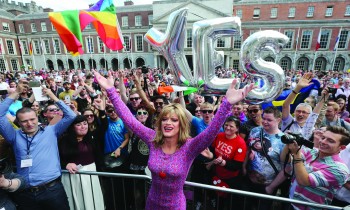
By Eoin O’ Malley The marriage referendum was a roller-coaster. The reports of thousands of Irish taking boats and flights home to vote in the marriage referendum were heart-lifting. Ursula Halligan’s revelation in the last week of the marriage-referendum campaign that she had hidden her sexuality from everyone, including at times herself was heart-breaking. She cited the referendum campaign as the reason she finally found the bravery to come out. We can only assume that she was relieved at the response and delighted at the result of the referendum. The referendum gave popular approval to what we had already known: that Ireland and its people are decent and kind. Few who witnessed it will forget the happy, open and emotional atmosphere in Ireland on the weekend of the result. But there’s a reason why Ireland is the first country in the world to approve same-sex marriage by popular vote. Not many countries want to have to go to the people every time they want to change their laws, even constitutional law. As well as being expensive and slow it may cause more harm than good. The referendum last month has probably settled the issue of same-sex marriage. But that’s because it confirmed a measure that was on the path society was already following. There was no such settlement in the UK when a couple of years ago it rejected a change to its electoral laws. Many, from UKIP to the Greens, are calling to revisit that decision. And referendum certainly hasn’t settled the issue of Scottish independence. In fact the referendum has accentuated divisions within Scottish society. In the marriage referendum one Irish Times columnist proclaimed to be “heartsick at what we have witnessed in these past weeks”. Rather than unite the country it has exposed and deepened a division. This isn’t surprising. This is what happens in referendums. This is because as Paul Romer observes in a recent issue of the American Economic Review: “Politics does not yield to a broadly shared consensus. It has to yield to a decision, whether or not a consensus prevails. As a result, political institutions create incentives for participants to exaggerate disagreements between factions. Words that are evocative and ambiguous better serve the factional interest than words that are analytical and precise”. Romer was talking about politics generally, but the referendum process is even more guilty than representative democracy of incentivising division. Because referendums offer only an either or; they create binaries whereas issues are on a continuum. Instead of a Seanad referendum on its retention or abolition we could have had a debate on the nature of the second chamber we might actually want. There is a lot of shouting in parliament the main purpose of which is signalling to voters that the politicians care about an issue; but behind the scenes, in committees and, yes, in the Dáil bar politicians talk and share experiences (sometimes even evidence) and they work together usually in a slow and sloppy way to make things better. Productive collaboration is completely ditched in electoral campaigns, as politicians accentuate the differences between them and the other lot. That’s fine in the marketplace for competent politicians: you want to see how politicians perform under pressure. In referendums finding the best policy is important, but extreme positions are taken in an attempt to win. I experienced it directly when I was involved in the Seanad referendum campaign, on the side in favour of abolition. In response to what we thought was fanciful fear-mongering about democracy in danger, we exaggerated our rhetoric, to talk of the Seanad as a danger to democracy. In fact neither contention was true. The referendum was pointless, and neither outcome was going to change anything very much. I started out with that position, but campaigning moved me towards an extreme. In moving to the extremes we divide the country, and in having a referendum on marriage equality we missed an opportunity to talk to each other about the problems gay people have, well beyond the issue of marriage, and listen to the – we have to assume – genuine concerns of those opposed to marriage equality. The most righteous proponents on either side saw the morality of their position but made no attempt to speak to or hear the other side. As the social psychologist Jonathan Haidt points out, “[Morality] binds us into ideological teams that fight each other as though the fate of the world depended on our side winning each battle. It blinds us to the fact that each team is composed of good people who have something important to say”. The No side was dishonest. It didn’t want to say that it thinks homosexuality immoral, so it muddied waters with children and surrogacy. This appeals to those who are uncomfortable about the speed and direction Ireland is moving. The Yes side was honest in its frame about equality and fairness. This pushes buttons for liberals, but does nothing to convince for conservatives. The Yes side seemed to be saying ‘This is Ireland, your one is dead’ and didn’t care about bringing people along with it. Instead conservatives could have been persuaded by emphasising respect. Battle lines had been drawn when the campaign started with a call for a ‘homophobia watchdog’; we were never going to come to a genuine understanding of the other side. It was one where genuine doubters were called names and increasingly illiberal stances were assumed by many of either persuasion. We didn’t learn much, except to hate the other side. The media are also to blame. They stopwatch the different sides, and pick sometimes-extreme proponents of each view. This is the John Waters-effect. We like to hear strong opinions not rational ones. Some lawyers took a sceptical view of the children’s rights referendum. They wondered aloud whether it was needed at all because all these rights were already implied in judgments. But they weren’t clearly on one side or the other so instead of hearing these views,