Columns

Random entry RSS

  • Posted in:

    Let’s despatch the Eighth

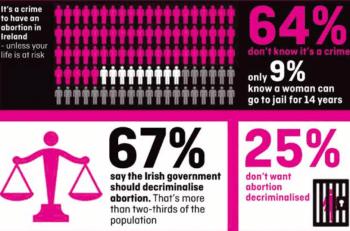
    One morning recently I woke up to abusive tweets. “What is it with lesbians hating unborn babies?? Please explain!”. “Why so many lesbians pushing abortion when they should never really need one??!!!”. As a long-time feminist campaigner and Convenor of the Coalition to Repeal the Eighth Amendment, vulgar interactions from anti-choice supporters are inescapable. I’m too long in the activist tooth to let them bother me (much), but this latest batch does make me wonder. Why is “lesbian” used as a term of abuse, and what has it got to do with “hating” babies, or women, or men, or indeed anything else? I’d like to tweet back (but I don’t): “Look here, you with the vituperative tweet finger, I’m a feminist, lesbian, radical Irish grannie (of two, so far), and I’m pro-choice because I believe in equality, in human rights, in justice, and in a world where all women, everywhere, including my daughter and my granddaughter, have the right to make decisions for ourselves about our bodies and our reproductive lives. It’s a national issue, it’s global and it’s also very personal. So there!”. The Coalition to Repeal the Eighth Amendment was set up in recognition of evident and popular demand for change. Our members include trade unions, pro-choice and feminist groups, human-rights organisations and many other NGOs and groups. The next year or so will be vitally important in advancing this issue. It has become a real election issue. If political soundings are to be believed, we can expect a “national conversation” after the election in the form of a Citizens’ Convention, followed by a referendum. It is hard to exaggerate the ‘chilling’ impact of the Eighth Amendment on women, on doctors in preventing them from working in the best interests of their patients, and on our society as a whole. What does it say about respect for women and our capacity to make our own decisions about our lives? What does it say about respect for human rights principles? Successive Governments have ignored robust criticism of the Eight Amendment from UN and other international human rights bodies. Even as I write, there’s a woman setting off from Sligo or Kerry or Wexford or Dublin on that dismal journey to the UK for an abortion she can’t obtain here with the support of her partner, her family, her friends, her GP. There’s another woman getting off the plane on her lonely trek back, and another desperately trying to find the money or the vital travel documents, or whatever else she needs to go abroad for an abortion. Every day, at least ten women are forced to go through this exhausting and demeaning process because the law and the health services fail to provide for women’s full reproductive needs and rights. We have no idea how many more women are in tears and desperate because they don’t have the resources of money, travel papers, childcare, time off work, good enough health and capacity, or whatever it is they would need to be able to make the journey. We predicted the direct and dangerous implications of the Eighth Amendment for women when it was introduced into the Constitution in 1983. We have learned with terrible sadness and anger of women dying. We have had to bear unwilling witness to innumerable personal tragedies dragged through the Courts and exposed in the media. As women, the Eighth Amendment ensures that our human rights are consistently breached during pregnancy by making a dangerous, unworkable distinction between our lives and our health. It denies us life-saving treatment such as chemotherapy. It forces us to remain pregnant against our will, even in cases of rape, incest and where a fatal foetal abnormality has been diagnosed. The Eighth Amendment puts our health at risk, denying us options even when the outcomes are clearly long-term and debilitating. It discriminates against poor and marginalised women and all those who cannot travel abroad for an abortion. Disgracefully, it criminalises women for the ‘procurement’ of an abortion, including women who obtain the abortion pill, the safest and most straightforward means of abortion. It criminalises medical professionals who assist women to do so. It places punitively strict parameters around the crucial information that reproductive health services can provide. It’s clear that the Eighth Amendment no longer reflects public opinion, with poll after poll showing strong support for its repeal. While we certainly don’t underestimate the amount of work to be done, our members are committed to the battle ahead. With public support we will campaign vigorously for repeal of the Eighth Amendment. In 2016, we don’t think that’s too much to ask. Do you? Ailbhe Smyth Ailbhe Smyth is Convenor of the Coalition to Repeal the Eighth Amendment

    Loading

    Read more

  • Posted in:

    Europeans Against the European Union. By Ronan Burtenshaw.

    By Ronan Burtenshaw In late September 2009 I was walking through Dublin as the city prepared for the rerun of the Lisbon Treaty referendum. Outside Dublin Castle I ran into canvassers from Generation Yes, a young, liberal, pro-Europe group established early that year to campaign for the passage of the treaty. Drawing them into conversation you could feel the passion of their arguments. They were the erasmus generation – students and graduates who saw the European Union as an engine of progress for Ireland and a liberator that had broken us from our bleak, parochial past. Rather than the ‘Yes for Jobs’ vacuities many of the main political parties ran with in the campaign, Generation Yes spoke to direct experience living and working in Europe or for European businesses in Ireland. Many of its best advocates came from the tech sector and saw the EU as a vanguard project of a globalising world, breaking down borders, encouraging innovation and providing opportunity. Generation Yes played a crucial role in the landslide victory of 2009. More clearly than any other organisation involved they developed an identity for the Yes camp. The European Union represented a young, modern, idealistic cosmopolitanism. The No camp, as I remember now-Senator John Crown saying on my local radio station, were the past, “Trotskyite communists and right-wing zealots”. So, Lisbon II passed, Ireland’s political elite celebrated, and Generation Yes disappeared. But less than a year later the European Union, so long considered a benevolent actor in Irish politics, imposing human rights with a pat on the head from the continent, came to wear a quite different mask. 2010 brought the Troika. Just five years after its arrival on the scene, the creditors’ union of the European Commission, the European Central Bank and the International Monetary Fund has come to dominate the popular imagination of the European Union. For the peripheral states they made their home their policies have inextricably linked the project of European integration to falling living standards, crumbling welfare states and debt servitude. It isn’t an exaggeration to say that a Generation Yes for 2015 is almost impossible to imagine. A group of the same name might intervene in a referendum, it might even attempt to use a similar message, but it would have to reckon with the fact that the sickly-sweet vision of Europe it once sold has been indissolubly mixed with the bitterness of austerity. It would also have to reckon with a rival identity. Not the eurosceptic Right, a nationalist opponent it had always comfortably beaten in Ireland. But, since 2011, a rival, pro-European identity has emerged which is highly critical of the Troika and the increasingly undemocratic apparatus of the European Union. Last month, in Greece, this movement was given a name: Generation No. The vote in Greece was striking in its breakdown. The average No voter rejecting the Troika’s ultimatum was young, working-class and held increasingly left-wing views. The percentage for ‘oxi’ under 25 was 85, under 35 was 78. These were a new generation, living in conditions of over 60% unemployment, often having to stretch out their studies over many years to afford to complete them, relying on cash from their parents to survive. But also, it is a generation increasingly willing to challenge the shibboleths of our societies – to experiment in unorthodox relationships to the economy, to housing, to politics. The price of building up the reputation of the European Union as an arena of opportunity for Europe’s periphery has been the weight of frustrated expectations when this turned out not to be the case. As a result not just in Greece but in an increasing number of states it isn’t Generation Yes which represents the future but Generation No. This shift in orientation towards the European project is not down to a turn against Europe. In fact, the Greek No vote enjoyed enormous support from across the continent – marches, direct actions, statements from social movements, trade unions, NGOs, academics and intellectuals. Instead what has happened is that the European Union has been stripped back to its essence as a neoliberal economic project. Gone are the pretences of internationalism or a social element – the Greek crisis has demonstrated that bonds of solidarity stretch only as far as is profitable. To understand why this disconnect between growing internationalism of European peoples and the European Union exists, we have to explore its economic basis. The idea of a ‘social Europe’ has never been at the heart of this market-oriented project of European integration. At the same time as Jacque Delors was seducing Europe’s social democrats into this myth in the 1980s, he was trapping them into arrangements they would never agree to without it. First in 1988 the directive mandating for extensive free movement of capital and then, in 1992, the Maastricht Treaty. These arrangements provided the foundation for the euro – a currency which was to drive the stake of neoliberalism into the heart of the European Union. The money in our pockets is the most right-wing currency ever designed, with a central bank that doesn’t care about unemployment and won’t act as a lender of last resort, modelled to work only in the free-market utopias predicted to arrive at Francis Fukuyama’s end of history. It was also forged in two stages of class warfare. On its inception the policies of Agenda 2010 forced wages and conditions down for German workers to create optimal conditions for its export industry. On the occasion of its first crisis the same has been done to workers in peripheral Europe. These divisions – between core and periphery, capital and labour – are key to understanding why the European project has ended up where it has. If we are mystified by the results of the recent negotiations in Greece it is only because so many stories about the euro haven’t been told. Another hidden story takes place in the late 1990s, when German banks took on huge exposure in states like Greece by investing in high-yield bonds. For the business class this meant

    Loading

    Read more

  • Posted in:

    Enough! The left needs to collaborate. By Frank Connolly.

    By Frank Connolly. The megaphone diplomacy involving prominent voices on the Left has brought some clarity to the task of preparing a common platform around which progressive parties, independent TDs, trade unions and other organisations and groups could unite in the months before a general election. At the Labour conference in Killarney there was a not unexpected but unhelpful and open hostility from the leadership towards Sinn Féin, the party most likely to dominate any such left formation or alliance in the next Dáil. The presentation of the James Larkin ‘Thirst for Justice’ Award to Belfast woman and rape victim, Mairia Cahill, was cringe-inducing, according to many of those in attendance, because of the overt politicisation of her trauma. Her case has been a cause celebre for many months for Independent Newspapers in its less than subtle political campaign against Gerry Adams, an irony not lost on many of those present. However, the overt criticism of Syriza by some Labour cabinet members was even more confusing for many delegates who might have thought that its historic election victory and forceful engagement with the EU over bank-debt restructuring could only be in Ireland’s long-term interests. Instead, prominent party figures have joined forces with the European centre-right as they seek to make domestic political capital out of the Greek crisis. The Labour Party appears to be in denial about its election prospects and is desperately clinging to the life-raft of potential Fine Gael transfers to save itself from oblivion. That may be the only strategy it has to emerge with more than 10 seats (from 34) but it has managed to alienate a large swathe of its left-wing support, internally and otherwise, in the process. In a wide-ranging speech to a fringe conference meeting SIPTU President, Jack O’Connor, enthusiastically welcomed the Syriza victory and suggested that its political agenda was not unlike that of Labour in Ireland over the past four years in government. O’Connor called on the party, of which he is a member, to pursue a progressive agenda for a society “in which all the services that are essential for the maintenance of a decent life, from healthcare to eldercare to childcare, through education, training, housing and the quality of the environment are available to citizens free at the point of use and funded through collective endeavour”. He called for the replacement of the Universal Social Charge with a social solidarity contribution that is spent on necessary health services, free third-level tuition, a greater role for public enterprise in job creation, and a referendum to prevent the privatisation of water, among other measures. He also called for dialogue with the Right2Water campaign, hundreds of whom protested in the rain outside the conference venue, an accelerated housing programme and a re-distribution of the burden of taxation from the lower paid to the wealthy. A day after the conference adjourned, Reform Minister Brendan Howlin proposed a new, public forum to consider proposals for pay, tax and spending as the economy recovers and preparations begin on Budget 2016 and for “an inclusive, societal debate about what a functioning modern economy looks like”. However, the outcome will be dictated by negotiations within cabinet and by what Fine Gael, and the wealthy people it represents, will seek in terms of tax cuts. Labour will be hoping that continuing economic recovery will allow for significant concessions to lower and middle income groups in the run in to the election. Either way, its leadership will have no truck with calls by O’Connor and Gerry Adams, as well as other voices on the Left, for a common anti-austerity platform, at least this side of the election. But for many members and supporters a return to the traditional values of Connolly and Larkin may be the only guarantee of the long-term survival of the party. As Sinn Féin delegates assemble in Derry this weekend (6th/8th March) they will also be tempted to reciprocate the attacks on their party in Killarney. For its leaders, the challenge of the coming months is the most significant since it opened the way to parliamentary participation in the south in the mid-eighties. To achieve their stated aim of a left-wing, or left-led, government Sinn Féin needs allies among the other independent left TDs, smaller parties, trade unions and progressive economic, cultural and non-governmental organisations. Time is pressing. Those who recognise the responsibility of the Left to provide an alternative to 90 plus years of centre-right-led administrations know that radical policies must also be credible ones, that every spending plan requires a source of revenue. It would be helpful if these could be worked out in a spirit of co-operation and dialogue among those who are serious and up for the challenge. Let’s see what happens. • Frank Connolly is  Head of Communications for SIPTU

    Loading

    Read more