
Culture

Random entry RSS

  • Posted in:

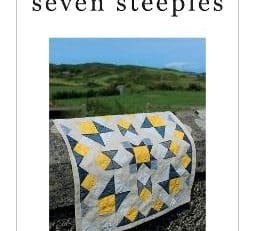
    ‘Seven Steeples’ by Sara Baume reviewed by Rory O’Sullivan: “a brilliant, captivating book which unfortunately does not get to the heart of the matter”.

      In Spring, when I was born, Ireland was full of daffodils: in the city in window-boxes and the front-gardens of houses, apartment-buildings, and on the stony small ridges beside footpaths as well as here and there in forests and uncultivated fields. I have always identified strongly with the daffodil. I have never said so openly before to a single person – nor, to be honest, have I remembered it much myself; and yet every Spring, like when an old friend’s favourite piece of music comes on in the car, suddenly, entirely they fill my thoughts at the centre. I am convinced that the part of everyone’s life we call ‘inner’ is like this: what Baudelaire described as “forests of symbols/who watch us with familiar looks”.  Our deepest selves are less a stream of ideas than a criss-crossing lattice of relations, memories, habits, and desires all around particular things. For everyone who exists there is a kind of secret symbolism, a non-verbal language, revealed to them and them only: it is their passport through life. A novel tries either to elaborate one new such symbolism in its writing; or else to depict in some way the conditions in which it forms, to discover or at least raise the possibility of an Ur-language, a theory of universal totemism; or else simply to scold and terrify people, or make them laugh. ‘Seven Steeples’, the latest novel by Sara Baume, is of the second kind. It is much less a story than a list of the objects and creatures encountered by Bell, Sigh, and their two dogs, who have left Dublin to seek out a way of life in the South-West far away from everybody. Insects, nettles, the washing machine – each other – the book is really about its paragraphs, like musical phrases, each describing an encounter with something, new or old, and its conversion into a symbol. Insects, nettles, the washing machine – each other – the book is really about its paragraphs, like musical phrases, each describing an encounter with something, new or old, and its conversion into a symbol. Baume’s sentences rhapsodically repeat words and make liberal use of the ‘Tab’ and ‘Enter’ buttons on the keyboard; sometimes the paragraphs feel like they were written by Alice Oswald. But if in Oswald’s poetry, which is after all made of verses, the point is to approximate by turns the gushes and drips of water, in Baume’s paragraphs it is to approximate the wind. As symbols, both water and wind are varieties of nothingness, which is to say that these stylistic approaches are both about accommodating non-being in speech. But if water is a refracting spread that pulls reality apart, then wind is a blustering movement that sweeps it all together. The embedded theme of Seven Steeples is oneness: symbiotic oneness, how things live by encounters with each other; erotic oneness, the drive towards the whole which is the greatest significance of love; and beneath these, symbolic oneness, the idea that in truth everything is one. The embedded theme of Seven Steeples is oneness: symbiotic oneness, how things live by encounters with each other; erotic oneness, the drive towards the whole which is the greatest significance of love; and beneath these, symbolic oneness, the idea that in truth everything is one. In a way this idea is very old – at least as old as the Greek philosopher Empedocles – the tone, shape, and themes of this book recall the Ancient Greek novel Daphnis and Chloe. What is new is how this deathly wind, this oneness gusting everything into symbols, is so strongly aligned in the book with interiority and the rejection of other people. As a result what we are given here is essentially a beautiful but false and virtual reality. People often say that virtual reality is something in the future – the day we can put on glasses and see the Spotify menu in front of us – but at least in sound rather (and more importantly) than sight, it is already here. Everywhere now public spaces achieve a kind of altered reality through music. For anyone who uses headphones this virtualisation of experience is even more profound, more personal, more constant, and in the end more solipsistic – think of the stereotype of the teenager with headphones tuning out the world. In ‘Seven Steeples’ headphones come up a surprising amount, even if near the end they are replaced: “In November the song of the house was a gurgling in the throat of the bathroom tap, a crackling emitted by the tangled TV cables. The boiler growled. The fridge purred”. Whereas in the past a ‘song’ was conceived as a public performance, something you went and looked at, someone talking to you, here it is imagined as something lived and moved around in: this kind of ‘song’ has not been widely available for more than a few decades. It is a great metaphor – two hundred years ago would someone have come up with it? I am not sure. None of Bell and Sigh’s friends of family (who do not appear in the book) understand what they are trying to do, which is to transport themselves into a reality as solipsistic and virtual – as musical – as can be. None of Bell and Sigh’s friends of family (who do not appear in the book) understand what they are trying to do, which is to transport themselves into a reality as solipsistic and virtual – as musical – as can be. This is not to say that the alternatives to which the book refers (emails and The Nine O’Clock News) are any less virtual; but Seven Steeples is about Bell and Sigh swapping one dream for another, somebody else’s for their own. The two dreams have the same basic origin. In A Line Made By Walking, also by Sara Baume, the main character takes photos of every dead animal they find. It is typical of her characters

    Loading

    Read more

  • Posted in:

    Rory O’Sullivan reviews Salvatore of Lucan at the Kevin Kavanagh Gallery: Painter of Universal Love The intellectual truth of modern positivist materialism is the psychedelic.

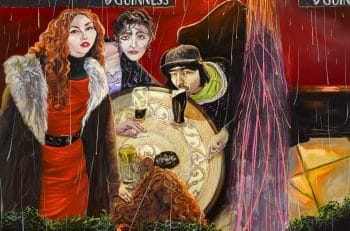
        Everywhere Salvatore of Lucan’s art combines a rigorous and searching honesty about all the most characteristic aspects of a single place, time and self with the intense feeling of a world which is not that place and time – even his name: as much serious as joking, as much old as completely new. If perspective is to visual art what drama is to theatre, then at the climax these paintings cause us to look through the eyes of a universal kinship If perspective is to visual art what drama is to theatre, then at the climax these paintings cause us to look through the eyes of a universal kinship. Most of us love no-one except maybe our families and a few friends, but here for the brief period of observing we understand that everyone, no matter who they are to us, needs and is worth love – even if sometimes they also need forgiveness. It may be (and strictly speaking there is no reason to believe not) that someday the view which is the heart of these paintings will become the global view. But for now, this perspective, arising from our own time in these paintings as from so many others before in other places, remains timeless: a perspective of un-time, of the future. Even before LSD, the psychedelic had already revealed itself as the profoundest contribution to thought of so-called modernity. Its place is equal to that in Christianity of Christ’s atheism on the cross (God, why have you forsaken me?). Those words revealed to the few among so many Christians afterwards who saw that the profoundest divinity in the human condition is the same as its most abject and most material suffering, its barest abandonment. If the divinity of wretchedness is the intellectual truth of Christian teaching, then the intellectual truth of modern positivist materialism is the psychedelic, which is about the beautiful and affective quality of things. If positivist materialism says we are protons and electrons, the psychedelic says this is what protons and electrons are like. In that strange sphere, it is possible for every convention and perception of form to melt away or else become completely different. We are forced to recognise ourselves as what Rilke called “Pollen of the blooming Godhead”. From this standpoint, the psychedelic, Salvatore of Lucan devotes himself in his paintings to understanding its brutal and widespread counterpart, the intoxicant. From this standpoint, the psychedelic, Salvatore of Lucan devotes himself in his paintings to understanding its brutal and widespread counterpart, the intoxicant. The intoxicant lures us in with its dreamlike verisimilitude to psychedelic reality, with its altered experience of drunkenness/being high, combined with the avoidance of seriousness. But in the end this same mechanism serves only to increase suffering by making everything apart from intoxication less bearable, more difficult, less changeable, more dull, less psychedelic. And as against this fear we lose the power to do anything other than repeat this intoxicating pseudo-experience, we change: the end-result of intoxication is deformity. In ‘The Castle Lounge,’ ‘Family Time/Nanny’s Shriek’ and ‘Me Being an Arse’ the subject is alcohol. But ‘Work’, which depicts two employees of what seems to be an IT-retail shop with a skeleton below under the floorboards starting a painting, and ‘Me as a Blemmyae’, where he is staring intensely at his phone, set up for Zoom with a ring-shaped webcam light, are also about intoxication. All ideologies – as well as ambition, money, power, and everything else that places the virtual above the actual – are intoxicants. All ideologies – as well as ambition, money, power, and everything else that places the virtual above the actual – are intoxicants. Currently what is missing in the public debate about alcohol is a sense of how it differs from these other things not in kind at all, only by degree. In these paintings usually the characters get drunk, and always they are subjected to the intoxicated fantasies of a broader world. The two indications of this are deformity, which is one of Salvatore of Lucan’s most developed tools; and defiance, which is his most impressive. Traditionally speaking the deformed is the other – hence all those fascinated descriptions and collections of monsters in Antiquity and the Middle Ages from which comes the ‘Blemmyae’ of one of the paintings – here deformity is about the self: the intoxicated self, deformed and distended by falseness.   But there is also the psychedelic self of whom deformity is the central condition: this is the defiant self, whom we can see in the eyes of every painting, the green and beautiful eyes for example of ‘Me as a Blemmyae’, and the deep and questioning eyes in ‘The Castle Lounge’.   The eyes of people in these paintings designate something in them that is strictly their own, that does not belong to anybody. The intoxicant offers an escape from suffering and death, but its price is deformity and at last self-destruction. If the psychedelic promises to transcend these it is only by confronting them in full horror: because horror, always, eventually, when you look at it for long enough, becomes beauty.   In the middle of this exhibition there are two paintings: ‘Forget Me Nots’, of a pot of flowers with a skeleton underground beneath them, and ‘Dead Present’, after which the exhibition is named and the smallest painting by far – of the same flowers dead and bunched hanging upside-down by a rope with a cross-shaped knot a few centimetres above in a Tiepolo-blue background, like the sky. In the first, life is stalked by death; in the second, death meets the open air of life.   There are many reasons to think our place and time is hopeless. But this exhibition shows that whatever else at least some part of it has not given up on itself. It is still possible for there to be among us an artist, who, even if just while painting, strives to comprehend the task of

    Loading

    Read more

  • Posted in:

    Rory O’Sullivan reviews Alberto Giacometti at the National Gallery: a genuinely philosophical artist.

      a few hundred pages of hard books  – or else a few minutes with the sculptures of Giacometti Theorists try to understand the world as if unfolding in a giant process with certain rules, whereas for artists the point is to observe it as a spectacle of which any thoughts and representations are just shadows, like childhood memories. But digging in their ditches always they eventually find each other. Plato is beautiful and Shakespeare is wise. Eventually the theorist sits back and laughs and even in Kant there are pages where the argument is carried by nothing but sheer ecstasy, in their repetitions and motifs at last artists discover obscure laws of which the elaboration is their gift. like Jack Yeats, instead of shapes he saw the world as lines Swiss-born Alberto Giacometti (1901-1966) was a genuinely philosophical artist in this sense. Apart from the earliest  pieces those collected here have an obvious unity of purpose: he wanted to describe the human condition as the ground. His sculptures, rather than the free-standing and well-bodied Michelangelo’s David, are mostly trapped as if sinking, but also (if you look from the side rather than the front) as if in judgement, enthroned with gravity on the stream of clay. He was so much a sculptor that even his paintings and drawings look like sculptures. But like Jack Yeats, instead of shapes he saw the world as lines: from that torrential criss-crossing figures emerge, more substance than form, as if soon to vanish. The exhibition is divided according to the models Giacometti used: his wife, his brother, his friends, and a man named Isaku Yanaihara. The photos of each near their sculptures are interesting and revealing. If Giacometti chose the same people over and over it was not because he wanted to sculpt them: it was because, just like Giotto and Charles Swann, for him there were a few primordial faces that represented everything and which each time he sought to disclose. The word for such a thing, in which is contained all of Giacometti’s debt to ancient cultures, is God: neither God-the-Father, nor the stupid God-of-Fire and God-of-Sleep entities of the modern imagination of polytheism, but Gods like Roberto Calasso’s description of the Vedic Rishis: “those who know something and keep silent, those who see what is looming”. The sculptures of Giacometti never act, but he was careful to give them aura: they are severe and full of light but give nothing away. The face is at the heart of this with its serene and perfectly divine expressionlessness. The name – ‘Half Length of a Man’, ‘Bust of a Woman with Folded Arms’ – like the face, is empty, and gives the observer not a single clue. Two shortages in this exhibition are walking sculptures and small sculptures. Giacometti once said “I can never make a woman in any other way than motionless, and a man always striding; when I model a woman, then motionless; a man, always walking”. The fact that no sculptures of men walk here is a shame, but it does make clear that Giacometti rather meant that in his work every woman is imposing and each man resigned. The obvious first- and second-sex connotations of this are certainly there. For Giacometti, women are imposing because of their intensity as desire-objects: this gives them a power that manifests in a few exceptional works in the exhibition. First, near the beginning, a small bust of his wife, painted blue and red – the childishness of feeling in the colours is extraordinary. Second, the ‘Bust of a Woman with Folded Arms’ – its model a woman named Francine Torrent – smiling. In her unique, closed smile there is jouissance, the bird flying in the air: an invitation and a threat. It is striking that Giacometti, a friend of Simone de Beauvoir, regularly at Les Deux Magots, repeated from a male point of view the precise terms of the difference between men and women that their society made seem natural and she eviscerated – whether to condemn or exalt it, I am not sure. As for small sculptures, more of them would have helped with understanding what Giacometti does with size: the large he always breaks down into fragments, the small he closes into unity, each disappearing and arising together and against each other from the generative cascading of the ground. The person who has come closest to Giacometti in this regard in theory was Gilles Deleuze, whose golden period as a philosopher began just two years before Giacometti died, in 1964, with Proust and Signs. That he never refers to Giacometti is completely beside the point: it was typical of Deleuze to speak about everything except what was profoundly nearest to him. Deleuze said things like “Being is said in a single and same sense of everything of which it is said, but that of which it is said differs: it is said of difference itself” and “The inhuman in human beings: that is what the face is from the start. It is by nature a closeup, with its inanimate white surfaces, its shining black holes, its emptiness and boredom”. To understand these lines it takes a few hundred pages of hard books like Difference and Repetition or A Thousand Plateaus – or else a few minutes with the sculptures of Giacometti. Giacometti: From Life is running at the National Gallery of Ireland 9 April – 4 September 2022. Tickets €5-17 with discounted rates on Tuesday mornings and Thursday evenings. Image: Alberto Giacometti Buste d’homme (Lotar II), c. 1964-1965 © Succession Alberto Giacometti / ADAGP, Paris, 2022    

    Loading

    Read more

  • Posted in:

    Tarry Flynn reviewed by Rory O’Sullivan: worthy, entertaining and physical:  every five minutes make you forget the previous five

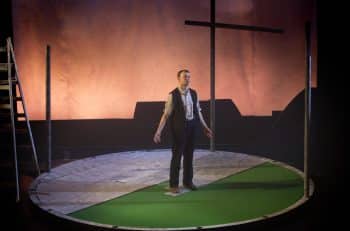
        In poetry the nearest figure to Patrick Kavanagh is Charles Baudelaire. Both were often destitute. Both found a verse that was above all music, not aspiring to music, like Walter Pater said of every art-form, but music itself made of words and because of it more profound.   For both men the heart of the effort was to make everything a spoken song, and a suspicion that it is one already; both made as much room for beauty as its privation.  But if Baudelaire’s main concern was to capture the putrid falseness of life in the modern city as an image of life everywhere Kavanagh’s was to dream of the true life gushing forth, the repose of memory and desire in happiness, too often misinterpreted as rural pantheism.   But both Kavanagh and Baudelaire succeed more often, if less thoroughly and famously, in their prose.   Baudelaire’s exalted dismissals of forgotten French painters are matched by Kavanagh’s invectives against Irish writers like WR Rodgers and FR Higgins (“Writing about FR Higgins is a problem – the problem of a labyrinth that leads nowhere”). With Baudelaire’s breath-taking asides on the French Revolution there are Kavanagh’s on the Irish question: “All of us who are sincere know that if we are unhappy, trying to forget our futility in pubs, it is due to no exterior cause, but to what is now popularly called the human condition. Society everywhere today and its beliefs are pastiche: there is no overall purpose, no large umbrella of serenity”.  And: “The questions we never ask ourselves in Ireland are: Do we believe in anything? Do we care for anything?”. Kavanagh’s two prose-books are ‘The Green Fool’, an autobiography, a masterpiece; and ‘Tarry Flynn’, a novel nearly as good as his long poem, The Great Hunger, because it is the same thing but set in Cavan instead of Monaghan. The theme of all three is a tension Kavanagh’s two prose-books are ‘The Green Fool’, an autobiography, a masterpiece; and ‘Tarry Flynn’, a novel nearly as good as his long poem, The Great Hunger, because it is the same thing but set in Cavan instead of Monaghan. The theme of all three is a tension: Kavanagh or Flynn or Maguire is caught between the beautiful world of his heart where there are no words, and society, where there is work to be done and questions in need of answers.   Writers often aim to fill gaps in themselves: every school student has heard the maxim, ‘Write what you know’,  but a more honest one may be ‘Write what you need’.   Kavanagh needed this argument with himself: he was vicious and took no shortcuts, which was what gave his words energy, how he could say O the thrilling daisies in the sun-baked hoof-tracks. O the wonder of dry clay. O the mystery of Eternity stretching back is the same as its mystery stretching forward.   He hated theatre. Its root problem for him was the audience: like a congregation in the abstract it seems like a good thing, but without the individual’s sense of real life it falls for simplicities, pietisms, cheapness, and what he called “newspaper morality”. There is a certain foolishness as well as bravery in choosing to adapt for stage a novel whose almost entire appeal is its narrative sentences – with a result its author would certainly have despised.   But this is the twenty-first century: Kavanagh is dead, and the production of ‘Tarry Flynn’ by Livin’ Dred Theatre Company, touring the country, briefly in the Pavilion Theatre in Dun Laoghaire, is lively, with huge range, impressively lurching from each thing – every five minutes make you forget the previous five – to the next, so that what comes out mostly is a theatrical sense of joy: a sense of play. this adaptation gets two important things right: it lets the words from the book do the talking (though with the ground artlessly salted here and there with lines from the poems), and it adds a lot of jumping and somersaulting to give the theatre-element. Originally by Conall Morrison and performed in the Abbey Theatre in 1997, this adaptation gets two important things right: it lets the words from the book do the talking (though with the ground artlessly salted here and there with lines from the poems), and it adds a lot of jumping and somersaulting to give the theatre-element. The worst bits are when it leans on tropes of Late Late Show Irishness: a Mammy, a spineless and severe priest, ‘Cotton-Eyed Joe’ – mercifully not as heavily or often as the kitschy Irish music at the performance’s start would mislead you to believe.   Mostly the show is entertaining singing, dancing and shouting interspersed with a few scenes and monologues by Tarry. In this production nine actors play fifty roles, which gives it a frenetic feeling and a sense of fun.   The weirdest part is when actors playing a bull and heifer act out having human-style sex to music in a cow-costume and bull-inflected gimp suit; the most touching are any of those when Tarry stands alone onstage simply talking about what is in his head.   The shame about this script and production is that it treats all its best parts the same way: raise the audience to a level of exalted feeling, bring them there with Tarry, and then pull the rug out immediately with his Mammy calling him to go to mass or pop a blister on her foot.   This makes the relation between the romance and the real, the inner and outer, tense but stable, easy to delineate and follow. On the other hand ‘Tarry Flynn’ the novel is about destabilising this, causing the real and romantic to spill into each other and contaminate both.   Which is why, at the end, when Tarry’s uncle sweeps him off to big life in the towns, his mother and he heartbroken, ‘Philadelphia Here I Come’–style, as

    Loading

    Read more

  • Posted in:

    X’ntigone at the Peacock: Amanda Gorman in combat boots. Reviewed by Rory O’Sullivan. The production feels like it has been authored by a committee

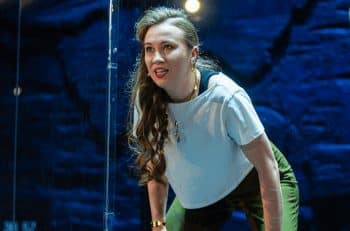
    One of Greek tragedy’s foremost concerns is the contemplation of polarities. In a part of Sophocles’s Antigone, Ismene tells her sister, “You have a warm heart for cold things”, In ancient Greek culture, warm things are alive, cold ones dead; but for Antigone, now, the fire of her life and self has its source in that cold thing, her brother’s corpse; and when she gives up her life wanting to bury it, burning with this wish, her heart, dying, becomes cold. The unity of opposites, the separability of truth: Greek tragedy. Antigone wants to bury her brother, Polyneices. The previous night he, with an army, attacking his home city of Thebes which has seven gates, at the seventh, fighting one-on-one against his brother, Eteocles, defending the city, died.  With two simultaneous blows, like on a frieze, falling, each killing the other, together at once, they died. Creon, whose role here as in Oedipus is to walk into the ruler’s part when the stage is empty and figure out what must come next, commands that Eteocles should be buried with all honours; but that Polyneices, who after all has just led an army against his own city, must lie bare on the ground to be eaten and waste away. The penalty for burying him is death. Simply, Antigone’s plot is her decision to defy this order, which, because Creon made it, is the law. The pair of Antigone and Creon have captivated among others Hegel, Brecht, Judith Butler and Séamus Heaney. For ancient Athens, a handmaid’s tale sort of city, Antigone was far over the edge just as Creon was too much in the middle. That they were interested, in Athens, in her at all shows this: the pious and the profane, the tyrant and the resistant, need each other in obscure ways; they are dance-partners. In Sophocles’s play there is no better proof of this than the side characters. Antigone’s sister, Ismene, and Creon’s son and Antigone’s husband-to-be, Haemon – stupid, reckless, caught in the middle – are equals of most of us. Teiresias, the blind seer, is like everyone when they know something pays with his powerlessness to alter it. Each is forced to where they end up by this secret, centrifugal thing, this law, which, when Antigone and Creon do not back down from each other (and she knows this better than him and mocks him for it), is what they commit to. ‘You have a warm heart for cold things’.      But the play’s best and most elusive opposition is between the action and the chorus: ‘the play’ (characters and dialogue) and the poem, in a special dialect and metre, which a group of dancing and well-dressed paid amateur actors performed between scenes. Maybe it is better to say that the play is between verses of the poem. The chorus has lines such as “There are lots of astounding things and none more astounding than humanity”,  and “Wandering far and wide, hope for many people is a dream” and “Love, who sweeps down through herds.”. The chorus, an ideal unity of the civic and religious elements, the poetic and speculative forms of thought, the individual and the group, of which it may be said that the Festival Dionysia in Athens, where the plays were first performed, was a continuous and blundering examination, has ensured that every straightforward attempt at Greek-style tragedy from the Romans to this day feels like a copy of an original.   Which makes them hard to adapt. X’ntigone (Zan-ti-guh-nee)’s biggest problem is that it does not decide whether to make the effort. On the one hand, the characters keep the original Greek names, which in modern mouths are like elements of the periodic table rather than words which a parent would call an infant; they discuss offhandedly Thebes, Persians, Oedipus, Laius; on the other, X’ntigone herself (who explains that the X signifies unpredictability, and is an homage based on – a faulty understanding of – ancient Persian mathematics), rejecting all the stories of ancient Greece, loudly and emptily says: “The Master’s Tools Will Never Dismantle The Master’s House.”.  The plot is different: the focus is a pandemic with the government and rebels both carrying around strains of the virus in test-tubes to inflict it on each other. Stripped to a discussion between X’ntigone and Creon, who both know all of this, but must repeat it so that the audience do, the play wallows in forced exposition, making its characters seem like they are inventions. Still, it is tough to divine what is going on. It is hard to shake the sense that this play wants everything but achieves nothing – Greek tragedy, Covid-19, Audre Lorde – the worst of all worlds, a play of ticked boxes authored by committee. The actors, Eloise Stevenson and Michael James Ford, do well with what they have. The problem is that the struggle between Creon and X’ntigone does not go anywhere, as if it was Blofeld versus Amanda Gorman in combat boots. X’ntigone is Good, Creon a Supervillain: there are no surprises. Near the beginning, twice, Creon is dismissive about non-binary people; later he even says that “Laius drained the swamp”.  The only twists are two “I knew about your plan all along” moments when X’ntigone and Creon each give ‘Order-66’-type instructions to the government and rebels through iProducts. The set and lighting in this production, designed by Ciaran Bagnall, are striking and interesting: for the whole of this production X’ntigone is imprisoned in a glass quarantine-cell. Unfortunately so is the performance.   X’ntigone (after Sophocles), written by Darren Murphy and directed by Emma Jordan is playing at the Peacock, Abbey St Dublin 1, from 16 to 26 March 2022        

    Loading

    Read more

  • Posted in:

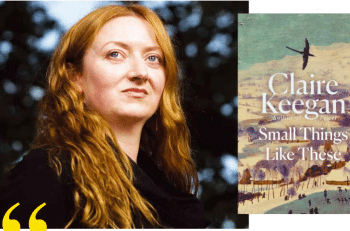
    The work of Claire Keegan: Can you ever have the same thing twice?

    66March/April 2022WEXFORD-BORN CLAIRE Keegan burst in on the Irish literary world in 1999 with her aptly named collection of short stories, ‘Antarctica’. These studies in extremity were followed by another collection, ‘Walk the Blue Fields’ (2008), which saw Keegan apply a less heady, more sedate artistry. But it was in 2010 that ‘Foster’, her novella and winner of the Davy Byrne’s Award for Irish Writing, frst located her alongside Maeve Brennan, William Trevor and John McGahern as one the fnest The work of Claire Keegan: Can you ever have the same thing twice?The ideal short story is like a knifeWhen working within the confnes of a short story, the result will either work or it won’t.practitioners of the short form. After an eleven-year-long wait Keegan has resurfaced with the highly anticipated ‘Small Things Like These’, another miniature study. Many writers have agonised over that perfect thing, that mythic little creature, the short story: so favoured and pursued and perfected, most obvious–ly by the great minds of Irish and American storytell–ing. Still more voices have sought to conjure the ex–act formula required for its construction. Where does that instinct come from we may wonder, the instinct By Nadia WhistonCULTURE March/April 2022 67to categorise the elements that must combine to ensure that a miniature work of art happens in the way it is meant to. Perhaps this aware–ness tells us that, when working within the confnes of a short story, the result will either work or it won’t. It is either a perfect thing or is not. The success of the thing is absolute.For F Scott Fitzgerald the secret lay in fnd–ing the “key emotion”. Michael Swanwick felt that the short story “should be something that can be held in the mind all in one piece”, that the “ideal short story is like a knife – strongly made, well balanced, and with an absolute minimum of moving parts”. Claire Keegan’s ‘Foster’ (originally pub–lished as a short story in the New Yorker, later as a novella by Faber) has haunted readers for a long time. It is the type of story that comes to rest in you. When you think of it, you can feel it there, the way you remember the feeling of your dog’s head in your hands, its weight, its memory. It tells the story of an unnamed 10-year-old narrator and her stay with the Kinsellas on their farm in Wexford in the hot summer of 1989. Her mother is pregnant again and she is to stay with them until she is called back. It is the familiarity of ‘Foster’, its clarity, its specifc mode of humanness which makes it a difcult book to get over. Linguistically it is propelled by the purity of vision in the describ–ing ‘I’ of the narrator. Her essential innocence acknowledges and uncovers, without senti–mentality, the pain of the adults whose world she enters. She enables their grief to breathe, to be understood. And while she tells us who they are, about the tenderness with which they treat her, we come to glimpse her pain and her longing. With remarkable, bafing, simplicity readers are reminded of the imperative for, and the exquisite consequences of, afection; of our need for it, of the moment when we re–alise what having it feels like, of the moment when it gets taken away from us. In ‘Foster’Keegan re-entered, shape-shifter-like, into a space she had occupied before. In her debut, ‘Antarctica’, Keegan had stepped weightlessly a handful of times into the soul of a pre-adolescent girl. It is a role over which she displays quixotic power. One which, by vir–tue perhaps of its timing, ofers the author the ability to intercede upon the privacy of their thoughts, capturing them with a light androgy–nous hand. These very young women are often watching their mothers, see their fathers mis–understand – often mistreat – their mothers, they watch their mothers try to be women, try to be mothers, they watch their mothers fall, retreat, rebel and collapse. Interestingly and refreshingly, their almost tomboyish observa–tions ofer no feminist stance, no pointed or driven critiques. The women’s tales are set among the very physical provincialism of rural Ireland, root–ing them in an earthy salty muddy very real and quite asexual nightmare. Humanness is positioned directly against the elemental; the harsh demands of life take the form of trau–matised chickens. Heifers cry and moan and bewildered sheep are driven to the sales in the boot of the family Volkswagen. There is a degree of comedy which binds the margins be–tween nature and love, sex and violence very close together, and it has the efect of neutral–ising the many elements, establishing them as inseparable forces; capturing the ofbeat, awkward, cruel, often tragic reality of human existence. But through all of this Keegan exerts an im–pressive control over her visions which prohib–its drama. And unlike, for example, the important voice of feminist short-story-teller, Meave Kelly, Keegan communicates the devastating emo–tion of her stories with images rather than by lines of reported thought: we are not told what to feel, nor what our characters feel, instead meaning is trapped inside the images of what our characters see. The efect is not strident, it does not protest; it is evocative, poetic and necessary. The androgyny of Keegan’s voice draws un–expected comparison with other Irish voices in literature. Colin Barrett’s ‘Young Skins’ (a collection When you think of Keegan’s ‘Foster’, you can feel it there, the way you remember the feeling of your dog’s head in your hands, its weight, its memoryfrom 2013 which won the Frank O ‘Connor International Short Story Award, the Rooney Prize for Literature, and the Guardian First Book Award) has the abrasive power of early Keegan. Barrett’s ‘Bat’, like Keegan’s ‘Love in the Tall Grass’,is one of the fnest studies of a life I have ever read. Unlike the author of ‘Foster’, Barrett chooses as his constant stage the Irish provincial town; his hero the male adolescent. His characters do not witness sexuality, they are

    Loading

    Read more

  • Posted in:

    Irish as ecology

    62March/April 2022SoulPÁDRAIG PEARSE, the Irish revolutionary leader of 1916, declared “Tír gan teanga, tír gan anam,” which translates as “A country without its language is a country without a soul”. Certainly, by 1916 Ireland was a country that had lost its sense of self. Although acts of rebellion ultimately resulted in an independent state for roughly two-thirds of the island, much of what was hoped would be restored fell by the wayside. The reasons for Ireland’s predicaments are, of course, historical. The sins of colonialism reach into contemporary Ireland still. What Ireland has become is an imitator of trends, as opposed to a nation certain of itself and its defning characteristics. What Pearse described as the country’s soul remains lost. This sense of loss predominates in us as a people since residing in Ireland’s language Gaeilge(Irish) lies much of our heritage. It’s a language most of us don’t know. The language is at the periphery of a nation dislocated from itself. Irish as ecologyBy Liam Tiernach Ó Beagáin and Laoise Ní FhearchairThe language: from politics to culture to society marketed as environmentalismis promised for us, the humans. Neoliberalism is winning the ideological battle. The Irish view of life is weakening. But it can be resuscitated by the gems held in our language. Our culture is often mocked and belittled. The language is often demeaned. Viewing one language as superior to others is utterly rejected, indeed disdained, by contemporary linguistic theory but how often do we hear of contemptuous alienation from the simple pieties of the Leaving Certifcate novel, ‘Peig’. Modern life is full of this. The relentlessly driven ‘power-couple’ Vogue Williams and Spencer Matthews (we shall refer to them as “WM”) recently described Gaeilgeas “an ugly language”. Ryanair, Ireland’s low-fares airline openly mocked the language when Irish speakers asked for an Irish-language option on its website, while 3 Mobile asks people with “difcult” Irish names to translate them into English. Attitudes like these are not new. For example, the great Catholic emancipator and royalist Daniel O’Connell viewed Gaeilgeas inferior to English. We discuss here how our currently unused language can help move us toward a psychologically healthier, more culturally rich and caring society, and in doing so end the alienation of a nation. 1. Contemporary Ireland: Neoliberalism, humans and superhumansToday Ireland is haunted by colonialism, while a rampant capitalism perpetuates deference to outside ideologies that confict with who we are as a people. Neoliberal ideology encourages the false neo-Darwinian belief that it’s sink or swim. One must outdo the other to ‘get ahead’. But always inherent in the Irish attitude to life is zeal for strength in unity: that we are all in this together and that we look out for one another. This is what we want, but it’s not what we have. On the one hand, massive tax-free profts are guaranteed for multi-billion dollar corporations that we will describe as the superhumans. While, on the other hand, little CULTURE March/April 2022 63Some of these mind-sets towards Irish culture can be summarised in the following aphorism: what was: inferior, what’s now: superior. But it’s an absolute myth. What we currently have is an unsustainable greed machine built on a post-colonial porridge of wafe-ideology. Certainly, whatever of O’Connell, contemporary views such as WM are driven by the language of a specifc individualism that, for example, Friedrich Nietzsche so despised (‘On the pathos of truth’, 1872) – one that Jean-Paul Sartre warned would lead us to an inauthentic life (‘Being and Nothingness’, 1943). In buying into the view of life that the superhumans ofer, the individual, believing themselves to be free, hands over responsibility for their lives to them. From a deontological perspective, the individual is but a means to an end, who is unknowingly used in acts of repulsion towards Kant’s ethical demands and thus becomes the amadán or fool. If a language not only represents societal concepts but also shapes them, in what the great linguist Wilhelm von Humboldt (1767–1835) described as a nation’s “character of language”, then perhaps the language common in Ireland today (whatever its tongue might be) describes where our values lie. Elite decisions appear to result in ever-greater choices for everyone. However, choices trend to what seem to be consumer-driven demands, since these choices are agreeable with elite interests. Vacuous freedoms of choice in consumer purchases are illusions. Actual choices in other areas bear this point out, since there are little or no choices. Healthcare and housing are not easily available unlike, say, noodles.Humans demand togetherness. For example we want afordable healthcare and housing and we want the superhumans to pay their fair share. However, this is not in the interest of the superhumans who are so neatly entwined with government. For example, over half of Ireland’s TDs are millionaires tied to property and fnancial instruments (Philip Ryan and Wayne O’Connor, ‘Revealed: Half of Ireland’s TDs are Millionaires’, The Irish Independent, 13 May 2018). The cosiness between elites and TDs has been encouraged by successive Irish governments through tax-exemptions that allow the superhumans to buy up large swathes of housing, efectively barring the humans. What has resulted is another governmental crisis and is one that is best swept under the rug since such stories are not becoming in a media concerned with elite interests (the classic by Herman and Chomsky, ‘Manufacturing Consent’, 1988, explains why). Real freedom is saved for persons seen to be of merit. Despite what their very own mythoswould have us mere mortals believe, these superhuman entities are not signs of humanity overcoming itself, but more than likely, if allowed to continue they are signs of humanity ending itself. Let us focus on tax for a second. It is estimated that multinational corporations have avoided €1 trillion in taxes through what is known as the Double Irishtax loophole (Paul Mark, ‘Ireland is the world’s biggest corporate “tax haven”, say academics’, Irish Times, 13 June 2018). Apple has been an egregious benefciary of the Double Irish. While Ireland was still struggling under

    Loading

    Read more