

Culture

Random entry RSS

  • Posted in:

    Not quite feeling the Bern

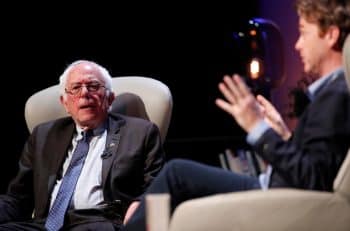
    In the foyer collected a curious mix of tattooed half-American lefties, millionaires, NAMA refugees, journalists, politicians and the plummy denizens of Dalkey. Interestingly there did not seem to be a presence from Ireland’s hard left or even soft left, though Eamon Ryan was there. What they were there for, surprisingly, was Senator Bernie Sanders, recent Democratic Presidential candidate, on his first ever visit to Ireland speaking to the Dalkey Book Festival at the Bord Gáis Energy Theatre. Tickets – €35 euro including a compulsory copy of his book ‘Our Revolution, A Future to Believe In’ – had sold out in under five minutes, which was quicker than Katy Perry’s gig at the theatre. This was because attending this event was a Cultural Statement for the Irish political classes. What they were not there for (except the plummy denizens) was David McWilliams but he was, predictably and essentially, oblivious to this. He started proceedings with a lengthy, familiar and unnecessary summary of the “magic” appeal of Bernie but really it was about the magic of how McWilliams and his entourage had enticed Sanders off his tour of Britain to Dublin. McWilliams (and Sanders) had been welcomed earlier to Áras an Uachtaráin by President Michael D Higgins. This made McWilliams proud. You sensed he feels pride every time the President has him up. Then like a ringmaster he summoned Bernie from backstage and the audience rose to its feet. Sanders is a brilliant speaker: never a word astray, never dull, always passionate. On occasion he did refer to the US as “this country”, some of the speech – about terrorism for example – had been lifted from comments he must have made to British audiences earlier in the week and it was a little strange to hear an Irish audience cheer to the rafters acknowledgements of national political delinquency in another country, even if the country is the US. But Bernie is heroic and his talk was a joy to behold, politically. He opened with an excoriation of Trump’s policies on climate change. He said Trump’s actions in withdrawing the US from the Paris Climate Accord were “incredibly stupid and short-sighted and will end up harming the American economy and the world economy”. Trump’s claim that climatechange is a hoax is “dead wrong and not believed by the majority of Americans”. “How in God’s name do you make public policy in defiance of science?” he thundered, to applause. Trump was “lying through his teeth” when campaigning when he said he was on the side of the working class and at this stage in the cycle was the least popular President in history. He’d duped the people into believing he was on their side. Sanders said that 28 million Americans do not have health insurance and Trump’s measures would throw a further 23 million out of health cover. Trump plans to cut $800bn from Medicaid, which helps the poor, over the next decade and to defund Planned Parenthood which serves the poor with abortion and family-planning services, while, at the same time, providing a $300bn tax break to the wealthiest two percent of Americans. Trump’s Budget proposals are even worse, as he wants to cut $2.5tr from programmes that help the poor over the next decade while giving the same amount in tax breaks to the top one percent. He said Trump’s Budget proposals are “the ugliest and most destructive attack” ever by an American President on the working class, middle class, and poor people of America. His most incisive attack was on those who think they can champion equality in issues of feminism, abortion, racism and homophobia while not addressing the issue of the very richest, the 1%: of social inequality. He let loose on the very richest, particularly in America: “The top one tenth of the top 1% has almost as much wealth as the bottom 90%. 20 people in America own more than the bottom half. The richest 1 per cent of the world’s 7.3 bn people now own as much as the rest of the world put together. Eight men own the same wealth as the 3.6 bn people who make up the poorest half of humanity. After the Great Recession the total wealth owned by the top 1% of the population in the US grew from 35% to 37%, and that owned by the top 20% of Americans grew from 85% to 88%. 52% of all new income generated in America goes to the top 1%. One family, the Walmart Waltons, owns more than the bottom 42% of the American people. Under Trump’s proposals, that family would get a $50bn tax break over a decade”. It was blistering. And statistical. His most memorable attack was on the Democrat party for not representing the disenfranchised, for wasting time on fundraisers, for cultivating Wall St. After an hour of rhetoric from Bernie, McWilliams ushered him to a faux-livingroom set where he prodded him with questions, each of which necessitated a McWiliams’ hand revolution, every answer generating furious foppish nodding. McWilliams lounged the smug lounge of the initiate, head tilted in the general direction of Bernie at an angle twenty degrees north of what anyone who doesn’t run their own hedge fund would have adopted. However, there was an appropriate response from one of the world’s most people-attuned political practitioners: every time McWilliams asked a question from the intimate bay of yellow-lamp-lit armchairs where he and Bernie nestled, Bernie rose and addressed the audience, his back to the great man. Much worse than the optics of having an event for a radical leftie pre-paid and over-priced for a bourgeois book festival in a lavish amphitheatre that usually hosts blockbuster musicals, was the misconstruction of Sanders’ politics. At one point McWilliams seemed to make common purpose with Sanders, both being “people on the Centre or Centre-Left”. But this is a failure of imagination. To be clear: Bernie is on the radical left; McWilliams is a clever analyst whose whole body of

    Loading

    Read more

  • Posted in:

    Science ficsean

    Irish science fiction, dominated by writers from industrial Belfast but including works by Samuel Beckett, Kevin Barry and Louise O’Neill, demonstrates critical thinking in action

    Loading

    Read more

  • Posted in:

    Sex-abuse musical chairs

    The London-based Independent Inquiry into Child Sexual Abuse (IICSA) was established in 2014. It has a mandate to investigate VIP abusers with links to Westminster. Regrettably, it cannot be described as truly independent since it is a creature of the Home Office, the parent department of MI5 which blackmailed, protected and exploited paedophile networks in the UK and Ireland and has dirty tricks embedded in its DNA. An “independent” Inquiry? The Independent Inquiry into Child Sexual Abuse (IICSA) was established in 2014 by Theresa May in her then capacity as Home Secretary. Her first choice as chair was Lady Ann Elizabeth Oldfield Butler-Sloss, whose appointment was announced on 8 July 2014. A storm of protest swept her off the chair within days because she was the sister of the late Michael Havers. He had served as Margaret Thatcher’s Attorney General in the 1980s. As reported in Village last month, Havers spoke up for the high-ranking British diplomat and MI6 officer, Sir Peter Hayman, after he had been exposed as a paedophile in March 1981 by Geoffrey Dickens MP in the House of Commons. The police had discovered that Hayman had been involved in a paedophile network and was a connoisseur of child pornography. Havers, speaking in his capacity as Attorney General, parried that Hayman’s collection was not extreme and had not warranted prosecution. Butler-Sloss was born on 10 August 1933. Since the IICSA is likely to last another 12-15 years, she would have been well on the way to her century when it finished. Just what was Theresa May thinking? May’s second choice as chairman was Dame Catherine Fiona Woolf, DBE, JP, DL, who was appointed in September 2014 and lasted a month. She was a friend and neighbour of Leon Brittan who had served as Home Secretary in the 1980s. In 1984 he was handed the Dickens Dossier which exposed a VIP paedophile network, by Geoffrey Dickens MP. Brittan commanded all the resources of the police and by lifting a telephone could have ensured that immediate action was taken to end the rape and brutalisation of children described in the institutions in the dossier. Instead he did precisely nothing. Why? In 2014 it emerged that the Dickens Dossier had disappeared. When quizzed about this, Brittan initially claimed he had no memory of ever having received it but later relented and “recalled” he had handed it over to an official in the Home Office. After media reports that Brittan had been a dinner party guest at Woolf’s house on at least three occasions, she stepped down from the IICSA and was replaced by Judge Lowell Goddard who shouldered the burden until 2016 when it became too much for her. One would almost be forgiven for suspecting that the Inquiry was designed to topple over under its own weight. A subterranean campaign against the truth A campaign to suppress the truth about manipulation by MI5 and MI6 of VIP paedophile networks has been afoot for decades and shows no sign of abating. As detailed in recent editions of Village, last year MI5 and MI6 (which is attached to the Foreign Office) lied to the Hart Inquiry about their involvement in the Kincora scandal and received a clean bill of health from it. Meanwhile pro-establishment figures in the media (at least one of whom has been linked to MI6) have been campaigning to end police investigations into historical child abuse. There is growing support for this initiative among the British public on account of the behaviour of the police who investigated the singer Cliff Richard and others for child abuse when – patently – there was no evidence against them. Their behaviour was so inept one would be forgiven for thinking their intention was to poison the public against historical abuse inquiries. Some of the vice rings which the IICSA should be investigating overlap with networks in Ireland. The odds are stacked high that the IICSA will be persuaded to ignore them in light of the publication of the Hart Report earlier this year which was meant to have dealt comprehensively with Irish issues but was hoodwinked by the spooks. General-Election woes A small number of courageous Westminster parliamentarians have tried to shine a light on these issues during the last few years. Proving that no good deed goes unpunished, they have suffered nothing but bad luck and now face a more difficult battle to retain their seats in the British general election. Simon Danczuk MP is one of them. He is a candidate in Rochdale and author of the book which denounced the notorious paedophile Sir Cyril Smith. He revealed in 2014 that a Tory minister attempted to get him to back down as pressure was mounting on Leon Britton over the disappearance of the Dickens Dossier. He explained how: “As I was making my way from the House of Commons on Monday night after a late vote a Tory minister stepped out of the shadows to confront me. I’d never spoken to him before in my life but he blocked my way and ushered me to one side. He warned me to think very carefully about what I was going to say the next day before the Home Affairs Select Committee, where I’d be answering questions about child abuse. ‘I hear you’re about to challenge Lord Brittan about what he knew about child abuse’, he said. ‘It wouldn’t be a wise move’, he advised me. ‘It was all put to bed a long time ago’. He warned me I could even be responsible for his death. We looked at each other in silence for a second. I knew straightaway he wasn’t telling me this out of concern for the man’s welfare”. Danczuk persisted and became the target of a torrent of salacious reports about his private life in the red tops. Worse still, an accusation was hurled against him that he had raped a man in 2006, an allegation he described as “malicious, untrue and extremely upsetting”. At the

    Loading

    Read more

  • Posted in:

    The ruins of summer

    Growing up on the Mill Road in the suburb of Corbally in Limerick, I was always intrigued by what I considered to be the remains of an entrance to an ancient Greek temple leading down into the river. A forgotten gathering place bereft of any purpose. Having moved to Dublin I discovered other open-air baths in the sea no longer in use. I learned of their popularity up until the 1960s. With current proposals for Clontarf, Warrenpoint and Dún Laoghaire Baths, are we ready to take the plunge or are they destined to remain seashore antiquities? Taking the Waters While swimming in the sea has always exercised atavistic appeal for humans (and dogs), it was during the eighteenth century that sea bathing became particularly popular and  fashionable. Sea bathing was seen as beneficial to  health, in much the same way as taking the waters was at spas in Lisdoonvarna and Mallow. The earliest designated bathing spots were recorded on Rocque’s 1756 map, for men and women, at Salthill near Monkstown as well as a bathhouse on Killiney Beach. The increased popularity of sea-bathing during the eighteenth century saw many towns in Ireland and Britain develop as resort towns frequented by the upper classes during the summer months. While the south coast of Dublin benefited from an impressive sandy expanse, a disadvantage was the shallowness of the shoreline and the fact that at low tide, the water receded for a distance of as much as two miles. Certain locations along the coast, such as the Forty Foot at Sandycove, were prized for the fact that they were largely unaffected by the tides. The best-known sea-bathing places of today were established by the railway companies to encourage coastal businesses. The construction of the Dublin to Kingstown (Dún Laoghaire) line saw the closure of the baths at Booterstown and Blackrock, as the bathing huts there were now cut off from the sea by the railway, which ran along an embankment across the shallow bay. While the arrival of the railway did spell the end for some bathing spots, it opened up other parts of the coast for bathing. Man-made baths became increasingly popular during the nineteenth century with the earliest sea-bath or ‘lido’ (an Italian word for beach, bespeaking elegance and cosmopolitan excitement) erected in 1833 at Lymington in Hampshire, England. The bathing pools at Clontarf, Sandymount and Dún Laoghaire all followed the style of the Lymington baths. Significant for their maritime heritage and 20th century maritime recreation tradition.       Bathing in Blackrock As early as 1754 a proposal was put forward to build a bathing place at Blackrock. When the Dublin and Kingstown railway was opened in 1834 Blackrock was the principal village between the termini. The Blackrock Promenade and Pier Company Ltd decided to establish “a promenade Pier and suitable Bathing Place for the residents in the locality and for the use of the public at a point near Blackrock Railway Station”.  This followed public outcry that access to the sea had been cut off with the building of the Railway line. The baths were completed by 1839 and a special integrated train ticket also permitted entrance to them. In 1887 the baths were rebuilt in concrete with a large gentlemen’s bath and a smaller ladies’ bath to the designs of architect and engineer William Kaye-Parry. In 1928, the Urban District Council bought the Blackrock baths for £2,000 and readied them for the Tailteann Games, a Celtic Olympics. The baths, with a 50-metre, eight-lane pool, were well known for their swimming galas and water polo and could accommodate up to 1,000 spectators.  They boasted dramatic 10m and 3m springboards, as well as two smaller children’s pools. The decline in use of the baths started in the late 1950s when indoor heated swimming pools started to appear in hotels and local authority facilities. Dún Laoghaire Corporation closed the Blackrock Baths to the public in 1987. The Leinster branch of the Irish Water Polo Association made private use of the pools, diligently carrying out extensive cleaning and repair work to make the baths usable again after a year of exposure to the sea – but succumbing to the need to withdraw the 10m diving platform from use for safety reasons. At this point, the estimated running losses for a summer season were £10-30k, depending on admission fees. By 1992, due to lack of maintenance, parts of the baths were dismantled. In 1997 they were sold by Pembroke estates holdings to developers Treasury Holdings who failed to get planning permission for a shopping mall encompassing the baths site and DART station in 2001. An earlier (and greedier) redevelopment proposal  which came from a council ‘ideas’ competition in 1999 comprised 54 apartments and a restaurant with retail and leisure facilities. In 2013, the baths were demolished due to safety concerns following a routine inspection by Dún Laoghaire-Rathdown County Council. It was found that the diving platform had been significantly corroded and detached from the pool base. However, the bay in Blackrock is still used for swimming and board sailing.       Sandymount Swim Another massive seawater baths was built at Sandymount, designed by Frederick Morley, and erected as the Merrion Pier, Promenade and Baths in 1863. The baths did not operate all year round but  were usually open from late May until September. Serviced by both tram and rail it became very popular. 33,000 bathers used the facility at its height over the summer of 1890, splashing around in fresh seawater baths and reveling in ancillary pleasures such as music and refreshments. However, frequent ablution was not within the grasp of the unwashed poor. The Irish builder in 1863 noted that the  cost of admittance was well beyond what a labourer could afford, particularly if accompanied by his wife and children. It noted that these bathers ‘were compelled to shelter themselves in a [communal] bathing box close by with the scum of society…and were supplied with ragged garments called “bathing dresses” at

    Loading

    Read more

  • Posted in:

    Brother is bigger than you think

    With worldwide news leading with elaborate but anonymous hacking operations that have interfered with recent elections in the US and France – and pose a threat to the upcoming one in the UK – many are wondering how a foreign intelligence agency can conduct a surveillance or hacking operation without engaging with local law enforcement. Many have speculated why Ireland had been spared the terrorist attacks seen in other countries across Europe. It is possible there is a form of ‘Entente Cordiale’ between Islamic extremists and Irish law enforcement ensuring we remained untouched. In such circumstances a foreign agency would naturally be suspicious of any shared information and might look to conduct operations in a more ‘independent’ manner. Finding Targets Surveillance requires getting close to chosen targets to establish behaviour patterns and movements with the ultimate goal of eavesdropping on meetings and conversations to establish their intentions. The initial challenge would be to actually find a person of interest. There are many technologies that can be brought to bear on this problem including surveillance satellites, but there are far easier ways. Extremists need to hide where there is a large population, which immediately limits the choice of locations to one of only three or four cities in Ireland. Assuming an Islamic extremist is also somewhat devout, this narrows the search down to locations around our few mosques. They don’t need to live close by, merely to attend. Peppered around our target mosques will be mobile-phone-network antennae. Whenever a phone is powered on, when leaving religious services in a mosque for example, it reaches out to a number of mobile phone antennae to establish a connection. There would be two pieces of information of interest to our agency here, the initial connection information and the call detail records – more on those a little later. The initial connection information allows specific mobile phones to be identified. From this our agency might establish an initial group of targets, and start tracking on a rudimentary level. The phones don’t have to be smartphones with fancy GPS units, although that would make the process easier: the information is fundamental to the operation of the network and it is generated by every phone. Each phone has a unique identity that is used to tie it with all sorts of interesting information. Of particular interest is the call detail record, or CDR, used by telephone companies and hackable using illegal software. The CDR is a little nugget of information that underpins billing on mobile networks. It identifies, among other things, the number that is making a call, the number that is receiving the call, how long the call lasts and information on the telephone exchanges from which a general location of the caller and receiver could be largely established. From a CDR our agency could now track down a billing address and also a range of associates. Now it can start to infiltrate the homes of its targets. Through the Front Door Many extremists like the Internet, for its propaganda-spreading potential, sharing videos and pictures of their beliefs, ideals and manifestos, sometimes with abandon. Watching ISIS videos in a public place is not the best way to stay hidden so they have Internet connections to their homes. With the details from the CDR in hand, our agency could target Facebook, Twitter, Google and all of the other multiple Internet hangouts frequented by our extremists. With very little information a user’s Internet Protocol, or IP, address can be established. The IP address, while not unique, is enough to identify an Internet Service Provider; from there it’s a short hop for an intelligence agency to get to the Internet router, the anonymous device with the flashing lights connecting the extremist’s house, and probably yours, to the Internet. Suddenly, and invisibly, the agency can penetrate the perimeter of the target’s house. Closing the Noose The Internet router represents an extraordinary vulnerability in a house if not properly protected. Every Internet-enabled gadget connects through this single device and, to a sufficiently well-trained operative, it provides a digital potpourri of surveillance opportunities. There are three things to note at this stage, first the router cannot be properly protected, second even the poorest of intelligence agencies have sufficiently-well-trained operatives and finally routers can be compromised for weeks and months before raising any suspicion. Using the router as a stepping-stone, laptops, smart phones, tablets and increasingly ‘smart’ televisions all with microphones and cameras that can be turned on remotely and silently become available to the agency. The extremist has literally brought the surveillance device into their home and opened the door through which it can be accessed. Phishing for fun and Electoral Disruption The recent attacks on election campaign candidates fall into the realm of ‘phishing attacks’, bait-and-hook attacks with bad spelling. Phishing attacks present emails, instant messages and websites under a false flag. They look legitimate, but their entire purpose is to have the target reveal sensitive information such as passwords or bank account details. In the case of Macron, a mysterious Russian cyber espionage group, ‘Fancy Bear’ aka APT28, possibly associated with the Russian military intelligence agency GRU, last month registered decoy domain names, the addresses that drive the internet, which resembled the name of En Marche. Using these domain names, a flood of communications would have been issued, often, ironically, containing a security warning requesting password verification leading back to the false-flag domain. With this simple step, a user’s credentials are obtained, leaving access to the legitimate systems utterly compromised. In the case of Macron, those domains include onedrive-en-marche.fr and mail-en-marche.fr. OneDrive of course is the name of the cloud-based document service offered by Microsoft. The attackers’ standard mode of operation is to access these systems to download sensitive documents and materials, releasing it to the internet via Wikileaks or other leak sites, or through their own sites, to an agog international public. The Next Domestic Surveillance Device What do Siri, Alexa, Cortana, Amy, Bixby and Google Home all

    Loading

    Read more

  • Posted in:

    McLaren and Murray, fresh new faces in control of the Abbey

    I enter the sempiternally dingy Abbey by the stage entrance and advance up the mid-century staircase to a poky room alive with two middle-aged but effervescent non-Irish Celts. The guy at the desk has said he sees a lot of them and they seem effortlessly in control. They’re informal, blithe, cheerful and open throughout our whistlestop chat, bantering with each other supportively, and joshing.     Can you just please describe your backgrounds and records in the arts? Murray: “I’m from South Wales (McLaren thinks this is shaping up to be like a dating pitch). I‘ve worked as usher, stage technician and eventually front-of-house manager, in the Citizens Theatre in Glasgow. Stayed at the bottom for quite some time. Worked for 7:84 Company in Glasgow – a political touring company particularly touring rural Scotland. Ran a building, a beautiful converted church, the Tron Theatre in Glasgow as creative producer. I was the inaugural executive producer of the new National Theatre of Scotland based on a model of a theatre without a building, without walls, for eleven years”. As to what he brings that is special he says “I hope I’m an imaginative producer I have an eye to initiate and exploit and get the most out of them and I have a good all-round knowledge, love, passion for the theatre”. McLaren stops us to note that “John Tiffany, maybe the most significant theatre director of his generation (much as it pains me to say it) characterises Neil Murray as ‘the best theatre director on the planet’”. Murray intervenes to say drink had been taken. McLaren: “Neil and I have been associates for 20 years. When Murray ran the Tron theatre, I ran a touring company called Theatre Babel and we toured across the planet. Like Irish theatre, Scottish theatre is very small. He ran a venue and I ran a touring company. We kinda needed each other. When I joined National Theatre of Scotland we worked together again. In the last five years we worked together on a number of significant projects especially around the social and political changes in Edinburgh. I’m not sure what I bring to the table”. Murray intervenes to explain that he’s “primarily a very fine director of plays” and McLaren agrees “I direct and design plays”. “Coming to Dublin, we didn’t see it as an opportunity to replace what had been before but to envisage a new working model”.         The Abbey describes its mission as “to create world-class theatre that actively engages with and reflects Irish society”. So what’s the vision for the Abbey, and has it changed? McLaren: “There’s nothing we could argue with. That mission statement is always going to be the case. The problem when you give a phrase like that is that it sounds like a set thing. It’s responsive to the ever-changing Irish and global society socially and economically that we find ourselves in. Murray intervenes “It doesn’t really dig into how we think the Abbey will be working and how it fits in Irish theatre and society”. McLaren resumes: “it’s a great privilege to inherit an organisation with such a remarkable past but we have to be cognisant of the fact that its best years are ahead of it. As an organisation it’s been a long time since it’s behaved and thought of itself as if it’s best years are ahead. It’s way too quick to rely on its past brilliance to justify its existence rather than what we will do next year or the year after”.   But the protagonists have always said this, I note. According to McLaren they already have. Murray says, “I think the way the building’s work in terms work we’re producing ourselves and presenting with others’ work It’s a different model already. We’re saying, ‘The national theatre stage belongs to other people as well, not just the Abbey’. That is something that’s been ignored. So for example tonight, Druid: Waiting for Godot. Druid haven’t been here for over a decade. It’s a brilliant production that should be seen at the national theatre. Our programme for the year reflects that more open approach”.   So will there be more co-productions? “More presentations, co-productions. A mixed economy. The days of being able to produce huge shows eight times a year: it’s not what the theatre public want – they want a faster turnaround of activity. Economically it doesn’t make sense to do that it makes sense to be lighter on your feet ,working with wider range of people and artists from Ireland and perhaps further afield. In the end the audience define what the Abbey is. Going back to values, we have to believe anything we put on the Abbey stage is hopefully world-class and reflects modern Ireland. McLaren says “We said we’d investigate the three words around national Theatre of Ireland. What does it mean to be National? For the first time ever we’re about to go to Leitrim simply because it’s about Leitrim, no other reason: because it’s there. Hitherto the company’s attitude would have been we’ll put on some matinées and ensure the good people of Leitrim will be able to see it on a Saturday afternoon or we’ll do a special gala performance. No we’re going to go and make it there and use locals to build the show. That’s the first time in the company’s history that it’s explored what it means to be truly geographically National and Irish, and the different kinds of Irishness from the diaspora through to the new Irish who don’t even speak even English: they also have a national theatre – we’re it and we have a building on Abbey St. But we’re not confined to that”.   Are there dangers to co-producers of subsuming to the Abbey and losing independence? McLaren notes: “We’re there to collaborate”. Murray says it’s “The opposite. ‘Dublin by Lamplight’ by Corn Exchange, ‘The Train’ by Rough Magic and many other shows would not have

    Loading

    Read more