
Culture

Random entry RSS

  • Posted in:

    Trouble Pilgrims

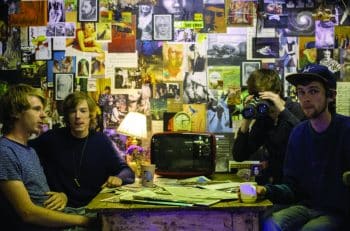
    The Radiators From Space, Ireland’s first punk band, captured the subversive mood of 1979 in the groundbreaking ‘Ghostown’ album. Now they cast a long shadow over Trouble Pilgrims who have inherited band members Steve Averill and Pete Holidai. But the iconic pair of Irish rockers are not just surviving, they’re thriving. The reason for this must be the strength of their collaborators in Trouble Pilgrims. In fact, Trouble Pilgrims now are almost an Irish post-punk supergroup. The lineup includes Bren Lynott who was a member of The End and The Cathedral, and Johnny Bonnie who comes via the Skank Mooks, Those Handsome Devils and The Baby Snakes. Tony St Ledger was in The Myster Men, The Deep and Vatikan3. So there are plenty of ghosts in this album, and ghosts of hopes. The 1970s and 1980s Dublin’s scene’s glimmer of dreams. Prospects of stardom; the price – a ticket on the B+I ferry. As ex Radiator and Pogue, Philip Chevron said: “where the hand of opportunity draws a ticket in the lottery”. ‘Dark Shadows and Rust’ is a triumph, an essential piece of modern Irish art. It takes all of the hopes and aspirations of those Moran-ish, Baggot-y, Ivy Room-y (although that’s an oxymoron), McGonagle-y, college and Magnetic first steps of young bands and welds them together into an unholy celebration of the power of rock. While ‘Dark Shadows and Rust’ is a very Dublin album, it also celebrates the dust and grit, the sweat and blood, the tension and release of the blues, from the Delta to Canvey Island. It wears the ghostshirts of glam, of Bolan and Bowie and Roxy and the candyfloss pop of the Everly Brothers and Roy Orbison. In the key word from the opening track, it’s a carnival. Snake Oil Carnival sets the tone for the album in grand style. After an introduction featuring a cacophony of traffic, cymbals and radio drone (a riot in Chatham St music academy perhaps), Steve Rapid and Tony St Ledger combine to sizzling effect in a Doors meets Queens of the Stone Age sixties stomper. It’s almost overflowing with taut guitar whose sinewy histrionics pulse in this rock and rollercoaster. And then without warning, with the sharpest of shocks, the Carny is over. It’s breath-taking. Another outstanding track is Tony St Ledger’s, Instant Polaroid, which celebrates a Dublin character, snapping pics on O’Connell street. Capturing moments of bliss, delirious smiles, and the beauty of youth, and developing them in what must have been a lonely dark room. It’s an intensely evocative song and is delivered with the panache of early Bauhaus, the sparkle of Spizz Energi and the invention of the great post-punk bands. And that’s why ‘Dark Shadows and Rust’ is such an exultation: it captures the moment punk was a kaleidoscope of images and sounds, of personalities and dreams. It marshalled a sense of power and glory for the people who felt powerless and inglorious. Death Ballad and Queen of Heartache are a pair of Moore Street meets New York-flavoured gems. The first contains a candyfloss melody combining with barbedwire guitars. If Debbie Harry fronted the Outcasts this would be the song to record. Queen of Heartache is the Ramones twisting with the Royal Showband. Style icons hucklebucking trends, throwing shapes at the mineral bar in some maple-sprung dancefloor of dreams. It’s the song the Golden Horde shudda wrote. I am only pointing out the points of comparison that I imagine because: a) it’s fun, and b) the album refuses to be typecast or to fit into any neat compartment, and that makes it thrilling. These kicks are encapsulated when Pete Holidai grabs the mic for Animal Gang Blues. To my ears, he’s never sung truer, more convincingly, more intensely than on ‘Dark Shadows and Rust’. It’s a career-high. The song itself is a prequel to ‘Ghostown’. It’s a bloody B-movie of a song, a scare-a-thon, washed in acid guitars where Holidai is the grinderman, voicing the moral panics that stalked deprived Dublin. Scorning the hopeless souls with finger wagging and wondering where it all went wrong. The characters of the first two Radiators’ albums are here in spirit, although it documents pre-1970s Dublin. That’s one of the best things about the album. As rap did in the 1980s and early 1990s when it celebrated the tenements of New York City, Trouble Pilgrims take the same razor-sharp cinema lens to their own surroundings. Most rewardingly the Pilgrims invoke the past, but never wallow in it.

    Loading

    Read more

  • Posted in:

    The rock star should be sometimes alone, but never lonely

    The story of the contemporary rock diva, Lady Gaga, who literally could not stand to be alone, is a philosophical fable for our times. A few years back, according to claims in a legal action filed by the rocker’s former personal assistant, who sued for overtime pay, the singer could not tolerate being in her bed alone. The assistant was required to be with her boss 24 hours a day (including sleeping with her), yet was not paid for the extra hours. What is going on?   A Globalised World Specialising in the torture of Sleep Deprivation No aspect of our biology is left unscathed by sleep deprivation, according to Professor Matthew Walker, director of the Centre for Human Sleep Science at the University of California, Berkeley. “It sinks down into every possible nook and cranny. And yet no one is doing anything about it. Things have to change: in the workplace and our communities, our homes and families”. It’s not just margaret Thatcher who suffered from lack of sleep, you do yourself… In the book ‘24/7: Late Capitalism and the Ends of Sleep’, Jonathan Crary argues that the expanding non-stop communication technology of twenty-first-century capitalism is ruining individual attentiveness and impairing perception. The 24/7 marketplace is endlessly pushing us into constant activity, damaging the fabric of everyday life. Humans are endlessly diverted and distracted by the images, demands and noises of ubiquitous technology, including mobile phones and other electronic devices. There is never any peace. Doctor Frank Lipman, who treats conditions of stress and fatigue, has noted that: “feeling spent is an understandable response to the 21st century. If you put a human being in a modern city, and add computers, mobile phones, credit cards, neon lights and 24-hour shopping…what do you expect?”.   The ‘Wired Life’- or the Death of Solitude But the modern condition engenders more than just the death of sleep, chronic fatigue, and pointless frenetecism. This famous saying of the philosopher Blaise Pascal has never been more relevant to the contemporary world – yet never more violated. “Our unhappiness arises from one thing only, that we cannot be comfortably alone in our room…That is why the pleasure of solitude is seen as so incomprehensible”. The Wired Life of hyper-capitalism and its world-wide-web – think of a massive spider’s ‘web’ in which we are all entangled – is designed to be intrusive and overweaning. To want solitude is to be an oddity. Experiments summarised in the journal Physiology & Behaviour suggest that, given a choice of physical pain or isolation, social mammals will choose the former. Capuchin monkeys starved of both food and contact for 22 hours will rejoin their companions before eating. Children who experience emotional neglect, according to some findings, suffer worse mental health consequences than children suffering both emotional neglect and physical abuse: Though he wrote his short story ‘The Pedestrian’ in the era of Big Box TV pre-cable, pre-streaming media, Ray Bradbury grasped the effect of emerging electronic communication, which tended to undermine both the right of – and desire for – privacy. The pedestrian Lawrence Mead is out walking alone: “And on his way he would see the cottages and homes with their dark windows, and it was not unequal to walking through a graveyard, because only the faintest glimmers of firefly light appeared in flickers behind the windows… In ten years of walking by night or day, for thousands of miles, he had never met another person walking, not one in all that time”. Shortly thereafter Mead is arrested by a robotic police car and taken to a psychiatric institute for treatment for regressive behaviour, that is, seeking solitude in a world saturated by media. Unlike the rock star who cannot sleep alone, the Pedestrian wants to walk alone but a technocratic world won’t leave him alone. Non-stop video games, omnipresent online streaming, iPhones, social media, multiple cable channels, all conspire to make humans into Outer-Directed Machines always looking to be attached to the Wired World for their amusements. Montaigne in his essay, ‘Of Solitude’ said: “We must reserve a backshop, wholly our own and entirely free, wherein to settle our true liberty, our principal solitude and retreat. And in this we must for the most part entertain ourselves with ourselves, and so privately that no exotic knowledge or communication be admitted there”. The reference to finding solitude away from “exotic knowledge or communication” – a harbinger of the WWW – is a battle cry for those seeking to liberate themselves from the endless distractions of a 24/7 Interconnected Info-World. The philosopher Arnold Schopenhauer assailed those who constantly seek happiness through external stimulations (food, entertainments, games, wealth, etc). Such a life “cannot protect a man from being bored”, Schopenhauer cautioned. The rock singer could not be alone because she no longer had the capacity to entertain herself with herself. The ability to be comfortably alone in her room was beyond her. She is a contemporary casualty of the age-old War against Solitude. George Monbiot, who believes capitalism has inspired a generation of loneliness, has written: “Of all the fantasies human beings entertain, the idea that we can go it alone is the most absurd and perhaps the most dangerous”. He and Gaga are only half right: we should relish company but thrive too, because it is sometimes inevitable, on solitude.

    Loading

    Read more

  • Posted in:

    O’Brien Comium

    Trinity College’s recent Conor Cruise O’Brien centenary symposium was a largely uncritical exercise. It was especially notable that it was so as it focused on Irish politics. Invited US academics, who discussed O’Brien’s assessment of the American Revolution, appeared unaware of O’Brien’s distinctly illiberal local contribution. Reverential tones underpinned contemplation of O’Brien’s analysis of Irish nationalism. Remarks at Gerry Adams’ expense massaged the prejudices of the mainly elderly audience. Critical observations came mainly from the floor. Audio from an evening session, put up online by TCD, omitted audience interventions. In a way, that was appropriate. O’Brien’s main contribution to the ‘Troubles’ was perfection of radio and television censorship. He achieved that with amending legislation and intimidation of broadcasters, while Minister for Posts & Telegraphs, 1973-77. Many of the academics and journalists chosen to speak referred to “Conor”, whether or not they knew him. A Labour Party activist questioned this from the floor during the last session. He remarked that O’Brien’s 1977 defeat was generally welcomed, including by some on Labour’s left, and asked why no speakers reflected that majority view. One participant, who knew O’Brien quite well, momentarily punctured the semi-sacral nature of the proceedings. In opening the evening session, TCD Chancellor and former Irish President Mary Robinson, recalled how her participation in a public meeting in 1974, in opposition to internment in Northern Ireland. It “enraged” O’Brien. She was, he said, “dancing to the tune of the IRA”. The audience might have been forgiven for expecting the speaker following, barrister and historian Frank Callanan, to tell us more. It was not to be. After her remarks Robinson left the Edmund Burke Hall. The theme of hommage to O’Brien re-congealed around the platform, which included Margaret O’Callaghan from Queen’s University Belfast and former Labour leader Ruairí Quinn. President Michael D Higgins also attended. I pointed out (in remarks that were omitted) that O’Brien insinuated also that Robinson silently acquiesced in the killing of judges. The then-minister, a secret supporter of police brutality, told journalists they were IRA stooges and hacks. The brutality of O’Brien’s language eased his transition from verbal opposition towards explicit support for censorship. Before chastising Robinson, he entered RTÉ and sensed an IRA “spiritual occupation”. Eoghan Harris, RTÉ’s then best-known republican ideologue, was disciplined for broadcasting a programme on internment. Harris told the symposium he was actually a secret supporter of the author of his misfortune. He was not, as is assumed, converted later while producing agricultural and children’s programmes. O’Brien shifted his focus in 1976, the year he amended broadcasting censorship. He threatened to imprison Irish Press editor Tim Pat Coogan for publishing letters O’Brien disliked. Coogan was told this by O’Brien’s interviewer, an alarmed Bernard Nossiter of the Washington Post. Coogan published the threat and republished the letters. In 1979, as Observer editor in chief, O’Brien terminated the contract of Ireland correspondent and leading feminist Mary Holland. She was, he said, “a very poor judge of Irish Catholics”, who “include…the most expert conmen and conwomen in the world”. O’Brien observed of Holland’s ten-years-of-the-Troubles profile of Derry woman Mary Nellis: “Irish republicanism – especially the killing strain of it – has a very high propensity to run in families… the mother is most often the carrier”. Such sectarian and misogynistic perspectives did not interest Friday morning lecturers, Sunday Independent columnist Eoghan Harris and Irish Times journalist Stephen Collins, on their hero as “journalist and editor”. It was left to Susan McKay in the last session to criticise O’Brien’s sacking of Holland. Margaret O’Callaghan delivered an appreciative paper on the 1973-77 Fine Gael Labour government’s subdued remembrance of 1916. She did not discuss its 1976 prohibition of Sinn Féin’s annual 1916 commemoration, which thousands defied. The 1976 platform included Labour TD David Thornley; and the daughter of executed 1916 leader, and Labour Party founder, James Connolly. The ban was accompanied, typically, by threats to sack participants in public-sector jobs. RTÉ’s director general Oliver Maloney directed the Irish-language programme Féach not to cover the banned commemoration. That was testament to an emerging culture of selfcensorship fostered by O’Brien. This did not interest O’Callaghan. Speakers suggested that O’Brien’s 1976 amending legislation liberalised censorship, a foolish thought originated by O’Brien. Before O’Brien’s new measure came into force in January 1977, he declared RTÉ’s pre-existing censorship order too liberal. It permitted interviews with Sinn Féin representatives. O’Brien banned them with terminology from his soon-to-be-enacted measure. The TCD symposium censored the real Conor Cruise O’Brien, once described as “a champion of the overdog”. The real O’Brien can be heard on ‘Bowman Sunday’ talking over Kadar Asmal, former head of the Irish Anti-Apartheid Movement (RTÉ Radio 1, 5 November), while opposing an academic boycott of Apartheid South Africa.   Niall Meehan is the author of The Embers of Revisionism, which considers Conor Cruise O’Brien. On sale at Books Upstairs, Dublin

    Loading

    Read more

  • Posted in:

    Radical Love

    ‘I deem as heroic those who have the harder task, face it unflinchingly and live. In this world, women do that.’ – James Salter ‘I know too well those marvellous lips. By Allah, I’m not lying if I say I love sipping their finerthanwine delicious dew.’ – Hafsa Bint Al-Hajj Arrakuniyya about her lover Abu Ja’far – Twelfth century Granada ‘All lovers wear my castoff clothes and jewels and gulp down my overspilt drink. I have raced with lovers at love’s racetrack and beaten them all at my own pace.’ – Ishraqa al-Muharibiyya, pre-Islam   At a time when women from Arab and Muslim cultures are facing the dual oppression of gendered racism from without and sexism from within, Radical Love #FemaleLust pushes them centre stage and celebrates their self-expression on their own terms. Frustrated with the burial of female voices across history, we found inspiration in those that rang out loud and strong across the Arab world thousands of years ago. Over 1000 years ago, women across the Arab world from Iraq to Andalusia were writing poems that read like the best Pop lyrics – succinct and sweet in their indignant pride and defiance, their passionate seduction and longing. The lust for love. Mostly from the Muslim world of the seventh to the twelfth centuries, these women challenge preconceptions of faith, class, and the female experience long ago. They capture some of what there is to relish in this swirling and confounding life and living. Whatever external restraints were placed on these women, they retained a vitality and independence of spirit, a powerful tonic to these troubling times. The lust for life. The lust for love and life was so apparent the show’s title suggested itself. To demonstrate the timelessness of the female energy so viscerally evoked in these words, an idea struck to ask female artists across the globe to use the poetry as inspiration for new work. With no more to go on than the individual poem they received in the post, 48 female artists from various cultures (half Arab or Muslim) created paintings, sculpture, photography and textile art. Moreover, they are just sublime. Radical Love #FemaleLust is a dialogue between past and present, words and visuals, and between different faiths and cultures. Most but not all the artworks will show in Dublin and the artists featured include young Spanish, Turkish, Saudi Arabian, British-Iranian and Egyptian photographers, a Palestinian calligrapher, a Jamaican painter, four Syrian artists who’ve been displaced, an Irish sculptor and an English stained-glass artist. It ran in London at the Crypt Gallery in February and at the Women of the World festival in May, and comes to Dublin’s Gallery X on 65 South William St , 10-26 November. Donations to help cover expenses incurred in bringing it to Dublin are greatly needed. All the beautiful artworks are for sale with profits split between the artists and Global Fund for Women, helping Syrian refugees. Poems showcased are from Abdullah al Udhari’s collection ‘Classical Poems by Arab Women’, recently re-published by Saqi books with a foreword by Mona Eltahawy.   Radical Love #FemaleLust is curated by Róisín O’Laughlin

    Loading

    Read more

  • Posted in:

    10 From the ’10s [so far]

    The creation of lists and listicles titilatingly combines the writer’s self-indulgence with a gratifying boxticked clarity. The October 1 edition of the Sunday Times did this better than most, on a subject of notorious sensitivity – music, as a much-feted “101 Irish Albums We Love” list, compiled by Something Happens vocalist/Newstalk doyen Tom Dunne, ripped the bandage from the hairy arm of unending argument over objective stances on a subjective medium. Was ‘Astral Weeks’ really that good? Was the chase for the next U2 really the best thing for Irish music? Why aren’t hip-hop innovators Scary Éire, techno wild-children The Fourth Dimension or black-metal trailblazers Primordial ever on these all-timer lists? The big takeaway from this latest bout of squabbling, however, was a note of disappointment for readers under thirty: one of the country’s highest-profile disc-jocks and champions of music programming had included only one (1) single independently-released album from this decade on an otherwise comprehensive list. Just one from the current gilded age of independently-released music in Ireland. While the debate has cooled down to the usual simmer among Irish music pedants, it would be a misuse of space here not to create a companion piece to balance the conversation. And here it is: a list, though by no means definitive, of ten Irish records from this decade you should be adding to your collection (or Spotify account). The rules are simple: albums released since 2010, open-genre policy, no big-name reunions, no major-label releases, no bores. ADEBISI SHANK This Is The Second Album of a Band Called Adebisi Shank (2011, Richter Collective) A day-zero event in the current chapter of independent music in Ireland, the Wexford trio’s second long-player marked their transition from fret-burning, pedal-stacking math-rock noisemakers to something more. Post-rock and its associated sub-genres set about rearranging the furniture to magic something new out of an established setup. With the beep-boop, oddlymetered intro to opener ‘International Dreambeat’, the intention was apparent: clear the living room and make way for a futuristic anime parade. The following forty minutes are unlike anything this country has produced, ever. AND SO I WATCH YOU FROM AFAR Gangs (2012, Richter Collective) North Shore four-piece And So I Watch You From Afar had also been grafting for years on sweetly melodic, yet no-less-deft tunes that packed the detail of math-rock, the dynamic & breathing space of post-rock and the velocity of metal into its ebbs and flows. A self-titled début LP saw the band begin to make themselves a space; ‘Gangs’ threw explosives in and cleared their path through. ‘Search:Party:Animal’ is a shot of concentrated adrenaline, ‘…Samara to Belfast’ oozes tension, while single ‘7 Billion People All Alive at Once’ takes a pretty, building piece of post-rock and detonates it into a grin-inducing, la-la waltz. A special record from a band that was phosphorescent LAURA SHEERAN What the World Knows (2012, self-release) While Ireland has a proud tradition in improvisation and the avant-garde, there are very few artists who have contrived to force together the sheer love of the process with a singular, driven vision for every aspect of creation, quite like Galwegian Laura Sheeran. What the World Knows gifted us our first longform glimpse of Sheeran’s internal creative world, stark and melancholic, playing with arrangement and form, but always maintaining her strong and steady voice as the eye of the storm, as best demonstrated on ‘Hurricane’. BANTUM Legion (2013, ElevenEleven) Dublin-resident Corkman Ruairí Lynch was a favourite among bloggers earlier in the decade, featuring an eclectic, yet accessible take on a wide swathe of electronica. Début long-player ‘Legion’ sanded his sound down to the grain, leaving only the swelling, full heart of a creator and the friendships behind the collaborations. Singles ‘Oh My Days’ and ‘Legion’ both heave with a wistful, yet ultimately upbeat, riff on internal monologues; the former nesting Eimear O’Donovan’s vocals amid layers of reverb and delay, the latter providing an eighties-indie glow of earnestness to warm, yet haunting electronic pop. LYNCHED Cold Old Fire (2014, self-release) Under Austerity, tone-deaf cries from mainstream music press bemoaned the lack of protest music as with previous generations, before moving along to the next shiny thing. If they’d bothered looking around, they would have found the band currently known as Lankum, recasting lost folk gems from around the world for the modern condition, and co-penning the definitive modern recession song in the album’s title track. In the process, the Dublin four-piece began their transformation into the custodians of the Irish folk tradition, a contrast from the stuffy gatekeeping of the musical friends of conservative Ireland. ILENKUS The Crossing (2014, self-release) With a keen ear for technicality and a fervour for the weight of sludgy, metallic tones, Galwegian five-piece Ilenkus have always shoved to the forefront of their music something casual observers have wrongly remarked is missing from the genre: humanity. The band’s second full-length is a brave, honest work that confronts internal and external issues, from the painful, cathartic and intricate title track, to the pointed sociopolitical barbs of ‘Over the Fire, Under the Smoke’ (sent viral that year for a one-take promo video that saw Chris Brennan perform his gutturally yowled vocals on a walk down Galway’s Shop Street). NAIVE TED The Inevitable Heel Turn (2015, self-release) By day mild-mannered social worker/music teacher Andy Connolly. By night skratchador enmascarado Naive Ted. A longtime fixture on a small but dedicated Irish turntablism scene as one-man duo Deviant and Naive Ted, Limerickbased Connolly emerged to a wider, albeit cultish, spotlight via a series of chance encounters culminating in his work ending up as entrance music on Japanese national television, accompanying Wicklow pro-wrestling superstar Fergal Devitt and his villainous Bullet Club gang. The full-length that followed was bananas, as old-school skratchology met a multi-polar range of samples before being thrown, full-force, at Steve Reich-esque experimentation and being thoroughly deconstructed accordingly. SHARDBORNE Living Bridges (2015, Out on a Limb) Metal in Ireland has always been kept alive by community efforts, from gigs and labels to

    Loading

    Read more

  • Posted in:

    Lowry and Sinclair

    I recently concluded a criminal case in the Crown Court in Manchester; a city I had not visited in over 20 years. Much has changed while I’ve been gone. It is a little less frenetic, with no Tony Wilson or Hacienda club, and a good deal more gentrified. Salford, the traditional working-class area, immortalised in the works of such working-class poets of music as John Cooper Clark and Mark E Smith, is no longer as bleak and industrial as it was 20 years ago, but has acquired a glossy riverside sheen, or rather façade. Appearances are always deceptive, and much is still very rundown indeed. Perhaps the most famous chronicler of Mancunian and Northern working-class existence is the painter LS Lowry, to whom there is dedicated a fabulous museum in the designer-revamped Salford: a huge treasure, free to the public and staffed by authentic people of the utmost friendliness. The museum is there, along with a northern version of a Daniel Libeskind structure – actually designed by James Sterling, containing the imperial war museum, northern branch; two theatres; and sundry other cultural delights. The paintings, once seen en masse in the beautiful gallery in the Lowry Centre, are indeed like the ‘matchstalk men and matchstalk cats and dogs’ that I remember children singing about in my youth. Humanity is represented by little emaciated speckled archetypes, often scurrying around in droves near the citadels of northern capitalism, the industrial factory. The people appear as miniature figurines to highlight the backdrop as in an industrial Canaletto view of Venice. The people are all like dots of insignificance: working-class cyphers, their lives dedicated to the service of their paymasters. If you wander away from the totemic works there are, not as famous but more precise, evocations of workingclass existence. A drunken brawl, a funeral congregation in black, the Sunday best for the big occasion: dour. The celebration of shortened lives in rank conditions. These paintings are stark but full of empathy, observed calmly and with rational detachment, as indeed are some of his portraits, and he is a remarkable portrait painter, though I had not realised it. Separately, some weeks ago on a visit to Dublin I spoke to a friend, the librarian in the IFI bookstore, an oasis of modern civilisation in an ever-bleaker city. We conversed and he intimated to me that he had read a recent article by me in the Dublin Review of Books, where I noted the need for a new Orwell to chronicle how the poor die in our nefarious third-world state. No, he firmly intimated, we need not Orwell but that great chronicler of American depression-era working-class life, Upton Sinclair. In Sinclair’s most famous book ‘The Jungle’ he demonstrated sub-standard conditions of workers in the Chicago meat-packing industry and many of his works including ‘Oil’, which became the film ‘There Will be Blood’, are attacks on unbridled, greedy capitalism and what it does to the human spirit. Lowry and Sinclair are ever more relevant as we return to the present. The Marxist analysis of dead capital sucking the blood of labour is more pertinent than ever. I know the tropes and nuances are different, and that the culture has shifted. I know with Marx that identifying the problem does not solve it but recognise the communist manifesto will not work. The existence of the ordinary person in under-paid and over-worked corporatism is not unlike the heyday of Victorian capitalism, or indeed the Great Depression, with the modern version of the factory being the bleak buildings of financial services and corporate law firms. Death by overwork while serving the interest of the plutocracy has become banal in much of western society. Ordinary people console themselves often, as in a seminal painting of Lowry, in the consolations of booze, the Friday night out, the office party. Oblivion. Blowing the limited amounts of disposable income they have, which has not been hoovered up by inflated rents, and mortgages which may never be repaid. Certainly in Ireland there is little or no ‘real’ economic growth as such. Those who have wealth and property run the country like a feudal oligarchy, abusing state structures to go after anyone that poses a threat to their interests. They often mask it well. But deep-seated criminality and thuggery are intrinsic to the modus operandi of our ruling classes and the tactics of surveillance, fabricated cases and false or political prosecutions endemic to a system descending into anarchy, where vested interests are using ever more desperate and ruthless tactics of human exploitation. There is a pattern to all of this. As Arundhati Roy intimates in her monograph ‘Capitalism: A Ghost Story’, and her recent novel ‘The Ministry of Small Things’, the pattern is that globalised capitalism is ‘cartelising’ the world into a small number of people who control the wealth and assets, and enforce penury and degradation on the mass of the population who are deemed surplus to requirements. That word “surplus” implies disposability by any means necessary. Thrown in a river, locked up in prison, shot. Exposers of the systemic corruption such as Roy in India have been jailed for their temerity in pointing out the growth of the rotten neoliberal agenda. Lives are being destroyed or truncated and the lunatics of the corporatocracy and the insanely rich are pillaging the planet with a speed and rapacity never witnessed before. In their wake, they are destroying equality of opportunity and the ability of ordinary people to work themselves out of the poverty trap. It is not just the working class but all of us, including the educated middle class, who are suffering. So, the working middle classes are confronted with longer working hours, increased competition and migration through neoliberalism – a wholesale race to the bottom. As Roy demonstrates in her ‘Capitalism’ book droves of Indian farmers are committing suicide because of the punitive conditions imposed on them. Suicide rates are exorbitant for failed businessmen, lonely farmers and the homeless of Ireland. A

    Loading

    Read more

  • Posted in:

    Acting Deep, and Acting Shallow

    In September, Elisabeth Moss twice used the word “fuck” as she accepted the best-actress Emmy for her role in the TV series ‘The Handmaid’s Tale’. As it was a live broadcast, the network (CBS) was using a time delay and so was able to bleep out the offending words. There were many reports online and on television in the hours and days that followed about the gaffe. None of them included the actual “fucks” as they were never broadcast, but then neither did practically all of the reporting outlets use the word either, opting for “f-bomb” or “f—” instead. Perhaps the attack on puritanism, which is at the heart of the show and the novel it is based on, is more necessary even than the liberal media establishment thinks. And yet, was it a gaffe? Two other gestures by Moss on that night may cast some light on the matter. First, the soles of her shoes had the handwritten message “off” on one shoe and, presumably, “fuck” on the other. The credit for this is perhaps equally due to her stylist, Karla Welch, who displayed the sole of the “off” shoe on Instagram with this message: “You”ll have to guess what the other shoes says.… our note to the patriarchy #teamresistance”. This “fuck” goes unseen, just as the other went unheard, but the message is clear enough. The other notable gesture by Moss from the same ceremony is captured in a cheekily smiling photo of her holding two award statues with her right middle finger raised to the camera. This did the rounds on Instagram too, after Moss posted it on her own profile. Those “fucks” seem a little less spontaneous now. And so what?, you may ask. The reason why this celebrity tittle-tattle is of interest is that Moss is a Scientologist, and her behaviour on the night was analysed by some commentators as being a deliberate Scientologist ploy. In a story that circulated in very similar versions on The Hollywood Reporter, Mashable, The New York Daily News and elsewhere, Moss’s speech is described as following the Scientologist practice of ‘going down the tone scale’ in public utterances, in order to make yourself more relatable to the average person. High-tone speech and behaviour are a turn-off, apparently, and Moss’s actions at the Emmys and various other on-camera bird-flipping incidents down the years are alleged to fit this kind of deceptive thinking. So what is real, and what is acted, in her actions? It’s an interesting question because her profession is to act, and she is undoubtedly excellent in ‘The Handmaid’s Tale’, as she has been in the two seasons of ‘Top of the Lake’, and as she was for years in ‘Mad Men’. In all of these, her major roles, Moss plays an obedient, or obedient-seeming, efficient performer of tasks expected of her, who occasionally and dramatically breaches the bounds that she ought to respect. These flashes are what keeps us interested in her. And they are the moments when we think we might be able to see the real actor, the common thread of her concerns working across various TV stories. ‘The Handmaid’s Tale’ is the story of women who live as sex slaves and are forced to be surrogate mothers in a misogynistic near-future America. The problem that the dystopian society faces with these ‘handmaids’ is that they are impossible to live without, as they are the only fertile women left, and they are impossible to live with, as the narrative makes clear. As a result, they are made visible and invisible. They cannot be imprisoned in some cage in the basement because their role in society is sacred and ceremonialised. So they are imprisoned in a fully public, open prison. They may not speak out of turn, they may not show their faces and they may not have any independent existence. They do not even have enough power over their own lives to be able to end them. Their mode of speech and interacting with one another is a way of expressing this odd position. The costumes and the sexual politics, and the frontierism of a society under threat from an unnamed enemy, all point to puritanical America (and England). The characters must act a certain way with one another and speak in a highly coded manner. As part of their training for this new acting role in society, they are forced to publicly condemn each others’ previous lives in the abhorrent finishing school that is the segue between the end of their normal, pre-dystopia lives and the beginning of their lives as handmaids. Much of the enjoyment of watching the characters in this show comes from trying to interpret whether this emotional labour that the women are performing is merely on the surface, or deeply felt. The distinction is that between what is known as shallow acting, which is the smile and bare minimum of eye contact you get at a burger restaurant, and deep acting, where people in service positions really align their inner beliefs with those of the organisations they work for. In ‘The Handmaid’s Tale’, we gradually realise that all of the handmaids are engaged in shallow acting, and this realisation has the force of making them seem to be liberated on the inside, and lends optimism to their plight, and opens up the possibility of a second season (which is on the way). Many critics of Scientology, whose numbers are legion, have pointed out the irony that Moss is receiving accolades for her portrayal of a victim of a totalitarian cult. Viewing her in this light, and examining her actions and words on that Emmy night, are we confronted with the maniacal, glazed-eye, single-mindedness of the cult member, trapped inside a web of self-deceiving, selfimproving, self-belief that Scientology helps people be, as Moss herself has recently said, “a better you, not necessarily changing who you are”? Is any of this important? Does it matter that it is Moss who delivers

    Loading

    Read more