
Culture

Random entry RSS

  • Posted in:

    The 1916 Rhinzone

    We are not required by the film to consider sectarian inequality, the corruption of London administrations, underinvestment, the racism of Paisleyism, centuries of colonialism, or cronyism in all walks of life

    Loading

    Read more

  • Posted in:

    Oceanic Consciousness

    Neo-Darwinian consensus is cast in doubt by the new era of Epigenetics that suggests genetic codes are altered by the use of certain faculties by an organism over the course of its life

    Loading

    Read more

  • Posted in:

    Oceanic Consciousness

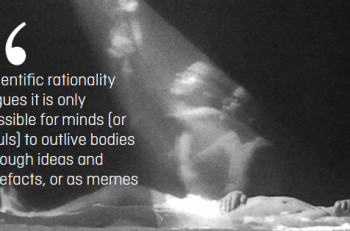
    We think of ourselves as unique, and so we are, but defining individuality is problematic. Ninety percent of a person’s cells – mostly bacteria – are not their own while those cells with our distinct genetic codes only last up to ten years. In terms of consciousness this poses questions such as: where is memory located if cells in the brain degenerate along with the rest of an atrophying body? Is it possible that morphic fields containing recollections lie beyond ourselves – like data stored in a cloud – as Rupert Sheldrake has proposed? Is this close to the elusive idea of soul that scientific rationalism considers impossible? In ‘The Science Delusion’ (2012) and other works Sheldrake (who has a PhD from Cambridge and is the author of numerous articles in peer-reviewed scientific journals) argues for his hypothesis of morphic resonance employing a scientific methodology, albeit not to the satisfaction of many sceptics including his nemesis Richard Dawkins. Dawkins’ ‘The Selfish Gene’ (1976) remains a classic exposition of neo-Darwinian genetics. His persuasive argument is that the battle for survival is at the level of the gene which conveniently uses the replicator, our bodies or that of another species, for its purposes. But even within the field of genetics the neo- Darwinian consensus is cast in doubt by the new era of Epigenetics that suggests genetic codes are altered by the use of certain faculties by an organism over the course of its life. Apparently the child of a practising musician enjoys a musical predisposition beyond any genetic inheritance. It goes to shows how mistaken it is for any age to assume its reigning ideas are impregnable. Nevertheless this should not provide an excuse for abandoning measured analysis or the quest for elusive truths notwithstanding the limitations of human minds. Scientific methodology yields extraordinary results but we must be careful to avoid new dogmas. It could also be that there is wisdom in ideas now considered obsolete. Faced with our own mortality and that of those around us, many of us entertain the possibility of an afterlife, a phantom echo from a person’s life on earth, and possibly a unifying principle, or One, conventionally called God. But scientific rationality argues it is only possible for minds (or souls) to outlive bodies through ideas and artefacts, or as memes in the rather obtuse description of Richard Dawkins, and mostly dismisses the idea of a unifying principle. And make no mistake the arguments adduced by scientific rationality are compelling. But a consequence of accepting this approach of scientific rationalism is moral ambivalence. For example, although science shows the effect of human activities on planet Earth there is no discourse within it to offer a way of prescribing our behaviour, it is simply descriptive. Moreover per Dawkins, if it is a case of elements within us competing for expression it is hardly possible to invest them with any moral sensibility. Within the framework of a supersensible world redemptive possibilities seem to arise: if souls exist beyond bodies this appears to impose moral obligations as we could be compelled to endure the consequences of our actions for an eternity. The idea of a unifying principle also suggests that truth can be arrived at through the exercise of intellect. This concept is domesticated by religions through ideas such as sin and karma but we need not accept the tenets of a particular religion in order to accept the possibility of Oneness and immortality. Let us consider evidence of those possibilities then, especially through the lens of art, which need not succumb to the dogma of a particular organised religion. Our own WB Yeats, perhaps the foremost English-language poet of the twentieth century and certainly the greatest Romantic, held ideas anathematic to the intellectual culture of his day, and perhaps even more antipathetic to those of our own time. But what might be dismissed as superstition, far from holding him back, liberated an artistic imagination engendering verse of truly magical quality that he attributed to presences beyond himself. If Yeats had simply expressed his ideas in philosophical terms they would easily be dismissed but through the beauty of their poetic form they are more acceptable to the wider society. Passively or otherwise this poetry is still a conduit for notions adopted by most school children, inculcating what many would normally dismiss as obscurantist notions about faery realms and spirits. And who would dare remove such perfectly crafted verse as Yeats’ from the school syllabus? O sages standing in God’s holy fire As in the gold mosaic of a wall, Come from the holy fire, perne in a gyre, And be the singing masters of my soul. Consume my heart away; sick with desire And fastened to a dying animal It knows not what it is; and gather me Into the artifice of eternity. In an article entitled ‘Magic’ written in 1901 he set out his beliefs: “I believe in the practice and philosophy of what we have agreed to call, in what I must call the evocation of spirits, though I do not know what they are, in the power of creating magical illusions, in our visions of truth in the depths of the mind when the eyes are closed; and I believe in three doctrines, which have, as I think, been handed down from early times, and been the foundations of nearly all magical practices”. He identifies these principles as: “1. That the borders of our mind are ever shifting, and that many minds can flow into one another, as it were, and create or reveal a single mind, a single energy. 2. That the borders of our memories are as shifting, and that our memories are part of one great memory, the memory of Nature herself. 3. That this great mind can be evoked by symbols”. Yeats comes from a tradition in Western thought that stretches back to Pythagoras and Plato which has been the philosophical basis of Christianity also. The statements, or revelations,

    Loading

    Read more

  • Posted in:

    Peak Tourism

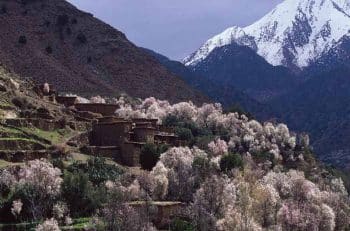
    ‘Eight Million Tourists Expected To Visit Ireland Next Year As Star Wars Effect Lifts Off’ Headline in the Irish Examiner, December 1, 2015 Marrakech is a hard city to leave, because someone is always tugging at your arm. One hour south, near the highest mountain in North Africa, you can hike to a pass with a view of three valleys and still be interrupted. I was alone up there for half an hour when an elderly man appeared, smiled and presented me with a sad lump of coal about the size of a tennis ball. I almost laughed, but I was wrong. He opened the stone to reveal a shimmering bed of purple crystals. It was a piece of amethyst. The old man seemed reluctant to part with his treasure for just €20, and I felt a bit guilty about defrauding him, but we shook hands and the deal was done. On holiday one craves experience that feels privileged, local, unusual. In Ireland that means drinking in a pub after closing time, the ancient but highly regarded lockin. In India it might be a ten-day silent meditation. Authentic and rare, here was another great travel moment. Half a mile up the road there was a hut with a rusty Pepsi sign. That’s charming, I thought, I must be their first customer today. But no! The owner was chatting to my friend the amethyst dealer. Not talking, really, so much as laughing, as if they had just played a practical joke on someone. And look! There I was, sipping a lukewarm Pepsi, not Lawrence of Arabia but something more mundane. The first proper patsy of the day. My amethyst story was not supposed to end like that. Going on holiday is meant to broaden the mind. Saint Augustine said the world is a book and people who don’t travel read only one page. If that’s true, then we’re in luck. It has never been cheaper or easier to fly to faraway places, and sometimes tourists have a benign impact. In 2003, when going to Burma – with its corrupt military dictatorship – was widely frowned upon, a diplomat told me that one of the most encouraging developments there was a rise in tourism, as it facilitated a more open society. In 2008 I discovered the power of personal diplomacy when I spent three weeks hiking in Iran. One day I taught a 12-year-old boy how to juggle. In Morocco I was a traveller until the moment I became a stupid tourist. Still, I can’t blame the chap for selling me that rock. The observer always affects the observed. And there is often a tension between visitor and host. In Barcelona, locals hang banners from their balconies, begging tourists to allow them a good night’s sleep. The 42-year-old mayor of the city, Ada Colau, was elected on a promise to recapture Barcelona for its citizens. In Hong Kong, local residents have marched in protest against visitors from China, whom they call ‘locusts’. As they say in, well, everywhere, tourists are a pain in the ass. Why do we bother going on holiday, anyway? Personally I travel to get away, to be alone, to escape myself, or at least to meet a more attractive version of myself. moments of transcendence – ‘that wine is delicious and it costs half-nothing’ – but for the most part holidays are confused, even disturbing, experiences. Consider: Your flight takes off in just five and a half hours. There you are, packing new clothes in an old suitcase. As you fantasise about lounging by the pool it’s easy to forget that you will be appearing as yourself. (Look! The skin is falling off your nose.) Then there’s the quiet domestic hell of other people. The comedian Kelly Kingham: “My wife and I can never agree on holidays. I want to fly to exotic places and stay in five-star hotels. And she wants to come with me”. Who among us knew that a hotel reception would make such a lively venue for a family row? Or that a short flight could be quite so depressing? Consider the fatalistic niceties (“In the event of an accident…”), the casual indignities and the cruel economies that are now accepted as part of the bargain. When Michael O’Leary of Ryanair joked about charging to use the toilet, many of his customers thought he was serious. The literature is of no assistance. Brochures are works of fiction. Travel journalism is PR with a suntan. And guidebooks are just as bad. Over-scripted drivel, they rob travel of its novelty, thus its charm. (“No visit to New York is complete without seeing the view at sunset from the top of the Empire State Building”.) Maybe we are not explorers, you and I. Maybe we are rough girls and lonely plonkers – a nuisance, frankly, with all our demands that strip a place of what made it attractive in the first place. When I tell you that Starbucks tastes just the same in Marrakech, I should be blushing. It was the German writer Hans Magnus Enzensberger who first argued that tourists threaten or destroy what they have come to see: originality and local colour. That was nearly 60 years ago. Enzensberger’s theory (“Tourism anticipates its refutation”) still seems topical. Writing in the Guardian a few months ago, Tobias Jones observed the same Faustian pact: “The more visitors you have and the more money you make, the less you are the naive, folkloric, authentic, untouched place of the tourist imagination”. Last year there were 1.2 billion tourists. There will be two billion tourist arrivals by 2030. We coach-tour insects like to think of ourselves as a benign presence. We imagine that a long journey absolves us of any petty provincialism. It’s good of us to meet the people. But most of the time the exchange is purely commercial. We are just a source of revenue, and most of it goes to elites. In 2006 the Canadian journalist

    Loading

    Read more

  • Posted in:

    The Emperor has no balls

    Depressing as the US election may be for progressives at least it’s spawning some spirited political art from which the rest of us can learn. For example ‘Indecline’ went viral when it erected guerrilla statues overnight of a naked Donald Trump, in several US cities. Each bore the title, ‘The Emperor has no Balls’. Though that much is clear from the works (see right). Arts and culture grasped an immediate relevance in offering a provocative perspective on electoral politics. Less noticed, but still indicative of a desire to heal the splintered resistance, and broker the solidarity that an effective civil society must embody, is the ‘United States Department of Arts and Culture’ (USDAC). It initiated a ‘Super PAC’ for the forthcoming election. In mainstream US politics, Super Political Action Committees (PACs) are used to funnel millions of dollars into election campaigns. These PACs can’t make direct contributions to candidate campaigns or parties. However, they can engage in unlimited political spending independently of the campaigns. They can raise funds from individuals, corporations, unions, and other groups without any legal limit on donation size. The ‘United States Department of Arts and Culture’ (USDAC) plays with the rhetoric of a Federal agency or think tank. It is the engine room for a grassroots action network. Its work is about inciting creativity and social imagination to shape a culture of empathy, equity and belonging. It organises at local and national levels and works with artists and community members to address social issues. It seeks to promote programmes and policies that move art and culture from the margins to the centre of civil society. USDAC aims to power democracy with mass artistic creativity. It has garnered cross-community and crossgeneration traction. Over 170 communities signed up to host events and share stories online in a collective national self-portrait. Cultural Agents are recruited to organize and host ‘Imaginings’, art-steeped community events that have included more than 3000 people. Volunteers come from a pool of 4,500 Citizen Artists. Over 10,000 people have been part of USDAC events in 40 states since late 2013. The USDAC ‘Super PAC’ doesn’t have anything to do with the political spending of the PACs. Its ‘Super PAC’ is a Super Participatory Arts Coalition that nurtures high-impact, low-infrastructure models for building a creative community. It promotes participatory public projects that activate agency, inspire meaningful dialogue, and embody community and equity. These projects could disrupt narratives of hatred. In the midst of a hugely volatile election cycle, they serve as a reminder of what democracy looks like. One of ten models chosen for the Super PAC came from a proposal by ‘Les Agents Provocateurs’ which choreographs flash-mobs to challenge consumerism and reclaim public space. Their plan is to create the same flash-mob performance simultaneously in twenty different cities worldwide. The performance is dancing riot police – they assemble in a public space in riot formation and break into a kind of ‘Chorus Line’ movement, something that resonates for many in our fractious world. Broadway meets the official use of force. Another is ‘Democracy Uncut: A Hearable Dialogue on Race and Social Justice’, a filmmaking technique was used to create meaningful media channels to deal with traditionally polarising topics. This is built on the idea that democracy works best with conversation, which is preferable to riots or tank warfare. It tries to take some of the toughest topics and find ways to bridge the gap between two starkly opposing groups. It has adopted a technique called ‘Question Bridge’ to pose questions, videoing one group at a time, and then letting the opposing group view those questions and reply on video. You take out the noise, the clutter that happens when you get two opposing groups talking at the same time. It ends up with a dialogue you can clearly hear. Finally Sara Taliaferro’s ‘Buffalo Commons Un-Voting Fair’, again for USDAC, is a playful pop-up fair with messages for public officials, historic re-enactments, hugs, zines, and more. There is an ‘un-voting booth’ where you can talk, write, or make art about why you do or don’t vote. The anatomy of democracy in the US has congealed and encrusted. Old mechanisms for participation and meaningful discourse are no longer available. Creativity, arts and culture are evoking new ways to engage. Ireland should emulate. Ed Carroll is the Blue Drum convenor

    Loading

    Read more

  • Posted in:

    The local

    General disparagement that anyone concerned with their own patch must be a small-minded xenophobe fuelled the Brexit debate. Such lazy stereotyping of Leave voters by the liberal collective undermines its own self-perception as open-minded. In the midst of this continuing existential maelstrom, my metaphysical GPS has been happily trekking a terrain of books based on the idea of place and our connection to it. The volumes are very different in style, sensibility, and age. But each one possesses a common thread: a love of the local, be it knowledge; the land; or the language we attach to it. This convergence of homegrown thought enveloped a strong environmental message too. The books are a perfect rebuke to anyone who vaingloriously carries a lumpen backpack around the globe (with the associated grotesque carbon footprint) in an effort to accumulate knowledge about the world. The writings prompt questions: why do we disdain knowledge of the wild flowers that grow in our own fields, for example; why do we think learning is only impressive when the flowers grow 6000 miles away? One of the books is by Hubert Butler, who died 25 years ago this year. His relatively littleknown voice is fortunately abloom again in a collection of essays published by Notting Hill Editions called ‘The Eggman and the Fairies’. I am grateful, otherwise I might not have found this tactful and enlightening writer. Butler’s unfussy talent might have been tucked away quietly in his home county of Kilkenny, travelling no further than the libraries of the literati. The central philosophy of Butler’s connection with civic consciousness literally jumps off the page – the engraved quote on the cover reads: “I have always believed that local history is more important than national history. Where life is fully and consciously lived in our own neighbourhood, we are cushioned a little from the impact of great far-off events which should be of only marginal concern to us”. His inherent sense of locus is a refutation to the hate-lacquered acronym NIMBYISM and its implied curtain-twitching malevolence. Instead, Butler’s cipher could read: KYOBISM, Know Your Own Backyard: for there you will find a world of wonder to be getting on with. In his introduction to the book John Banville places Butler alongside Hazlitt, Orwell, and Robert Louis Stevenson in the canon of great essayists. Banville describes him as “the least noisy of writers”, which is delineating as one moves through the pages with Butler, for he seemingly shuffles through places such as the River Nore or Fethard-on-Sea. His markings are usually near to hand, but his mind is always large, pan-European, in spirit. The sensibility can remain broad, even if the eyes are restricted. “These essays appear to be about Russia or Greece or Spain or Yugoslavia, (but) they are really about Ireland”, he writes in the preface, before expounding on subjects as diverse as Wolfe Tone or plans to build ‘a new Geneva’ on the River Suir in Waterford. “I go on believing that the strength to live comes from an understanding of ourselves and our neighbours or the diaspora that has replaced them”. Butler was born in 1900. After an education at Charterhouse in England and St John’s College, Oxford, followed by some travel through Europe, he returned to his birthplace Maidenhall in Kilkenny for the rest of his days. His family was part of the landed gentry, yet he was staunchly Irish, describing himself as part of Ireland’s rich strain of Protestant Republicanism. The essays were written over a period of sixty years for various newspapers and magazines, as he cleaved – to use Banville’s word – steadfastly to the home place. The book is a treasure trove of knowledge, shared with dignity and a deliberate style. The topics are unapologetically indigenous, yet the themes resound universally, in an artful synthesis akin to Orwell’s musing on that quintessential English subject: the per-fect cup of tea. Michael Harkin contrasts markedly to Hubert Butler in background, but when it comes to wit they could have been brothers. Born in Carndonagh, Donegal in 1830, he penned a precious jewel of local history while working as a post office master, ‘Inishowen – its History, Traditions, and Antiquities’ under the nom de plume Maghtochair. “Our legends and traditions are dying, the customs and habits of the olden time are nearly extinct, but in order to preserve some of them from total oblivion I thought it well to gather this collection”, he declares. The book is a tidy volume of rural life and community in microcosm: mixing topography, history, songs, anecdotes, and verse. Just like Butler, Harkin drew beauty and depth and anchored a deep-seated affection, in the local. Presented in gazette format, these segments also appeared initially in a newspaper, The Derry Journal(how many local or regional papers carry such columns today?). The stories were inspired by Harkin’s travels around the Donegal peninsula in a rattling little car, stuffed with books of poetry and prose, collating information from the local seanachies all the while. In Maghtochair, the people in the Big Houses are sidelined. Instead we find monks or clergy, and issues such as the fight for better rights for farmers in rural Ireland: “Was it the landlords who made our valleys smile with plenty and teem with fertility?”, Maghtochair asks pointedly. “Certainly not; it was the peasantry”. A chapter on ‘Illicit Distillation’ is a joy to drink in, combining fact with plenty of fiction in all likelihood. It humorously sends up officialdom’s presumptive interference and folly in trying to reform human nature. He seems to say, “we like things that are bad for us: if you commit to the futility of preventing us from enjoying them, we will only enjoy them even more”. Maghtochair describes “the lynx-eyed constables of the Revenue Board” tilting at windmills with their still-hunting and concludes, not without reason, that the production of contraband Inishowen whiskey “probably will be carried on while light and dark succeed each other”. The imagination flickers at the thought

    Loading

    Read more

  • Posted in:

    Birdbrain internet

    We live in an age of ephemera and digital myopia that befuddle our wits and have thrown up the possibility of a Trump Presidency. Britain departs the European, stage right, after a campaign marred by cynicism and misinformation. The Siren sounds of advertising impel us to consume beyond what we need and corporations and their despots exercise unaccountable power over vast, and growing, fortunes. In an effort to understand this cultural drift I turn to philosophy, evolution and the effect of changes in technology, for answers. In philosophy I attempt to harmonise two seemingly contradictory notions that inform my understanding. The first is a notion expressed by the early Greek philosopher Heraclitus (d 475 BCE) that “no man ever steps into the same river twice, for he’s not the same man and the river is not the same”. This phenomenological view rests on observation of a constantly evolving reality. It is a process similar to the gathering of scientific data. The second approach is ideological but might be seen as analogous to over-arching scientific laws. This is the idea of prior knowledge, an objective belief in identifiable forms of justice or beauty. In Western philosophy this is identified with Plato (d 347 BCE) and his successors who trained their ears to the strains of an elusive harmony. Inferring truth solely from observation of phenomena is problematic, especially where life is reduced to competition between individual genes for expression as expounded by Richard Dawkins in his formative, ‘The Selfish Gene’ (1976). These competing ideas may be resolved by allowing for an evolving objectivity: a fleeting truth. That is to say that answers to questions posed in Ancient Greece are quite distinct from those we seek today. It is dangerous talk, no doubt, to assume that humans have a capacity to discern principles arising from observation of a shifting reality, but without that assumption there is little hope for us. We can reject that idea and see homo sapiens as no more than a primate with a powerful brain that has successfully stored knowledge over millennia, beginning with farming and proceeding through literacy into the Internet. But then there is a temptation to retreat into relativist angst and dismiss our thoughts as idle. Most political ideologies, Marxism not least, eschew nihilism and posit a Utopia that we should drive towards, the best acknowledging the word’s origins in Greek as ‘no place’, but an aspiration. For example Village magazine promotes equality and sustainability as substantial ideals necessarily shifting with the flow of events. Agreeing on principles is a treacherous business, not least in crooked Ireland. It requires serious engagement over time with a great range of information and disciplines. Moreover, we must also leave a space for mystery as most Ancient Greek philosophers assuredly did. It was in that Greece of Antiquity that it seems that ideal and reality – form and content – came into closest balance. Fifth-century Athens was not human perfection incarnate: slavery was commonplace and women were not seen as equal to men, but still their achievements are unparallelled in a host of domains, including architecture, where an accommodation with Nature appears to have been reached. In his ‘History of Western Philosophy’ (1945), Bertrand Russell wrote that: “nothing is so surprising or so difficult to account for as the sudden rise of civilisation in Greece … What they achieved in art and literature is familiar to everybody, but what they achieved in the purely intellectual realm is even more exceptional”. How to comprehend the virtually simultaneous arrival of science, history and mathematics, the very fundaments of a dominant Western civilisation? The psychiatrist and literary scholar, Iain McGilchrist, in his ‘The Master and his Emissary’ (2009), proposes that a steep evolution occurred in Ancient Greece when an abrupt collective separation in function between the two hemispheres of the brain – broadly a creative right and rational left – occurred. To begin with the hemispheres achieved a beatific balance. But he argues that, since our Hellenic heights, left-brained rationality has emerged dominant over the creative right hemisphere. Thus we have developed extraordinary technologies but failed to use them wisely, bringing us to the brink of auto-destruction, a process that continues apace in the age of the Internet. McGilchrist writes that: “The Greeks began the process of standing back; and the beginnings of analytical philosophy, of theorising about the political state, of the development of maps, of the observation of the stars and the ‘objective’ natural world, all may be mediated by the left hemisphere; though the urge to do it at all comes from the right”. He also sees the origins of the individual “as distinct from, as well as bonded to, the community”. He wrote of this evolution in our minds: “My thesis is that the separation of the hemispheres brought with it both advantages and disadvantages. It made possible a standing outside of the ‘natural’ frame of reference, the common-sense everyday way in which we see the world. In doing so it enabled us to build up that ‘necessary distance’ from the world and from ourselves, achieved originally by the frontal lobes, and gave us insight into things that otherwise we could not have seen, even making it possible for us to form deeper empathic connections with one another and with the world at large. The best example of this is the fascinating rise of drama in the Greek world, in which the thoughts and feelings of ourselves and of others are apparently objectified, and yet returned as our own. A special sort of seeing arises, in which both distance and empathy are crucial”. However: “Separation also sowed the seeds of left-hemisphere isolationism … At this stage in cultural history, the two hemispheres were still working largely together, and so the benefits outweighed by a long way the disadvantages, but the disadvantages became more apparent over time”. A technological development that McGilchrist associates with the shift was the emergence of money currencies, reigning ascendant by the fourth century

    Loading

    Read more