Economy

Random entry RSS

  • Posted in:

    Think [and consider the data]

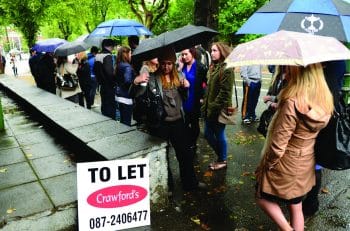
    A CLEARER PICTURE is emerging of the state of the housing sector. A number of reports and newly-compiled statistics point to a heavily strained system, struggling to provide even modest levels of supply and affordability. Most households cannot afford a new home within reasonable commuting distance of Dublin, without first stumping up a significant deposit. Policies aimed at reducing building costs by either increasing building heights, or reducing standards, are ineffective and don’t facilitate the common good. And only ten local authority homes were built in Dublin the first half of this year. What does this crisis look like? Here are some figures that help point the way. 1. HOUSING SUPPLY Due to inaccurate official housing statistics, Goodbody has instigated an independent audit of house-building output. Its ‘BER House-building Tracker’ is based on new Building Energy Ratings, certification of which have been a legal requirement for all dwellings since 2013. By this measure, 6,447 new homes have been completed in the year to date, less than half the official Department of Housing figure, which is based on ESB connections. The pace of building is increasing, rising 86% year-on-year in September, though it remains well below official estimates. In total, fewer than 8,000 new homes will be built this year. 80% of these new dwellings are houses, and fewer than 1000 apartments have been completed this year. Seven out of ten new dwellings, and most apartments, are located in the Greater Dublin Area, the ‘recovery’ evidently being restricted to the capital. 2. HOUSE PRICES The Central Statistics Office’s Residential Property Price Indicator Index is an accurate record of house prices. It confirms that government policy has facilitated a remarkable recovery in new home prices. In 2010, the average new home was 25% cheaper than the average second-hand house price. By 2016, the average new home was 15% more expensive, at €450,274. The price of second-hand homes in Dublin has increased at a much slower rate – an average of 11% per year, to €389,879 by 2016. By last year, Dún Laoghaire-Rathdown had seen new home prices double in six years to €618,026, almost 14 times the average full-time wage. 3. APARTMENT PRICES & AFFORDABILITY A report in October by the Society of Chartered Surveyors Ireland (SCSI), ‘The Real Costs of New Apartment Delivery’, confirmed what the industry has known for years – new apartments are severely unaffordable. A combined household salary of €87,000 is required to afford the cheapest low-density two-bed apartments in suburban Dublin. The average sale price across the city is €435,500, almost ten times the average full-time wage. Prospective owners must be in the top 20% household-earnings bracket. The report raised a number of interesting facts. Increasing height – an official preoccupation, actually drives prices up. Reduced standards like smaller floor areas and reduced lift cores – an industry preoccupation, do little to reduce the ‘affordability gap’. Site values are the biggest cost, and a significant driver of price inflation. Land values and developers’ profits comprise 35% of sales prices. 4. SOCIAL HOUSING Rebuilding Ireland’s ‘Social Housing Completions Report 2017’ catalogues an expanding ‘pipeline’ of almost 700 projects, with the capacity to provide more than 11,000 potential social homes. However, actual output is far less impressive than official inputs. Local authorities built 75 social housing units nationwide in the first six months of this year. In addition, 380 social homes were completed nationwide by ‘approved housing bodies’ (AHBs) and voluntary co-ops, organisations that heavily rely on voluntary efforts and fund-raising, in addition to state funding. Of the 120,598 people on housing waiting lists nationwide, 40,207 are in the four Dublin council areas. Ten local authority homes were built in Dublin the first half of 2017. Dublin city council has the largest population, and the highest number of homeless families, but it built no social housing. Cork city council, Kildare county council and Galway city council did not build a single local authority home between them, despite having housing waiting lists of 6,005, 6,869, and 4,095 respectively. 21 local authorities built no social housing in the first six months of 2017. CONCLUSIONS There are 240 new households availing of state rent assistance every week. Approximately €730m will be spent on state rent assistance, for 96,000 households, this year. By 2018 this will increase to €900m for 110,000 families. Rising levels of homelessness have been well documented, and are truly alarming. There are only 1000 rental properties available in Dublin, and 3,200 nationwide. The lack of supply continues to pressurise the rental sector, and lower-to-middle income households and tenants in arrears are especially vulnerable. Local authorities own enough residential- zoned land to build 37,000 dwellings, yet at current rates just 300 local authority homes will be completed this year. Considering the continued reliance on the private sector, low levels of new house-building, the lack of an affordable housing scheme, and low permanent social-housing provision, the situation for families on more modest incomes will remain perilously difficult for the foreseeable future.   Mailíosa (Mel) Reynolds is a Registered Architect and Certified Passive House Designer

    Loading

    Read more

  • Posted in:

    Bud Get Real

    The annual ritual surrounding the budget will come to an end on Tuesday 10 October when finance minister, Paschal Donohoe, unveils his first package of tax and spending proposals since his appointment earlier this year. Don’t expect too many surprises though, as most of the expected initiatives have already been well aired through inspired leaks from various government and other sources. Once again, and despite the faux outrage of some Fianna Fáil frontbenchers who are threatening to pull out of its confidenceand-supply agreement unless the USC is cut or pensioners given another fiver, the reality is that the deal is already done. It will not take much to cobble what both parties will claim as a victory in relation to cuts to the USC for lower- and middle-income earners while also ensuring that the wealthy are not overburdened and indeed will also gain from fiddling with tax bands and rates. Varadkar has promised to reward those who get up early and those who create wealth and pay for public services in what is clearly a pitch to the middle-class and better off voters he needs to keep on board if Fine Gael is to regain power. Equally, Micheál Martin does not wish to alienate the same constituency which he hopes will return to the Fianna Fáil fold in greater numbers than the party managed in 2016. Ultimately, the differences on tax and spending policies between the two main parties are minuscule and any rows over tax breaks for builders, increases in stamp duty, inheritance tax or whatever other measures are largely manufactured. The real question of the ratio between reducing the tax burden at the expense of improving public services is of course ideological. This makes the contribution of the hardly radical Economic and Social Research Unit all the more interesting. It has warned against tax cuts while the economy is growing by around 5% this year and an expected 4% in 2018. It submits that tax cuts will only overheat the economy. “Given the pace of growth over the past number of years there is certainly no case to stimulate economic activity with the budgetary package”, ESRI economist Kieran McQuinn said. He added that, if anything, the Government might need to raise taxes in order to dampen consumption and in order to raise the funds for essential capital spending on infrastructure in housing, health and education. This is not the narrative that Varadkar needs, to boost his chances of retaining power after the next election which many expect will come some time after the third and final budget to which Fianna Fáil committed in the confidence-andsupply deal. This is subject of course to the upshots of other unexpected events which could prompt a rush to the polls earlier next year or following the abortion referendum. Others on the Left who oppose the tax-cutting agenda and argue that the housing and health crises, not to mind other social needs, demand that all available resources should go into public services. SIPTU president Jack O’Connor spelled this out at the union’s biennial conference in Cork on 2 October. In his final presidential address to the union after more than fourteen years in the job, he argued that there should be no tax cuts whatever between now and the centenary of the foundation of the State in 2022. Arguing that all available resources should be put into the construction of social housing, decent health and education systems and a mandatory second-pillar pension scheme, he condemned the main parties for promoting tax-cutting policies and “a value system that precipitated the crisis in the first place”. “It’s back to be looking the other way, while exponentially growing inequality reasserts itself in our domestic and social affairs. It is absolutely unforgiveable that thousands of our children are homeless, in the aftermath of the collapse of a credit fuelled property bubble”, he told delegates in Cork city hall. “It is appalling to think that this is happening within twelve months of the celebration of the centenary of the insurrection of 1916, which was fought on the basis of a Proclamation which declared the establishment of a Republic which would cherish all the children of the nation equally. And while this is unforgivable in itself, it is absolutely obscene that our major political parties are again promoting a tax-cutting agenda while children are homeless, in this, one of the wealthiest countries in the world”. It is unlikely that Donohoe and Varadkar will heed such advice or that Fianna Fáil will do anything more than pay lip service to such utterances. As O’Connor, who is chairman of the Labour Party, also said, it will require an alliance of all genuinely progressive forces in Ireland to achieve his ambition for the common good by 2022. And that is a big ask.   Frank Connolly

    Loading

    Read more

  • Posted in:

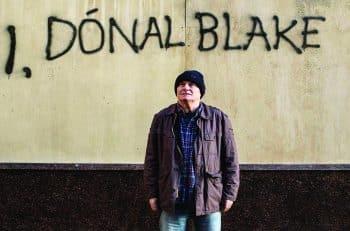
    I, Dónal Blake?

    Our new Taoiseach Leo Varadkar TD makes sure he gets out once a week, often to see a movie. Last year he went to see the English movie ‘I Daniel Blake’ directed by Mike Leigh. Discussing the movie at a Pobal conference he showed little sympathy for the plight of Daniel who, having suffered a heart attack at work, was forced to reply on job seekers payments while attempting to appeal a decision not to allow him  a disability payment.  Nor did he appear significantly moved by single mother Katie and her children (Daisy and Dylan). Katie, having moved to Newcastle from a London homeless persons’ hostel, and increasingly desperate to survive, resorted to  food banks, shoplifting, and work in a brothel. Indeed he has since gone out of his way to affirm his belief in the heavy-handed ‘work-first’ policy message at the heart of UK welfare reform. Through a rhetoric of ‘welfare cheats’ and an election campaign that spoke to the “coping classes”, the “people who get up in the morning” he has consciously sought to replicate an anti-welfare rhetoric in Irish political discourse.  The question we must now ask is whether, under his new emboldened leadership, the bleak lives of Daniel and Katie, dominated by a hostile welfare state, could happen here.  Are we seeing conditions emerge for ‘I, Dónal Blake?. The Irish welfare state has recently played catch-up to new forms of globalisation,  privatisation, marketisation and voguish new public management (NPM) and has, championed by both international and domestic actors,  moved towards work-first activation  which is  a more active use of income support to promote participation in paid employment.  It is a mixture of enabling, compensation and regulatory regimes, but the general international trend has been  for policy, and managerial, reforms to undermine potentially enabling elements and intensify its regulatory and punitive elements.  Pathways to Work (PTW),  Ireland’s activation policy,  has fundamentally restructured Ireland’s activation institutions and programmes,  rolling back old institutions like FÁS and rolling out new institutions like Intreo, the pay-by-results private-sector Job Path, and the Social Inclusion Community Activation Programme which has reoriented local community-development work towards supporting job readiness.  New penalties have been introduced and, while the incidence of sanctions is still comparatively low,  the unemployed have heard the message clearly. There is a new regime in town which must be engaged. Activation is often associated with recommodification of labour and mobilisation of a new form of ‘floating’, or more available and flexible employee,  where claimants are gauged by their ‘standby-ability’ and live in a condition of flex-insecurity. We can best understand what activation is for by asking activation ‘into what’. The crisis also saw increased incidences of low pay and more precarious working conditions.  Low pay is an increasing feature of the Irish labour market, with up to 30% of Irish workers low-paid according to the OECD definition of two thirds the industrial wage. Some groups of people are more likely to be low-paid, with women, young people and migrants not only more likely to be in low-paid work but also to work involuntarily part-time, to be underemployed or to  be in precarious forms of employment. The Irish state spends over €1bn  in in-work benefits to support low-paid workers and their families,  compensation mechanisms that supports participation in low paid employment ultimately act as forms of corporate welfare, supporting not only low-paid workers but ultimately making such low-paid work viable. Taken together then, recent Irish changes point to a work-first policy strategy with a greater use of privatised actors working in  a more managerial culture and using more  regulatory sanctions to pressurise working-aged claimants into low-paid and precarious employment.  That this work is often only viable through compensation in the form of in-work and employer subsidies raises questions about the quality of employment people can aspire to and whether in fact paid employment offers a sustainable route out of poverty.  There is an alternative and it includes  longer-term ‘preventative’ measures including properly accredited and quality education and training and regulating for decent jobs and living wages. One desirable recent change is the inclusion of Employment in the remit of the old Department of Social Protection.  We need to judge success not by movement from welfare into work, but movement into lasting, sustainable and decent employment.  If the new Taoiseach wishes to avoid a dystopian future or ‘I Dónal Blake’ situation  he might look to addressing low pay as a significant Irish labour market phenomenon and introduce policy initiatives that counter a ‘low hours’ employment culture.  People want jobs and to ‘get up in the morning’ but need a combination of institutional and income support responses to unemployment that reverse the emerging reality where approximately 30 percent of Irish workers experience not only low pay but also low hours of work, part-time work, temporary contracts and precarious working conditions.    By Micheál Collins and Mary Murphy

    Loading

    Read more

  • Posted in:

    Demexit

    While the consequences of the UK’s decision to leave the EU remain unclear, one thing is certain – the power and influence Ireland, North and South, will exercise over the final decision-making is limited. The hype in May of this year over apparent ‘concessions’ gained by Ireland from the EU, about an early resolution to how the Irish border will be affected, was quickly rubbished by UK Brexit Secretary, David Davis. He and other English Tory politicians have made it clear that the UK’s self-interest goes beyond, and is much more important than, the concerns of those living either side of the Irish border, or indeed the Irish peace process. It is not even clear how the 27 remaining member states of the EU (of which the Irish State is only one) will actually approach negotiations with the UK, and whether they will indeed take the concerns of the Irish seriously. The Irish State has not been awarded a veto similar to the one apparently granted to Spain by the EU over any decisions on Gibraltar, in relation to the North or the Border. Indeed it is not clear that EU interests (if they exist collectively) are likely to coincide with Ireland’s when it comes to what will be a new EU land border with what will be a non-EU state. And if the Irish State will have limited power and influence over negotiations it is clear that the people of the North will have none at all. Despite a majority of the North’s population (56%) voting to Remain in June 2016, that voice has more or less been silenced by an overwhelming majority of English MPs in Westminster supportive of Brexit whose minds are concentrated on negotiating a deal that will suit their own constituencies. One option touted by some hopeful nationalist politicians is for the people in the North to vote for Irish reunification, in a referendum (allowable under the Belfast Agreement, 1998). David Davis accepted in March of this year that by joining an existing EU State (Ireland) the North could remain in the EU without having to reapply. However, while many Unionists, particularly in Border areas, voted against Brexit it’s not clear that this would translate into a vote for the ending of partition. The Northern Ireland entity was after all created in 1920 specifically to give Unionists a majority, where they had lacked one in the whole of Ireland. It is true that that majority has decreased in recent years. It is also true that in the Assembly elections in March 2017 the Unionist parties (for the first time since partition) did not win a majority of seats, but then neither did the Nationalist parties. There is also no guarantee that votes for the Nationalist parties would necessarily translate into votes for reunification, particularly if this led to the loss of the NHS, social services and public-sector jobs. Ironically, a Westminster Tory Government dedicated to rolling back the welfare state and public-sector cuts, might make that choice easier! In any event the British Government has refused to agree to a referendum in the North as it also has in Scotland, apparently fearful that this might lead to the break-up of the UK. The lack of control over its own destiny is not something new for Ireland of course. Though the North remained within the UK after the 1921 Treaty, the ‘independence’ of the Irish State in the South always seemed compromised, initially by economic dependence on Britain and then, from 1973 onwards, by EU membership and a progressive seepage of sovereignty to the EU and, in particular, its bigger states. The lack of democratic control over the economy in Ireland, North and South, became particularly clear during the banking crisis and the period of austerity. While the experience of the crisis and austerity was different, North and South, reflecting different social, economic, and political contexts, as well as different forms of democratic control, it nonetheless showed that power lay elsewhere. The 2008 global economic crisis and the responses to it in the industrialised rich countries of the world led not just to a re-moulding of capitalism, but to increased clarity about both the lack of global democracy and what John Pilger termed in 2002, “the new rulers of the world”. Neoliberal minimalist State regulation of financial institutions, and the economy in general, was replaced by high-State interventionist ‘austerity’ measures, aimed at protecting capitalist financial structures. In the EU, Governments nationalised private debt, spreading the costs across their local communities, largely to ensure that capitalism as an economic structure and ideology was maintained. The notion of ‘European-ness’ and a sense of a unified EU citizenship – used to promote the idea of a greater social and economic union from the 1970s – gave way to single-State self-interest as the bigger economies banded together to protect their national interests and the interests of their banks and their bondholders. Smaller EU states, having progressively relinquished sovereignty to the larger states, from Maastricht (1992) to the Euro (2002) to Lisbon (2007) in the interests of ‘Europeanisation’, realised that they no longer controlled their own economies, budgets or fiscal arrangements. Ideological choices appeared limited in smaller states – either accept the new ‘austerity’ measures, enthusiastically, as the only solution to a global crisis, or accept them, reluctantly. What Greece’s former Finance Minister, Yanis Varoufakis, was to call, “financial terrorism” was in town. Irish Governments from 2008 on fitted in with that ‘austerity’ agenda accepting with enthusiastic energy the dominant agenda of public-sector cuts. Although the capitulation to threats from the IMF and the EU seemed to show a lack of democratic control, they still had a choice, even if it was simply to raise a protest at the way their State was being treated. A ‘pragmatic’ approach to the powerful seemed the best option and by and large the approach fitted with the world view of the main parties. Up until 2015, the North of Ireland had not suffered

    Loading

    Read more

  • Posted in:

    Macronomics

    In the acknowledgement section of philosopher Paul Ricoeur’s last major book, he thanked his editorial assistant for a “pertinent critique” of the draft work. As he was then finishing up working for Ricoeur, in 2014, that editorial assistant, fresh-faced Emmanuel Macron, professed himself “like an excited child at the end of a show”. Macron, now French President, has shown more leadership than the entire rest of the Western world since his election. He claims to have found a political path between left and right, has made clear in the most elegant ways his disdain for Trump and has bowed to nobody, least of all Vladimir Putin in sharing truths about international political thuggery. So it is interesting to trace his philosophic influences. For Ricoeur, phronesis, Aristotle’s term practical wisdom, is the tool we bring to bear on political or social puzzles. There is no single method and it does not flow not from a universal moral code but instead from leading an ethical life. In 1969 when he learned that a group of student radicals was committed to preventing professors enter the cafeteria at the University of Nanterre, then a refuge for radical leftists from the University of the Sorbonne, to which he had just been appointed a professor, Ricoeur nevertheless walked into the room in the hope of dialogue. However, one of the students placed a dustbin lid on Ricoeur’s head. This cameo grimly illustrates what Ricoeur called the fragility of politics.   The week before the recent French Presidential Macron talked – and listened – to a crowd of angry workers at a tumble-dryer factory in Amiens, northern France, threatened with closure by June 2018. Greeted by whistles and calls of “Marine for president” when he arrived, by the time he left Macron had, if not completely convinced his audience, at least ended the jeers – and won some respect. “I’m not sure he can truly help us” one striking employee was reported as saying. “But he tried. He was quiet and honest”. It was a dustbin initiative. It was more ethical than the actions of most politicians in similar circumstances.   For Ricoeur, integrity can be judged by our attachment to the promises we make to ourselves and to others.   Distinguishing himself from Le Pen and Jean-Luc Mélenchon, the leader of the extreme left Defiant France, Macron declared: “I will not promise that I will nationalize your factory. The answer to what is happening is not to suppress globalisation or close the borders. Do not be fooled by those who tell you otherwise. They are lying to you. Unhappily, there will always be companies that fail”. When a worker demanded to know what Macron would do as president, he vowed that his government would invest heavily in retraining programs for endangered industries. Hearing frustrated groans, Macron replied by telling the workers that he did not come to “promise the moon,” but instead that he would fight for them: “We all have responsibilities. If I did not respect your work, your fears, and your anger, I would not be here today”. He then made a final promise: “I will return, without cameras and even if I lose”. The recognition of the other’s singularity, the recognition that there are no simple solutions and that confrontations must become dialogues — creating a space, even in parking lots, where answers might not be found but questions will find respectful listeners — all reflect Ricoeur’s ethics. So, too, does Macron’s repeated invocation of promises, both those he would make — such as returning to Amiens to meet the workers — and those he would not, like Le Pen’s to keep Whirlpool’s operations in Amiens.   In an essay titled ‘Existence and Hermeneutics’ Ricoeur claims he is striving for a philosophy which can describe and engage with the various ways that people make sense of their worlds. He wants a philosophy which can arbitrate the claims which different world views, each a philosophy in its own right, will present. Ricoeur proposes hermeneutics, the art/science of interpretation, as a model for the philosophy he desires. This he defines as the art or science of interpreting texts where more than one meaning is present.   Macron has famously formed his party, En Marche, and his government in equal measure from the left and the right, and – allegedly – from neither. He characteristically frames his vision with the famous formula “and at the same time”: For example addressing probably the most fractious issue in French politics he has said he wants to make work more flexible but at the same time protect the most vulnerable.   Ricoeur emphasises an ethic of responsibility, a sort of ‘practical wisdom’ seeking constantly to integrate actions with a sense of the consequences.   This would account for Macron’s strength on the issue of climate change. He berated Trump for his withdrawal from the Paris Climate Agreement, in English, calling to make the planet great again; and he called on climate scientists disgruntled with Trump’s policies to help France with its efforts to arrest global warming.   Ricoeur struggles with the correlation between power and evil.   There is evidence Macron does not pull his punches. Who could deny that scrunching Trump’s tiny fist in a symbolic macho handshake was addressing evil used by power, head on, albeit in a banal way.   Ricoeur is Christian, utopian and idealistic. He thinks that politics should intersect with economics and ethics. One of the manifestations of this is strict honesty. After telling celebrated, fashionable psychoanalyst Jacques Lacan in 1963 that he could not understand a word of his writings on Freud, Ricoeur became the bête noire of Lacan’s zealous followers. It was blunt and brave.   In the presence of the intimidating Vladimir Putin and in another “muscular exchange”, in May, Macron attacked Russian propaganda outlets, which he says do not practise journalism. “I will not give an inch on this”, he asserted. “Russia Today and Sputnik … behaved as

    Loading

    Read more

  • Posted in:

    IMF Oomph

    According to a recent IMF study, there are reasons to worry about a new housing-markets-triggered financial blowout. And although IMF data suggest that we are not at panic level regarding house-price inflation its researchers conclude that “there are several reasons to think that the present conjuncture is a time for vigilance”.

    Loading

    Read more

  • Posted in:

    Trump/Slump

    By all possible measures the US presidential election of 2016 has set a record low in the quality of political discourse. However, with the outcome handing the Republicans a decisive victory in the White House, Senate and House of Representatives contests, the election will have a lasting and systemic impact on the development of economic and social policies in the US for years to come. First, the presidential contest failed to develop key policy proposals that could define the new administration. In a way, by diverting election debates away from large-ticket economic and social issues toward personalities, legal and ethical mudslinging, and geopolitical blame-games, both Donald Trump and Hillary Clinton have cleared the water for a rudderless new Presidential Administration. Key issues including immigration, healthcare, social insurance and taxation, spending and fiscal policies, and economic strategy were left largely unaddressed. This leaves the legislative agenda to the Republican-controlled Congress. This is a far better outcome than the commentariat allow, but not as good an outrun as those of us expecting significant economic change would have wished for. Second, for all the differences between them, both candidates were aligned in one specific area: their propensity to shower voters with promises irrespective of their costs. While Trump mentioned the Federal debt overhang, his policy priorities included accumulation of more debt to fund increased social security handouts to interest groups, massive infrastructure investment, and tax breaks. His isolationist stance on foreign trade also implies heavier debt though the effect is unclear. Hillary Clinton was even more profligate that Trump.   The US is heading for Government debt of over 108% of GDP in 2016, and up until 2021. With President Trump and the Republican-controlled legislature, the likely outcome will be that US Federal debt  will remain high, as the deficit swings from the 3.5% average expected 2017-2021 to closer to 3.7-3.8 percent. Most of this debt will go to fund military expenditure (the so-called modernisation of the US armed forces will take trillions out of the Treasury, interest groups, and a wave of tax cuts, primarily targeting capital and financial markets, as well as the upper-middle class and higher earners. Third, neither of the candidates offered a serious plan to address competitiveness, including bureaucratic regulations and the tax codes, especially corporate taxation that incentivises capital flight and corporate-tax avoidance. Trump vaguely talked about the need for change, but never offered specific measures. Hillary Clinton advanced only marginal reforms. By default, the regulatory and tax agenda will now shift to Congressional Republicans. As a result, we are likely to see unwinding of even the feeble banking and financial-services reforms currently in train. Clawing back Federal controls and giving more room to individual States is preferable to the Democrats top-down approach. Fourth, while both candidates decried the loss of competitiveness and jobs in the manufacturing sector, neither offered a plausible solution. Declining labour-productivity growth, stagnant total-factor productivity, and the challenges of growing automation and robotisation, including for many services, remain untouched. And there was nothing constructive on offer on external imbalances and the impact of the trade deficit on the domestic economy. On balance, therefore, the Democrats loss across ensures that the gridlock and acrimony that characterised the presidential contest will now be past. Much however, remains uncertain, given the unclear divergence of agendas between the Republican legislature and the Republican Presidency. While the US economy inherited by President Trump appears to be in much better health than the one inherited by President Obama in January 2009, US growth has been weak and the risks of a new economic calamity are rising, not abating. Within the last two weeks, the US economy reported a much better trade deficit for September, down 10 percent compared to August. This is the best external trade imbalance in 19 months driven by the fourth straight monthly rise in exports. Exports rose 0.6 percent on a monthly basis, reaching the highest level since the summer of 2015. The silver lining imported a couple of clouds: much of the recent gains were driven by lower energy imports and the weaker dollar, albeit this was moderated by the undesirability of currency volatility. However, since the dollar is expected to further strengthen as US monetary policy tightens, the likelihood of these trade gains continuing is low. A Republican-controlled Federal Government will deliver current account deficits that remain around 2.5-2.7 percent of GDP over the next four years – below the 3.4 percent average for the last ten years, but not healthy enough to support export-driven growth. Another bright spot in the economy over recent months has been the labour market. Based on October figures, US pay levels are rising at the fastest pace since 2009 and unemployment currently stands at 4.9 percent, a near eight-year low. Healthcare companies, white-collar professional services, education and financial firms now lead job creation: a change of fortune from the low-wage-jobs growth that characterised 2015. In line with tight labour markets, hourly average pay jumped 0.4 percent in October, to $25.92. This implies we are now witnessing a change in the US labour market compared to 2015, when gains in income were predominantly concentrated amongst the non-working population. Judging by the headline numbers, the pace of the jobs recovery  since 2008 has been faster than after the 2001 recession, and is running closer to that of the recovery of the 1990s – the last ‘golden’ era of growth. It all sounds wonderful. And yet… those in unemployment for 27 weeks or longer (the US definition of the long-term unemployed) currently account for 40 percent of all unemployed, the lowest share since 2009, but still well above the same figure at the same time after previous recessions. It is also roughly double the average rate across the growth cycle. This attests to the severity of the Great Recession, but also reflects the simple fact that the US economy continues to deleverage, meaning that the massive fiscal and monetary stimuli deployed over the years are having less impact than

    Loading

    Read more