Economy

Random entry RSS

  • Posted in:

    Spring unsprung.

    By Constantin Gurdgiev. With po-faced pomp the Government has launched its mutli-annual fiscal programme, aspirationally titled ‘The Spring Statement’. A lengthy, over-manned delivery of the programme required the strenuous efforts of a score of  civil servants, economists and two ministers to energise the public imagination. Yet, for all this effort, it smacked of the vintage 2002 “A Lot Done. More to Do” election slogan of Bertie Ahern. The strenuous efforts fizzled out before the speeches started, for the Spring Statement sounded like self-congratulatory pre-electioneering loaded with promises of the future that rely on a heavy dose of hope and faith, rather than sound fundamentals. The political timing was good as there is Spring in the air, in public perceptions of the economic recovery. But there is still an arresting chill in the way households are feeling improvements in their own lives. Energising people to buy into a new economic plan in such an environment requires two things: strong vision and focus on reality. Both were lacking in the Spring Statement. Ignoring the reality that the state continues to borrow to fund its liabilities, there were promises of pay rises for public-sector employees and tax cuts for working people. All underwritten by growth forecasts that were driven by an optimism not seen since the days when a soft landing in the property sector was still showing up in the Department of Finance’s tea leaves. The growth and recovery bit in the Spring Statement was a sort of comic relief that none of us really needed and few of us really enjoyed. It was also nauseatingly predictable: we’ve heard this song so many times in recent years. Based on Department of Finance projections,  the Irish economy is expected to grow on average by 3.4% annually between 2015 and 2020. To make things sound more plausible, the Department referenced in its projections the IMF forecasts from October 2014. Alas, a couple of weeks before the Spring Statement publication, the very same IMF came out with revised forecasts, putting Irish real GDP growth at an average of 2.9% annually for the same period. The difference between the two forecasts amounts to a not insignifcant 3.2 percentage points over the 2015-2020 period. Differences in forecasts aside, the Spring Statement is projecting growth in Ireland to shift away from exports toward the domestic economy. In line with this, the Government is expecting investment to rise 15.3% in 2015, 12.1% in 2016 and on average by 8% annually between now and the end of 2020. Domestic private consumption is expected to grow at 2.4-2.5% in 2015-2016 and at just over 1.3% annually for the rest of the period. Strangely, all of this growth is going to happen without anything new happening in the economy generally. Those who traditionally generate demand for new investment and the supply of goods and services – entrepreneurs – are simply absent from the entire document. Another engine for domestic growth – SMEs – is mentioned only in passing, in the context of already published plans. Trending alongside the entrepreneurs, the self-employed also got no mention in the documents, except for one instance referring to the timing of tax receipts. The fiscal-fodder class – part-time workers, sole proprietors and the self-employed – are simply not considered worthy of Government attention, for their votes can be easily coerced: any alternative to the political status quo would mean only higher tax burden on them, so there is little option but vote back the existing mediocrities. The only growth-focused vision in the Spring Statement ended up in the Annex to the document. Instead of offering anything new it simply rehashed the already published National Reform Programme of 2014, and Europe 2020 targets that focus Government pro-growth agenda on yawn-inducing “areas” of “improving active labour market policies”,  which entail “reducing costs and improving the efficiency of legal services”, while targeting “employment, R&D, climate change and energy, education and poverty”. In short, there is nothing new, nothing tangible, nothing that can capture public imagination. The Spring is soggy, wet and grey, according to the Statement. If-then promises Still, whilst any growth vision remains lacking, launching the Spring Strategy, Minister Noonan said the government is in a position to implement another expansionary budget this year and every year out to 2020 “if this is deemed prudent and appropriate”. The “if” part – crucial as it may be – is hardly enforceable, once the train of spending rolls out of the station. The Government does not strike a year-on-year pay and pensions deals with the unions. It signs multi-annual commitments. The Government does not launch investment projects that can be unwound in the future – as the botched ones from the past, such as the Poolbeg Incinerator and Irish Water, exemplify. Once a Government pet project goes up or rent-seeking vested interests secure public funding, it takes a national emergency to cut that funding. Which brings us to the question as to who will gain from the Spring Statement. According to Minister Noonan the state has, this year, “fiscal space of the order of €1.2bn and up to €1.5bn… for tax reductions and investment in public services”. So, “the partners in Government have agreed that [this] will be split 50:50 between tax cuts and expenditure increases …in Budget 2016”. Does this breakdown make much sense? No. Over 2014-2015 the cumulative decrease in the deficit can be broken down into: • 50% from increased tax revenues, • 14% from GDP growth, • 9% from a reduction in net Government expenditure and • 27% from other factors. And over recent years, taxes on ordinary incomes have underwritten most of the fiscal adjustment, while taxes on corporate profits and capital largely stagnated despite record high profits being booked via Ireland by the multinationals. Job-creation and wealth-creation both require reducing the burden of State and taxation on the self-employed and early-stage entrepreneurs. Domestic demand growth – that allegedly contributes two thirds of 2015 growth and more than three quarters of 2016 growth –

    Loading

    Read more

  • Posted in:

    Trichet: Franco-Banco-anchor

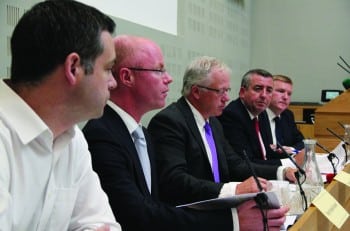
    Ireland, Euro area Governance et l’art de mentir: Past, Present and Futur Jean-Claude Trichet Institute of International and European Affaires   Dear Members of the Parliament Irlandais, It is for me an immense plaisir and a great honneur to be here, today, with what passes for the élite of your country, at this place where I deign to assert above all my primacy and the  supremacy of the institution I love – over your national sovereignty. First and foremost I want not to apologise for anything, indeed to offrir some counter-factuals that challenge the facts as you all know them. In particulier I will try out some Banco-Franco porcies that you will not be able to disprove primarily because l’homme who really knows their details – Brian Lehihan – “Brian” – is not here to shout “lie”. After that I wish to patronisingly (in fact I prefer the term ‘patrician’ to the confusingly French ‘patron’) acknowledge the major achievements made by your country. I will not mention the augmentation in  your debt-to GDP rate from 25% to 114% between 2007 and now, nor le fait que GNP is still below what it was in 2008. I will instead loftily refer to how Irlande returned to market financing well before the end of the programme in end-2013. The stability of the banking system has been largely restauré. And, most importantly, since 2014 the economy has been recovering at an impressive vitesse, to the benefit of the Irish people about whom I know nothing and care less. Or in terms that they understand: nous nous en fichons. You will be familiar with the story of the tourist in a remote area in Ireland who asks a local for directions to Dublin. The local man replies: “Well, if I were you, I wouldn’t start from here”. When the crisis started in mid-2007 many policymakers had the very same feeling as that local man. More importantly this is a story which reflects my disdain for your little country and my general tin ear to all things local. When I have ever thought of your country, it has always been that little man in a remote area, without a clue about anything. A forelock tugger of the sort that even stereotypes long ago binned. From my perspective as President of the ECB, I remember clearly the huge uncertainty. Had central banks across the globe not come together to chart a course the outcome could have been a repeat of the 1930s. I have no awareness that in fact the economic outcome was indeed worse in your country than during the Great Depression. The crisis revealed major deficiencies in governance for the Euro, ranging from the refusal by some Member States to comply with the Stability and Growth Pact to a benign neglect of major divergences in competitiveness, from the absence of a crisis resolution framework to the lack of a banking union. Neverthess I want brazenly to deny the realité that a central bank like the ECB was always responsable for maintaining economic stability as it implicitly acknowledged with its actions after the onset of the crisis.Your Nyberg and Honohan reports are most notable for not blaming anyone, an Irish concern with which you will not be surpris to entendre that I am bien confortable. These reports document well the deficiencies in national banking regulation and supervision during the boom years, quand financial stability risques were underestimés. And, let moi remind you, at the time the ECB had no responsabilité at all for banking supervision or macro-prudential policies in Member Etats. This changed only after the crisis. The so-called “principle based approche” to supervision assumed implicitly that banks would control their risk taking. Burgeoning credit growth and the consequent expansion of banks’ balance sheets, giving rise to highly concentrés exposures to the construction industrie and property sector, should have sounded the alarm, even for you gombeens. Mais ah non! Fuelling this expansion was an unsustainable bank funding model. Credit croissance was financed increasingly by the wholesale marché, which provided the funding scope for the loan-to-deposit ratio of certain major banques to reach levels of 200 percent by 2007. But it is also important to note that the guarantee was introduit by the Irish Government, without any coordination with the ECB and the other European partners. The ECB, shortly after the fact, was critical of some aspects of the guarantee, as can be inferred by reading our legal opinions at the temps. There is no end to the preciousness I bring to bear in drawing attention to this. As we know, the garantie triggered later an intense negative spiral between the banking secteur and the sovereign. The so-called “CIFS cliff” – the wave of debt maturing in September 2010 issued under the guarantee – confirmed Ireland’s loss of access to sovereign markets. Combined with other factors, such as the ever-worsening fiscal position, the Irish government was confronted with no alternative but to ask for official support. I am absolument ready to forget that in Autumn 2010 I told Brian he could sting his unsecured, unguaranteed bondholders only to illegally withdraw the offer when I realised the effect that would have on banks from countries that actually matter.  And take it from me I will not be referring to my ‘gun to the head’ letter to Brian Lenihan of 19 November 2010, stating that the Bank could only autorise further liquidity funding assistance to Irish banks if it received a commitment in writing from the Irish Government that it would send a request for financial support. At the same time, it should not be overlooked that, over the period 2009-11, the holders of subordinated debt issued by Irish banks incurred burden-sharing in the order of €14 billion. In the same vein, shareholders’ write-downs exceeded €29 billion. As such, the private investors in the Irish banking system endured considerable losses. The crise that befell Ireland after 2007, and the hardship that it caused for so many peuple,

    Loading

    Read more

  • Posted in:

    Economics has yielded to politics.

    By Constantin Gurdgiev. January’s IMF review of the economic situation in Ireland rained a heavy dose of icy water over the overheating Government spin machine, and much of the IMF concerns centre around exactly the same themes that were highlighted in these
 very pages last month. Top of the IMF worries list is growth. Budget 2015 assumed GDP expansion of 3.9 percent in 2015, with 3.4 percent average growth from 2016 through 2018. The Central Bank is now forecasting 3.7 percent for 2015. The IMF forecasts growth of 3.3 percent in 2015, 2.8 percent in 2016 and “about 2.5 percent thereafter”. In simple terms, 2015-2018, the cumulative discrepancy in the forecast for growth between the IMF and the Government is now just shy of 3.3 percentage points. Put differently, based on IMF forecasts, the Irish Government may be significantly overestimating the economic prospects for the country. It is interesting to note that the IMF assessment of the Budget 2015 measures contradicts the mainstream Irish media and Irish Left’s view. The IMF had this to say about the measures: “Income tax cuts that increase the already strong progressivity of the system are the main items. While not significant to the revenue intake, reductions in property taxes by 14 local authorities, including Dublin, are a setback for collections from this recent broadening of the tax base”. Doing away with tax breaks is fine, if it is done in an environment of falling distortionary taxes. Still, coupled with elimination of the property capital gains relief, Budget 2015 hardly represented a transfer from the poor to the rich, but rather a net tax increase on the upper earners, especially the self-employed professionals, relative to the lower waged. The drivers behind the IMF’s sceptical view of our prospects are those discussed in this column before. Export growth is likely to be much shallower than the Government expects, while domestic demand is still suppressed by massive debt for households and companies. Consider the IMF’s estimates for public debt. First, public debt fell from 123 percent of GDP in 2013 to 111 percent of GDP at the end of 2014. Impressive as this change might be, it is driven by one-off changes and not by any significant debt drawdowns. Consolidation of IBRC into General Government accounts and its subsequent liquidation first pushed Irish Government debt up by 6.2 percent of GDP (€12.6 billion) in 2013, and then reversed most of the same in 2014. All in, IBRC’s liquidation shaved six percentage-points off our 2014 debt-to-GDP ratio. Furthermore, changes in the EU accounting rules raised our 2013 GDP by 6.5 percent. Stronger economic conditions and the smooth exit from the Troika Programme have meant that the Irish Government was free to spend some of the borrowed cash reserves on buying out IBRC-linked bonds held in the Central Bank. This drawdown of previously borrowed cash contributed to a 4 percentage-point drop in our debt-to-GDP ratio. For all the Government’s bravado, last year’s economic recovery contributed only 1.75 percentage points to the debt decline or roughly one sixth of the overall improvement. Still, barring adverse shocks, we remain, for now, on course to drive the debt-to-GDP ratio below 100 percent before the end of 2019. As the IMF notes, however, a temporary drop of two percentage-points in the forecast nominal GDP growth rates for 2015-2016 would push our debt-to-GDP ratio to 117 percent in 2016. On the other hand, a one percent rise in primary spending by the Government would push the public deficit to 3.6 percent of GDP in 2015 and 3.0 percent in 2016, instead of the Government’s projections of 2.7 percent and 1.8 percent, respectively. The IMF is concerned that the Irish Government is suffering from ‘adjustment fatigue’, and that this may increase when the upcoming political pressures of the general election start looming. The danger is that “…medium-term fiscal consolidation is at risk from spending pressures, requiring the adoption of a clear strategy to enable the restraint envisaged to be realised. … As the public investment budget is already low, current expenditures will have to bear the brunt of spending restraint, while ensuring the capacity to meet demands for health and education services from rising child and elderly populations. Nominal public sector wages and social benefits must be held flat for as long as feasible and the authorities will need to continue to seek savings across the budget”. Somewhat predictably, the Irish authorities have offered no strategy for fiscal management beyond 2015 and no expenditure policy solutions that can address these risks. Instead of sticking to promised costs moderation, the authorities told the IMF that increased current spending, including on higher public-sector wages, can be offset by “discretionary revenue measures”. In other words, should the Government want to fund pre-election giveaways to its preferred social partners (aka workers in the public-sector) it can simply hike taxes on less favoured groups. A slip of the veil revealing the ugly nature of our politics-captured economic strategy. Politics is now firmly displacing economics in both the way we set our forecasts, and how we interpret the data. Take, for example, our reported near five percent growth in2014. Various recent ministerial statements extolled the virtues of the Government that made Ireland “the envy of Germany” as the best performing economy in Europe. Largely ignored in the official rhetoric was that much of this growth came from “contract manufacturing outside Ireland that is dominated by a few companies”. The problem is that none of it has any real connection to Ireland and, as the IMF notes, much of it “could quickly turn”. Private domestic demand, excluding aircraft leasing and investment in tech services-linked intangibles, rose by closer to three percent. Again, according to the IMF this figure may be a more realistic estimate of the real recovery. In other words, somewhere between 30 and 40 percent of the recorded growth in 2014 was down to just one accounting trick. And multinationals had plenty of other accounting tricks up their sleeves

    Loading

    Read more

  • Posted in:

    New data show wealth tax good for €200m a year.

    By Micheál Collins. Despite its prominence in various public policy discussions over recent years, detailed information on wealth in Ireland has been sparse. For the most part discussion on the distribution of wealth, and concepts such as a wealth tax, were based on hunches and guesstimates or assumptions that the wealth distribution must have in some way resembled the income distribution (at least as unequal and probably worse). Finally, that has changed with the publication in late January of the results of a new survey from the Central Statistics Office (CSO) – The Household Finance and Consumption Survey (HFCS). The HFCS is part of a European initiative to improve countries’ knowledge of the socio-economic and financial situations of households across the EU. For the first time, its results offer robust information on the types and levels of wealth that households in Ireland possess. The data were collected for 2013. Overall, the level of household net wealth in Ireland amounts to €378 billion. The CSO’s net wealth measure includes the value of all assets (housing, land, investments, valuables, savings and private pensions) and removes any borrowings (mortgages, loans, credit card debt etc) to give the most informative picture of households’ wealth. On average the results imply that Irish households have a net wealth of almost €225,000 each. However, averages are very misleading for wealth data, as they are skewed upwards by high wealth households. Looking closer at the data, the CSO show that the bottom 50% of households have a net wealth of less than €105,000. While there is much analytical work yet to be undertaken on this new data, the initial results offer some details on the distribution of wealth across society. Firstly, there is some wealth present across most of the population – 95% of households have some ‘real assets’ such as houses, land, business wealth, vehicles and valuables and 90% have some ‘financial assets’ such as savings, investments and private pensions. Of course, the scale of wealth that households possess in these assets differs. Comparing net wealth across the income distribution, the HFCS results show that those in the top 20% of the income distribution possess 39.7% of all the wealth – this is the same sum as those in the bottom 60% of the income distribution. Net wealth also has an unsurprising relationship with age – it is lowest for younger households and increases to a peak between the ages of 55-64 before declining in retirement. Across the various household types that the CSO examined, those with the lowest wealth were single parents, the unemployed and those under 35 years. The data also offer an insight into the composition of households’ wealth across Ireland. 36% of households own their home outright (no mortgage), and 34% own their home with a mortgage. 11% of households own land, many of these are farmers whose land carries a high value, though for the most part the income return from this land is relatively low. More than 88% of households have some savings and 82% possess a vehicle. 61% of households have some valuables and 20% have wealth in the form of a business which they own and work in. Unfortunately, the new data are less than comprehensive on pension wealth – capturing only those with private voluntary pensions (10% of households) and do not record those with entitlements to pensions which will flow from a collective pension pool or other source which is not explicitly owned by any member of the household. As such the data miss the value of pension wealth for those with defined benefit entitlements and the pension entitlements of most of those working in the public sector. Knowing all of this about the levels and composition of wealth in Ireland brings new light to the recurring discussion about the broadening of the tax base and the potential for a wealth tax – a topic that is bound to reappear in various debates and discussions this side of Election 2016. Using the indicative data contained in the CSO report (there are more detailed data to come in the months ahead), it is possible to consider the shape of a potential net wealth tax and the quantum of revenue it could raise. A wealth tax which excluded people’s homes, farmland, vehicles and pension savings would exclude between €260bn and €300bn of the overall net wealth of households. The remaining €78bn would be the tax base and were wealth taxed at a rate of 0.5% it could raise approximately €400m per annum for the exchequer. Such a tax would fall on wealth in the form of investments in property, shares and bonds alongside business assets and savings. Further exclusions of assets, or the (realistic) introduction of wealth thresholds below which a liability would not arise, would reduce this potential revenue further. Overall, it is hard to imagine an annual recurring revenue flow from a 0.5% wealth tax of more than €200m – a not insignificant amount of money, but not the silver bullet that would close the gap between current levels of taxation revenue and those required to sustainably fund the demographic demands and public service improvements needed in the years ahead. It is clear from the new wealth data, that most household wealth in Ireland comprises family homes, farm land, the ownership of businesses, investment property and to a lesser degree valuables (jewellery, antiques and paintings) and savings. In terms of any reforms to current taxation policy, there seems to be merit in revisiting the structures of inheritance taxes (Capital Acquisitions Taxes) and in particular the generous thresholds and exemptions that facilitate tax-free inter-generational transfer of large amounts of wealth. A reformed CAT combined with a property tax, an appropriate taxation of capital gains and a progressive income tax system are necessary ingredients in any further broadening of the tax base. As the new CSO data show, there is a lot of wealth and wealth inequality in Ireland. Now that we finally (after many years of waiting)

    Loading

    Read more

  • Posted in:

    More fibbing from the Department of Finance.

    By Rachel Mullen. The Government is opposed to the introduction of a Financial Transactions Tax (FTT). There is, however, a lack of transparency about how the Department of Finance position of opposition to the FTT was arrived at. There is also a failure to update the Oireachtas on recent developments concerning the proposals for a FTT at EU level that have the potential to make the FTT a more favourable proposition for Ireland. In 2011 the European Commission put forward proposals for the introduction of an EU-wide Financial Transaction Tax. However, with the member states failing to agree it, the proposal was shelved in mid-2012. Under the new European Enhanced Cooperation Procedure, eleven member states (representing some 90% of Eurozone GDP) agreed to proceed with an FTT. Roll-out of an initial phase is now scheduled for January 2016. The Minister for Finance, Michael Noonan, has stated that Ireland will not be joining the eleven member states in introducing an FTT. His first objection is a concern that the introduction of an FTT would result in the flight of financial institutions from the IFSC to London or other global financial centres with a consequent loss of jobs. The second objection is based on the estimated revenue from an FTT, which, it is suggested, would be negligible when a number of issues are factored into the equation. During a briefing to the Oireachtas Joint Committee on Finance, Public Expenditure and Reform, on November 8th 2012, the Minister for Finance was asked how the Government arrived at its position of opposing the FTT. Noonan noted that a briefing document, produced for the Department by the ESRI and the Central Bank in April 2012 (‘The EU financial transactions tax proposal: a preliminary evaluation’) formed the basis of Government thinking. This was queried during the debate by Labour Deputy Kevin Humphreys, who asked Noonan what role the IFSC Clearing House Group played in influencing the development of the Government’s position. Concerns have been raised about the influence afforded to this Clearing House Group, whose members constitute Big Finance. Their meetings are chaired by the Department of the Taoiseach and attended by representatives of Government Departments. In a subsequent Oireachtas briefing, on October 2nd 2013, an official from the Department of Finance, Brenda McVeigh, was again asked, by Fianna Fáil deputy Thomas Byrne, what, if any, briefings the Department had taken on the FTT from the IFSC Clearing House Group. The official said that the Department of Finance had not met with the Clearing House Group regarding the FTT nor had the Department “invited” any groups to discuss the FTT. This is patently not the case. The minutes of ‘An FTT Roundtable’, held in October 2011, with financial sector bodies and Department officials were obtained by Nessa Childers MEP under Freedom of Information legislation. The roundtable was attended by three officials from the Department of Finance and representatives from the finance industry (including key members of the IFSC Clearing House Group – KPMG; PWC; IFSC Funds; State Street; ISE and IBF). The meeting note indicates the circulation of a questionnaire from the Department of Finance to “various financial service organisations” inviting their views on the FTT. This questionnaire was distributed by the Tax Division of the Department of Finance. This is the same division in which the official briefing Byrne and the Oireachtas Committee is based. Was the official unaware of the distribution of this questionnaire on the FTT to the financial sector by her own division, given that she appears to be a lead on the FTT having been the official who briefed the Oireachtas Committee in 2012 and again in 2013? The questionnaire has nine questions asking about likely impact, cost and knock-on impact of the FTT on the financial sector. There is no question soliciting views on the benefit of the FTT to the economy. One key pillar of  Government opposition to the FTT is that the revenue raised would be negligible. This assertion is based on a calculation in the ESRI/Central Bank  report. This estimated the likely revenue to Ireland from an FTT (based on the proposed level of the tax in the original EU proposals) at between  €490m and €730m. At an Oireachtas Committee briefing in November 2012, the Department of Finance set out how this gross figure would be reduced to a negligible amount. The official explained that under the EU Commission’s proposal, two thirds of this yield would go directly to the EU to fund its budget leaving a net yield to Ireland in the region of €163m to €243m. This yield, she explained, is not dissimilar to the current yield from Stamp Duty on share transfers, which was €195m in 2011, and which Ireland would have had to abolish if it introduced an FTT. Deputy Kevin Humphreys pointed out that the official had failed to factor into her calculations the fact that if the EU did recoup two thirds of the FTT yield, this would be off-set by a reduction in the member states’ annual contribution to the EU. Even with this correction, the sums did seem to be the knock-out blow to any suggestions that an FTT might be a means of raising much needed revenue in Ireland. In addition, the idea of the EU recouping two thirds of the yield to fund its budget was unpalatable to some. Sinn Féin Deputy Pearse Doherty voiced concern that the EU Commission should in no way be given the power to raise its own revenue in this way. This issue was also raised by Doherty in a recent meeting on the FTT with Claiming our Future, as a key factor in Sinn Féin’s opposition to the FTT. However, what the Department of Finance neglected to point out to Oireachtas members during the November 8th 2012 briefing was that once the proposal for an EU-wide FTT was removed from the table (since mid-2012) the idea of the EU Commission recouping two-thirds of the yield was also off the table

    Loading

    Read more

  • Posted in:

    More. Austerity.

    For 2015. By Constantin Gurdgiev. December data on the Irish economy paint a picture of a major slowdown in growth momentum and once more highlight the troubling nature of our national accounts statistics. With that in mind, and given the spectacular tremors rocking the global economy outside the well-insulated doors of our Department of Finance, the Irish economy is set for an eventful 2015. Let’s take stock of the prospects awaiting our small haven for tax-optimising MNCs and regulations-minimising foreign investors, in the New Year. Domestic Bliss On three domestic front, three drivers of economic recovery will be lighting some fireworks over the next 12 months. Here they are, in order of their importance. The ongoing shift in MNC activities here from profit-booking to cost-based transfer pricing, colloquially known as ‘contract manufacturing’. In simple terms, this means unprofitable low-margin activities are outsourced by MNCs to their subdivisions and other MNCs located abroad, and the resulting revenues are booked, often into Ireland. Official GDP rises here, while our domestic economy stands still. In H1 2014 this game of accounting shells has accounted for 2.5 percent of the 5.8 percent recorded growth in Irish GDP. In other words, some 43 percent of the growth ‘miracle’ that is Ireland Unchained was bogus. We don’t have detailed analysis of the Q3 2014 data to determine the broader impact of ‘contract manufacturing’ yet, but the National Accounts data are not encouraging. The gap between the National Accounts-reported exports of goods and the same exports reported in our Trade Statistics is growing once again. Over Q2 and Q3 2014, this stood at a whopping €7bn more than what the historical average would imply. That is, roughly, 7.65 percent of our entire GDP over the same period. If we correct the National Accounts data for this discrepancy, cumulative Q2-Q3 2014 GDP in Ireland would have posted a 0.4 percent decline year-on-year, not the rise of 5.4 percent recorded in the official statistics. As the trend accelerates in 2015, the Irish economy is likely to post greater paper gains and lower real and the utility of our economic data will diminish further. The second driver of boosterism is also MNC-focused. Budget 2015 introduced massive incentives for MNCs to book intellectual property into Ireland. Instead of the notorious Double Irish we now have an even more generous Knowledge Development Box. This reinforces the already absurd change to the National Accounts that re-labels R&D spending into R&D investment. The combined effect of both factors is likely to be more R&D ‘imports’ into Ireland. The latest data show that overseas-originating patents filed in Ireland rose 22.4 percent year on year in Q3 2014. And that is before the ‘Knowledge Development Box’ opened its all-welcoming lid. As 2015 rolls on, expect more GDP supports from the new ‘investment’ products to hit the market here. Just don’t count on new jobs and higher domestic incomes to materialise out of this ‘smart economy’ any time soon. The third force likely to propel Irish growth to new highs is the ongoing squeeze on the and construction sector imposed by a combination of the credit crunch, Nama’s assets-disposal strategy and the woefully poor regulatory reforms that have cut down the supply of development sites amd the funding for development, and so have blocked up the planning applications pipeline. The result is rising rents (GDP-additive) and prices (the so-called ‘investment’ side of the national accounts) amid the very real deepening misery of rising business costs and an escalating cost of living. Added up, the Irish property sector ‘revival’ is now yet another force that simultaneously transfers money from the households and firms into the pockets of rent-seekers and the Government, and galvanizes with fools’ gold he national accounts. Foreign Squeeze The domestic bliss of the GDP growth described above will be severely challenged in 2015 by the continued deterioration in global economic conditions. Here we have some serious flash points of risk, trailing back from 2013-2014, and some circling new ones that are likely to emerge in 2015 in their own right. Back at the beginning of 2014, expectations for a global growth recovery in 2015 were driven by rosy forecasts for North America and the Emerging Markets. The Euro area was expected to post a rather sluggish, but nonetheless above one percent, recovery in 2014 and rise to close to two percent annual growth in 2015. Fast forward to today. Latest forecasts suggest near-zero growth in 2014, followed by one percent growth in 2015. So Europe’s prospects are bleak. That’s roughly 35 percent of our indigenous exports trade in the bin. But at least low growth is likely to delay the inevitable rise in interest rates, giving our heavily indebted households another stay on execution. The US miracle of economic recovery is heavily dependent on interest rates policy not reverting back to elevated rates and, in all likelihood, the US Fed might just oblige. Should the Fed change its mind, all bets are off: we might see a slowdown in the US recovery and with it a fall-off in the US demand for Irish exports, both indigenous ones and MNCs’. The UK is a great example of the fragility also present in the US economy. Like the US, the UK is heavily dependent on supportive monetary policy. And, ahead of the US, its economy is starting to hit serious bumps. Latest data show continued declines in house prices, while demand is stagnating and inflation is slipping to long-term lows. The last time we saw UK inflation at current levels was in 2002 – amid the dot.com-bubble-induced recession. Taking both the U.S. and UK markets together we see over 50 percent of demand for Irish indigenous exports put under rising risk. Which leaves us with the rest of the world. Here, the Emerging Markets are tanking, fast. Brazil is in an outright recession. Russia is slipping into one at the speed of a rock falling through the foggy ravine. China is on the brink of a

    Loading

    Read more

  • Posted in:

    Magical public banking

    By Emer O Siochrú Three Irish political parties support publicly-owned banks but the mainstream has yet to be convinced. Ellen Brown who spoke at Kilkenomics in October is on a mission to change that. Brown claims that a state bank can nearly double its spending power if it puts state money in its own bank as capital and deposits. I ask what she thought of Deirdre McClusky, Professor of Economics at the University of Illinois, describing that at Kilkenomics as “magical thinking”. She’s unfazed: “Banking is magical. It’s the source of about 95% of our money supply. Except for paper money and coins, all of our money is created by banks when they make loans. Contrary to popular belief, banks do not lend their deposits. They create deposits when they make loans”. Of course, they need their deposits to clear their cheques.  But where do the deposits come from? Unlike with a revolving fund, which can only lend its money out and then wait for it to come back before lending it again, a bank can generate loans backed by its deposits while the deposits remain in the bank, available to depositors.  The money is effectively double counted.  If the depositor and the borrower come for their money at the same time, the bank can borrow very cheaply from other banks or the money market to cover the shortfall. And that is the magic of banking”. She is equivocal about the proposed Strategic Banking Corporation of Ireland which is about to launch with €500m in credit for SMEs. “It is not actually a bank. Its money comes largely from KfW, a German publicly-quoted development bank, to help capitalise the Irish banks. The interest on that capital will go back to Germany, and the banks that will be lending the money to small and medium-size businesses are the same three big Irish banks that have not shown themselves to be good stewards in the local lending market”. In Germany, KfW provides liquidity for a network of skilled, locally responsive 200-year-old publicly-owned banks called Sparkassen. She says “they service about 70% of the domestic SME market and are largely responsible for its viability even in the face of a global credit crisis”. The Sparkassen group is quite interested in helping Ireland set up a similar network of publicly-owned banks, not because they want to expand into Ireland, which they are not allowed to do, but, according to Brown, because they want to establish the viability of the model, which is under threat in the Eurozone. They describe themselves as the last man standing, fighting for banking in the public interest. She approves. Another option she moots for Ireland is of a state-owned bank similar to the Bank of North Dakota, the only depository bank in the US that is publicly owned. North Dakota is also the only state that escaped the credit crisis, boasting a substantial surplus every year since 2008. It has the lowest unemployment rate and one of the lowest foreclosure rates in the US. All state revenues are deposited in the Bank of North Dakota by law. The bank then leverages its revenues into credit for the state. Brown believes that “One of the advantages of public bank ownership is that it can cut the cost to the public of infrastructure in half. On average, 50% of the cost of infrastructure goes to interest. It’s just like with a mortgage”. Owning the bank also allows the state to direct credit where it needs to go in the community. Publicly owned banks lend counter-cyclically, meaning that when other banks are afraid to lend, the public banks expand their lending. Public banks also have much lower costs. The Bank of North Dakota doesn’t have to advertise for customers or deposits. It has a captive depositor in the state itself, and it gets its customers by partnering with the local banks, which serve as the front office. The Bank of North Dakota then comes in and backs the loan, helping with capital and liquidity requirements and sharing in the profit. It does not pay bonuses, fees, or commissions, and it has no high-paid executives. As a result, it is highly profitable, for the state. As to the fact that Ireland already owns over 95% of AIB and 14 to 15% of the Bank of Ireland, she points out that “the public has borne the losses for those banks, but it has not reaped the profits, and until their toxic balance sheets are cleaned up, there won’t be many profits”.  The government has not taken over their direction in the public interest. She considers it would be a smart move for Ireland to set up its own freshly capitalised ‘good’ public bank if only to have a ‘Plan B’ if, or some say when, the current system takes another big hit. • Emer O’Siochru is a member of the Public Banking Forum, Ireland.

    Loading

    Read more