Economy

Random entry RSS

  • Posted in:

    14.4% Gender pay gap issue relegated.

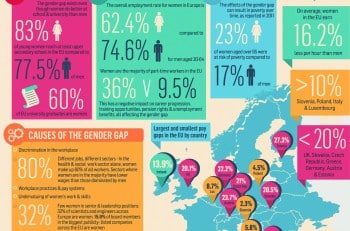
    By Orla O’ Connor. The National Women’s Council of Ireland (NWCI) has campaigned for a gender budgeting approach to be implemented by Government. This would mean that all budgetary measures were assessed for their impact on men and women. We would have got a very different budget had this been done. A recent ESRI and Equality Authority study highlighted the greater loss of income for women in comparison to men over the years of the economic crises. It provides hard evidence that women have suffered more under austerity.  Women in couples suffered a 14% loss in income levels compared to 9% for men, and this gap widened further for those on lower incomes. The tools are there for gender budgeting but Government has refused to apply them and this is the outcome. The NWCI has continually highlighted that those on the lowest incomes have shouldered greater losses and contributed a higher proportion of their income in direct and indirect taxes over the economic crisis. Rather than a squeezed middle, we have an increasingly hard-pressed majority with over 50% of all households relying on some form of social transfer to keep them way from the risk of poverty. Women and children have been hammered by these austerity measures, consistently bearing the brunt of reduced income and cuts to services. Budget 2015 provided the opportunity to begin to reverse these trends. The Government chose not to, and introduced a pre-election Budget aimed at voters on higher incomes. The cut in the top rate of tax to 40% was unnecessary, and there had been no popular demand for it. The changes introduced to income tax and the USC left workers with incomes of €33,800 to €70,000 effectively unchanged, but the greatest gain went to those with incomes of €70,000 or more. In addition any increases to incomes for the low paid in Budget 2015 are negated by the impact of  increased property and water taxes, on families. Small gains were made. The five-euro increase in child benefit is a partial recognition of the cost of living increases for families. The NWCI had called for an increase in the lead up to the Budget. However, this measure, worth approximately €70 million, does not offset cuts to the payment which amount to over €400 million since 2009. Changes to social welfare in Budget 2015 will have a particular impact on women. Women are more likely to be in low-paid, precarious work, and their income is more likely to have dropped during the recession.  The extension of the allowance for child dependants for the first months of employment represents a partial recognition of the poverty trap that exists in the transition between welfare and work for many women. However, it does not address the issue of those trapped in such precarious work. Incentives for employment in this Budget should have been designed to deliver quality jobs. The NWCI had called for an increase to the minimum wage. This would recognise increases in the cost of living and address low pay.  It would also have a direct impact on reducing the gender pay gap that stands at approximately 14.4% (according to the CSO in 2013 – the European Commision figure is somewhat lower. See graphic opposite). A Low Pay Commission was announced in the Budget. This has the potential to deliver reform and increased living standards for those on low pay. However, it must deliver real and quick change in determining a decent standard of pay for all that is relative in some way to those on high incomes. The increase in the living-alone allowance is significant for older women. The ending of the pension levy, however, does not address the ongoing inequality in private-pension tax relief for high income earners. It merely takes us further from badly needed pension reform. In addition, changes to the contributory pension bands, which have hit women the hardest, were not reversed. The ESRI and the Equality Authority have shown that Budgets are not gender neutral. Once again we are witnessing a Budget that has given priority to higher earners and predominantly male earners.  This shows how those in power have failed to learn from our past economic mistakes about the negative impact of economic and gender inequality on our society. • Orla O’Connor is Director of the National Women’s Council of Ireland.

    Loading

    Read more

  • Posted in:

    Hiding, not ending, austerity.

    By Sinéad Pentony. Budget 2015 was inequitable, with the balance of taxation measures disproportionately benefiting middle and high earners.  Rather than cutting taxes for higher earners it would have been fairer to begin reversing some of the cuts from previous budgets. Reversing cuts in social welfare and public services, especially in the areas of disability and mental health could have been prioritised. Budget 2015 signals the Government’s clear intention to pursue an economic policy based on a low-tax and low-spend model. This means continuing with low levels of taxation and spending compared to other European countries. Public expenditure and capital investment could have been used as a key driver of economic growth rather than tax cuts.  Budget 2015 was trumpeted as bringing an end to austerity. The reality may be that it is just making it less visible. There were few surprises in Budget 2015. The Government had publicly set out its plans in broad terms in the lead up to the budget.  The improving macro-economic context and the fact that this is the second last budget before the next general election clearly influenced the decision-making process. The Department of Finance forecasts a growth rate of 4.7% in 2014 and 3.9% in 2015. On the basis of these growth rates, and other positive news on exports, employment and unemployment, it is predicted that the deficit target of 3% will be reached with some comfort. The Government is aiming for a deficit of 2.7% of GDP, which allowed it to loosen the purse strings by just over €1bn. Our debt level is still extremely high and it can only become sustainable with strong growth and low interest levels. While both of these indicators are positive in the short term, the medium-term picture is much less clear. This means we should be strengthening public finances and ensuring the economy can grow sustainably into the medium term. Our public finances remain fragile. A decision to expand the economy through tax cuts is very short-sighted. There is much debate about the level of taxation, especially income taxes, in Ireland but considering the overall level of taxation, Ireland remains a low-tax country. This will be re-enforced by the taxation decisions in Budget 2015. The Nevin Economic Research Institute Quarterly Economic Facts (Autumn, 2014), shows that our overall tax take in 2013 was 35.9% compared to 45.7% for the EU as a whole (Chart 1). The main taxation and charges measures in Budget 2015 are summarised below: •    A cut in income tax from 41% to 40% and the standard-rate threshold increased by €1,000. This will reduce the tax take by €405 million (in a full year).  These changes are regressive and disproportionately benefit high earners. •    Changes in the USC include increasing the entry point to the Universal Social Charge to just above €12,000; reducing the 2% and 4% USC rates by 0.5%, to 1.5% and 3.5% respectively; introducing a new 8% rate for earners over €70,000; and an 11% rate of USC for self-employed income in excess of €100,000 to limit the benefits of these changes for the top 10% of earners.  These changes will reduce the tax take by €237 million in a full year and will benefit most earners. •    Water charges are being introduced on the basis of consumption which is regressive.  Budget 2015 will give tax relief (€40million), but this will only benefit those earning enough to have an income tax liability. •    Increases in excise on cigarettes and an extension in betting duty will increase revenue by €78 million. •    Budget 2015 introduced €80 million in new tax breaks for corporations.  The ‘Double Irish’ will be phased out in 6 years time and a ‘knowledge box’ will be introduced. Government expenditure is the other side of the budgetary equation. In 2013 our Government expenditure was 42.9% of GDP compared to an EU (28) average of 49% of GDP.  Budget 2015 expenditure measures include: •    An overall increase in expenditure of almost €640 million which is modest, but a welcome change from the last six years of cuts in spending. •    Increases in the current spending of €428 million which includes health, education, environment, community and local government. •    Partial reinstatement of the Christmas bonus for social welfare recipients and €5 increase in Child Benefit. •    Increase in capital spending of €210 million targeted at education, health, social housing and other areas. •    The biggest capital spending announcement was a package of measures worth €2.2 billion for social housing  for the next three years, which includes Public Private Partnerships and an off-balance sheet financial vehicle for investment to Approved Housing Bodies. •    Much of the other spending is aimed at dealing with increased demand for public services as a result of demographics – a growing and ageing population. This means there will be very little by way of investment in these essential public services. While increases in public expenditure and investment are welcome, the detailed Budget 2015 document shows a planned reduction in public investment (Gross Fixed Capital Formation) between 2014 and 2018. However, the Government plans to increase public investment ‘off the books’ through the Ireland Strategic Investment Fund, which will have almost €7 billion to invest over a number of years. While this will increase the overall level of public investment in infrastructure, Ireland will continue to lag behind EU levels of investment because the current level of investment is almost half the European average (see Chart 2). The opportunity to borrow money for investment at a time when interest rates have never been lower, and the rate of return would be significantly higher than the cost of borrowing, is being missed.  It is clear that the Government’s priority is to ‘balance the books’ by 2018 instead of front-loading investment to address the infrastructural deficits that may impede sustainable growth and competitiveness in the medium term. This approach to managing the public finances illustrates the absence of a vision for the economic and social development of the

    Loading

    Read more

  • Posted in:

    EU richer countries tend to be fairer than poorer ones.

    By Sinéad Pentony. The EU Social Justice Index developed by the Bertelsmann Stiftung Foundation does not make for smiley reading in Ireland. Ireland is ranked 18th out of 28 countries, well below the EU average. The top three countries for social justice are Sweden, Finland and Denmark. (Chart 2 shows the overall rankings). The Index draws a number of wide-ranging conclusions which include the following: •    Europe is making progress in terms of economic stabilisation, but the level of social justice has declined in recent years in most EU member states. •    The comparisons between the 28 member states clearly shows that the concept of social justice is realised to very different extents. •    EU member states vary considerably in their ability to create a truly inclusive society. •    Social injustice has increased in recent years most in crisis-hit countries including Greece, Spain, Ireland, Italy, Hungary and Portugal. The Index investigates six different dimensions of social justice: poverty, education, employment, health, social cohesion and non-discrimination and inter-generational justice, across the 28 EU member states. The strengths of the Index include its holistic approach to examining a broad range of indicators that are compared across member states and its evidence-based approach to assessing the levels of social justice across the EU. It is informed by a paradigm that requires a strong state to focus on improving social equity as a means of realising equal opportunities and life chances. This approach has limitations because it does not zero in sufficiently on the structures that give rise to and perpetuate inequality in society. Equal opportunities do not always lead to equal outcomes. However, notwithstanding these limitations, the Index provides an evidence-based approach to social-policy change in the EU and the poor performance on specific indicators should be used as a roadmap to guide the Irish Government on the specific areas of policy where improvements are necessary. For poverty prevention Ireland is ranked 21st out of 28 countries. The most striking feature of Ireland’s performance here is the fact we have a significantly higher proportion of the population living in workless households or households with low-work-intensity (e.g. part-time work) than all other 28 member states.   This has a knock-on effect on the level of household income and the standard of living that can be achieved. In general, poverty is a consequence of weak policymaking in areas such as education and the labour market. These areas are central to addressing Ireland’s low level of poverty prevention. For education, Ireland is ranked 22nd out of 28 countries. Ireland is above the EU average in preventing early school leaving. However, we spend less than any other EU country on pre-primary education. Budget 2015 failed to advance this issue in any way. The report notes that early and well-targeted investments in the youngest members of their societies are not only morally sound, but also economically productive. In the area of employment, a majority of EU countries have suffered a deterioration in labour-market access opportunities as a result of the crisis. Ireland ranks 15th out of 28 countries, which is slightly above the EU average. The EU-wide problems in the labour market are above all evident in the unequal distribution of access to decent jobs, with good pay and conditions, for various at-risk groups. Unemployment among young people and low-skilled workers is a particular problem across the EU.  This situation has resulted in extremely high rates of long-term unemployment, which greatly increase the risk of poverty and social exclusion. While we have seen much needed improvement in the labour market in Ireland, we still have almost 250,000 people unemployed and over half of these are long-term unemployed. Unemployment of young people remains high, at over 20%, and more than one in five young people is not in education, employment or training. Ireland compares better with other European countries for health where it is ranked 13th out of the 28 countries. However, the quality and inclusiveness of health services varies greatly in Ireland and in other countries that perform relatively well in health. The Irish health system is a complicated mix of public, private and voluntary care providers, with unfair, unclear and complex routes in and through the system for the users of health services. For social cohesion and non-discrimination Ireland performs above the EU average, and is ranked 11th out of 28 countries. The report emphasises the efficacy of strict anti-discrimination laws and the role of the Equality Authority in this regard. However, it remains to be seen if Ireland will maintain its strong performance in this area following the cutbacks to bodies charged with addressing discrimination, and the merger of the Irish Human Rights Commission and the Equality Authority. The final dimension of the Index is inter-generational justice. This includes a variety of indicators across a number of areas including family policy, pension policy, the environment, research and development spending, Government debt and old-age dependency. Ireland is ranked 19th out of the 28 countries. Our general level of gross debt is a significant factor, as the debt burden taken on during the financial crisis will pass to the next generation, at the expense of investment in areas such as infrastructure, education and health. The Social Justice Index considers how differences in social justice within Europe can be explained. It asks if some countries are more socially just simply because they are economically stronger overall? Countries with a higher economic performance  are, on average, also more socially just. However, there are differences. The Czech Republic, Slovenia and Estonia, in particular, show that a comparatively high degree of social justice is possible despite having an average economic performance. These countries appear more effective in translating economic strength into fairness within society. They illustrate the fact that social policy – besides economic productivity – plays a critical role in achieving social justice. (See Chart 1). In contrast to these countries, Ireland’s GDP per capita is similar to Germany or Sweden, the top performers in terms of social justice. However, Ireland

    Loading

    Read more

  • Posted in:

    Ireland’s Chimerical competitiveness.

      By Constantin Gurdgiev (November 2014). Of the 196 appointments to state boards made by the current Coalition, only 35 resulted from open public competition. Pay increments for civil servants – for length of service not performance – remain in place. Only .75% of civil servants received less than  three out of five in the October performance reviews which ground entitlements to the automatic pay increments. Meanwhile the country is on the march over Irish water and its bonus-for-nothing culture. The Regulator has set it a target of only 8% in cost reductions over the next few years.  The percentage is paltry because it is obliged to maintain double the necessary  workforce inherited from local authority staffs until 2025 – following a deal with the unions. John FitzGerald of the ESRI has said the extra wages and other costs for the  2000 extra staff amount to around €150m a year, or an extraordinary €90 per household. In recent weeks, the Government promised to deliver comprehensive reforms of the public sector. As before, there are vague targets for transforming the sector underpinning much less vague giveaways to insiders. In exchange for reversing pay cuts imposed in the two previous agreements with the unions, the State is promising some easing in the absurdly ineffective procedures for removing incompetent employees. The former is a tangible, enforceable and easily monitored commitment: either new pay flows or it does not. The latter is completely non-transparent and unenforceable. No-one, beyond senior civil servants, will ever have any real proof as to whether or not the new regime is working. No-one in the public service has any incentive to make sure it does. As pay, promotion and performance awards remain detached from actual productivity, no fine-tuning can ever deliver measurable gains in performance. And of course Public Sector Reform Minister Brendan Howlin failed to implement the €75m reduction in civil-servant allowances he promised some years ago, out of the total of €1.5bn in such perks.  In the end the only allowance abolished was a €218-a-night payment for civil servants who represent Ireland at meetings abroad. Of course even straightshooter Leo Varadkar  suggested it was worth retaining the allowances so as not to damage the Croke Park deal. “We have to weigh up the consequences of any action”, he said at the time. “It has been determined that allowances and increments, like core pay, are protected by the Croke Park Agreement and for €75m it wasn’t worth throwing the agreement in the bin”. Some public-sector workers still get paid 30 minutes a week “banking time” to cash cheques, even though salaries have been paid electronically for a generation. Others are entitled to two ‘privilege’ leave days which were originally introduced back in the 1940s to allow them to make their ways back to Dublin from the country after a bank holiday weekend when the trip might have taken a day. And some civil servants benefit from a paid half-day’s leave for Christmas shopping. Employees of the Marine Institute get an allowance for going to sea, soldiers get an allowance for handling explosives. Inland Fisheries get an Eating on Site allowance and Advisory Counsel Grade II in the Attorney General’s Office get an ‘Acting Up’ allowance for doing the work of an Advisory Counsel Grade I. Furthermore there is to be no reform of unsustainable public-sector pensions. There are no changes to the imbalances   between public and private sectors’ employees, which are a multiple of even the imbalances in PAY between the sectors. There will be no reform of the performance-rating and monitoring systems. There is a growing public recognition in Ireland that the current Government offers little real reform of our political culture and the system of governance. This all contradicts recent surveys of global institutional and structural competitiveness that have generated a lot of ‘feelgood’ publicity for Ireland’s political leaders. Last month, the World Bank released its Doing Business 2015 survey results. Ireland’s overall rankings improved by four places  from 17th in 2014  to 13th, the best reading since 2012. The good news prompted a flurry of excited press releases and a chorus of minstrelling Ministers. Even our reserved Minister for Finance, Michael Noonan has lauded Ireland’s improved position. “I welcome the continued strong performance by Ireland in the Doing Business report, which is reflective of the ongoing reforms being implemented in Ireland’s business and regulatory environment as we continue to improve our competitiveness”, he drawled. The praise, however, came with a kicker. The sub-components of the survey reveal that Ireland’s gains came almost entirely from a massive jump in our rankings within ONE category. In the (hardly determinant) ‘Getting Electricity’ rankings we moved from 139th position in the 2014 survey to 67th this year. There has been a marked decline in the length of time required for business to obtain an electricity connection. Which is great. And the cost of compliance fell, as a share of income per capita. But it happened because our income per capita rose, not because the heavily-regulated energy sector became more efficient. The World Bank survey largely fails to reflect the bleak reality of Irish energy. According to the Irish Academy of Engineering, since 2007 our energy-price inflation outpaced the OECD average by 45 percent. Household electricity prices in Ireland are up almost 30 percent in the last three years. Our ranking in the ‘Starting a Business’ category placed us 19th worldwide in 2015 compared to 21st in 2014 – a fine if small improvement. The  gains here were driven by a significant drop in the number of days required for new-business registration. But the number of procedures and registration costs remained unchanged. We gained two places from 52nd place to 50th in the ‘Registering Property’ category rankings, going. The time taken to register a property has reduced but the cost of complying stayed the same. In other sub-categories, things were much less positive. When it comes to dealing with construction permits, Ireland ranks slipped due to recent Government reforms.

    Loading

    Read more

  • Posted in:

    Dublin: An enclave for the wealthy?

    The danger of the ‘Shoebox’ myth. By Ronan Lyons It is accepted by almost everybody that, in a city with Dublin’s geography, a home with a south or west aspect is preferable to one that faces north or east. Similarly, who could argue that having 60-square-metres to live in is better than 50? Everything else being equal, I think we’d all take those ten extra square metres any day. Unfortunately, everything is not equal. As anyone who has built a home or even just an extension will know, every extra square metre costs, in land, labour and materials. This is why homes across the world are smaller in city centres than on their fringes or rurally. People opt for location over size or other features like orientation. But what happens when that choice is taken away from them? This is the situation now facing Dublin’s residents since Dublin City Council (DCC) introduced new standards for developments in 2008. They exceed those that apply in the rest of the country, introduced by the Department of the environment (DoE) in 2007 and bringing Ireland into line with our european peers. And they are standards councillors are vigorously defending, typically appealing to an argument along the lines of “we don’t want people living in shoeboxes”. At its heart, the new standards are an inversion of logic. The one place where smaller sizes can be justified due to the benefits of location, such as access to jobs or a wide array of consumption services, is the one place where new units have to be at least one quarter bigger than anywhere else in the country. If 50-square-metres is good enough for the citizens of Cork, Copenhagen or Cologne, why in Dublin is it a shoebox? In addition to forcing new units to be a minimum of one quarter bigger than elsewhere in Ireland, all apartments must come with a basement car-parking space, a lift and a stairwell shared with no more than one other unit, and dual aspect. Where dual aspect is not possible, DCC will not consider any north-facing apartments. Each of these makes sense in a world where basement car parks, lifts and extra space are free. But as soon as you accept that each of these things costs money, what you are doing is effectively discriminating against lower-income households. Whereas those on higher incomes can choose between older or newer dwellings, the prohibitive cost of building new units means that rents of new builds will be far beyond the means of those on below-average incomes. To see how DCC’s guidelines are anti-poor, let’s walk through the maths of building a unit in Dublin city. If we wanted to build a two-bed unit in Dublin today, it would have to be at least 85 square metres. Given Irish local authorities’ disdain for tall buildings, this means that the cost of any given site has to be split across a smaller number of units than would other be the case. So where an acre costs €7.5m, instead of a 76-square-metre unit costing roughly €100,000 in land, the 85sqm unit costs over €110,000 each. The requirement for a basement car-parking space per unit – rather than for every four units, where central or close to urban rail, as is standard elsewhere – imposes a per unit cost of €20,000, rather than €5,000. Similarly, the requirement for a lift for every two units, rather than every ten, not only adds huge extra costs but also reduces the amount of space left for units. Together with the size requirements, the lift/stair requirements add nearly €50,000 to the construction costs of a two-bedroom unit. On top of this are added the costs of finance and development levies. All told, these supplemental regulations, above and beyond the DoE’s well thought-out standards applied in 2007, raise the development cost of a two bedroom unit from roughly €265,000 to €350,000. It is at this point that the developer’s profit is added in, typically a margin of 15%. (Thus an irony of these regulations is that, where viable, these new regulations mean greater per-unit profits in euro terms for developers!) Whereas 15% of €265,000 is €40,000, the same margin applied to the higher amount is over €50,000. So the final price, which includes VAT, of a two-bedroom unit in Dublin is currently €460,000, as opposed to €345,000 if the standards that apply elsewhere in Ireland applied in central Dublin. Translating this into the monthly rent required for a two-bed to be viable for an investor to buy (at a 6% yield) and thus for a developer to build in the first place, the rent for a Dublin two-bed would need to be €2,750 per month. Under DOE standards, the rent would need to be €2,050. Rents for two-beds in Dublin currently range from €1,150 in Dublin 9 to €1,650 in Dublin 4. What sort of income would you need to have to pay €2,750 a month on your rent? Accepted financial wisdom is that the highest fraction of your income to spend on housing that is sustainable is 35% of your disposable monthly income. A professional couple earning €120,000 gross per annum should not be spending more than €2,250 on housing costs per month. To afford a DCC-standard two-bedroom apartment, with its two balconies, its lift and basement car parking space, you would need to be earning €140,000 a year. Is it any wonder that nothing has been built in Dublin in the last few years? DCC’s regulations are effectively turning Dublin – or certainly its new developments – into an enclave for the wealthy. This is not to argue for a second that Dublin needs to allow shoddy construction and miserable accommodation. Far from it. There has been excellent value-creating regulation introduced in Ireland in recent years, including the focus on energy efficiency, while standards for things like green space and build quality all enhance quality of life and thus the value of a unit. The problem is that,

    Loading

    Read more

  • Posted in:

    Economic hopium for the masses

    The Interloper: Ireland’s national accounts extraordinarily manipulated. By Constantin Gurdgiev.   Since the publication of the second quarter 2014 (Q2 2014) National Accounts on September 18th, Irish media have virtually abandoned any critical assessment of the economy in a fog of fawning, culminating in some wayward demi-jubilation over the Budget. The ‘crisis easing’ narrative of the past has now turned into an unrelenting celebration of the ‘Celtic Phoenix’. Evidence of mortgage and utilities-payment arrears, and the rising numbers of those who find it difficult to meet their monthly groceries bills has been swept away by cheering for the official statistical releases.   Recent commentary by Central Bank Governor Patrick Honohan is revelatory. Data published by the Central Bank show that over 40 percent of ‘permanently restructured’ mortgages remain in arrears after restructuring. Despite this, the Governor claimed that some 80 percent of all restructurings were a resounding success.   The nation has been well prepped for this confidence turnaround. Years of unrelenting bad news, rising tax burdens and cuts in public services have tolled. Like a drunk told by his doctor that he has cirrhosis, Ireland needed a bottle of ‘good news’ to drown its sorrows.   The intoxicating power of rising home prices and torrents of feel-good press-releases from Government Departments and the commentariat have done the trick: the nation has pushed aside its indebted and insolvent, its poor and homeless, its tax-hit middle classes struggling to pay their bills and the unemployed. A new story – a tale of our mythical revival – fuels our imagination. Much of this is hopium – a PR ‘drug’ for confidence.   Consider our national accounts. Ireland was one of the first countries in the EU to switch from the the ESA 95 to the ESA 2010 accounting framework back in Q1 2014. This means that we started including estimated illegal economic activities (sales of drugs, stolen goods, prostitution etc) as a part of our official GDP, GNP, Gross National Income and domestic demand. We also reclassified R&D spending by companies, including Multinationals (MNCs), and state enterprises, as investment. Under previous standards, R&D spending was treated as a business cost, not adding to the economic activity until it generated actual returns. Now, R&D is labelled as investment and thus counts fully for national income irrespective of whether it produces anything meaningful in the end or is simply written off as a loss.   According to the EU Commission, just three companies account for almost 70% of all R&D ‘investment’ in Ireland: Accenture (31%), Covidien (24%) and Seagate Technology (15%). So R&D inclusion simply introduced more MNC-driven statistical noise into our aggregate figures. The effect of these accounting changes was not immaterial. Overnight, 2013’s GDP was boosted by €10.6 billion or a whopping 6.5 percent. With it, the entire informational content of the national accounts has become unprecedentedly muddied. As actual Government debt continued to climb, the debt-to-GDP ratio fell from 123.7 percent to 116.1 percent. The Government deficit shrank from 7.2 percent to 6.7 percent. Thanks to statistical gimmickry, we were made richer than before without adding a single cent to our actual purses.   Then the preliminary Q2 2014 estimates rolled in with even more aggrandised revisions and upgrades to national income. In nominal terms, in H1 2014, personal expenditure on consumer goods and services was up 2.9 percent on the same period in 2014. Still, even with the illicit activities factored in, our nominal consumption over 3 years went up less than 1.5 percent. Not exactly booming.   Government spending went up 0.2 percent year-on-year yet is down 0.8 percent on H1 2011. In other words, post-austerity spending is basically flat. Out-performing its own Budget 2014 targets, the Government is now presenting a rising tax take capable of funding interest costs on our debt as a sign of economic strength.   Gross Fixed Capital Formation is also booming, officially. Much of this is, once again, thanks to reclassifications and tax-optimisation by MNCs and the notorious rise in corporate inversions. In H1 2014 €98 billion worth of mergers and acquisitions deals were announced involving ‘Irish’ companies. Virtually all related to ‘inverted’ US MNCs superficially registered in Ireland.   Vulture funds and other institutional investors continued to sieve the rubble of the Celtic Tiger, buying up property in the hope of flipping it in 1-2 years time. This too counts as investment, even though it sustains nothing more than a handful of legal jobs and NAMA employment rolls. All in, gross investment officially recorded in the national accounts saw a rise of 13.3 percent year-on-year in H1 2014 and is now running 7.2 percent ahead of H1 2011.   With the help the above factors, year-on-year, Irish GDP rose a jaw-dropping 5.7 percent in H1 2014 in nominal terms or €4.86 billion. Three quarters of this is due to tax- and property-linked ‘investments’, higher stocks of goods held by companies and net-exports expansion. One quarter is attributable to the real domestic economy, including illegal-activity adjustments.   To paraphrase Dirty Harry: “Are you feeling rich, punk?”. The Irish Government has been quick to claim wild numbers in new jobs creation: from 60,000 in Q1 to 71,000 in Q2.   But things are not as they seem. In Q2 2014, year-on-year, non-agricultural private-sector employment in Ireland rose by 21,400. Not bad, but far from what is emitted as political sound bites. Worse, since the current Government came into office, total non-agricultural employment has risen by only 24,700.   Of course, a job added is better than none. And the number of officially unemployed is down 66,000 on Q2 2011. But the number of retirees is up 52,200. Everyone knows there have been plentiful early retirement schemes across the economy but it is important to note that retired workers are not being replaced one-for-one with new ones. This explains why in Q2 2014 the Irish labour-force participation rate was running at 60.0 percent, which is lower than 60.5 percent three years ago.   The

    Loading

    Read more

  • Posted in:

    Picking at Piketty.

    By Constantin Gurdgiev. Thomas Piketty’s ‘Capital in the Twenty First Century’ (Harvard University Press, 2014) has ignited both public and professional debates about the economics of income and wealth distribution not seen since the inter-war period a century ago, when applied Marxism collided with laissez-faire economics. To give the credit due to the author and his book, this attention is deserved. Like Marx’s ‘Das Kapital’, Piketty’s volume is sizeable enough to induce unwavering submission from the reader to its meticulously factual and theoretically all-encompassing virtues. Like Marx’s opus, ‘Capital in the Twenty First Century’ is impenetrable to anyone unequipped with an advanced degree in political economy and understanding of economic theory. They both aim to herald a Revolution, indeed essentially the same revolution: the dis-endowed against the endowed. Like Marxist debates of the 1930s, Piketty’s thesis comes at a time of major upheaval and crisis. And Piketty’s work is destined to stay with us for a long, long time. Its thesis of the coming age of chaos rising from the chain reactions of growing wealth inequality will be fuelling activists’ imaginations for decades. Yet, perhaps to the surprise of the majority of non-specialists, the book has within a month of its publication faded into the background in the world of economics. The reason for this is that the comprehensiveness of the book’s ambition – of creating a unified theory of future economic development – renders it an easy target for criticism, challenge and, ultimately, negation amongst economists. Before diving deeper into Piketty’s work, let me state three facts. Firstly, I admire Piketty for his audacity to challenge the orthodoxy of macroeconomics and tackle a broad-ranging set of targets. Ninety-nine point nine percent of economic literature explores the minutiae of empirical or theoretical cul-de-sacs in specific sub-divisions of sub-fields of economics. Piketty falls into the 0.1 percent of economists who pursue the big picture. Secondly, witnessing the vitriol with which Piketty’s book was greeted in economic policy circles, I have defended his work in the media and on my blog. Lastly, having read Piketty’s academic publications and working papers in the past, I found his book to be inferior to his academic publications. ‘Capital in the Twenty First Century’ is too long and stylistically un-engaging to be worth returning to in the future. The last fact means that you should read Piketty’s thesis and be aware of his core evidence, as well as the growing evidence of its shortcomings. The best means for acquiring this information is by reading Piketty’s articles and interviews, as well as taking in the debates surrounding his book. But you should not buy ‘Capital in the Twenty First Century’, unless you are determined to impress your friends with your economic scrupulousness, in which case you had better avail of Flann O’Brien’s gentlemanly service that can get the tome thumbed, marked and annotated for you with scientific-sounding marginalia. Piketty’s core thesis is based on what he defines as the “fundamental laws” of capitalism. Both of these laws stem directly from his view that economic inputs can be grouped into only two categories: capital (something that can be bought and sold, and thus accumulated without limit) and labour (something that cannot be sold, although it does collect wage returns, and cannot be accumulated without limit). Incidentally, outside undergraduate economics, this division remains valid only in the pre-1980s literature. Piketty’s First Law states that capital’s share of income is the ratio of income from capital (or return to capital times the quantum or stock of capital) divided by national income (for example, GDP). As anyone with a basic knowledge of economics would know, this is not a law, but an accounting identity. Furthermore, any student of economics would spot a glaring problem with the above definition: it applies to all forms of capital, including the ones that Piketty omits. This brings us to the first major problem with Piketty’s core thesis: capital itself is neither homogeneous, nor does it yield a deterministic and singular rate of return. Instead, capital takes various forms. There is financial capital – where the rate of return is measured in the form of equity returns, bond returns, financial portfolio returns and so on. There is intellectual capital that can be traded. This generates financial returns to holders/investors, but also yields productivity gains to its users, including workers. There is human capital – which (along with other inputs into production) generates returns to labour (wages and performance-related bonuses), but also returns to entrepreneurship, creativity of employees and so on. There is managerial and technological know-how that can be invested in and transferred or sold, albeit imperfectly, in so far as it often attaches to labour and skills. To measure the income share of all of these forms of capital, one simply needs to divide income from the specific form of capital by total income. It is the same for labour’s share – and for any other input share. This is neither Piketty’s own discovery, nor a law of Capitalism. The problem is that in many cases we cannot easily measure returns to the more complex forms of capital. And a further problem is that returns to one form of capital are linked to returns to other forms of capital. A good example here is urban land. Return to this form of capital is strongly determined by the returns to human capital that can be deployed on this land, as well as by know-how and technology that attaches to the economic activity that can take place on it. Piketty’s second fundamental law is a theoretical proposition derived from mainstream macroeconomic theory. The author claims that the ratio of the stock of capital to income will be equal to the ratio of the savings rate to the sum of the growth rates in technology and population. Together with the first law this implies that the income share of capital equals the ratio of the product of the return on capital and savings rate to the combined growth

    Loading

    Read more