Environment

Random entry RSS

  • Posted in:

    Drain(Herit)age

    The office of Public Works (OPW, the State’s building service) proposes to construct up to 15km of flood defence walls and embankments in Cork City, including dykes, concrete walls and railings throughout the historic centre of the city. The works would be carried out under the Lower Lee (Cork City) Drainage Scheme (Flood Relief) and are an effort to mitigate the effects of climate-change driven flooding which all agree needs to be addressed in Cork. In some places the OPW walls would cover the entire frontage to the water of 16th, 17th and 18th Century historic quays while in others the new walls (and railings) would be constructed on top of older quays. Clearly the aesthetic and design of the scheme as presented is in stark contrast to the existing historic fabric and could not rationally be considered sensitive to the historic setting. Drawings for the scheme show the effect would be dramatic. The proposals have been viewed as a way of investing in the quays and the historic setting of Cork, and there are those, including some business groups, who want to secure the investment without questioning whether it is necessary or how the project is designed. However, Save Cork City and a growing number of opponents say that, like the main drainage project, the construction of the scheme would undermine local business in the historic city, destroy heritage and leave a barren landscape in the city centre that would lose the competitive advantage of its special character, over out-of-town locations in the Cork area. It says the widespread construction of drainage walls and pump chambers is ill-conceived in Cork where tampering with ground-water systems could lead to building subsidence and that water will rise within buildings, flooding the city from within as has long been the case, regardless of the works proposed. HR Wallingford international hydrological engineers, commissioned by Save Cork City, have said overtopping of quay walls after implementation of the OPW scheme could cause serious risk to life and the OPW has confirmed this may happen as early as 2049. Save Cork City say a tidal barrier at Little Island is the most economical and the fastest way to protect Cork. International experts agree, with Delft University saying it is “an interesting and attractive option” to protect the city. Emeritus Professor Philip O’Kane has extensively studied the upstream dams in Cork and, with HR Wallingford which has provided consultancy advice to the ESB over the years and the Port of Cork Authority, confirming that the dams are suitable to protect the city from fluvial flooding with little alteration to current practice or even electricity production. Save Cork City say the walls scheme is the largest scale planned destruction of heritage in the history of the state. They also say Cork has the largest intact urban Georgian waterway landscape in the World. Cork city has grown for a thousand years as a centre of trade. Its development was heavily influenced by its connections with Northern Europe and the south of England. Early Cork as seen in John Butt’s view of Cork c1740, (Crawford Art Gallery) shows a city of canals and waterways with fine Dutch style gabled, brick buildings. Ireland was a different place back then and Cork connected very fast with other trading cities especially in progressive and innovative Northern Europe. In 2017 Save Cork City ran an international design competition with a €10,000 prize for the quays of Cork to demonstrate what the city quays could be if sensitively repaired. The jury was chaired by Yvonne Farrell of Grafton Architects a multi-award-winning Irish practice and included Tim Lucas of Pryce Myers Engineers in London. The competition received entries from all over Europe and was won by Henry Harker and Francis Keane. The City Council and OPW largely ignored the exhibition and the results, in what was seen as a punitive response to a genuine effort to improve Cork. The winning design considers flood defence and provides for a tidal barrier that would cost less than the OPW and City Council scheme. Save Cork City describe the OPW designs as brutal and insensitive to the art of design in historic settings. It says Cork City Council now has an opportunity to repair the damage it inflicted on the city during the darker days of the later 20th Century. For example as part of the modernisation of the 18th-Century centre the City removed all cobbles from the quaysides, discarding them into the river; and built bridges that prevented boating on the river by being too low. It also demolished much of Cork’s 18th Century building stock. Save Cork City say the destruction has deeply affected the psychology of citizens and wants political support to protect the historic centre of the city and its quay scape. Cork City Council proposed to start the OPW scheme under a Part 8 process (where a local authority gives citizens an opportunity to comment on proposals). It duly consulted on the first phase of the OPW walls proposal – at Morrison’s Island. Tidal flooding has run into the city centre from low lying Morrison’s Island and protecting the area is seen as a priority for the City Council. Save Cork City says localised OPW walls at Morrison’s Island are a wasteful sticking-plaster-type solution and won’t solve the problem as many more areas are also vulnerable and the city would flood regardless. They question that the Council has not ever provided demountable protection to the area. The City Council says Morrison’s Island is a stand alone project, yet the OPW say it is not. Save Cork City has raised concerns as to why there has been no tender process for consultancy services for the “separate project”. It claims the City Council and OPW are supporting “project-splitting” methods to push the scheme against substantial public opposition. Clearly, the full project exceeds the size threshold over which an EIA is required. The City Council received an unprecedented 1491 submissions in response to its part 8 consultation process for the Morrison’s

    Loading

    Read more

  • Posted in:

    The silent clearance of North Kerry

    North Kerry has become the ‘renewable energy capital of Ireland’, by default rather than strategic design. This bountiful traditional farming landscape has been obliterated by an industrial landscape of wind turbines, situated in random pattern, at the behest of developers, and not the wider community. Of 411 turbines with full planning permission in Kerry, only 200 had been built as of May 2017. Since then another 100 have gone up, many in my own community. Between Beal (where I live) and Tarbert, we have 25 new turbines constructed in an area of 12 miles, some straddling the Wild Atlantic Way. 13 have been constructed and are now marketed as the Tullahinell Windfarm. The pity is it derived as a comedy of errors, enforced, by a bit of cute hoorism, on the part of Kerry County Council. Before any Renewable Energy policy plan had been created for Ireland, Kerry County Council had granted permission for 375 wind turbines in Kerry, principally in North and East Kerry: 225 of them on Stacks Mountain, which is a protected area for the hen harrier under the EU Habitats Directive. The gung-ho approach slipped under the radar of most people in the county and the permissions were granted with little opposition. It was only when the windfarm constructions started, that people realised what had happened. Even the National Parks and Wildlife Service, guardians of the Habitats Directive failed to exercise any clout in the planning process. Support from the powerful farming lobby and the posting of a dead hen harrier to the local newspaper stating that landowner rights were paramount, set the tone and laid a path for many more permissions. By 2007, the seeds had been deeply sown for an unofficial land clearance policy of North Kerry, orchestrated by Kerry County Council. The collapse of the so-called Celtic Tiger prompted a pause in the escalating growth of Ireland’s carbon emissions. Kerry County Council’s Development Plan, at the time stated that the strategic site, located in the Listowel Municipal District, is “eminently suitable for windfarms and is reserved for such purpose”. In 2012, for the purpose of drawing up a Renewable Energy Strategy for the County, Kerry County Council had to draw up a landscape character assessment. This, now infamous, assessment states “The majority of North Kerry landscapes were identified as ordinary, i.e. as landscapes of no particular merit in terms of amenity”. As regards the area around Ballybunion the Council asked itself: “Is this landscape important for scenery, tourism or recreation?” and answered “no”, stating bad planning, (which they granted). More generally on windfarm zonings for North Kerry the assessment stated “It is being zoned as Open to Consideration… and in order to properly assess the cumulative impact of numerous windfarms in the area’ And so most of the area of North Kerry has been zoned for windfarms, to the relative exclusion of the rest of the County. It is worth noting that the public consultations for the strategy, took place in Tralee and South Kerry. No public consultation took place in Listowel. People were asked at the meetings, where the windfarms should go, and naturally they all stuck their fingers on North Kerry. This was brought up at a Council meeting but the Council engineer stated that “all regulatory requirements were met”. North Kerry was stitched up. The planning and construction of the windfarm at Tullahinell has been a classic example of project splitting, facilitated by Kerry County Council. The consulting company for the farmer/landowner did a copy-and-paste job for serial applications. The planning files show that the consulting engineer, who was previously working with Kerry County Council, had a meeting with a senior planner about the applications. There were two applications for Tullahinel North and Larha, a total of four turbines. Madden’s bog, known locally as the runaway bog, is so wet that it ran away into the village of Ballylongford in 1898. On the Ordnance Survey maps you will see that two blue mud holes are marked on it, highlighting how wet and fluid it is. There is permission for 10 turbines but only nine have been built. During the construction, thousands of tonnes of peat have been moved. In the Runaway bog they had to dig down twice the normal depth, I believe. For our community it has been devastating. At one stage, it felt like the seven plagues of Egypt had descended upon us as the peat disturbance evicted thousands upon thousands of lizards and frogs. The construction traffic drawing in stone, concrete and other materials destroyed what were already bad roads. If you look at the geography of North Kerry it is mainly podzol underlined with a blue clay, a drained flood plain. Much of it is considered peatland which is one of the reasons why it has become a dumping ground for wind turbines and coniferous forestry. We only have to take a short spin back in history to the Napoleonic wars, to see a much more logical solution to many of our environmental problems. Scotsman Alexander Nimmo was one of the Bog Commissioners appointed to survey the south-west in 1811. He surveyed this peatland, as the agenda at the time was to drain it, in order to grow hemp for the production of canvas and rope. It was too large a project at the time and was perceived to be too emotive as peat was being used as a fuel. Agricultural practice has drained a lot of this peatland and now hemp has appeared on the horizon again. Hemp, with its carbon sequestering properties and up to 5000 uses, is poised to become an important component in the development of a true bio-economy for Ireland. It could also become the heart of a model for rural renaissance, by providing a truly sustainable and valuable crop for our farmers. Back in 1971 the IDA bought what is known as the Ballylong-ford land bank – 390 hectares of land zoned for enterprises that require deep water access. There is

    Loading

    Read more

  • Posted in:

    Dublin’s North Inner City

    Dublin’s North City fell out of fashion after the flight of the future Duke of Leinster to Kildare St and the Act of Union. That’s more than two centuries ago and the journey back has been slow. It suffered shocking poverty over succeeding generations, the collapse of world-class mansions into tenements, dereliction, the flight of nearly all private residents and a drugs and crime epidemic. In the last twenty-five years it has been subjected to an inundation of third-rate private-sector apartments, the re- division of many old houses including the removal of period features and a pogrom of gang killings. It has also witnessed wholesale immigration and a degree of cultural diversity. It has a dramatic need for new apartments but the focus for new development in 2018 appears to be hotels and (high-quality if expensive) student housing, not – perhaps because standards are in flux – apartments. It seems likely a naïve Minister for Housing and Planning will indulge a reduction in building-height standards that may compromise perhaps the area’s principal attraction, its historic human scale. CONSERVATION The focus of this piece is on one small new pattern of development: some exciting conservation projects. ORMOND QUAY The construction of Ormond Quay Upper and Lower – named after James Butler, 1st Duke of Ormonde – began during the 1670s with the development of the former lands of St. Mary’s Abbey by Sir Humphrey Jervis, and with the setting out of a formal quay-line and carriageway as part of the Corporation’s grant of substantial lands to Jonathan Amory in 1675. These developments were facilitated by the construction of two bridges under the auspices of Jervis linking the walled medieval city with the new north-side suburbs: Essex Bridge (now Grattan Bridge), erected in the late 1670s, and Ormond Bridge (now O’Donovan Rossa Bridge), completed by 1684. The speculative development of the quay front soon followed, with the lands of Ormond Quay Upper developed as a fashionable residential parade with associated commercial uses under the freehold of Lord Santry, Henry Barry.   1-1A ORMOND QUAY LOWER The house on the corner of Capel Street and Lower Ormond Quay is most famous from its appearance on a late-18th-century Malton print (the ones you find on greasy place mats and on bathroom walls in Dublin 6) with a view across the river to the then Custom House where the Clarence Hotel now stands. It’s been derelict for twenty years since it served as offices for a solicitors firm fronted by Liam Cosgrave Junior who was disgraced after unedifying information about planning corruption emerged in the planning tribunal. It comprises an existing four-storey over basement protected structure with four bays and two shopfronts facing Ormond Quay and two bays with one shopfront facing Capel Street. The shopfronts are shuttered and now messy. There was previously a fast food restaurant at street level. The façade of the building is rendered and in a poor state of repair; however, there are interesting features including arched windows at first-floor level and corner quoins. Permission has been granted for development comprising conservation and a change of use at first, second and third floor levels from commercial occupancy to use as short-term-lease guest suites and change of use of the ground floor and basement to restaurant/cafe use, supervised by James Kelly of Kelly and Cogan Architects. Indeed it might be argued that in view of the strategic significance of the site, facing the overblown Temple Bar, in effect an ambassador for the North Side, public uses – pub or restaurant – might have been suitable for the entire building. The site of No 1 Capel Street was originally occupied by a larger house, which also occupied part of neighbouring plots. The exact age of the building is unclear but it is shown on a map dating from 1784, and also on a 1795 image by James Malton. The building was used as the state lottery office before 1800 and was then in a variety of uses including draper, feather merchant, stationer, bookseller and bookbinder in addition to briefly accommodating solicitors’ offices. By the mid-19th-century the building had been stucco-finished, with quoin detailing and decorative moulding added. The facade to the quays was partly blank but included an arched window at street level. During the Civil War in 1922 the façade and shopfront of the building were damaged. A new shopfront was then provided on the façade to Ormond Quay, which was divided into two parts and included a new entrance lobby onto the quays, though access to the building was, and remains, tricky with narrow pavement on two sides and a torrent of parking-free traffic down the quays. By the late 20th century the retail/commercial unit at ground floor level had been subdivided. It is stated that the building has been largely unaltered since the late eighteenth century, with the exception of the alterations to the shopfront and the plastering over the original brick façade. Original fabric, including the gothic rounded headed windows to Capel Street and the quays, survives, as do internal joinery works including architraves, staircase and doors. The building retains its commercial character, while the original plan form is substantially intact. 18 UPPER ORMOND QUAY On Upper Ormond Quay, to the South of the area, the Dublin Civic Trust is leading a project to restore an interconnected pair of riverfront merchant buildings. – the quayside house dates to 1842-43 and the rear building to the 1760s. The four-storey over basement house includes a rare arcaded Georgian shopfront composed from cut granite of, depending on who you listen to, a date of 1789 or around 1810. This is the most challenging and transformative building project the under-celebrated Trust has embarked on since its foundation in 1992 and is one of the most significant initiatives of its kind in Ireland. Both buildings require extensive structural stabilisation and careful conservation of fabric. The project will restore residential use to the upper floors and traditional shop use below. Number 18 started life as a river-fronting

    Loading

    Read more

  • Posted in:

    Wild geese

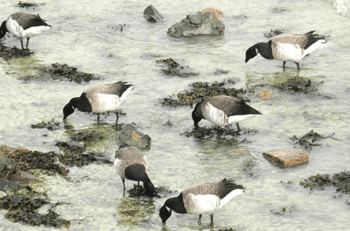
    In April An Bord Pleanála surprisingly granted permission to Crekav Trading for 104 houses and 432 apartments on playing fields east of St Paul’s College on Sybil Hill Road in Raheny, despite receiving more than 1,000 objections, and a recommendation for refusal from Dublin City Council. The site was originally part of the St Anne’s estate, the home of the Guinness brewing family on which Lord Ardilaun forged a magnificent Palazzo out of the original seventeenth century house. According to Dublin City Council’s Parks Division, St Paul’s is the most important ex-situ (ie outside of the North Bull Island) feeding site for Brent Geese in Dublin, based on numbers (a large majority of the Dublin population feed at this site), regularity of use, geographical location in relation to North Bull Island, size, and the relative lack of disturbance. The Brent Geese on the North Bull Island Special Protection Area are now largely reliant on the availability of inland feeding grounds, like St Paul’s. These lands are not designated but are nonetheless protected under habitats legislation. The only exception whereby development might be deemed to be compliant with this protection would be in exceptional cases where there is overriding public interest, and even then, only when no feasible alternative for the development has been demonstrated, and compensatory measures to offset the ecological damage are implemented. There is no suggestion that these exceptional circumstances and compensatory measures are to be found in the case of this development. Development on feeding areas forces the geese to travel greater distances to feed and potentially brings them into conflict with agricultural interests feeding on winter cereal crops. This results in greater expenditure of energy which affects the condition of the birds and their ability to complete the annual migration to their breeding grounds. The cumulative effects of this residential development proposal alongside existing impacts on geese arising from other already permitted developments which have removed some of their feeding sites, should have been assessed by An Bord Pleanála. In addition it should have considered whether adequate feeding areas will be left for Brent Geese after these developments are complet and whether any such areas are zoned appropriately in the Dublin City Development Plan. An Bord Pleanála is obliged to comply with European law on these issues . In considering the proposal, An Bord Pleanála’s inspector noted that the extent of potentially suitable feeding areas for the geese within Dublin city is finite and that the currently recognised feeding sites that are considered to be an alternative to the lands at St Paul’s may currently be experiencing pressures, including recreational disturbances, that may limit their capacity to accommodate the loss likely to occur as a result of the proposed development. Not withstanding this concern by its inspector, the planning board went on to grant consent for the development at the St Paul’s site. Of course Bord Pleanála decisions are formulaic and legalistic but we can take some indirect insight into its possible thinking from the reasoning in the report of its inspector whose conclusion it adopted: “The numbers of inland feeding areas are relatively significant, the geese appear to be thriving based on their increasing populations and I consider that the loss of this site as a feeding ground will not adversely impact on the conservation objectives of any of the five designated sites. In light of this assessment, I am of the opinion that there is capacity for the existing ex-situ inland feeding areas to absorb the loss of St Paul’s and I consider it reasonable to conclude on the basis of the information on the file, which I consider adequate in order to carry out a Stage 2 Appropriate Assessment, that the proposed development, individually or in combination with other plans or projects would not adversely affect the integrity of the five relevant European sites, in view of their Conservation Objectives”. However, whether this reasoning meets the requirements of European law and related case law remains to be seen. Bord Pleanála is under political pressure to approve housing schemes, in a housing crisis and the government is infamously unconcerned with environmental and planning niceties. In particular, for instance. The lack of certainty around the capacity of alternative sites to absorb geese displaced from the St Paul’s site may be problematic. Dublin City Council had eloquently warned in its submissions to An Bord Pleanála that the suggested capacity of alternative sites to accommodate the displaced geese is questionable and may not be achievable. The St Paul’s site is one of the top eight inland feeding sites for Brent geese. Accordingly, Bird-Watch Ireland and the Irish Brent Goose Research Group commented in their submission to An Bord Pleanála on this application: “We conclude that is an unacceptably high proportion of the population to be expected to be displaced to and absorbed within the existing network of sites and not in keeping with the conservation objectives of adjacent European protected sites” and furthermore that: “To suggest that these birds are flexible and will simply move elsewhere is simplistic and is especially weak given the recent pattern of development (all representing habitat loss) in the area”. The application was made under the new Strategic Housing Development ‘fast track’ planning system. This allows applications for schemes of more than 100 homes to be made directly to An Bord Pleanála, bypassing the local authority decision phase and excluding the possibility of an appeal. This leaves judicial review as the only course of action for those aggrieved by the planning consent. A miffed Dublin City Council, which turned down a less intrusive application for an associated application for sports facilities on a site at St Paul’s adjoining this one (on grounds of impacts to Brent geese) is hostile to the decision. City Manager Owen Keegan told the Council: “My recommendation, based on planning advice, was the board should not have granted this”. He obtained, presumably suitably conservative, legal advice that it did not have “locus standing” or legal standing to take

    Loading

    Read more

  • Posted in:

    Drastic Plastic Profligacy

    For years, it was widely ignored, even as the evidence grew more and more overwhelming. Reports had been flooding in from some of the remotest places on Earth, from the middle of the Pacific Ocean to the North Pole. Researchers found its impact was hammering every ecosystem, disrupting natural processes and spreading havoc across the living world. Then, slowly at first, the message began to resonate well beyond the usual narrow circles of scientists and environmental NGOs. The public’s ears pricked up, the media began to look deeply into the story and politicians, ever eager to follow the crowd, jumped aboard and began to huff about taking action, stepping up to the plate, not standing idly by, etc. And so, slowly, after scandalous decades of neglect and indifference, the wheels of change began their inexorable shift. The task ahead remained Herculean but at least many societies could be said to be engaged, and from there, anything is possible. I would like at this point to claim the preceding paragraphs are a description of how humanity has finally – hopelessly late – begun to grapple with the existential ecological crunch of which emissions-fuelled climate change is the most obvious manifestation. Sadly, this is not the case. The belated public response is instead to the plague of plastic pollution that has reached such an epidemic point that even the usual defenders of the free market haven’t bothered to construct a phoney ‘alternative’ narrative to beguile the media and stymie political action. The extent to which a carelessly used and discarded by-product of global industrialisation has come to present such a potent threat to the web of life on Earth has been known in scientific circles for many years. Marine biologists in particular have been trying with little success to draw attention to the rising tide of plastic pollution and its deeply insidious effects. Perhaps it was only when it became obvious that the human food-chain is also compromised did the wider public really start to sit up and take note. Plastic marine debris is now described as: “one of the most pervasive pollution problems facing the world’s oceans and waterways”, by the US National Oceanic and Atmospheric Administration. Around a million tons of plastics, comprising tens of billions of individual pieces, is now produced globally every week. Perhaps a tenth is ever recycled. People come and people go, but plastics persist. Complex polymers, under the influence of UV radiation and sea water, break down into near-microscopic monomers that enter at the base of the food chain, being ingested in their trillions by the vast shoals of tiny organisms that support and underpin the entire marine web of life. As these creatures are eaten, ever increasing amounts of toxic plastic pollutants are concentrated in the next level of the chain, and so on, until creatures at the apex, from sharks, dolphins whales and sea birds, are carrying catastrophic levels of toxins. Consider that every square mile of the surface of every sea and ocean on Earth contains around 50,000 pieces of plastic debris and you begin to get a grasp of the scale of the crisis. And, with the equivalent of a full dump truck of new plastic waste entering the world’s waterways every minute, it is manifestly clear that nothing short of a radical, global response will suffice if we are to have any chance of stemming the toxic tide of plastic pollution before it is too late. Ireland’s response has been mixed. Back in 2002, the then government introduced a modest tax on the purchase of single-use plastic bags handed out in their millions at supermarket checkouts and elsewhere. Industry critics said it was unfair, too expensive to administer, would never work etc. etc. They were all proved wrong when, within 12-18 months of its introduction, the quantity of single-use plastic bags fell by some 90%. Even more unexpectedly, the public actually supported the tax, and this support was maintained when it was increased to ensure compliance. Ireland found itself, for a short time, in the unusual position of being a global leader on an environmental issue. Success would, however, be short-lived. In the intervening decade and more, ever more plastics have made their way into our lives. It’s not unusual to find apples being sold on a plastic mat, with cellophane wrapping and perhaps an outer layer of another plastic. Milk went, in the space of just a few decades, from being sold in reusable glass bottles to in recyclable paper tetrapaks to now being largely sold in heavy plastic jugs. Meanwhile, tiny plastic yogurt pots are sold with more wrapping than yogurt. The ubiquitous ‘take-away’ coffee cup is constructed with a plastic inner lining, making the entire cup (and its plastic lid) unrecoverable. Ireland is in fact the EU’s number one per capita producer of plastic waste. Irish people account for 61kg annually – this is nearly 50% above the EU average. Repak, the industry-funded recycling group, boasts of our high levels of recycling relative to other countries, but this begs the question: what exactly happens to all this material? The short answer is that, in 2016, 95% of all Irish plastic waste was shipped to China for ‘recycling’. Conveniently for us, far lower environmental standards apply in much of China, so quite what happens to our so-called recycled waste remains unclear (China has since shut its doors to western wastes, which will now have to be dealt with much closer to home). I was involved in a recent radio debate on the issue of plastics hosted by Newstalk. Repak CEO, Seamus Clancy explained in glowing terms some of the achievements of the industry. He instanced a decline of several grams in the average weight of a plastic drinks bottle as demonstrating the industry’s determination to reduce waste. What Clancy was less forthcoming was on the total number of plastic bottles in circulation. The weight of an individual bottle is almost immaterial when overall volumes continue to increase rapidly. An

    Loading

    Read more

  • Posted in:

    Swimming against a plastic tide

    Along Ireland’s coastline, you’ll encounter long sandy stretches and wild seas crashing against craggy coastlines. Yet, if we care to look under the surface – literally – it’s clear our seas and coastal habitats are not quite as pristine as would appear. The global issue of plastic pollution has recently come to the fore, amplified by David Attenborough’s series Blue Planet II. According to a study by the US National Center for Ecological Analysis and Synthesis Working Group, roughly eight million tonnes of plastic enter the world’s oceans from land, annually; a 2016 report from the World Economic Forum and the Ellen MacArthur Foundation predicted that there will be more plastic than fish in our oceans by 2050. Ireland apparently became one of the best EU performers for plastic recycling, though most of it has been treated in China where it is difficult to track, and which has now stopped taking European waste. We’re also the EU’s top producer of plastic waste, producing 61 kg per person annually. When not disposed of responsibly, this plastic can cause significant environmental destruction. While difficult to form statistics on the quantity of plastics in Irish seas, the founder of Coastwatch Europe Karin Dubsky says we have an inkling on the extent of the problem. “Through coastal surveys, we can see improvements in certain areas, for example there’s less pollution from oil and sewage. However, other problems seem to be persistent. Plastic drinks bottles continue to be the most widely distributed item found on Irish coasts`’, explains Dubsky. “The amount of coastal cleaning has increased but the baseline number of plastic bottles we find remains greater than in countries that have a deposit return scheme. Without this, we rely on telling people not to throw bottles and on cleaning up after those who do”. Indeed, over 8,800 plastic drinks bottles were counted across 535 sections of Irish coastline in the thirtieth annual Coast- watch survey in 2017 – along with 4,867 cans, 988 plastic bags and over 1,100 tyres – some of which had formerly been used for peeler-crab traps. Inevitably, much of this waste will be swept in and out with the tides if not collected. Plastic pollution isn’t solely a result of littering. Coastal landfill sites are falling victim to erosion, resulting in leakages of hazardous waste into the sea. “At the old landfill site in Bray for example, the sea has been causing approximately 1.5 metres of erosion annually. We need these sites to be very secure to prevent this from happening”, says Dubsky. She adds that while a decision has now been made to appoint consultants to place rock armour at the Bray site, it would be more appropriate to remove the ‘band of waste’ altogether. “It’s mind-blowing how slow it is for action to be taken”. Waste also ends up in our oceans as individuals take coastal erosion management into their own hands. “We have no national erosion management policy so people decide to do their own thing. They put all kinds of litter in front of their homes but because the area is at risk from erosion, the sea takes it away”, says Dubsky. Lack of policy surrounding the environmental impacts of new materials and products is having a detrimental effect. “We need a proper screening process so clever ideas don’t go to the market without being screened to ensure they aren’t going to create another litter problem”, she suggests. “Pontoons are one example. The cheapest way to make pontoons is using polystyrene with a concrete surface. During Storm Emma, polystyrene was released from pontoons in Holyhead following a breakage. From April 14 onwards, it has been arriving on our shores”. Discarded fishing gear, known as ghost fishing gear, is also an environmental concern. According to a recent report from World Animal Protection, it kills over 136,000 seals, sea lions and whales every year, in addition to millions of birds, turtles and fish. An estimated 640,000 tonnes of fishing gear are left in oceans annually. In the coming months, the Ghostfishing foundation will collaborate with local divers and stakeholders to remove discarded fishing gear off Irish coasts. Nic Slocum from Whale Watch West Cork is involved with the project. “We decided it was important to first find out the extent of the problem”, explains Slocum. “We went to a number of dive companies and they told us that the extent of ghostfishing is not that great along the south coast here. Ghost-fishing is a greater problem further offshore on much deeper wrecks”. As diving to such depths is challenging and requires specialist skills, the project is currently slightly delayed as organisers assess how they can run it in the safest and most effective manner. For now, Slocum continues to take part in clean-ups and informs visitors about the environmental dangers of plastic. He has seen it first-hand, recalling incidents of seals getting caught up in nets and a recent occasion when he was alerted to a young whale trapped in fishing gear. “We do see evidence [of harm from marine waste]: I can’t say daily or weekly but, when we do see it, it’s significant. For example, that whale would have starved to death if we weren’t able to free it”. Internal harm is less obvious. As Ireland doesn’t have a facility to conduct post-mortems on large marine mammals, it’s impossible to know whether whales washing up on Irish shores have died as a result of plastic ingestion. However, worldwide studies suggest that this could be the case for some of our species, according to Slocum. “Sperm whales are very prone to plastic ingestion. They feed on squid and often mistake plastic bags for food. Post-mortems have been done on many sperm whales around the world and it has been shown they are full of plastic. There’s no reason why it would be different here”. While visible waste in our oceans is of great concern, an equally pressing but perhaps more difficult issue to tackle is that of microplastics. This refers

    Loading

    Read more

  • Posted in:

    Wicklow Council reacts to housing crisis

    A fiercely fought decision by Wicklow County Council officials to buy and demolish an Edwardian house in central Bray for 45 car spaces raises questions about the power of local authorities. The house, inhabited until now, was torn down on 12-13 April. Residents suspect that spending at least€1.3m to buy and replace it constitutes an indirect public subsidy to Paddy McKillen’s Oakmount/Navybrook. Oakmount is erecting the Florentine retail centre nearby, for which Wicklow council reduced the number of car spaces required compared to previous plans. Officials snubbed a last-minute appeal by local TD and Minister for Health Simon Harris who supported the residents’ call for independent legal advice before proceeding with, as Harris put it, “the irreversible action of demolishing this heritage house”. Minister Simon Harris TD and Sinn Féin’s John Brady TD, as well as the Green Party, An Taisce, Bray Cualann Historical Society and many local residents (including this writer) have objected to demolition. But a coalition of Fianna Fáil and Fine Gael councillors held firm and rejected calls by fourteen councillors for an independent legal opinion on the process followed. And the Office of the Information Commissioner has now informed residents that it has identified more than thirty records relating to St Paul’s Lodge that the council did not previously disclose to it on foot of a continuing Freedom of Information appeal by residents. Wrecking St Paul’s Lodge during a housing shortage is the latest in a series of controversies involving Wick- low County Council. Last year it was strongly criticised by a High Court judge. The Council was originally poised also to buy and demolish for more spaces at the same location a second house, occupied by Wicklow’s former county manager. Although the Council assured An Bord Pleanála that the planned Florentine centre included enough car spaces, it now claims that new spaces are needed elsewhere “urgently” and at public expense. Critics point out that at least double the number of spaces planned to replace St Paul’s Lodge are empty daily in the car park under the Council’s own civic offices on Bray’s Main Street, and objectors have also identified other alternatives. For some time critics have called on the minister for the environment to initiate an enquiry into how Wicklow Council does business. The management of Bray’s fire services and of related matters following the death of two firemen there, the presence of an illegal dump in West Wicklow that may cost the state tens of millions to clean up, the status of land near Greystones, and the sale of public properties on Bray seafront and elsewhere have given rise to concerns. It is remarkable (and not widely appreciated) that, when endorsed by a majority of councillors, plans to demolish or build on council-owned properties cannot be appealed even to An Bord Pleanála. The absence of any right to appeal may be unconstitutional. John Ryan, the Fine Gael councillor most prominently supporting demolition, recently filed a form declaring his interest in a contract to provide services to Wicklow County Council staff. But he did not inform or withdraw from meetings about St Paul’s at which councillors had to adjudicate between council staff and objectors. Nor did Fianna Fáil’s Pat Vance, who owns commercial properties facing the Florentine site. Eight of 32 Wicklow councillors represent Bray, with just one each from Fianna Fáil and Fine Gael (elected last and second-last respectively). Fianna Fáil’s Bray councillor is Pat Vance, currently deputy chair of Wicklow council. Fine Gael’s is John Ryan. Most independent councillors in Wicklow, especially retired garda Brendan Thornhill, along with Green Party and Sinn Féin councillors have strongly resisted the demolition of St Paul’s Lodge. Protesting councillors convened a special meeting of Wicklow County Council in March to question the way in which the decision to demolish St Paul’s Lodge has been taken. That meeting lasted over two hours but the large Fianna Fáil-Fine Gael bloc largely remained silent before voting against a proposal to take independent legal advice. It was backed by Bray District Chairman, Councillor Christopher Fox. Councillors from these two parties in Wicklow generally support one another, with implications for resources. Three trips abroad during the St Paul’s controversy cost the Council over €6,500 and saw Council chairman Edward Timmins in New York with the county CEO, while deputy chair Pat Vance and a Council official went to Dublin, California (twinned with Bray). With residents against the demolition of St Paul’s refused permission to address the full Council, and their requests to meet officials rebuffed since last June, such trips exacerbate a sense of exclusion. The Council told residents last June that it was examining all options for parking. In fact, as its appeal to the Office of the Information Commissioner has already revealed, the Council had earlier decided to try and purchase both St Paul’s Lodge and an adjacent house. No record has been discovered that reflects any consideration of options beyond Herbert Road. Nor have records been uncovered that record any authorising decision early last year to buy two houses, or that might reveal who inside or outside the Council first suggested this, or what budget was allocated for the transaction. The Council eventually spent well above its initial valuer’s estimate of €765,000 buying St Paul’s Lodge, and even covered the cost of the vendor’s auctioneer, solicitor and furniture removal to Spain. Residents would have campaigned earlier to stop demolition had they been frankly informed when they first enquired. They object especially to the fact that council officials closed the purchase of St Paul’s unconditionally before the necessary statutory ‘Part 8’ consultation was even commenced, and question the point of that consultation, in which 150 parties including An Taisce made submissions. The Council admits that it did not ask its own heritage officer for her opinion. Submissions opposing demolition were also not circulated to councillors but were instead dismissed in a report presented by the Council official who had directed the purchase of St Paul’s Lodge. Most of the undisclosed records now

    Loading

    Read more