
Environment

Random entry RSS

  • Posted in:

    Planet guardian

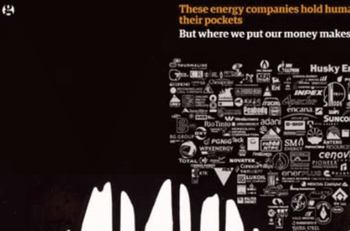
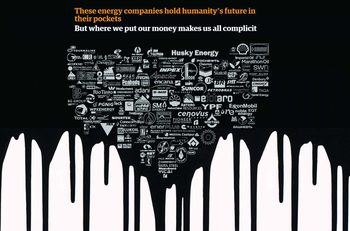
    By John Gibbons There is nothing new about newspapers striking postures over climate change. On December 7th, 2009, some 55 major newspapers from all over the world (including the Irish Times) ran a joint editorial just ahead of the opening of the Copenhagen UN climate conference. Who could forget the dramatic call to arms from some of the world’s most respected newspapers? It began: “Humanity faces a profound emergency. Unless we combine to take decisive action, climate change will ravage our planet, and with it our prosperity and security. The dangers have been becoming apparent for a generation. Now the facts have started to speak: 11 of the past 14 years have been the warmest on record, the Arctic ice-cap is melting… In scientific journals the question is no longer whether humans are to blame, but how little time we have got left to limit the damage. Yet so far the world’s response has been feeble and half-hearted. Overcoming climate change will take a triumph of optimism over pessimism, of vision over short-sightedness. The politicians in Copenhagen have the power to shape history’s judgment on this generation: one that saw a challenge and rose to it, or one so stupid that we saw calamity coming but did nothing to avert it. We implore them to make the right choice”. Stirring stuff. The Copenhagen conference, mired in phony controversy and crippled by internecine squabbling, was a wretched failure. Less than four weeks later, with Ireland in the grip of a (climate change-related) freezing spell, the Irish Times editorial writer had a Damascene conversion. “So much for all of that guff about global warming! Are world leaders having the wrong debate? We are experiencing the most prolonged period of icy weather in 40 years and feeling every bit of it”. Humanity’s ‘profound emergency’ turned out to be little more than a nine-day wonder, as the media folded up its collective tent and moved on to more promising editorial fare. After all, who could be bothered reading (or writing about) the dull, technical and seemingly interminable non-story that climate change and the relentless destruction of our planet’s biodiversity and habitability had become. Sprinkle this journalistic ennui with a side order of character assassination of selected individual scientists and voilà, the greatest crisis humanity ever faced morphs into the greatest non-story of the century. That may be how the media work, but nature itself continues to be stubbornly cooperative with the grimmer prognostications of those wearisome scientific eggheads. “Climate change is one of those stories that deserves more attention, that we all talk about”, Jeff Zucker, president of news network CNN said last year. “But we haven’t figured out how to engage the audience in that story in a meaningful way. When we do do those stories, there tends to be a tremendous lack of interest on the audience’s part”, was Zucker’s candid appraisal. Paul Weller opened The Jam’s 1980 single ‘Going Underground’ with the line, “the public gets what the public wants”, but as the song unfolds, this inverts to become: “the public wants what the public gets”. The Irish public today knows far more about the disturbed sexual fantasies of one south Dublin architect than it does about the existential noose that draws ever tighter around our collective neck. Since these salacious stories, along with exhaustive ‘economic’ analysis predicated solely on growth and consumption, are what the public gets, day after day, ergo this must be what the public wants. Small wonder then that our politicians and public servants shrug off environmental angst as being not on the public agenda, and therefore nothing for them to bother with. To put a number on our collective failure, consider the following: the world’s political leaders have known since 1990 that CO2 emissions were putting humanity in jeopardy. Countless conferences, protocols, treaties and solemn declarations later, and, rather than reducing, global emissions have instead spiralled by 61% since Jack Charlton led the Irish team to the World Cup quarter finals in Rome. In the same period, species extinctions have intensified and global biodiversity has gone into free-fall. The neo-liberal assault on the foundations of life on Earth is fast approaching its triumphant, albeit suicidal, apotheosis. Anyone who pays more than fleeting attention to the output of the world’s leading climate journals and scientific academies will realise this is not mere journalistic hype. It is instead an unremarkable observation on a species that has run amok and has been blind-sided to the fact that its own fate is inextricably linked with the very fabric of the natural world it is carelessly unravelling. In recent weeks, the Guardian newspaper, under outgoing editor, Alan Rusbridger, has sought to break this communications impasse. And it has done so in the most spectacular style, beginning its campaign with full wraparounds on several editions of the newspaper carrying in-depth articles from Naomi Klein and Bill McKibben, among others. Both the newspaper and its editor are out on a limb, and success is far from assured. Explaining his thinking, Rusbridger described journalism as a rear-view mirror. “We prefer to deal with what has happened, not what lies ahead. We favour what is exceptional and in full view, over what is ordinary and hidden”. Vast, complex stories with no apparent beginning, middle or end, in which there is no clearly identifiable bad guy and in which we in the rich world and almost everything we do are to blame are an exceptionally poor fit for the news paradigm. “Changes to the Earth’s climate rarely make it to the top of the news list. The changes may be happening too fast for human comfort, but they happen too slowly for the news-makers – and, to be fair, for most readers”, he expanded. “These events that have yet to materialise may dwarf anything journalists have had to cover over the past troubled century. There may be untold catastrophes, famines, floods, droughts, wars, migrations and sufferings just around the corner. But that is futurology, not

    Loading

    Read more

  • Posted in:

    An improvement, but unfair and ineffective

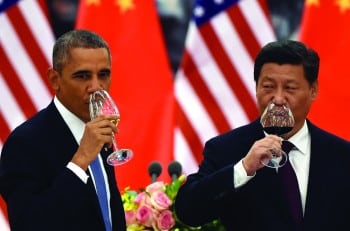
    By Sadhbh O’ Neill Twenty years after the UN Framework Convention on Climate Change, adopted in 1992, there is still no comprehensive agreement that regulates emissions from all countries, or which would divide up the remaining carbon budget fairly between developed and developing countries. Indeed there is a strong case to be made that emissions budgets should be allocated to people, not countries, which would eliminate the historical entitlement of developed countries to existing high levels of emissions. Against a background of obfuscation there is increasing speculation that what might emerge from COP-21 is a ‘bubble’ of options which offer increasing flexibility for countries to devise and meet targeted reductions. Such measures include emissions trading, technology cooperation and transfers and forestry and what are alarmingly referred to by Robert Keohane and David Victor as land-use ‘innovations’. They have also presented the advantages of a “regime complex” or a combination of overlapping and intertwining measures and mechanisms instead of a comprehensive instrument. They claim this is more “politically realistic” in a climate where nation states are still bound by the interests of ‘major constituencies’, such as major fossil consumers or producers. Notwithstanding the unfairness and ineffectiveness of the current Kyoto and post-Kyoto arrangements, there are signs that major emitters from developing countries – China and India particularly – will be drawn into the next deal to be hammered out in Paris next December at ‘COP 21’. The US particularly has found it politically impossible to get a climate deal without the involvement of developing countries through the Senate, Although President Obama has found renewed zeal on the issue it is not on the agenda for the upcoming Presidential elections. Senate Majority Leader Mitch McConnell said his first priority on election would be to “do whatever I can to get the Environmental Protection Agency reined in”, he said, referring to the agency’s proposed regulations to limit carbon pollution from power plants. Climate-change sceptic James Inhofe now heads the Senate’s environment panel, Presidential candidate Ted Cruz and even establishment-backed candidates like former Florida governor Jeb Bush, deny climate change. Bush had previously asserted that the climate may be warming and, as governor of a state regarded as the hotbed for hurricanes and coastal erosion, fought against drilling off the Florida coast and launched a massive Everglades restoration project. These attitudes underpin appeals for flexibility – even if they undermine the comprehensive regime that environmentalists have been campaigning for through the UNFCCC. So, the US recently signed a climate deal with China directly, whereby both parties entered a bilateral political agreement, outside of the UNFCCC process, to stabilise and reduce emissions according to an (arbitrary) timetable consistent with their national interests: “The United States intends to achieve an economy-wide target of reducing its emissions by 26%-28% below its 2005 level in 2025 and to make best efforts to reduce its emissions by 28%. China intends to achieve the peaking of CO2 emissions around 2030 and to make best efforts to peak early and intends to increase the share of non-fossil fuels in primary energy consumption to around 20% by 2030. Both sides intend to continue to work to increase ambition over time.’ (US – China Joint Announcement on Climate Change, November 2014)” This agreement signals an important shift in US policy though the Obama administration has committed itself to working also towards a binding agreement in Paris at COP-21. While the targets for the US appear more onerous than the Chinese objective of merely stabilising emissions in 2030, the reality is that US emissions have not grown since 2005, largely due to the shift from coal and oil to gas, and Chinese emissions are increasing at a perilous rate of about 7% per annum. Key to the success of this deal will be the degree to which China acts before 2030 to peak and reduce its emissions, and the degree to which the US can deliver the cuts it has promised in the face of a return to moderate economic growth. While the commitments are phrased very differently for the US and China, the key point is that China will have to get its emissions off the exponential track before 2030. According to analyst Raymond Pierrehumbert, the trick is to both guess – and influence – the point at which China will peak its emissions. In principle, the US-China deal does not specify at what point China should peak its emissions. In an article for Slate Magazine, Pierrehumbert argues: ‘Translating this commitment into quantitative implications for cumulative carbon involves a lot of guesswork as to how China will go about fulfilling its commitment, because the agreement does not spell out the value at which emissions will peak. A cynic would say that China could just increase its growth rate to, say, 10 percent and peak at an enormous value in 2030, giving itself plenty of wiggle room to hold emissions constant or decrease them thereafter. If this is really China’s intent, then the new agreement is largely meaningless. But let us suppose instead that China’s commitment was taken in good faith. A minimum good-faith fulfilment would be to continue growing at 7 percent up to 2030 and then hold emissions constant thereafter. This scenario is shown in the middle (black) curve of Figure 1. In terms of cumulative carbon, that would mean that China emits another roughly 70 gigatons out to 2030, and holding emissions constant thereafter, emits a further 86 gigatons between 2030 and 2060. Without the agreement, China’s emissions scenario would look like the upper (red) curve, and China would emit a further 790 gigatons in the latter period, which would be more than enough to bring the world over the trillion-ton limit regardless of what anybody else did. So yes, getting China off the exponential curve is a very, very big deal indeed.’ The analysis above highlights the difficulties in securing an effective global regime for emissions reduction in a context where developing countries with large populations – such as

    Loading

    Read more

  • Posted in:

    Milk battle

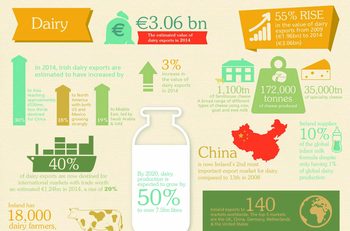
    By Oliver O’ Connor The ending of milk quota has been greeted with almost unbridled hoopla in Ireland. From the countdown clock in Ag House, where the Department of Agriculture has its HQ to features on foreign media about Ireland and milk, the coverage has been, mostly, glowing. So what was this quota thing the agri-food sector is so happy to be rid of? Quota was a limit, an imposed ceiling, placed on milk production 31 years ago. This was an era of milk lakes and butter mountains, when Europe could produce far more than it or anyone else could consume. Levies were imposed when production went over the pre-set level. Now, with strong export potential in emerging economies, especially China, quota has been lifted and production can rise again. World trade in dairy has grown from 53 to 65 billion litres in just four years, while demand in China is expected to grow by 43% by 2019. By European standards, Ireland is a big shot in dairy in many respects. While quota has limited production to about 5 billion litres, Ireland has compensated by placing more emphasis on processing and value-adding than other big producers such as Germany. Companies based in Ireland trade over 15% of the world’s infant formula, while new processing plants, such as Glanbia’s €235m unit in Kilkenny, have opened to much fanfare. Ireland has also already begun investing far more in dairy-processing research and development than its EU competitors do. Food Harvest 2020 has been the blueprint document for much of this growth. Ostensibly not a Department of Agriculture plan (despite the Department logo being the only one on the front cover page) this industry growth plan predicts a 50% increase in milk production in Ireland by 2020. And Ireland is on target to deliver this. Dairy is already the wealthiest of all the sectors in Irish agri-food. Dairy farmers are price-makers and not price-takers, in part because they have worked together for decades, generating the benefits of economies of scale while retaining ownership or strong interest in the upstream sellers. Land prices are strong, in part because of demand from the dairy sector. Many in the sector look to New Zealand, which now produces 18 billion litres of milk annually. When quota came in in 1984, like Ireland, they too produced 5 billion litres. 10,000 new jobs, and 300,000 new cows, are projected to come from this milk bonanza in Ireland. What’s not to love? A lot, according to those concerned with environmental issues, from water quality to climate change, and to those on what can be called the rural left. Beef production in general is very inefficient with extremely high carbon emissions per kilo. Dairy cattle in Ireland produce 9% more methane emissions per head now than in 1990, though they  are admittedly producing more per head. Simon Coveney has said he is determined to make sure Irish farmers do not have to scale back on environmental grounds: “Any old fool can reduce emissions by simply reducing production. There’s no challenge in that”, he told the Dáil last month…The challenge for the globe, and for Ireland in terms of giving leadership in this area is finding a way to produce more food while reducing the overall emissions footprint of our production systems”. The IFA without whose say-so Coveney never even gets up in the morning has welcomed the absence of what it calls “divisive and unachievable sectoral targets” in the Climate Action and Low Carbon Development Bill. This is code for welcoming the absence of effective, sustainable, time-tabled targets. The Taoiseach and Minister Coveney have argued that Ireland’s national emissions reduction target which is to be agreed at EU level “must take account of Ireland’s specific circumstances including the size and importance of our agri-food sector”. Try selling this message to other unsustainable sectors like Polish coal-miners. Ireland’s binding 2020 emissions target is to achieve 20% reductions in emissions relative to 2005. Currently, we will only achieve 2%. As Irish agriculture produces nearly a third of national emissions, it is a major part of this national failure. Agriculture had steadily reduced emissions until 2011 but Food Harvest 2020 plan is rapidly reversing that progress. “Rural left” sounds like an oxymoron in Ireland. However, agri-food is so dependent on subsidies, that the distribution of this bounty has helped foster a divide between notions of fairness and productivity around Europe, including in Ireland. The new Common Agricultural Policy (CAP) was supposed to be fairer – to distribute funds in a more equitable manner. This has been curtailed, due to the hard work of Minister Coveney and others, who have argued that fairness would somehow punish those who are more ‘active’ and productive. The 10,000 member ICSA – Irish Cattle and Sheep Association – have in some significant ways broken ranks. Unlike Simon Coveney, they see the need for a beef regulator, criticise the Bord Bia Quality Assured scheme, and argue against the unfair implementation of the CAP and the potential sacrifice of an Irish beef industry in the EU-US trade agreement, TTIP (Transatlantic Trade and Investment Partnership). Similarly, farmers in the BMW (boarder midlands west) region and other places traditionally considered to have poorer land are forming small organisations opposed to current political trends, or joining the organic-farming scheme in increasing numbers. This rural left is represented in European dairy affairs by organisations like the European Milk Board. It is not so much potential growth in dairy that this organisation worries about but rather the effects of price volatility and the loss through consolidation of small-to-medium-sized producer. Their protest in Brussels on 31 March reflected this. Seeing a real shift in power from producers to companies, the president of the EMB Romuald Schaber warned “thanks to the expected milk surplus, as of now conglomerates will dictate terms and conditions to the farmers even more than before. Prices will be rock-bottom, as Europe’s farmers will have even less market power to achieve a cost-covering milk

    Loading

    Read more

  • Posted in:

    Your lethal aversion to discussing climate.

    By Sadhbh O’ Neill. With all the seemingly urgent messages in the media about climate change and need to reduce emissions, there is an astonishing cultural silence about the issue. Climate changes will affect us readers of Village magazine, no doubt in our lifetimes, never mind the lives of our children and grandchildren, as evidence mounts that even current extreme weather events can be attributed directly to climate change. Yet we don’t talk about it, we don’t discuss it, and according to a Royal Society for the Arts survey in 2013, only a fifth of the respondents were convinced there even was a problem. Only 60 percent of the sample had ever spoken about climate change and, of those 71 percent did so for less than ten minutes; 43 percent for less than 5 minutes. This poses the question whether, as Clive Hamilton puts it, climate denial is due to a surplus of culture rather than a deficit of information. I’ve tried this out on a few friends and it is true: the conversations fizzle out after a few minutes unless you can get people interested in talking the detail about energy policy or intergovernmental negotiations (this rarely happens). They definitely don’t want to get into the detail of how scary it might all get. But is this because they don’t want to know, or that they do know somehow, but are willing to invest a lot of emotion in denying the truth? These are the questions George Marshall takes up in his new book ‘Don’t Even Think About it: Why Our Brains are Wired to Ignore Climate Change’ (Bloomsbury Press, 2014). As a former Greenpeace activist, and now a ‘climate communications expert’ Marshall sets out to understand how it is that we are collectively in denial about the most serious problem of our time. Marshall is convinced there is a good psychological or evolutionary explanation for our inaction. He explains that essentially we are wired to act on the basis of primitive emotional responses, whilst we analyse information more slowly through the cognitive centres of the brain. The effect of this is to make some threats more real and immediate than others. The issues with the greatest salience are those that are here, now and contain a clear visible threat from an identifiable enemy. Social cues compel us to pay attention to some issues not others. Without salience or social cues, climate change sits outside the analytic frame that we apply to make sense of the world around us, he explains. Added to all this, climate change and the vast science around it can make it easy to select truths on an à la carte basis through cognitive bias, confirmation bias and mis-categorisation – all of which helps keep the extent of the problem on the edge of what he terms a “pool of worry” that we all have anyway about the usual things (bills, jobs, elderly parents etc). Climate deniers in particular have misled the public by setting up false debates based on partial or incorrect information knowing that sowing the seeds of doubt and dissent leaving us both confused and worried, but unsure of what to do. Marshall’s big ideas are for climate communicators and policy makers to zone in on the role of stories and myths (especially religious ones): the means by which the emotional brain makes sense of the information collected by the rational brain. When non-experts make sense of complex technical issues, they make their decisions on the basis of the quality of the ‘story’ or ‘narrative fidelity’ rather than on the quality of the information. Whilst the ‘good’ guys in this story get tangled up in complex and defensive explanations and talk about raising new taxes (always a bad communication strategy), the ‘bad’ guys win the argument by talking about the ‘American way of life’. Essentially deep community values, however conservative, are more persuasive and socially binding than bad, complicated news. Helpfully, Marshall quotes Frank Luntz, the US GOP pollster and strategist as saying that a compelling story has the following rules: “simplicity, brevity, credibility, comprehension [by which he may of course mean comprehensibility], consistency, repetition, repetition, repetition… “. Marshall explains also that a successful storyline contains simplicity of cause and effect, a focus on individuals or distinctly defined groups, and a positive outcome. When will Disney make a climate movie, I wonder. That is what is needed here. In the meantime, other writers outside even  the science-fiction genre are beginning to do the work of telling us the story of our present, from the perspective of the future. Naomi Oreskes and Erik Conway, famous for their devastating assault on climate deniers in ‘Merchants of Doubt’ (2010) have written a new book about what is happening to our climate and possible future scenarios if we fail to act on time. What is interesting about ‘The Collapse of Western Civilisation: A View From the Future’ (Columbia University Press 2014) is that it is a piece of historical fiction, but written from the future, since this seems to be the most narrative-faithful way of joining the dots about what we are doing at the moment and how it will impact on the future. Written from 2393, 300 years after ‘The Great Collapse’ the authors retell the story of how civilisation collapsed first from inaction and then from desperate efforts to reduce global warming with failed geo-engineering experiments. It is telling that the story is written from inside China, whose centralised decision-making made recovery possible. Oreskes and Conway are not eco-authoritarians but they do give voice to the desperation among climate activists that our democracies are simply failing to act effectively out of deference to fossil-fuel and other interests, even when public opinion is solidly behind abatement measures. What is missing from their history however, is real people: survivors, heros who have adjusted and re-organised communities to be resilient. Without real characters, we may well reluctantly have to apply Marshall: we need individual characters and

    Loading

    Read more