Environment

Random entry RSS

  • Posted in:

    Planet Earth: quarry and dump.

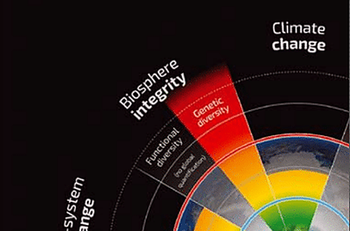
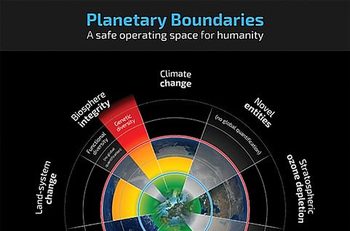
    By John Gibbons. In 2009, some months before the ill-fated UN climate conference in Copenhagen, an Earth system framework was proposed by an international collaboration of environmental scientists. Their aim was to establish a measurable set of ‘planetary boundaries’ with a view to identifying a ’safe operating space’ for humanity. The researcher team, involving scientists from a range of disciplines, developed a set of nine key boundaries, beyond which lay the risks of “irreversible and abrupt environmental change”. In January 2015, the team published an in-depth update on their investigations in the journal Science, and it was discussed in depth at the recent World Economic Forum in Davos. The findings took even seasoned environmental commentators and observers by surprise. The paper confirmed that humanity has already breached four of the nine key boundaries, namely biodiversity loss, deforestation, atmospheric CO2 levels and the flows of nitrogen and phosphorus used in agriculture into the world’s waterways and oceans. The era known as the Holocene began almost 12,000 years ago, just as the last Ice Age was in full retreat and climatic conditions favourable to humans led to our exponential surge. Human expansion was marked throughout this period with spasms of extinctions, as well as major changes in land cover and use. Our mastery of fire in particular allowed humanity to alter entire ecological systems radically, thousands of years before the industrial revolution. We have been a significant force on the planet for millennia; what has so profoundly altered in the modern era has been the rate and scale of change. In the last two centuries, human numbers increased more than seven-fold. In the 20th century alone, we consumed more energy than used by all humans in the preceding 10,000 years. And in the first decade and a half of the 21st century, the exponential surge in human numbers and impacts has continued unabated. Growth, expansionism and the meeting of human needs and desires primarily by consumption is the dominant ideology of this era in human history, and are essential to the ever-expanding engine of globalised capitalism. In this paradigm, the entire natural world is both a quarry from which we can extract an unlimited supply of ‘resources’ to fuel the Age of Man and a dump into which we can quietly excrete the toxic by-products of this whirlwind of activity. To downscale the biosphere into a single human body, you could also identify nine key systems which operate both independently and as part of a closely integrated biological system. The heart, lungs, liver, endocrine system, brain, nervous system, kidneys and digestive system are all ‘boundary’ systems, and each in turn support myriad sub-systems, as well as combining to define our overall health and well-being. The ‘planetary boundaries’ report is the planetary equivalent of the doctor informing an individual that his heart is badly damaged, his lungs are diseased, his liver is barely functioning and his kidneys are showing signs of acute organ failure. The good news is that his brain is still functioning well, his digestive system is in reasonable shape and his neurological function appears normal. After the initial shock, how would you expect the patient react to this news? Humanity’s collective response thus far has been to call the doctor a quack, accuse him of faking the x-rays and lab results and head out the hospital door with a bottle of scotch in one hand and a cigar in the other. While all nine boundary systems are important, by far the most critical are biosphere integrity and climate change, as these are what are known as overarching systems, upon which all other systems depend, and “operate at the level of the whole Earth System, and have co-evolved for nearly four billion years”. Prof. Will Steffen, lead author on the ‘Science’ study describes the pace of change as the most striking aspect of their findings. “Almost all graphs show the same pattern; the most dramatic shifts have occurred since 1950”. It is, he added, “difficult to overestimate the scale and speed of change. In a single lifetime, humanity has become a planetary-scale geological force”. This is genuinely new, he pointed out, “and indicates that humanity has a new responsibility at a global scale”. In a masterful piece of understatement, the study authors advise: “The precautionary principle suggests that human societies would be unwise to drive the Earth System substantially away from a Holocene-like condition. A continuing trajectory away from the Holocene could lead, with an uncomfortably high probability, to a very different state of the Earth System, one that is likely to be much less hospitable to the development of human societies”. That is scientist-speak for a future that looks somewhere between ‘Mad Max’ and Cormac McCarthy’s ‘The Road’. Another of the report’s authors, Dr Steve Carpenter argued that the study’s findings mean “we’re running up to and beyond the biophysical boundaries that enable human civilisation as we know it to exist. It might be possible for human civilisation to live outside Holocene conditions, but it’s never been tried before. We know civilisation can make it in Holocene conditions, so it seems wise to try to maintain them”, he added wryly. As one of 18 experts in the group which completed this study, Carpenter’s main focus was on nitrogen and phosphorus, elements which attract far less headline attention than they actually merit. “We’ve changed nitrogen and phosphorus cycles vastly more than any other element. The increase is of the order of 200–300%.” In contrast, he pointed out carbon has ‘only’ been increased 10–20%. Nitrogen and phosphorus are the inevitable byproducts of the ‘Green revolution’, in which global agricultural output increased dramatically as a result of the massive input of fertilisers, pesticides and herbicides. In the short term, this bought humanity several decades reprieve from the risk of widespread famine, which had been predicted in the 1950s and 1960s, as world population boomed. The father of this revolution was a gifted scientist, Dr Norman Bourlag. In his speech accepting the 1970

    Loading

    Read more

  • Posted in:

    Climbdown

    Lacking any new targets or any teeth the Climate Bill is useless and environmental NGOs should have said so

    Loading

    Read more

  • Posted in:

    Campaign

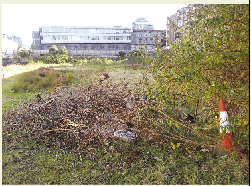
    By Ciaran Cuffe Dublin city, particularly as Hayley Farrell notes [p64-65] the north inner city, could do with more parks, and luckily there is space to spare. Apart from the dozens of parcels of derelict land under the control of Dublin City Council there are also many large sites under the control of NAMA, and other bodies. The Law Society controls a significant site beside the Luas on Benburb Street and CIE controls a large site beside the Jervis Centre. These lands could be converted to parks, even on a temporary basis as with the pop-up ‘Granby Park’ that appeared on Dominick Street in the north inner city in 2013. One of the more suitable sites is a large empty patch of land just off Church Street between Smithfield and the Four Courts. The site of the former Maguire and Paterson match factory has languished derelict for over a decade.  It is over an acre in size, and the Red Line Luas passes by its northern boundary. Tourists on their way to the Generator Hostel and the Jameson Whiskey Corner pause as they go past, and gaze down into the crater. The factory that occupied the site was demolished in 2002. Since then it has been under the ownership of the Office of Public Works. An archaeological dig in 2009 revealed traces of an old Viking House, but the site has been vacant since the dig occurred. On a recent visit to the site bulrushes and reeds were growing on the lower end of the site, and buddleia, rushes, grasses and willow trees had colonised the upper levels. A blackbird was perched next to some rubbish and a traffic cone. Even in the space of a few short years the site is developing its own unique ecosystem that could be protected as part of a park proposal. (Note to the OPW – send in the bulldozers to level off the site again, quick!) An inquiry to the Office of Public Works received a reply from Commissioner John Sydenham who stated: “The site is being retained by the State for development and is under consideration for the possible location for key institutions of State (sic) in the medium term. To this end I am afraid that we could not consider any other use for the site even on a temporary basis”. To be fair he went on to say that they would consider placing information panels giving details of the archaeological investigations undertaken at the site. They also have removed some of the ugly hoarding that surrounds the site, allowing the public to see what they’re missing in the green chasm beside them. The beleaguered north inner city is desperate for more parks and space for children to play. This could be an ideal site for sports and leisure. It is big enough to accommodate a five-a-side football pitch or basketball court as well as trees and planting. Instead it has been an eyesore for over a decade. Will it take another ten years before the OPW decide to do something with the site? Ten years ago the OPW said they wanted to build a Land Registry Office on the site. If they really need more office space they could consider using some of the Dublin Institute of Technology buildings that will be vacated arising from the move of the Institute to Grangegorman. It is unacceptable for the OPW to say they are retaining the site for ‘strategic’ purposes. In the north inner city it is strategic to plan to create an environment suitable for families! They should put up or move on and make this oasis available to the local community. Smithfield has only a handkerchief of greenery on it, and is mostly cobblestones. It always seems to come back to land in Ireland, and both individuals and institutions seem to hang on to it atavistically, even if it lies uselessly derelict for generations.  It is unacceptable that large urban sites are left empty for decades, doubly so in the hands of a public agency. The board of the OPW under chairperson Claire McGrath as well as Junior Minister Simon Harris should rethink their decision to leave these lands idle. If you’d like to see the area converted to park, even on a temporary basis why not drop a line to info@opw.ie or Simon.Harris@Oireachtas.ie, and perhaps you’d copy your email to me at Ciaran.Cuffe@DublinCity.ie. The campaign for a new park in the North Inner City starts here. •

    Loading

    Read more

  • Posted in:

    Quays are key

    By Michael Smith After the Second World War private cars began to fill the streets of cities across the western world. In the 1960s Dublin’s traffic authorities began to contemplate radical interventions to accommodate the influx of cars. One scheme involved covering the river over and using the new surface for road widening and car parking. This was rejected but Dublin’s quays are nevertheless today almost completely dominated by vehicular traffic. Traffic danger, crime, noise and air pollution makes them a blockage that cyclists and pedestrians make an effort to avoid. Some of the riverside footpaths are so narrow they can only be passed in single file.  The advent of the port tunnel has failed to alleviate the sense that crossing the quays risks a mowing down by a fast-moving juggernaut. The quays have the potential to become a great urban boulevard. The river needs to become an asset, not an untouchable sump. The quays are the city’s principal artery, indeed its most distinctive feature, and they should be a destination in themselves, not a means to an end: a great city’s living room: a worldwide urban-renewal talking point. The rejuvenated quays could support a pedestrian trail linking the IFSC and the National Convention Centre in the east with the National Museum at Collins Barracks, Heuston Station and the Phoenix Park in the west and in between inject life into the knife-edge city markets and Smithfield areas. The High Line in NewYork was conceived by two local artists who set up a trust and  spent seven years campaigning before finally convincing the authorities to solidify the plan which hovers like an oasis over the hard-edged meat-packing district. Dublin needs an alliance of residents, planners, architects and radical artists to promote something subversive of the mediocrity that can hold it back. Dublin City Council has committed to prepare a local area plan for the quays by 2017 “in order to develop the public realm of the river and anchor it as a central civic spine”. Plans are being drawn up for a change in traffic on Dublin’s north quays introducing a new two-way cycle lane and restricting private motorists to one lane instead of two, while maintaining the  bus lane. City council chief executive and zealous cyclist Owen Keegan has acknowledged the proposal would slow up traffic on the busy north quays, but told the Irish Times “It is not something that we have to apologise for…Cycling has to be for the unbrave as well”. Removing one and sometimes two traffic lanes would have an obvious short-term effect on the flow of traffic along the quays. It should not, however, be a substitute for Greening. Fresh radical thinking is needed and unfortunately for those who actually might use the space it is not possible to have an inspirational park next to lines of traffic. We should be planning for a hundred years not five years hence. While integrated with the water the whole space needs to feel self-contained. Wild greenery could be peppered with diversions such as bandstands, cafes, playgrounds, meadows; activities such as cycling and picnicking; and events including occasional markets, funfairs, film showings and the like. But the ensemble should centre on the omphalos of the city, the river. The quays should afford ready access to the river so it rings with the joy of organised leisure. Imagine a Liffey alive with boating, canoeing, swimming, diving, fishing and the like. Perhaps a barrage would be necessary to sustain the tide above the level necessary for the Liffey to become something it has not been in a century – useful. In this regard, the boardwalk is ambiguous being perhaps as much a substitute, as a complement, for imaginative thinking about the quays’ relationship to the water.  Proposals for a Suas – an overhead cable car intermittently mooted for the quays – need to be scrutinised with extreme aesthetic caution for the quays have their own gentle momentum. Inevitably, even the modest proposal from City Hall was attacked, including by the Irish Times’ Kathy Sheridan who seemed to feel Dublin with its privileges and responsibilities gets a good deal already and that the quays need to be as much for optionless commuters as for locals and Dubliners generally. She seems wedded to the notion that someone else’s environment can be ordained somehow secondary to the interests of others, specifically those of free-riding if immiserated commuters. Meanwhile there are separate but linked plans to extend the scandalously under-usable Croppies Acre memorial park, at the front of Collins Barracks, out onto the riverside, allowing for a car-free public park and two-way walking and cycle route in the vicinity. Public consultation could start in the new year, according to the city council. It’s all go in the City Council but breaking taboos shouldn’t limit its imaginative horizons to the short and medium term. •

    Loading

    Read more