
Environment

Random entry RSS

  • Posted in:

    Back to school.

    By Tony Lowes. The environment is the enemy of jobs”.  That’s what my lad recently reported was the universal belief of all those in his Leaving Cert ‘Civic, Social and Political Education’ (CSPE) class in our west cork community school. To be honest, it’s what most people think in modern Ireland. To object to developments in rural Ireland is a swift route to social ostracisation – or worse. But if we don’t protect the environment our dwindling natural resources will be used foolishly and the ultimate cost of cleaning up will one day be too great – or too late – to pay. Yet Dan and his school mates are no different from the current revisers of Directives in Brussels or the Kerry Councillors with their Material Contravention motions to overrule planning protection. Environmental regulation is under unceasing attack at every level. The buzz word is ‘light regulation’. Light regulation? Isn’t that an oxymoron, a paradox, like ‘open secret’? We rely on the environment for life itself. It’s just that the connections can be hard to see. Let’s look at what happens with – say – industrial peat extraction and public health. In 2009 the group I work with received an anonymous letter from a hotmail account. It was a detailed missive with photographs demonstrating the devastation of hundreds of hectares of raised bogs in Westmeath by large industrial operators. We found no planning authorities had any record of these activities. We spent five years pursuing the authorities to require them to assess the activities and protect the environment. We filed a Petition to the European Parliament. We went through the planning process all the way to the High Court where even now three cases await final determination. We commissioned a satellite survey of exposed peat-lands from University College Cork and presented the Department of the Environment with detailed maps of 126 extraction sites of more than 30 hectares across 19 local authorities, the vast majority of which their subsequent site visit reports confirmed required planning permission. Why does this matter? Is it the quixotic defence of a rare bog orchid? Well partly: fragile ‘biodiversity’ matters; and bogs are a significant carbon store also. It matters also because the drainage of peat – and forestry and land reclamation on peaty soils – releases organic carbon into the water – the ‘peaty colour’ you sometimes see. When this water is treated with chlorine, THMs [Trihalomethanes – a group of chemicals like chloroform that are associated with cancer] are formed. According to the EPA’s Quality of Drinking Water in Ireland we analysed for our complaint, almost 600,000 consumers in 153 water supply zones are currently receiving drinking water exceeding the European Union / World Health Organisation’s parametric limit for THMs. And nobody has told the consumers, even though the law says they must be informed. The Directive and the Irish Regulations say that: “In such cases consumers shall be informed promptly thereof and given the necessary advice”. THMs are volatile – prolonged showering, jacuzzis, steam-rooms become dangerous, pregnant women may be at greater risk, etc. Ireland’s defence to the EU’s investigation was assembled by the Environmental Protection Agency and the Health and Safety Authority. “The public should be reassured that all exceedences of the standards are examined to determine if there is a potential danger to human health”, the joint document said. It concluded that there is “not enough evidence to prove that THMs pose a health risk in the short term”. Carcinogens by their nature are not “immediate” risks. Cigarette smoking, exposure to asbestos – these are not immediate risks either. They have to deny any public health risk because the Commissioner for Energy Regulation [who also regulates water] is committed to giving a 100% discount for consumers receiving water unsafe for human consumption. And a 100% discount to 600,000 consumers would end water charges more quickly than any marches on the Dáil. Meanwhile, the public will continue to drink potentially dangerous water that could be made safe – if they knew – by a simple charcoal filter. The eight or nine ‘mini Bord na Mónas’ who are doing the extraction – most of them registered outside the state – have been lobbying the Government (‘from high up’) over the loss of jobs that potential controls could mean. The booming mushroom industry – which is now almost half of all Irish horticultural products – relies on peat to grow its crop. Our competitive advantages will be lost, they say: 3,500 jobs will be at risk. Hence the Minister is told regulation is a ‘threat to national food security’. He has been told that peat should be removed from planning controls altogether and subject instead to – you guessed it – “light regulation”. If we want a more progressive Ireland we’ll have to go back to school. • Tony Lowes is one of the founders and a Director of Friends of the Irish Environment, an environmental lobby group established in 1997 to ensure the implementation of European environmental law.  

    Loading

    Read more

  • Posted in:

    2ºC.

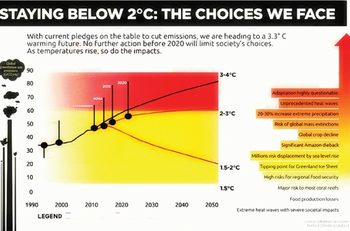
    By Sadhbh O’Neill. In 2009, signatories to the UNFCCC met to agree new legally binding greenhouse-gas emission targets. The outcome, known as the Copenhagen Accord, singularly failed to meet high expectations for a legally-binding agreement but the Accord did specify for the first time that the objective of the international community was to “hold the increase in global temperature below 2 degrees Celsius”. In the lead-up to the next big opportunity for a global climate agreement in Paris this December (COP-21), 2 degrees is repeatedly used as a reference point to frame a political deal. The 2 degree warming limit is essentially a political construct with a scientific basis for climate policy – but it is a tragically flawed approach. In principle, the 2 degree threshold made sense back in 2009: it seemed to be a politically realistic target but the politics changed as it became clear that change would be too slow, and – even more importantly – the received science changed too. As recently as 2007, scientists reasoned that CO2 concentrations could be safely allowed to reach 550 parts per million (ppm),  but more recent research produces a scientific consensus that “urges the world to reduce atmospheric carbon dioxide concentration CO2 to about 300 ppm by volume” to keep below 2 degrees warming. But crucially and shockingly it is already over 400 parts per million. The National Geographic noted that the concentration of carbon dioxide in the atmosphere is this high “for the first time in 55 years of measurement – and probably more than 3 million [others say 20 million] years of Earth history”. In any event, the risks associated with even 2 degrees of warming have been vastly underestimated. The likes of former NASA climate scientist James Hansen are now saying that even 1 degree is not safe. Tyndall Centre scientists Kevin Anderson and Alice Bows-Larkin stated as far back as 2011 that the latest evidence suggested that 2 degrees “…now represents a threshold, not between acceptable and dangerous climate change, but between dangerous and ‘extremely dangerous’ climate change: in which the importance of low probabilities of exceeding 2 degrees Celsius increases substantially”. The scientists argued that any assessment of climate policies should be framed in light of the likelihood of adhering to an emissions pathway that would stick to the 2-degree carbon budget. Yet they found that many of the models used to map out emissions-reductions scenarios showed that there was in fact a high probability of the 2-degree warming threshold being breached. For one thing, the global climate regime requires an acceptance of a global carbon budget instead of future-oriented mitigation targets. It is cumulative global emissions that count; not just good intentions to reduce emissions in the future. According to one recent publication [Brad Plumer ‘2 degrees: How the world failed on climate change’ Vox, 22nd April 2014], one tenth of the total carbon budget allowable under a 2-degree warming scenario was emitted in 2012 alone. Moreover emissions are still rising: the only year since the base year of 1990 to report a global emissions reduction is 2008, when economies around the world ground to a halt in the grip of a global recession. That decrease only amounted to 1% and only for one year. Overall, since 1990 global emissions have risen by 57%  and show no signs of abating. Even the IPCC has warned that the narrow window of opportunity to take action on reducing emissions gradually has probably passed, and effective measures will now require drastic and sustained cuts by Annex I [ie rich] countries. In 2011 and in more recent papers, Tyndall Centre scientists Kevin Anderson and Alice Bows-Larkin have looked at the realistic emission pathways required both to meet a 2-degree warming limit and fairly share the carbon budget between Annex I and non-Annex I countries, and conclude that developed nations are likely, based on ‘business as usual’ scenarios, to use up the remaining budget since they are ‘locked-in’ to fossil fuel and growth-dependent economies. Furthermore, the various emission pathway scenarios developed by Annex I countries to project a peak to their emissions and then reduce them whilst adapting to already-embedded climate change do not adequately assess the risks and probabilities of reaching or exceeding the 2-degree warming target. If the international community is serious about backing up any limit to global warming with credible but fair policies, then scenarios will have to be developed that explicitly construct pathways for developing countries to grow, peak and then reduce their emissions, alongside radical cuts in emissions by Annex I countries. But effective climate policies need to be measured against scientific evidence and their likelihood of succeeding: not against wishful or magical thinking. •  

    Loading

    Read more

  • Posted in:

    States burgeon while world shrinks.

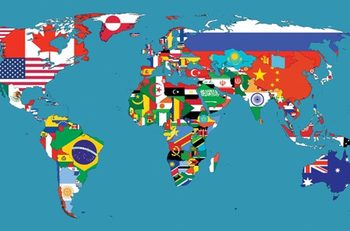
    By Anthony Coughlan. The growth in the number of States in the world is one of the most  remarkable features of our time, though it is not often commented on. The United Nations had 51 Member States when it was established in 1945. It had 193 at the last count – a near fourfold increase in 70 years. The dissolution of the colonial empires after World Wars 1 and 2 brought many new States into being. The number of European States has gone from 30 to 50 since 1991. When the USSR dissolved that year one State was replaced by 15. Czechoslovakia divided into two new States around  then, Yugoslavia into seven. Will Scotland eventually leave the UK? Will Catalonia leave Spain? Will the Flemish and Walloons in Belgium hold together indefinitely? If nation state boundaries are still at issue in Western Europe, where people have been at the business of State formation for centuries, the process of new States coming into being subsists in Eastern Europe. It has scarcely begun in Africa and Asia, where the bulk of the 7,000 million people who make up the human race now live. There are some 6,000 different languages in the world. At their present rate of disappearance there should be 600 or so left in a century’s time. These will survive because in each case they are spoken by a million or more people. Not every such language group will necessarily become a national community aspiring to its own State, but that is the historical tendency. The international community looks like growing to 300 or 400 States or more over the coming century.  At the same time ease of communications, the internet, free movement of trade and capital, and common environmental problems make us all conscious today that we are part of a ‘global village’. The world shrinks while simultaneously the number of States in it grows. Nations exist as communities before nationalisms and Nation States. To analyse nations and the national question in terms of ‘nationalisms’ is philosophical idealism, looking at the mental reflection rather than the thing it reflects. Nationalism developed as an ideology legitimating the formation of Nation States in the 18th century, although its elements can be found in some of the world’s oldest States centuries before – in Denmark, England and France in Europe; in China, Japan, Iran and Thailand in Asia. Nations evolve historically as stable, long-lasting communities of people, sharing a common language and territory and the common history and culture that arise from that. On this basis develop the solidarities, mutual identifications and shared interests which distinguish one people from another. Some nations are ancient, some young, some in process of being formed. Like all human groupings – for example the family, clan, tribe, they are fuzzy at the edges. No neat definition will cover all cases. The empirical test is what people say themselves. If people have passed beyond the stage of kinship society, where the clan or tribe is still a political unit, as it was in Ireland 400 years ago – and some half of mankind still live in kinship societies, mostly in Africa and Asia – they will know themselves what nation they belong to. What are the implications of these trends for democrats? Nationhood, shared membership of a national community, is the normal basis of democratic states in the modern world. We are internationalists on the basis of our solidarity as members of the human race. As internationalists we seek the emancipation of mankind. The human race is divided into nations. Therefore we stand for the self-determination of nations. This is internationalism, not nationalism. The word “internationalism”, from Latin “inter”/”between”, implies the pre-existence of nations. The right of nations to self-determination inspired the 18th-century American Revolution. It was formally proclaimed as a democratic principle of universal validity in 1789 in the Declaration of the Rights of Man of the French Revolution.  It is now a basic principle of international law, enshrined in the United Nations Charter. The right of nations to self-determination is based on the fact that it is principally within the national community that there exists sufficient solidarity and mutuality of identification and interest to transcend other social divisions and induce minorities freely to consent to majority rule, and to obey a common government based on such rule. Such mutual identification and solidarity characterise the “demos”, the collective “We”, which constitutes a people possessing the right to national self-determination. If such a people is incorporated into a State with its own government, this mutual identification and solidarity underpins people’s sense of shared citizenship of that State and their allegiance to its government as “their” government, possessing democratic legitimacy. It is what makes them willing to finance that government’s tax and income-transfer system, thereby tying the richer and poorer regions and social classes of that State together. The right to self-determination of nations does not require a nation to seek to establish a separate State. Nations can co-exist amicably with other nations inside a Multinational State, as the English, Welsh and Scots did for three centuries in the UK, or the many Indian nationalities inside India. They can do this, however, only if their national rights are respected and the smaller nations do not feel oppressed by the larger ones, in particular linguistically and culturally. If this condition is not observed, political pressures will develop to break-up the Multinational State in question. Some Multinational States are the legatees of colonial conquest – for example, India, Indonesia and most of the States of Africa.  Others have been formed by the governments of large nationalities extending their sway over smaller ones and incorporating the latter into either a unitary or a federal State. Examples are Britain, Spain, Russia, Turkey. The historical tendency seems to be for Multinational States to break up into national ones, mainly because of the breakdown in solidarity between their component nationalities and the development of a feeling among the smaller ones that they are

    Loading

    Read more

  • Posted in:

    Climbdown.

    By Michael Smith. Climate change is the biggest issue of our age. It seems likely to leave a legacy for future generations that will mean our epoch will be remembered primarily for its stupidity and spendthrift environmental profligacy. It is generally accepted that to stabilise CO2 concentrations about 450ppm by 2050, which might avert runaway global warming, we must reduce greenhouse gas emissions by 60% of their 1990 level by 2050.  Because rich countries have spent the proceeds of two hundred years of carbon-squandering in enriching their societies and their infrastructure it is generally accepted they must reduce by at least 80% over the period. Ireland is a rich, educated country blessed with a youthful, dynamic and imaginative population. Young people are our future and climate change is our legacy to youth. So what does the climate bill, its once-in-a-generation incarnation – delayed now for seven years since the Greens first put it in a Programme for Government, and having been through at least four iterations, do about it? The Bill purports to establish how our transition towards a low-carbon economy will be achieved. There will be a National Mitigation Plan (to lower greenhouse-gas emissions) and a National Adaptation Framework (to deal with the changes that climate change will bring). These two plans will be renewed every five years,  They will embrace tailored sectoral plans for all government departments. While there are no explicit targets set out, the legislation obliges the State to “take into account any existing obligation of the State under the law of the European Union or any international agreement” – a reiteration of mandatory EU targets to which all Europe is bound. The Bill formally obliges, or rather reiterates the obligation, of the State to adhere to EU targets such as an 80 percent reduction in emissions by 2050 over 1990 levels and a 20% reduction in emissions by 2020 over 1995 levels. But it allows for a delay of up to two years before any plan is instigated: fully nine years after the UK Act. This compares with the 2008 UK Act which provides for the 80% reduction in greenhouse gases by 2050, but also that emissions reduce by 26% by 2020. Regrettably overall the Irish Climate Bill seems like a washout – of non-binding ‘commitments’, legislation that has none of the characteristics of legislation. Homeopathy for the truly sick. Gratuitous and cynical. In essence it provides that Government shall endeavour to achieve the national climate objectives’. The UK legislation notably says: “The Environment Minister has the duty to ensure” objectives. The nub of the matter is that if the Taoiseach (or Environment Minister) has a duty to ensure 3 percent reductions every year (say) then individuals and worthy groups can probably sue the Taoiseach (or Environment Minister) for failures, possibly even injuncting her. Clear, aggressive targets, and teeth are basically all that this Act required and the failure to provide either makes it useless. The drafters of the bill and the vested interests who lobbied for it to be toothless must know it is froth so it’s not helpful or credible to pretend otherwise. Agriculture, energy-supply and development interests know exactly what “shall endeavour”, “shall have regard to” etc mean in the context: nothing. Climate Act wording which stated “The Taoiseach has the legal obligation to ensure compliance with the strict targets set out in this Act” and which could include the  phrase “for the avoidance of doubt, applications for judicial review  of compliance with the targets set out in this bill, including for injunctive relief, may be made by interested parties”, or some such would present third parties with a right to go to court if the targets referred to are breached. The risk of litigation would concentrate official minds on compliance. In passing it is worth pausing to note that the Greens’ bill, about which much was made in the dying days of the 2007-11 coalition, was not much better. Illegal behaviour can already expressly be challenged in the courts by third parties in the case of planning legislation and under EPA and water legislation. The Bill also proposes the establishment of an expert advisory council of between nine and 11 members which to make recommendations to the Minister for the Environment. Its chair will be independent but it will include the top officials from the EPA, Teagasc, Sustainable Energy Ireland and the ESRI, but not campaigning environmentalists such as the Irish Environmental Network, at least ex officio. Unlike the Fiscal Advisory Group the legislation does not even bother to state that the council will be independent. The Minister will not be obliged to follow its advice although he or she will be required to make an annual transition statement to the Dáil. Environment Minister Alan Kelly said the Bill gave a “solid statutory foundation” and noted: “It is important that developed countries such as Ireland provide leadership in terms of their contribution and the framework underpinned by this bill will enable such a response to be developed well into the future”. On the other hand spokesman  for Stop Climate Chaos (SCC), the leading climate NGO alliance,  Oisin Coghlan, said: “This legislation is urgent, Ireland is already off-track and without climate action plan. It’s now up to TDs and senators to fix this bill and pass it into law as quickly as possible”. Aid agency Trócaire also criticised the bill, with executive director Eamonn Meehan saying a national mitigation plan would not be produced until 2017. Indeed this two-year delay is arguably the only substantive change from the draft Bill produced by Phil Hogan a year ago. The Government has delayed the adoption of a national mitigation plan with sectoral policy measures by at least another two years. Oisín Coghlan said it was deeply disappointing the Bill had ignored the proposals of the Oireachtas Committee. “The Bill does not include a definition of low carbon, it doesn’t guarantee the independence of the Council, and it doesn’t include the principles of climate

    Loading

    Read more

  • Posted in:

    Meat causes flooding.

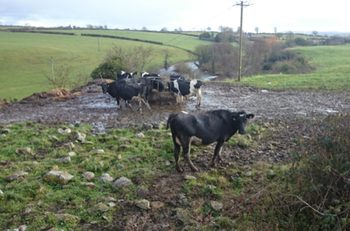
    By Cathal O’Meara. Landscapes that support extensive meat and dairy farming are dramatically damaging our rivers and contributing to flooding in our towns and cities. Globally livestock accounts for 70% of all our agricultural landscapes and contributes more greenhouse gasses (18%) than the entire transport sector (12%). However, our livestock-dominated landscapes are having their most significant impacts not on climate but on our rivers and watercourses. Current flood-relief schemes in Ireland appear to exemplify a linear pattern of thinking about watercourses. Recently completed schemes in Fermoy and Mallow, on the Munster Blackwater, treat the towns in isolation from the catchment of the rivers that periodically flood them. This, however, is addressing the symptoms without considering the cause, of flooding. Landscape policies that encourage and subsidise livestock are compounding flooding nationally, remains rarely discussed, the opposition cowed. Soil compaction, and faecal matter runoff due to overgrazing and overstocking in the Blackwater Valley Much of our uplands are maintained in a state of arrested ecological development where grazing, often combined with annual burning of the vegetation, is used to retard the development of vegetation that is unwelcome (from a livestock perspective). This is despite the fact that the productivity of these lands is so marginal as to render them unworkable without grant aid. Often vegetation in these uplands remains below half a metre tall for the limited grazing benefit of sheep (and deer). Policies that promote cattle or dairy cows on better-quality “improved” land prevent us from realising the potential of a sustainable forestry policy. A recent study undertaken by the Centre for Ecology and Hydrology in Wales found that: “Water sinks into the soil under trees at 67 times the rate at which it sinks into the soil under grass”. A series of studies undertaken by various bodies including the Department of Environment and Cork County Council concerning the water quality of the Blackwater River, as well as similar work undertaken by the Department for Environment in Britain all come to the same conclusion that “animal trampling” (soil compaction) and “intensive cattle grazing” pose a risk to the “riparian areas and to the water channel itself”. The risk is multifaceted and includes intensified sedimentation from increased runoff of rainwater due to soil compaction and also from increased nutrient content within the water itself from the faecal matter of cows, leading to eutrophication of the water. Recent Cryptosporidium outbreaks nationally highlight the dangers of untreated human and animal waste. There is a further complication with livestock due to the growth of maize to supplement the diet of cows and cattle. Maize, which is increasingly being grown here, is harvested in the autumn – leaving the soil bare during its most critical time, the winter months. Without vegetation there is little capacity for the soil to retain water and the winter rains wash the sediment into the rivers. A 1998 Study by Morgan et al estimates that this loss of soil can be as significant as several tonnes per hectare, per year. Drainage schemes throughout river catchments in Ireland complete this picture. The remit of the Office of Public Works (OPW) under the 1945 Drainage Act empowered it to carry out drainage of agricultural land. Under the 1995 Act the OPW was charged with the protection of urban areas subject to flooding. However, both of these issues arise from the same logical fallacy. The desire to increase the speed of water flowing from the land and through the rivers has increased the propensity of our towns to flooding. Recent inspiring projects are being undertaken internationally that aim to slow down the speed of water flowing through our landscapes, seeking instead water-attenuating solutions. ‘Room for the River’ is a Dutch Government programme that seeks space to allow the callows and lowlands to flood. ‘Adaptive Land Use for Flood Alleviation’ in France seeks to create sacrificial wetland landscapes upstream of Paris on the River Seine to prevent downstream flooding. How can we use these concepts for reinvigorating rural Ireland? Perhaps we need just to look to Mayo where the success of the recently completed Greenway provides inspiration. We could add to this a network of campsites, horse-riding bridle paths and walking trails along our river valleys. Our growing agri-food sector and craft breweries would benefit from this expansion of rural tourism. We could go further and reintroduce the wolf, ensuring not only increased rural tourism but also increased biological diversity, as the wolves would maintain the deer populations at sustainable levels. We could also combine this with agriculture looking instead to different models of lower-intensity silvopastoralism and locally-grown organic production instead of a one-size fits all beef or dairy model. However to do this we may first need to challenge the sacred cow in Irish agriculture. • Cathal O’Meara is a chartered landscape architect and runs the practice www.cathalomeara.com

    Loading

    Read more