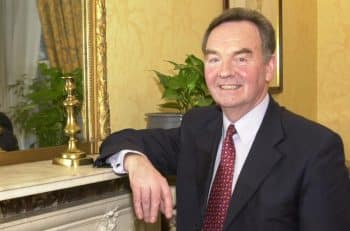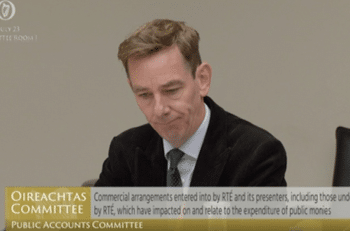
Frank Flannery and Ciaran Conlon, Enda’s backroom boys The smuggest men in politics That man you see on the box when FG do something popular like incorporate George Lee, the one who is so ostentatiously controlling the sequence of press questioning by authoritative sweeps and pointings. That’s young(ish) Ciaran Conlon. He used to work for the PDs. FG’s backroom boys brought you the Twink as charlady sketch, the Celtic snail, Enda the Action Man and the 2007 General Election loss that should have been impossible Tom Curran and Frank Flannery have run the show for years with Curran the capable adminstrator as General Secretary, and Flannery the fearsome Svengali strategiser. But the main problem with Frank is that he thinks FG did well at the last election. He doesn’t feel how bad FF were, how ripe to be taken out. And most of all he doesn’t sense how bad Enda Kenny and FG are, how lacking in credibility as an opposition Not directing the press but thinking for a long time that he’s in charge of a broader agenda that drives this old country of ours is Frank Flannery until recently both director of elections and director of organisation. In an article published in the Mail on Sunday newspaper before the elections, Mr Flannery said his party would consider entering Government with Sinn Féin if the situation arose. Enda Kenny was quick to distance himself from those remarks and said his party has no intention of negotiating a partnership with Sinn Féin. After some nasty talk of demotions Fine Gael quickly confirmed that its national director of elections for the recent local campaigns would not be reappointed to the role for the next General Election. Frank Flannery will retain his position as the party’s director of organisation, concentrating on issues such as candidate development. The spokesman said Mr Kenny said the next director of elections would probably be a politician, as was the case with Fianna Fáil. Fianna Fail of course have deployed grinning PJ Mara for the last few elections, though he is retiring now. Part of PJ’s job, a small part, was to get the message across that they were scared, in a respectful way, of Flannery and his boys. Nothing could have been further from the truth. Flannery saw no problem with Kenny as leader and believed coming in second in the last election was a triumph of his psephological wizardry. PJ was happy just to smile, respectfully. What Fine Gael needs is the iron hand in the velvet glove. Bring on Varadkar. 2009. Pic: Broadsheet
‘When art is made easy, it’s made cheap’ RóisIn Waters Okay, I admit it – I’m a hipster. I’m the person you see with a polaroid camera slung around my neck on my way to pick up Howlin’ Wolf’s psychedelic album – on vinyl, of course. I belong to that group of people who treat yellowed books like gold and would use a Kindle as kindling. And I’m one of the worst of them – I even have two typewriters, and I’m still at school. There is a general hatred of hipsters felt by almost every individual on this planet who notices us, but we don’t care, don’t register. The criticism is that we think we’re too ‘hip’, that we want to be different for the sake of it, that we drift away from the mainstream and have gone to live La Vie Bohème because of our supercilious feeling that anything popular has to be bad. We’re seen as a strange breed of elevated hippies. However, this opinion misses the point of ‘hipsterism’ (by the way, we’re not a weird unified cult or anything, we wouldn’t coalesce or even conspire). It’s not a matter of “we’re so original and cool” compared with the drab majority who just don’t get it. For me, it is a reaction to the airbrushed digitalisation of art. We’re not trying to be above everyone else, we just don’t buy into this. There is a desire for expression in a tangible form, to read books rather than screens, to see the needle on a spinning record, to understand that light doesn’t create a photograph just by magic. Nowadays we are so distanced from the process of creation that we are reverting back by decades, before iPods and eBooks even started. Think of it in terms of the notorious polaroid. When all you have in your camera is twelve shotsworth of film, you’ll be careful with your pictures. You’ll set them up just right, and you won’t just go snapping away at anything that takes your momentary fancy – film is way too expensive for that! With a digital camera, there simply isn’t the same value in your shots. Admittedly it is convenient, but when you limit yourself you’re more likely to want to photograph something eloquent or beautiful, rather than shooting off 127 ‘selfies’ in front of your bathroom mirror. The case is similar with typewriters; when you’re typing on your robotic wireless keyboard, just as I am now, there’s no sense of an actual connection. I’m hitting the buttons, and letters are appearing magically, but I have no real physical link with it. With a typewriter though, you really get the feeling that you’re making it happen, you can even tell how angry or excited someone was while typing, because they’ll often tear right through the page. But of course, vinyl is the ultimate hipster symbol. I love vinyl, and I don’t care how expensive or scratchable its artful disks are – when the needle sets down and I hear that first crackle, I relay lumbar shivers. Maybe the sound isn’t crystal, but some people just don’t go for the polished auto-tune of the Glee cast; some music is meant to be rough. Take The Velvet Underground for instance, soignée hipster favourites. If White Light/White Heat came out today, Sister Ray would be a three-minute single, most likely featuring Nikki Minaj. And then there’s the wonderment that you can actually watch it spinning – it’s the only form of recording where you can watch the music happen. iPods function on the surreal notion that you can fit Sonic Youth’s complete works into a matchbox, but with records you’re brought back down to earth, where things are made real in front of you. We live in a world of mail-order experience. Why go to a concert when you can hear it all on Spotify? Why read a book when you can just Wiki the plot? Our chronological displacement is a symptom of the search for unique and personal experiences. All the secret treasures you can find – light leaks in a photograph, a locked groove on a record – are alien fugitives in a perfect HD world. Today we ‘access’ everything at our touchscreen-compatible fingertips, and sure, convenience is great, but something is eroded. When art is made easy, it’s made cheap, so we ‘hipsters’ look for the real thing. We want to feel the rough edges of creation in this dented universe.
Solicitor Colm Murphy struck off after Law Society falsely imputed an undertaking, and relied in part on a forged document and evidence from a fraudulent solicitor By Frank Connolly Allegations of “repeated skulduggery on the part of officials of the Law Society” are likely to be aired in the Supreme Court in the not too distant future when struck-off solicitor, Colm Murphy, finally gets his day in court. Embroiled in a complex legal battle with the society long before, and since, he was struck from the Roll of Solicitors in 2009, Murphy is determined that his former colleagues will no longer delay a full hearing of his claim for damages for breach of duty, negligence, defamation and misfeasance in public office. Kenmare-based Murphy has claimed in a detailed submission to the Supreme Court that his striking off was based on spurious and inaccurate information provided by the Law Society to its Disciplinary Tribunal and the High Court ten years ago. Key to the decision to strike him from the roll was a claim by a society official, Linda Kirwan that Murphy had breached an undertaking he had given to the President of the High Court. Kirwan insisted in an affidavit seen by Village that she had been in the High Court on the day the undertaking was made. It was only after the unfortunate Murphy was struck off that she admitted, in affidavit and in a letter to Murphy in 2010 that she was not in fact in the court when the supposed undertaking was made. No such undertaking is recorded in the order from the court issued on the day in question. Murphy was also able to prove, again after the strike off, that the Law Society had taken attachment and committal proceedings against him based on a document forged by Frank Fallon who was subsequently jailed for two seven-year terms. Frank Fallon had claimed that he had not received title to a property even though he had paid Murphy and received a copy of the Deed from the then solicitor. It later turned out that the Deed in question was forged by Fallon and that no such transaction had taken place. Fallon from Charleville in Cork was sent to jail in Britain in 2009 after he was convicted of conspiracy to defraud by forging the wills of up to twelve people and stealing more than £500,000. The Law Society case against Murphy also included an incorrect claim that he had attended an auction of the Brown Pub in Kealkill county Cork in August 2006 in breach of its rule that a retired solicitor without a practising certificate cannot participate in the sale of a property by a former client. This error sparked what are known as Section 18 procedures against the former solicitor. Murphy’s submission goes on to list various other defamatory allegations pursued by the society including an incorrect implication that his client account was overdrawn. Further, he claims that a suggestion by the President of the High Court, Nicky Kearns, back in 2010 that a full hearing of the case should take place was frustrated by the society which instead sought to restrict matters to a trial of ‘preliminary issues’ rather than a full civil action. When the case came before Kearns again in June 2012 he queried why Murphy’s substantial case against the society had not gone ahead, as he had recommended. In his comments, Kearns referred to the case as a “spread-eagled mess” and referred to the claims of “alleged repeated skulduggery on the part of officials of the Law Society”. If this was not the sort of thing that could bring the Law Society into disrepute, the back story to the whole affair raises even more disturbing questions about its modus operandi in dealing with allegations of wrongdoing by its members. Murphy has insisted that his fall from grace originates in 2001/2002 when he complained about another member of the roll, Fergus Appelbe, who also had a conveyancing practice in west Cork and south Kerry. At a recent Disciplinary Tribunal hearing in Dublin, Appelbe admitted to various trangressions, including putting together false deeds, updating deeds to defraud the Revenue and creating a double mortgage over the same property which he owned (the same misconduct as Thomas Byrne’s). Appelbe, who through his various companies may have incurred debts in excess of €50 million, is due to learn his fate in mid-February. What is most extraordinary about “the spread-eagled mess” is that the society appeared to have based at least some of its unfounded suspicions about Murphy on information in complaints sent to it by Applebe over ten years ago. As far back as 1987/1988, Appelbe was the subject of no less than two investigations by the RTE Today Tonight programme into his somewhat unorthodox conveyancing practices in the south west. The late Cathal O’ Shannon listed a series of allegations involving unusual land deals against Appelbe who, despite the unwanted attention, went on to invest in an impressive portfolio of properties including Waterford Castle through various companies before the crash and his rapid descent into catastrophic debt. In August last year, a liquidator was appointed to the four-star castle, hotel and golf complex in Ballinakill after the operating companies, Negold Ltd. and Cendant Ltd. ended up with debts to the NAMA vehicle, National Asset Loan Management (NALM), of just under €34 million. Appelbe is one of four directors of the companies described in the High Court as hopelessly insolvent and unable to pay their debts. In 2010, Allied Irish Banks (AIB) secured summary judgment orders for some €18 million against Cronin’s Wood, a development company for which Appelbe acted, over its failure to repay a loan to re-finance a property acquisition in Killarney, Co Kerry. Mr Justice Peter Kelly granted the order against Cronin’s Wood Developments Ltd, South Mall, Cork, at the Commercial Court. He also entered judgment for €10 million arising from guarantees over the loan provided by Appelbe, and a businessman,
By John Gormley. Debacle is the word most often used to describe the setting up of Irish Water. I always took the view that the need for water charges was self evident, but I could never see the justification for the establishment of yet another quango. Fine Gael and Labour, who pledged in their respective election manifestos to rid the country of red tape and bureaucracy, have succeeded in giving us probably the most egregious humdinger of a quango since Fás. Talk of bonuses and over staffing have annoyed people. But that annoyance will quickly turn to anger when flat-rate charges are introduced, a move which will be completely at odds with the polluter-pays principle. I’ve argued previously in this column that the project was ill-conceived from the start, its primary objective being the eventual privatisation of water services. But it would appear that Fine Gael and Labour could well be thwarted in this ambition. So who will stop the liberalisation gallop of the government? It won’t be Labour backbenchers, or the unions, or protests, or even poor local election results. It will come from the unexpected quarter of the European Union. Or more precisely a provision of the Lisbon Treaty, which was dismissed by opponents of the Treaty at the time of the referendum. Ironically, many of those who opposed Lisbon did so because of fears of further market liberalisation. Article 11 of the Treaty on European Union (TEU) has given EU citizens power to call on the Commission to propose legislation. A petition of one million EU citizens from at least seven different member states is required to set the process in motion. On 17 February the first ever European Citizens’ Initiative (ECI),’Water is a human right!’, will be the subject of a public hearing in the European Parliament. On the the same day the proposers will meet the European Commission. Their arguments and demands are very clear: they believe that water is a resource and a public good, not a commodity, and they invite the European Commission to propose legislation which would implement the human right to water and sanitation as recognised by the United Nations. They have three main demands: 1. The EU institutions and Member States be obliged to ensure that all inhabitants enjoy the right to water and sanitation. 2. Water supply and management of water resources not be subject to ‘internal market rules’ and water services be excluded from liberalisation. 3. The EU increase its efforts to achieve universal access to water and sanitation. In line with the regulation on ECIs they will be given the opportunity to explain their demands in both the EU Parliament and the Commission. The meeting with the Commission is a closed session but the hearing in the European Parliament is open to anyone who registers in advance. This is a test case. Would the unelected Commission dare to ignore the wishes of 1.65 million citizens? Any attempt to dilute (I won’t say water down) the proposals by the Commission would only play into the hands of those who believe there is a democratic deficit at the heart of the EU project. Nevertheless, it would be naive to underestimate the sizeable lobby in favour of the privatisation of water resources. There may be some within the European Union who sympathise with the US reluctance to join all other nations in a universal agreement on the definition of rights to water and sanitation as defined in a resolution of the UN Human Rights Council (UNHRC), adopted by consensus in September 2013. Amnesty International was critical of the USA, stating: “At the time [of the unanimous adoption of the UNHRC resolution] the United States was the only country that disassociated itself from the definition of these rights and stated that it did not agree ‘with the expansive way this right has been articulated’. However, it has not explained what aspects of this definition it does not accept”. The press release continues: “Such rights are only ‘expansive’ if one adopts a 19th century understanding of hygiene and of government duties to ensure the provision of public services”. It’s clear that the related issues of water and climate change will be defining issues of the twenty-first century. Regrettably, the last number of weeks have shown that we have a government that understands neither issue. Our only hope at this stage is that the European Union can come to our rescue.
“the religiously deferential Philomena denies that she was coerced into signing away her child” At the glitzy Dublin premiere of Philomena there was marked discomfort in the Q & A emanating from some of the victims of institutional abuses as the normally boisterous Steve Coogan made every effort to be inoffensive in his efforts to appease Catholic sensibilities. Coogan is the producer, co-writer and star of the movie, as journalist Martin Sixsmith who helped Philomena Lee trace her child, Anthony. The boy was taken from her during their incarceration in Sean Ross Abbey, a Mother and Baby Home in Co Tipperary, in the 1950s. Perhaps Coogan didn’t really understand the politics of the issue. The politics of the church with all its abuses is indeed fraught. But he needed to be aware of this: that gentleness towards oppressors might be seen as indulgence of regimes that wish to keep us all silent, all stunted: childlike and contained. The most startling thing to emerge from Philomena is the lack of accountability for what was in effect the moral theft and trafficking of the child. The whole issue of criminality was avoided throughout the entire film. Indeed the religiously deferential Philomena denies that she was coerced into signing away her child. At the core of the problem of the film is that this denial is taken at face value. This important and still topical ethical issue has been sweetened and pressed into a glowing human interest story rather than a story of organised, criminal conspiracy. Philomena is a road movie for the politically emasculated. A Tinseltown bauble that purports to capture a moment in time that it implies is long gone. Comfortable history. The whole reality of this film is sentimentalised through a naive and clichéd catholic spiritualism. In the book on which the film is based, the real Sixsmith wrote that “The nuns were lovely” and the mother superior was as “a friendly, educated woman … who had devoted her life to the care of disadvantaged and disabled people”. The film is more nuanced but there is certainly no judgementalism. Unlike for example Peter Mullan’s 2002 The Magdalene Sisters, this film is no polemic. As a result it lacks the catharsis necessary to make for even dramatic greatness. The Mother and Baby homes like Sean Ross Abbey, Bessborough, and Castle Pollard formed part of a network of compounds where individual citizens were incarcerated and exploited till they died, made good their escape or somehow found themselves miraculously released. They were all of a piece with the Magdalene laundries, the industrial schools, reformatories, orphanages, mental institutions and indeed some ordinary religious schools. The trauma of what took place in these institutions still permeates this society through the suffering of the individuals who were incarcerated there. As to the brutal separation of mothers from their children, the likes of the Adoption Rights Alliance deal daily with sustained suffering as many both mothers and children are still not being given access to personal records, which can enfranchise the children with an authenticity, an origin. Punitive attitudes incarnated in the movie’s venomous Sister Hildegarde pervade in the often contemptuous attitudes of contemporary Religious Congregations and indeed the State. There was an opportunity in Philomena to address these issues but the writers of the script chose not to do so. Nobody so far has been held to account for this practice; there have been no Garda or Interpol investigations; nobody from Aer Lingus or Pan Am which handled what was in effect the trafficking of the children out of Ireland has been confronted. No-one from the Garda, no-one from US Immigration, from Social Welfare or Foreign Affairs. We had to drag the apology from the Taoiseach in relation to the Magdalene Laundries and large parts of the truth have still been avoided in the massive whitewash of the Ryan and McAleese Reports. The complete indifference and lack of consequences for all those that were involved in the criminality and abuses that were described in the Ferns, Murphy and Cloyne Reports is dumbfounding. Closure is a myth. Respect is due to all the victims of church depredation and deep respect to Anthony Lee who died searching for his mother – diverted by the lies of the very people who thieved him from his mother and continued the expropriation by robbing him of his mother’s whereabouts. But this story is not just theirs; it is all our stories. It needed to have indelible consequences for the church and state – otherwise the story is simply peripheralised, managed, alienated, othered. It will take some time for society to extract the truth on this whole issue. Memorials at the Garden of Remembrance, hollow apologies, and atmospheric, politics-free films like Philomena can never be a substitute for the political truth. With all that in mind – please go. It is well-acted and moving, though to ambivalent ends. And when you come out of the cinema, get involved, demand answers, seek the truth, change the politics, strive to right the wrongs.
’In a democracy the voters have a right to make stupid and irresponsible decisions, the right to vote for gombeens and bribetakers who will ignore development plans and rezone every blade of grass in the country’ ‘The Greens ,while in power, initiated the enquiries; Fine Gael and Labour put a halt to them – for the most spurious of reasons. And they got away with it’ On the day that the Mahon tribunal found that Frank Dunlop had made corrupt payments to certain politicians Twitter was in a frenzy – with the news that Pat Kenny was departing RTE for Newstalk. Maybe the general public were suffering from a serious bout of Tribunal fatigue, or maybe the showbiz/human interest element of the Kenny story was irresistible, but could there be a deeper, more uncomfortable truth in evidence here? Is it possible that the Irish are just not that pushed about corruption? Are they really that bothered about the poor planning that has blighted this country for decades? Could they really give a toss about the over zonings that fuelled the property bubble? It’s not popular to say so, but my twenty years as a public representative tell me that the above topics are not ones which exercise the public mind when it comes to elections. You need look no further than the last local elections when some of those councillors who received corrupt payments were re-elected. And no doubt at next year’s local elections the electorate will once again reward corrupt politicians while ignoring many of the candidates who have never taken a bribe. So, it’s down to the voters, the people, and for whatever historical reasons we have a tolerance – even a sneaking regard – for the rogue in our society. Some may see this as an endearing quality – we understand human frailty and don’t get too hung up on the letter of the law. At the heart of this is a more uncomfortable truth. We’re really not that pushed about corruption. We don’t see bribery or white collar crime in the same league as the common or garden thief. Frank Dunlop is a witty, entertaining, intelligent guy, who just happens to be corrupt and a perjurer. You see, those who crusade on the planning/corruption issue are not the norm in this country. People like Michael Smith, Colm MacEochaidh, Elaine Byrne or Trevor Sargent are exceptions – ‘odd bods and misfits’ who are quickly marginalised and neutralised. It was Trevor Sargent who first brought the problem to public attention when he stood up in the Council Chamber waving a developer’s cheque and asking if anyone else in the Council had received one. The omerta code had been broken and the reaction was swift. Trevor was surrounded by councillors and physically attacked. Councillor Don Lydon , who was subsequently found to have accepted bribes, got Trevor in a very expert headlock. Those who witnessed the events of that night say that Dr Lydon, who was a psychologist by profession, really missed his real calling in life and should have been a cage fighter. Don had Trevor in very professional headlock, depriving my colleague of oxygen and demanding the return of the cheques. As Trevor’s face turned blue. I recently sat beside Don at a dinner for past members of the Oireachtas. We had quite a pleasant and civil conversation, and he asked me to pass on his warmest regards to Trevor. He was very fond of Trevor, he said. I couldn’t help but wonder afterwards what he would have done to Trevor that night had he actually disliked him. Don, like the others in the corruption trial, now finds himself in an unusual situation. A Tribunal of Enquiry has found that he took bribes, whereas in the courts he has essentially been acquitted on the same charges. I’m sure on a human level the past few years have been an ordeal for him, but contrast his treatment with that of Gerard Convie, the Donegal planner. Mr Convie was the whistleblower in Donegal County Council, who alerted the Department of Environment to serious planning irregularities in the region. Not only had Mr Convie been dismissed, but when the new Fine Gael and Labour government took over they very quickly dropped the independent inquiries which I had initiated as Minister for the Environment. Mr Convie took the matter to the courts where his good name was vindicated, and the new government was forced to reinstate the planning enquiries. Again, keen observers of these matters will note that a clear pattern of public and media indifference emerges. The news that the independent planning enquiries were to be dropped in the first place was greeted with barely a whimper in the newspapers and broadcast media. Try to imagine – if you can – the howls of outrage and indignation of certain columnists if Fianna Fail had pulled such a stunt. But it gets worse. Incredibly, the day after the Convie case an editorial appeared in the Irish Independent, complimenting the government on their announcement of the independent planning enquiries, completely ignoring the fact that this government had dropped the enquiries in the first place! If there was any finger of blame, it was pointed, unjustifiably, at the Department for the Environment. It’s true that government departments try, generally, to avoid unnecessary hassle or extra work and expense, but the decision to stop the independent enquiries was a political one, pure and simple. The Greens ,while in power, initiated the enquiries; Fine Gael and Labour put a halt to them – for the most spurious of reasons. And they got away with it. Given the distinct lack of enthusiasm already displayed by the new government for these planning enquiries, don’t get your hopes up. I expect nothing more than a perfunctory ticking of boxes. No heads will roll; no ground-breaking changes will be made to our planning laws. One of the changes being demanded by An Taisce –and a key recommendation of
By Kathleen Lynch. The impact of rising economic inequality on inequality in education is profound, especially over time. Education is essentially a competition for advantage in an unequal society. Those who have most resources and wealth, outside of education, can and will use it to gain advantage for their children within schools and colleges. Under-resourced public services like education, services on which those with lowest incomes depend heavily, cannot guarantee equality of opportunity for all. Wealthier parents can afford to, and are enabled to, subsidise their children privately. Their private annual expenditures on education through fees, grinds, tutoring, trips, summer camps, IT supports, etc often far exceed total state expenditure on a given child per annum. As Michael Marsh noted in his book Class Dismissed (2011), economic inequality is at the root of educational inequality, and enabling economic inequality to rise annually is a way of actively promoting educational inequality. Yet this is precisely what has happened and is happening in Ireland as the rich are getting richer and the poorest are getting poorer: between 2009 and 2010, the wealthiest ten percent of households experienced an 8% increase in disposable income while the poorest ten percent had a 26% drop in disposable income. (CSO, 2012: 11, Figure 1d). This pattern persisted with the new government, as poverty rates increased between 2010 and 2011: “In 2011, the at risk of poverty rate increased to 16.0% from 14.7% in 2010…. Almost one quarter (24.5%) of the population experienced two or more types of enforced deprivation in 2011 up from 22.6% in 2010” (CSO, SILC, 2013:1). The OECD’s Economic Survey of Ireland (OECD, 2013: 35), published in September, confirms that “Poverty and social exclusion have increased since the crisis…” Cuts to Educational Services and Supports: Punishing the Poor Not only have the current and previous governments enabled economic inequalities to rise, they have compounded this injustice by cutting or greatly reducing the supports that lower-income households need to participate as equals in education. Blanket cuts to child benefit in the recent budget had the greatest impact on those who are poorest; as have the very significant decreases in Rent Allowance, which eat into the very meagre budget of the poorest families in the State. Both recent governments have also reduced the resources that schools and colleges need to support those who do not have access to discretionary funding from their families. While the unjustifiable cuts to educational services for children with learning disabilities have received some public attention, relatively little attention has been given to the significant reduction in language supports for immigrant children, despite the evidence from the 2011 census that one in seven children under the age of 14 is from an ethnic minority (excluding Traveller) or migrant background. Traveller-specific educational supports have also been devastated with a cut of 80% in recent budgets. This happened despite compelling evidence that Travellers are among the most educationally disadvantaged groups in Ireland. As many immigrants and Travellers are not only economically and socially vulnerable, but also lack a powerful, organised public voice, this makes the attack on their educational supports especially reprehensible. Class Inequality and Educational Attainment A survey by Barnardos in 2012 found that, on average, parents are spending €355 for a child in senior infants, €390 for children in fourth class in primary school and €770 for children going into first year in second-level education. Yet the Back to School Allowance in 2013 was only €100 for children aged four to eleven and €200 for a child aged 12 or over, for that minority who are entitled to it. This is an enormous disparity between expenditures and supports. When this is combined with the reduction in school transport supports (unless the child has a medical card), and the planned reductions in one–parent-family payments, it is clear that both the current and previous government policies have been to punish the most vulnerable and the most voiceless. Policies that increase economic inequalities and reduce public educational services and supports will exacerbate an already unequal educational system. Emer Smyth and Selina McCoy’s Investing in Education (2009: 7, Figure 2.2) report showed that there were already significant social-class differences in attainment before the financial crisis. At the end of primary school, children from higher professional backgrounds had a mean literacy score of 43 (out of a possible 50) while those from semi- or un-skilled manual backgrounds had a score of 28 and those in households where neither parent was employed had a mean score of 25. These social-class-related differences are huge and are compounded by, and contribute to, differences in educational attainment at junior and leaving certificate levels, all of which, in turn, translate into further class inequalities in gaining access to higher education. What the government is doing is making a bad educational situation worse for the most disadvantaged. Cuts in Higher Education: Keeping people in their place Although there has been no major discussion of the impact of cuts on low-income working-class, immigrant, disabled, lone-parent or mature students in higher and further education, the impact has been considerable. Between 2010 and 2011, students were among the groups that showed a statistically significant change in their at-risk-of-poverty rate. While 22.7% of students were at risk of poverty in 2010, this rose to 31.4% in 2011. This means that almost one third of students are now at risk of poverty (CSO, 2013: 4). There have been a number of really pernicious cuts in further and higher education that are profoundly class-biased and that have led to this situation. New entrants under the Back to Education Allowance (benefitting the disabled, lone parents and the unemployed) will no longer get maintenance support. This makes it almost impossible for those mature students on low incomes, or those with young children who need childcare, to return to third-level education. Moreover, those students who are from low-income families and on grants, at undergraduate level, and who need to do a further degree/diploma to qualify for a job (such as