Village

  • Posts: 13
  • Comments: 0
  • Since:
  • Posted in:

    Humphreys honoured hoax-bombing, domestic-abuser garda with Scott medal

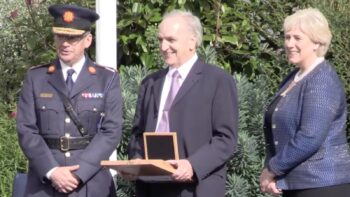
    By Michael Smith published in partnership with the Ditch A former garda who was accused by his wife of serious domestic abuse and of holding a gun to her head at their family home in Donegal was awarded a Scott Medal at a ceremony attended by then acting justice minister and presidential candidate, Heather Humphreys, in September 2021. Former Detective Garda Noel McMahon resigned from the Garda in 2004 after the Morris Tribunal found that he was involved in planting “hoax bombs” and ammunition across the North-West in the early 1990s He and a senior Garda colleague then claimed these as IRA explosives-finds to advance their careers. McMahon purchased illicit drugs which were then placed in the premises of publican Frank Shortt in Quigley’s Point, in County Donegal in October 1994 before a large force of gardaí raided the nightclub. Shortt was charged with allowing his premises to be used for the sale of illegal drugs and, in 1995, was wrongly imprisoned for three years. He later obtained a miscarriage-of-justice certificate and substantial damages from the State. Judge Freddie Morris found that Noel McMahon had lied during his evidence to the tribunal. McMahon faced dismissal from the Garda before he resigned in July, 2004. At the Morris Tribunal hearings, Sheenagh McMahon described how she was subjected to serious abuse by her garda husband who threatened her with his official firearm at their home in Buncrana in 1995. “He put a gun to my head and he told me he would blow my brains out,” she told the Morris tribunal in March 2003 as she recounted the years of abuse she suffered at the hands of her husband. She said that she was wrongfully arrested after Noel McMahon produced a false court Safety Order made against her in 1999 and that her children were placed in care as a result of his actions. She later regained custody of her children and obtained an apology and damages from the State in 2018 over her wrongful arrest. In the apology, lawyers for the State, the Garda, the Minister for Justice and Noel McMahon said in open court that: “The Defendants concede liability on the basis that they accept that the Plaintiff was wrongfully arrested and detained on 30th June, 1999 by reason of the arresting Garda executing a Safety Order produced by the Plaintiff’s husband which in fact had never been issued by the District Court”. Ms McMahon was awarded €20,000 in damages. She refused an offer of an additional €5000 if she would agree to the apology not being read out in court. In its final report, the Morris Tribunal stated that Noel McMahon had threatened a garda colleague with a loaded gun in Buncrana garda station in 1992 and that “nothing was ever done about this incident”. In September 2021, Heather Humphreys, acting Minister for Justice, attended the ceremony during which serving and retired members, including McMahon, were awarded the Scott Medal for bravery during the rescue of businessman, Don Tidey in 1983, after his kidnapping by members of the IRA. Ms Humphreys and Commissioner Drew Harris, with Noel McMahon standing between them, were photographed along with other recipients of the award. The former minister and Fine Gael presidential candidate told those present: “Your actions on that day were truly heroic. You performed your duty as garda members and for that we are thankful. You are honoured with this exceptional award”. 

    Loading

    Read more

  • Posted in:

    Journalism and the Genocide notes on the talk given by Audrey Kissane (St Kieran’s Hall, Cloughjordan, Friday 1 August 2025)

    By Caroline Hurley Eloquent enforced absences The evening opened sombrely: the organisers, Cloughjordan Arts and Cloughjordan Palestine Justice informed the assembled crowd, nearly a hundred strong, that Abubaker Abed, the 22-year-old Gazan journalist who had only recently escaped the besieged enclave, would not be attending. His absence, however, was eloquent. News had just reached him of another death within his already devastated family—who remain trapped in Gaza, having already lost forty members to Israel’s annihilating assault. At a previous event, Abubaker had spoken with searing candour about the experience of hunger—not in the abstract, but as endured by himself and witnessed in those he loves. Once destined for a career as a sports commentator, he was drawn inexorably into the theatre of war, compelled to bear witness to horror. His reporting soon attracted the ire of Israeli authorities who warned that his work was becoming “troublesome”; targeted and threatened, he fled. The entry fees and donations from the event were dedicated to supporting him. A musical performance by members of the Lajee cultural tour from the Ayda Refugee Camp in Bethlehem had also been planned, but the now-familiar obstacle of delayed visas rendered their presence impossible. In their absence, a candle was lit, and the room fell into a moment of mindful silence — an act of collective mourning and solidarity. The machinery of dispossession in the West Bank An update was shared on the ongoing wave of evictions and systematic land theft in the West Bank. The tactics of displacement were laid bare: obstruction of harvests, mass sackings, and bureaucratic sabotage that forces Palestinians to complete Kafkaesque documentation in order to prove ownership of their own homes. Access to neighbourhoods is denied through strategically placed street gates; arbitrary detentions proliferate. At the heart of these efforts lies a relentless Israeli ambition to seize full control over Land Registry Area C. https://www.aljazeera.com/wp-content/uploads/2020/01/34008a8c7d3446789674bc79f59d9477_18.jpeg Since June, under what can only be described as an imposed lockdown, over 40,000 Palestinians have been forcibly displaced in just 100 days. One fifth of the West Bank is now designated a military firing zone. Amid this devastation, one beacon of practical resistance remains the Union of Agriculture Workers Committee (UAWC). Trusted by both sides, though not unscathed — their seed bank was damaged in a bombing — UAWC personnel continue to provide water, food, shelter, and building materials to those in greatest need. The international solidarity movement (see: International Solidarity Movement) has witnessed a recent resurgence, particularly across social media platforms. Its Irish counterpart, Pals for Palestine (Pals for Palestine Ireland), has emerged as a growing force. Audrey Kissane: mainstream media’s complicity Audrey Kissane took to the floor with quiet force, introduced as a rare voice in Irish journalism—one unafraid to expose the complicity of mainstream media, not through overt distortion, but by the more insidious method of silence. An independent journalist and media reform advocate, Kissane has garnered wide publication for her work—especially her trenchant critiques of national broadcaster RTÉ’s reporting on Palestine. Her talk was titled with sharp irony: ‘RTÉ: Covering Genocide or Covering Up?’. Kissane’s central contention was stark: in its quest for “balance”, RTÉ has deliberately downplayed the scale of overwhelmingly one-sided Israeli violence. Journalism, she argued, must be the vanguard of truth — not its obfuscation. While even figures like Taoiseach Micheál Martin have acknowledged the likelihood of genocide, RTÉ continues to equivocate, lagging behind even traditionally cautious outlets like The New York Times. She cited mounting evidence—from legal experts, human rights organisations, and damning statements by Israeli officials like Smotrich, Netanyahu, and Ben-Gvir (all now wanted by the ICC). In June 2025, a study linked to Harvard revealed that nearly 400,000 Palestinians in Gaza have been “disappeared” since 7 October 2023 — half of them children. “Framing”,  Kissane explained, “erases victims by painting them as Hamas terrorists”. RTÉ’s editorial loyalties, she argued, appear to lie more with the Israeli narrative and its American backers, such as the CIA, than with international humanitarian law. Worse still, their sources are frequently subject to Israeli military censorship — restrictions never declared to their audience. Such concealment, she insisted, is not merely dishonest but a betrayal of democratic ideals. An absence of effective regulatory oversight has allowed these practices to go unchecked. When questioned, Ireland’s media regulator, Coimisiún na Meán, offered only a generic reply claiming such matters were “outside their remit” — an astounding abdication, especially given its European responsibilities. Kissane condemned the media’s blatant asymmetries in humanisation. Israeli hostages are afforded detailed, empathetic coverage—names, familial context, psychological insights — while Palestinian detainees are rendered faceless, often not even named, and rarely acknowledged as victims of arbitrary detention. The United Nations, she noted, has sounded the alarm on a new Israeli law allowing life sentences for children as young as twelve. Such normalisation of propaganda, Kissane warned, constitutes a crisis of democratic representation. “What should be a critical inflexion point for Ireland is largely ignored”. She referenced The Ditch’s reporting on Israeli intelligence operatives such as Inbal Goldberger and their secretive meetings with Irish ministers, including Jennifer Carroll MacNeill, where strategies were discussed for incorporating the International Holocaust Remembrance Alliance (IHRA) definition of antisemitism into the regulation of international tech companies operating in Ireland. Micheál Martin’s dismissive reaction to The Ditch — a well-regarded independent outlet — was symptomatic of a broader tactic: to frame transparency seekers as “bullies”, a rhetorical sleight-of-hand bordering on corruption. Goldberger’s influence reportedly extends to the review of Irish school textbooks, urging that narratives of oppression be softened to serve future pro-Israeli historiography. The Chair of the Jewish Representative Council, Maurice Cohen, is likewise a regular figure in hate-speech discussions, including in relation to the Occupied Territories Bill. Despite frequent accusations of anti-Israel bias by Ambassador Dana Erlich, Kissane reminded the audience that President Michael D Higgins has publicly refuted the claim that Ireland has a problem with antisemitism. The IHRA definition adopted recently by this government, she warned, dangerously discourages accurate references to Israeli aggression. RTÉ’s

    Loading

    Read more

  • Posted in:

    Martin Giblin SC — an appreciation by David Langwallner

    ‘In the round, Martin may have done more than any of his contemporaries to address miscarriages of justice in Ireland’ Martin Giblin, Senior Counsel, doyen of cases challenging Irish miscarriages of justice is dead too young, at 73. Abroad, I often feel like the character in Cinema Paradiso (1988), who is informed of the death of a mentor—and, in effect, the slow passing of what I regard as a more innocent, principled, and better Irish generation. Martin Giblin SC, along with my good friend and instructing solicitor Paul McNally, Paul Callan SC who led a number of important cases on sovereignty and the independence of Ireland’s foreign policy, including Crotty and McKenna, and the leading EIA environmental case, Lancefort. The great Adrian Hardiman, who rose to the Supreme Court in the end, too was part of a diminishing “band of brothers” in the Law Library. Their work was frequently motivated by justice and civic duty. In the round, Martin may have done more than any of his contemporaries to address miscarriages of justice in Ireland. Martin grew up in a working-class area in a family of modest means. An academically gifted older brother was withdrawn from secondary school for economic reasons. The introduction of the third-level grant scheme, just as Martin was finishing school, enabled him to progress to university and the King’s Inns — an achievement that would have seemed unlikely earlier in his life. At university, he encountered an upper-middle-class world marked by snobbery and disdain for the working class. In the 1970s, he championed the cause of women who defied the exclusionary traditions of ‘men only’ bars, taking on pubs that brazenly refused to serve female customers and challenging the renewal of their licences with quiet but determined fury. In the late 1970s, he acted as a junior barrister for Osgur Breatnach after brutal framing by the Garda Heavy Gang in the infamous Sallins Train Robbery Case. Ministers of Justice have indulged this injustice ever since, with the latest refusal of a Citizens’ Petition from every human rights organisation in Ireland and Fair Trial International for a public inquiry into the case. Giblin secured the overturning of Breatnach’s conviction but the State refused to compensate him. His co-accused Nicky Kelly was released on “humanitarian grounds” in 1984, and later received a Presidential pardon and compensation.  Breatnach is still seeking a declaration of miscarriage of justice: after 40 years. Infamously the Special Criminal Court, in addition to pretending to believe fabricated confessions and ignoring perjured evidence of Garda brutality, ignored the fact that one of their own was asleep on the bench during the trial. By comparison, the behaviour of today’s American courts seems almost sane. This case shaped Martin’s future. It made him beloved of the downtrodden and despised by the ruling elite. Breatnach told Village: “Martin received an objective life-lesson on injustice, the Irish Courts and the law when he ably advised me as a junior barrister in the Sallins Case, in what was to become the longest criminal trial in Irish history. He never forgot the lessons therein. He continued to pick the side of the marginalised for the rest of his life. At a personal price”. Decades later, Giblin stood at the forefront of one of Ireland’s most harrowing public inquiries—the Lindsay Tribunal—serving as a senior figure in the legal team representing the Irish Haemophilia Society. The tribunal, launched in 1999, probed the heartbreaking scandal in which haemophiliacs were infected with hepatitis C and HIV through tainted blood products distributed by the state’s own Blood Transfusion Service. Though we were of different generations, outlooks, and backgrounds, Martin and I shared a complete distrust of the Garda. In his case, he saw little good in them — or in the state officials, barristers, and judges whose careers were tied to Garda patronage. He lamented judicial appointments rising through the prosecutor ranks — cognitively biased and agency-captured from the outset, not least those with extreme religious views. Discretion prevents me naming names, but you know who I mean. He was a defence lawyer par excellence. That generation is fading now, replaced and marginalised in a country knee-deep in corruption, authoritarianism, state-sponsored surveillance and murder—and perhaps anarchy. His historic representation of the McBreartys is legendary—a sustained campaign to expose framing by malice and incompetence. He acted for Frank McBrearty Junior following the false identification of him and his cousin Mark McConnell as the main suspects concerning the 1996 death of a cattle dealer, Richie Barron. It spawned the Morris Tribunal. Frank McBrearty Junior told Village: “It would take three books to explain Martin Giblin SC and what he did for us when we were challenging the corrupt State and Garda and the useless Morris tribunal. He was my mentor, teacher, left and right hand—especially during my fight for justice at the useless  [he actually said corrupt] Morris Tribunal. An ordinary man with an exceptional IQ, Martin helped us take on the might of the Irish Free State. He knew it was a cover-up and wasn’t afraid to act on it”. Fiat Justitia Ruat Caelum — “Let justice be done though the heavens fall”.  McBrearty says: “It is the Latin proverb Martin taught me that I live by. It’s tattooed on my forearm in Celtic script. Every time I look at it, I remember Martin and our battle against a corrupt State and police force who tried to frame us for a murder that never happened”. He was a Rumpolean thorn in the establishment’s side—and proud of it. He wore his notoriety like a badge of honour or a war wound, and was happy, over breakfast, to offer detailed explanations of corruption too extreme for publication. Collegiality, at least on the surface, had to be maintained. Martin was an expert in extradition law. His representation of Ian Bailey—also supported by my friend Jim Sheridan—stands in stark contrast to the idiotic and sub-literate sentiment expressed on that matter by Taoiseach Martin. His championing of Bailey, where in 2012

    Loading

    Read more

  • Posted in:

    Deserting as resistance: the Easter Rising’s impact on the Western Front

    British military justice backfired in the case of Irish ‘Tommies’ By Brian Flanagan School history teaches that World War I’s causes were complex: Nationalism, Militarism, Imperial ambition and decline. Sometimes the slogans were simpler: ‘the shot heard around the world’, ‘over by Christmas’, and ‘the war to end war’. New research into the Irish experience reveals just how precarious the whole edifice of war, including the State’s monopoly on violence, then was. Over 130,000 Irishmen, Catholic and Protestant alike, volunteered to fight for the then United Kingdom of Britain and Ireland. However, as the war dragged on, Britain’s heavy-handed suppression of the 1916 Easter Rising in Dublin — a rebellion timed to exploit Britain’s military commitments overseas — transformed Irish perceptions of British rule. New research reveals just how precarious the edifice of war, including the State’s monopoly on violence, was Disregarding warnings by Irish parliamentarians, the British authorities executed — by firing squad — the Rising’s leaders. These included the grievously injured James Connolly, himself a British army veteran, whom they tied to a chair. A backlash to these tactics ushered in the War of Independence, through which, by 1921, most of Ireland would exit British rule entirely. A study of the attitudes of Irish WWI volunteers, by Professor Daniel Chen  to be published in the Journal of Law, Economics and Organization, in July 2025, shows how decisively Britain’s actions eroded its standing as Ireland’s source of law and order. The British army lost over 700,000 men in Europe’s trench warfare. And there was no escape from the Western Front. Soldiers who fled the fighting were almost invariably caught within a fortnight, court-martialled, convicted and sentenced to death. A decision was then taken — on a seemingly random basis — on whether to implement or commute the soldier’s sentence. Through subjecting the convicts to this ‘pitiless lottery’, British commanders unwittingly created the conditions for a natural experiment by which the deterrent effect of capital punishment could be tested in roughly the same way medical trials test the prophylactic effect of a vaccine. Analysing the impact of executions and commutations on the army’s Irish contingent, Professor Daniel Chen of Harvard University made a remarkable discovery — one which runs counter to historical research that downplays the Rising’s effect on Irish morale. The harshness of British military justice seems to have had the desired effect of deterring indiscipline — in general. On the army’s Irish soldiers, in contrast, it had the opposite effect. Before the Easter Rising, about 17 percent of the unauthorised absences that followed the execution of an Irish soldier involved another Irishman — five points (12 percent) higher than when the soldier’s death sentence was commuted after the Rising, however, the share of absences that followed executions jumped to 23 percent, while that following commutations remained at 12 percent, widening the gap to over double. It appears irrational to be more open to committing a crime if you’ve seen someone else punished, let alone executed, for it. No government expects its people to react in this way. But this was precisely how Britain’s Irish soldiers increasingly came to view the offence of deserting their unit. Self-interest offers little explanation. In refusing to continue to fight for the Crown abroad, a judgement of its legitimacy at home was at work. Sometimes, an execution is just a killing — sometimes, a criminal punishment is just violence. In responding to the executions of their countrymen not with greater compliance but rather with risky defiance, Britain’s Irish volunteers demonstrated the difference—and how quickly one can seem to change into the other. Initially supportive of Britain’s war aims, the Irish poet Francis Ledwidge wrote, “I joined the British Army because she stood between Ireland and an enemy common to our civilisation”.  By the time of his death in the Battle of Passchendaele in July 1917, Ledwidge’s confidence had vanished: “If someone were to tell me now that the Germans were coming over our back wall, I wouldn’t lift a finger to stop them. They could come!”. This stark shift was mirrored widely: after the Rising, Irish military recruitment collapsed, and subsequent British attempts to impose conscription faltered. What Chen discovered is that, on the Western Front, Britain’s punishment of Irish revolutionaries at home had the effect of inverting the whole concept of British punishment as a deterrent. The experience of the Irish ‘Tommy’ remind us that the distinction between a legitimate government and a vigilante is always provisional We object to vigilante justice not because the punishment does not fit the crime but because of the punisher’s illegitimacy. We insist, instead, on the rule of law. The Irish volunteers’ reaction to the British punishment of militant republicans tells us that official justice is fragile. The tendency of even the severest punishment to positively encourage disobedience vividly illustrates how swiftly a State’s moral authority can unravel. With Britain’s seeming violation of the implicit trust that had sent Irishmen willingly into battle, desertion became as much an act of political resistance as a military crime. The experience of the Irish ‘Tommy’ reminds us that the distinction between a legitimate government and a vigilante is always provisional. Brian Flanagan is Associate Professor in the School of Law and Criminology at Maynooth University

    Read more

  • Posted in:

    Sex, power, and consent violations:

    Untellable stories from Dublin’s nightlife By Ama Alzaki Let’s be honest: no one tells the full truth about nightlife. Not in Dublin, not anywhere. The headlines skim the surface: “safety on nights out,” “binge drinking”, “harassment in clubs”. But the deeper, messier stories? The ones that live in the blurry space between consent and coercion, pleasure and power, being wanted and being used? Those get buried in silence, shame, and disbelief. But I’ve had it with staying quiet. girls call it “a bad night” because calling it assault would mean facing how often it happens Because behind the sparkle of a Friday night and the rhythm of the DJ, there’s another reality: women waking up unsure if what happened was sex or something else entirely. Girls calling it “a bad night” because calling it assault would mean facing how often it happens. Men whispering apologies they don’t mean. And a city that parties hard while brushing everything else under the rug. I’ve seen it. I’ve lived it. When I first moved to Dublin, going out was the ritual. Every weekend, my friends and I would hit the clubs: shots, drinks from strangers, dancing until our feet hurt. We were out to have fun. But not every night ended with fun. Some nights ended with me waking up next to someone I didn’t know, with no memory of what happened or how I got there. And it wasn’t just because I drank too much. I’ve had nights where the amount I drank didn’t match the total blackout that followed. No images, no flashbacks — just silence. Once, I even fell asleep in a taxi, which I never do, and woke up completely disoriented. I started to wonder if my drink had been spiked. I still don’t know. But the fear that comes with not knowing, that feeling of not being safe in your own body, never leaves you. That’s not paranoia. In 2022 alone, Gardaí recorded more than 100 reports of drink spiking across Ireland. Experts say these numbers are wildly under-reported₁. In a survey conducted by SpunOut.ie, 59 % of young Irish women said they had experienced spiking or knew someone who had₂. Another survey by the Union of Students in Ireland found that 29 % of students believed they had been spiked.₃ “I didn’t bother reporting it. Half my friends told me the guards would never test me in time, so what was the point?”.  That is what a 19-year-old respondent told a USI survey₃. That hopelessness isn’t unique to Ireland. A 2024 UK study by Drinkaware and Anglia Ruskin University found that 90 % of people who suspected they were spiked never contacted police — and half of them said they ‘didn’t see the point”4.  Karen Tyrell, CEO of Drinkaware, put it bluntly: “Drink spiking is a serious crime that can happen to anyone at any time.”₅ A UK Home Office review of 1,261 police toxicology screens, published in December 2023, underscored the same mismatch: only 5% of suspected spiking samples contained any controlled drug at all, and benzodiazepines such as flunitrazepam (Rohypnol) were “rarely detected”.₁₃ Pop culture often trivialises those fears. British comedian Jimmy Carr once condensed the threat into a single gag—“See no evil, hear no evil, speak no evil. Rohypnol” —turning a violent crime into a punch line and reminding victims how casually their trauma can be dismissed.₁₄ But it’s not just about spiking. It’s the entire culture. In nightclubs, consent is a joke. A guy groping you as you pass is “normal.” A stranger grinding on you without asking is “expected.” You say no, and suddenly you’re the one ruining the vibe. The minute you walk into a club, your body stops being yours. It becomes part of the scene. We’re told this is freedom, but it’s not. It’s pressure. It’s performance. It’s sex without connection, touch without care, parties without protection. Hook-up culture is sold as empowerment, but for many of us, it feels like survival. And sometimes, survival means pretending you’re okay just to make it out. One night, I left a club around 1 a.m., tired and wanting to avoid the long, expensive taxi ride back to Blanchardstown. While waiting outside, a guy I barely knew offered to let me stay at his place instead. I said yes. At the time, it felt like a relief, a safe escape from the cold and a long commute. I thought I’d crash on the couch or in a spare bed and head home the next morning. But when we got to his flat, it quickly turned. He wanted to have sex. I told him no. I was tired; I just wanted to sleep. But no wasn’t an option to him. He became aggressive, his mood darkening fast. He told me I wasn’t leaving unless we had sex. I realised then that the “help” he offered was always, for him, going to come with strings. I froze. In that moment between no and yes, I understood exactly how powerless I was. The door was locked. He was stronger. I didn’t want to, but I went along with it because I was scared. The sex was rough, violent even. I wasn’t present. I was just trying to get through it so he’d let me go. After, I left shaken and silent. What would I even say? That it wasn’t rape in the way people imagine it? That I had said no, but also didn’t fight back? That I was afraid? That I didn’t scream? That I just wanted to get out? The truth is, I’ve told almost no one about that night until now. Since moving to Cork, I’ve never set foot in a nightclub. Not once. I’ve lived here for over seven years now, and that part of my life is over. The fear, the trauma, the questions that never got answered—they left a mark. It has taken seven years. And I’m not alone. This happens every weekend in Dublin, and in cities

    Read more

  • Posted in:

    Boiling doesn’t make them go away

    Boiling water contaminated with THMs does not make it safe; it compounds the danger. Ireland is now in clear breach of EU law and permitting a growing risk to public health. By Tony Lowes Uisce Éireann is failing to warn the public about a dual risk: the health threat posed when consumers are told to boil water that is already contaminated with dangerous levels of Trihalomethanes (THMs). That’s the stark message from Friends of the Irish Environment (FIE), which has written to Uisce Éireann, the Environmental Protection Agency (EPA), the Minister for Climate, Energy and the Environment, and the Health Service Executive. Boil water notices are being issued in areas where THM levels exceed safe limits and consumers are being advised to boil water without being told that this increases exposure to harmful chemicals Our central concern is this: boil water notices are being issued in areas where THM levels exceed safe limits, and consumers are being advised to bring water to a “vigorous, rolling boil” without being told that this process increases exposure to harmful chemicals. Boiling water contaminated with THMs does not make it safe; it compounds the danger. Ireland is now in clear breach of EU law and a permitting a growing risk to public health. Boiling water contaminated with THMs compounds the danger According to the press release issued by FIE on 10 June 2025, “Ireland has failed in its obligation to provide clean and wholesome water as required by EU law and continues to supply a large number of households with water polluted with toxic chemicals.” This failure is backed up by data from the EPA, which shows that “the number of people served by ‘at risk’ public water supplies has increased again in 2023 to 561,000, up from 481,000. The increase is primarily due to detections of persistent Trihalomethanes [THM] and cryptosporidium.” One in twenty supplies failed to meet the THM standard in 2023 [1]. THMs are a group of more than 60 chemical by-products, including chloroform, created when chlorine added as a disinfectant reacts with organic materials in the water, such as peaty soil. Long-term exposure to elevated levels of THMs has been associated with increased risk of cancer, particularly bladder cancer, and adverse reproductive outcomes such as low birth weight and small-for-gestational-age infants [2, 3]. These risks are amplified in everyday domestic settings through activities such as showering and bathing, which increase both inhalation and dermal exposure to these chemicals. While the HSE maintains that chlorine cannot be reduced without risking bacterial contamination, FIE argues that “the issue can, in fact, be addressed by simple charcoal filters” [4]. Despite this, no systematic provision or recommendation for such filters has been implemented in affected areas. Issuing boil water notices for contaminated supplies without informing the public of these inhalation and dermal risks creates what FIE calls a “dual risk.” Tony Lowes explained that “boiling water with THM poses a significant long-term health hazard by releasing the toxic chemicals into the atmosphere with impacts including an increased risk of bladder cancer.” Scientific research confirms these dangers. Studies show that blood concentrations of THMs can rise five- to fifteen-fold during showering, and bathing and hand dishwashing also significantly increase THM exposure. These results underscore that boiling contaminated water in enclosed environments can, paradoxically, elevate the health risk it is supposed to reduce [2]. Despite these known dangers, Uisce Éireann continues to advise a “vigorous, rolling boil” of water without qualification. The absence of transparent warnings on this compounding risk is a major failure in public health messaging and may expose the State to liability. The problem is not hypothetical. The FIE press release details multiple affected water supplies. A brief boil water notice in Limerick affected 113,764 consumers. Persistent notices continue in: According to the EPA’s Q4 2024 Drinking Water Remedial Action List, 11 of the supplies exceeding permitted THM levels still have no plans for action and are listed as “to be submitted by Uisce Éireann” [5]. FIE notes that this issue was first highlighted in 2016, when the group lodged a complaint with the EU regarding Carraroe, County Galway [7]. The resulting 2024 judgment from the European Court of Justice confirmed that Ireland had breached the Drinking Water Directive. FIE argues that the situation has worsened since that judgment. That judgment, based on years of inaction, detailed how Ireland had failed to adequately monitor, report on, and address chemical contamination in its public water systems. It emphasised the principle of preventative action in EU environmental law, and highlighted how vulnerable communities were being left with unsafe water for years. The Court found that even when remedial action was planned, delays in implementation rendered Ireland non-compliant with its obligations. In some cases, families living in affected areas report relying on bottled water for drinking and cooking for years, at personal expense. In rural areas especially, people on small group water schemes face barriers in accessing filters or alternative supplies. There is frustration, too, at the lack of public engagement. Citizens are rarely consulted on remedial plans, and communication about risks often comes only after media attention or pressure from environmental groups. Comparatively, Ireland’s handling of THM contamination contrasts sharply with the approach taken in other EU member states. In Denmark, for example, water authorities routinely publish detailed chemical profiles of local water, including all THM levels, in public databases updated quarterly. In France, where THM issues were discovered in Brittany, local health authorities launched immediate door-to-door awareness campaigns and offered subsidies for household filters. In both cases, transparency and action reduced risk. By contrast, in Ireland, even basic transparency is lacking. Information is often buried in technical documents or behind freedom of information requests. The EPA’s own remedial action list, while important, gives only high-level overviews with limited narrative. No map of affected zones has been made public, and boil water notices continue to be issued without reference to the chemical profile of the water involved. Moreover, the State’s failure to act is

    Loading

    Read more

  • Posted in:

    Dying alone and unreported

    A homeless person is more likely to die prematurely, and people are less likely to know about it By Julia Danilowa A large Garda presence was spotted in Bridgefoot Street Park, just off the quays in Dublin 8,  early one morning at the beginning of the month. Witnesses saw what seemed to be a covered body and stated that access to parts of the park was restricted. Most of the area remained accessible throughout the incident indicating that no violent crime took place. No ambulance arrived on the scene. Within a few hours all parts of the park were again opened to visitors and no further Garda presence was seen that day. Bridgefoot Street Park is close to social housing, multiple homeless charity services and several emergency accommodation hostels. The area is frequented by rough sleepers. An Garda Síochána did not issue a statement regarding the incident. No further information outside of the witness accounts has been made available to the public at large nor the homeless community in Dublin 8. The event illustrates a larger trend in how the health and wellbeing of homeless people in Ireland is handled generally and specifically how information surrounding the deaths of homeless people is treated. The homelessness crisis in Ireland remains uniquely severe despite the levels of homelessness rising across Europe. The number of people in Ireland experiencing homelessness has more than doubled over the last decade and continues to rise. As of February 2025, there are 15,378 homeless people accessing emergency accommodation, of which 4,653 are children. In the month before the eviction ban was lifted, January 2023, there were 11,754 people in homeless services in Ireland. These numbers do not include ‘hidden homelessness’ adults and children staying in domestic violence refuges, sleeping in cars, couch surfing with friends and relatives, or living in unsafe and unstable accommodations. A 2022 poll by the Simon Community showed  nine per cent of people had friends affected by hidden homelessness in the past 12 months. The Simon Community Official Winter Count of people sleeping rough shows that at least 134 people were sleeping outside over the week of 4 to 10 November 2024 in Dublin alone. Furthermore, many adults using emergency accommodation still occasionally sleep rough due to a lack of beds, difficulties travelling, and conflicts in hostels with staff or other service users. The Health Research Board (HRB) recorded 84 premature deaths among the homeless population in Ireland in 2019. In 2020 the figure rose to 121. 115 people died in Dublin in 2021. In 2022 the number of deaths fluctuates between 47 and 95. Despite these solid figures, further information about the deaths among the Irish homeless population is scarce. After 2022 no official data have been published. In both 2023 and 2024 only incomplete monthly data were made available for Dublin. There, twenty homeless people died in the first four months of 2023, among them a 17-year-old boy. 40 deaths were recorded in 2024 up to the month of October. There are no national figures available after 2020 and no further HRB studies have been published. Few of the deaths among people experiencing homelessness in Ireland are publicly acknowledged by officials. Furthermore, people who are homeless often have difficulties getting information about their potentially deceased friends and community members. Some report that gardaí can be dismissive, especially towards the concerns of people who are sleeping rough. The 2020 HRB report showed that many of those who died while homeless tended to be significantly younger than those dyingin the wider population. Half of the men were aged 42 years or younger at the time of death and half of the women were 36.5 years or younger. Almost all who died had a history of substance abuse, however below half had ever received treatment. 46.3% of the deceased had a history of mental health issues. Research by the UCD School of Public Health shows that experiencing homelessness increases the risk of illicit drug use, self-harm behaviour and visits to the emergency departments. At the same time, access to GP health services is limited. The findings suggest that there are not enough programmes for harm reduction, mental-health support, general healthcare access and care for frequent emergency department attenders. This increases the risk of premature death. These issues present in addition the inherent increased danger of exposure to the elements as well the inherent stress and trauma of homelessness. Authorities try to limit extreme weather exposure yearly. 400 additional cold weather beds were made available by the Dublin City Council in the winter of 2024 to 2025, 70 more beds than the year before. However, due to the quality and accessibility of the accommodations, some of those sleeping rough can choose to remain outside. Many have traumas associated with hostels, most hostels are not equipped to take care of service users’ mental health conditions and concerns. Furthermore, some individuals do not want to be separated from their communities, families or partners and so feel safer remaining outside despite weather conditions. Homeless people in Ireland experience increased health and safety risks, yet information about risks, supports, services and deaths in the community remain limited and inaccessible to both the wider public and the homeless population. A homeless person is more likely to die prematurely, and people are less likely to know about it.

    Loading

    Read more

  • Posted in:

    Jes Paluchowska reviews ‘Men’s Business’ at the Glass Mask Theatre: viscerally disomfiting

    Butchering romance J Grafton Street’s Glass Mask Theatre is offering a delightfully unpleasant chance to observe two people destroy each other from 11 February  to 1 March. Men’s Business is Simon Stephens’ widely acclaimed translation of Franz Xaver Kroetz’s rarely performed 1972 cult classic, Mannersache. Rex Ryan and Lauren Farrel star as Victor, a welder with strong opinions about what it is that women are supposed to do, and ‘Charlie’,  the owner of a butcher shop whose name we only learn when reading the programme after the play, as she is not referred to by that once.   We meet the couple in media res, dining in the back of Charlie’s shop before proceeding to the first of many sex scenes of Men’s Business. Ryan, who graced Glass Mask last summer as the charismatic but troubling Gian Lorenzo Bernini in a production of Elizabeth Moynihan’s Celebrity, does not hold back in this role. His Victor is hateful, controlling and overall abrasive, hiding a fragile, self-doubting weakness behind performative over-masculinity. We love to hate him, which is a good thing, since for the solid first half of the show that is almost exclusively what we will be doing.  ‘Charlie’ is at first more quiet, the almost too-innocent victim, clinging to her uncommitting partner as he turns more and more obviously abusive.  All things come to an end, however. Farrell, in her first appearance at Glass Mask, delivers almost a double performance, captivatingly transforming on stage in front of our eyes to after reaching her breaking point. Despite the slower start, by the bloody end she expertly balances the line between sympathetic and abject. Do not let yourself be fooled by the heart-shaped poster and the release in Valentine’s season. Men’s Business is not about romance. Or rather, if it is, it does not have very nice things to say about it.  From the very first scene, when Victor tells ‘Charlie’ that she is not beautiful, we know that something is rotten, and hope, for her sake, that the relationship is doomed. The signs are certainly there.  Despite ‘Charlie’s’ best attempts to lead her almost-boyfriend back to her place, the pair never meets outside of the butcher shop. All of their intimacy is set with the background of cleavers, deboning knives and hanging legs of meat, occasionally to be interrupted by ‘Charlie’s’ work – sifting through entrails or chopping off finer cuts. The lighting and sound choices further flesh out the non-romantic point, breaking off colour and music mid-thrust, leaving the supposed intimacy awkward and uncomfortable to watch.  all things human boil down to soft tissue and fluid mechanics The message is clear: despite what grander hopes the parties might have, all things human boil down to soft tissue and fluid mechanics.  One hell of a message to discuss on the way home with your date.  Finally, it would be remiss to not mention the charming performance of the third actor, who not once failed to steal the show when they appeared on stage. Spice the dog takes on the role of Wolfie, ‘Charlie’s’ dog whom Victor, for one reason or another, deems his romantic rival. Some viewers may be disturbed, as Men’s Business contains implied, off-stage depictions of violence towards animals. Let them be assured that Spice at the end is fine and a very good dog indeed. While not comparable in size to venues such as Abbey or the Gate, Glass Mask continues to provide a much-needed artistic alternative in Dublin theatre. Its productions are consistently off-mainstream, and the directors are not afraid to take them in unexpected directions. In Men’s Business’s case, the script directions of Kroetz’s plays would usually lead to a more dialogue-heavy adaptation. An extra layer of choreography, sound and lights that the Theatre settled on adds on significantly to the image. The effect is strong, if lacking in subtlety. It knows it can never be Ibsen, so why bother trying. Glass Mask’s next show, Little One written by Hannah Moscovitch and starring Hannah Brady and Dan Monaghan, premieres on 18 March 18, with tickets starting at €20. Glass Mask describes it as a “gripping psychological thriller” that “challenges our perceptions of memory and explores the complexities of what it means to love”.  If that is a claim you would like to verify yourself, beware. It will not run for more than two weeks and seating is extremely limited.

    Loading

    Read more

  • Posted in:

    Jes Paluchowska interviewed the on-message candidates for President of Trinity College Dublin’s Student Union. Voting closes on 27 February at 4pm

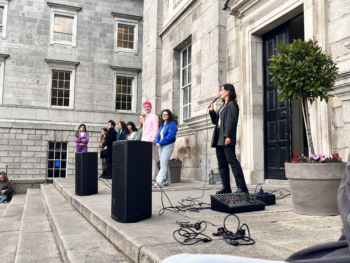
    . The Student Union in Ireland’s top-ranking university, Trinity College, is currently in the process of electing new sabbatical officers. The first hustings was on 18 February.  Last year, the Students Union (SU) President, Laszlo Mornafi, made headlines when it promoted an encampment that blocked access to the Book of Kells as an act of protest against the war in Gaza. Recognising the importance of Trinity’s student body, Village asked the SU’s presidential candidates to give a brief account of how, if in office, they plan to address the values of sustainability, diversity and equality. Here are their responses. Patrick Keegan “Trinity has many shortcomings, and it’s up to us to take action to hold the college to account. Students have the power to enact change, and we must engage in direct action and lobbying at every step to ensure that Trinity properly represents us all. Trinity often focuses on optics rather than real sustainability, and has partnerships with companies like Coca Cola and Ryanair, promoting greenwashing while they continue their harmful practices.  On diversity and equality, we must push Trinity to do better. Student consultations are crucial to identify areas for improvement. We must ensure that all students from all backgrounds feel welcomed at Trinity, and it’s through consultations that we can best identify and address all issues, no matter how big or small. Trinity must also confront its ties to oppressive regimes, such as apartheid Israel, and address shortcomings in trans healthcare and racism. Trinity must do more to support Irish-language speakers, such as by offering modules through the medium of Irish. As President, I will work for all students, demanding the college prioritises students. Trinity also has much to do to ensure equal access to education, as many lectures are not recorded, and many students don’t have their LENS reports properly met. We will address these issues through lobbying, information campaigns, and direct action. Additionally, our campaign weeks provide a perfect opportunity to address specific issues. We are the largest stakeholders, and we must hold Trinity accountable, acting radically to ensure Trinity represents us all”. Giovanni Li  “Sustainability, diversity and equality are three of the most recent popular buzz-words within this decade, advocating for the rights as well as the well-being of the average person and not just those who are privileged. No matter the race of the individual, background, status or any other external factor. If I were to be elected it would be of utmost importance to me that these core values are held to the highest standard possible, no student will be left behind, no tables unturned in fighting for what we now know as student rights, no blind-eye will be turned to any individual who poses a threat to the well-being of students. But most importantly, I will ensure that ignorance will be the last thing that shows up on the Union’s doorstep. To advocate and allow visibility for the needs of the students such as rent pressure alleviation, campus quality, poorly run examinations, lack of recourses, lack of accessibility, lack of inclusivity… the list goes on and I will not stand down or be silent in these tumultuous times. I will turn what we now know as a Trinity into a haven for students, a place where they feel safe, heard and educated without barriers. We must break free of these barriers that have been placed upon us by our oppressors. #VoteLiBreakFree”. Seán Thim O’Leary “I view all three values as deeply intertwined. Sustainability is the ability to operate and live up to one’s values in the long term. Diversity should lead one to proactively take steps to bring about fair access for those from marginalised backgrounds. Equality then is self-evidently linked in, involving proactive and codified efforts to engage and improve experiences of those from marginalised and disadvantaged backgrounds. If elected  President, I would like to draw particular attention to the systemic barriers within and outside college, which impact thousands of Students within Trinity. I would like the Union to take a proactive welfare- and service-based approach to meet student needs on campus, while employing grassroots organising, to aggregate the voices of students of all backgrounds, and use that as a platform to fight the government and college administration for justice on students’ behalf. The government disregards the student perspective, and disregards some students far more than others; the fight for justice here is a fight for all students. Specifically within Trinity, I want to take the opportunity to highlight chronic underfunding of the student counselling service, college health, and necessary course equipment (impacting students from STEM to Creative Arts). Here we have a lack of focus from college administration, and chronic neglect from the government; tackling this requires targeted political action, and on campus organising over a sustained period. The Union needs to properly engage and mobilise student action on this front, and not just through token surveys”. Jes Paluchowska is studying English and Philosophy in Trinity Photos: Trinity News

    Loading

    Read more