General

Random entry RSS

  • Posted in:

    Kenny fumbles in a greasy planetary till

    The mammoth COP21 circus will folds its tent after Paris, on December 11th. Already, it’s been a record-breaker, with thousands of journalists and the largest ever gathering of heads of states descending on Paris for the two week jamboree. Conspicuously absent from the event were the tens, possibly hundreds, of thousands of activists and demonstrators who had been planning for months to descend on central Paris to apply ‘street pressure’ on the politicians and policymakers to deliver a deal that, for once in 21 of these annual Conference of Parties mega-talking shops, just might actually mean something. History suggests otherwise. Since this whole UNFCCC (UN Framework Convention on Climate Change) was first mooted after the 1992 ‘Earth Summit’ in Rio de Janeiro, with the express aim of avoiding “dangerous anthropogenic interference with the climate system”, the emissions, rather than being stabilised or reduced, have in fact spiralled by over 60%.   Kenny dispensed with the hiatus and instead effectively completely retracted his entire three-minute speech on behalf of Ireland to COP21 an hour before he delivered it   This time the result will be different. Maybe. The last ‘make or break’ conference, COP16, took place in Copenhagen in a bitterly cold December 2009. Obama was then still wet behind the political ears, the Chinese were completely disengaged and, to make a bad situation hopeless, the dark money poured into the climate denial networks struck gold with the phoney ‘Climategate’ scandal which a credulous and lukewarm global media swallowed without even chewing. An older, undoubtely wiser Obama was back, this time with his political legacy very much in mind, and the Chinese fully engaged. Joining the pantheon of statesmen for the opening day was our own Taoiseach, Enda Kenny. Given what we have come to expect from Mr Kenny, it may well be said that while he disappointed, he did not surprise. Kenny usually waits a couple of weeks after his latest outing on the world stage before telling Paddy back home what’s the real deal. This time, most likely under acute pre-election pressure from the IFA lobby machine, Kenny dispensed with the hiatus and instead effectively completely retracted his entire three-minute speech on behalf of Ireland to COP21 an hour before he delivered it. This, even by his standards, was quite something. Just before he addressed the Summit on World leaders’ day, Kenny told reporters that the targets for Ireland needed to be “fair” and “sustainable”, which is Kennyspeak for “meaningless’ and ‘unenforceable”.   “What we want is an understanding that we are serious about achieving fair and sustainable targets but we need space in order to achieve that…what we have to have is plenty of ambition but one that is tempered with reality”. He went on to make the quite grotesque argument that we as a nation are just too poor to shoulder our share of the burden. “Ireland was not in a position over the lost last decade to plan for the future in the way we would like”. From here, Kenny started channelling Flann O’Brien: the recession, apparently had resulted in Ireland “not being in a position to invest in climate change mitigation and research”. “Until we have an economic engine that will enable us to change structures – and to invest in research and innovation to invest in more sustainable ways of doing agriculture – it presents us with a challenge”. Linguistics departments are, even as I write, rushing to parse this last couple of paragraphs to see if even the slightest morsel of meaning was inadvertently trapped between the layers of waffle. Kenny must have forgotten his IFA briefing notes – the ones that repeatedly brag about our world-beating levels of ‘carbon-smart’ agriculture, our amazing ‘carbon footprinting’ of tens of thousands of individual farms. Wandering dangerously off message from Farm Centre, Kenny admitted that we in fact have not developed any “innovation to invest in more sustainable ways of doing agriculture”. Turns out all this ‘carbon efficiency’ is just more fairy dust being sprinkled around by the agri-industry spoofers and boosters. Lest this seem a little harsh, it’s worth considering what Kenny committed to the Green Climate Fund in time for COP21 – €2 million, or less than 50 cent per capita, and, by unhappy coincidence, precisely the amount of the payoff agreed between IFA president Eddie Downey and ousted general secretary Pat Smith. Oisin Coghlan of Friends of the Earth correctly identified the apparent main purpose of Kenny’s talking down of the achievability of EU emissions targets for Ireland: Kenny is trying to get the goalposts moved so that everyone, bar the hard-case Irish can do their share. In the future, of course, things will be different, honestly: “As our economy and technology improves and smarter ways of doing production, we will have a stronger economy being able to make the changes after 2020”. Translated, this sounds like Kenny code for: “I’ll be long gone by the time the emissions shit hits the fan, so long suckers!”. For the leader of a first-world country with a GDP per capita of almost €40,000 to have the gall to say it is too poor to shoulder its share of the critical burden of dramatically lowering greenhouse gas emissions almost defies parody; and may be unique. Perhaps Malawi, with a GPD per capita of around €750, a negligible contributor (unlike Ireland) to current or historic global GHG emissions, should take the hit instead? Crazy, but this appears to be how Kenny’s logic works. For COP21 to break the long and disastrous sequence of broken promises and missed opportunities to finally put a brake on runaway climate change, there has to be an agreement that we all jump together. As Barack Obama put it in his COP address: “One of the enemies that we’ll be fighting at this conference is cynicism, the notion we can’t do anything about climate change”. Little did he know that, as he spoke, Ireland’s leader had just come into the room having

    Loading

    Read more

  • Posted in:

    Civilisation under threat

    The slaughter of 129 innocents in Paris by the so-called Islamic State (IS) instils, by its casualness, fear into most of Europe. It is a new venture and one which is likely to be repeated perhaps until it affects all of our daily lives adversely. But IS operates on many fronts. Another comprehensivist IS policy covers culture. IS deplored Paris as the centre of licentiousness and adultery. But it also deplores any culture incompatible with stringent Sunni extremism. History has no value for IS. Idolatry must be obliterated. In August 82-year old antiquities scholar Khaled al-Asaad was beheaded by IS and his head suspended from a pole in Palmyra in Syria, after he apparently refused to reveal under torture the whereabouts of artefacts IS wished to plunder. The act subverted heroism, culture, civilisation itself.   History has no value for IS. Idolatry must be obliterated   Since IS overran Palmyra in May, it has gradually been destroying the site using barrels of dynamite. The 2000-year-old Arch of Triumph, the Temple of Baalshamin and a large temple, dedicated to Bel, have been blown up. Palmyra was one of humanity’s great treasures. It may seem obtuse to draw attention to the destruction of architectural heritage considering the casualty and refugee tolls of the war but Palmyra reveals the proto-state and terror-supporting Islamic State (IS) as a totalitarian regime that eradicates reminders of competing narratives in Orwellian fashion. Sadly, it is difficult to convey the serene and fragile grandeur of Palmyra in Syria. I visited it in 2004. Such was my solitude – even at that time there were few visitors to this remote outpost in Assad’s Syria – it felt like I had been given permission to wander around a vast outdoor museum after closing time. What remained were a series of structures conforming to neo-Platonic ideals of orderly beauty, integrating stone that blended with the shades of the desert for an effect that revealed the highest expression of human achievement. It was an oasis of affecting scale and flickering artistry that civilised a harsh environment whose form has withstood a steady stream of Romans, Arabs, Ottomans and Europeans conquerors. Deriving wealth from a strategic location along the spice route that for millennia channelled Asian riches into Europe, it is a wrenching reminder of how civilisations decline but, conversely, endure to inspire future ages. This ancient city challenged Rome itself under the rule of queen Zenobia. Khaled al-Assad in all his pride named one of his daughters after that formidable matriarch.   Palmyra is a reminder of how civilisations decline but, conversely, endure to inspire future ages   Palmyra conjures a plurality of narratives. For example early Islamic scholars greatly esteemed Greek philosophy. Indeed much of our Classical heritage was brought to Christian attention through contact with the Islamic world in the early Middle Ages. Such nuance is ignorantly rejected by IS as well as by those commentators in the West who promote the false idea of a timeless clash of civilisations. Considering the expunction of other sites in Syria there is a strong chance that what remains of Palmyra will be destroyed like other sacred monuments in Afghanistan and Saudi Arabia in the name of obscure branches of Islam. IS ideology can be seen as offshoot of Wahhabism – a violent interpretation of Islam articulated by Muhammad ibn Abd al-Wahhab (1703-1792) whose ideas were adopted by the Al-Saud clan in the eighteenth century, helping them become the dominant force in Arabia until they were finally defeated by the Ottoman Empire. The resurgence of the Al-Sauds in the early twentieth century was under the banner of Islam, infused with Wahhabism. A crack force, known as the Ikhwan (brotherhood) helped the Al-Sauds, led by Abdulaziz ibn Saud, to re-conquer Arabia. On seizing Mecca and Medina, the Holy Cities of Islam, from the ruling Hashemite family, who would subsequently supply monarchs for Iraq and Jordan, tight controls were imposed on forms of worship such as playing instruments and dancing in religious processions. Medieval executions, oppression of women and persecution of other religions followed. These barbarisms have subsisted in the Kingdom of Saudi Arabia since its foundation in 1932. Shared opposition to Arab Nationalism and Communism, combined with oil and associated wealth, brought support from the United States. Where the Saudi authorities have been unable to control their own extremists, as first with the Ikhwan in the 1930s, they have been brutally supressed and use of torture has been commonplace despite its prohibition under Islamic law. Once the genie of militant Islam is released into the political sphere it is not easy to put back. The Taliban, as well as the specialists in global terror, Al-Qaida, and now IS have gone beyond the tenets of Wahhabism. In the face of a global order characterised by economic inequality, and the failure of Communism and Arab Nationalism to adequately address these problems, in many countries Islam became the political answer, notably in the Iranian Revolution of 1979 which though Shi’a served as an inspiration to other parts of the Middle East. Political Islam’s appeal derives from rejection of alien cultural norms. Though the Ottoman Caliph imposed homogeneous orthodoxies, its modern articulations are characterised by radical diversity. Since the end of the Ottoman Caliphate in 1923 Islam has become increasingly malleable, and even post-modern, with a variety of online rulings now available to adherents. In a stable relatively prosperous country such as Turkey it has bred a political movement under Tayyip Erdogan akin to an authoritarian Christian Democracy. But more reactionary interpretations have found fertile ground in the turmoil of the Levant since the defenestration of the Ba’athist regime in Iraq and its weakening in Syria. An influential article by Graeme Wood in the March edition of Atlantic Magazine makes the nightmarish case that the apocalyptic tendency derives from a not implausible interpretation of the Koran, and indeed that acute terror is mandated in the period between the restoration of the Caliphate, which IS of course claims

    Loading

    Read more

  • Posted in:

    Coming soon to your phone, and then everywhere

    A few years ago, as print media watched their subscription and circulation plummet, digital advocates were fond of reciting the adage of internet guru, Clay Shirky, that “no medium can survive the indifference of 25-year-olds”. The advocates had a simple solution. Readers didn’t care about paper and ink, they wanted content, so move the content to where the readers were, establish a presence online, through the web and apps, get rid of the unsustainable dead-tree costs, and pursue a combination of advertising and subscription revenues. A few – a very small few – have managed the transition successfully, The Times and Financial Times are bullish about their subscription-only models, the New York Times seems happy with its constantly tweaked mix of leaky paywalls and advertising, the Guardian and Mail open their content to all and bet on advertising alone. But for most newspapers and magazines, the economics of a sustainable online product are still at least one more iteration away, and readers are rebelling against the one constant of all publishers: advertising. Ad blockers in one form or another are almost as old as the internet, and over the years have ebbed and flowed in popularity. Their first appearance in the 1990s was prompted partly by the intrusive nature of early web advertising – who remembers flashing and blinking pop-ups? Their tendency to inflame became less of an issue as the growth and spread of viable broadband made loading times and worse still download times if you made the mistake of clicking on it, less of a concern. Blockers still live on some desktop computer browsers, but the numbers there stabilised a long time ago. But bandwidth issues resurfaced again in the last decade, as smartphones consumed more and more of readers’ attention. In the first five years of this decade, the number of consumers globally using ad blockers grew tenfold. The smaller screen size on even the largest phones makes advertising more noticeable – and more of a nuisance – than on a full-size computer screen, and the combined constraints of slower chips and constrained wireless speeds mean that the ad blocker’s promise to improve loading speeds by blocking useless advertising is highly appealing. The result, as outlined in the 2015 PageFair/Adobe report on The Cost of Ad Blocking, is a phenomenal growth in ad blocking, with worldwide 41% year-on-year growth since 2014. In the EU blockers grew by 35%, and are now used on 77 million devices. Notably, the report found that 93 percent of phone adblockers are installed on Chrome and Firefox browsers – that is, on Android phones. With Apple’s Autumn announcement that it will allow ad blocking on its own Safari browser, the problem seems set to increase. The global cost of ad blockers to date is estimated at $21.8bn [€20.5bn]. In the second quarter of 2015, 17.7% of monthly users in Ireland had ad blockers installed. That number is low by international standards, and that should worry Irish media outlets. The comparable US number is 47%, in the UK 39%, and where the US leads, the UK tends to go also, followed shortly afterwards by Ireland. In hard cash terms, the Irish Times expects to earn €8m from digital advertising in 2015, while INM expects digital revenues of around €12m. Circulation and print advertising revenues continue to fall at both companies. The Irish economic recovery means digital revenues are increasing for both publishers, just about offsetting print declines, but as international experience is sowing, that growth depends not only on the Irish economy prospering, but on readers continuing to accept advertising taking up their attention,bandwidth, and phone screens. The state of the Irish market can be understood by noting the Irish Times profitability increased in 2014 in part because it gained contracts to print the irish Examiner following its receivership. INM revenues in the same year were helped by a contract to distribute the Irish Times. Newspapers are consolidating their print and distribution efforts, thus shaving costs, but this activity is based on the ever-shrinking print sector. Cost savings and managed decline can only sustain the industry for so long. Advertising and editorial departments both need to adapt. User-hostile strategies, such as blocking browsers which use adblocking, seem unlikely to succeed. Those indifferent 25 year olds will simply go elsewhere, and there’s a whole wide world of web content out there. More favourable options may include increasing use of advertising formats such as sponsored content/branded journalism (the advertising formerly known as commercial features) or new forms such as sponsorship of podcasts (and perhaps vidcasts) or interstitial advertising in ‘casts.

    Loading

    Read more

  • Posted in:

    Dismantling our housing

    We’re in the middle of a housing crisis. But we didn’t get there overnight. This government engineered the very crisis it found itself in and came up with its own grand plan to solve it. Or thinks it has. But it is all part of a drastic disaster economics. It involves what we have seen until now: people dying in the streets, children sleeping in hotel rooms, soup kitchens feeding hundreds of people, tenants being evicted after the homes they were living in were sold, an unprecedented increase in the number of suicide… But we may well see much more of this, for this government has essentially abdicated its responsibilities to the wolves.   Selling off assets when there is an acute shortage should be the last thing any government would want to do   Local authorities were sidelined What started with Irish Water and the Local Property Tax is part of a larger scheme in which they are first suffocated of funds, then made redundant, policy by policy. This is now what is happening with housing. The implementation of the Social Housing Strategy is being hampered by significant infrastructural issues, which are not being dealt with quickly enough. That’s according to Dr Donal McManus, CEO of the Irish Council for Social Housing (ICSH). He outlines three critical issues – from the perspective of housing associations – that need to be addressed: lack of sites for development; the urgent need for coordination of funding schemes for social housing; and the absence of development programmes for housing associations. The most serious obstacle hampering implementation of the Social Housing Strategy is the failure to make enough sites available to housing associations, he says. “There are over 800 sites in public ownership that could be assessed for social housing and transferred from local authorities to housing associations. Housing associations could then access private finance to deliver much-needed homes. However, this is not happening due to unnecessary infrastructural obstacles and delays. Alan Kelly’s Urban Regeneration and Housing Bill legislates such a move. Developers under previous bills were to surrender 20% of developments to Local Authorities. Not only did they bring it down to 10% in theory, in practice it now stands at virtually zero. Instead they will lease these premises to local authorities, retaining ownership. This means the already depleted stock will not increase. Another recent Kelly announcement, a new tenant-purchase scheme, will exacerbate this. Under this plan, Social Housing is to be sold off at discounts of 40 to 60 per cent of market value. This does not make any logical or economic sense: selling off assets when there is an acute shortage should be the last thing any government would want to do. Local authorities just lost the capacity to provide affordable housing at a local level. The statistics below illustrate that trend: No funds for essential repairs either Local Government lost the ability to provide new homes, but it also lost the capacity to repair vacant ones. Thousands of houses are sitting idle nationally, most for want of funding from central government. The Essential Repair Grant was discontinued in 2011, when it reached its lowest figure at €92,000, down from nearly €52m in 2008. One of the arguments advanced by Alan Kelly in favour of his new tenant-purchase scheme was that these costs would not be incurred by local authorities anymore, but this is small change on the value of state assets being sold at a loss in the first place. Calls were made for the Local Property Tax proceeds to be allocated for these repairs, but these were instead diverted to Irish Water. Ironically, you cannot buy a house under the new tenant-purchase scheme if you haven’t paid your water bill. NAMA has a stranglehold Thousands of houses were not built for lack of funds, thousands more remain idle for the same reason, and yet thousands more are in the control of Nama and are not released in the market or for social housing at a time we need it most. The December 2014 survey on Unfinished Housing Developments noted that 4,453 vacant homes were then ready to be occupied, but starved Local Authorities cannot avail of them. The report highlighted that: “To date, demand has been confirmed by the local authorities for 2,121 properties that NAMA has indicated are potentially available (This relates to all developments and not just developments identified as ‘unfinished’). A further 507 properties are currently being evaluated bringing the total that may be deemed suitable to 2,628”. So right in the middle of a housing crisis, we find that Nama is still to identify houses “that may be deemed suitable”. Its website states: “As at end June 2015, NAMA had identified over 6,542 residential properties as potentially suitable for social housing. Of these, demand has been confirmed by local authorities for over 2,500 properties, of which 1,386 have been delivered for social housing use. Confirmation of demand is a matter for local authorities and is not something in which NAMA has a role”.   Only 1386 units were delivered nationally, a trickle. And notice again the discrete disclaimer: Confirmation of demand is a matter for local authorities and is not something in which NAMA has a role. In other words the government has ample supply, but will not feed Local Authorities any funds to purchase it from itself. Local authorities are made the scapegoat of this government’s non-policy on housing. The media toed the government line, and few if any asked the local authorities for their opinion when reports came out that “4000 Social Housing units offered by NAMA” had apparently been rejected by them. The reality is evidently more complex and refusals usually stem from the government’s own policy and frameworks on housing, as well as building regulations. For example, South Dublin County and City Management Association offered the following insight in a statement to “The Dublin Gazette”: “Local authorities do not turn down available housing units unless there are strong reasons for

    Loading

    Read more

  • Posted in:

    Band Aid

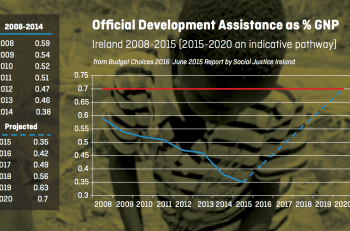
    62 people now own the same wealth as the poorest 3.6 billion people. 1% owns more than 99%. The gaps are widening. Talk of overseas aid may seem like trying to use a sticking plaster to plug a haemorrhage. In a world of trickle up economies with ever growing needs driven by conflict and climate, aid remains critical. Despite the critiques of aid in the past decade, without it, many of the Least Developed Countries, would collapse. This Government is not without achievements in Official Development Assistance (ODA). Following the financial crash in 2009, the aid budget was an easy target and was slashed by 30% in the 2010 budget. Those affected by cuts in the aid budget are not visible and certainly won’t arrive at Leinster House on their tractors. Several Irish NGOs were also downsized and their aid programmes closed as a result. Following that significant cut, however, the aid budget was stabilised at around €600m. This was made possible by cross-party support and opinion polls which showed the tacit support of the public. Over 80% of people in Ireland regularly state they are in favour of aid. They may not raise it on the doorsteps, but they see it as the right thing to do. On the other hand, all OECD countries are committed to giving 0.7% of Gross National Income (GNI) in ODA and we have failed to reach this target. The commitment is a long-standing gold standard in international development and one which many countries had been close to achieving before the financial crash. In 2009, Ireland was giving 0.59% of GNI in ODA. The target, as a percentage, is set up to be cyclical. Countries will give according to their means as their economy expands and contracts. The commitment to reach the 0.7% target was in the Programme for Government of the current Government, with a target date of 2015. However, there has been no real commitment. The economy is now growing yet the aid budget has remained at. We increasingly and significantly lag behind the OECD target. Our aid provision now stands at 0.38% of GNI, the same as in the early 2000s. A new commitment to reaching the target within the life time of the next government is essential. Significant improvements have been made in the quality of Ireland’s aid programme over the lifespan of the current Government. International trends reflect shifts towards concessional lending and private-sector engagement. However, Ireland’s aid programme has become more poverty-focused. This is both in country focus, with one of the highest rates of funds going to Least Developed Countries, and in the types of programmes it funds. The aid programme has bucked the international trend of skewing aid to serve the needs of the donor country and has remained highly poverty-focused. ‘One World, One Future’, the Irish Aid policy, was launched in 2013 following a public consultation. It sets out Ireland’s priorities in overseas development. The commitment to addressing hunger is clear. The current Government spearheaded the drive to address hunger globally and led on international initiatives such as ‘Zero Hunger’ at the UN. It has become a leader in this area and ensured that this initiative was central to the new Sustainable Development Goals signed in New York last September. Questions have been asked, however, about the involvement of Irish Aid in the corporate- backed Global Alliance for Climate Smart Agriculture, which has received much criticism from global civil society, and attempts to link this to the hunger agenda. The biggest gap, however, is the failure to embed the priorities for development in all government departments. While both the Irish Aid Policy, and the ‘Global Island’ policy, the core foreign policy statement, boast commitments to development and human rights as a “whole of government effort”, little has been done to implement it. This incoherence is stark. As Ban Ki Moon, the UN Secretary General said during his visit to Ireland last May: “One cannot be a leader on hunger, without also being a leader on climate change”. Coherence demands that our commitment on global hunger is matched by a commitment to funding programmes for climate adaptation and resilience matched with equal effort to reduce our own emissions. Aid remains essential. However, if aid is to be effective it requires commitment as well as joined-up thinking across all policy areas. This challenge must be addressed by the next Government. Lorna Gold Lorna Gold is Head of Policy and Advocacy with Trócaire

    Loading

    Read more

  • Posted in:

    The Government’s not that interested in the North

    The outgoing government is showing the same lack of vision on the North as it has shown generally. In 2011, the Programme for Government had a total of 120 words on the North in its 64 pages. Significantly, 45 of these were on security: “The threat from dissident paramilitary groups cannot be underestimated. We will foster the continuing strong relationships between An Garda Síochána and the Police Service of Northern Ireland to deal with this threat and we will also ensure the necessary resources to deal with these groups”. That reflected the belief that the Good Friday and St Andrew’s Agreements solved the political problems. The North is a security issue, to be contained. Any continuing violence is pathological in nature, rather than the result of from political failures. It neatly mirrors the knee-jerk reaction of much of the Fine Gael heartland, innately fearful of violent Republicanism. It reflected shifts in the Labour Party. At the time the Programme was drawn up, Labour was dominated by former Workers Party members, who had come to the party via Democratic Left. The Workers Party had been largely financed from robberies and extortion carried out by Official IRA members in the North. There is, of course, no indication any of those who became Labour TDs had any knowledge of these activities. However, media reports made them increasingly embarrassing in the South. When Democratic Left collapsed into the Labour Party, it abandoned its Northern organisation. It also further diminished interest in the North: while the SDLP is theoretically a sister party, the connection is increasingly distant. Certainly, both government parties have an innate hostility to Sinn Féin, which does not assist relationships with a Northern Executive where Sinn Féin is the second largest party. Enda Kenny is certainly on the Nationalist wing of Fine Gael – which sees Sinn Féin as betraying the legacy of 1916. However, the Taoiseach has never indicated the North was among his political priorities. Since the Programme for Government was drawn up, there have been three Progress Reports and one Statement of Government Priorities. In three, the North has barely featured – except as a security issue. The 2015 Report marked a departure, with no security concerns mentioned. It did not, however, reflect any greater engagement. The Coalition has made little impact on the North, except involvement in drawing up the Belfast Agreement and its successor, the Stormont Agreement, which brought Southern-style austerity to the North. On an optimistic note, there has also been ongoing growth in Cross-Border sharing of services. This has improved the quality of life of many, particularly those, on either side, who close to the Border. There are questions about some Cross-Border projects. The Coalition has promised up to £400million for the A5 project: the North’s largest-ever road project, a dual carriageway from Newbuildings, Co Derry, to the Monaghan Tyrone Border. The project has been controversial, with the North’s High Court quashing planning permission, and the planning process has restarted. No part of the existing A5 is among the 50 busiest stretches of road in the North, and a part of the proposed route was submerged during December’s floods. While the Coalition is generally perceived as hostile to Sinn Féin, Sinn Féin sees the A5 as a flagship project: the SDLP is doing its best to be as vocal in support. Northern nationalists generally perceive the Coalition parties as indifferent or hostile to them. This is accompanied by amnesia regarding the great majority of the Northern IRA having supported the Treaty in 1922: and Fine Gael’s amnesia regarding the 1922 Provisional Government organising military attacks on the Northern state. Northern nationalists, to the extent that they engage with Southern politics, tend to see Fianna Fail as their party. The SDLP is theoretically a sister party of Labour in the Socialist International: officially, it seeks support from the three big Dail parties: in practice, it was always closer to Fianna Fail, and many would now like to become Fianna Fail’s Northern organisation. While Sinn Féin’s ministers in the North have a working relationship with the Coalition, the party feel it is hostile, and drags its feet on some Cross-Border initiatives so as not to give prominence to Martin McGuinness. On balance, Unionist parties would prefer the return of the Coalition. A DUP source told Village it had no particular problems with the Coalition. “They were sufficiently wrapped up in their own problems”, the source said. “In talks, they have been sufficiently anti-Shinner that it is useful”. However, the source felt the two big Southern parties have only slight differences on the North, though was surprised at the anti-Sinn Féin vehemence of some Fianna Fáilers. Ulster Unionists lean very much towards Fine Gael, some hoping to develop relations. However, no party feels a re-elected Kenny government would take any Northern initiative.

    Loading

    Read more

  • Posted in:

    The governments substantial achievement is steadying the public's finances

    In a nearly picture-perfect setting for a politician in the last days of a pre-official campaigning season, framed by snow, sun and high alps, surrounded by an unctuous cabal of journalists and global elites largely impervious to Ireland’s economic realities, Enda Kenny delivered his new vision for Government. His new Three Point Plan is composed entirely of the remnants of his 2011 Five Point Plan with a 2015/16 twist. “Since a new government was formed under my leadership in 2011, we have followed”, chirped Kenny, “a clear plan: fix our banks and the public finances quickly and get our country working again. That plan involved huge sacrifices by the people, but has clearly worked. Since the end of the bail-out in 2013, our economy (real GDP) grew by 5.2% in 2014 and is likely to have grown by a further 6.2% in 2015. Unemployment has fallen from a peak of over 15% to below 9%. Government borrowing has fallen from 11% of GDP in 2011 to less than 2% last year”. With his usual smile so full of thoughtfulness and compassion, he went on to add that “the recovery of the Irish economy is now driven by exports, business investment and high productivity, and is diversified across a range of sectors”. As half-truths go, these were pretty much on the money. It’s the economy… stupid Yes, GDP has expanded in the aggregate at a blistering pace. However, in per capital terms (even with massive outflows of migrants out of Ireland over the recent years), Final Domestic Demand (the sum total of household spending, government spending and private and public investment – the measure least polluted by Multinationals (MNSs)’ accounting shenanigans) remains 11% below pre-crisis peak and 40% below the level if the pre-bubble growth trend had persisted up to today. Unemployment has fallen significantly over time, but Ireland’s labour-force participation rate was 60.5% in the third quarter of 2015 (3Q 2015), virtually unchanged on 60.4% in 3Q 2011 and down on the 62.8% average for the pre-crisis period. Actual unemployment – according to the latest CSO data – stands at 9.3%, which is somewhat different from the “below 9%” claimed by Taoiseach. The Government is keen on citing the 137,400 new jobs added in 3Q 2015 compared to 3Q 2011, while forgetting to note that the current total level of employment is still 186,600 short of that for the same quarter in 2007. All of these missing jobs are accounted for by employees (155,500 short) and self-employees with employees (29,000 short). Meanwhile, stripping out people in self-employment with no employees and those assisting relatives the actual increase in employment during the tenure of this government falls to 107,100. A good number, but not as good as the boisterous claims from the Taoiseach’s quarters suggest. As to Enda Kenny’s claims that the Irish economy is now being driven by “sustainable” exports and investment, these too constitute a sausage roll: one quarter pork, three quarters fillers. In the first three quarters of 2015 (the only data we have so far), our GDP at constant market prices rose €9.94bn compared to the same period of 2014. Over the same period of time, exports More ‘Points’ than Growth The government’s substantial achievement is steadying the public finances by Constantin Gurdgiev GENERAL DELIVERY February 2016 47 net of imports fell €828m. Worse, unaccounted in the above, net factor payments from abroad (the balance between what MNCs expatriate out of Ireland in profits and what Irish companies and households earn abroad) rose €3.25bn. Which means our overall “exports-led recovery” delivered a net loss to the economy of €4.1bn in the first nine months of 2015. The table below sums up sources of growth in Irish GDP. So contrary to Mr Kenny’s assertion, 69% of growth in Irish GDP and more than 103% of growth in Irish GNP in 2015 came from one source: Fixed Capital Formation. This includes investments by the MNCs, the IFSC and aircraftleasing businesses, and vulture funds transacting with the likes of Nama. Our fabled growth also comprises some of the effects of tax inversions, for which Ireland is now well known worldwide. For example: in 2015, the top 5 Mergers and Acquisitions (M&A) deals in Ireland included the Pfizer-Allergan merger with a total value of €143.564bn, Teva Pharma’s purchase of the generic drugs business of Allergan at €35.454bn, Shire’s deal with Baxalta at €29.533bn and Willis Group Holdings’ purchase of some of the assets of Towers Watson at €15.566bn. The only Irish deal was CRH’s acquisition of Holcim & Lafarge’s assets at €7.671bn – outside Ireland, with no real effect on the Irish economy. According to the NTMA, the Irish current account surplus of around 4.3% of GDP over 2014-2015 reduces to 1.6 – 1.7% if we factor out tax-inversion-driven PLCs from our national accounts. Adjusting for intellectual property imports and aircraft leasing (just two distorting factors), Investment contributed 2.7 percentage points to GDP growth in 1Q – 3Q 2015 year-on-year, while net exports contributed only 1.6 percentage points. The balance of 2.6 percentage points accrued to all other sources. Last, but not least, Enda Kenny cited the miracle of Irish productivity growth. Recent analysis from the EU and NTMA shows that Ireland has the largest gap between claimed competitiveness gains and recorded productivity increases of all EU countries. This gap is explained by one simple factor – completely outside the Government control – devaluation of the euro. Other sources of our productivity growth include such ‘organic’ gains as changes in MNCs’ tax optimisation strategies, corporate tax inversions, changes in the mix of goods and services billed through Ireland and so on. Now devaluations work the following way: they improve trading conditions for exporters (predominantly MNCs) at the expense of importers (predominantly households). So based on EU data, Ireland leads the way in transferring real income from its people to foreign multinationals. That is some ‘productivity growth’. Exchequer Bubbly Mr Kenny is on stronger ground when he speaks about our public

    Loading

    Read more