General

Random entry RSS

  • Posted in:

    How progressive is the Irish tax system?

    In recent months there have been many references by politicians and economic commentators to Ireland having one of the most progressive tax systems in the OECD. These statements reference data from the OECD Taxing Wages database which provides “…an insight into the levels of progressivity in the income tax systems of OECD countries”. However, progressivity in the income tax system is often presented as the tax system as a whole being progressive, but this a different matter entirely. The overall progressivity of the tax system cannot be measured by the levels of income tax alone and a comprehensive overview of progressivity should include the effect of all taxes, charges and tax reliefs that make up the whole tax system. The Irish income tax system is progressive using the OECD method, which means those on higher incomes pay proportionately more tax on their income than lower earners. The OECD method compares the tax liability of a single person earning two-thirds of average earnings (67%) with that of someone with a gross income of one-and-two-thirds (167%) of average earnings. Where the difference between these two tax liabilities is high, the tax system is considered progressive, as those with higher earnings pay more as a percentage of their income than those on lower incomes. In Ireland, the person on higher earnings pays 19.3% more of his/her income on tax than the person on lower earnings, whereas this difference across the OECD is an average of 9.6%. It is important to note that Ireland’s high progressivity score (as measured by the OECD) is a result of having low taxes on low incomes rather than particularly high taxes on high incomes. It is also important to remember that measuring the progressivity of the income tax system in this way, is based on the theoretical level of tax payable and not on Revenue data of the actual amount of tax paid. In practice this means that the OECD data only includes personal allowances and universal cash benefits, which in this case, is child benefit. It doesn’t include tax deductions such as mortgage interest, health insurance, pension deductions or tax relief on investments, which are used to reduce the amount of tax that is actually paid (the effective tax rate). These reliefs disproportionately benefit high earners. These tax reliefs are particularly important in an Irish context because the OECD’s Economic Survey of Ireland 2009 found that the average EU level of tax breaks in the income tax system was equivalent to 5.6% of the total tax take, whereas the equivalent number for Ireland was 18.3%. While many tax reliefs, such as those relating to property development, have been closed off, tax reliefs continue to feature strongly in the Irish tax system. The Tax Strategy Group, for example, in its 2014 report on ‘High Income Individuals’ Restrictions’ found that those with gross incomes of €140,000 to €160,000 had an average effective income tax rate of 25%, despite paying most of their income tax at the marginal tax rate of 40%. The Revenue data shows that while there is progressivity in the Irish income tax system, in that the proportion of gross income that is paid as income tax increases as income rises, the extent of progressivity is significantly reduced by the effects of tax reliefs beyond the basic system of tax credits. Micheál Collins’ analysis of the ‘Total Direct and Indirect Tax Contributions of Households’ in Ireland uses the Household Budget Survey data to estimate total household income tax and social insurance contributions. The lowest 10% of households pay 0.3% of their gross income in income tax, while the top 10% of households pay 23% of their gross income in income tax and social insurance (Chart 1). The average income tax and social insurance is 14%. This analysis shows progressivity in the income tax system, with contributions increasing as incomes increase. The effects of other taxes also needs to be factored into assessing the level of ‘progressivity’ in the tax system. The OECD data relates to income tax, and this accounts for less than half (43%) of the overall tax system. Taxes on consumption account for 35% of the tax system, while taxes on capital account for 22% of the overall tax system. Consumption taxes are also known as indirect taxes and they include VAT, excise duties, levies, local taxes and charges. This type of taxation is regressive, which means that low income families pay proportionately more of their income to these taxes compared to high income families. The lowest income households contributed over 4 times more of their income (27%) to It is important to note that Ireland’s high progressivity score (as measured by the OECD) is a result of having low taxes on low incomes rather than particularly high taxes on high incomes. Going backwards How progressive is the Irish tax system? Something wrong here GENERAL DELIVERY February 2016 51 indirect taxes than the highest income households (6%) (Chart 2). Ireland is more reliant on consumption/indirect taxes than other European countries, with an EU average of 28.5% of revenue coming from this source compared to 35% in Ireland. Micheál Collins combines the effects of direct (income tax and social insurance) and indirect taxation (VAT, excise, levies etc.) (Chart 3). On average, households contribute 24% of their gross income in direct and indirect taxes. The lowest income households contribute 28% of gross income in taxes, most of which is made up of indirect taxes. The highest income households contribute over 29% of their gross income in direct and indirect taxes. Using this analysis, the Irish tax system can be described as regressive, as the lowest income households pay only slightly less tax (as a proportion of their income) than the highest income households. Micheál Collins concludes his analysis by stating “judging tax contributions by income taxes alone offers a limited and misleading picture of the distribution of tax contributions across society.” With the general election campaign in full swing, all of the political parties have set

    Loading

    Read more

  • Posted in:

    Levels of Public Integrity Show Multi-speed Europe

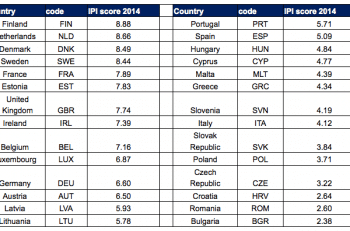
      The Dutch Presidency of the European Union released on Thursday, January 21 at the European Commission in Brussels a new ranking of public integrity for the 28 EU Member States. The ranking represents the first objective measurement of public integrity in the EU. It is part of a report on trust and integrity commissioned to a group of research institutes associated in the EU FP7 ANTICORRP project lead by Professor Alina Mungiu-Pippidi at the Hertie School of Governance in Berlin. The ranking is based on six closely associated indicators, which on one hand correlate sufficiently to be aggregated into one index, and on another are strongly associated with existing corruption indicators. These commonly used indicators, for instance Transparency International’s Corruption Perception Index, are based on expert perceptions. The new Index of Pubic Integrity (IPI) is more objective. It is drawing on six transparent indicators: administrative simplicity (time to register a business and pay tax), trade openness, auditing capacity, judicial capacity, e-services offered by government and e-services used by the population. This transparent structure allows for the index to be compared across time (from one year to another), something that should not be done with perception based indicators. It also makes the indicator sensitive to policy reforms, another shortcoming of perception based indices that are notoriously lagging behind reality. For instance, Greece was only ranked as very corrupt in rankings after the euro crisis became public, whereas corruption is seen as a major cause for it. The ranking, shown in Table 1, lists Scandinavian countries and the Netherlands firmly on top, with Bulgaria, Romania and Croatia competing for the bottom of the ranking. The index is offered for 2012 and 2014, the latest available data. It shows positive trends for Romania (which moved ahead of Bulgaria after being last until 2012) and especially Greece, which registered the largest progress in recent years together with Latvia and Lithuania (see Figure 1). The report argues that economic performance alone does not explain the sometimes dramatic decline in trust in government. Europeans in many member states perceive a serious drop in the quality of governance, and the failure of current policies to redress it. Only in a minority of countries in present-day Europe we encounter a clear majority believing that success in either the public or private sector is due to merit. More than half of Europeans believe that the only way to succeed in business in their country is through political connections. Less than a quarter of Europeans agree that their government’s efforts in tackling corruption are effective. The countries where citizens perceive higher integrity and better governance are those that managed to preserve high levels of trust in government despite the economic crisis.   In pointing at these factors contributing to the growing loss of trust in national and European institutions throughout EU-28 the report takes major steps in helping to understand this crisis. It formulates lessons learned from this review if evidence and hopes to inform the policy debate on how to address the apparent lack of public integrity in Europe.

    Loading

    Read more

  • Posted in:

    A player mayor

    In 1991 I was elected as a councillor onto Dublin City Council. Before we took our seats on the new City Council we were deferentially issued with robes to wear for the formal first meeting. As a councillor my robes were green and blue. Councillors first elected in their ward were referred to as aldermen and wore the same robes but with an extra yellow strip indicating their gorgeous ascendancy. However, as I walked into my first meeting in Council Chamber I spied someone wearing bright purple robes. This was Frank Feely, the unelected City Manager, whose self-chosen robes summed up the anti-democratic nature of local government in Ireland since the 1920s. Not only did he get to chose his own spiffing robes, but he, and all other unelected city officials then and now boast pre-eminent powers over decisions locally that affect our lives. Name the last four mayors of Dublin. It shouldn’t be difficult: you only have to go back four years. In fact, because of the limited power and tenure, it is unfair to ask: even aficionados will admit that it would be too much knowledge. A year ago I tweeted that the “Dublin Mayor idea will die a slow painful death by committee. Bad for Dublin, bad for Ireland”. Unless there is a change of heart by Fingal councillors this may well be the outcome. Apparently they aren’t enthusiastic about a directly elected mayor, and have the power to block the proposal. They may well decline, given that their status depends on the status quo. Had the Green Party’s proposals for a directly elected mayor for Dublin come to fruition we would have had a mayor for all of Dublin directly elected by the people of Dublin next May, rather than the Fine Gael proposals that at best will result in a mayoral election in five years time. The blame again slumbers at Phil Hogan’s door for setting up a process that seems doomed to fail, unless there is a change of heart. Even his master plan for local government reform “Putting People First” contains a breath-taking anti-urban bias as he proposes giving Dublin City equal powers to Westmeath on regional issues. It seems clear that, although Phil Hogan is Minister for the Environment, he is wholeheartedly Fine Gael TD for the Carlow-Kilkenny constituency, and doesn’t want to devolve power to Dublin or other cities. Currently national government decide on the important issues that cities should be deciding, and councillors are mostly left to sort out issues of administration, maladministration and zoning. The legislation introduced by the Green Party in the last Government provided for a mayor who would co-ordinate water, waste, transport and planning policies. Time and again, we return to the legacy of bad planning decisions across the country. The people of Dublin are still picking up the tab for mad rezoning decisions that took place in Dublin County Council in the 1980s. Councillors were allowed rezone land without any sense of responsibility and without a mayor who had the bigger picture about what the city might be. It doesn’t have to be this way: a mayor can have serious powers for strategy, policy and implementation – as well as to set a tone and man a bully pulpit. The challenge in Dublin is that the current divide and conquer approach of four different local authorities with four different agendas, managers and mayors elected on a revolving basis is confusing and dysfunctional. Henry Kissinger asked who would he talk to if he wanted to talk to Europe. We need someone to talk to when we want to talk to Dublin. We need someone who has a strong, coherent vision for Dublin. Of course elected mayors can be kicked out in a vote on their performance, effecting significant accountability. All across the world, strong cities have directly elected, strategic, accountable mayors. Georges Frêche one of the most colourful and controversial voices in the south of France was mayor of Montpellier for 27 years. Under his mayoralty the city thrived. That is why most French people when asked say they would like to live in Montpellier. Barcelona would not be the same without the legacy of Pasqual Maragall, who transformed that city from industrial backwater to hosting the 1992 Olympics. He made the city tick, and work effectively because he was a strong and dynamic civil leader who united the city and brought the Games to Barcelona. We all remember the scenes at the diving events, where the divers competed with the city as a backdrop. That was no accident, it happened because there was a strong mayor. Against the odds though we have had some great mayors in Dublin city. I have strong memories of Carmencita Hederman and her fantastic contribution to the city during its Millennium year. Half way through the millennium year, she was replaced by the more prosaic Ben Briscoe, followed by Seán Haughey. Under the current system this cannot happen. It gives the permanent government of Managers, of John Tierneys and Owen Keegans, who serve seven years, the upper hand, and diminishes the role of elected representatives. In many places, a city’s lifeblood – its economy, cultural life and sense of place – is channelled through its mayor’s office. One only has to look at Shirley Clarke Franklin in Atlanta, Martin O’Malley in Baltimore. I can easily recall – dating remarkably back to 1977 – the last four mayors of New York City – Ed Koch, David Dinkins, Rudolph Giuliani and Michael Bloomberg. Dublin too needs mayors who represent a vision, and leave a legacy. And are remembered. Ciaran Cuffe

    Loading

    Read more

  • Posted in:

    No civilisation in this jungle

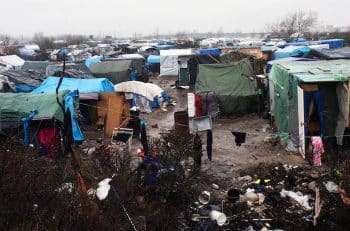
    Hundreds of people line up in a queue as soon as the doors of the van open, each hoping to get a pair of warm trousers. It is a cold November day in Calais, but some of them are wearing just shorts and slippers. In the queue I recognise a Syrian man that I met in the refugee camp on the Greek island of Lesbos just three months ago. He is so thin that it is hard to find him a slim enough pair. But what strikes me even more is his eyes – their sadness and exhaustion – that seem to reflect the cumulation of hardships of the past months, starting in his home country, and now continuing in Europe. That moment of hope and relief, when the overcrowded flimsy rubber dinghy he was on reached the shores of Europe, has now turned into hopelessness at being stuck in one of the worst makeshift refugee camps in Europe, the Calais camp, also known as the Jungle. It’s not a jungle though: it’s more of a disaster zone. Shabby tents and improvised shelters made out of pallets reach as far as the eye can see. The site is far from ideal for camping, the less so during this chilly rain; the sandy ground has become just muddy. Some parts of the camp are exposed to a heavy wind, and people are looking for help to fix their collapsed shelters. There is no electricity. Sanitation is severely inadequate. No more than 40 toilets are currently serving over 6,000 inhabitants – one for every 150, while the UNHCR recommendation is one toilet per 20 users. With only three taps in the camp, there are not many opportunities to wash hands. Litter is everywhere, and some areas are covered with human extracts. At one of the two refuse points of the camp I meet representatives of the Médecins Sans Frontières, who have come to collect the rubbish. They remind me to be careful what I touch due to the threat of scabies and other infectious diseases. A recent investigation by the University of Birmingham, supported by the Médecins du Monde, further highlights detrimental health situations in the camp including the prevalence of ‘white asbestos’, sometimes used to weigh down tenting. As food in the camp cannot be stored safely, much of it carries infective amounts of pathogenic bacteria, causing diarrhoea and vomiting. Several water storage units exhibit levels of bacteria exceeding the EU safety standards, too. The lack of washing facilities prevents the effective treatment of scabies, lice and bedbugs. Many here are suffering from mental illnesses. The makeshift hospital in the camp has the capacity of treating only up to 90 patients a day and there is a constant shortage of medical supplies. It is especially hard to provide treatment for long-term medical conditions such as tuberculosis. Many patients also come in with serious injuries, often resulting from unsafe conditions in the camp, or failed attempts to cross the border. I meet a young boy who has a broken arm, after a failed attempt to jump an England-bound train – a typical case. The United Nations High Commission for Refugees (UNHCR) has continually expressed about the reception conditions for refugees and migrants in Calais, stressing that security measures alone are unlikely to be effective, and urging the French authorities to relocate the refugees to proper reception facilities in the Nord Pas de Calais region and further afield. Some relief is expected from the proposed EU- supported refugee centre, that is expected to be opened in Calais in 2016. It will reportedly be equipped to deal with 1,500 persons. Another alternative would be to involve experienced non-governmental aid organisations such as the Red Cross to act as auxiliaries for the public authorities in the humanitarian field. Charities and voluntary organisations offer an invaluable contribution to the current European challenge, but they cannot be expected to supersede the responsibilities of European governments. Of course, permanent aid mechanisms will be required for as long as the conflicts causing the crisis, sometimes exacerbated by Western military interventions, are allowed to continue. Naiim Sherzai is standing at the exit of the camp, watching the trucks headed for British ports. Sherzai, who comes from the Helmand province in Afghanistan, is a former translator for the British forces, and had to leave the country because of the threat of the Taliban. He now wants to seek asylum in the UK, and ultimately to bring his wife and two children there. He asks whether we could recommend him any legal ways to enter the UK. But in Calais, there are no such routes available for a refugee. Lack of alternatives drives many to desperate acts, trying to hide in the trucks headed for the ferries or the Eurotunnel, or cutting the fence to hide in the trains. At least 16 people have died this year trying to get across the Channel. Tear gas fills the camp regularly as the police tries to drive out refugees from the proximity of the trucks entering the port of Calais. Although the tightened security measures and border controls have decreased the numbers of those who try to leave, groups of refugees lunge for their freedom every night. The rest, like Sherzai, find themselves lost – the road ahead blocked, but with no turning back either. In the jungle. In limbo. Johanna Kaprio

    Loading

    Read more

  • Posted in:

    UNrealistic

    At the end of last September, under the shadow of the glimmering New York skyline overhead, the world celebrated the dawn of a new era. The UN Summit on the Sustainable Development Goals (SDGs) concluded with a massive party in Central Park, graced by the presence of superstars such as Ed Sheerin and Beyonce. The party was sponsored by Gucci, Citi, Unilever, Google and others. Many of their super-rich executives could well have been watching the party from their high-rise apartments in that most elegant part of the planet. Some people had paid upwards of $10,000 for VIP passes to the party. All proceeds went to charity, of course. There was no whiff of a world on the brink of collapse, threatened environmental destruction and violent extremism, the one that had been so eloquently articulated by Pope Francis in his landmark address to the UN General Assembly the previous day. The gap between the optimistic, almost euphoric atmosphere in some UN quarters and the pessimistic, almost despairing perspectives of others, including Pope Francis, was palpable at the Summit. On the one hand, famous business moguls, UN officials and many states, including Ireland, lined up to hail the goals as a new beginning. On the other hand, many wondered whether yet more goals would make any difference at all or even whether they would take us in the wrong direction altogether. Whatever your perspective, the SDGs are now a universally agreed UN document. For the most part, they set out important objectives for the world, 17 in all. They point to all the critical areas of human development that must be addressed if we are to tackle inequality, poverty and environmental destruction. They set 167 indicators of progress which are to be monitored and followed up annually. Importantly, for the first time ever, they promise to “leave no-one behind” and put a deadline of 2030 on achieving that goal. While as individual objectives the SDGs are desirable, as a global policy framework they are deeply flawed in at least four ways. Firstly, the sheer number of goals agreed and the lack of real interconnection between them has turned them into a shopping list. Everything becomes equally important. Yet the truth is that global imperatives exist. There are critical enablers which everyone needs to address alongside second-level priorities, which can be reached only on condition the first are being achieved. So the SDGs create a kind of policy fog in which it is hard to see the wood from the trees. Secondly, despite years of debate, the goals fail to resolve the decades old conundrum of sustainable development. This is the fact that ‘economic’, ‘social’ and ‘environmental’ dimensions do not really sit side by side or form interlocking circles. The ‘economic’ and the ‘social’, in reality, are dependent on the ‘environmental’. We need to move away from the inadequate cliche of interlocking circles to a ‘doughnut’ model as put forward by Oxfam. There is no overarching agreement in the SDGs that we need to move towards a world which lives within planetary boundaries. This is a real opportunity lost. Thirdly, however worthy the SDGs are, they are weak voluntary initiatives rather than an international treaty. Of course, voluntary initiatives have an important role in setting norms, but they only thrive when the environment is conducive to their realisation and are matched by strong implementation measures. The goals are debilitated by dysfunctional power structures, which render them a side-show, if not quite irrelevant to the main drivers of power. Unfortunately, important policies are being actively promoted by the same states that signed up to the SDGs and whose actions elsewhere directly contradict many of the goals. One alarming example is the emerging rules on global trade and investment, epitomised by the Transatlantic Trade and Investment Partnership (TTIP), which is being negotiated between the EU and USA. Controversial proposals within TTIP include Investor State Dispute Settlement mechanisms. These will effectively facilitate MultiNational Corporations to circumvent domestic court systems and sue sovereign states through a confidential arbitration mechanism in challenging governments for introducing regulations that in multinational businesses’ view harms their interests or profit margins. This raises concerns about the state’s right to regulate on a wide range of public policies, including extreme poverty and environmental standards. SDGs do not even enter into these negotiations. Another example is continued state subsidies and investments in fossil fuels. If remaining below the agreed 2°C-increase target for global temperatures is to be possible, a basic pre-requisite for the SDGs, 80% of known remaining fossil fuels need to remain under ground. Yet in 2014 the global economy missed the decarbonisation target needed to limit global warming to 2°C for the sixth year running. Fourthly, the respective roles of the state and the private sector in SDG development and implementation is deeply concerning. The visibility of the private sector and the pledges made in New York reflect the way that major corporations have managed to skew the agenda. One official pledge made by MasterCard at the SDG Private Sector Forum to bring 500 million people in the developing world into the credit market, thus enabling them to achieve Goal 8, is indicative of this. A pick-and-mix approach to the SDGs is already evident, facilitating corporations to use them to their marketing advantage while not addressing basic human rights and issues such as lack of accountability. The UN appears to have already relinquished control of its own message about the SDGs to the corporate sector through its ‘Global Goals’ campaign. This was launched during the Summit. In signing a licensing agreement for the Goals with key sponsors such as Gucci, Citi and others, it effectively delivered the SDGs, a key global public good, into private ownership. A clause in the campaign agreement means that those who use the goals’ branding must do so in ways which do not damage the partner brands. Technically speaking, therefore, if an NGO such as Trócaire or Christian Aid, draws attention to the systemic problems of corporate power whilst using the goals’ branding, they are in breach of the licence. Though it

    Loading

    Read more

  • Posted in:

    Review: Faith in Politics by John Bruton

    John Bruton (Taoiseach 1994-7, Minister for Finance 1981-2, 1986-7) has a book out. His publisher, Currach Press, suggested journalists might like to interview the lively former Taoiseach. I signed up and an appointment was arranged. The morning of our interview the man from Currach texted to say Bruton was concerned it should be primarily about the book and then half an hour later to say there was bad news, Bruton would not do it and he would not say why. I said I’d do it by email and was mostly interested in the book. Currach said they would get back to him. But I heard no more. Rude. Maybe he was worried I’d ask him about Cherrywood. In 2006 Bruton told the Mahon (Planning) Tribunal that a donation of £2,500 to him as party leader was received from Monarch Properties in November 1992, during the general election campaign. At that time I was campaigning against a make-or-break rezoning scheme being pursued by Monarch for 234 acres in Cherrywood, Co Dublin. Most Fine Gael County Councillors had not supported the rezoning in 1992 but they would vote for it in 1993: in addition to Bruton, nine out of the 12 FG Councillors who would talk to their party’s internal Inquiry in 2000 admitted receiving money from Monarch or Frank Dunlop (or both) in the 1991-1993 period when I was concerned with the Cherrywood vote. Monarch’s boss, Phil Monahan, had told me he was paying Councillors for rezonings and that many of the Fine Gaelers would vote against it in 1992 but in favour (when it really counted) in 1993. Monarch was duly found by the tribunal to have obtained the rezoning corruptly. During the 1997 general election campaign, the party received a further cheque for £3,800 from Monarch Properties. Later Bruton said he had not tried to “whip” Fine Gael Councillors on 78-member Dublin County Council though he had pressured his 19 party councillors to act coherently when he met them in September 1993: Councillor Mary Muldoon told him that acting coherently would require the minority of non-rezoners moving to back the majority of rezoners. The Council rezoned the Monarch lands shortly afterwards, in November 1993. According to leaflets we produced at the time FG voted 7:7 on the up-zoning in 1992. By 1993 their vote was 12:5 in favour. Why did so many change their minds? The torpid tribunal never asked. Frank Dunlop informed the planning tribunal that he had told Bruton about demands for a £250,000 bribe made to him by a Fine Gael councillor, Tom Hand, to rezone the Quarryvale development. Dunlop testified that Bruton replied, “There are no angels in the world or in Fine Gael”. Bruton vehemently denied this but, following further inculpatory evidence at the Tribunal, returned and conceded that “it gradually came back to me”, that Dunlop, “did say to me something about a councillor looking for money”. He acknowledged that he did not investigate the matter because he had found the story told to him by Dunlop “exceptionally hard to believe”. Anyway the book: Faith and Politics: I couldn’t really see the connection. Bruton is is an intellectual by Irish political standards but he’s wrong to endorse GK Chesterton’s illogical comment that “When a man stops believing in God he doesn’t believe in nothing, he believes in anything”. It is good to see an assiduous Christian Democrat recognise that freedom is no alternative to ethics, as it says nothing about how we should treat one another. He’s right the Rising probably held back a 32-County consensual Republic, and that support for “our gallant [Axis] Allies in Europe” weakened our case for independence, at the 1919 Paris Peace Conference. He’s right that the obligation on Northern MLAs to declare themselves Nationalist or Unionist is now holding back a new politics that transcends history. He’s wrong to even contemplate that we can burn all the fossil fuels left in the world. I hadn’t realised how consistently the EU had emphasised the need for economic and monetary union and (as far back as the 1971 Werner report) that it would involve EU involvement in domestic economic policy. It’s interesting that a man of Bruton’s experience considers a third party in coalition can mitigate tensions. Sometimes he is demonstrably illogical as where he claims that 30 minutes daily spent on religion in schools has not reduced Irish educational attainment because we have been doing it for generations and the reductions are only recent; but then claims that teaching Irish, which we have also been doing for generations, has reduced educational attainment. Some of his articles seem hastily put together, like the ill-thought- through views on ‘waste’ and the half-baked views on Ireland’s “strengths and weaknesses”. And more generally it’s unwise for an ex-Taoiseach to preach the need for Irish people to do more with less when he has a public-sector pension of €141,849 and, perhaps because he’s getting a six-figure salary as president of the IFSC, to obtusely advocate reining in regulation of the banks. Michael Smith

    Loading

    Read more