General

Random entry RSS

  • Posted in:

    Skewed Irish Times asylum coverage

    The received narrative in a democracy is that there is an inherent adversarial relationship between politicians and civil servants on one side and journalists on the other. The job of the diligent journalist is to pursue transparency by scrutinising policy; they should hold government to account through critical engagement in order to arrive at the truth, or at least an approximation of the truth. The citizen is then properly informed on government policy by the journalist acting in the public interest as a watchdog on power. Well, that’s the theory at least. In Ireland and elsewhere however an incestuous nexus between media and government exists. Journalists frequently rely on anonymous sources—who are often Cabinet members and senior civil servants—to the detriment of real transparency and accountability. One story that illustrates this point well is coverage over the past year in the Irish Times of attempted reforms of the Direct Provision system and, more recently, the governmental response to the so-called ‘migrant’ crisis. Following months of protest in Direct Provision centres last summer, the Minister for Justice set up a working group, chaired by retired High Court Justice Bryan McMahon, to look into reform of the system. The group was an ‘independent’ vehicle comprising members from various NGOs and representatives from the relevant state departments including the Department of Justice (DoJ). A week after the announcement of the group, an article by Conor Lally headlined ‘Asylum claims increase for the first time in over a decade’ was published in the Irish Times. The article, apparently sourced from the DoJ, reported – accurately but well before official statistics were due to be announced – a 40% year-on-year increase in asylum applications. Lally, who is the Irish Times’ crime correspondent, had not written about statistics on asylum since 2006. In December of that year, Lally delivered another article, headlined ‘Asylum claims up 45% in first rise since 2000’. In this second piece, which again included accurate statistics before their official publication, Lally allowed anonymity to a “senior justice source” who said that “the fact the Republic was regarded internationally as recovering from its recessionary years may be a contributory factor for some of the increase”. In other words, the implication is, the increase in asylum-seeker numbers is down to crafty economic migrants falsely claiming asylum in Ireland to take advantage of our growing economy. At the time of the article, a number of “senior justice” officials were involved in the working group. The DoJ, in an attempt to limit the potential reforms being discussed by the group, had an incentive to push the narrative that the increasing numbers of asylum claims were due to an influx of ‘economic migrants’. Was Lally’s senior source involved in negotiations on the working group at the time? We may never know because Lally granted him or her anonymity for no clear reason except, perhaps, in the source’s interest. Fast forward to June 2015. Barring a couple of contentious resignations, the working group successfully completed its task and produced a report which called for minor reforms of Ireland’s Direct Provision and asylum systems. On the morning after the report was delivered to government, the front page of the Irish Times featured a story entitled ‘Minister Raises Concerns over Immigration Spike’. This article, by Fiach Kelly, was based entirely on anonymous sources. Before covering the McMahon report, Kelly gave his source prominence to say that “an estimated 700 migrants had entered the country in the space of one month”. Unlike for Lally’s statistics, there is no evidence to back up this ‘700’ figure. When he finally mentions the working group report, Kelly quotes “concern in the Coalition” that improving Direct Provision could make Ireland “a destination country for immigrants”. As a journalist, Kelly has a duty to ensure his reporting is in the public interest. It is not clear that the public interest is best served by granting anonymity to senior government sources so that they can engender and promote, using unverified figures, a concocted anxiety about welfare-seeking migrating hordes. It’s not clear if the public interest is served by contrasting the release of a long-awaited report with anonymous ‘concern’ that any change to the status quo would lead to increased immigration by people “who are in essence illegal immigrants”, as another anonymous source said in the article. What is clear, though, is that some within government and the DoJ had an interest in controlling, directing and containing the immediate political and media discourse surrounding the publication of the McMahon report. Kelly’s article allowed his sources to do that; in effect he let certain figures distort the release of the report under cover of anonymity. The intricate and incestuous nexus between government and media in this instance, you could say, trumped the democratic theory, and the imaginary adversarial relationship which we are told exists. After the release of the report, events in the Mediterranean and beyond overshadowed any Direct Provision reforms. The huge numbers of refugees arriving in Europe suddenly became big news after a number of tragedies including the death of three-year-old Aylan Kurdi in September. The EU slowly moved towards a response, finally agreeing to two refugee-relocation programmes in addition to a previous resettlement programme. Ireland agreed to take in around 4,000 under these programmes, and the government set up the Irish Refugee Protection Programme (IRPP), led by the DoJ, to deal with the logistics. The Irish Times’ coverage of the ‘migrant’ crisis on the fringes of Europe has been good. If you want to find out what’s happening in Serbia or on the Greek island of Lesbos, the Times will inform you. However, their coverage of the IRPP leaves a lot to be desired. The government is setting up, as part of the IRPP, a series of Emergency Reception and Orientation Centres (EROCs) to host and process the relocated refugees yet to arrive. Kitty Holland has produced some excellent reports on the first orientation centre (for resettled, as opposed to relocated, refugees), the Hazel Hotel in Monastarevin,

    Loading

    Read more

  • Posted in:

    Legal affairs

    Village is loth to get into the salaciousness that drives the professional classes in decadent Dublin. Nevertheless the integrity of the judiciary, and indeed the perception of that integrity, has to be beyond doubt and a story unfortunately came our way which challenged it, anonymously, and was accompanied by affidavits submitted for in camera family proceedings. A bankrupt developer with an alpha personality and omega ethics alleged in the affidavits, which he was never allowed to open in court, that Irish High Court and Supreme Court judgments against him were tainted with bias because the lead Supreme Court judge in his case had an alleged affair affair with the High Court Judge who determined the matter originally, and that the Supreme Court judge anyway had shown in dealings with him in the judge’s former life as a barrister, that he despised him. The developer’s affidavits are clumsily drafted and he is careless as to whether the relationship may have continued at times when the Supreme Court judge heard the action – on occasion fudging the tenses about the timing of the relationship. Nevertheless as a matter of fact the relationship had ended by the time of the Supreme Court hearing, even if it had subsisted, insignificantly and irrelevantly, during the High Court hearing. The High Court judgment was persuasively damning of the developer personally, finding he had deliberately and fraudulently failed to make certain disclosures and misled the court and his ex-wife. The developer claimed he had been in the process of preparing disclosures when a settlement was reached that obviated the necessity for him to make the disclosures. But the High Court, on the facts, said there was no evidence of this. He had engaged in litigation misconduct. The appeal was fast-tracked to the Supreme Court but took four years to be heard. At the last minute, the Supreme Court panel of judges was apparently changed, with the particular Supreme Court justice who had allegedly had the affair stepping in to replace a judge who had been originally listed to sit. The developer claims to have been wrong-footed by the change between the judges and would have aimed to pre-empt the Supreme Court judge sitting on the matter had he known he intended to do so. He claims he had already advised his solicitor of the potential for the judge being compromised. His legal team noted that day one of a two-day appeal was already over, and they didn’t dare question the judicial etiquette. The Supreme Court upheld all the High Court’s substantive reasoning. When the judge endorsed his alleged former lover’s strong judgment without – according to the developer – “canvassing” all the developer’s fundamental grounds, the developer sought redress on grounds that there was a reasonable suspicion of objective or apprehended bias. Justice must not just be done but be seen to be done, was the cry. However, these days thankfully an alleged affair between judges that may have been finished for years does not constitute, or rather does not necessarily constitute, a reason for the appellate judge to refuse to hear an appeal of his former lover’s judgment. For obvious reasons the developer had difficulty getting any Irish lawyers to take on his prurient case. In the end he sought help from UK barristers but ultimately the Official Assignee in Bankruptcy successfully objected to the developer taking a judicial-bias challenge because he was bankrupt and therefore lacked the standing to take the case. The Assignee in Bankruptcy took the reasonable stance that even if the judgments were overturned it would not be appropriate for the Assignee, who alone could take the decision do so, to refight the substantive issues of fraud, failed disclosure etc on the part of the dubious developer. Even if the unsubstantiated allegation of bias could be proved, it would achieve nothing, for the case was not worth re-running. Michael Smith

    Loading

    Read more

  • Posted in:

    Planning in Donegal

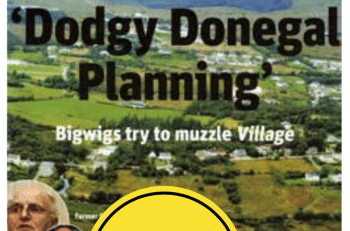
    Gerard Convie is a man who wears sober ties and measures his words. He worked for the County Council in Donegal, once Ireland’s most beautiful and wildest county, as a senior planner for nearly 24 years. He has claimed that during his tenure in the Council planning irregularities were perpetrated by named officials at the highest level in the Council. He claims these included former Manager Michael McLoone – who has initiated defamation proceedings against Village magazine (though we’ve heard nothing in a year) – as well as named county councillors. Convie had a list of more than 20 “suspect cases” in the County, a ‘cesspit’. Two years ago the government initiated a review of his allegations. Then a Minister dismissed them as lacking substance and closed it down. Convie claimed this made him look bad and sued. And got a payout and – in September – , the appointment of a senior lawyer, Rory Mulcahy to look into his allegations. The ‘review’ [by god is this not an Inquiry or Tribunal] is non-statutory ie makey-uppy and Minister Alan Kelly has reserved the right for himself or his successor not to publish its findings. So he has provided in surprisingly hazily- drafted terms for review of “all written allegations received in the Department in relation to certain planning matters n [sic] respect of Donegal County Council”. Originally the terms contained a confidentiality clause but following further correspondence this seemed to disappear. In November, Convie expressed his concern that his evidence may be shared beyond the ‘review” and said he considered the change may represent “bad faith” and even “affect my continued cooperation with the exercise”. The terms also fail to make it clear if it will address impropriety ie corruption or just ‘bad practice’’ie incompetence though if it does not address impropriety it’s possible that Convie will feel slighted and have another payday.

    Loading

    Read more

  • Posted in:

    Review 2015 in Village

    January The Minister for Health, Leo Varadkar, reveals he is gay to a receptive Miriam O’Callaghan, becoming the first openly-gay government minister in Ireland. The Irish economy is not some kind of exemplar, says President Michael D Higgins, controversially but magnificently. Mahon tribunal reverses its finding of corruption against Ray Burke because the tribunal never revealed that whistleblower, James Gogarty, had made unsupportable allegations against the likes of Nora Owen, TD, and Supreme Court justice, Seamus Henchy. Nobody names the lax lawyers, who permitted it, or demands return of their fees. SIPTU’s Jack O’Connor sets out principles for a Charter for parties on the Left.   February 13 men aged 50-70 to appear before the bank inquiry; no women. Gardai arrest Paul Murphy, TD, along with three other anti-austerity activists and politicians, leading to public speculation about “political policing”. Former Fianna Fáil minister Pat Carey reveals his homosexuality publicly. The Irish Times announces the reintroduction of a paywall for its website, beginning on February 23. Michael D Higgins gives us another poem. March Solicitor Brian O’Donnell barricades himself into his Palace in Killiney with help from the ironically titled Land League. The Sunday Independent reports that O’Donnell scion, Blaise, didn’t know how rich his parents had made him. Contrariwise, The Mail reports Blaise got a €156m London office block from Dad. Ireland’s rugby year peaks with Six Nations Championship. Belfast County Court finds Asher’s Bakery guilty of discrimination for refusing to bake an ‘Eric’n’Ernie’ cake bearing a pro-gay-marraige slogan. april Joan Burton proposes a cap on the property tax when the freeze on increases start to register, at the end of the year. Minister Alan Kelly to allow builders of one-off houses to opt out of the usual building-control certification requirements. John Fitzgerald writes that borrowing to fund the bank bailout costs around €1bn a year, a small fraction of the total fiscal adjustment of €30bn since 2008. Gerry Adams tells CBS he never pulled a trigger, ordered a murder or set off a bomb during the war in the North. Ed Moloney, of course, disputes this. May A smug Jeremy Paxman, on the verge of retirement, lays into British Labour leader, Ed Miliband, on Newsnight and is overheard at end asking “are you ok, Ed?”. Miliband says “yeah” and wonders if Paxman is himself ok. Broadcaster and political editor of the TV3 television channel, Ursula Halligan, publicly declared her homosexuality and her support for a ‘yes’ vote for marriage for homosexuals and lesbians in the Constitutional marriage equality referendum. Competition Authority finally getting serious over CRH. Mary Harney promised investigation a political generation ago. Broadcasters Bill O’Herlihy and Derek Davis died. Charles, Prince of Wales, and his wife visited the west of Ireland, including Mullaghmore, County Sligo, where his great-uncle, Lord Mountbatten, was murdered by an IRA bomb in 1979. Referendum on two amendments to the Constitution – the 34th (marriage equality) wins; and the 35th (presidential election voting) loses. NY Times and Guardian, Village and Broadsheet. ie publish the Dáil Record of Catherine Murphy’s allegations about Denis O’Brien’s banking arrangments. The Irish Times, Independent, Mail, Sunday Business Post wait for clarification from the courts. June Strong, clear clarification from High Court on the unambiguous existence of the privilege for Dail utterances. Binchy J as predicted clarifies that he never intended, nor could it have been intended, his comments would apply to reporting of utterances in the Dail. Exciting dream team of Catherine Murphy, Stephen Donnelly and Roisin Shortall to form Social Democrat party. RTE tells Atheist Ireland it will reconsider the title of the Angelus Ireland’s poorest kids hit by lone-parent payment cut. “We are not God,” acknowledges Pope Francis, and we shouldn’t “trample his creation underfoot.” The average American woman now weighs 166 pounds — as much as the average 1960s man. Dutch government ordered by court to cut carbon emissions in landmark ruling. Central bank Governor Patrick Honohan explains “the bank guarantee should not have included subordinated debt nor existing senior-term debt”. Joan Burton slams social welfare fraudsters for “giving two fingers to their neighbours”. July The hottest month in history Brian Cowen scathingly tells the banking inquiry his ‘friends and colleagues’ were private people not bankers though doesn’t explain relaptionship with Fintan Drury, or golf. Media consider performance a triumph. Greece votes no to bailout plan but government imposes it anyway. Yanis Varoufakis resigns as Greek Finance Minister. august IS destroys 200 year old temple in Palymyra, Syria. September INBS, Michael Fingleton appears before Oireachtas banking inquiry but is let off hook Radical socialist Jeremy Corbyn elected leader of British Labour Party. October Five adults and five child Travellers die after fire at Carrickmines, Residents object to rehousing of the survivors nearby. Budget will reduce USC but is light on plans for investment. The Archbishop of Dublin, Diarmuid Martin tells a synod of bishops in Rome that Irish people “struggle to understand abstract moral principles” and that the recent debate about same-sex marriage in Ireland has been conducted by lay people in language that traditionally belongs to the Roman Catholic Church: ‘equality, compassion, respect and tolerance’”. November Judge Brian Cregan announces he does not have the legal powers necessary to conduct his inquiry into write-off sales of loans by IBRC do not allow him to. 130 people murdered by IS in Paris. Peter Robinson says he will resign as First Minister. Former Minister Pat Carey resigns after improper media leaks about alleged paedophilia. December IFA President Eddie Downey declares he has been thrown under a bus by his colleagues after it was revealed he received €147,000 annually and CEO, Pat Smith, half a million annually, from often impoverished farmers. David Cameron announces Britain’s intention to bomb IS in Syria.

    Loading

    Read more

  • Posted in:

    Profile: Treasury Holdings and Johnny Ronan

    The Treasury boys are back.  Without Treasury. Great.  Richard Barrett is reported to be deploying two billion euro of investment in property and Johnny Ronan has paid Nama back and is back in business all  over town.  He’s even found time to make reference to Nazi slogans in pinpointing the injustice done to him by Nama and to get the Banking Inquiry to pull its criticism of him, lest he perhaps injunct it from publishing. The Irish Times misreported in September 2015 (and has still not corrected the error) that Treasury had “exited Nama” but in fact Treasury went bankrupt owing €2.7bn, €1.7bn to Nama alone.  This suggests they cost the country around €7oom. Johnny Ronan may have bought out his personal loans but Treasury benefited from the socialised capitalism for market losers that is the bankruptcy regime.  No swaggering market icon, Treasury. Treasury  – Johnny Ronan and Richard Barrett, inspired awe and respect in financial, political and media circles but I have had reason to be circumspect, myself, over the years. Johnny is an accountant whose father was a wealthy pig farmer in Tipperary and whose cousin is Vita Cortex’s Jack Ronan. Richard comes from a family of Ballina millers. They were at school together in Castleknock College. Treasury once had little Dublin at their feet. I first met Richard and Johnny in the mid-nineties when they were developing the Hilton (subsequently Westin) Hotel on Dublin’s College Green. I was opposing their plan for the biggest destruction of listed buildings in Dublin since the 1960s. After they got their permission from An Bord Pleanála, an academic advised us that they should clearly have carried out an Environmental Impact Assessment (EIA) because of the significant “nature, size and location” of the ‘project’. We decided the scheme was unsustainable and uncivilised, Treasury’s attitude cocky and the planning authorities’ flouting of the law on EIA outrageous – so we would attack their scheme in the courts. Treasury, it was said, were vicious, and were involved in twenty-six other sets of litigation around town. An Taisce, which I had been representing, didn’t want the risk of a devastating legal-costs order, we didn’t want the inevitable PR storm to blow away vulnerable individuals and we didn’t want personal legal liability for costs, so we formed a company. We had little time so we got a pre-formed ‘shelf’ company, the chivalric-sounding, “Lancefort’. After 47 appearances in the High-Court and six days in the Supreme Court, Lancefort lost its case on the primary ground that, although it was okay to litigate through a company that had not even existed at the time of the Bord Pleanála decision which it was challenging, the protagonists in the company, primarily I, should have raised the need for an EIA before An Bord Pleanála. The chief justice Ronan Keane seemed to imply I had known of the point at the time, even though I did not, and there was no evidence to that effect. Usually the Supreme Court is very careful not to invent or infer false facts. Furthermore European law clearly states it is the obligation of the authorities to conduct the EIA. The Lancefort decision is generally, by academics and practitioners, accepted as wrongly-decided. Since that time – 1997 – EIA (and its plan-focused counterpart (SEA)) has taken off as a tool for residents and environmentalists in assessing the impact of what is being imposed on them – if only because it often requires photomontages of the proposed schene and an indication that the developer fully considered the alternatives. During the campaign we were assailed by Treasury and their PR team – and I guess since Johnny Ronan reckoned we cost them 6m Euro, we were fair game. Irish Times environment correspondent, Frank McDonald, is sometimes one of the most acute and courageous commentators on these matters. But he was close to Richard Barrett – as well as to some of us in the campaigning sector, and he wrote several damaging reports including pieces misrepresenting our European Law stance in a way that was likely to annoy Irish judges, mis-stating the numbers of listed/historic buildings on the site and giving extraordinary coverage to the supporters of the scheme – including a fawning profile of the ‘conservation’ architect who was writing off the value of some of the buildings to the benefit of Treasury, in an interview under the headline “Keeper of the Past”. When we lost the case Frank McDonald in the Irish Times quoted Richard Barrett saying “his [ie my] house is gone” and that “I” faced legal costs of £1m. In fact we were always going to escape the costs of the case because the company was a separate vehicle from its directors, which at various stages included, apart from me, heritage activists Garret Kelly, Ian Lumley, Tony Lowes and in the end my gamey brother. Nonetheless Lancefort finished up comprehensively liquidated. Treasury later boasted that “certain opponents of ours have underestimated our ability to cause legal havoc to their detriment”. Probably true. At one stage when the publicity was bad and the case looked fragile, we had discussions with Johnny Ronan about settling our case and it appears some of our lawyers got further with instructions we gave them than we had understood. We were then skewered by Matt Cooper in the Sunday Tribune and Cliodhna Ó’Donoghue, editor of the property section of the Irish Independent, in aggressive but not entirely unfair features that made it sound like we were seeking money for ourselves rather than building-conservation causes (which we were not). We had discussed a wide range of possible resolutions ‘without prejudice’ and got nowhere close to agreeing any of them. It emerged a little later that Cliodhna Ó’Donoghue was the beneficiary of a glittering Italian trip paid for by Treasury in 1998, an extravaganza involving a Pavarotti performance I seem to recall. I was invited by current affairs magazine, Magill, to write about all this for a new ‘rant’ column it was

    Loading

    Read more

  • Posted in:

    If we can borrow it, we will spend it

    Two recent events highlight the true nature of the ongoing Irish economic recovery. Firstly, ahead of the infamous Ireland-Argentina Rugby World Cup match, the press office of the main governing party, Fine Gael, produced a rather brash infographic. Charting projected growth rates in real GDP for 2015 across all Rugby World Cup countries, the graph put Ireland at the top of the league with 6.2 percent forecast growth. “FACT: If the Rugby World Cup was based on economic growth, Ireland would win hands down”, shouted the headline. Having put forward a valiant performance, the Irish team went on to lose the game to Argentina, ending its incipient ascendancy. Secondly, within weeks of publication, Budget 2016 – billed by the Government as a programme for the ‘New Ireland’ – has been discounted by a range of analysts, including those with close proximity to the State, as representing the return of a fiscal policy of …electioneering. Worse, judging by the public opinion polls, even the average punter out there has been left with a pesky aftertaste from the political wedding cake produced by Merrion Street on October 13th. Tasteful or not, the public gloating about headline growth figures and the fiscal chest-thumping that accompanied Budget 2016 did not stretch far from reality. Official growth is roaring, public finances are in rude health, and the Government is back in the business of handing out candies to kids on every street corner. The air is filled with the sunshine of recovery and talk about the Celtic Tiger Redux is back on the menu for South Dublin along with the fennelised lamb. Ireland by the numbers On budget day the government projected full-year 2015 inflation-adjusted growth of 6.2 percent followed by 4.3 percent in 2016. Extraordinarily optimistic, “one minister acknowledged that the growth figure for this year is likely to end up nearer to 10% than the 6.2% estimated just 6 weeks ago”, according to a story on the front page of the Sunday Business Post in late November. Much less optimistic, the IMF has the figures at 4.9 percent and 3.8 percent, respectively. Still, this ranks Ireland at the top of the advanced economies’ growth league, with second place Iceland at 4.8 percent and 3.7 percent, respectively. The only other advanced economy expected to post above 4 percent growth in 2015 is Luxembourg. Which is dramatically telling: of all euro-area member states, the two most exposed to tax optimisation schemes are growing the fastest. Though only one has a Government gushing publicly about that fact. No medals for guessing which one. The problem is: the headline official GDP growth for Ireland means preciously little as far as the real economy is concerned. The reason for this is the composition of that growth by source and, specifically, the role of the Multinational Corporations trading from Ireland. We all know this, but keep harping on about the said ‘metric’ as if it mattered. Based on the figures for the first half of 2015 (the latest available through the official national accounts), the Irish economy grew by €6.4 bn or 6.9 percent in real GDP compared to the first half of 2014. Gross National Product, or GDP accounting for the officially declared net profits of multinational companies, expanded by a more modest 6.6 percent over the same period. Other distortions arising from this structural anomaly at the heart of the Irish economic miracle are the effects of foreign investment funds and companies on the capital side of the National Accounts. Back in 2014 the European Union reclassified R&D spending as investment, superficially inflating both GDP and GNP growth figures. Since then, our investment has been booming, outpacing both job creation and domestic public and private sector demand. In more recent quarters, capital investment has been outperforming exports growth too. Which compels a question: what are these investments about if not a tail sign of corporate inversions past and a forewarning of the changes in the pattern of economic output in anticipation of our heralded ‘Knowledge Development Box’? Beyond this, the legacy of the financial crisis has compounded the artificiality of growth statistics. Irish ‘bad bank’, Nama, and its vulture-fund clients are aggressively disposing of real estate loans and other assets bought at regrettable cost to the taxpayer. Any profits booked by these entities are counted as new investment here. Once again, GDP and GNP go up even if there is virtually nothing happening to buildings and sites which are being flipped by these investors. And while we are on the subject of the old ways, last month Ireland was announced as the domicile of choice for an upcoming merger between Pfizer and Allergan – two giants of the global pharma world. Despite numerous claims that Ireland no longer tolerates so- called ‘tax-driven corporate inversions’ (a practice whereby US multinationals domicile themselves in Ireland for tax purposes), it appears that we are back in the old game. Just as we are apparently back revenue shifting (another corporate tax practice that sets Ireland as a centre for the booking of global sales revenues despite no underlying activity taking place here), as exemplified by the Spanish Grifols announcement earlier in October. Just when we thought we were out they pull us back in! All of these growth sources also benefit from the weaker euro relative to the dollar and sterling, courtesy of ECB printing presses. Looking at the national accounts for January-June 2015, Gross Fixed Capital Formation accounted for €3.8 bn or almost 60 percent of total GDP growth over the last 12 months, and nearly three quarters of total GNP growth. In simple terms, the real economy in Ireland has been growing at closer to 3.5 or 4 percent annually in 2015 – still significant, but less impressive than the 6-percent-plus figures suggest. exchequer kindness Still, the above growth has worked well for the Irish Government. In the nine months up to September 2015, Irish Exchequer total tax receipts rose a strong €2.75 bn, or 9.5 percent year-on- year.

    Loading

    Read more