International

Random entry RSS

  • Posted in:

    Smug EU: Pass the claret (and the deal). By Lynn Boylan MEP.

    By Lynn Boylan, MEP. I’ve never been one to shy away from criticising the democratic deficit at the heart of the European Union. However, even a critic like me was left speechless with the antics recently in the European Parliament. MEPs were due to vote on June 10th on a report that outlined the Parliament’s position on the current Transatlantic Trade and Investment programme (TTIP) negotiations. Then stroke politics on a European scale kicked in. This trade agreement if it comes to fruition will be the largest of its kind and will account for 45% of global GDP. It will potentially impact on every aspect of people’s lives, from further liberalisation of public services, to reduced labour conditions, and to a downgrading of environmental and food regulation. The most controversial part of the deal is the inclusion of an Investor State Dispute Settlement (ISDS) mechanism. This allows multinational corporations to sue governments if they feel that a government policy interferes with their profits or their future profits. Resistance to ISDS is widespread across the EU, especially in countries that have experienced these secret courts. As a result the level of public lobbying before the vote on June 10th was enormous. I, for one, received thousands of emails from Irish citizens encouraging me to vote No to the report. This clearly spooked many MEPs, particularly members of the two largest groups – the Socialists and Democrats, and the European People’s Party – which usually form a majority coalition on most key votes. There are already many examples of ISDS mechanisms in place and they have led to serious problems. For example there was Veolia’s challenge to the Egyptian government for attempting to raise the minimum wage. Phillip Morris is currently involved in an action against the Australian Government for introducing plain-package tobacco requirements. These cases are settled behind closed doors and there is no right of appeal. In the days leading up to the Parliament vote, it was clear that neither of the two main political groups could guarantee they could bring their members along to support the report, particularly with the inclusion of ISDS. A hastily arranged dinner in Strasbourg was attended by the President of the Parliament, Martin Schulz (Socialist and Democrats group), the President of the Commission, Jean Claude Juncker (the European People’s Party’s man in the Commission), Martin Weber, Chairperson of the European People’s Party, Gianni Pitella, President of the Socialists and Democrats group, and the Vice-President of the Commission, Frans Timmermans (the Socialists and Democrats group’s man in the Commission). Schulz’s promises of the TTIP vote being in the bag could no longer be guaranteed. Time needed to be bought. On the eve of the vote, an email was circulated to advise that the vote would now be postponed due to the volume of amendments (over 200) that had been submitted. This was hardly the most robust excuse for an institution that deals with thousands of amendments on a daily basis. However, when you are the President of the Parliament, it’s easy to find a rule to suit your agenda. Later in the evening, another email circulated, advising MEPs that the debate was to be postponed. Heaven forbid that the interested citizens should know which MEPs were not happy with ISDS, TTIP or, indeed, the suspiciously suspended Parliament vote. Unfortunately this behaviour is not unique and we are set to see more of it. It seems that the cosy dinner between the five movers and shakers of Brussels was not a one off. ‘G5’ as they affectionately refer to themselves meet at least twice a month for dinner to discuss upcoming files and to offset possible difficulties. It is believed that it was at one of these cosy dinners that they managed to wrangle Jean Claude Juncker out of a possible European Parliament censure. The censure was related to his connection to the ‘LuxLeaks’ corporate-tax-evasion scandal, which happened under his watch as Prime Minister of Luxembourg. With increasing numbers of people across the EU feeling disconnected from the EU institutions, the idea that all major decisions will come down to five men sitting around a table in a five-star hostelry will do nothing to reassure them. Democracy in the EU, it seems, remains a nice idea. •

    Loading

    Read more

  • Posted in:

    Gaza again and again. By Barry Walsh.

    By Barry Walsh. One year on, over 100,000 people still remain displaced in Gaza. Some people are living with extended families, others in temporary accommodation and UN schools. The ongoing economic blockade of Gaza by Israel and Egypt means that reconstruction can’t begin in earnest. Yet for many people in Gaza, the greatest challenges are those of having lost loved ones in the conflict and the difficulty of seeking justice. I visited ruined neighbourhoods in Gaza, in February. The scenes reminded me of images of European cities devastated after World War II. The 50-day Israeli military operation, ‘Protective Edge’, in the summer of 2014 saw whole neighbourhoods in Gaza destroyed. 1,462 Palestinian civilians were killed, a third of them children. Palestinian militant rockets into Israel killed six Israeli civilians including one child. The international community, including states like Ireland, have a role to play in seeking justice and accountability in Gaza. Any potential war crimes need to be adequately investigated by credible and independent investigations. Those in command who may have been responsible for undertaking war crimes must face justice. The UN Human Rights Council established a Commission of Inquiry into the conflict and its report finds evidence that war crimes may have been committed by both Israel and Hamas. I met Rawda Al-Astal, who lost two sons who were watching the World Cup semi-final in a beach-side café on 9th July 2014. Eight people were killed when an Israeli airstrike hit the café. Rawda asked me plaintively, “What do these children have to do with anything? 18 and 16 years old, what did they do to deserve this?” . On the 21st July, heavy shelling provoked Nabil Siyam’s family to flee their house. While on the street an Israeli drone launched a missile which hit the family. Nabil was seriously injured and lost his arm. However, his wife and four of his five children, along with two of his brothers and five other members of his extended family, were killed in the attack. Nabil said, “I am hopeful that an international court can restore our rights and prosecute Israel”. The UN Commission of Inquiry, chaired by Justice Mary Davis, has recommended that both Israeli and Palestinian authorities improve the stringency of their investigations and bring perpetrators to justice. The report highlights that: “questions arise regarding the role of senior officials who set military policy” and that “individual soldiers may have been following agreed military policy, but it may be that the policy itself violates the laws of war”. We have been here before. Operation Pillar of Defence in 2012, Operation Cast Lead in 2009, Operation Warm Winter in 2008 and so on. These cycles of military operations in Gaza happen with alarming regularity. Without accountability for grave breaches of international law, a climate of impunity exists. We see history repeating. One of Trócaire’s Israeli partner organisations, Breaking the Silence, is a movement of veteran Israeli soldiers that collect testimonies about soldiers’ conduct while serving in Israeli military operations. Their most recent report, ‘How we fought in Gaza’, details the permissive rules of engagement used in last summer’s conflict. The report exposes soldiers’ admissions of shooting at civilians and ambulances, and of firing tank shells at buildings in revenge fire. It goes some way towards explaining why 70% of the Palestinian casualties were civilians and not combatants. The UN Commission of Inquiry report paves the way for the further pursuit of justice if domestic investigations continue to lack credibility and teeth. It calls on the international community to “to support actively the work of the International Criminal Court in relation to the Occupied Palestinian Territory”. The International Criminal Court (ICC) has opened a preliminary investigation into Gaza, and could potentially provide an avenue for prosecutions of Israelis and Palestinians responsible for grave breaches of international law. If action is not taken to challenge impunity, another round of conflict in Gaza in the coming years is all but guaranteed. We need meaningful pressure to be put on Israel and the Palestinian Authority. It is time for the international community to galvanise. • Garry Walsh is Trócaire Programme Officer for Israel and occupied Palestinian territory (www.trocaire.org/Palestine)

    Loading

    Read more

  • Posted in:

    Gaza again and again?

    By Garry Walsh. One year on, over 100,000 people still remain displaced in Gaza. Some people are living with extended families, others in temporary accommodation and UN schools. The ongoing economic blockade of Gaza by Israel and Egypt means that reconstruction can’t begin in earnest. Yet for many people in Gaza, the greatest challenges are those of having lost loved ones in the conflict and the difficulty of seeking justice. I visited ruined neighbourhoods in Gaza, in February. The scenes reminded me of images of European cities devastated after World War II. The 50-day Israeli military operation, ‘Protective Edge’, in the summer of 2014 saw whole neighbourhoods in Gaza destroyed. 1,462 Palestinian civilians were killed, a third of them children. Palestinian militant rockets into Israel killed six Israeli civilians including one child. The international community, including states like Ireland, have a role to play in seeking justice and accountability in Gaza. Any potential war crimes need to be adequately investigated by credible and independent investigations. Those in command who may have been responsible for undertaking war crimes must face justice. The UN Human Rights Council established a Commission of Inquiry into the conflict and its report finds evidence that war crimes may have been committed by both Israel and Hamas. I met Rawda Al-Astal, who lost two sons who were watching the World Cup semi-final in a beach-side café on 9th July 2014. Eight people were killed when an Israeli airstrike hit the café. Rawda asked me plaintively, “What do these children have to do with anything? 18 and 16 years old, what did they do to deserve this?” . On the 21st July, heavy shelling provoked Nabil Siyam’s family to flee their house. While on the street an Israeli drone launched a missile which hit the family. Nabil was seriously injured and lost his arm. However, his wife and four of his five children, along with two of his brothers and five other members of his extended family, were killed in the attack. Nabil said, “I am hopeful that an international court can restore our rights and prosecute Israel”. The UN Commission of Inquiry, chaired by Justice Mary Davis, has recommended that both Israeli and Palestinian authorities improve the stringency of their investigations and bring perpetrators to justice. The report highlights that: “questions arise regarding the role of senior officials who set military policy” and that “individual soldiers may have been following agreed military policy, but it may be that the policy itself violates the laws of war”. We have been here before. Operation Pillar of Defence in 2012, Operation Cast Lead in 2009, Operation Warm Winter in 2008 and so on. These cycles of military operations in Gaza happen with alarming regularity. Without accountability for grave breaches of international law, a climate of impunity exists. We see history repeating. One of Trócaire’s Israeli partner organisations, Breaking the Silence, is a movement of veteran Israeli soldiers that collect testimonies about soldiers’ conduct while serving in Israeli military operations. Their most recent report, ‘How we fought in Gaza’, details the permissive rules of engagement used in last summer’s conflict. The report exposes soldiers’ admissions of shooting at civilians and ambulances, and of firing tank shells at buildings in revenge fire. It goes some way towards explaining why 70% of the Palestinian casualties were civilians and not combatants. The UN Commission of Inquiry report paves the way for the further pursuit of justice if domestic investigations continue to lack credibility and teeth. It calls on the international community to “to support actively the work of the International Criminal Court in relation to the Occupied Palestinian Territory”. The International Criminal Court (ICC) has opened a preliminary investigation into Gaza, and could potentially provide an avenue for prosecutions of Israelis and Palestinians responsible for grave breaches of international law. If action is not taken to challenge impunity, another round of conflict in Gaza in the coming years is all but guaranteed. We need meaningful pressure to be put on Israel and the Palestinian Authority. It is time for the international community to galvanise. • Garry Walsh is Trócaire Programme Officer for Israel and occupied Palestinian territory (www.trocaire.org/Palestine)

    Loading

    Read more

  • Posted in:

    No to free-market Europe

    Few countries elevate rejection as far as celebrating a national “No” day. But every October 28th Greece’s Oxi Day holiday commemorates the No with which it replied to a humiliating Italian ultimatum in 1940, a refusal to acquiesce that led to invasion. Greece is also the country whose stereotype is plate-smashing. The New York Times recently ran a story recalling doughty Greek fighters in the early 1800s who blew themselves up rather than submit to the Ottoman; in the mountains of Zalongo, by legend, women flung their children off a cliff and then danced off after them rather than be sold as slaves. And yet feisty contrarianism may be just what the twin hegemonic systems of free markets and undue influence by the demands of capital, deserve in exhausting 2015. Greece’s negativity has gone global after a No vote to a referendum on whether it should approve an already lapsed offer from eurozone finance minister for a new bailout. When it comes to it most people’s view on the Greece tragedy is rooted in their psychology: do they favour the underdog and the romantic, or the powerful and the financial. Above all it is rooted in their desire for change. If you think the world, presumably symptomised by your own situation, is in good shape, you will be nervous about it; if not you may be more open to radicalism. Village tends to be critical of prevailing politics and economics and is open to radical change. But even for the cautious the weight of evidence suggests we must stop bullying the admittedly traditionally profligate Greeks. On a human level certainly Greece commands our sympathy as, five years into the debt crisis, the country has suffered a loss of 25% of its GDP and a debilitating rise in immiseration and the unemployment rate – which now stands at over 50% among young people. However, even on a basic practical level, Nobel Prize-winner Paul Krugman, for example, says austerity is also probably shrinking Greece’s economy faster than it reduces debt, so all the suffering serves no purpose. According to the conservative IMF’s analysis, Athens’ debts are unsustainable and require large-scale relief: a 20-year grace period, or a haircut that yields a reduction in debt of more than 30% of GDP. Otherwise even if the economy managed to grow at close to its historical long-term average of 1pc a year, Greece’s debt ratio would still top 100pc of GDP in three decades. “Facts are stubborn. You can’t hide the facts because they may be exploited”, one IMF official told Reuters. If discomfiting, this analysis at least has the determining virtue of being the truth. As Village went to press the normally practical Germans were finally coming around to this truth, though confusingly they did not seem to incline to being a consensual partners to any write-off. More fundamentally for non-Greeks, the debacle has certainly undermined those who claim either global capitalism or the European project are exercises in democracy. For example if you wondering why the IMF favours the markets and keeping taxes down, when dealing with the likes of Ireland and Greece, it is important to know that IMF decisions require an 85% majority, and the US holds 17% of the votes. The IMF will not allow Greece to raise taxes on the rich or on corporations. It interfered with Greece’s fiscal authority to insist on a change to any possible bailout to reflect this concern. A previous Greek government was forced out when it called a referendum and a change of leadership was foisted anti-democratically by the eurogroup on Italy when the Euro-technocrat Mario Monti was imposed as Prime Minister in 2011. In Ireland the process where in 2010 at a conference call with the G7 finance ministers, a haircut for Irish bank bondholders was vetoed by US treasury secretary Timothy Geithner, shows closer to home just how undemocratically decisions that affect all of us can be taken. How often do we see policy driven by resigned, indeed sometimes enthusiastic, deference to the markets. It is alleged you cannot buck them. Moreover, whatever government the cradle of democracy chooses it must, like all eurozone countries, defer to the decision taken in December 2011 by the European Council to adopt a new fiscal compact, imposing on all members of the eurozone a rule that “government budgets shall be balanced or in surplus”. The rule had to be transcribed into national law, and to “contain an automatic correction mechanism that shall be triggered in the event of deviation”. Decisions on Greece have been dominated by ‘the eurogroup’, an informal group not bound by treaties or other laws that actually does not consider itself bound by those long-lucubrated European treaties. The European Financial Stability Facility (EFSF) is an anonymous and unelected body, passing itself off as a robotic ‘Facility’ that has acquired the power to bankrupt an entire country and effectively expel it from the euro zone. It recently issued a formal threat to call in Greece’s loans from the EFSF early. It simply has no mandate. Why should we be in thrall to a bureaucracy supporting that has now shown itself willing to support kleptocracy? In 2015 Ireland will spend over €8bn on interest alone on debt repayments. That’s roughly the same as we spend on the entire education budget. It is unsustainable, mini-boom notwithstanding. On ethical and selfish grounds, and because Ireland uniquely can see that global capitalism, represented by the extraordinary boom, crash and enforced payments to unsecured bondholders, and democratic deficits represented by our vulnerability to decisions taken elsewhere. In an interview with Die Zeit in early July French Thomas Piketty suggested that we need a conference on all of Europe’s debts, just like after World War II: “A restructuring of all debt, not just in Greece but in several European countries, is inevitable. Just now, we’ve lost six months in the completely intransparent negotiations with Athens”. A new European institution would be required to determine the maximum allowable

    Loading

    Read more

  • Posted in:

    Portuguese parallels

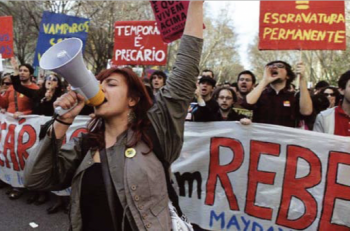
    In 2011 Portugal was at the forefront of Europe’s anti-austerity movement. Yet, four years later, as elections approach in the Autumn, there is no chance of a Left government to ally with Greece’s Syriza or the recent municipal victories in Spain. What went wrong? And can Portugal return to the frontlines? Village’s Ronan Burtenshaw interviews Bloco de Esquerda’s Catarina Príncipe. Q. First, can you tell me how Bloco de Esquerda [the Left Bloc] came about? Several events happened at the end of the 1990s that played into our foundation. The anti-globalisation movement, centred around Seattle in 1999, was important. There was a growing conclusion that we need to find new ways to work together and build projects. Some of these were forums, others were political parties. That was the international moment we were in. Then there was the Indonesia-East-Timor war and occupation. The Portuguese population had its own anti-war movement and sided with Timor against Indonesia. This managed to bring different sections of the Left together to discuss war and campaigning. Finally the failure of the abortion referendum in 1998 was also an influence. There was a referendum to overturn laws banning abortion in Portugal but no broad campaign by progressive or left-wing forces; instead every little group ran their own one. Some of these ran against each other or had clashing strategies. The Yes vote lost, so abortion was illegal in Portugal until 2007. This was the last straw for many on the Left. Q. So how did Bloco form out of these conditions? The definition of Bloco, in its first statute, is a party-movement. It is a broad party that engages with other movements without substituting for or controlling them. It is built up by this grass-roots strength and given a voice in institutions, with a political programme that unites those two domains. Therefore it manages to build strategy together with people who come from very different perspectives, activist histories and traditions. We grew steadily from 1999, when the party formed, until 2011. From 2005 Portugal had a liberal government under the Socialist Party [Portugal’s Labour Party] which had been applying austerity measures for some time before the crisis hit. They used the crisis as an excuse to escalate this. In 2009 we had elections and a broad social mobilisation against austerity. The Socialist Party still won these elections but they didn’t achieve a majority and formed a minority government. Bloco de Esquerda had 10%, the Portuguese Communist Party had 8%, so the radical Left was on almost 20%. Q. What was the result of this growth in support for anti-austerity alternatives? It didn’t mean anything in terms of the programme of the Socialist Party government. In fact, from 2009 onwards they began to impose what they called the “four pacts”, which were packages of austerity measures. The first one cut public spending, the second cut social security, and so on. In parallel they introduced continual measures liberalising the labour market. This produced social mobilisations. We had important Euro May Day demonstrations in 2010. Euro May Day parades are structures we inherited from Milan – colourful, anti-union, involving precarious/ zero-hours workers, quite creative and young, talking differently about labour. Some parts have very Negrian theories, others go with Guy Standing’s idea of the precariat. Our version of this, in contrast to those in Italy, didn’t adopt an anti-union discourse about precarious work but rather tried to ‘add struggles to the struggle’ and forge links with the unions, joining them on the May Day march. We developed a theoretical framework called “precarity in life”, which was a new form of labour discourse. We weren’t just talking about conditions at the point of production – contracts, wages and so on. We talked about the way labour instability affects different spheres of life, and affects you differently if you are a woman, a migrant, or LGBt. We were exploring the relation between exploitation and oppression, developing the particularities of these, but framing it in a new and accessible way. This allowed us to bring together the feminist, anti-racist and LGBt movements with the anti-precarity movement to form the Euro May Day. Euro May Day fed into the first really big demonstration occurring on March 12th 2011 called Geração à Rasca, Generation with No Future. It was started by a call on Facebook by four people, all of whom had some previous involvement in politics but had not been particularly active. It grew exponentially. This was the time of the Arab Spring with all the discussions about the role of new media in facilitating protests so the Portuguese media took this up as our own little experience of it. The organisers were on television almost every day. Soon they realised that they could not organise this phenomenon themselves so they put a call out to social movements and those involved in Euro May Day to help them out. In the end the demonstration had 500,000 people in various places, in a country of around ten million. Q. Was it mostly young people? We were expecting that it would be but in the end it was intergenerational. This proved our thesis in the anti-precarity movement that the issue couldn’t be dealt with in generational terms. There is a particularity to how young people experience insecurity but almost half of the Portuguese working population is precarious right now so you can’t talk about it as generational. The movement was very broad so it was quite apolitical. At the time it was correct to do this but it had limitations. there were no demands, which was necessary because it would not have brought out many people if it was too concrete, but the right-wing also used this space. Two months after the big demonstration they won the snap elections. This was then followed by the arrival of the Troika and the signing of its memorandum by the two right-wing parties who were in coalition [the PSD and People’s Party] and the Socialist Party, who had lost the election.

    Loading

    Read more

  • Posted in:

    World War 1 and the Middle-East

    If Colonel Gadaffi were still running Libya there would not be mass migration across the Mediterranean, with thousands drowned because of unscrupulous traffickers. Gadaffi was guilty of the sin of all those secular dictators. He was too independent of ‘the West’. Britain and France, backed by America, bombed him out of existence. Their excuse was that he intended assaulting civilians in a provincial town. They got the cover of a UN Security Council resolution, which a weak Russia failed to veto. Now Libya is a failed state racked by civil war. Where do these Mediterranean migrants come from? Many are from Syria, another state afflicted by civil war encouraged by the West. Since 2011 the Syrian rebels against the Assad regime have been covertly financed and armed by Saudi Arabia, Qatar and Turkey, with the CIA and Israeli intelligence overseeing the details. Recall the House of Commons vote which denied Tory Premier David Cameron permission to bomb Syria by 285 votes to 272 in 2013. Encouraged by the US, Cameron and France’s Hollande wanted to repeat in Syria the regime- change they had brought about in Libya two years before. It was surely Ed Miliband’s finest moment as Labour leader that he refused to go along. 30 Tories and nine Lib Dems voted against Cameron too. This House of Commons No in turn gave the US Congress the impetus to stop Obama’s impending assault on Assad. In Syria the pretext was to be that Assad used chemical weapons against his foreign-financed rebels. If these rebels succeed in overthrowing the Assad regime, the country’s Christians, Alawites and many Shia Muslims are likely to have their throats cut. The paradox now is that support for the Assad regime in Syria and its Shia-backed counterpart in Iraq looks like being the best hope of holding back the ISIS monster which these ‘rebel’ groups with their dubious sources of arms and finance have spawned. America needs Iran and its clients as allies, not opponents, in the region. Najibiullah in Afghanistan, at the time of the Russian intervention there, was the first of the secular dictators America sought to overthrow by backing the mujahideen fundamentalists against him. Osama Bin Laden was on the US payroll then. Najibullah was executed by the Taliban in 1996. Saddam Hussein was the second, overthrown by Bush and Blair in their 2003 invasion of Iraq. When Saddam ruled Iraq, Sunni, Shia and Christians lived peaceably side by side. Now Iraq too is well on the way to being a failed state, racked by the Shia-Sunni conflict which America encouraged until the tormented politics of the region spawned ISIS. Najibullah, Saddam Hussein, Gadaffi and Assad were certainly dictators but the West did not realise that worse could follow. Since Bush invaded Iraq the USA has become self-sufficient in oil because of the fracking revolution. America no longer needs Saudi oil as it once did. This is the basis of Obama’s turn towards Iran, which in turn causes consternation among the Saudis and Israelis. The Saudi-Israeli response is to try to up Sunni-Shia antagonism further, building on what the Americans had started, seeking thereby to undermine Iran’s clients in the Iraqi and Syrian governments and in the Lebanese Hezbollah, in the hope of stymying a US-Iran deal. A seminal book on the historical background to the region’s current anguished politics, is James Barr’s ‘A Line in the Sand: Britain, France and the Struggle that shaped the Middle East’. The catastrophe in the Middle East is rooted in Western power-grabbing for the provinces of the Ottoman Empire a century ago in World War 1. Iraq, Syria, Lebanon, Palestine and Jordan were all Ottoman provinces then. The different religious communities had lived peaceably side by side in them for centuries. Getting hold of them was one of the war aims of imperial Britain and imperial France in 1914. It was why Britain and France pushed Turkey into an alliance with Germany in the first months of the Great War. What was presented to British and French public opinion as a war to defend the rights of small nations and to prevent ‘poor little Belgium’ from falling under German rule, was seen by these countries’ Governments as an opportunity to expand their empires in the Middle East at the expense of the Turks. Britain particularly wanted to gain control of Palestine and with it the eastern approaches to the Suez Canal, that vital route to Britain’s empire in India. The Bolsheviks published the secret treaties between the Entente Powers within a month of the 1917 Revolution, while simultaneously repudiating them and announcing Russia’s withdrawal from the War. The British were embarrassed, the Arabs dismayed and the Turks delighted. The most important secret treaty was the agreement in March 1915, just one month before the Gallipoli operation, promising Russia control of Constantinople and the Dardanelles after the war, in return for Russian agreement to support British interests in Persia, next to India. Britain had fought the Crimean War in 1854 to prevent Russia taking Constantinople and establishing itself on the Mediterranean. For the same reason Disraeli risked war with Russia in 1878 and sent the British Mediterranean fleet through the Dardanelles at the time. In the lead-up to World War 1, however, a century of British rivalry with Russia – the “Great Game” that was given literary form in Kipling’s novel ‘Kim’ – was abandoned in order to induce Russia to join France in encircling Germany. Russia and France together were the only European land powers that could crush Britain’s rising commercial rival, Germany. As a seapower Britain could help in that defeat, but only land power and large armies could ensure a decisive victory. In early 1915, with stalemate on the Western Front based on static trench warfare from the Channel to the Swiss border, the British and French Governments were worried that Russia might pull out of the war altogether in view of the pasting its armies were taking at the time from

    Loading

    Read more

  • Posted in:

    UN is not Coca-Cola

    By Lorna Gold Negotiations on the UN Sustainable Development Goals (SDGs) may still be ongoing, but the debate is shifting to questions of implementation. A strange logic is evident. A highly technocratic market-driven model of delivery is envisaged rather than any focus on embedding these goals in national political life. There appears to be little appetite to commit the substantial new public resources, estimated at over $1.5tn, required to meet the goals. The SDGs are to be universal to all countries. They cover a vast range of areas. Previously, there were eight Millennium Development Goals, focused on priority basic development areas. There are now seventeen SDGs, addressing the full range of economic, social and environmental objectives which constitute the daily public life of a modern nation. It is all about choices, contradictions and possible pathways when it comes to implementing the SDGs. Issues which are priorities for one nation, are not so vital for another. Decisions around what gets prioritised in any one country have to be embedded in the political choices of that nation if they are to be legitimate and meaningful. The SDGs must be democratically accountable if they are to be achieved. Preparations for this new SDG era is, however, giving rise to a new breed of ‘contract ready’ international NGOs, focused almost entirely on delivery of services connected to one or more of the SDGs. This new breed, such as the Adam Smith International, are winning contracts from local NGOs. Donors are favouring large-scale consortia with a private-sector ethos. In the case of the UK Department for International Development this is accompanied by a ‘payment by results’ approach. Multi-national NGO conglomerates are driving out smaller independent organisations as a result. In the absence of any significant commitment from governments to address fundamental inequalities in the global economy, SDG delivery will mainly come down to new global initiatives by partnerships involving major private-sector entities like Unilever and Coca cola. Last year, Unilever signed a multi-million dollar partnership with Solidaridad, aimed at improving livelihoods through their supply chain. Engaging in such partnerships is set to become the new norm. On the surface, such a shift seems logical. NGOs and corporations join forces to achieve common goals, or in business speak to ‘create shared value’. This ensures economies of scale, greater integration, and faster speed of response. Multinationals can readily achieve ‘market penetration at the bottom of the pyramid’. However, this shift will have serious repercussions for local civil society organisations across the world and their capacity to engage in social action and seek accountability. It will have serious repercussions for the global justice organisations that still support them. Funding for thousands of local NGOs, particularly community-based organisations, that are unable to meet the audit and reporting standards of the ‘contract ready’ NGO, is under threat. This goes to the heart of the concept of human development. It reflects a fracture between approaches to development that have co-existed for decades. On the one hand, there are those who see the business of development as needs-based, involving direct provision of essential services and, essentially, stepping in where government can’t or won’t provide. Speed and scale are off the essence. On the other hand, there are those who see development as about human rights involving action to enable and empower communities to hold duty bearers to account. Local knowledge, community participation, and political accountability are central. The SDGs are broad enough to embrace both approaches, but the needs-based, service-provision model backed by private finance now has the upper hand. The drive towards contract-based SDG provision could lock in an approach to development co-operation that is heavily skewed towards this service-provision model. The big question then is what happens to the local NGOs that focus on democratic governance, participation, empowerment and human rights? Civil society organisations across the world are already under pressure in retaining their democratic freedoms to engage in social action and participatory accountability. Finding funding for such work is increasingly challenging. In countries like Kenya, Ethiopia and Zimbabwe there is an insidious security discourse emerging about international NGOs being agents of foreign interference. These countries are already using legal, policy, and financial means to obstruct the work of vocal local NGOs. They would happily take the help of SDG contract-ready partnerships that absolve them of their responsibilities and make no noise, in preference to the involvement of organisations that support a vibrant and challenging civil society. How INGOs position themselves in regard to these issues over the coming months is critical. •

    Loading

    Read more