
International

Random entry RSS

  • Posted in:

    Make us the best little country for sustainable development

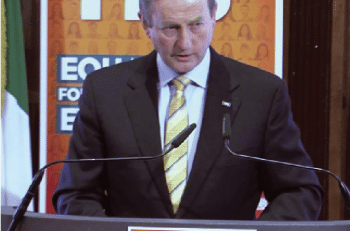
    The Taoiseach got our man at the UN, David Donohue, in to co-chair the process. That looked good and he seemed to do a great job. We need more than rhetoric now though. It would have been better if in addition to signing it he had meant it. There are enough good intentions around to save the planet twice over. It’s pretty big really, the UN’s proposed text on ‘Transforming Our World: The 2030 Agenda for Sustainable Development’. Universal development goals and targets are proposed that involve the whole world, even little Ireland. Can the Taoiseach not imagine a world determined to end poverty and hunger, combat inequalities, and ensure the protection of the planet and its natural resources? He could become part of that really. It’d look great on his CV when he moves on. He shouldn’t get too carried away though, because so far no one seems to want to pay for it. And he wasn’t too generous on that score either. Still, that doesn’t mean he couldn’t head on and make some progress on it back here. There are 17 sustainable development goals and 169 targets. That worries me too. Will Enda Kenny ever keep track of them all? The proposed text says that these goals and targets are “integrated and indivisible”. He’ll have to pursue all of them together, without cherry picking. Will he just sign it and shelve it? Will he hand it over to the makers of indicators and the drafters of reports? We do great reports here but reports never changed much. Ending poverty, inequality and planetary destruction needs more and, let’s face it, the UN are putting it up to us. There is a target to “reduce at least by half the proportion of men, women and children of all ages living in poverty” by 2030, under the goal to end poverty. This government hasn’t been great on poverty. Deprivations levels continue to rise since the coalition took over. Deprivation means people can’t afford two from a list of basic items, but they know that. The deprivation rate in Ireland stood at 30.5% in 2013 and it probably hasn’t got any better since then. That’s at least 1.4 million people. One thing they’re asking for here is the creation of “sound policy frameworks based on pro-poor and gender sensitive development strategies to support accelerated investment in poverty eradication actions”. No one could argue that this government has invested in any way in poverty eradication. Is this all going to change? It must if the Taoiseach is sincere about poverty. The proposed text is big on equality. This is not a value that seems to animate the Taoiseach at all and it would be great if this could change. Yes, he did the marriage equality referendum and that was fantastic. Full marks there. But equality is a bit on the indivisible side too. You can’t do it for some and not for others. Kenny will have to up his game on this one. One goal is to “achieve gender equality and empower all women and girls”. The Taoiseach should be moving to end all forms of discrimination, and to eliminate all the particular forms of violence, against women and girls. He’ll really have to work on this violence one. In 2014, the EU Fundamental Rights Agency found that 26% of Irish women surveyed had experienced physical and/or sexual violence by a partner or non-partner since the age of 15. There is another goal, to “reduce inequality within and among countries”. The government is going to have to “progressively achieve and sustain income growth of the bottom 40% of the population at a rate higher than the national average” by 2013. The Taoiseach’s problems with the tiny minimum wage increase proposed don’t bode well. The starting point for him isn’t great either, with the top 10% of households getting 23.5% of all net income here in 2012 and the bottom 10% only getting 3.1%. It’s almost a case of ‘nothing done, more to do’ on this one. He’ll also have to “ensure equal opportunity and reduce inequalities of outcome” and to “empower and promote the social, economic and political inclusion of all, irrespective of age, sex, disability, race, ethnicity, origin, religion or economic or other status”. Kenny’s track record here, to be honest, is miserable. Under the goal on “cities and human settlements” he’ll have to ensure access for all to “adequate, safe, and affordable housing” by 2030. This is one this government only seems go backwards on. And all that’s before we get to saving the planet. The Taoiseach should go on and sign it anyway. Then come back for the plaudits but get stuck into preparing and publishing the ‘ambitious national response’ the UN is looking for. Make us the best little country to do sustainable development goals in. That’s what he’d really be remembered for, if he cared. •

    Loading

    Read more

  • Posted in:

    Witnessing Halawa’s purgatory

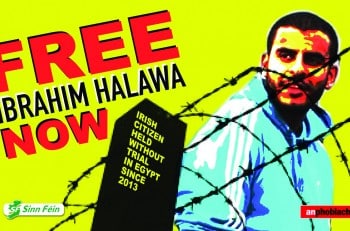
    Everyone I have spoken to says Ibrahim Halawa is a character: a joker who, like many teens, always wanted to be famous. A sad irony that fame has come to him in such awful circumstances: Ibrahim Halawa, along with 492 other protesters, faces the death penalty. Human Rights NGOs Amnesty and Reprieve have both investigated his case and deem him a prisoner of conscience. His trial has been postponed repeatedly. He is not permitted to testify in his defence. His lawyer is not permitted to visit him in prison to hear his version of events. When the court sits, Ibrahim and his co-defendants are kept behind a glass wall and cannot hear the evidence being presented against them. Ibrahim travelled to Cairo in 2013 to visit relatives. He was there when the first democratically elected president of Egypt, Mohamad Morsi, was overthrown by the military. He joined the thousands of others who protested. No matter what your opinion of Morsi and the Muslim Brotherhood, what unfolded on the streets of Cairo was shocking. Over one thousand protestors were left dead. Hundreds, including Ibrahim, were imprisoned. Frustrated at the lack of progress in securing this Dublin teen’s release, I travelled out to Cairo for his tenth trial date. I was accompanied by his legal representative in Ireland, Darragh Mackin. We witnessed first-hand the arbitrary nature of these show trials. Families of the defendants waited outside in the blistering heat; entry to the proceedings is at the whim of the judge. Only lawyers were permitted into the hearing this time. The trial was then summarily postponed until the 4th October. Hopes were dashed again, with devastation for the Halawa family at the realisation that Ibrahim would enter a third year of detention. Once a week Ibrahim is permitted a three-minute visit from a relative. There is no physical contact allowed during these visits. Darragh Mackin and I accompanied Khadija, Ibrahim’s sister, as she made the weekly trek across Cairo to where the permits are issued. It is then an hour-long drive into the desert to Wadi Al Natroon prison. Khadija explained how relatives with permits are regularly turned away. At any point the permit can be rejected. We were brought into the Governor’s office when they realised I was an MEP. We sat there for an hour while they got Ibrahim ‘ready’. Khadija explained how they would shave and dress him in clean clothes for his visit with a parliamentarian. When Ibrahim entered the room, his sister rushed to hug him. The emotional reunion of the two was heartbreaking. Deprived of physical contact for over a year, Ibrahim clung to his sister’s hand for the whole visit as he detailed the horrific prison conditions. He is confined to a 5m x 4m cell with nine other prisoners, twenty-four hours a day. There are no beds, no shower, just a tap and the toilet is a hole in the floor. Every morning he wakes to the sounds of prisoners screaming. He himself was beaten two weeks ago. A glimmer of the ‘joker’ Ibrahim, I had heard so much about appeared as the visit progressed. He mocked his sisters shoes. Through tears there were smiles as she told him to stop. A normal sibling interaction in a very abnormal setting. It was hard to listen to this young man talk about his depression, how he spent days trying to remember school lessons to try to keep his mind active. He should be two years into his engineering degree in Trinity. Instead he sits in a cell in Cairo facing the death penalty. The Irish government has opted for a strategy of quiet diplomacy. From my conversations with NGOs and human rights lawyers working in Egypt and London I disagree with this strategy. There are, however, still a number of simple measures that the Irish government could take that would improve Ibrahim’s situation. Ibrahim has asked to see an outside doctor for breathing difficulties. He struggled to breathe when we met with him. Minister Flanagan should write to his counterpart asking that this request be granted. There has been no ambassador in Egypt since April. The consulate based in Cairo covers four other countries. Fast-tracking the appointment of the new ambassador would ease the workload on the consulate. More importantly, an ambassador carries more status for dealing with Egyptian officials. The Australian Consulate brought Peter Greste’s family with them when they visited him in prison. The Irish Consulate should seek to do the same for the Halawas. These steps may be small but they would make a huge difference to the morale of this young Dublin teen. •

    Loading

    Read more

  • Posted in:

    Multinationals outmanoeuvre UN’s sustainability agenda

    The historic UN Summit on the new Sustainable Development Goals is only weeks away. Everything is all but agreed. The final-outcome document has been in wide circulation since early August and all that remains now is a photo shoot with world leaders and a massive corporate party in Central Park to usher in a new era of global peace and prosperity. Ireland, as co-facilitator of this process, has achieved an almost impossible task in pulling the rabbit out of the hat. The problem is that for all the promises to take “bold and transformative steps” to ensure that “no-one is left behind”, it is increasingly hard to see how this new agreement can achieve anything significant. While “Transforming our World: the 2030 Agenda for Sustainable Development” abounds in ambition – 17 goals and 169 targets in total – it is very weak on the necessary measures to turn this agenda into reality. The means to implement the new goals were meant to be decided at the third Financing for Development (FfD) Conference, which took place in Addis Ababa in July. This event delivered little in terms of the resources needed to address extreme poverty, inequality and environmental degradation. History may well look back on this as a pivotal moment when state-based multilateralism caved in spectacularly to transnational private interests. The dawn of a new stream of “plurilateralism” has emerged. The Addis Conference was the third such conference hosted by the UN since 2002. The FfD process was established in 2000. It was comprehensive, meaning that it had the mandate to look at ALL areas of global finance and economic governance necessary to deliver on the ambitious Millennium Development Goals. It was not restricted to issues of aid, but could make recommendations on tax, debt, trade, and the private sector as well as systemic issues such as economic-governance reform. This was truly revolutionary. During that first conference in 2002, through strong civil society action, for example, the proposal for a financial transaction tax, which had been ridiculed before, gained formal recognition. Issues of human-development-based debt sustainability were put on the table, as was the idea of a new global economic governance council under UN auspices to temper the power of ad hoc groupings such as the G8 and the OECD. Since then, however, the FfD process has been dogged by the same political obstruction which has hampered other major international reforms. It was seen as a serious threat to the power of wealthy nations, who prefer to discuss finance behind closed doors in institutions such as the World Bank, WTO, IMF and OECD. They have, therefore, sought to undermine the process at every turn, divesting it of any real power to tackle issues of financial reform, especially issues of economic governance and taxation. Despite these efforts, the issue of taxation made it to the top of the agenda for the Addis Ababa FfD Conference. Former South African Prime Minister Thabo Mbeki launched a report showing that African countries have lost the same amount in illicit financial flows as they have received in aid in the last 50 years. Annually they lose $50 billion in tax through these illicit financial flows. Multinational corporations based in rich countries, who also set the tax rules, are by and large responsible for this through tax dodging schemes such as transfer mis-pricing. If development is to be funded through domestic resources, this massive haemorrhage of capital needs to be stemmed. As Mbeki said, “we need to stop the bleeding”. The conference heard calls on the part of the G77 and of civil society for the establishment of a global tax body under the auspices of the UN. Such a body would enable all countries to have an equal say in setting tax rules. This was backed by the report of the Independent Commission on the Reform of International Corporation, headed by Nobel Prize winner Professor Joseph Stiglitz.These calls, however, were blatantly ignored as rich country after rich country, including Ireland, was at pains to state that they prefer to talk about tax in the OECD, a club for rich nations, not the UN. Ireland’s intervention at the conference was, for the most part, very weak. Despite pressure from civil society in advance to use this opportunity to lead by example and re-interate its commitment to meeting the 0.7% target on development aid by 2020, the government preferred to hide behind the weak EU position. On other controversial issues, such as taxation, it was clear that it shared the broad OECD consensus. Despite its prominent role in the UN process for new Sustainable Development Goals, no new commitments were made. The focus of most wealthy countries was not even in the main conference room. As has become the pattern at such UN conferences, the main action was happening elsewhere in the many hotel conference suites surrounding the conference venue. The private side-events, many of them invitation-only (though it was not hard to get in if you could find them), represented the main focus of attention. Here the transnational private sector and governments joined forces to launch new ‘blended financing initiatives’. At such events, initiatives can simply be announced rather than agreed. The ReDesigning Development Finance Initiative backed by the World Economic Forum announced several new initiatives which have the potential to re-shape the development landscape. Whilst the initiatives may have been dressed up in their best sustainable-development rhetoric for the occasion, they are far from sustainable. In reality, they are essentially about replacing the role of public finance with new unsustainable cycles of international debt. The new “collaborative development financing model”, backed by the online Convergence Platform, describes itself as “a new global platform that generates a flow of credible investment opportunities in emerging and frontier markets from a network of leading investors and financiers. Convergence allows private and public funders to blend their capital, creating more financially attractive, high-quality deals”. It aims to harness $100bn in blended finance towards public private partnerships in the developing

    Loading

    Read more

  • Posted in:

    Nationalism before socialism

    The political Left, whether social democratic, communist or Trotskyist, has always found the European Union problematic. This is because supranational EU ‘integration’ poses the issue of national independence and national democracy so acutely, something many on the Left find embarrassing. They prefer to concentrate on economic issues, for on political ones like national independence they fear being found on the same side as the Right. Their political sectarianism makes that hard for them to cope with. The EU shifts a myriad of government functions from the national level, where they have traditionally been under the control of democratically elected parliaments and governments, to the supranational, where the bureaucrats of the EU Commission have the monopoly of legislative initiative and where technocracy rules. Should the Left oppose or support this process? The classical socialist position is clear. It is that leftwingers should eschew “economism” and should seek to give a lead on democratic political questions as well as economic ones. They thereby put themselves in the best position to win political hegemony in their respective countries and to implement leftwing economic measures in due course when their peoples desire these. Marx and Engels took it for granted that socialism could only be achieved in independent national states. In ‘The Communist Manifesto’ of 1848 they wrote: “Though not in substance, yet in form, the struggle of the proletariat with the bourgeoisie is at first a national struggle. The proletariat of each country must, of course, first of all settle matters with its own bourgeoisie”. They supported Irish independence from Britain. Engels wrote to his friend Kugelman: “There are two oppressed peoples in Europe, the Irish and the Poles, who are never more international than when they are most national”. Their Irish follower, James Connolly, showed by his political practice in allying himself with the radical democrats of the IRB in the Easter Rising that he regarded the establishment of a fully independent Irish State as the prerequisite of being able to achieve the socialist measures that he advocated. While awaiting execution he speculated on how the international socialist press would interpret the Dublin rebellion: “They will never understand why I am here. They will all forget I am an Irishman”. Outside Europe the proposition that the Left should be the foremost advocates of national sovereignty would be taken as self-evident. The strength of communism in Asian countries like China and Vietnam rests on its identification with nationalism. The appeal of the Left in Latin America is largely based on its opposition to Yankee imperialism. Only in Europe do so many Leftwingers regard the defence of national independence in face of EU integration as “right-wing” and therefore by definition reactionary. This is primarily due to the fact that the main countries of Western Europe – France, Germany, Britain, Spain, Italy etc. – were all imperial powers in their day and historically their mainstream labour movements identified with that imperialism and its colonial accompaniments. With honourable if marginal exceptions, the national labour movements in these countries supported their respective national bourgeoisies in going to war with one another in World Wars I and II. In the second half of the 20th century transnational capital became predominant over national capital in the advanced industrial world. In Europe continental social democrats now shifted to backing European-based transnational capital in supporting its main political project, the construction of a supranational power, the EU/Eurozone, in which the classical principles of capitalist laissez faire – free movement of goods, services, capital and labour – would for the first time in history have the force of constitutional law. In Britain and Ireland Labour initially dissented. The political tradition in Britain is that all the main issues of national policy are decided inside the Tory Party, with the rest of society having bit parts. Joining the EEC became the central goal of Conservative policy from 1961. The Labour Left originally opposed this, as indeed in this country the Irish Labour Party opposed Irish membership of the EEC in our 1972 Accession referendum. Under Michael Foot’s leadership British Labour advocated the UK’s withdrawal from the EEC in the 1983 general election. Then in 1988, with Margaret Thatcher in Downing Street, Commission President Jacques Delors, a French socialist, wooed the British TUC at Blackpool and Ireland’s ICTU at Malahide and promised them labour-friendly legislation from Brussels which they would never get at home. The Trade Union leaders embraced “social Europe” and much of the Labour Left followed them, in some cases becoming missionaries for the grand “project”. As the downside of the EU/Eurozone became clear in recent years, Euro-scepticism began to grow on the political Right. Now some on the Left are starting to follow the Right in that too, in Southern Europe and maybe in Britain. In France and Italy the central role of communists in the war-time Resistance and their consequent appeal to national sentiment gave these countries mass communist parties for three decades after World War II. A key factor in the subsequent decline of these parties was their embrace of the EC/EU in the 1970s and 1980s as one of the tenets of “Eurocommunism”. In France this volte-face was necessary to allow Communist Ministers join Francois Mitterand’s socialist government in 1981. I recall the labour historian Desmond Greaves remarking at the time; “This will revive fascism in France.” That was before anyone had heard of Le Pen. The French CP, which had one-quarter of the seats in France’s National Assembly in 1956, has 2% there today. Many former French working-class communist voters now vote for the National Front. Leftwingers in the Trotskyist tradition tend to be upholders of EU supranationalism as “objectively progressive”, while stigmatising concern for national independence as nationalism and “rightwing”. This goes back to Trotsky’s famous dispute with Stalin in the 1920s over whether it was possible to build socialism in one country – that being Stalin’s view – or whether it required a more general transformation, world revolution, as Trotsky thought. The EU is

    Loading

    Read more

  • Posted in:

    Agenda 2030 to replace Millennium Goals, at UN. By Luke Holland.

              Key is implementation. Do we really intend to keep our promises? It’s a question that begs to be answered as the international community unveils the new global development agenda for the next 15 years, because meaningful provisions for monitoring and accountability are notable by their absence from the framework. What’s more, many nations have been reluctant to take on their share of responsibility for financing the new agenda, further fuelling doubts over their determination to achieve the goals it sets out. Agenda 2030, which will be  rubber stamped by the UN General Assembly in its meeting of 25-27 September after three years of debate and consultation, comprises 17 goals and associated targets tackling everything from extreme poverty and hunger to confronting inequality and combating climate change. It takes the place of the Millennium Development Goals (MDGs), a set of eight global objectives agreed back in 2000, most of which have not been achieved. But unlike the MDGs, the new framework will apply in both developing and developed countries alike. If Agenda 2030 is to prove more effective than its predecessor, it is crucial that mistakes of the past be avoided this time around. To this end, civil society organisations around the world have been campaigning hard over the past few years for the new framework to be anchored in human rights. Underpinning this demand is the understanding that the new agenda must offer a vision of development based on justice, rather than the outdated charity-based model of the past, if it is to deliver real change. This in turn requires that robust systems be put in place to monitor progress towards the new goals and targets, and to hold those in power answerable wherever there are shortfalls. Weak provisions for monitoring and accountability are one of the main reasons progress towards the original MDGs was so limited; without strong monitoring and accountability mechanisms, governments do not face the necessary incentives to prioritize their development targets, and civil society is left with few avenues to challenge them over any lack of progress. During the negotiations, attempts to include systems of monitoring and review were deemed “overly prescriptive” and effectively kicked down the road to be dealt with at a later stage. Even some timid language suggesting that countries might conduct a review process at least every four years was removed from the final draft of the agenda, and there is no clear picture of what the lines and channels of accountability will be. As things currently stand, the UN Secretary General is to provide a set of proposals in early 2016 on how countries should provide for monitoring and review, but his recommendations will remain just that – recommendations – and as such member states are not obliged to make meaningful commitments. Some governments, in particular those that have grown weary of onerous conditionalities attached to aid packages, see any international-level monitoring as a recipe for finger-pointing and infringements on their policy space. While past experience makes their concern understandable, strong monitoring and review processes, at the national, regional and international levels, will be crucial to determine what is working and what needs to be improved, and to ensure the experiences and concerns of the most disadvantaged are taken on board as development processes unfold over the years ahead. In both rich and poor countries, real progress is contingent on the voices of marginalized sectors being incorporated into all areas of policy design and implementation, from international aid and trade to development financing and taxation. The issue of monitoring and review is not the only area where a certain reticence has been on display, as some member states have also been reluctant to take on their fair share of responsibility for the costs of future development. Indeed, one of most persistent controversies in the final phase of the talks was the question of how much various member states should have to pay. The “Group of 77” developing countries argue that rich countries should be required to contribute more, but richer countries’ recalcitrance to make concrete, time-bound commitments in this regard has proved intractable, particularly with regard to the structural obstacles that prevent poorer countries from raising sufficient money to pay for development. At the Financing for Development (‘FfD’) talks – a parallel set of negotiations on how resources for global development should be raised and deployed – certain developed nations blocked proposals for an international tax body designed to address crossborder tax evasion and dysfunctional tax competition, both of which impede the development of poorer countries. As a result the FfD process, which drew to a close at a summit in the Ethiopian capital Addis Ababa in June, delivered a final agreement that fell far short of what was needed.   But even in the face of these important shortcomings, it must also be recognized that the new framework does provide cause for some cautious optimism. Being anchored in the principle of universality, it applies in both developed and developing countries alike and, in a time when soaring inequality is exacerbating social marginalization and unrest in many parts of the world, this pledge to end deprivations in both poor and wealthy nations is of no small significance. Commitments on transparent, accountable governance, together with targets that reflect a range of human rights obligations, from water and education to equality and access to justice, likewise mark a crucial departure from the outdated vision of the MDGs. And perhaps most fundamentally, the breadth and scope of the new agenda’s 17 goals provide a comprehensive consensus on what a better world should look like in 2030. These are commendable provisions, but the history of international development is littered with unfulfilled promises and the true test of the Agenda 2030 will lie in its implementation.  While there will inevitably be an air of celebration when the new framework is formally approved at the General Assembly, member states would do well to remember that this is the beginning, rather than

    Loading

    Read more