International

Random entry RSS

  • Posted in:

    Portuguese Parallels

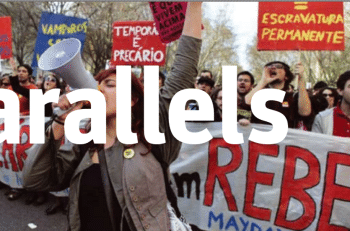
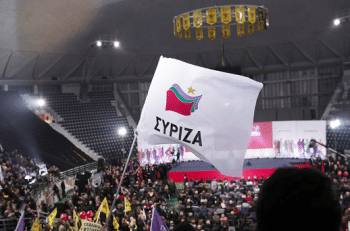
    In 2011 Portugal was at the forefront of Europe’s anti-austerity movement. Yet, four years later, as elections approach in the Autumn, there is no chance of a Left government to ally with Greece’s Syriza or the recent municipal victories in Spain. What went wrong? And can Portugal return to the frontlines?

    Loading

    Read more

  • Posted in:

    Clintoff

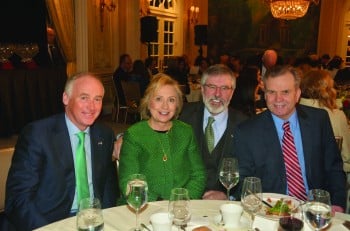
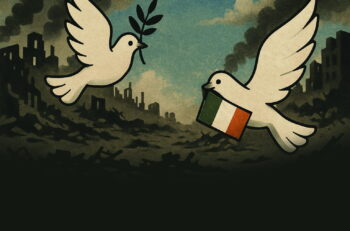
    By Michael Smith Although his recent profile in the Sunday Business Post of potential President Hillary Clinton was entirely uncritical, in fact the apogee of Niall O’Dowd’s insatiable need to ingratiate himself with the Clintons was on the eve of St Patrick’s day.  It was then the Irish Voice publisher inducted Hillary Clinton into his partly self-serving Irish America Hall of Fame, an excruciating event that exquisitely encapsulates the difference between Ireland (which recoils from Halls of Fame) and the US (which can’t get enough Halls/ Fame/ Halls of Fame). “Hillary Clinton played”, averred the man who always finds a way to put Irish next to America, “a leading role in creating the links between the White House and leaders on the ground that would become so important during crunch time when negotiations came”.  However, Trina Vargo, former peace-protagonist, foreign policy advisor to the late Senator Ted Kennedy and scathing O’Dowd antagonist, is sceptical: “That’s as specific as he can get, and as non-specific as he has to be, because there’s no there there”. The official US view of Ireland is romanticised, so small emblematic things like tea are afforded more than their due space in a way they would never be in, for example, the official take on Israel. Ireland and tea have Clinton history.  During Hillary Clinton’s 2008 campaign for president, her primary opponent, Barack Obama, meanly disdained her as having merely “had tea with” world leaders as first lady. Her husband bounced to her defence as “a peacemaker, not a tea maker”. Clinton nodded to that history as she was feted by O’Dowd and the usual assemblage of Irish and Irish-American power hawks at dinner in Manhattan. She emphasised the importance of tea – classically steeped and shared by women whose embrace of peace accords, she said, was vital to their evolution. She has said: “I remember a meeting that I pulled together in Belfast, in the town hall there [in fact it seems to have been in a café on the Ormeau Road], bringing together for the first time Catholics and Protestants from both traditions, having them sitting a room where they had never been before with each other because they don’t go to school together, they don’t live together and it was only in large measure because I really asked them to come that they were there. I wasn’t sure it was going to be very successful and finally a Catholic woman on one side of the table said, ‘You know, every time my husband leaves for work in the morning I worry he won’t come home at night’. And then a Protestant woman on the other side said, ‘Every time my son tries to go out at night I worry he won’t come home again’. And suddenly instead of seeing each other as caricatures and stereotypes they saw each other as human beings and the slow, hard work of peace-making could move forward”. Others, including the Belfast Telegraph at the time, say the meeting was stilted, overrun with secret-service operatives; and that far from its being their ‘first time” the protagonists at the tea were in fact ‘pre-networked’. A recent discussion of the speeches at O’Dowd’s dinner on his television show culminated in Vincent Browne’s conclusion that Hillary was “telling porkies”. Moving (largely) beyond metaphor, Clinton stopped well short of depicting herself as instrumental to the Good Friday Agreement that President Clinton brokered in 1998, but said her outreach to women in Belfast during that period had played a critical role. “You cannot bring peace to people just by signing an agreement”, Mrs Clinton told the St Patrick’s weekend dinner. “In fact, most peace agreements don’t last. There’s been some very important work done in recent years that – where women are involved, and therefore where the work of peace permeates down to the kitchen table, to the backyard, to the neighborhood, around cups of tea – there’s a much better chance the agreement will hold”. During the Presidential election in 2008 uxorious Bill Clinton, who eschewed tea imagery, had withdrawn from a 10th anniversary commemoration to be held in Belfast, inflaming intrigue and tension between Mrs Clinton and her opponent for the Democratic nomination, fresh-faced Barack Obama, over her experience in foreign policy matters. Clinton claimed that, unlike Barack Obama, she and likely Republican nominee John McCain had “cross[ed] the commander-in-chief threshold”. Northern Ireland had become one arena of an increasingly acrimonious debate between Mr Obama and Mrs Clinton about her experience, sparked when Mrs Clinton ran a campaign advertisement which left tea entirely to one side to ask tendentiously who would be better equipped to answer an emergency call to the White House at 3 a.m. But we should not inflate our importance: other arenas included Bosnia, Rwanda and China. On the campaign trail, Clinton had on several occasions said she “helped to bring peace to Northern Ireland” and certainly she had visited the area seven times between 1995 and 2004 – five times as first lady. Of course, “helped” is a fairly anodyne claim and in an interview with National Public Radio she went a step further, declaiming that the role she played was “instrumental” in ending the decades-long conflict there between Catholics and Protestants. The Obama campaign accused Mrs Clinton of exaggerating her specific role and general experience. A policy memorandum written by Greg Craig, a well-placed foreign policy adviser to Mr Obama complained: “It is a gross overstatement of the facts for her to claim even partial credit for bringing peace to Northern Ireland”. Though Mrs Clinton globe-trotted as first lady and had some contact with Irish women’s groups, he added, “at no time did she play any role in the critical negotiations that produced the peace”. Visiting the United States around that time Bertie Ahern, who might be expected to know but who might also be unreliable  ventured that Mrs Clinton had been “hugely helpful” in the peace process, but he pulled up short of crediting her

    Loading

    Read more

  • Posted in:

    Fracture

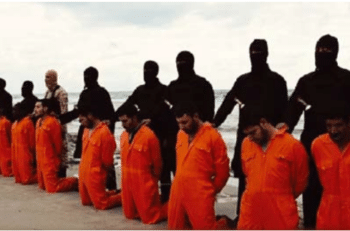
    ‘Values’ clash with a ‘prosperity’ imperative in Ireland’s new foreign-policy framework. By Lorna Gold

    Loading

    Read more