Interview

Random entry RSS

  • Posted in:

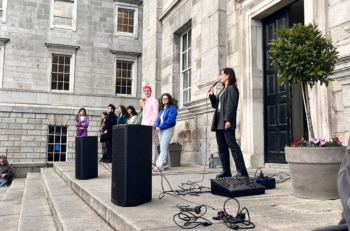
    Jes Paluchowska interviewed the on-message candidates for President of Trinity College Dublin’s Student Union. Voting closes on 27 February at 4pm

    . The Student Union in Ireland’s top-ranking university, Trinity College, is currently in the process of electing new sabbatical officers. The first hustings was on 18 February.  Last year, the Students Union (SU) President, Laszlo Mornafi, made headlines when it promoted an encampment that blocked access to the Book of Kells as an act of protest against the war in Gaza. Recognising the importance of Trinity’s student body, Village asked the SU’s presidential candidates to give a brief account of how, if in office, they plan to address the values of sustainability, diversity and equality. Here are their responses. Patrick Keegan “Trinity has many shortcomings, and it’s up to us to take action to hold the college to account. Students have the power to enact change, and we must engage in direct action and lobbying at every step to ensure that Trinity properly represents us all. Trinity often focuses on optics rather than real sustainability, and has partnerships with companies like Coca Cola and Ryanair, promoting greenwashing while they continue their harmful practices.  On diversity and equality, we must push Trinity to do better. Student consultations are crucial to identify areas for improvement. We must ensure that all students from all backgrounds feel welcomed at Trinity, and it’s through consultations that we can best identify and address all issues, no matter how big or small. Trinity must also confront its ties to oppressive regimes, such as apartheid Israel, and address shortcomings in trans healthcare and racism. Trinity must do more to support Irish-language speakers, such as by offering modules through the medium of Irish. As President, I will work for all students, demanding the college prioritises students. Trinity also has much to do to ensure equal access to education, as many lectures are not recorded, and many students don’t have their LENS reports properly met. We will address these issues through lobbying, information campaigns, and direct action. Additionally, our campaign weeks provide a perfect opportunity to address specific issues. We are the largest stakeholders, and we must hold Trinity accountable, acting radically to ensure Trinity represents us all”. Giovanni Li  “Sustainability, diversity and equality are three of the most recent popular buzz-words within this decade, advocating for the rights as well as the well-being of the average person and not just those who are privileged. No matter the race of the individual, background, status or any other external factor. If I were to be elected it would be of utmost importance to me that these core values are held to the highest standard possible, no student will be left behind, no tables unturned in fighting for what we now know as student rights, no blind-eye will be turned to any individual who poses a threat to the well-being of students. But most importantly, I will ensure that ignorance will be the last thing that shows up on the Union’s doorstep. To advocate and allow visibility for the needs of the students such as rent pressure alleviation, campus quality, poorly run examinations, lack of recourses, lack of accessibility, lack of inclusivity… the list goes on and I will not stand down or be silent in these tumultuous times. I will turn what we now know as a Trinity into a haven for students, a place where they feel safe, heard and educated without barriers. We must break free of these barriers that have been placed upon us by our oppressors. #VoteLiBreakFree”. Seán Thim O’Leary “I view all three values as deeply intertwined. Sustainability is the ability to operate and live up to one’s values in the long term. Diversity should lead one to proactively take steps to bring about fair access for those from marginalised backgrounds. Equality then is self-evidently linked in, involving proactive and codified efforts to engage and improve experiences of those from marginalised and disadvantaged backgrounds. If elected  President, I would like to draw particular attention to the systemic barriers within and outside college, which impact thousands of Students within Trinity. I would like the Union to take a proactive welfare- and service-based approach to meet student needs on campus, while employing grassroots organising, to aggregate the voices of students of all backgrounds, and use that as a platform to fight the government and college administration for justice on students’ behalf. The government disregards the student perspective, and disregards some students far more than others; the fight for justice here is a fight for all students. Specifically within Trinity, I want to take the opportunity to highlight chronic underfunding of the student counselling service, college health, and necessary course equipment (impacting students from STEM to Creative Arts). Here we have a lack of focus from college administration, and chronic neglect from the government; tackling this requires targeted political action, and on campus organising over a sustained period. The Union needs to properly engage and mobilise student action on this front, and not just through token surveys”. Jes Paluchowska is studying English and Philosophy in Trinity Photos: Trinity News

    Loading

    Read more

  • Posted in:

    Heir Apparent’s Big Day Out

    Conor Lenihan interviewed Minister for Finance, Jack Chambers on the eve of his first budget Jack Chambers assails Sinn Féin policies that would turn Irish economic success “to dust” and says Trump policies are a “present risk” to Irish growth; Conor Lenihan sees Chambers as heir apparent to Micheál Martin and says few in Fianna Fáil would consider opposing Martin if he runs for the Presidency next year. In his office on Merrion Street, Chambers told Village Magazine that Irish economic success would “turn to dust” should Sinn Féin be allowed into government.  Describing Sinn Féin’s alternative budget as “reckless and dangerous”, Chambers said their policies would seriously risk and jeopardise the country’s progress.  “We are in line to receive around €30bn in corporation tax this year – much of which is from multinationals operating here. Sinn Fein’s proposals would not only discourage any from setting up here but would drive the existing companies away”, he said.  Chambers was surprisingly trenchant: “Worst of all, Sinn Féin have said they would raid the Future Ireland Fund which will be essential in providing for current and future generations”. His comments will be read as his first shots in the election campaign with a  general election now expected by political pundits for 15 November.  Both Fianna Fáil and Fine Gael are expected to target Sinn Féin which they perceive to be weak on a number of fronts.  “Worst of all, Sinn Féin have said they would raid the Future Ireland Fund which will be essential in providing for current and future generations”.His comments will be read as his first shots in the election campaign with a  general election now expected by political pundits for 15 November. The new Finance Minister professed admiration for some of the new initiatives on clean energy being carried out by the Starmer Labour government in the UK. Chambers acknowledges that Ireland must now pay attention to the risks we face due to the retreat from globalisation from which Ireland greatly benefited.: “The country must be prepared for potential disruptions to global trade, especially with key trading partners like the US and China. Managing these risks will require a careful balancing of domestic and international interests”.  Not mincing his words, Chambers cites a Donald Trump presidency as one of the key risks we face: “It certainly presents risk and possibilities of disruption, as it did on his previous term, but some of the risk didn’t necessarily crystallise.  However, some of the Trump policies in lots of areas are a present risk”. He intends to use the €8.3 billion available to him on budget day to promote growth: “Our primary focus is on providing tax relief to workers, promoting enterprise, addressing the housing crisis  and securing long-term sustainability through strategic investments”. “”. Chambers has insisted that the tax package in his budget will be targeted at lower and middle income earners. He admits that the average worker on approximately €50,000 still carries a  “significant tax burden”.  “Beyond tax relief, a core aspect of our economic policy is fostering enterprise and innovation. These are the driving forces behind the future productivity and competitiveness of the Irish economy”. In Fianna Fáil circles his meteoric arrival in Finance and his appointment by Micheál Martin as Deputy Leader of Fianna Fail makes him the heir apparent to Martin if the latter moves on following the General Election. With Michael McGrath gone to Brussels it is hard to detect any serious opposition to him becoming leader. Of course Darragh O’Brien, Jim O’Callaghan and more recently Norma Foley have also got their supporters.  Chambers, not unlike other colleagues, will not be drawn on what the future for his party will be beyond the leadership of Micheál Martin. There has of course been intense recent speculation that Martin may be a candidate in the Presidential election which will happen towards the end of next year when Michael D Higgins stands down.  Few would presume to oppose Martin should he decide to run for the party.  Fine Gael under Simon Harris are enjoying a huge opinion poll boost to their support. It remains to be seen if this will be sustained. Clearly Fianna Fáil are hoping that a strong budget performance from Jack Chambers will even out the extraordinary surge in support that Simon Harris has brought about.  A distinct feature of the recent European and local elections was the strong rate of transfer  between Fianna Fáil and Fine Gael candidates when one or the other dropped out. This is clearly giving hope to Martin and Fianna Fáil that the General election will not fare out to be bad for them. Jack Chambers (33) has been Minister for Finance since June 2024 when he was also appointed deputy leader of Fianna Fáil. He previously served as a Minister of State attending cabinet from July 2020 to June 2024, and as Government Chief Whip from July 2020 to December 2022. He has been the Dublin West constituency since the 2016 general election.  He was educated at Belvedere College; Trinity College where he studied Law and Political Science; and the College of Surgeons where he completed a medical degree. He is the youngest Minister for Finance since Michael Collins and a likely successor to the leadership of Fianna Fáil. In the first part of the interview, former Fianna Fáil Innovation Minister and journalist, Conor Lenihan, discussed the budget and the Sate’s finances.  In a second part, to appear in Village magazine later this week, Michael Smith talked to him about his political outlook. He gave Village over an hour of his time the week before the budget, remaining characteristically upbeat, solid and sober throughout the interview.  Here’s the interview, lightly edited for length: Economic Statement on Tax, Expenditure, and Growth Since I became Minister in June, I’ve been working on the Summer Economic Statement and latterly Budget 2025. The Statement outlines a comprehensive plan to use €8.3 billion in tax and expenditure measures for sustainable economic growth. Our primary focus is on providing tax relief to workers, promoting

    Loading

    Read more

  • Posted in:

    In a legally questionable  move, on January 3, 2020, the Central Electoral Commission of the Spanish government, an administrative body with no judicial standing, voted to remove Torra from office immediately.

      Up until two years ago Joaquim ‘Quim’ Torra was a business executive and cultural activist who had never been involved in electoral politics.  However, when the Spanish central government dissolved the Catalan parliament over its late October 2017 vote in favour of seceding from Spain, and subsequently ordered new elections that it clearly presumed would restore a pro-unionist majority in that body. To the surprise of much of the world, and the intense dismay of the Spanish government, exiled President Carles Puigdemont’s Together for Catalonia list won the elections, and hence the right to form a new government. Torra was successful as a parliamentary candidate. But Spain would have none of it. When, on January 30 2018, the Catalan Parliament was about to swear Puigdemont in by video connection from Belgium, the president of that body abruptly stopped the process in reaction to the threat of judicial sanctions – sanctions rooted in highly questionable jurisprudence – he had received from the Spanish courts. Two further candidacies centring on pro-independence figures were similarly scuttled in the succeeding months. Finally, on 17 May 2018 the then still largely unknown Torra was voted head of a pro-independence coalition government. Since assuming office he has repeatedly made clear that he believes that Carles Puigdemont is still the legitimate president of Catalonia and that his prime goal is that of advancing Catalonia toward independence in the most expeditious manner possible. The fact that he is a political newcomer who did not come up through ranks of his own party has led the generally pro-unionist press of both Catalonia and Spain, a press corps that tends to view machine politics as normative and  their continuation as inevitable, to treat this most cultured and literate of public figures  with no small amount of condescension, though Torra does not seem to care. This interview, conducted in Catalan and edited for reasons of space, took place on 30 October in the Palace of the Generalitat (The Catalan Government) in Barcelona, that is, 16 days into the massive and still ongoing acts of civil disobedience unleashed in reaction to the Spanish Supreme Court’s harsh sentencing of the politicians and civil society leaders responsible for promoting the October 1, 2017 independence referendum, 11 days before the fourth Spanish general elections in as many years, and 19 days before Torra’s own trial, at which he defiantly pleaded guilty to disobeying a Spanish government order to remove a banner hanging on the front of the Generalitat  that made reference to Catalan “exiles” and “political prisoners”. TH: How would you explain what is going on in Catalonia today to a reader who has little or no detailed understanding of the country’s history? QT: A quick response would be to compare it to a case with which most English language readers are familiar, and have to a certain extent reflected upon, which is Scotland – and the UK. I would speak of an ancient nation from Southern Europe that has always demonstrated a firm dedication to the pursuit of liberty, and that, after suffering a number of setbacks over the last three hundred years – years during which it worked to fit into the Spanish state and gain its trust – has, over the last decade or so, chosen to initiate a democratic process aimed at gaining independence. This is not about flags and borders. It is about quality of life, better education, better healthcare, an improved infrastructure and, of course, greater protections for the country’s language and culture. But above all, it is about being able to face the challenges of the twenty-first century with all of the tools that any modern country can expect to have at its disposal. TH: Do you think Catalans have a special obsession with freedom? QT: There are historians, such as Rovira i Virgili, who define the history of Catalonia precisely in terms of this special relationship to freedom. Others, such as Vicens Vives, link it more to a “will to exist”. Josep Benet, in turn, has summed it up, in a marvellous phrase, as centring on a “combat in the service of hope”. Others, of perhaps a more fatalistic cast, like Ferrater Mora say that a people cannot live life always on the defensive, that it  must arrive, or seek to arrive, to a state of vital fullness. TH: How did you come to be president of the Generalitat in the Spring of 2018? QT: I spent most of my life as a lawyer in private business, the last two years of that in Switzerland, an experience that allowed me get to know a country, the Helvetian Confederation, that I admire a lot. Returning to Catalonia, I founded a publishing house and got involved in historical research and writing. I’d always had strong cultural, civic and political interests thanks to my work in voluntary organisations of the type that are, in my view, fundamental to gaining an understanding of the country. These entities are the basis of its strongly ‘associative’ social fabric, and what provides it with very strong social cohesion from below. I had the good fortune of working side by side with the late Muriel Casals at Omnium Cultural  [along with the Catalan National Congress, the country’s most important pro-independence civic organization], an experience that allowed me to participate, as it were,  from the “second row”, in the last ten years of the country’s fast-moving history. During the latter part of this time, the country’s government was forcibly dismissed by the Spanish state (on 27 October 2017) while our elected leaders were either imprisoned or forced into exile. In the lead up to the 21 December 2017 elections imposed by Spain, I received a call from President Puigdemont in which he asked me to run as a candidate on his parliamentary list (Together for Catalonia). But owing to a series of events that would take a very long time to explain, and that are rooted in the repression that this country currently suffers

    Loading

    Read more

  • Posted in:

    Michael Smith interviews Olivier Peter about his client Jordi Cuixart who, though innocent, faces 17 years prison on spurious charges of rebellion and sedition

    ON FEBRUARY 12, a criminal trial of twelve Catalan independence leaders, ten of them elected representatives, commenced before the Spanish Supreme Court. Though it is dressed up as a judicial process clearly it has political motivations and implications. It is clear there are systemic problems with the Spanish legal system. Village interviewed Olivier Peter, a Geneva-based lawyer representing an activist jailed 17 months ago without bail on implausible charges of rebellion and sedition. Jordi Cuixart, a long-time activist, pacifist and human rights defender is President of Omnium Cultural which is a cultural and civil rights organisation, not funded by government, with 160,000 members. Olivier Peter is a Swiss lawyer who says he got involved when he received an invitation to visit Cuixart in prison. “We had a long discussion on political trials and the international dimension of the case, and here I am”. After the referendum on Catalan independence in 2017 Peter says Cuixart was arrested: “He was ordered before a tribunal and sent to prison without bail. 17 months later he’s still in jail”. The charges were rebellion and sedition, “for participating in a demonstration and calling people to participate in the referendum. The charge said that on October 1 2017, the day of the referendum, voters built a ‘human wall’” and threw themselves against the Spanish officials and Spanish institutions. But there was no violence from the Catalan side and numerous media outlets have published a video of Cuixart climbing on top of a car to ask demonstrators to remain peaceful. It went around the world. This violence narrative continues to be spread by the Spanish government and parts of the press. The Spanish prosecutor is seeking a 17-year jail sentence. Peter says fundamentally the Spanish court is conducting itself illegally: “Firstly, it is judging activists when the Court is only competent to try elected representatives. And even when trying elected representatives, such as Carles Puigdemont, it is only allowed to do so if there is an “external” angle, which it is contriving by looking to the role of international observers in the independence referendum. It seems willing to convict people for exercising their fundamental rights to demonstrate and protest. And it is not allowing them the right to appeal the conviction”. The Supreme Court is a “tribunal d’exception”. Peter considers that there is a problem with its composition. GRECCO, the Council of Europe’s anti-corruption monitoring body, has criticised Spain for the lack of judicial independence in the appointment of judges, in particular the appointment of judges with ties to the Partido Popular (PP), which was voted out of power last year. Some of the judges leading the case are particularly well-known for their political links. He says that “Many of its judges have been chosen because of their ideology and their links to Spanish unionist parties. As recognised by the Senate spokeperson of the Partido Popular, the Party’controls the Criminal Chamber from behind’”. There are significant procedural flaws in the running of the case. Cuixart was given only six working days to prepare the trial. The Court has contrived to hear the matter which normally would be heard in a regional court on the spurious basis that, since the events in question affect Spain as a whole, it will hear the case as it is the highest court in the land: the Supreme Court. Peter again emphasises that as a lawyer his concern is not politics or independence, it is legal propriety and human rights. “This is not about independence, it is about democracy and human rights. 41 French senators called for a political and not judiciary solution last week and we hope that more European democrats will ask Spain to respect human rights”. Several UN special rapporteurs have called on Spain to respect human rights, though perhaps the most shocking thing is the failure of the European Union and its members to express concern. Nevertheless Peter says he has “no doubt that if Catalans leaders are convicted, the European Court of Human rights would condemn Spain”. Most of the Spanish media has not covered the trial properly. As to what Spain should do now, Peter says it should “Do what Amnesty, Front Line Defenders, the World Organisation Against Torture and the overwhelming majority of Catalan society are asking: drop the charges and immediately free the prisoners”. He thinks the EU should denounce human rights violations by a Member State. Ultimately Peter says, “This is a political trial. The conviction sentence has already been written. But we keep faith in civil society and international opinion. With enough pressure, things can change”.

    Loading

    Read more