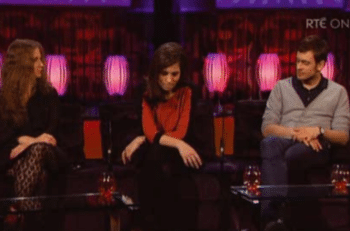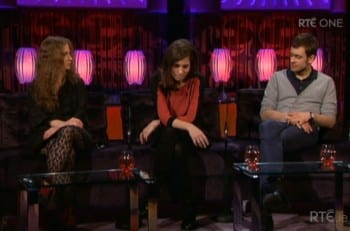
By Rónán Lynch. BrendanOConnorGuests-1 While Village can do serious analysis of serious talk radio, we can also get down with the celebrity stuff that people crave, openly or in secret. In this issue, we turn our attention to the Irish television talk show, and Brendan O’Connor’s Saturday Night Show in particular. O’Connor occupies a unique slot in the Irish media world as a talk-show host who has developed a crackling synergy between the reality TV of the nation’s station RTÉ and the celebrity culture of the nation’s favourite newspaper, the Sunday Independent. His profile has risen on the tide of celebrity culture that has steadily filled the TV schedules. When there’s space to fill on television or in print, and there’s nothing obvious to run with, there will always be one available: the only issue is A, B or C list. RTÉ 1 is home to Ryan Tubridy’s Late Late Show on Friday and Brendan O’Connor’s Saturday Night Show, with O’Connor’s show lagging slightly behind in the ratings, and much else. Both shows promise national and international celebrities, music and comedy, with the Late Late offering the additional attraction of political guests. Tubridy also has his daily slot on 2FM, though he never seems quite as comfortable with celebrity culture as O’Connor, whose second job is his high-profile spot in the Sunday Independent where he edits Life Magazine. For this issue, Village looked over the 2013/2014 season of the Saturday Night Show, running from September 2013 to May 2014, drawing up a list of 128 guests who appeared on the show, but broadly excluding singers who didn’t sit to talk to the host. Predictably, the Saturday Night Show is a TV show about television. So, if you like television, or more particularly Irish television, you may like it. For more than a decade the Sunday Independent has given O’Connor free rein to troll the nation. He’s dropped some spectacular clangers over the years, including his exhortation for people to plunge into the property market in September 2007, just as prices went off the cliff, and his resolute defence of Bertie Ahern long after most had decided that the former Taoiseach was living in an alternative reality. O’Connor’s broadcasting career began with a stint on the comedy show Don’t Feed the Gondolas with Seán Montcrieff as host during the 1990s, followed by a spell as a judge on the RTÉ talent show You’re A Star, and two years as host of the TV3 show The Apprentice: You’re Fired! O’Connor’s Apprentice was a ratings success despite its low production costs. The producers could film two shows in an afternoon and still compete in the ratings with RTÉ. The synergy between O’Connor’s television career and his Sunday Independent column and editorship of the paper’s celebrity magazine Life encouraged the paper to campaign for O’Connor’s installation as a talk show in his own right. O’Connor’s move to prime time came in 2010, when Pat Kenny’s decision to vacate the Late Late Show caused a reshuffle at RTÉ, which moved Ryan Tubridy from his Saturday night Tubridy Tonight show over to the Late Late Show on Friday nights, leaving an empty slot on Saturday nights. RTE initially pitched a Brendan O’Connor-fronted show against the slicker Craig Doyle, with O’Connor’s show proving the more popular, particularly in the Sunday Independent, and he was invested as the regular host in 2011. After three seasons of interviewing celebrities with nothing to say beyond promoting their products, O’Connor decided to ramp up the seriousness quotient, as he interviewed Barry Egan, the chief celebrant of celebrity at the Sunday Independent. Egan gazed down the couch at O’Connor and asked him how it feels to interview celebrities and soap stars every week. “I love it”, said O’Connor, going on to explain that the show would try to avoid the ‘PR rollercoaster’. “Some people only want to talk about their product. It’s like if I came in and kept going on about the Saturday Night Show is coming back on Saturday night at ten to ten, don’t miss it and all that”, said O’Connor, brilliantly satirising the onanism of the celebrity editor being interviewed by his own celebrity features writer while talking about the narcissism of celebrities. Of course, being a scion of the Sindo, it’s not entirely clear if O’Connor was being tongue-in-cheek. Watching a Saturday-night talk-show, viewers aren’t expecting the parade of politicians and other worthies who populate daytime and weekend radio talk shows, and only three politicians featured during the entire season we looked at: Mary Mitchell O’Connor, who was talking about fundraising for breast cancer; the now-retired Mary O’Rourke; and Joan Burton, another surprising Sindo favourite, talking about her ambition to become leader of the Labour party. The clever strategy of avoiding the PR rollercoaster turns out to be entirely aspirational, and the workaday formula turns out a lifestyle-oriented list of TV people and celebrities, chefs, sports stars, authors, stylists and comedians, though the show does have a good share of ordinary people, who make up about 15 per cent of the guests. Unfortunately, to qualify as an ordinary person on a television talk show, you generally need to have undergone some life-changing tragedy in the form of an execrable illness or the unexpected or impending death of a close family member. That’s the trade-off: most ordinary people only share their tragedies in public once. Most celebrities share the intimate details of their private lives with the general public as often and as vacantly as possible in exchange for wealth, fame and influence in the form of a rotating presence on the small screen. The phenomenon of reality television and its attendant celebrity especially rising/falling celebrity permeates the Saturday Night Show. Little did celebrity culture realise that it spent 300 years awaiting the rise of reality TV. Not that celebrity culture is anything new. From the eighteenth century, editors and reporters looked for publicly recognisable figures whose exploits would sell papers. The travails of jockeys, boxers, actors,