• Posted in:

    Marian Finucane Show: professionals over weekend brunch. By Ronan Lynch.

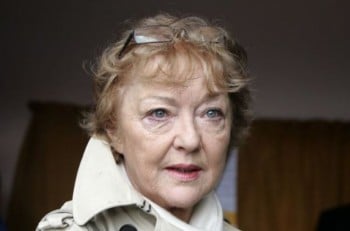
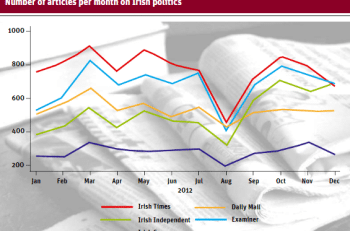
    Formulaic and incestuous – promoting journalists and politicians along with a strange number of PR and legal voices (see spreadsheet below) The discussion on Marian Finucane’s radio show (Sunday 25 May) had turned to the financial troubles of former billionaire businessman, Tony O’Reilly. It was, said regular guest Stephen O’Byrnes, a kind of a tragic story. Michael Smurfit had bemoaned the tendency in Irish society to delight in seeing Tony O’Reilly brought down. O’Byrnes disagreed with Smurfit’s analysis, only to be interrupted by an indignant Finucane. “I mean, people take glee in so-called rich people’s misfortune’’, said Marian, perhaps not sure that O’Reilly qualified as rich. Finucane is one of RTÉ’s top broadcasters. RTÉ states that her Saturday and Sunday shows are the third and fourth highest ranked programmes at the station after Morning Ireland and Liveline, claiming figures of 376,000 listeners on Saturday and 360,000 on Sunday. While more people are free to listen to the radio on Saturday and Sunday mornings than weekdays, the competition is also robust: Finucane’s show from 11am to 1pm competes with PR man Anton Savage’s ‘Savage Sunday’ on Today FM and Shane Coleman’s ‘The Sunday Show’ on Newstalk. They all follow similar formats and it’s not unknown for guests to appear first on one show and then on another on the same morning. These Sunday newspaper review shows are a staple of Irish broadcasting: less frenetic than weekday shows, and less-driven by the news cycle; the Sunday papers themselves are more reflective than daily papers, and more given to analysis and commentary. Few listeners want to hear screaming matches on Sunday mornings, but Sunday shows can easily become insufferably smug and Finucane’s show often sounds like a long expense-account lunch at the Unicorn; just a little bit sautéed Dublin Bay Prawns with White Wine, and only a hint of garlic. When community radio stations run training courses, they teach journalists to talk to “people on the ground”, recognising that the voices of ordinary people are rarely heard on the radio unless they’ve suddenly become newsworthy because they’ve been the victim of a crime. The community-radio approach is not found on national radio, as professional training teaches journalists to seek out authoritative voices, particularly people who speak for others: politicians, fellow journalists, and spokespeople for causes or movements; otherwise they favour experts in their fields such as doctors or legal professionals. It’s an almost unconscious pattern of privileging upper-middle-class voices. If voices from the street make it on to national radio, they’re normally confined to vox pops where they’re offered a few seconds to comment on a current story. Village took a look and listen back though one year of Marian Finucane’s Sunday show, focusing on the newspaper-review hour. Finucane’s panel invariably consists of five guests, and typically features two journalists, a politician, a barrister or solicitor and someone from the business or charity world. How do the panels break down by profession (and it is almost 100% ‘professionals’)? From roughly 255 guests over one year, around 90, or slightly over one third, were women. Journalists and broadcasters (74) are the most frequent guests, followed by politicians (36), PR professionals (28) and legal professionals (26) such as solicitors and barristers. Close on the heels of legal professionals are academics (25) and businesspeople (18), with smaller groups of less than ten people from the charity sector (8), security analysts (5) doctors (5), economists (4). Creative writers (5) and actors (5) make up the rest, along with a dozen guests who don’t fit into any of the above categories, for instance Philip McCabe of the Citizens Information Service and Garda whistleblower John Wilson. Several guests appear regularly, though no one appears on the show more than once every three months. With journalists making up almost one third of the guests, we’re immediately plunged into the fatuous incestuousness of a broadcast journalist inviting fellow journalists to interpret the work of other journalists. As the market leader in Irish newspapers, Independent News & Media provides the most journalists, followed by reporters from the Irish Times and then journalists from RTÉ itself. The next most popular guest category is the politician, and the newspaper panel is a nice soft gig for politicians. It’s a chance to appear on national media to pontificate on matters of current interest as an expert of sorts without having to deal with matters of policy. Yet it’s the overweening presence of PR people and lobbyists that begs the question: why are professional spinners being invited to interpret the news for us? There’s no question but that they are doing their job superbly just to be getting themselves onto the show and, short of writing the news stories themselves, they couldn’t have a better platform for their clients. The symbiotic relationship between politicians, lobbyists and journalists is normally played out away from the public gaze but in this case its oppositional aspects are allowed to play out in public. Close behind the voices of the PR experts, we have the well-upholstered and soothing tones of barristers and solicitors. Again, one wonders what particular talents belong to the legal profession that makes them such good interpreters of our weekly news. Of course PR people and lawyers spend most of their time representing the monied classes – vested interests. They rarely declare those interests, but even if they did, the question arises whether the professionally articulate agents of monied interests have a place over our breakfasts at weekends. Less well represented professions include artists and writers: doctors are prominent, but nurses are invisible. Farmers, hairdressers and housewives don’t feature. The voice of union representatives is faint; the opinions of bus drivers or shop worker on matters in the papers go unheard. The veteran broadcaster has taken pay cuts in recent years. She earned €492,000 in 2011 for four hours of programming each week but in 2012 her earnings from RTÉ were set at €295,000 per annum, paid to her independent production company, Montrose Services Ltd. She

    Loading

    Read more

  • Posted in:

    Is Newstalk more than Kenny and Yates?

    The well-marketed commercial station  fails to cultivate its own youthful talent By Gerard Cunningham ‘ The ‘Move the Dial’ campaign for Newstalk, fronted by Pat Kenny in the weeks before his on-air debut on commercial radio, was something of a mixed blessing. The initial launch, with a poker-faced Kenny solemnly informing youtube viewers that if they experienced difficulty retuning their radios,  they could call a special hotline, may have led to some social-media mockery, but then again, social media mocks everything, and the internet’s disdain did get the campaign trending. The poster campaign that followed, costing over €1 million according to some reports, pushed the same message, with Kenny’s face prominently displayed alongside the Move the Dial message with a comprehensiveness that Seán  O’Rourke wistfully but accurately described as giving Dublin the  feel of Pnongyang. With RTÉ unable (or unwilling) to match the independent station’s ad spend on the new season, Newstalk executives can congratulate themselves on their coup, poaching one of the national broadcaster’s marquee names, but the campaign held at its core a mixed message. There’s an old rule in politics that you never name your opponent. In urging audiences to ‘move the dial’, Newstalk may not have identified RTÉ explicitly, but the underlying message was clear: Newstalk was the alternative, RTÉ was the default listener’s choice. RTÉ may not have had €1 million to spend on an advertising campaign for Sean O’Rourke, but Newstalk’s efforts (and regular articles in Independent  Newspapers boosting the contest between the two) had much the same effect. Whether Kenny or O’Rourke wins the major battle of the airwaves won’t be clear until at least until the end of the year, when the next JNLR research figures are published, and realistically it will be at  least a year before clear patterns emerge. Meanwhile Newstalk’s second major autumn announcement, the return on Ivan Yates, brings its own problems. His highly-publicised bankruptcy bought him some measure of sympathy, but also raised the hackles (or should that be heckles?) of many listeners, who saw in his story echoes of how the political class protects its privileges. Yates may not have been a TD for a decade, but he had the misfortune to re-enter the public spotlight just as the banks showed junior minister John Perry the kind of leniency few ordinary citizens can expect. His interview with Pat Kenny (on Kenny’s first morning at the Newstalk helm) brought with it a backlash of comments about his political pensions. It was not the only time Yates misjudged the public mood. His on-air gaffe in discussing Majella ODonnell’s public headshave on the Late Late Show (“ghoulish and inappropriate”) stands in contrast with the €550,000 pledged to the Irish Cancer Society in the week following her appearance. But then, Newstalk has always had a women problem, and not just in the lack of female voices among its presenters. At one point, the station’s listenership was skewed 70% male, and though that is improving, its listener profile remains as blokeish as the daily line-up. And strangely, for a station targeting a younger news audience than RTÉ Radio One, the first team feels like it’s growing older. Yates, at only two years older than Sean Moncrieff, is actually the youngest of the trio made up of himself, Pat Kenny, and George Hook. Moncrieff however sounds as though he comes from another generation. Newstalk’s coup in attracting Kenny disguises the other main personnel exchange in recent times, when the Off The Ball team walked (or were pushed) at the end of protracted negotiations over how to grow the innovative sports programme. Reborn as the Second Captains, the crew moved their format online, podcasting twice-weekly from the Irish Times website, and debuting on television on RTÉ. The irreverence and fresh ideas of the Second Captains had already reinvigorated sporting coverage on Newstalk, uniquely harnessing an audience that wasn’t actually that interested in ball games and contests, and it could do the same on television. Giles and Dunphy are still top dogs, but they look grey and tired compared to the upstarts.   Meanwhile, another Newstalk alumna, Claire Byrne, is one of the anchor presenters of Prime Time, a gig Pat Kenny had to vacate when he jumped ship. Newstalk seems unable to grow and retain its own brands, instead buying in already established – and ageing – names.   October 2013

    Loading

    Read more

  • Posted in:

    Denis to Dermot (Village imagines)

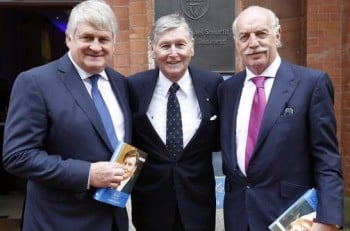
    Dear Mr Desmond, You never go to Davos.  Why’s that then? I’ve been going for more than a decade, cruising in on the old Gulfstream. I love to put myself about. I had them eating out of my hand with my clever stock tips: “I am positive about 2014, but it will not be like 2013 in terms  of S&P 500 index gains”, I told Bloomberg in one of my rare but exciting interviews. “Of course, I told them,  “politicians are the biggest hurdle facing the global economic recovery”. Now you and I both know what  I meant by that.  Give an elected member an inch and they’ll be right up your  ileum trying to get an inquiry or tribunal into you. “They are more and more worried about their re-election than  growing their economies”, is how  I put it. Meanwhile “’I’ve been investing heavily in Ireland because I believe in it”.  You and I, Sir, believers. The  green jersey. Love the new look Sunday Business Post, by the way.  Was that your  idea, the green bits on the cover?  If a man can’t show his patriotism by insisting on green bits on the cover of a newspaper, what’s this great little country come to? How’re you doing for cash? See you netted almost €180m from the sale of your stake in listed online payments and money transfer group Optimal Payments – a near eightfold return on his investment in little over four years. Personally, I’ll be getting a dividend of around $650m from Digicel in 2014. I’ll invest about $500m (€369m) in infrastructure for it in 2014.   We won’t be floating it for a while. Meanwhile we’re borrowing another more than €360 million from the capital markets to cover general company spending. See, I’m bloody determined to keep the telecommunications business outside Europe,  due to “failed” regulation. By that of course, as you well know,  I mean tribunals. Give me Burma any time.   But it didn’t stop me in early February becoming the fourth largest player in the UK radio market after buying eight stations from Global Radio in a deal worth £35million after they were forced to sell off by competition regulators following acquisition of GMG Radio. We’ll be adding  eight stations with a combined audience of 2.8 million listeners.   We’re  looking at other opportunities, including China. We have 4,000 people working for us in China in recruitment.  And not one of them’s ever been before  a tribunal.   Someone who should be in front of a tribunal is that Declan  Ganley where he gets his funding is even more  obscure  than the amount I’ve given Fine Gael down  the years.  Malicious Ganley  and his nasty little last-coming consortium are suing Esat, over the  ssecond mobile licence. It’s as if they actually believe the Moriarty report that Lowry interfered with the tender process to ensure Esat would be awarded the licence and that he accepted payments   from us. High Court – a ring of steel of course – ruled Ganley  doesn’t  have to cough  up security for costs to pursue his action since essentially he was loaded.  I’ll show  him loaded.   I’m on the verge of buying €304m worth of loans linked to Topaz and its mouth-watering 330 service stations across Ireland, as part of a big loan auction from IBRC. IBRC are great sports of course: they wrote off around €100million in debt belong to Siteserv, before I bought it for €45million even though an underbidder offered more – while I owed Anglo hundreds of millions.  Hate Anglo of course  after how they treated Seanie, my mate.   Those eejits in Broadsheet.ie, with their anti-everything smartarsery moved quickies to remove a typically begruding piece about me written by an anti-austerity protester that had been doing the rounds on social media. It suggested several allegations – which it didn’t stand up in the article – about Siteserv and Irish Water. A subsidiary of Siteserv is one of the companies that recently won contracts as part of the rollout of water meters. “It is outrageous that you should seek to impugn an investment by Mr O’Brien . . . in a struggling Irish business (Siteserv) that had the effect of saving jobs”, we thundered and they folded.       Sorry to hear about the depositions you’re giving in the  Paul Siegel defamation  case but a classic stroke getting it upgraded to federal racketeering.  According to the Irish Times your man “has admitted setting up meetdermotdesmond.com, a no longer active – deo gratias – website lampooning you”.   Fair game for you to file details of a restraining order taken out by Siegel’s former  and text messages he allegedly sent to his daughter, as well as details of alleged altercations involving Mr Siegel and his children following his recent divorce. Lovely touch Mr Desmond when this little fellow referred to his own “tenacity” to refuse to back down  to his threats and to tell him after dealing with you you’ll “know the meaning of the word tenacity”. Brilliant and right  out of the  Denis O’Brien book of witticisms.   So this whoor’s defence regarding the website is that it constitutes humour and satire, and that he had a right to publish it under the liberal free speech laws of the US. We’ve all a lot to lose if satire takes hold, Mr D.   See you in Twickenham.   Denis pic – thanks, Broadsheet

    Loading

    Read more