


Politics

Random entry RSS

  • Posted in:

    WICKlow standards.

    By Frank Connolly. Pressure is mounting on the environment minister, Alan Kelly, to carry out a thorough investigation into the administration of local government in Wicklow following the mysterious disappearance, in early September, from his in-tray of a file containing fresh allegations over zoning and planning matters, and the illegal dumping of waste, in the county. Beleaguered Council management are busy fighting a rearguard action against a number of Councillors and local and national media outlets, including Village, which have highlighted a range of embarrassing issues which require further investigation. The call, first reported in Village in September, by junior finance minister and Wicklow TD, Simon Harris for an inquiry into “the administration of local government” in his home county has been followed by a series of fresh allegations of official wrong-doing over the past two decades. The litany of complaints include the manner in which senior county officials and some Councillors facilitated the huge Charlesland housing development by Nama poster boys, Sean Dunne and Sean Mulryan, in Greystones in the early 2000s. In particular, fresh questions have been posed to the minister over the controversial compulsory land acquisition of lands at Three Trout Stream close to the 1,500 residential scheme in late 2003 which the management said was for social housing but which landowners and others believed was intended to help with road access to an undeveloped site at Charlesland. Councillors critical of the €3 million purchase of the three-acre site also point to its unsuitability for housing as the land is on a flood plain. The missing file also raises serious questions about a €27 million road contract agreed between the Council and Zapi, the company formed by Dunne and Mulryan, in July 2003, in which senior officials agreed to use their powers to use compulsory purchase orders to acquire lands required for the scheme and a planned €1.5 million retail development. That the key figure behind the claims is a prominent auctioneer who acted for Dunne and Mulryan before falling out with the latter over €4 million he claims he is owed, and a former Fianna Fáil activist and fundraiser makes them all the more potentially explosive. Whistleblower Gabriel Dooley, as reported in Village in June, has written an extensive letter containing serious allegations concerning senior officials and some Councillors to the elected members of Wicklow County Council and has been met with a wall of silence from those whom he has implicated in some serious allegations. The missing file also included references to the extraordinary role played by the Council in the long running controversy over the dumping of over a million tonnes of commercial, domestic and medical waste at various sites in west Wicklow. It refers to an alleged conflict of interest involving an ‘Authorised Officer’ of the Council who set up his own company to remediate one of the largest illegal waste sites at Whitestown in west Wicklow and to cash in on a potential €25 million from the clean-up. A High Court action in 2009 heard that the authorised officer and environmental consultant, Donal O’Laoire, had discussed his effort to set up the consortium with County Manager Eddie Sheehy and Head of Services, Michael Nicholson, before the venture collapsed when the landowner refused to sell or lease him the Whitestown land. The action was suddenly halted in late 2011 just as pretty sensational claims were about to be made by lawyers acting for the so called illegal dumpers including details of how the Council itself was involved in the illicit waste disposal activity. The case was taken initially by Council management against a number of alleged dumpers from whom it was seeking damages which could pay the multi-million costs of remediation. The indefinite adjournment of the action followed an intervention in November 2011 by the Department of the Environment which intervened at the eleventh hour with a promise to underwrite the clean-up costs estimated during the case at between €25 and €50 million. The new minister must decide whether to set up an inquiry into the mess in Wicklow including this decision to intervene in the court action which was made by senior officials of his department and his immediate predecessor and newly installed EU commissioner, Phil Hogan. He will also discover that it is not the first time a sensitive file has gone missing from the Department as was pointed out by former Ombudsman, Emily O’Reilly (now also ensconced in Europe),who was probing how the copy of a licence for illegal waste disposal at another site in Ballybeg in west Wicklow went awol from the department some years ago. Kelly’s problem is that he may have to ask some awkward questions of some of his senior officials concerning their apparently close relationship with senior Council management over the years. •

    Loading

    Read more

  • Posted in:

    Ansbacher back: the Caymans, LuxLeaks, Offshore Leaks and WikiLeaks.

    By Ronán Lynch. The vast sums accruing to the 1%  present at least one problem for the most avaricious: how to hide their money. With vast amounts of wealth invested in property it may be  the case that offshore accounts, tax evasion and property bubbles are not unconnected. The return to life of the Ansbacher investigation into offshore accounts held by senior Irish politicians and businesspeople from the 1970s to the mid-1990s reminds us how things used to be done. Some might argue that little has changed. Under the new protected disclosure legislation, serving civil servant Gerry Ryan, who began investigating the Ansbacher accounts in 1997, has contacted the Public Accounts Committee to voice concerns that tax evasion among high-ranking politicians with offshore accounts was not properly investigated. Mary Lou McDonald said they were “household names” from Fianna Fáil, Fine Gael and the Progressive Democrats. Responding to the disclosure, the government said that the files had already been forwarded to the “relevant authorities” which apparently did not include the Gardaí, as Minister Richard Bruton finally forwarded the files to Gardaí on Monday 10 November. Ansbacher was closely associated with CRH, the giant Irish business which has connections across almost all political parties. In ‘A History of Scandal’, (Village Oct/Nov 2012), Michael Smith outlined a series of serious instances of failure of the “relevant authorities” to lay a finger on CRH; it materialised, for instance, that Justice Moriarty had £500,000 worth of shares in CRH that in his opinion precluded him from investigating the company. Now it emerges eminent progressive turned President of the High Court, Declan Costello, who investigated the bank’s Cayman operation as a High Court inspector in 2000 had a domestic Ansbacher (ie Guinness and Mahon) account though he had ‘forgotten’ it when denying it to Ryan. He resigned as inspector citing ill health,  He died in 2011. Ansbacher bank became a household name in Ireland from stories emerging from the McCracken Tribunal in 1997 as it uncovered a complex series of payments from Ben Dunne to Charles Haughey that eventually landed in Ansbacher bank, formerly the Cayman Islands branch of Guinness & Mahon Bank. The accounts were run by Haughey’s bagman Des Traynor and John Furze, an English-born banker who ran the Cayman Islands end of the venture. Furze’s career was straight out of a John le Carré novel. He was instrumental in establishing the offshore banking system in the Cayman Islands, arriving there in 1967 at the age of 25. When his name was first mentioned in the Irish Times in 1996, the paper wrote that it considered Furze to be a fictitious name. Another early Irish Times report on the island referred to John Grisham’s novel ‘The Firm’ for context. Yet by 1996, Des Traynor was already dead, and Furze had travelled to Ireland for the funeral and to remove paperwork from Traynor’s office at CRH. Furze died in July 1997 following heart surgery and by that stage he had destroyed much of the paperwork. A full 200 customers of the bank were identified in a 2002 report but no prosecutions resulted. Revenue later cited a number of reasons for not bringing prosecutions, including the lack of original documentation, an inability to compel Cayman Island entities to release documents, and the elapse of more than 10 years in bringing cases. Despite the criminal-law  inertia, by the end of 2012 the Revenue Commissioners had recovered more than €112 million in unpaid taxes and penalties, (an  Irish solution to  a  Cayman  Islands problem) but now it appears other names have been identified and efforts by Gerry Ryan to recover documents that may have aided a prosecution were stymied. The return of Ansbacher reminds us of the scale of tax evasion and tax avoidance on a personal and corporate scale. The recent ‘Lux:eaks’ story involves PriceWaterhouseCooper, several of the world’s biggest corporations, and the now European Commission President Jean-Claude Juncker, who was Prime Minister in Luxembourg for much of the relevant period from 2008 to 2010, and after a short period in apparent hiding he has now emerged to “take responsibility” for the “unethical” policy, and possibly spear Ireland’s Corporation Tax policy. Interestingly, when the story broke, the Cayman Compass news website promptly issued an editorial in support of Juncker. Documents obtained by the International Consortium of Investigative Journalists (ICIJ) and released in early November showed Irish companies among hundreds of businesses using Luxembourg as a tax haven. By routing money through Luxembourg in the form of intra-business loans, these companies were avoiding billions of euros in tax; the annual tax savings achieved by Irish businesses including Glanbia and the Sisk Group and Irish subsidiaries of multinationals such as Pepsi and GlaxoSmithKline dwarfs the money collected from the Ansbacher accounts. Of course there is no suggestion that the Luxembourg operations were indulging in evasion as opposed to (legal) avoidance. Among the companies availing of the arrangement were several media investors including UK media group Northern and Shell, which owns 50% of the Irish Star and used an Irish branch of its Luxembourg subsidiary to facilitate the deal; London investment firm Doughty Hanson, which owns TV3, also availed of Luxembourg tax structure, as did the Cayman Islands-based Tiger Global Private Investment Partners V, which by 2008 had acquired a 25% share in Daft Media. A follow up report in the Irish Times found that Ireland’s biggest indigenous company, CRH, also had subsidiaries in Luxembourg that engaged in the intra-business loans that saved tax for other businesses. The Luxembourg leaks story drew irate comment from charities and campaigners furious about tax income lost to the Irish exchequer, though not from Bono who recently expressed the view that tax avoidance is a point of principle for Irish people. The Cayman Islands, wealthiest of the Caribbean islands, ranks as the fourth largest tax haven in the world, with dourer Luxembourg seizing second place, according to the Tax Justice Network. The islands feature high in the 2013 ICIJ project Offshore Leaks which

    Loading

    Read more

  • Posted in:

    How government has dismantled the equality infrastructure.

    By Rachel Mullen. The Equality Tribunal has been an important part of the Irish equality infrastructure. The system whereby the former Equality Authority provided support to those taking cases of alleged discrimination and a specialist Equality Tribunal heard and decided these cases had been lauded as best practice by the European Commission. The Equality Authority has been subsumed into the Irish Human Rights and Equality Commission. Now the Equality Tribunal is to be abolished. The Workplace Relations Bill 2014 replaces the Labour Relations Commission (including the Rights Commissioner Service), the National Employment Rights Authority, the Employment Appeals Tribunal and the Equality Tribunal with a new Workplace Relations Commission and an expanded version of the Labour Court. The Department of Jobs, Enterprise and Innovation has set the end of the year as the target for enacting the Bill. Sufficient care has not be taken in drafting the Bill to take account of the specific nature of discrimination cases and to ensure the particular role of the Equality Tribunal is sustained. Cases of discrimination extend beyond workplace relations. They cover the provision of goods and services, under the Equal Status Acts. Specific legislation prohibiting discrimination draws from European Union Directives and a body of established case-law at European level. The Equality Tribunal has years of specialist expertise in the field of discrimination. The Equality Tribunal does not operate like an ordinary court since it investigates cases. It is not reliant on legal arguments presented by the complainant or the respondent. Cases of discrimination are unique as the burden of proof that discrimination is not involved passes to the respondent once the complainant has made a prime facie case of discrimination. There are high levels of under-reporting of discrimination and it is important that any new arrangements do not worsen this situation. Research has shown that the groups most likely to experience discrimination are the least likely to report it. Less than 10% of those experiencing discrimination took any formal action, including taking a case. 60% of those experiencing discrimination took no action at all. The Bill is devoid of reference to claims under the Equal Status Acts and as to  how these will be considered. This is particularly noteworthy in a number of areas of the Bill: in relation to the presentation of complaints and referral of disputes, appealing the dismissal of complaints, and enforcement of decisions by Adjudication Officers. The Adjudication Officer is given discretion whether to permit someone to accompany the complainant or respondent at the hearing or to represent them at the hearing. There is no equivalent provision under current equality legislation. This provision could be in breach of EU Directives and the Charter of Fundamental Rights. If lawyers or any other representatives are excluded this could prevent a complainant adequately arguing a claim and gaining an effective remedy. Employment cases before the Workplace Relations Commission will not all fall neatly into one area. Where cases have a discrimination dimension alongside a general employment dimension it is unclear how Adjudication Officers will deal with them. For example, will the alleged discrimination, where a different burden of proof applies, be addressed separately from a general employment rights concern?  Will the complainant be forced to select between a discriminatory dismissal and an unfair dismissal claim? How will Adjudication Officers decide an equality claim where they have investigative powers under equality legislation, and then proceed to hear other aspects of the claim where they have no such power? There is much emphasis in the Workplace Relations Bill on dealing with a claim without recourse to an independent hearing. The Director is allowed to refer the claim for resolution to a case resolution officer, mediation, or by way of written submission. While the parties to the claim can refuse to have the matter dealt with in this manner, for complainants under equality legislation who may be highly vulnerable, this adds another layer which they must navigate before they have the right to a hearing. Finally, the Workplace Relations Bill 2014 proposes to delete sections in the equality legislation that allow the complainant or the respondent to appeal a decision of the Equality Tribunal to the High Court on a point of law. This is a diminution of the redress previously available. •

    Loading

    Read more

  • Posted in:

    The Jordan petition on Ireland’s referendum act.

    By Anthony Coughlan. We will fix that Stalinist body”, the late Brian Lenihan TD said to me in the car-park of Athlone College of Technology following a debate on the Nice Treaty in 2001. The “Stalinist body” was the statutory Referendum Commission. The “Stalinism” seemingly consisted in the Commission being required to set out the arguments for and against in referendums The Referendum Commission was established following the 1995 McKenna Supreme Court judgment that it is unconstitutional of the Government to spend taxpayers’ money trying to obtain a particular result in a referendum. The fact that the original Referendum Commission had the job of setting out the pros and cons of constitutional change meant that the No-side arguments on the Nice Treaty had a significant weight in money behind them for the first time, through the Commission’s media advertisements. This was a major reason why voters rejected Nice in 2001. Of course the Government was anxious to reverse that result in the Nice 2 referendum. On the last day before the Oireachtas rose for the Christmas holidays in December 2001, with just one day’s notice to the Opposition, the Government put all stages of a new Referendum Bill through the Dáil and Seanad in a couple of hours with the media and public oblivious. This removed from the Referendum Commission its function of preparing and publicising a statement setting out the relevant Yes-side and No-side arguments in referendums. It left the Commission with its other original function of informing voters what the referendum was about. Fine Gael and Labour opposed this change. The democratic merit of the Referendum Commission’s original Yes/No function was that the Commission had to be satisfied that the Yes/No arguments it publicised were validly grounded in the constitutional change proposed and in legitimate hopes or fears citizen voters might have with regard to it. Obvious fallacies, irrelevancies or ad hominem arguments were not acceptable to the Commission, although these are commonplace in elections and privately funded referendum contests. Another result of the Referendum Commission losing its Yes/No function was that when private interests knew that the arguments on each side would be put fairly and honestly before the public through the Commission’s advertisements, big-league private money had little incentive to get involved. Thus when an unchanged Nice Treaty was re-run in 2002, with the Referendum Commission no longer putting the Yes/No arguments, private funders, including private companies and State firms, weighed in in a big way. In Nice 2, in contrast to Nice 1, Yes-side advertising outweighed No-side by a factor of ten to one In the eleven constitutional referendums which were held following the Supreme Court’s judgment in McKenna no Irish Government presumed to run its own ‘information campaign’ alongside the independent Referendum Commission’s statutory-based campaign to inform citizens what the subject-matter of the referendum was. This changed with the next EU referendum after Nice, that on the Lisbon Treaty in 2008. On that occasion the Government decided the Referendum Commission’s campaign was not enough.  It sent its own booklet to every household in the State with the tendentious title ‘EU Reform Treaty’ instead of Lisbon Treaty.  The booklet carried the following slogans on its cover, which clearly amounted to implicit advocacy: “Effective democratic union”, “Progress and prosperity”, “Peace and justice in the wider world”, “A union of values”. Inside it summarised the provisions of Lisbon under such headings as “Increased democratic controls” and “Equality between Member States”. The same happened in Lisbon 2 in 2009 and in the 2012 Fiscal Treaty referendum which makes permanent balanced budgets mandatory for Eurozone States like Ireland. These one-sided Government “information campaigns” were not challenged in the courts, but engineer Mark McCrystal did make a challenge to the 2012 Children’s Rights referendum. On that occasion the Supreme Court found that the Government-issued booklet was one-sided, contained errors of fact and constituted a breach of Irish citizens’ rights to a fair and democratic referendum. In its McCrystal judgment the Supreme Court made clear that its 1995 McKenna principles accorded with best international practice in referendums. It referred to the ‘Code of Good Practice in Referendums’ which had been adopted by an advisory body of the Council of Europe, and which included the statement that “Equality of opportunity must be guaranteed for the supporters and opponents of the proposal being voted on. This entails a neutral attitude by administrative authorities, in particular with regard to public funding of a campaign and its actors”. In the Children’s Rights referendum the misleading Government ‘information campaign’ was continued to the very eve of the poll. Did it therefore pollute the Children’s Rights referendum result such as to invalidate it? This is the issue raised in the petition against that result by Joanna Jordan. A seven-judge Supreme Court heard this petition for five days in December and will give its judgment in the New Year. The Jordan petition echoes the Hanafin petition on the 1995 Divorce referendum. In 1995 the Supreme Court ruled in McKenna that the Government’s expenditure of £500,000 on Yes-side advertisements for divorce was unconstitutional. This caused the Government to pull all its adverts on the weekend before the divorce poll. Free party broadcasts on radio and TV then became crucial for the Yes-side, as all the Dáil parties favoured Yes. In the week before the poll this led RTé to give 42 minutes of free broadcasting time to the Yes-side as against 10 minutes to the Nos. Even though the present writer was not involved in the divorce campaign, he went to court when the poll was over to challenge what he regarded as the unfairness of this imbalance in free broadcasting time. In its Coughlan judgment given four years later the Supreme Court found that such imbalance was illegal under the Broadcasting Acts. These require broadcasters to be “fair, impartial and objective” on issues of public controversy and debate and ”fair to all interests concerned” at all times. Every citizen is “an interest concerned” in a referendum. The

    Loading

    Read more

  • Posted in:

    Review of ‘In the Name of Love’ by Una Mullally.

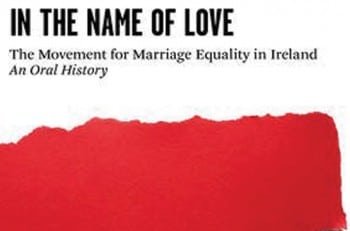
    By John Gormley.   A refreshing and open evocation of the evolution of the fractious civil partnership legislation   When excerpts from ‘In the Name of Love’, which was written and compiled by the journalist, Una Mullally, appeared in the Irish Times recently it sparked quite a bit of debate in Green Party circles. A lot of the discussion centred on why Roderic O’Gorman was not included in the long list of interviewees. Roderic was probably the person who worked hardest to ensure the introduction of civil partnership legislation. While he does receive honourable mention, the lack of a direct interview is a serious omission in what is otherwise a comprehensive and stimulating account of an important social movement. I should declare my own interest here: I was interviewed by Una Mulally for the book and later answered a series of questions by email. I realise now that my written replies were not entirely in keeping with the spirit of the undertaking. It is, after all, an oral history, and it’s the free and sometimes discursive manner of direct speech which is the real strength of this book. The interviewees talk honestly about how the movement for marriage equality evolved, providing some fascinating insights, interesting anecdotes, and claim versus counterclaim. Refreshingly, unlike the professional historian, Mullally allows readers to draw their own conclusions. Reading the text revived memories of a fraught period in government. While we were attempting to introduce the civil partnership legislation we were also dealing with an economy in meltdown. To make matters more complicated and acrimonious, elements within the Marriage Equality movement decided to portray those who opted for an incremental approach as sellouts and traitors. I don’t have a clear recollection of the much-referenced meeting with the LGBT representatives in Government Buildings, but I do recall a lesbian couple visiting my clinic and accusing me of enshrining discrimination in legislation. And how did I react to these accusations? Well, according to Gráinne Healy of Marriage Equality there may have been a ‘touch’ of resentment on my part. Believe me, it was more than a touch. I was livid. They were so successful in discrediting the legislation that David Norris was going to vote against it. He only changed his mind when Senator Rónán Mullen tried every means possible to filibuster and block it.   The book is revealing in so many ways. Dermot Ahern, the former Minister for Justice, features extensively. He rejects his categorisation as socially conservative. While his Fianna Fáil colleague and opponent of the legislation, John Hanafin, is adamant that the Bill would not have happened without a major push from the Greens in coalition. The book also shows the extent of the distrust and hostility between the fundamentalists and pragmatist in the LGBT community. Kieran Rose of GLEN concedes that Marriage Equality and Noise won the ‘communications battle’, and indeed I remember the rather muted ‘victory’ celebration in the POD nightclub. In a separate chapter, devoted to the organisation Noise, Annie Hanlon explains how it was formed by members of the Labour Party LGBT group when their private members bill was defeated.     To complete the social history the book looks forward to the forthcoming referendum. Churchill once commented that history would be kind to him because he intended to write it. Those with power and influence control the historic narrative, and whereas for generations the LGBT movement was marginalised and suffered real discrimination, it now enjoys overwhelming support in the newspapers and broadcast media. The tables have turned quite dramatically in a relatively short space of time: our Taoiseach makes an appearance in the Pantibar, elected representatives from the mainstream parties are coming out, and commentators who question gay marriage have become pariahs. Breda O’Brien, a sincere critic of marriage equality, felt her personal safety was at risk at the time of Pantigate. She expresses the hope that “the oppressed do not become oppressors” now that the liberal revolution is almost complete. With the winds blowing so strongly in the right direction, and with every political party supporting the proposition, it would appear that victory in the referendum for marriage equality is assured. But such an assumption would be a mistake. The electorate is in an unforgiving mood right now. If the political establishment tells them to vote a certain way, they might just take a notion to do the exact opposite. The bookies might tell you otherwise, but this pragmatist says it’s not a certainty.  

    Loading

    Read more

  • Posted in:

    Fuck you, Mattie McGrath.

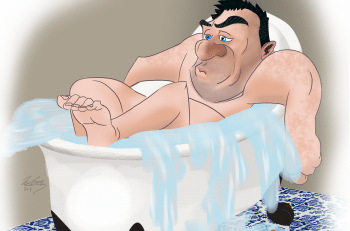
    In the bath with Minister for the Environment, Heritage and Local Government, Alan Kelly. Alan Kelly contemplated his navel over the water, Irish Water, in his dirty bath. Thank Jaysus it was only thirty thousand.  Thanks the lord. And the  Garda tallymen. I fully accept the dirty bath, he practised, ministerially.  Errors were made in how it was run at the beginning.  But they were not my errors.  We will now take clean steps out of the dirty water. We or, should I say, they have not communicated why I am in this dirty bath. Fuck you, Mattie McGrath he murmured, and then forgot he’d said it. A drop of the valuable resource plashed into the foam.  But he didn’t cut it off. The water supply  will not be reduced or cut off, he mouthed. Did I say timelines yet?  Confusion.  Other people’s confusion. My hyper-confidence.  Fianna Fail in the  bath. I have my ear in the  bath, listening to the people. The bath will not cost what people think.  Better communication.  Less confusion. Leader Burton, in the way, those funny ideas about iquity, she said.  Equetty. Ek-wetty.  It sounded good.  That was what he was for.  While the timelines may have been dictated by the Troika, we all accept at this stage that they were simply too ambitious. I fully accept this. While I was not a member of cabinet at the time, it is important that as a Government we acknowledge that errors were made – the timelines, the complex nature of the charging structure and poor communications by Irish Water. We must now take steps to address them and we will.The timelines have led to confusion, uncertainty and huge frustration for the public. Again, I fully accept this. As a Government, it is time for us to listen and we are doing that. We are working on a package to bring the necessary certainty and clarity to the charging structure so that the public do face water charges which are modest and affordable. Many people are preparing for bills in the region of €500, €600 or €800. Based on the package we are bringing in, nobody will be paying these levels for their water. Let me repeat that, nobody will be paying these levels for their water services. I fully acknowledge there have been failures in communication.  Irish Water have correctly and appropriately apologised to its customers and elected members for this and are taking steps to remedy it. I apologise myself even though I have nothing to apologise for. Sorry for telling Mattie to fuck off if he’d said it. Sorry.  Sorry.  Apology. Eqwetty. There is nothing I will not accept, or remember. He couldn’t remember a thing about what was good or bad about water, baths or taxes. It was all about avoiding reaching for the towel. The bath was nice if dirty. Emissions. And getting hotter.  Like the country’s climate. He kept telling himself he should care, just short of the point where he actually did. Climate legislation that didn’t have any of the qualities of legislation. He let the hot tap run some more. Some of it splashed over the side down onto his jocks. I am on record as stating that the 2020 targets were unrealistic and unachievable and that did not take into account Ireland’s dependence on agriculture or the fact that we have one of the most climate-friendly agricultural systems in the world. This deal recognises that we have secured recognition across the EU of the importance of a sustainable agriculture  as a key consideration in ensuring coherence between the EU’s food security and climate change objectives. I made it clear that Ireland would not be signing up to any future targets that would be unachievable. Ye can’t eat the environment.  Couldn’t give a rat’s arse he confided to himself and moved his head forward on its plane, like he used to do before he’d become an important man. He’d the lip under control since he’d become the big fella up in Dublin. Fuck the  climate.  Doesn’t vote.  Beef.  Beef,  belching Beef forever he couldn’t get enough of it. 500 votes that was worth.   And he emitted again. He caught a glimpse of the biggest bullox in the cabinet, through the soup below. And a night out on Macra, Christmas week. Minister for Local Government, he mused. He loved Government.  But he if anything preferred Local. Local Funding he thought and fisted one out of the water. €1.1m New Ambulance Base, €350,000 Jimmy Doyle Road, €140,170 Thurles Leisure Centre, €95,000 Thurles Town Council for Pre-Approved schemes, €200 million investment in Limerick Institute of Technology’s Limerick and Tipperary campuses, €71,000 extra for road maintenance & major funding for Thurles bridge rehabilitation, €66,000 MUGA Monakeeba, €50,000 Thurles Walkway, €25,000 Thurles Boxing Club, Substantial funding for the CBS and the Presentation Secondary school and the Thurles international festival of hurling. Huzz-fuckin-Ah. And jobs. I am delighted to announce that a Tipperary company is among the preferred bidders to deliver the Government’s Jobpath programme. FRS Recruitment, who are based in Roscrea form part of the Consortium who have been selected to deliver the Jobpath programme in the Southern half of the country for the Department of Social Protection. 500 employees with their head office expected to be located in North Tipperary.  Fuckin A.  I haven’t even realised it’s privatisation of essential services. Better Tipp and private than the pale and public, he thought then threw himself back under the water confused. Jayz but amn’t I against privatisation? The bloody referendum.All that thinking they were expecting of him now in the senior hurling. Nobody seemed to care he’d the MPhil from Boston, founding chair Kemmy Branch Labour UCC,  former Chair Labour Youth. TD.  Minister for the Environment and especially local government.  And the other thing.  MEP, BA, MPhil, Dip (Leadership) Bost, MBS. Deputy leader  Labour Party. And still under thirty. Had anyone so unknown been gifted such a role (the brother, maybe)? Youngest ever

    Loading

    Read more

  • Posted in:

    In the soup: Gerald Kean.

    By Frank Connolly. Fresh from his latest, and unfortunate, altercation with the Law Society celebrity solicitor, Gerald Kean, has landed himself in the thick of it again. No doubt motivated by the best of intentions, Kean has joined the trustees of soup kitchen, the Cork ‘Penny Dinners’, where his friend Caitriona Twomey has ruled the roost over many years. Kean of course has been associated with many charities over the years and, when he is not promoting himself, his bejewelled partner, and his lavish Wicklow mansion on the pages of the Sindo, he has managed to maintain a lucrative practice from his offices on Upper Pembroke Street in Dublin. In September, the High Court dismissed an appeal against a finding of professional misconduct arising out of Kean’s handling of a former client’s case. Justice Nicholas Kearns upheld a finding of professional misconduct made by a Solicitors Disciplinary Tribunal (SDT) against the solicitor over his handling of a case brought by Christopher O’Neill. Fortunately for Kean, the court said it would not impose a fine of €20,000 for misconduct which had been recommended by the SDT. Kean was also for some years during the lengthy and brutal Pinochet regime the honorary consul for Chile in Ireland even though, according to himself, he never once visited the Latin American dictatorship.  When the reviled general was arrested in England in 1998 in connection with a Spanish-led investigation into human rights abuses, some of his advisors called on Kean to help. Sure enough, the solicitor kindly introduced a delegation of Chileans to the then foreign minister, David Andrews, who did not look kindly on their request for assistance for the embattled Pinochet, or his possible refuge in Ireland. The dictator remains subject to a global investigation into his vast hidden assets, led by the Spanish judge Baltasar Garzon which has apparently failed to uncover any significant riches. After a heated emergency general meeting on 6th November of the volunteers who run the Cork Penny Dinners, a charity set up by concerned Catholic, Church of Ireland and Quaker religionists in the late 19th Century, the absent Kean was among a new board of trustees appointed “as part of a major restructuring of the charity” according to a report in the Irish Examiner. He is joined by new chairman and businessman, Jim Urquhart, who defended the exclusion of a number of people from the EGM at the charity’s somewhat dilapidated premises and kitchen at Little Hanover Street in the city. There has been an angry and vocal reaction from some former volunteers who claim that those who managed to get in were not allowed by Urquhart to ask questions or to query the credentials of many of those present and permitted to vote for the new board. Among those who was permitted to attend and the only one allowed to make a speech was solicitor Martin Archer who castigated efforts by a group of people who, he claimed, had made an attempt to establish a new governing board without notifying members as required under the code of governance of the charity. He also cited other alleged breaches of the code before promptly resigning his position as legal advisor to the Penny Dinners. What is at stake here is not just the reputation of one of Cork’s most popular charities which feeds the needy, down and out and impoverished of the city with the help of generous retailers and volunteers but the estimated €1.5 million held in its various accounts. According to Urquhart, the finances of the charity are “absolutely sound” and a Garda investigation had found “nothing wrong” with their administration. This inquiry followed complaints by volunteers some time ago over the handling of the Christmas collection, among other matters, leading to a number of recommendations as to appropriate business practice. Following the departure of Archer, and those of other long-standing trustees, the incoming board appointed South Mall solicitor, David Donegan, (who is listed with Urquhart on the board of Cork -based company, Family Business Ireland) to keep a legal eye on the affairs of the charity. No doubt he can call on Gerald Kean to help him if the financial waters prove too choppy in the future. •

    Loading

    Read more