
Politics
-
-
Posted in:
Eurostrich (June 2011)
by admin
‘See nothing’ or ‘do nothing’ about structural problems: the EU wrongly sees only “liquidity” problems in “peripheral” states. By Constantin Gurdgiev Perhaps nothing defines the detachment from reality of European (and Irish) élites than their own statements. Like proverbial ostriches with their heads in the sand, the official responses to the current crisis have been oscillating between two extremes. On the one side, there is the extreme of ‘do nothing’ about the structural causes of the unfolding financial catastrophe – the ‘kicking-the-can-down-the-road’ policies of the ECB, Ecofin and the member states. On the opposite side, there is the extreme of denying the catastrophe itself – ‘ see nothing’ – that is evident in the policy pronouncements from Brussels and, most recently, in the debate here. The ‘do nothing’ response by Brussels and the member states, like Ireland, is embodied in the policy platforms adopted over the last three years. It is further reinforced by the soaring choir of ‘Hope will set us free from the crisis’ analysts who push forward an argument that, with just a little tweaking here and there, the Titanic of the debt-financed Euro zone will be able to sail on. The core policy documents published since 2008 by the EU Commission have virtually nothing to do with the crisis Europe is facing. The flagship EU programme unveiled during the crisis is an aspirational tome called Europe 2020. This envisions not a path to resolving the problem of debt overhang in the ‘peripheral’ countries but a grandiose scheme to jump-start the EU’s knowledge, green, and social economy. That Europe 2020 is an idea that is neither new, nor workable is highlighted by the fact that most of the platform proposals date back to the failed and abandoned Lisbon Strategy (2000-2010), Social Economy Europe (a zombie policy lumbering on since 2000) and a long line of knowledge-economy strategies aggressively promoted by the EU over the last decade. Even over the boom years of 2003-2007, these delivered virtually nothing. ‘See nothing’ is predicated on the political timetables of local and national elections in Germany, France and elsewhere across the EU. As a result, political rhetoric is being used to combat economic reality. The economically artificial deadline of 2013, the much-hyped hope of Portugal, Ireland, Italy, Greece and Spain (‘the PIIGS’) returning to the bond markets and imposing burden-sharing on the banks lenders (in the case of Ireland) and sovereign bondholders (in the case of Portugal and Greece) serves as both the goalpost to be reached and the deadline for the end of the can-kicking. The circularity of this 2013-or-bust argument is compounded by its surrealism. By 2013, the entire debt burden of the PIIGS will be carried solely by their central banks, the ECB and the Governments. Put simply, if debt default comes after 2013, it will be default of the worst imaginable variety –sovereign default. In the mean-time, as the debt crisis ravages the Eurozone, Brussels, Frankfurt, Berlin and Paris continue to deny the true extent of the problems we face, though Angela Merkel has at least recognised recently that the problem is a “debt crisis”. Hence, instead of finding the means permanently to reduce debt burdens accumulated across a number of EU economies, the Union pushes forward a solution of writing even more debt against already over-indebted countries. Behold EFSF/EFSM (don’t ask) and their ‘permanent’ off-spring ESM (European Stability) which will come into existence… yes, you’ve guessed it right… in 2013. The most amusing vehicle for this denial is the EU’s terminology. As you’ve heard, the Euro area is experiencing ‘liquidity problems’ in its ‘peripheral member states’. Never mind, the terminology seems to imply, that the liquidity problems – the phrase evokes some sort of temporary hiccup – are a full-blown debt crisis with a number of countries effectively frozen out of the bond markets and large swaths of the Euro-area-wide banking sector left unable to function as banks. In 1991, Euro area members’ gross government debt to GDP ratio was just under 54.1%. By 2007 it had risen to 66.2% of GDP. That was pre-crisis. At the end of 2010 the same ratio reached 85.04% and it is now projected by the IMF to peak at 88.4% in 2013. Since 1991, levels of real indebtedness across the Euro zone have grown annually by 2.26% in excess of economic growth. The chart above, based on IMF data and forecasts, illustrates this. Next, take a look at the ‘periphery’ label attached to Portugal, Ireland, Italy, Greece and Spain. In 2010, its ‘periphery’ accounted for 35% of Euro-area GDP, 40.5% of its population and 40% of the total gross government debt. I doubt any US administration would ever be arrogant enough to call, say, the States west of the Rockies the ‘periphery’. The crisis, faced by the EU is a structural one, which means it is long-term in nature and not resolvable by simply sitting and waiting for growth to come. And it is not being helped by those who deny it – be it Brussels politicians or Irish economists and ‘green jersey’-sporting commentators. Let’s face the facts, while using our own situation as an example of what is going on across a number of other European economies. Having digested the fact boxes, you must either assume that all these losses, if they materialise, will be covered by a fairy, in which case no contingency provisions should be made ahead of them crystallising. Alternatively they will be covered by the Irish taxpayer, in which case some forward thinking is required. Whether by our own design or by the interaction of complex forces of politics and economics (and I prefer the latter explanation) we are now caught in an EU-wide crisis of unprecedented proportions. Instead of praying for a magic solution and sitting out this crisis, we need a credible plan. That plan must start with analysis of the problems we face – problems of debt overhang, not liquidity shortages; and of lack of real-growth drivers, not lack of
-
by admin
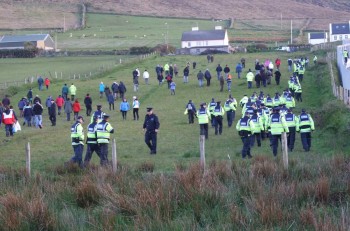
By Miriam Cotton In April 2006, life-long native of Erris, Co Mayo, Willie Corduff was honoured to go to California to accept the coveted Goldman Environmental Prize – awarded to him for his efforts to protect his community from environmental and other threats it faces from the proposed Shell/ Statoil/ Marathon Consortium’s Corrib Gas project. The Goldman is awarded annually to just six people from around the world. Here was a big story: a source of national pride, with international significance and full of human and social interest. Yet there was only a relatively low-key murmur about it in the Irish national media. Three years later almost to the day Corduff allegedly found himself attacked and viciously beaten by a number of men in balaclavas. By the early hours of April 23rd, 2009, Corduff had spent much of the previous day trying to prevent the erection with dubious permission of fencing for a Shell compound above Glengad Beach in Broadhaven Bay, by sitting under a Shell works truck and so rendering it inoperative. The sandy beach cliff at Glengad is home to a much-loved population of sand martins but it is also the proposed landfall site for the 92km, globally unprecedented, pipeline of highly volatile raw gas – from seven well heads out in the Corrib field. Having hit the landfall at Glengad, Shell say the pressure will, if the project goes ahead, be reduced from the extremely high 345-bar pressure to 144-bar via a ‘reduction valve’ and then travel a further 9 kilometers inland, criss-crossing the exquisitely beautiful Broadhaven Bay, to a proposed refinery at Ballinaboy. Following the alleged assault on Corduff, again, the national media have been strangely reticent in key respects. Most reports, at first, relied on Garda statements which focused on a separate allegation that earlier the same night ‘an armed gang’ had frightened off two Shell security men and taken down the fencing – ‘with paramilitary precision’– but omitting mention of any attack on Corduff or of the beating sustained by his brother-in-law, Pete Lavelle, who says he had tried to help Corduff when he was attacked. As other accounts of the incident began to surface from alternative sources, further Garda statements mentioned that an ambulance had been called for Corduff to take him to Mayo General Hospital because he had been ‘feeling unwell’. An RTE report on the 23rd April is typical. Brian Dobson in Dublin and Teresa Mannion in Mayo emphasised at every turn the removal of the fencing while noticeably understating what Corduff believes was a serious attempt on his life. His wife, Mary Corduff, has expressed her dismay at how her interview with Mannion was presented – most of her testimony edited out and chopped to imply that her husband had been happily sitting under the truck until, as then qualified by Dobson, he was ‘led by gardai’ to an ambulance. According to Corduff, unable to stand or walk, he was carried by paramedics on a stretcher. Corduff says of his attackers ‘they knelt on the side of my head and neck and on the side of my chest, my airways were constricted and I couldn’t breathe. One of them jumped repeatedly on the inside of one leg. Eventually, my tongue fell out of my mouth and when they saw that, they stopped. I think they thought I was gone.’ Corduff says he heard one of them say “ ‘Stop now lads, he’s nearly finished’. I could see two gardai mingling with the people who attacked me who were still wearing the balaclavas but none were arrested.’” For the first five or six years of the ten-year-old dispute in north-west Mayo the media reaction was mainly one of indifference. That all changed when, in 2005, four farmers and a retired school principal – ‘The Rossport Five’ – including Willie Corduff, were jailed for refusing to comply with an injunction by Shell requiring them to allow access to their land for works on the project. The story was iconic: five Davids were taking on three colossal Goliaths on points of safety, environmental, social and national economic principle. Support for the men poured in from all over the country. After toughing out the negative media onslaught for 94 days, Shell, the majority shareholder in the project, was effectively forced to concede the public relations disaster their injunction had generated – though a face-saving explanation was found for lifting it – a course of action they had been adamant they could not and would not take. Shell is to go on trial in the US on the 26th of May for its activities in the Niger Delta where Ken Saro Wiwa, was hanged with eight other men by the Nigerian government following his determined opposition to Shell activities there. In his book about Corrib “The Price of our Souls: Gas, Shell and Ireland”, Michael McCaughan, who often writes for the Irish Times, though not about Rossport, quotes the observations of Kevin O’ Hara, the founder of the Centre for Social and Corporate Responsibility in Port Harcourt, Nigeria about what he saw in Mayo: “I pulled up in my car and people jumped out at me and were taking photographs of me and my car and my number plate…I realized, oh boy, here we go again, Shell in Ireland…I was very saddened to see all of the same mistakes, a repeat of what I saw in Nigeria and it was happening in County Mayo, Ireland”. Was there a planned, behind–the-scenes campaign to smear the reputation of the community in response to the popularity of The Rossport Five? In October 2006, almost exactly a year after their release, a large force of gardai was sent to Ballinaboy where they began to physically engage with local people participating in the ongoing, non violent direct action to prevent the construction of an onshore gas refinery. A baton charge ensued and many people were injured. Since then, the victims have, in the media narrative, become the aggressors. Community
-
by admin
“None of us know what to do” Fintan O’Toole has a brilliant agenda but doesn’t know how to implement it Michael Smith interviews Fintan O’Toole First of all, Fintan O’Toole is very charming. He’s one of those people, like one of his Nemeses, Bertie Ahern, you think you know even if you’ve never met him. Because he is angry and a master of invective I’m expecting intensity, even testiness, and after a few unanswered emails and mutterings from some people who’ve met him I am a little nervous but, no: during our discussion over coffee and then lunch in the wine-bar below the Village office he’s almost disappointingly well-rounded, self-deprecatory, humorous, serious, a little shy. I open by asking him what he thinks of his Apres Match persona (all huffing and expansive angularity). He thinks it’s frighteningly like him. A lady in the chemist mistakenly congratulated him on “his” performance on the Late Late Show. I should say, during our extended interview, his arms remain exactly where you’d want them to be. Fintan O’Toole, of course, is a columnist, assistant editor and drama critic with the Irish Times. He has written over a dozen books, on drama, history and politics, including two in the last year. Ship of Fools outlined many of Ireland’s main social and economic problems. The first part of Enough is Enough again outlines the problems, centring on ‘Five Myths’ including that we live in a proper representative democracy when in fact “the Irish parliament is probably the weakest in the democratic world”. It’s the well-rehearsed exegesis of how public waste, disadvantaged schools, inadequate infrastructure and a two-tier healthcare system co-exist with crass displays of personal wealth. The second, more original, part of the book outlines solutions centring on ‘Five Decencies’. So here’s the agenda. He believes all the principles have been tried somewhere. If you go to his website www.fintanotoole.ie you’ll find it expressed in ten points; if you go to his book it’s in fifty. 1 Establish a genuine system of local democracy. Introduce a property tax to fund it. 2 Transfer the useful functions of quangos to local councils. 3 Bring in legally binding national standards for planning and development and give the National Spatial Strategy statutory status. 4 Implement the Kenny report of 1974, allowing councils to purchase development land for its existing value plus 25 per cent. 5 Establish “deliberative democracy” experiments in every substantial community. 6 Severely limit the ability of governments to use the guillotine mechanism to pass legislation that has not been debated in parliament. 7 End the fiction that Ministers are responsible for everything that happens in their departments. Make them responsible for decisions they take and for information they ought to know. Make senior civil servants responsible for the decisions they take. 8 Restore the right of the Oireachtas to inquire into all activities involving the use of public money. 9 Make all appointments to state and public boards open to public competition and subject to Oireachtas scrutiny. 10 Reduce the size of the Dáil to 100 members. 11 Either make the Seanad representative of civil society, social partners and the new local councils within a short time frame or abolish it. 12 Change the Dáil electoral system to the additional-member system. 13 Introduce a gender quota of at least 30 per cent, to be enforced by reducing public payments to political parties by the degree to which they fail to introduce gender balance. 14 Hand primary schools over to local and democratic ownership and control. 15 Replace GDP as the primary measure of progress with a well-being index. 16 Radically curtail tax incentives for private pensions and stop putting money into the National Pension Reserve Fund. Use the money to increase the state pension for everyone to 40 per cent of pre-retirement income. 17 Switch spending from both social-welfare rent supplements and tax breaks for landlords to the provision of decent social housing. 18 Introduce a national system of social health insurance, abolishing the two-tier health system and radically reducing the size of the Health Service Executive. 19 Switch more health spending towards community and preventive services. Implement the primary-care strategy. 20 Charge university fees to those who can afford them. Increase grants for those who are currently excluded. 21 Expand adult and continuing education. Consider the idea of individual “education funds” attaching equally to each citizen. 22 Identify children at risk of failure from an early age and intervene immediately with personal and family supports. 23 Make the pay of those at the top a fixed percentage of that of those at the bottom. 24 Bring taxes up to average European levels. Reduce tax breaks to average EU levels, saving more than €5 billion. 25 Limit to three the number of directorships of public companies that any one individual can hold at the same time. 26 Give coherent legislative protection to bona-fide whistleblowers. 27 Restore the Freedom of Information Act to its former status. 28 Create a register of lobbyists and publish records of all meetings between lobbyists, ministers and public officials. 29 Review company law to end impunity for white-collar crime. 30 Ban all significant private donations to political parties and force all registered parties to publish full annual accounts. Like David McWilliams, and perhaps Shane Ross, Fintan O’Toole offers an analysis so acute that he has become a messiah. Like them he is offering, more or less coyly, political solutions. So what drives the thinking of the Cassandra of Ireland’s journalistic left? He says he’s “obviously a socialist”, though not a “scientific socialist” and he considers socialism evolves. He believes there are levels of income beyond which people should not be allowed to rise, though pointing to China where he has lived, O’Toole says that “the depradations of an attempt to impose equality are greater than those of the market”. He’s influenced by Fabianism and British views of socialism – “Victorian socialism”. Still he’s quite prepared to half-describe himself as a social
-
by admin
Prosecute a banker (A DIY guide for Village readers) By Gary Fitzgerald Since the beginning of the banking crisis in September 2008, the government’s strategy has been to protect the banks at all costs. With the IMF/EU deal announced recently, it is now clear that the government intends that the taxpayer will pay for bank losses irrespective of the impact on public services and on the wider economy. The final cost of this policy is not yet known, and it may never be known. We have lost track of the billions of euro already spent and the billions more promised. The government’s decisions may lead to national bankruptcy. The voters will get a chance to express their opinion on this policy in the upcoming general election. It is also clear that there will not be any criminal prosecution of senior bankers under this government. More than two years have passed since this crisis began and apart from a little grandstanding by the Gardaí in March 2010 (with the arrest of Sean FitzPatrick) and the occasional public statement by the Gardaí, nothing appears to have happened. In a previous article I wrote about how some of these criminal offences were not very complex. Two in particular carry jail terms of up to 5 years and a number of board members from both Anglo Irish Bank and Irish Life and Permanent could be prosecuted and face jail terms of up to 35 years. Voters may take direct action against politicians on polling day, but is there any direct action they may take to prosecute white-collar criminals? The general rule in criminal law is that the State prosecutes the defendant on behalf of the people. For serious cases the Director of Public Prosecutions (DPP) initiates the prosecution and for minor offences it is the responsibility of the individual Garda who is in charge of the case to initiate a prosecution. But audit is not the only possible source of criminality that could ground an action; and the Financial Regulator is, for example, investigating allegations that banks provided “false and misleading information” to NAMA about the value of their toxic property loans. But there is a little-used process whereby any individual may initiate a criminal prosecution. This is known as the right of Common Informer. Over recent years the rights of the Common Informer have been limited by Acts of the Oireachtas, but the basic right still exists. The rest of this article will set out the process involved in taking a criminal case by way of Common Informer. But first, it is necessary to explain some principles of sentencing in criminal law. Sentencing offenders A summary offence is a minor offence, triable in the District Court, with the judge acting as both judge and jury. The maximum penalty is two years in jail or a fine of up to €5,000. An indictable offence is a serious offence, triable in the Circuit Criminal Court or the Central Criminal Court. The case is heard by a judge and jury and there is no limit on jail term or fine. The punishment available for any individual offence is set out in the relevant statute. For many crimes the statute sets out a punishment if the case is tried in the District Court and a heavier punishment if the case is heard in the Circuit Criminal Court. The choice of court is, in general, determined by the prosecuting authority (such as the DPP). For example, S197 of the Companies Act 1990 makes it an offence for an officer of a company to give a false statement to the company’s auditors. S240 (as amended) sets the punishment for that offence as follows: Summary offence a fine of €1,900 and/or up to 1 year in jail Indictable offence a fine of €12,600 and/or up to 5 years in jail Should more than one false statement be given to auditors, for example, were a false statement made in each of 7 different years, the defendant could be charged with 7 instances of the same offence. Were the prosecution to be successful, it would be up to the judge to determine if the sentences should be served concurrently or consecutively. Were the former chosen then the defendant would serve a 5 year jail term, while in the latter case he would serve a 35 year jail term (5 years x 7 offences). The normal procedure is for concurrent sentences to be handed down but if the offences are serious enough then the judge may impose a consecutive sentence, or a combination of both. The Common Informer procedure Any private individual may initiate a criminal prosecution as a Common Informer. The process begins with the making of a complaint under S10 of the Petty Sessions Act 1851. That act states that a complaint is made to a judge of the District Court. If the judge is satisfied that there is a prima facia case then he must issue a summons for the defendant to appear in court to answer the complaint. The judge must ensure that there is substance to the complaint and may refuse to issue a summons. But the evidential threshold that the Common Informer must reach at this stage is low. There is no time-limit on the making of the complaint by the Common Informer for offences that may be tried either in the District Court or the Circuit Criminal Court. Right at the outset the Common Informer has an important decision to make. He may seek a prosecution for summary offences only. In this case the Common Informer has full control of the prosecution and the DPP cannot interfere with the prosecution. Or the Common Informer may seek to try the offences as indictable offences. Here the Common Informer has control of the early stage of the proceedings but thereafter the DPP is obliged to take over. The DPP may either continue with the prosecution or decide to stop it. This decision is a difficult one. On
-
by admin
Interview by Paul Dillon Michael D Higgins, veteran polymath TD for Galway West, was born in Limerick in 1941. His father, a lifelong republican, had been sentenced to death by the Free State for blowing up Mallow Bridge, but reprieved, the Cork Examiner having called for his execution. His father left his family and the very young Higgins who has written that while “there are images [of Limerick] which I retain, such as the pleasure of being brought up past Janesboro to the public park in Limerick, [that] memory fades into insignificance when I consider the implications for all concerned of the leave-taking that was involved in the break-up of our family”. Raised in Newtown-Mount-Fergus, County Clare, from the age of 5 by an aunt and uncle, Higgins had a nanny with an Anglo-Irish accent – trained in a Limerick ‘big house’, accounting perhaps for his unusual dialect, though not his intermittent shrillness. He was educated at St. Flannan’s College, Ennis, Co. Clare, University College, Galway, Indiana University and Manchester University. He is Married to Sabina Coyne, a founder member of the Focus Theatre and Stanislavsky Studio in Dublin. They have one daughter and three sons. Politician Higgins was active in Fianna Fáil as a student in UCG but in the end stood (unsuccessfully) for the Labour Party in the 1973 general election despite a fresh-faced Éamon Gilmore canvassing for him. A former member of Galway County Council (1974-1993), he has twice been Mayor of Galway. As Chairman of the Labour Party 1977-1987, he opposed coalitions with Fine Gael. Higgins was a member of Seanad Éireann 1973-1977 and 1982-1987 and was elected to Dáil Éireann in 1981 and 1982; and re-elected in 1987, 1989, 1992 and 1997. In 1992 he thought of joining Democratic Left but stayed with Labour and became Minister for Arts, Culture and the Gaeltacht 1993 -1997. Dessie O’Malley said he’d ‘go mad’ in a ministry but he didn’t quite. Indeed he is highly regarded in arts circles for his achievements in office. Currently he is President of the Labour Party and Party Spokesperson on Foreign Affairs. He will not stand in the imminent general election as he has his sights, not for the first time, on the Presidency. A straw poll in the Sunday Times showed an overwhelming preference in the parliamentary Labour Party for the intellectualised Higgins over his party rival, the more worldly Fergus Finlay. Sociologist Higgins is Honorary Adjunct Professor at Large in Political Science and Sociology at the National University of Ireland, Galway, and former Visiting Professor at the University of Southern Illinois. Writer/Poet HIs first collection of poems, ‘The Betrayal’, was published in 1990. His second book of poems ‘The Season of Fire’ was published in 1993. The Irish Times’ reviewer wrote: “T]hough Higgins declares in one poem his dedication to “the blinding light/ Of the ordinary”, too many of the poems are damaged by his use of a language that doesn’t practise what he preaches. So even a poem of affecting memory can slide into a language that distances us from its experience, is clotted with abstractions”. A selection of his writing, speeches and academic work, ‘Causes for Concern’ was published in 2006. He is currently preparing a new academic work on political theory and practice, emphasising the necessity for an integrated approach and stressing the hegemony of values. Human Rights Activist Michael D Higgins has campaigned for human rights and written of conflict in many parts of the world, including such areas as Turkey, Western Sahara, Nicaragua, Chile, Gaza, The West Bank, Peru, El Salvador, Iraq and Somalia.. In recognition of his work for peace with justice, he became the first recipient of the Sean MacBride Peace Prize of the International Peace Bureau in Helsinki in 1992. He has been an active feminist for all of his political life. Former Labour leader, Frank Cluskey once was told, when he asked why Higgins was not at a party meeting, “he is in El Salvador”, prompting the response that when given the choice of saving the world or the Labour Party, Higgins always took the easy option. This reflects the party’s sometimes testy, but always respectful, indulgence of a man sometimes seen as the conscience of a party that perpetually wrestles it and wins. What were your early political achievements and interests? When I first stood for election in 1969, I was 28. I made a conscious decision at that time to bring in economic rights and social rights to the discourse I was developing. I became a Senator in 1973 and I was very much involved in personal-rights issues, such as family planning. I recall the first attempt to abolish the status of illegitimacy. Between ‘77 and ‘81, my work was quite internal within the Labour Party and I was out of electoral politics. In ‘81, I was elected as a TD for Galway West and I won the seat on quite a left-wing agenda. There were 3 elections in 18 months. In the first election in 1982, I surviveD But then in the second, I lost my seat. I had been targeted by the Christian Political Action movement. The other people who were targeted by that group in that election were Jim Kemmy and Mary Robinson. No change in Ireland happened by accident and none of the thinking around change happened by accident. It was based on a very solid foundation of work on a rights-based agenda. How did your association with Central America begin? In 1980, you had the shooting of Archbishop Romero in El Salvador. Éamon Casey was involved in Trócaire and I was invited to go to El Salvador. And then I went to Nicaragua and it was then I began my long association with the Sandinistas. That began a relationship with Central America that would develop. Much later, I was part of an international delegation which met with Senator Ted Kennedy. It was Kennedy who put down the motion in the US Congress which ended the
-
Posted in:
We are under-taxed
by admin
Patriotic wealthy people should push for higher taxes. by Mark Lonergan As the impending day of Fiscal Judgement arives in the form of the Budget, many Irish workers have resigned themselves to both increased taxation and significant cuts in Health and Education. The gap between Governmental expenditure and tax revenue is edging close to almost €18 billion so something radical is needed. It may come as a surprise but Irish workers are among the lowest taxed in the EU – according to the latest figures from the OECD. While the headline rate plus the income levy edge the marginal rate to mid 50% this is not a true picture of the Irish fiscal landscape. Effective tax rates in terms of income tax and social contributions are very low by international standards.. A large portion of workers, equating to approximately a third of the workforce, do not pay any income tax in 2007 because our income tax thresholds are high. The recent UK election campaign had Nick Clegg proposing to raise the tax threshold in the UK to £ 10,000 (€11,600) from the current rate of £6475 (€ 7600). In Ireland the threshold for a single worker is €18,300. For a married couple either of whom is over 65 no tax is paid if their income is less than €40,000. It make sense to bring more people into the tax net by reducing these generous thresholds. Surely they should be contributing at least some minimum level of tax? It is intended to combine PRSI, health contributions and the income levy into a single tax. Employers groups will protest that this is a tax on employment since it will increase employment costs. But in comparison with other EU countries the employment costs in terms of tax and social welfare are relatively low in Ireland. For each €100 that an Irish worker can take home, the employer has to pay out €140. This extra €40 goes on Income tax and employer’s and employee’s PRSI contributions. The average across the EU is €72 for each €100 and in Germany the figure is €100. A historical comparison with 2006 shows that even with an increased tax burden as a result of the health contributions and income levy the Irish worker is still paying less income to the state than they were in 2006. The reality is that in 2006, any fiscal shortfall on income tax could easily be averted by bumper Capital Gains Tax, VAT and stamp duty – one-off transaction-taxes that have plummeted in the recession. The light income tax burden in Ireland is most marked for high earners. People earning between €200,000 and €500,000 paid only an effective tax rate of 13.63% in 2007 – after availing of the various tax shelters (many of which are property-related and have no equivalent in the tax codes of other EU states). It is imperative this low effective tax rate be increased by whatever means possible. Its ludicrous nature is exacerbated when one considers who these people are: a significant proportion of them are earning their high incomes on the back of state largesse – Hospital Consultants, University Heads, Politicians, Barristers working for tribunals and Solicitors advising the state (€11million was recently paid for NAMA-related work to a top Dublin firm) and General Practitioners with large medical card patients. Studies have shown such professional groupings to be paid way in excess of their colleagues in other EU states. For example, some health professionals earn up to three times more than there UK counterparts. Arguments from lobbyists that these high earners will leave Ireland if taxed too heavily are fanciful in the extreme. What has paid for the 40,000 new cars registered in the state to March 2010, when there is a scarcity of car finance in the domestic financial system? In Germany, wealthy individuals have begun lobbying for higher taxes. Dieter Kelmkuhl, a retired doctor who launched a petition for a wealth tax, says: “It’s time for the wealthy to come to the aid of their country”. The Irish élite are unlikely to promote such initiatives. Perhaps it is time for them to show their patriotism somewhere other than the yearly rugby match against England. Let’s not pretend that we are over-taxed in Ireland and let’s accept that the State can only cut so much. We all have to be prepared to pay effective tax rates comparable to our EU counterparts if we wish to have an acceptable level of state services. The days of the Capital tax windfalls are over. Income tax must provide more Governmental Revenue.