



Brzezinski was part of a triumvirate of Western powerbrokers whose malign influence has scorched the Earth for more than 50 years. One of his confreres, David Rockefeller, died last March aged 101. Now, only the third member of the coven, Henry Kissinger, is left to serve the interests of the billionaires and trillionaires of Wall Street and NATO. When Kissinger goes, their combined legacy will be plain to see: a mountain of twisted and broken skeletons.
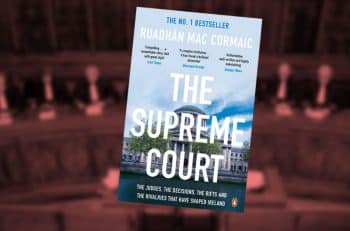
Review by Máire Moriarty. Ruadhán Mac Cormaic, Irish Times journalist and former legal affairs correspondent, has written what is in effect a biography, the first, of the Supreme Court, bringing to life its stories through its judges and litigants. Clearly he has had unprecedented access to many of the most prominent judges and their papers. The research is meticulous, the unnamed sources are intriguing, the interviews with litigants are refreshing and illuminating. Chapters unfold in the manner of a drama, with a rolling cast of colourful characters meticulously drawn. Each chapter is carved out of a step forward in the evolution of Ireland embracing the creation in 1922 and recreation in 1937 of the Irish Constitution, then leaping beyond the guardrails of the Constitution, as drafted, to the genius of the doctrine of unemunerated rights, that the Supreme Court utilised to unlock the superpower of the “powder blue book”, Bunreacht na hÉireann. This is no dusty history. Litigants are propelled into the foreground, given a multidimensional rendering by Mac Cormaic, and so come alive in a manner that would never shine through in a clinical court report or, for those of us who studied law, in text books. Legal teams, which broached new and creative ways to challenge laws, and judges, who reviewed, expanded and reinterpreted the constitution, are shown through a real and unfiltered lens. He expatiates in particular on the Ryan (water fluoridation and the right to bodily integrity), McGee (contraception), Norris (homosexuality), de Burca (female participation in juries), CC (a lacuna in the law of sex offences), Crotty (power of government to sign European treaties) McKenna and Coughlan (government intervention in referendum campaign), Abbeylara (capacity of Oireachtas members to conduct meaningful parliamentary inquiries), X (abortion), and Sinnott (right to education – the nadir) cases. Definitive sketches emerge of the great lawyers of the last century: Brian Walsh, Seamus Henchy, Cearbhall O’Dálaigh, Tom O’Higgins and Adrian Hardiman. He gives the personal side to the evolution of unenumerated rights first logically extracted from the constitution by Justice Kenny in the High Court in Ryan – the Constitution lists some rights but makes it clear they are not exclusive: therefore there other rights can be inferred. Perhaps the hero of the book is Brian Walsh who was never elevated to the position of Chief Justice, partly because of a perceived proximity to Charlie Haughey. Mac Cormaic has unearthed friendly correspondence between him and the great US Supreme Court Justice William Brennan, which suggests Walsh was systematically monitoring US Supreme Court jurisprudence during the golden era of judicial enumeration of Constitutional rights in both jurisdictions. The doctrine of unenumerated rights has been in decline since Sinnott (2001). Mac Cormaic outlines the events that led to the resignation of Hugh O’Flaherty from the Supreme Court and how senior judges leant on Chief Justice Hamilton to strengthen his report about the Sheedy Case. Mac Cormaic clearly spoke to an impressive range of the protagonists too in researching how both Albert Reynolds and newly-appointed High Court judge Harry Whelehan came to resign following the seven-month neglect by the office of Attorney General, which Whelehan had just vacated, of a request for extradition to Northern Ireland for paedophile priest Fr Brendan Smyth. Politicians who feature in periodic clashes that unfolded between the legislators and the judiciary, are also scrutinised. The hard fought battle by Mrs May McGee, to assert her right to import into Ireland contraceptives for personal use within her marriage, seems to come from an impossibly different era of so called 1970s modern Ireland. McGee told Mac Cormaic that she found the Four Courts “cold and scary… an awful place to be”, but she is proud of her part in probably the court’s most important decision. The McGee case was successful on appeal to the Supreme Court, but paradoxically, as noted by Mac Cormaic, the freedom won by McGee was undoubtedly the catalyst for a conservative political movement to kickstart the pro-life campaign that ultimately led to the 1983 amendment to enshrine the right to life of the unborn in the constitution. This was the Eighth Amendment to the Constitution and a campaign to amend or repeal it is a very live political issue today. If only there was an addendum to this book to address the current struggle between the judiciary and the government on the topic of the Judicial Appointments Board. It seems that political expediency has propelled the Cabinet to endeavour to fast-track this Bill and introduce a new balance of power to the Judicial Appointments Commission Board which is to comprise a majority of non-legal members and a lay chairperson, rather than the Chief Justice Susan Denham. This bill is getting a mighty push, despite the lack of support from Fianna Fáil which benefits from a Confidence and Supply Arrangement with the government. Fine Gael are relying on Sinn Féin Party and the radical left to land their Bill. It would be really interesting to imagine what views the late and volcanic Justice Adrian Hardiman would have launched into the debate. Mac Cormaic would have extracted them, discretely but forensically. Máire Moriarty is a barrister and journalist
The government is preparing a ‘Plan’ for the development of the country. It is intended that ‘the Ireland 2040 Plan’ will be a “high-level document that will provide the framework for future development and investment in Ireland. It will be the overall Plan from which other, more detailed plans will take their lead, hence the title, National Planning ‘Framework’, including city and county development plans and regional strategies. The National Planning Framework will also have statutory backing”. The most noticeable thing is that “statutory backing” means nothing. A plan gets “statutory” backing just by being mentioned in legislation. A meaningful plan should be ‘mandatory. For example legislation might require government agencies and local authority plans to merely “have regard to” the plans referred to in the legislation. It needs to require them to comply with and implement those plans. Suspending cynicism for a moment, however, what might an excellent plan look like. The first thing would be to work out the criteria that would dictate the plan. It’s notionally accepted that these should be criteria that conduce to “sustainable development” that is development that meets the needs of the present without compromising the ability of future generations to meet their needs too. It’s a good definition and a good goal. The starting point in assigning the earth’s stock of resources must be to minimise their depletion. The nuts and bolts of sustainable development are taken to mandate equal attention to economic, social, environmental and perhaps cultural agendas. The goal of society in our post-religious times is quality of life, even if many use an inept surrogate, Gross Domestic Product. Sustainable development conduces to quality of life, over the long time. If anyone decides to bother it can be measured to ensure its promotion – unemployment rate, inequality measured by the Gini coefficient, water quality, number of opera houses etc. Planning can be seen as a machine for improving quality of life – if we want to. The upshot of this for this State is a policy imperative for balanced regional development, with the nature of the balance being determined by the economic, social, environmental and cultural imperatives. Economically there is an imperative to develop Greater Dublin, particularly Dublin itself. We live in a foolish world where economics is supereminent, particularly among policymakers, many of whom particularly at local-government levels are promoted almost exclusively because of their performance on economic matters. Environmentally too, it is arguable that if we concentrate development around the capital, it tends to free the much bigger rest of the country from the ecological depredations that characterise human activity, at least in the early part of the twenty-first century. It is also, on the other hand, arguable that environmental imperatives suggest pre-existing infrastructure, and the energy embodied in its manufacture, should continue in use. In any event, socially it is regressive to force people to live away from their communities. So what does this mean in practice in Ireland? First, there must be a plan and it must be implemented. The last plan, the national spatial strategy (2002-2020) had no teeth and was not implemented. Most development was sprawl for Dublin and one-off housing in the countryside. With its cynical use of the loaded term statutory rather than the more practically important term “mandatory” there is no evidence the Government has learnt the lesson. Unfortunately existing development patterns suggest we can look to more of the same. However what we need is development to counteract Dublin. Realistically this must attract the development that otherwise would occur in Dublin, particularly high-tech, high-paying companies that seek sophisticated, urban settings for their workforces. This suggest we need to look to divert development that otherwise will take place in the hinterland of Dublin to cities outside Dublin, including Cork, Galway, Limerick, Waterford and perhaps a new city in the midlands. This probably necessitates shifting government expenditure to these cities, though not in the ad hoc way Charlie McCreevy attempted in the early 2000s. Citizens too may have to be incentivized through tax incentives for sustainable developments in the right areas. We might remember that if a policy is worth legislating for it is worth also pursuing through fiscal measures. Beyond this there are other imperatives: for social reasons stated no area should go into decline and for environmental and social reasons people should live near to their workplaces . The market must therefore similarly be stacked to promote the development of existing towns and villages, the next two layers down from cities. Of course new energy in the cities outside Dublin would generate its own knock-on effects in local towns and villages. Finally then least sustainable development of all is one-off housing (apart from people who live and work on the land) as it cannot be served by public transport, requires disproportionate costs in servicing such as postal and electricity services and risks disengagement as populations age and cannot leave their isolated homes. It’s fairly simple and logical: incentivise people to live in cities outside Dublin; regulate against development in Dublin’s hinterland (though development in Dublin itself, particularly high-density developments in areas like docklands in the city centre is fine); ensure towns and villages don’t decline; eliminate new one-off housing. By Michael Smith
Disgraced religious orders making unholy sums from selling school green spaces that betray their public-interest legacy and crystallise imperatives for a healthy Church-State relationship