Politics

Random entry RSS

  • Posted in:

    Morally Most Wanted

    Christopher Hitchens, no stranger to contrarian positions, once wrote a remarkable polemic called ‘The Trial of Henry Kissinger’ impugning Kissinger for being as guilty as any common war criminal of crimes against humanity. In evidence Hitchens proffered his inculpation in the murder of democratically-elected Chilean president Salvador Allende. After General Pinochet assumed power Kissinger told Richard Nixon that the US “didn’t do it”, but “we helped them…created the conditions as great as possible”. Hitchens also marshalled in evidence Kissinger’s sponsoring of the carpet-bombing of Cambodia, and his and Gerald Ford’s oblique tolerance, and perhaps approval, of genocide in Indonesia. At the time the book had an incendiary effect but the allegations were not immediately directed into concrete legal action. Ultimately of course Kissinger had to leave France with unseemly haste with an arrest warrant pending and return to the safe refuge of the US where he thrives as a nonagenarian staple of talk shows, the idol of Fox News and a totemic visionary of Realpolitik. Such is the shadow existence of a once lethal global potentate. But Kissinger is old news, disempowered, with the historic crimes fading over time and mercifully, absent a call from Trump, out of harm’s way. Though you never know, such is the plausibility in our unethical world of the king of statecraft. Realpolitik has moved on from such crude seventies tactics as murdering a head of state to simply disemboweling him metaphorically – as with Tsipras – with the panoply of capitalism. Moreover we have, some of us, moved on to business-craft. From the modernist, almost industrial complex of building that is UCD stands out a splendid new addition, the Sutherland school of law, a sleek new premises which “incorporates teaching and learning facilities which are purpose built to foster and support more experiential styles of learning”. This is most apparent in the Clinical Legal Education Centre which incorporates a trial room suitable for mock trials, though not of its benefactors of course. If Peter Sutherland were a building it would be this building for, though well-upholstered, it’s a little top-heavy. Why do we never name schools of law after true heroes, or at least flawed ones? The Mansfield School of law, The Sean McBride or Mary Robinson School of law? Of course international businessmen and plutocrats of all sort seek, in the dusk of lives dedicated to the pursuit of money, to have their reputations magnified for future generations. Tony O’ Reilly, by far the most elegant of the Irish philanthropists, has his sponsored buildings in Trinity and UCD, named – perhaps – after his parents. But these things are done better and with fewer strings in the US, where the culture and indeed the tax regime are more conducive: Warren Buffett and Bill Gates are charitable icons and are scrupulously divesting themselves of their assets in the common good; many US universities depend on philanthropy. Naturally the Sutherland school seems a bit more business- friendly than its fuddy-duddy anonymous predecessor: it aims to make “our teaching and learning challenging, rewarding, relevant, and critical in engaging with the challenges of law in Irish and international business, social, political and economic life”. If Goldman Sachs did law faculties it might probably do this one. It is not clear whether the minions and opinion-formers, rushing to their lectures, have been encouraged to downgrade human rights, the environment and culture as part of the process of embracing their exciting challenges. Peter Sutherland is a unique case; a pasha of world fuzzy democracy, a knight of the British realm described in the Financial Times in 2009 as “at the centre of the establishment in all its forms”, a querulous and basilisk Buddha, looking down from a great height at the mortals of the world and their fig-leaves of democracy and national sovereignty, barriers to the elevation of trade that his career has so eminently promoted. But let us construct a narrative for this man. Gonzaga, UCD and King’s Inns educated and aggressively-rugby-playing, he became Attorney General of Ireland in his 30s, after a brief and unsuccessful electoral dalliance with Fine Gael; and then was made the youngest ever EU commissioner – for Competition, in which capacity he was famously dynamic, driving competition in the airline, telecoms and energy sectors, and attracting the admiration of federalist Commission President, Jacques Delors. He chaired the Committee that produced The Sutherland Report on the completion of the Internal Market of the EEC. Only Ireland’s dreary civil-war politics deprived Sutherland of the job he coveted most when, back in 1994, the UK recommended him for the post of European Commission president. His strings to Fine Gael meant he did not enjoy the support of his own country’s government, then led by petfood Taoiseach Albert Reynolds. Tellingly, he once told the Financial Times: “I do absolutely believe in the European project. I think it’s the most noble political ideal in European history in a thousand years”. The Competition Commissionership was the first step in his championing of globalisation, internationalisation, sovereign fluidity, and the promotion of economic liberalisation. Of course Sutherland can surely speak the language of progress and ethics – and he is even, as a Good Catholic, an economic advisor to the Vatican, Consultor of the Extraordinary Section of the Administration of the Patrimony of the Apostolic See (and President of the International Catholic Migration Commission). Nevertheless his work – and even his lifestyle – bespeaks slavery to the amoral deities of capital, profligacy and greed. Globetrotting private jets, secret meetings in the Vatican or with the Bilderberg Group, carefully regulated and deliberately evasive public appearances: bread and butter for decades for this warrior for the business agenda. It is of course an ambivalent existence – grey: not a matter black and white. He is an agent of liberalisations the upshot of which he feels no obligation to take responsibility for. The Moral Charge Sheet So we propose a new offence. Let’s leave it shy of a crime for there is no

    Loading

    Read more

  • Posted in:

    Noonan had information to stop dodgy Project Eagle sale

    Isn’t it nothing sort of remarkable that the Irish Independent failed to explore the extraordinary role played by Michael Noonan and his officials in the Department of Finance in the Project Eagle affair until just after the votes were counted in the February election? While the newspaper had covered the story over several months it found space on its front page for an exploration of Noonan’s role only after the election results were in, and partisan energy had considerably dissipated. This followed the publication of a report by the Stormont finance committee into the Project Eagle affair which, as Village has revealed over several months, contributed directly to the resignation of Peter Robinson as first minister and DUP leader late last year. The committee report expressed concern at Noonan’s willingness to ignore embarrassing information about controversial fee payments of which he was informed and instead of halting the bidding process instructed NAMA to proceed with the disposal of the massive residential and commercial loan portfolio. In early 2014, NAMA was informed by Pimco, a US fund bidding for the £4 billion (€6.5 billion) property portfolio that it had been asked for a £15 million success fee to be divided between US law firm Brown Rudnick, Belfast solicitors Tughans and a member of the agency’s advisory committee in Northern Ireland, Frank Cushnahan, in connection with the Project Eagle tender. NAMA informed Noonan of this irregular and enormous side-payment request but, instead of halting the process, the finance minister suggested that the largest sale of property assets in the history of the state should proceed. Pimco withdrew from the process on the instructions of its compliance officers in the US. Another giant US fund, Cerberus, subsequently purchased the portfolio for £1.2 billion (€1.6 billion) later that year before it emerged that in excess of Stg£6 million (€7 million) had been lodged by lawyers acting for it in an Isle of Man account. The money was lodged by then Tughans partner, Ian Coulter and, according to Mick Wallace TD, was intended for Cushnahan and others including, it has been alleged, a leading politician or party. In February last, the BBC Spotlight programme broadcast a secret recording in which Cushnahan admitted that he was due a significant fee from the Cerberus deal, contradicting previous claims that he was not due to receive any money. Cushnahan, a former adviser in Robinson’s office of NI First Minister, also claims he and Coulter had put the Cerberus deal together but his role was kept secret from Nama. On top of these claims it has now emerged that a senior executive from Fortress, the underbidder against Cerberus in the deal, met Cushnahan and Ronnie Hanna, then NAMA head of asset recovery, in December 2012 to discuss the agency’s Northern Ireland loan-book some 12 months before it was put up for open sale. Cushnahan left the NI advisory board of NAMA in late 2013 while Hanna resigned from NAMA in late 2014, six months after the sale to Cerberus was completed. Mike George, the managing director of the US private equity group, a Belfast man, made a presentation to the NAMA pair at the Tughans office in Belfast during the December 2012 meeting. NAMA has refused to respond to queries over this latest revelation which puts a former senior NAMA executive in a room alongside a former advisor to the agency who has admitted to seeking side payments from the enormous sale. George refused to confirm that such a meeting took place when contacted by Village last autumn but said he was concerned about the manner in which the Project Eagle sales process was conducted, indicating that some bidders had access to more information than others on the quality and value of the huge portfolio of distressed assets across the North. Can anyone seriously suggest that Michael Noonan is suitable to have have his tenure as finance minister renewed in a new government while questions surrounding his judgement and actions in the Project Eagle controversy remain unanswered? By Frank Connolly

    Loading

    Read more

  • Posted in:

    The Chassis underneath the Stasis

    It’s a couple of years since I observed somewhere or other that, if Enda Kenny chose to have an election in the springtime of 2016, he would fight it not against Micheál Martin and Gerry Adams but against Pádraig Pearse and Joseph Mary Plunkett. So it has come to pass, although this meaning of the outcome, like most of the others, has been overlooked or fudged in the moronic cacophony of the pol corrs, who have managed to achieve a quite astonishing feat of anti-journalism by reducing an unprecedented moment in Irish politics to a succession of quasi-routine news days. I had been hoping to stay out of it. Having deliberately abstained from voting for the first time, and for the most part reading and listening to nothing but the dogs’ and street-criers’ accounts of the fallout through my open window, I imagined the whole thing would be over by now and we restored to our normal state of non-government by showroom dummies. When I heard the outline of the outcome – some five weeks’ since, at the time of writing – I immediately perceived that the arithmetic presented an insoluble conundrum for virtually every one of the 158 freshly-elected deputies, not to mention those we laughably call leaders. What has astonished me (somewhat) is that almost nobody mentions the impossibility of the arithmetic. Most of the commentary since February 27th appears to have consisted in speculations, hints and musings about likely alliances, ‘exclusive’ information about possible seductions, lists of demands and breathless whispers of phone calls and texts, all delivered well into April as if it were still February. But there is no possibility – other than a theoretical one – of a workable government being formed out of the present Dáil arithmetic. This is so obvious that we should be deeply concerned by the fact that it has not become conventional wisdom and given rise to the rather urgent question: what now? When the pol corrs have not been talking up the talks about talks aimed at a minority administration of Fianna Fáil or Fine Gael supported by the other, or a National Government of the two, they have been murmuring about the feasibility of various permutations of independents and others in conjunction with either FF or FG. But it must surely be obvious that this latter category of administration is conceivable only at the most theoretical and abstracted level of conjecture, since it would require the harmonic incorporation of between half-a-dozen and a dozen discrete and differently-minded entities (imagine a menagerie of wildcats, badgers, rats, ferrets, foxes and, sitting in the middle calling for order, Willie O’Dea). Since most of the swollen ranks of the raggle-taggle technicolour brigade have been elected on the basis of either local grievances or broader anti-austerity platforms, no government dependent on their continued concurrence could hope to last anything more than a few weeks. The first time a contentious issue cropped up, the mavericks would be tripping over one another to be first out of the door. In the old days, mavericks were simply bought off, but those days are gone. There are far too many, and what would the IMF say?   And in case you have not already guessed this from the track records of those predicting it, there never was the slightest prospect of a National Government. Fine Gael, having peddled a localised relapse of the Celtic Tiger as a national ‘recovery’, is hoist on its own rhetorical petard: it cannot now claim that conditions exist for the declaration of a national emergency. A minority government of either of the theoretical options is almost equally improbable. Two words: Tallaght Strategy. The dismal political fate this phrase invited upon the head of its architect, Alan Dukes, speaks to us of the perils of statesmanship in a context where Darwinian principles obtain. Nearly three decades ago, Dukes thought to gain himself a place in history by doing the decent thing and placing the national interest before party-political advantage, supporting the then minority Fianna Fáil government in a programme of austerity that would have made Claire Daly choke on her own fulminations. Perhaps Dukes foresaw the electorate rewarding his selflessness, or perhaps he had a more Machiavellian intention, but in any event history records the electorate as computing something to the effect that martyrs should seek their rewards in the next life. Fine Gael failed to cash in and Dukes became political toast. Kenny and Martin may not be Pearse and Plunkett, but they didn’t get where they are today without functioning memories and finely tuned instincts for the meaning of past events in the present. Neither of them wants to end up like Dukes, wandering the post-political landscape, the lost soul of a former contender. This is why all the continuing talk of ‘horse-trading’ is simply smokescreen: they must SEEM to be trying to form a government, but both of them know that, whichever of them ended up supporting a minority government led by the other would have signed his own political death warrant. There is, in other words, no horse. The abortive Fine Gael proposal for a “partnership government”, rejected as Village was going to press, was no more than an attempt to deny the result of the election. Any such arrangement would amount, in effect, to the nullification of electoral contests, since it would mean that in future any number of parties and candidates could engage in all kinds of debates and disagreements during an election campaign in the knowledge that, once the election was over, they were free to carve up the cake between them as though nothing had been said and nothing had occurred. The idea of a ‘rotating Taoiseach’ amounts to a satire on the office: why not – as an alternative to two periods of 30 months – simply have a night shift and a day shift on an alternating weekly basis? I have never been one for attributing a mind to the electorate. We

    Loading

    Read more

  • Posted in:

    Country Report in Limbo

    It’s hard to remember now. It is more than a month ago. Who remembers the delayed European Commission Country Report on Ireland, the one that got postponed until after the February election so it would not influence the voters? There was all sorts of hype about the timing and what the European Commission was or was not up to. There was little about the content of its report and nothing about why the European Commission was publishing it. As the European policy process grinds on, there is now complete silence as the time approaches for Ireland to respond to the report. That is, of course, if we have an Ireland, in the form of a working Government, that can respond. The report was part of the ten-year ‘Europe 2020 Strategy’ for smart, sustainable and inclusive growth. Each year, in February, the European Commission publishes Country Reports on each Member State. These assess the overall economic situation in the country and highlight issues to be dealt with. In April of each year the Member States submit a National Reform Programme setting out the steps they are taking to address the targets of the Europe 2020 strategy, taking into consideration the issues highlighted by the European Commission. In April the European Commission presents Country Specific Recommendations to each Member State after assessing their National Reform Programmes. It is all a bit tedious. But wait! The aims of the Europe 2020 Strategy are to increase the employment rate, to reduce the rate of early school leaving and to increase the numbers completing third-level education, to reduce the number of people living in poverty, to increase investment in research and development, and to reduce greenhouse-gas emissions. These ambitions surely merit public scrutiny and debate. The Country Report on Ireland opens with a round of backslapping for all concerned. The “remarkable economic rebound” is applauded. The successful implementation of an “ambitious series of reforms”, austerity in other words, “with the support of the EU- IMF programme of financial assistance” is lauded. Turning “Ireland into the fastest growing economy in the European Union in 2014 and 2015” is a success story. It goes gently downhill after that with positive steps taken by Ireland celebrated in the report but ongoing vulnerabilities grimly laid out. The vulnerabilities include quaintly termed “legacy issues’ of “private and public debt, and financial sector repair”. There is an unenthusiastic nod to “some progress” being made by Ireland on last year’s Country Specific Recommendations. These addressed the need to reduce the deficit, increase the cost-effectiveness of health provision, increase the work intensity of households and reduce child poverty, and resolve the mortgage arrears issues. We heard nothing about these last year. It would seem, however, that we are more compliant when it comes to taking ownership of austerity reforms from the EU, IMF and ECB troika than when it comes to implementing more positive policy strategies. We get good marks in the report for our performance on the employment-rate target and the early-school-leaving target of the Europe 2020 Strategy. We get a polite “more effort is needed” mark when it comes to the targets for investment in research and development, reducing greenhouse-gas emissions, increasing the share of renewable energy, improving energy efficiency, reducing poverty, and completion of tertiary education. A wide range of issues needs addressing, it says: unemployment, infrastructure and health are of particular interest from an equality and sustainability perspective. Long-term unemployment is highlighted as a concern. The report identifies skills mismatches and skills shortages. It suggests a lack of inclusive growth, a polite reference to poverty and inequality. It makes particular reference to inactivity traps for certain households, the high proportion of people living in households with very low work-intensity, child poverty and the lack of access to affordable, full-time and quality childcare. Infrastructure emerges as a difficulty. It is acknowledged that “seven years of sharply reduced government investment have taken a toll on the quality and adequacy of infrastructure”. The big infrastructure issues identified are inadequacies in housing, water, public transport and climate change mitigation capacity. When it comes to healthcare, cost-effectiveness, equal access and sustainability are identified as being at issue. So now April has arrived and Ireland must submit its National Reform Programme. Incredibly the first barrier to this is the lack of a Government, and that particular barrier does not look like being resolved any time soon. That’s still the easy part. The next step is to secure a National Reform Programme that introduces new measures to address these issues from the report. By Niall Crowley

    Loading

    Read more

  • Posted in:

    An optimistic take on the stasis

    After the General Election the political vista remains hazy. A minority Government led by Fine Gael but backed by Fianna Fáil looks the most likely after Fianna Fáil’s churlish rebuttal of Fine Gael’s Partnership Proposal. Before the election, Fine Gael and Fianna Fáil said they refused to go into coalition with one another. Sinn Féin is refusing to go into coalition with anyone, and Fianna Fáil seems to be serious about it. Radical-left groups such as the AAA/ PBP despite proclaiming to represent the people couldn’t convince many of them to join their cause. These are the fundaments of the situation. A week before the General Election, Fine Gael ran an ad in The Sunday Times that stated Ireland was the envy of Europe. This depiction of Ireland and its reflection of Fine Gael will undoubtedly have jarred with who was vulnerable or angry at the incompetence, iniquity and misconduct of the outgoing government. During the general election campaign the Labour party leader Joan Burton demonstrated all the bluster we expect from Irish politicians on the cusp of demise. “The worst mistake we could make now”, she told her party conference in January, “is to squander our hard-earned progress by gambling on uncertainty”. She inferred from this that the people would return Labour to Government. The efforts by Labour to appeal to its voter base failed, in large part because people were jaded being lied to. A lot of people voted for Independents because of discontentment with the mainstream political parties but this vote was largely cast without expectation that the agenda of the Independent would ever be enshrined in any government policy. Interestingly, perhaps dangerously, in fact low expectations of the implications of these protest votes may be confounded. Irish politicians lie brazenly with no apology. It is the cynicism that this has generated that underpins the current deadlock. The lack of integrity has become so pervasive that it verges on a lack of legitimacy. A lot of people may simply just sigh at these remarks but that is the problem. In Ireland we have become so accustomed to political corruption and contempt that it doesn’t strike us as an issue, less still one we can do something about. Before the 2011 election Fianna Fáil was keen to insist that it “made all the difficult decisions”, despite the fact it had bankrupted the country. Dishonesty shines through even when our politicians have cornered the market in attempting to be honest: Lucinda Creighton voted against the Protection Of Life During Pregnancy Bill – an issue of conscience. What was extraordinary was that she didn’t explain why she didn’t vote with her conscience on a range of other poltical issues, many of which she felt strongly enough about to form a new political party, the earth-bound Renua party. There have been some attempts to resolve this: an elected Ceann Comhairle for example will tend to work against government (or even Fine Gael-Fianna Fáil) hegemony, albeit that it would have been more encouraging had the incumbent come from outside the ranks of the big parties. Eoghan Murphy proposed a series of “radical” reforms to the whip, which would include the ostensibly rather unradical freedom of TDs to question the leaders of their own parties. Partisan jealousies have undermined many efforts at progressive legislation. Last year the Social Democrats proposed to create an Anti-Corruption Agency based on an Australian model. It was voted down by the coalition parties. The Parliamentary structures in Ireland don’t allow independent and opposition party TDs to influence policy in a meaningful way. In the US Senate Committees are structured in such a way that independently minded politicians can influence policy. Quite recently the OECD also revealed that Ireland had one of the least effective Parliaments in Europe. On the budgetary process Ireland ranks lowest. In the UK, politicians voting against the party whip are only rarely expelled from the party. If anything the internal ethos of Irish political parties limits reform more than the internal structures of out political system. In many other countries, it is possible for politicians in the same political party to differ greatly from each other on key issues. In the Conservative party in Britain the views of David Cameron would differ greatly from those of Eurosceptic Daniel Hannan. Likewise In the UK Labour Party, the views of Trotskyite Jeremy Corbyn are radically different from Blairite Liz Kendall’s. In the US, Democrats and Republicans from the same parties disagree with each other on a host of issues: think Trump and Romney. In Germany it is an offence to interfere with the conscientious decision of a member of Parliament. In Ireland it’s almost impossible to point to any mavericks within the mainstream political parties, rather the mockable pathology is to defend everything the ruling party does as if it were gospel. The Irish political system is broken. We are facing the prospect of a second election or a coalition of parties which defied their democratic mandate by going into coalition with a party they said they would not go into coalition with. When individual TDs in coalition Governments can’t be trusted to stand up for an ideology, a mandate or even their constituents a minority Government would probably be the best option. It will be more difficult to get legislation passed, but at the moment there is virtually no oversight, almost all legislation that is proposed by the Government is passed. The second house of Parliament the Seanad is only capable of delaying legislation not repealing it; Seanad reform looks unlikely. In the US legislation has to be passed through three houses before it can be approved. A minority Government would not guarantee support for every piece of legislation that the ruling parties propose. But any stringent analysis suggest that is no bad thing. The only case for optimism is the possibility of the creation of a left and right divide in Irish Politics. The Lanigan’s ball of Fine Gael and Fianna Fáil allowed

    Loading

    Read more

  • Posted in:

    Love over hate

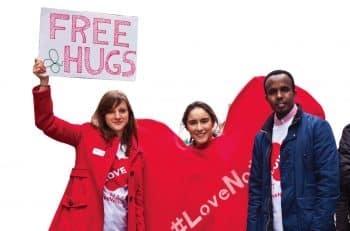
    On March 8 this year – International Women’s Day – Dubliner Victoria Curtis posted a photograph of her recently bruised face on Facebook, and wrote: “This is what misogyny looks like. This is what being a faggot looks like. This is what happens women on Saturday nights walking home with their friends. This is what a man did to me after I told him it wasn’t cool for him to tell us to take off our trousers, pull down our knickers and show him our arses …This is Ireland 2016”. Curtis’ post went viral, grabbing the attention of national radio, momentarily re-opening the much needed national conversation about hate crime. The discussion provided a sober reminder, after marriage equality, that in spite of formal equality before the law Ireland in 2016 isn’t yet an equally safe place for all who live here. Almost uniquely among members of the European Union (EU) and the Organisation for Security and Cooperation in Europe (OSCE), the Republic of Ireland lacks effective hate-crime legislation (not counting the inoperable 1989 Incitement to Hatred Act). In this regard our government has come in for multiple criticisms from the Council of Europe’s Commission against Racism and Intolerance (ECRI), the EU Fundamental Rights Agency (FRA), and the United Nation’s Committee for the Elimination of Racial Discrimination (CERD). It is likely also that the State will be deemed in breach of the 2008 EU Framework Decision on Racism and Xenophobia, and the 2012 Victims Directive. For some years a coalition of NGOs representing, migrants, Travellers and other ethnic minorities, lesbian, gay and transgender communities, and disabled people, has been working closely with members of the Oireachtas, the Irish Council for Civil Liberties and academics at the University of Limerick who produced ‘Out of the Shadows’, an evidence-based roadmap for addressing hate crime. It was hoped that at its launch there would be an announcement by government that it would present the accompanying Criminal Law (Hate Crime) Bill 2015 for enactment. The bill provides a solid formal mechanism for gardaí to identify a racist or other bias-motivated element in a crime, and for the courts to consider this at sentencing. It promised to be a very welcome first step for groups most likely to be the targets of bias-motivated violence. To the surprise of the groups involved, this anticipated move by the government did not happen. Only days later, on July 22 2015 – International Day Against Hate Crime – The Examiner broke the story about “Jane”, a working mother living in west Dublin whose young family had been subjected to a years-long and escalating campaign of racist bullying, harassment, threats and criminal damage, culminating in two masked men spraying “Blacks Out” on her living-room window and front door, and slashing all the tyres on her car. After six years of investing in relationships in her local community Jane threw in the towel, took her children out of school, and fled to stay with relatives in Donegal. In spite of some of the best will, Gardai and the local authority were powerless to protect Jane and her children. Jane’s experience is not unusual. The iReport.ie confidential racist incident reporting system, administered by the European Network Against Racism (ENAR) Ireland, records around 140 criminal acts motivated by racism each year, while the State with all its resources logs fewer than 40. Action Against Racism (AAR) is an ENAR-Ireland-supported campaigning group comprising people who have experienced racism and who are determined that our Republic should – as the name requires – promotes a safe sense of belonging and participation for all who live here. This year AAR launched the Love Not Hate campaign to push for the enactment of Hate Crime legislation by the nex government. The campaign has produced promotional material, including brochures and a video that has gone viral, explaining how hate crime works. On March 19, to mark European Day Against Racism, members of AAR dressed as love-hearts and offered free hugs to amused shoppers on Dublin’s Grafton Street. The tactic was very effective in supplementing the online petition that has already collected thousands of signatures. There will be a strong Love Not Hate contingent at this year’s Dublin Pride march. Hate-crime laws are not a panacea, and on their own will not eliminate the structural and institutional racism (and other forms of bias) of which hate crimes are a violent manifestation. But in the UK, Sweden and Finland, where such laws have been embedded for longest, the data show that they can provide a criminal justice system with a range of instruments that can facilitate the targeting of behaviours, and the promotion of a culture where in future Victoria Curtis will be able to challenge bigotry, and “Jane” will be able to live and work in a neighbourhood and raise her children, without fear. Shane O’Curry is the director of ENAR Ireland, a network of 50 organisations campaigning for political and cultural change on racism. ENAR Ireland manages iReport.ie, Ireland’s independent racist-incident-reporting mechanism. http://enarireland.org/hatecrime By Shane O’Curry

    Loading

    Read more

  • Posted in:

    More to be done

    The situation is stark according to the report issued in late March. 56% of LGBTI people aged 14 to 18 year old have self-harmed, 70% have had suicidal thoughts and one in three has attempted suicide. Compared to the ‘My World National Youth Mental Health Study’, lesbian, gay, bisexual, trans, and/or intersex (LGBTI) young people reported twice the level of self-harm; three times the level of attempted suicide; and four times the level of severe or extremely severe stress, anxiety and depression. Being LGBTI does not accounts for this situation. It is caused by the unnecessary and preventable stresses that LGBTI children and teenagers still encounter as they grow up. This situation was revealed in The ‘LGBTIreland’ Report – the biggest ever survey – launched by former President Mary McAleese. She made the telling point that things will not improve by chance, only through change. It is important for LGBTI young people and their families to know they are not alone. There are LGBTI youth and community services across the country. Schools, mental-health services and other support agencies are being increasingly proactive about creating safe and supportive environments for the LGBTI people in their care. The report highlights, however, the urgent need to accelerate this work. Last May Ireland changed what it means to grow up LGBTI: first with a resounding ‘Yes’ in the marriage equality referendum and then with the Gender Recognition Act. The research did find that the majority of LGBTI people aged 26 and over are doing well. They report good self-esteem and are proud of their LGBTI identity. However, these positive findings are not shared across all age groups. LGBTI people still face considerable barriers to good mental health, including bullying at school, fear of rejection, discrimination, harassment and violence, and negative attitudes and stereotypes. We still have much work to do to achieve the equal and inclusive society so many voted for. The LGBT Ireland Report was Ireland’s largest ever study of the mental health and wellbeing of lesbian, gay, bisexual, transgender and intersex people. The study was funded by the National Office for Suicide Prevention and commissioned by BeLong To and GLEN. The study provides vital evidence that must now drive change. However, the findings were of little surprise to us here in BeLonG To Youth Services. We see these high levels of mental health challenges amongst the hundreds of young people we are supporting every week in our frontline services in Dublin and throughout our national network of youth services. There has been a doubling in the numbers of young people in crisis who have come to our services in recent time. Homophobic and transphobic bullying in schools, communities and even homes, is a major cause of these harrowing findings. The study found that 67% of those surveyed had witnessed anti-LGBT bullying and 50% had experienced it. It found that the majority of second-level schools do not provide safe and inclusive environments for LGBTI students. However, it did find that a growing number of teachers and principals are making an effort to change this. 25% of post-primary schools took part in BeLonG To’s ‘Stand Up!’ awareness campaign in 2015. This campaign, supported by the Department of Education, aims to end homophobic and transphobic bullying in schools by increasing awareness, friendship and support for LGBT students from other students. Clearly there is a long way to go from a base of 25% but it does represent an encouraging start. The study points to the urgency of building on this work. A 2014 evaluation of the Stand Up! campaign found that LGBT students, attending schools that participated in the campaign, reported a greater sense of empowerment and ownership of their education, and that the school was a more inclusive and accepting place after the campaign. They highlighted that they were more confident that the staff in the schools would be receptive to their needs and that they were more willing to approach a member of staff, and in particular the Social, Personal and Health Education teacher or Guidance Counsellor. BeLonG To has declared May 22nd as #BeLonGToTheFuture day to raise funds to ensure LGBT young people have access to youth support services such as peer support, resilience programmes and suicide/self-harm prevention programmes and to ensure more schools create environments that are fully inclusive, safe and supportive for LGBTI young people. Everyone has a part to play in creating this new culture, a culture that can save young lives. We achieved so much last May but there is still a job to be finished so that all LGBTI people are equal, safe, included and valued across Irish society. Moninne Griffith is Executive Director of BeLonG To By Moninne Griffith

    Loading

    Read more