



Posted in:
Locating Ireland in South America
he left should draw lessons about motivating people and cultivating protest capacity. By Mary Murphy
Posted in:
by admin
he left should draw lessons about motivating people and cultivating protest capacity. By Mary Murphy
by admin
Parliamentary democracy should deliver the small steps that reflect the incremental moves of society. By Eoin O’Malley
by Village
By Ann Irwin. Development and change at local authority level continue apace. We have had the formation of the Local Community Development Committees (LCDC), as part of the largely unpopular process of alignment of community development and local development with local authorities, which many believe undermines local participatory structures. We have had the very unpopular process of tendering for the new Social Inclusion Community Activation Programme (SICAP), as if the achievement of social inclusion is something that can be tendered out to bidders. Now we have more planning with Local Economic and Community Plans (LECP) to be prepared by each LCDC in all local authority areas. These could be better. There is no doubt that these new LECPs have the potential to provide a roadmap for the economic and community development of the local authority area. However, the flaws of the past need to be addressed if there is to be meaningful engagement from all sectors and there is no evidence of any evaluation of the past that might lead to this. The Local Economic and Community Plan will be the primary strategy guiding the development of each local authority area and is to be an important implementation vehicle for relevant national and regional policy. The plans are to comprise an economic element, the development of which is primarily the responsibility of the local authority and its Economic Strategic Policy Committee (SPC), and a community element, the development of which is primarily the responsibility of the Local and Community Development Committee (LCDC). Each local authority will establish an Advisory Steering Committee with representatives of the LCDC, the Economic SPC, local authority staff and others deemed to have a role to play. The Committee will devise a draft socio-economic statement for the city or county with high-level goals for the plan. This must be based on socio-economic evidence to be gathered by the local authority. While this sounds promising, experience suggests that it is the local authority, and not the democratically selected LCDC or even the Advisory Steering Committee, which is making most of the key decisions. This is leading to considerable frustration amongst community and voluntary sector representatives. Local Economic and Community Plan guidelines stress the importance of consultation with stakeholders, and that public consultation must take into account the importance of designing consultation processes to match the needs of different stakeholders across the economic and community sectors. However, there is no State budget assigned for the development of the LECP and each local authority will have to fund the development of the Plan from internal resources. Some local authorities will have the resources and capacity to undertake meaningful consultation, others will not. One of the keys to the success of the LECP will be the capacity to develop buy-in from a range of stakeholders, including communities that will be the focus for actions and strategies. The consultation phase of the Plan is crucial for this. Whether local authorities have the capacity to achieve this form of consultation is yet to be proven but many community sector representatives are not hopeful of any meaningful exercise in participatory consultation and planning. The LECPs will replace the strategies devised by the former City/County Development Boards. In most cases, these were ambitious roadmaps for the economic, social and cultural development of local authority areas. Communities and community organisations committed a lot of time and energy to the development of these strategies. However, in most areas, no proper review or evaluation was undertaken of what actions were or were not implemented. According to many community sector representatives who were directly involved in these bodies, their biggest weakness was in failing to ensure that local resources were focused on achieving the strategies agreed. The funds available to Local Community Development Committees are small in comparison to the budgets of the key statutory and other agencies involved. The success of the LECPs depends on convincing these agencies to focus their funding on the implementation of actions and strategies agreed. It is not clear whether the Department of the Environment, Community and Local Government has managed to persuade other Government departments to commit their funding to the LECP strategies agreed. Notwithstanding the argument that the local authority is not best placed to manage and co-ordinate local development and community development, the LECPs have potential to harness new and innovative ideas for the development of local areas, bring together social and economic development so that those in the most marginalised communities will benefit, and embed sustainability, equality and human rights in all development strategies. This needs goodwill, capacity and willingness to do the job properly. •
Posted in:
by Village
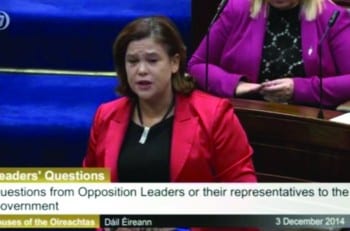
By Frank Connolly. The controversy over the naming in the Dáil by Mary Lou McDonald of several former politicians in connection with offshore accounts continues to rumble on. The Sinn Féin deputy leader has rejected a finding by the Oireachtas Committee of Procedure and Privileges (CPP) that she abused her parliamentary privilege when she named the politicians, including former ministers, in the Dáil on 3rd December last. She has also asked for the legal advice given to the Committee on which its finding of abuse of privilege was based. Despite attempts by the political establishment, aided by the usually compliant voices in the mainstream media, to close down the controversy, and the loud legal threats emanating from some of the former ministers named in the House, the issue has not gone away. Revenue Commissioner, Josephine Feehily, has told the Public Accounts Committee (PAC) that her officials had fully investigated the allegations contained in the dossier prepared by authorised officer, Gerard Ryan. Former politicians allegedly used Ansbacher/Cayman Island accounts managed by accountant Des Traynor and after his death, by Padraig Colleary – from the 1970s to the mid 1990s. Feehily, who has since been appointed to head the new independent policing authority, told the PAC that she was satisfied the matter had been dealt with but could not comment on individual tax investigations. Her response does not rule out the prospect that for all their forceful denials some of the individuals named did settle outstanding revenue issues arising from offshore accounts. What also emerges from correspondence between McDonald and the CPP over recent months is that Ryan is supported in his contentions by “two senior colleagues, both forensic accountants”. In a letter to the CPP in February last, McDonald strongly defended her action in naming the former politicians including a number of former Fianna Fáil ministers and one Fine Gael minister; and claimed she did so after she received advice from a parliamentary legal advisor to the effect that the only forum where she could raise the serious allegations of tax evasion was on the floor of the Dáil. Previously, the PAC had been advised that it could not investigate the allegations set out in a detailed dossier prepared by Ryan (much of which was published in Village in a recent edition). She said Ryan was “a senior civil servant who had been appointed as the authorised investigating officer into allegations of tax evasion and Ansbacher accounts by a previous Government. His professional competence as a forensic accountant is not in question. He made his disclosure in accordance with the Protected Disclosures Act 2014. I believe that this disclosure is made in good faith and in the public interest. His allegations are documented and are backed up by two senior colleagues, both also forensic accountants”. One of these is senior counsel John Hennessy who was retained by the Department of Jobs Enterprise and Innovation to assist and advise Gerard Ryan. The other officer has not been publicly identified. McDonald also described in her lengthy submission how a significant claim by Ryan, that the current Minister in the department, Richard Bruton, had sat for two years on a detailed witness statement the authorised officer had prepared and only released it to the Garda Bureau of Fraud Investigation when the controversy broke in November 2014. “For my part I made no assertion of wrongdoing against any individual”, McDonald wrote. “I merely referred to those allegations made – and subsequently stood over – by the whistleblower. In doing so, I very consciously and specifically refrained from offering an opinion on the veracity of the allegations, and moreover I did not assert that they were true. It is in the public interest that these allegations of tax evasion and political obstruction be publicly stated and investigated”. In response to her letter the CPP informed the deputy that her Dáil remarks were “in the nature of being defamatory” and “prima facie an abuse of privilege” and asked her to “make a personal explanation to the House: in effect to withdraw the utterances without qualification”, failing which the committee would recommend that she be reprimanded. Unsurprisingly, McDonald did not accept this finding and is still awaiting a response to her request for the legal advice given to the CPP to support it as well as the minutes of all relevant meetings where the matter was discussed. The CPP also released copies of letters from the former politicians who claimed that they had been defamed by McDonald’s remarks in the Dáil and from former Tanaiste and PD leader, Mary Harney, who denied the “untrue and defamatory” allegation that she had terminated Ryan’s investigation when it threw up the name of a prominent politician associated with her. Harney first appointed Ryan as an authorised officer to investigate the tax evasion scheme operated by Guinness & Mahon and its subsidiary, Ansbacher (Cayman), in 1998. In July 1999 the High Court, at her request, appointed inspectors to investigate the Irish business of Ansbacher (Cayman). The investigation was headed up by the late Declan Costello, former TD, Attorney General and President of the High Court, until he resigned for health reasons in 2000. It found that Guinness & Mahon (Ireland) Ltd. and its former managing director, Des Traynor had promoted a scheme of tax evasion in Ireland through offshore trusts and that Ansbacher (Cayman) Ltd had operated as an unlicensed bank in this country (including from the offices of Cement Roadstone Holdings in Fitzwilliam Square in Dublin for many years). In 2003, Ryan discovered that Costello had held a deposit account in Guinness & Mahon from 1976 to 1978 containing £15,000 which was managed by Traynor. When contacted by Ryan, Costello denied ever having such an account or having dealt with Traynor. Ryan claimed that the High Court investigation was compromised by what he described in the dossier circulated last year as Costello’s “major conflict of interest”. In June 2004, four months after Ryan informed Minister Harney that he had uncovered
Posted in:
by Village
By Kevin Callinan. The JobBridge internship scheme in the education sector is disguising the impact of the recruitment embargo, at times displacing jobs, and providing some interns with a low-quality experience, according to recent research sponsored by the IMPACT Education Division. It confirms trade union members’ sense of the improper use of the scheme within the sector. We offer constructive proposals for better and targeted labour activation internship schemes that are fit for purpose in a recovering economy. Open-market active-labour-market programmes are always open to displacement of entry-level jobs and to deadweight. The 2013 Indecon evaluation of JobBridge suggests 29% displacement of entry-level jobs. It suggests up to 48% deadweight, where the progression outcomes associated with the scheme were as likely to occur without the scheme. While JobBridge has benefited many, this is a high price to pay and there are serious questions about whether the price it too high in terms of entry-level job displacement and value for money. Labour activation measures need to be constantly adapted to reflect changing realities. JobBridge was established in the context of high employment and emigration in 2011. Renewed economic growth means displacement and deadweight are more likely. This necessitates a refocusing, resizing and ultimately a restriction of the use of such internships. Any justification for JobBridge as an emergency measure has dissipated. It is now time to take stock and address the gaps in regulation, monitoring and quality. The research recommends restricting the number of places available, reserving them for people who need them most , and restricting embargoed public-sector employers and low-value-sector employers from participating. Everyone who takes up an internship programme must be entitled to a quality experience which offers training and mentoring opportunities, career progression pathways, social insurance cover and fair reimbursement. Take up should always be voluntary. The growing culture of open-market internships as a pervasive feature of our economy needs to be stemmed. Overuse and misuse of internships must not be allowed to displace or replace full-time paid employment, or drive down basic terms and conditions for workers. The research notes that, internationally, some limited progress has been made in rolling back a pervasive culture of using such internships. This was achieved by constant and proactive monitoring and enforcement of minimum wage laws. Low Pay Commissions, internationally, have played a monitoring and preventative role in relation to use of internships in high-risk sectors such as fashion, entertainment and media industries. The British Low Pay Commission for example proactively targets online job advertisements for interns, ensures statutory officials provide adequate and clear information brochures and posters to alert employers about National Minumum Wage obligations, and encourages enforcement, including naming and shaming as well as back dating pay awards. While bad practice should be named and shamed it is also necessary to support good employers by acknowledging them through kite marks and allowing them be distinguished from the bad press associated with JobBridge. The leadership of the trade union movement is vital. All unions, throughout ICTU, need to rise to the challenge of the wider regulation of internships, stamping out the culture of unpaid work as the entry route to paid employment in Ireland, and playing an oversight role in the use of internship as labour activation programmes. Professional associations can also play a monitoring role in regulating internships in specific industries. A national governance framework would enable collaboration across the full range of these actors, including Solas for youth apprenticeships and traineeships, the HEA for graduate internships, the Department of Social Protection for the long term unemployed, and the Low Pay Commission for open market internships. This framework needs to address the weak culture of programme evaluation in Ireland and adopt robust evaluation processes using control groups. It should make more effective use of gender-segregated administrative data systems to monitor longitudinal outcomes across a range of social, economic and communit- level outcomes. Recent moves to publish the numbers participating in labour market programmes in the CSO live register reports offer greater transparency and accountability. The numbers being sanctioned and reasons for sanctions should also be published in this manner. •
by Village
By Rachel Mullen Public-sector services are different: they are supposed to serve the public good and its values. The citizen should have a sense of ownership of, and entitlement to, them. Cutbacks and public-sector reform have, however, crowded out any sense of difference. The clamour for aggressive reorientation, led by certain quarters of the press and their pundits, has been cacophonous. In 2008, just before the crisis took hold, an Institute of Public Administration paper by Muiris MacCarthaigh identified a range of values associated with public service. These were “efficiency, impartiality, honesty, loyalty, risk-aversion, equity, hierarchy, integrity, accountability and fairness”. He found that new non-traditional values were occasionally identified by public-sector officials, including flexibility, value for money and effectiveness. Some values, such as innovation, that he expected in the context of modernisation did not emerge. The ‘pecking order’ of values was seen to have changed as part of the modernisation of the public services. Many public servants reported that accountability was now the dominant value in their work. Efficiency, in the sense of speedy service delivery, had grown in importance. Public-sector reform has never been too explicit about what new values it offers. Yet it is, more than anything else, an exercise in changing public sector’s values. Modernisation has involved the incorporation of private-sector values and the pursuit of a market-led public sector. As the new values associated with this modernisation take hold other more traditional public-sector values inevitably give way and disappear. Public-sector reform and its private-sector value-base predate austerity. The 1996 ‘Delivering Better Government’ strategy identified ‘equity’ and ‘integrity’ as core values of the public service; and at the apex. However, it noted that values of professionalism, openness, flexibility, impartiality and customer orientation are integral to the public service. Austerity has provided the cover for a further reinforcement of such values. The Public Sector Reform Plan 2011-2014 emphasises efficiency, productivity and cost-reduction. Value-for-money has been established as the dominant public-sector value. This shifting ethic makes a difference. Every decision that an organisation makes and every action taken by its employees will reflect the value system of that organisation. Values are central to the development of the culture of an organisation, what it stands for, how it operates, and what it might prioritise. New and old values can end up in conflict with each other. Value for money, for example, that is concerned with productivity, can diminish values of equity and fairness. The voguish move to recognising its public as ‘customers’ can be to the detriment to seeing them as the holders of rights. MacCarthaigh concluded that “whatever values are deemed to be appropriate for the public service, the evidence suggests that performance will be enhanced through their meaningful integration into all aspects of the work of the service”. He captures the importance of values, however, he is mistaken to be so agnostic about what those values might be. We need to move away from market-based values for public service if we are to secure public services that better match and meet the needs of our diverse citizenry. Public sector reform has addressed values head-on. Now we need public-sector renewal to address the damage that the reform has done. The renewal too must be value-driven. The recent introduction of obligations of equality and human rights for the public bodies should be central to this renewal. Section 42 of the Irish Human Rights and Equality Commission Act 2014 requires public bodies, including government departments, to pro-actively consider and address equality and human rights issues that are relevant to their functions. The values of dignity, inclusion, autonomy, social justice and democracy underpin equality and human rights. A strategic and and funded drive is now required to centralise and implement this public-sector duty. This would refresh and bolster a public service that could stand central to a more equal Ireland. •
by Village
By Shane Darcy There is an important sub-plot to Minister James Reilly’s efforts to enact legislation for the plain packaging of tobacco products. It concerns the incongruent relationship that the Irish State has with the tobacco industry, and with legal firms that advocate on its behalf. Recent reports have shown that the Ireland Strategic Investment Fund has invested over €9m in tobacco companies, while Arthur Cox, the firm representing Japan Tobacco Ireland in its threatened plain-packaging litigation against the State, has also received around €1m in legal fees from advising various health-oriented State agencies and bodies, including the Health Service Executive. We have heard much pontification about the need to ensure that the right to a lawyer is respected, with an obscure UN charter even being cited, but that need not mean that State agencies that promote one agenda should employ lawyers or anyone else who currently promote a contradictory agenda. As it finalises a National Action Plan on business and human rights, the Irish Government has a prime opportunity to set out an ethically coherent approach to State investment and procurement. As an investor and consumer of goods and services itself, the Irish State has a significant capacity to promote responsible behaviour by the private sector and to insist on respect for human rights by those companies with which it does business. The Minister for Foreign Affairs and Trade, Charlie Flanagan, considers that “placing human rights firmly on the business agenda” is necessary for enhancing the reputation of Ireland and of Irish companies. The National Action Plan on business and human rights is being prepared by his Department, following a broad consultation with civil society and business. It is aimed at implementing the United Nations Guiding Principles on Business and Human Rights, a framework document unanimously endorsed by the Human Rights Council in 2011. Ireland is currently the proud holder of a seat on the Council. These Guiding Principles emphasise a State’s duty to protect human rights, corporate responsibility to respect human rights, and the need to ensure access to remedies in the event of breaches. They expressly state that: “States should promote respect for human rights by business enterprises with which they conduct commercial transactions”. The State duty is grounded in existing international human rights law, which requires a State to ensure that third parties, including business enterprises, do not violate human rights. A national business and human rights plan is very timely for Ireland, as concerns have been raised by the recent activities of Irish-based companies, both at home and abroad. These include the inadequate protection of data and the right to privacy by social media companies, the supply of software used for censorship to Syria’s repressive regime, and the operation of construction firms in Qatar where forced labour and irregular working conditions prevail. The State must make clear in its national action plan that it expects Irish companies to respect human rights throughout their operations. To embed respect for human rights from business, countries can insist on compliance with human rights as an eligibility requirement for State support or for availing of, or providing, government services, investment, procurement or listing on the Stock Exchange. The UN Guiding Principles consider that the various commercial transactions undertaken with companies by States provide a unique opportunity to promote awareness of and respect for human rights by business. In 2014 the European Union called upon Member States to bring about the “appropriate integration of environmental, social and labour requirements into public procurement procedures”. The Dutch national plan on business and human rights notes that in the Netherlands, “companies supplying the government with goods and services are required to respect human rights”. Ireland needs to move beyond merely encouraging Irish business to be socially responsible. The business and human rights agenda differs from corporate social responsibility as it is based on what is required and expected of companies, rather than on what a company may choose to do voluntarily to ‘give something back’ to society. No amount of charity or philanthropic work can offset a negative impact on human rights. Legislating to reduce tobacco consumption by introducing plain packaging can be seen as a legitimate attempt to meet the State’s human rights obligation to fulfil the right of every person to the highest attainable standard of health. A consistent approach to human rights here would mandate that the State does not invest in the tobacco industry and that it reconsiders doing business with companies that support, represent or promote it. • Dr Shane Darcy is a lecturer at the Irish Centre for Human Rights, NUI Galway.