
Posted in:
Labouring under delusions
The reliable mudguard of Fine Gael
by Village
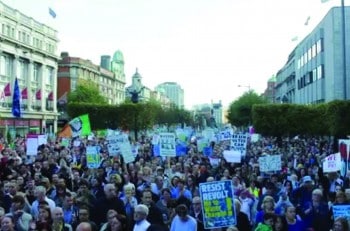
By Rory Hearne. Last month’s Village editorial missed the point in disdaining the water protests and favouring a campaign about the (admitted) injustices of NAMA facilitating the return of the delinquent developers. The water protests are most important because they represent a new form of citizens’ action and empowerment in Ireland. The water movement is in the process of transforming Irish politics and society. Its significance is that a large proportion of (extra)‘ordinary’ people, along with critically analysing the system, are actually engaged in political resistance and with the political system by seeking out political alternatives. This contrasts with decades of citizen passivity and acceptance of a corrupt political establishment. It would appear that space for a new Podemos-type political movement is emerging. It could be a movement for a New Republic, that would represent the desire for citizen-led and democratic political change. This is the evidence from research into the views of 2,556 water protestors recently undertaken by myself and MA students in the Department of Geography Maynooth. A majority of respondents (54.4%) stated that they had not participated in any previous protest. Respondents felt that the water protests have been successful because it “is a genuinely grassroots and local movement and has mobilised every village, town and city of this country” and “rallied Irish people from all walks of life”. The protests were motivated by a range of factors and not just water charges. People are protesting at the impacts of austerity (the most cited reason for protesting), a desire for complete abolition, and not just reduction, of water charges, and against the privatisation of water. People are also motivated by the belief that the current, and previous, government have, through austerity and the bailout, put the interests of the banks, Europe, and the bondholders before the needs of the Irish people. They feel that working, poor and middle income people have paid an unfair burden of austerity. Respondents identified “corruption”, “cronyism” and a belief that the “establishment parties look after a golden circle of wealthy business people and corporate elite” as reasons for public anger. Respondents sought change in the way politics is operated in Ireland such that politicians stop making false promises and could be held democratically accountable. They described, for example, how “our political system is broken, our politicians and political parties are owned by corporate elites who act in their favour. I’m not standing for it anymore. I want a government for the people” and, “The Republic has failed its people. The country needs to start anew”. Very significantly, 45% said they had voted for the main large parties (FF/FG/Labour) in 2011 but indicated that they are changing their vote to the opposition Left parties and independents in the forthcoming election. 31.7% said they will vote for People Before Profits/Anti Austerity Alliance, 27.5% said they will vote for Left Independents, 23.9% for Sinn Féin and only 5.6% for ‘Right’ Independents. 77% of respondents said that they believed the most effective way of getting change was through protesting while only 28% saw contacting a political representative as effective. Despite the strong support for ‘Left’ parties, a large proportion (79%) want to see a new political party formed. They identified that the issues such a new party should stand on include anti-austerity; anti-corruption and anti-cronyism; and radical political reform and democracy. They want a new party to stand for fairness, equality, social justice, and the right to housing, health, water, education and protection of the poor and vulnerable. These issues, particularly equality, are the very things Village elsewhere has editorialised for. It should also stand up to Europe (particularly on the debt), and ‘take back’ Irish natural resources (gas, fisheries etc) ‘for the people of Ireland’. It has become clear to ordinary people that they have to look elsewhere for new politicians and parties that will represent and fight for a New Republic. Three key developments have emerged with the potential to develop such an alternative. The first is the emergence of popular community struggle, protest, citizen’s initiatives and self-empowerment. The second is a new civil society leadership in smaller trade unions. The third is a new Left and anti-establishment politics in the form of Sinn Féin, the radical Left and independents. Major questions lie ahead as to whether some of these forces, together, can define and build a new political movement for a New Republic. This will depend on whether or not those who are arguing for a pluralist, community and grassroots politics, can link together and mutually strengthen the diverse struggles and campaigns over water, housing and other issues while also developing an alternative political, economic and social vision for Ireland that can attract a majority into supporting such a new political movement. Perhaps the Right2Water union’s successful May Day initiative holds out some hope in this regard. •
by admin
By Mike Allen. A person who is homeless can expect to live only until his or her mid-forties. Each year around 30 people who are homeless die in our capital city; most in emergency shelters, a few on the streets. You never hear of them. Their deaths get as little attention as their lives, unless they die in some manner which is sufficiently gruesome to be newsworthy, such as by drinking hand-cleaner or being crushed to death in a rubbish bin. Jonathan Corrie’s death within sight of the Dáil last December received a level of coverage usually reserved for the deaths of national figures or celebrities. For years the people of Dublin walked past Jonathan Corrie with few giving him a moment’s thought. Now we needed to hear almost everything about his life: his terrible addiction to drugs, his upbringing, his relationships, the feelings of his children. Within 24 hours of Jonathan’s death the Catholic bishops called for a ‘Summit on Homelessness’. Labour Minister for the Environment, Alan Kelly and the Lord Mayor of Dublin, veteran leftist radical, Christy Burke sought to be the first to respond to the bishops’ call. Within ten days Minister Kelly announced a ‘20 point action plan’ to tackle the problem of rough sleeping in Dublin. Kelly declared, after five years of cuts in homeless and health services, that money was not going to be a problem. You want to clap and cheer. At last the scandal of homelessness has come to public attention and political will has heard the public concern and turned it into action. We are a good people and Kelly’s is the sort of determined and immediate response we want from our politicians. On the 9th of January this year a homeless man was found dead in Temple Bar. There were news reports but, by the following day when his identity was confirmed, everyone had lost interest. For the record, he was Vytas Virzintas, a 54-year-old Lithuanian. In the second week of January, the Department of Environment posted a progress report on its 20-point plan on its web-site. There was little interest. Now you want to put your head in your hands and sigh. We are the goldfish of social conscience. Poverty is a profound problem in our society, but perhaps the least acknowledged aspect of the problem is that it is rarely simple and often hard to comprehend. One of the remarkable consequences of Jonathan’s death was that, for a brief period, it was possible to talk about these complexities. People wanted to understand what had happened, to hear about the messy human reality of homelessness – and about the fact that there are solutions and things we could do to prevent it. Jonathan Corrie died because he had nowhere to sleep? No. He had been offered a bed that night but did not take it up. Jonathan slept on the street by choice? No. He felt unsafe in a lot of the emergency hostels, though he was actually OK with the one he was offered that night. There are almost 2,000 homeless people in Dublin sleeping rough every night? No, actually most people who are homeless are in emergency accommodation. Rough sleeping is the most visible face of homelessness but numbers vary between 100-200. Isn’t homelessness caused by poverty? Well not always. Jonathan didn’t have a deprived upbringing. Is it about not having a home? Sorry again, Jonathan seems to have been bought a home on two occasions. Extreme poverty and homelessness are the outcome of all the myriad things that can go wrong in a life and with the network of family, friends, State services or a voluntary organisations which we all need. Jonathan’s childhood friend Luke Murphy said it best: “There are no simple lessons or easy political points to make from his life or death. He was brought up with love and discipline, his family never gave up trying to help him”. So did the unique circumstances of Jonathan Corrie’s death make a difference? Did the complexities of his story help Government to avoid knee-jerk reactions? The centrepiece of the 20-point plan is a commitment that ‘by Christmas’ there should be enough emergency beds available so that no-one should be forced to sleep on the street for want of a bed. This is a good commitment. All homeless services had been telling the authorities for months that there were not enough beds for the people who needed them. On November 11th, the official ‘rough sleeping count’ identified 168 people sleeping rough. That cold, rainy night virtually all of the more than 1,700 emergency beds in the city were full. Kelly’s plan committed to 260 new emergency beds being available and by Christmas the Catholic Church, Civil Defence and voluntary organisations had exceeded this and provided a total of 271 new beds. As a result, although around 15 people slept rough over Christmas there were more than 15 empty beds in the system. No one slept rough for want of a bed. But by the second week of January, the joint Focus Ireland/Peter McVerry Trust street team estimated almost 50 people were sleeping rough with no beds available for them. This is partly because the problem of homelessness is growing, but also because the ‘hidden homeless’ (people in precarious situations, such as squats) take the opportunity of decent beds being available to move into the mainstream system. This highlights that, while we must provide enough emergency beds for everyone who needs them, more and more emergency beds is not the answer. Throughout the world, cities that respond to a public outcry about homelessness only by providing more emergency beds find that, when the public attention moves on, the city is left with a permanently higher number of emergency beds and the same rough-sleeping problem. In this way many US cities have homeless hostels holding thousands of destitute men and women with no hope. While there are many routes into homelessness, every route out of homelessness requires the
by admin
By Reuben Hambackachere. Background article by Niall Crowley follows below. On the 21st of April 2015 I officially submitted my resignation as the named individual representing the Core Group of asylum-seekers and Refugees on the Government Working Group established to examine improvements to the protection process and the Direct Provision system. The working group was set up as the Government’s response to the countrywide protests by asylum-seekers living in direct provision and their supporters. This response presented the Government with an opportunity to remedy a broken system for asylum-seekers. The structure of direct provision raises cause for concern for the Irish state, given the level of public resources invested in the system and its administration. I felt that, coming together with so called experts on the issue, this was a step in the right direction to overcome the cultural blindness that I believe is one of the factors underpinning this failed system alongside the fact that there is no legislative framework for these reception centres. There were restrictions in the terms of reference in relating to coming up with an alternative for those who live in this system. I felt this needed to change immediately if there was to be any credibility that the rights of asylum-seekers would be upheld in line with Ireland’s international obligations under various human rights instruments. However, I took up my position with the hope that the Working Group would be committed to the liberation of people who are being oppressed. It was not long before I discovered that some members of the group could see the problem but did not think they were a part of it. My participation on the Working Group was an opportunity to see and learn how decisions are made or not made. I am glad I stayed up to the time I did. I participated in the consultation process and most of the plenary and thematic meetings. I felt I was well informed and had given it my best when I made my decision to exit. I initially agreed to be on the Working Group on the basis of a mandate to negotiate and safeguard that the report and its recommendations would offer real progressive change, and restore the dignity of asylum-seekers and their children through the creation of a protection system underpinned by human rights and in line with international best practice. During the period that I was a Working Group member I pushed hard to ensure that the voices of asylum-seekers and refugees were heard. I believe that the issues of concern to asylum-seekers were well articulated during the consultation process. It was therefore my realistic hope that these issues would inform the recommendations of the Working Group. However, after conscientiously going through all three thematic sub-group draft reports, which will form the final plenary report, I feel that the proposed recommendations fall far too short of my own expectations and probably those of the asylum-seeking community Central amongst my concerns was that without the option to discuss any alternative to direct provision or even to submit an alternative report without referring to the terms of reference, very little change would be made to the current system. Personally, as things stood I could not stand over the limited recommendations that were going forward from the sub-groups to the plenary, nor sign my name to them. My conscience will not allow me to endorse an exercise that has not truly taken into consideration the issues that were clearly articulated by asylum-seekers during the consultation process and through other submissions. However, the decision of the Core Group of asylum-seekers and refugees is to stay on and continue to fight. It is my hope that the Core Group will capitalise on my resignation and push further for recommendations that have some positive outcomes for the people caught up in this system. Communities which experience inequality, poverty and injustices should be protected and their rights vindicated. Ultimately, I believe high standards must apply to any reception system underpinned by the requirements of the EU Reception Directive. I am still participating in the struggle to end direct provision and I will continue to campaign and fight for the rights of all people let down by the current system which is broken and only results in further marginalisation. This system props up a flawed model that does not work for my comrades in the core group and beyond them for the wider community of asylum-seekers. By Niall Crowley Aodhán Ó Ríordáin, Minister of State at the Department of Justice and Equality, left no one in any doubt about his opposition to Direct Provision speaking in the Dáil in September 2014. “It is no secret that I have been, and continue to be, a critic of the Direct Provision system as it currently operates and want to see it reformed into something that we can be proud of in a civilised society that describes itself as a Republic. I have described it as inhumane, intolerable and as a system that I refuse to stand over in its current form.” He referred to the decision to “establish an independent working group to report to Government on improvements to the protection process as a whole as well as on Direct Provision and supports for asylum seekers in particular.” He promised: “We have form in this regard, we pledged to end the degrading practice of slopping-out in Mountjoy and we did. We pledged to close St Patrick’s Institute for Young Offenders and we have. We will not be found wanting in respect of Direct Provision”. Direct Provision for asylum seekers was introduced in April 2000. Asylum seekers get full-board accommodation and a personal allowance of €19.10 per adult and €9.60 per child per week. They may not work. In November last year the High Court found that the system was not a breach of human rights, though there were issues with the way the case was pleaded. It was originally envisaged that no one would
Posted in:
by admin
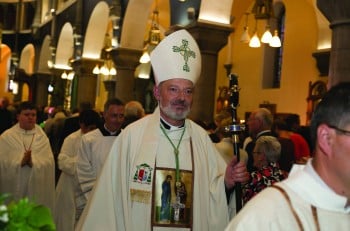
By Richard O’ Leary. Bishop Kevin Doran of Elphin insisted that the Roman Catholic bishops’ opposition to same-sex marriage is “not about homosexuality or the gay lifestyle” last November and fired the opening shot in their campaign for a No vote in the marriage equality referendum. Last March, in an interview on Newstalk, he went to say “the jury’s out” on whether people are born gay and that being gay is not what God intended. He compared sexual orientation to a disability (Down’s syndrome). How can a bishop be so ill-informed? Twenty years ago I was invited by the Forum for Peace and Reconciliation to present a sociological report on the Protestant minority and Catholic-Protestant marriage. Later the Roman Catholic Bishop of Killaloe, Willie Walsh, wrote in the Furrow of the “wounds” caused by his fellow bishops by their opposition to mixed marriage. He wrote “I feel that many of us would want to apologise and ask forgiveness from our non-Roman brethren for that pain and hurt…It has been a long journey from that sadness and isolation to the joyfulness of today’s inter-church marriages”. The Church of Ireland Bishop of Cork, Dr Paul Colton, apologised last year for the hurt Christian churches have caused lesbian, gay, bisexual and trans people. He later stated on BBC Radio Ulster that “I certainly support civil same-sex marriage”. Bishop Michael Burrows of Cashel, Ferns and Ossory also declared for Yes at a recent event for Faith in Marriage Equality (FiME). Bishops have got it wrong before and they were humble enough to admit it. Growing up in Cork in the early 1980s I attended St Fin Barre’s secondary school. The principal, Dr John Buckley, is now the Roman Catholic Bishop of Cork. Jerry Buttimer, now a TD for Cork and an out gay man, was in the year behind me. Every day in the classroom, I was ‘wounded’ when I overheard the put-downs of “homo”, “fag”, and “queer”. On my way to school, I remember passing someone in the street on the way to work who called out “fairy”. I was threatened and changed my route. I well recall visiting school-friends at the seminary in Maynooth in 1982. I was struck at how like our Catholic school it was, being single sex, without women teachers, and with the added struggle of sexual abstinence. That is the world that Irish Roman Catholic bishops were socialised into. Should we be surprised that they teach as they do about same sex marriage? The Roman Catholic bishops recently upped the ante in their No campaign with a threat to withdraw from the signing of the civil marriage register at all weddings in a Catholic church. The bishops did not resort to this supposed ‘nuclear option’ twenty years ago after the legalisation of civil divorce. I know that the Association of Catholic Priests does not agree with them. I know that in County Donegal, some parishioners walked out after the priest in the pulpit preached for a No vote. A face glared down from an aggressive poster calling for a No Vote as I recently walked down Shandon Street. Homophobic messaging is sweeping across the country. This is part of the emotional price to be paid by being gay or lesbian and engaging with the referendum campaign. This time I did not change my route. The negative messages are contradicted by my own personal experience of 25 years of a loving, faithful, same-sex relationship. There will be a price to be paid by the institution of the Roman Catholic Church. It will emerge as a smaller, more anti-gay denomination. Ironically, it may be the Catholic dissent, and the two Church of Ireland Bishops, who may one day enable the Roman Catholic Church to retrieve something positive when in the future it apologises for the wounds it inflicted on the gay and lesbian minority and its opposition to same-sex marriage. •
Posted in:
by admin
By Aoife O’ Driscoll One in six adults in Ireland (521,550 people) finds reading and understanding everyday texts difficult, according to OECD research published by the CSO in 2012. This includes reading a leaflet, for example, or medicine instructions. In addition, a significant 40% of Irish people have limited health literacy according to the 2012 European Health Literacy Study. This means that four out of ten people who use health services may find it difficult to understand and act on the health information and advice they receive. Irish Health Literacy Research (2015) shows that 45% of people surveyed were unable to define the term “prognosis”. A 2014 review, carried out by the Royal College of General Practitioners in the UK, found that patients usually retain about half of the information they receive in a consultation with their healthcare professional. Only half of the information that they do remember is generally correct. Health literacy and numeracy is about the healthcare provider communicating health information clearly and the patient understanding this information correctly. This is crucial for people’s health and wellbeing. The more effectively that people can act upon health information, the better their health outcomes will be. Health numeracy is the ability to understand, use and act on numerical information. Most health information requires us to use basic numbers and calculations. We are, for example, expected to manage our medication by reading and/or hearing instructions, understanding them, and working out doses. According to the OECD research, one in four adults in Ireland has difficulties in real-world maths – from simple addition and subtraction to the calculation of averages. A disturbing 17% of people surveyed in the 2015 research said they had taken the wrong amount of medication on at least one occasion. There are many reasons why people have difficulties with health information. There are factors such as literacy, numeracy, needs, age, language, disability and culture. Specialised medical language used by healthcare professionals when speaking to their patients is another factor. People are often not familiar with these medical terms and it can be embarrassing to ask the doctor to explain them in everyday language. A further factor is that it is difficult to take in information properly when receiving worrying news about our health. Medical jargon and emotional stress effect our health literacy and we could leave a consultation unclear about both our condition and treatment. Promoting good health literacy and numeracy practices means that we can make sound health decisions at home and in the community. We can give informed consent to treatment and follow dosage instructions. We can understand how to live with chronic health conditions. We have the skills and confidence to ask questions, and we can navigate healthcare systems effectively. This is in everybody’s interests. A Crystal Clear quality mark has just been launched to respond to this issue. This is the first ever such quality mark and has been developed by the National Adult Literacy Agency, along with the Irish Pharmacy Union, the Irish College of General Practitioners, and MSD (a pharmaceutical company). A Crystal Clear Pharmacy or General Practice delivers a quality service that takes account of possible literacy and numeracy needs of patients and consistently improves upon the services they provide. Getting the Crystal Clear quality mark also recognises that the service regularly evaluates and improves its health literacy practices. An online audit tool has been developed to assess the health literacy and numeracy practices of pharmacies and general practices (www.nala.ie/crystalclear). Healthcare providers need to take steps to communicate in ways that all their patients and patients can understand. They should think about the language they use when talking to patients and try to explain things in everyday language. When they talk about medication, they shouldn’t assume the patient will understand quantitative concepts or are familiar with the measurements involved. They should use teach-back, a way to assess and confirm that people understand what they have been told, by asking them to repeat back the key information in their own words and encouraging patients to ask any questions that they may have, after the repetition. • Aoife O’Driscoll is Policy Officer with the National Adult Literacy Agency