election

Random entry RSS

  • Posted in:

    Retrograde results reflect recalcitrant republic

    The recent General Election was a very good one for Sinn Féin. We increased our number of TDs from 14 to One thing is clear: the after-math promises to be far more interesting than the insipid election campaign, a campaign defined by the monotony of the government’s ‘Keep the Recovery Going’ message. It may have resonated with the select few, but most reacted with an incredulous, ‘Are you for real?’ The employment figures may be up, but the people in jobs are still feeling the pinch eight years after the crash. Meanwhile, our public services appear to be getting worse. Most people – even those with private health insurance – have experienced the horror of watching a loved one on an A and E trolley. The opposition parties sensed that change in the public mood. Fianna Fáil, with its finger back on the public pulse, devised a set of policies that reflected people’s concerns. To be fair, this wasn’t just Fianna Fáil focus-group politics. Micheál Martin, as comes across in his recent Village interview, does have a commitment to social justice and has steered the party to the left of Fine Gael. The ideological differences may be slight but they are discernible and make a coalition less likely. There are, of course, other mercenary reasons why the grand coalition may not happen. Fianna Fáil won the election. It wasn’t a knock out, but it had/has Fine Gael on the ropes. A rematch at its time of choosing would suit it much better than it would a demoralised, soul-searching, Fine Gael party, which has fundamental problems. Inevitably, there will be a simplistic focus on the party leader. In post-election interviews pledges of allegiance to Enda from cabinet ministers have been noticeably absent or halfhearted. Big Phil, his protector in chief, is no longer around to sort out any of the renegades. The heave seems inevitable. Will it come to that? Or will it be a dignified resignation like Eamon Gilmore’s. The former Labour leader was treated mercilessly by Joan Burton who in turn will find her leadership questioned by the party faithful. The Labour Party’s mauling by the voters was entirely predictable. Bleating on about having to make hard decisions doesn’t win you much sympathy, as the Greens discovered last time out. Labour calculated that, having lost the working class vote to Sinn Féin and left-leaning parties, it could count on the socially liberal middle classes for support. The fact is that abortion has been shown not to be a defining issue either way. Those who wanted to repeal the eight amendment didn’t get a tail wind, and those vehemently opposed to abortion, like Lucinda Creighton, were kicked out. Likewise, the marriage referendum was seen as eaten bread. Fine Gael and all other parties had managed to appropriate that liberal space effectively – sure we’re all liberals now, some having got here a bit later than others – but who cares. Other electoral tactics back red. The political Banking Inquiry simply muddied the waters and showed that the last government had few options, and that the same pro-cyclical expansionary policies were advocated by all the parties. The Green resurgence owes much to the hard work and unstinting optimism of Eamon Ryan. Not even his narrow loss in the European elections could stop his gallop, and indeed it proved to be a blessing in disguise. He and Catherine Martin are the dream team: a moderate, articulate and photogenic pair, who have the capacity to provide a platform for further green success. Like other newly elected candidates, the Greens will hope that another election won’t happen too soon. But the signs on that front are not good. The rejection of Eamon Ryan’s proposal for co-operation amongst the opposition parties means that the new dawn for Irish parliamentary democracy will have to wait. Those who think that this election will result in a new Borgenesque Danish parliament of progressive legislators are delud-ing themselves. Instead, we may revert to the worst type of parish-pump horse-trading that the country has ever witnessed. We don’t have a Scandinavian list system; we have proportional representation with the single transferrable vote, an electoral system that has resulted in an array of independent political efs. Right now, shopping lists the length of your arm (in the case of the Healy Raes – the length of two arms) are being prepared for the highest bidder. It all promises to be unseemly and retrograde, and will be, perhaps, the best reflection of where we are as a nation in the centenary of 1916. John Gormley

    Loading

    Read more

  • Posted in:

    Transfer pattern augurs well for Left

    Transfers matter under proportionate representation though perhaps more for psephologists and party tacticians than in terms of actual electoral difference. Noel Whelan, for example, notes that: “only 12 or 13 of the 158 deputies in the new Dáil will win their seats because of transfers. If we stopped counting after the first counts and declared the results, all but a dozen or so of the seats would have been filled by the same people”. The most dramatic difference transfers made was of Maureen O’Sullivan, a notably gentle and non-partisan independent in Dublin Central. She polled badly on first preferences, getting just 1,990 votes. The quota was 5,922. She was in sixth place. Everyone assumed she was out for the count but in the end she took the last of the three seats. In the same constituency in 2007 Bertie Ahern, then ascendant Taoiseach, brought in his running-mate Cyprian Brady in 2007, though he had polled 939 first preferences. The only other candidate ever to be elected with fewer than 1000 first preferences was Brian O’Higgins (later President of Sinn Féin from 1931–1933) elected in Clare in 1923 on DeValera’s transfers. The Right to Change campaign, which involved around 100 candidates, both party and non-party, helped Sinn Féin to secure transfers that pushed a number of their candidates over the line. As well as a strong transfer pattern (76% as opposed to 58% in 2011) between SF candidates running in the same constituency the party enjoyed a good return of more than 23% from other left candidates who endorsed the campaign. In Dublin Bay North, which had one of the longest counts in the election, Denise Mitchell of Sinn Féin was assisted by significant transfers from John Lyons of People before Profit (PBP) as well as from her party colleague, Micheál MacDonncha who was eliminated at an earlier stage. Similarly, SF candidate and trade unionist, Louise O’Reilly, won a seat following strong transfers from Barry Martin, also of PBP and a running mate of Clare Daly’s in the Fingal constituency. Richard Boyd Barrett who was always likely to take a seat in Dun Laoghaire, was helped by the votes transferred from Sinn Féin candidate Shane O’Brien on his elimination. Across the country, there were other examples of the Right to Change arrangement benefitting successful candidates. AAA-PBP transferred significantly more votes to Sinn Féin than any other party with independents the next block to gain from their transfers. Sinn Féin performed exceptionally in its internal transfers with an unprecedented rate of 76% which augurs well for its future prospects where it stands two candidates. Sinn Féin has historically been quite transfer unfriendly, but in 2016 they have improved significantly on their own transfers as well as taking 28% of the transfers from AAA-PBP. With the exception of Donegal where it overrated its chances of taking three of the five seats, leaving Pádraig MacLochlainn as the party’s most prominent casualty, it came close in several other constituencies to bringing in a running mate. Fine Gael also displayed strong transfer discipline. The transfer rate between Fine Gael candidates was much better than that between Fianna Fáil candidates. In 2016 this discipline brought Fine Gael an even bigger seat bonus than it got in 2011. It benefited from 54% of its own transfers as well as 53% of those of Labour candidates. What is also evident and perhaps a harbinger of the future is the number of transfers between Fine Gael and Fianna Fáil. Where a candidate had no running mate or he or she had been eliminated or elected, Fine Gael was more likely to transfer to its big right-wing rivals than any other party and vice versa. 18% of FF transfers went to FG candidates and 16% of FG transfers nished up with FF. As the two beasts prepare the ground for an historic coalition it would seem that their supporters do not share the view that their differences would make the ending of civil war politics impossible. Frank Connolly

    Loading

    Read more

  • Posted in:

    Post-election 2016

    The general election was tedious and it’s not really clear what message it purveys. The electorate seemed jaded and the politicians delivered no memorable new policies, apart from Renua’s utterly regressive at tax proposal. Village believes that elections should be all about ideas, ideology, policy (and how best to implement them). In these terms the election and its participants were a two-out-of-ten failure. Commentators from the equally idea-free media have interpreted the results in heterogeneous ways. Every sort of theory and cleverality was deployed to describe the drearily and precariously hung Dail: a triumph of democracy, a triumph of social democracy, the end of the civil war, the end/beginning of the beginning/end of the civil war. The perennial smart view that the electorate has failed the parties got several outings. If the second-rate sages had been able to they would have loved to interpret it as a triumph of angry white men. They couldn’t. Some saw it as a victory for the small parties and independents. But the Social Democrats did not increase, Renua was wiped out, the Greens gained only two seats in an era of climate-apocalypse. The People Before Profit/ Anti-Austerity Alliance finished up with only one more seat than they had before the election, and Direct Democracy did not gure. Before the election these were the only small parties. The truth is that this election was a triumph of the interchangeable FF/FG (FG/FF) duopoly, though its trajectory has been definitively defined as downward. Ideology is what political parties apply when they run out of policies. Since most of the parties’ manifestos are short and the events to which policies must be applied are unpredictable it is reasonable to expect that your candidate will have an ideology to guide her. Village for example favours an agenda of equality of outcome, sustainability and accountability. The ideology is comprehensive, it provides a solution for any situation, and a template against which policy formulation can be benchmarked. Candidates shouldn’t have to reflect Village’s ideology, but they’d be better having some sort of one. Neither civil-war party has an ideology. It is impossible to know what they will do once elected. How, therefore, could anyone who does not live under a stone be enthusiastic about a government of FF and FG? FF is a conservative party that believes in so little that it surrendered its entire ethos to a culture of provincialism and cronyism, last time it was in government. It believes in no more now so, though it is touting a centre-left agenda there is every danger it will return to populism, short-termism and promoting the only agenda it understands – the interests of the people its representatives actually know – a cronyist populism that always finishes up favouring those who shout loudest. It is naïve to think of FF as Micheál Martin and when it is the movement it has always known itself to be, of Eamon OCuív, of Barry Cowen, of Pat ‘the Cope’ Gallagher; and tens of marginally more presentable sons and daughters of best-forgotten FF dynasts. Kevin O’Keeffe, son of Ned O’Keeffe, anyone? FG is a conservative party currently dressed up as a Christian Democrat party. The ethos is exible enough that under Garret FitzGerald it was in effect Social Democrat. In its latest incarnation it has been right of centre, at a time when most people want fairness and an improvement in services. It failed to deliver an agenda of accountability and its representatives seem to believe in little beyond sound money, ‘Europe’ and law and order. Having once appeared to be purer than FF it is now tainted by the Moriarty Tribunal report and a perceived ongoing proximity to Denis O’Brien, Ireland’s richest man, as well as by its large number of low-grade County Councillors, whose corruption record is a hairsbreadth from as bad as FF’s. Though essentially conservative, both FF and FG contain some social democrats and liberals in their midst. These aberrations and those who vote for them are delaying the day a real Social Democratic party with coherent left-of-centre platform can become a force that could anchor a government. On the other hand it is clear that more people than is desirable voted FG in 2011 to get FF out and then FF in 2016 to get FG out. These people need to acknowledge that they are forces forconservativism. The incarnation of this is the dangerously articulate Éamon Dunphy who apparently voted FF in 2016 because he really believes in People Before Profit (or Sinn Féin. It isn’t clear). Anyone who thinks that FF was the solution to our problems in 2016 is part of the problem. So what next? FF and FG should merge as a conservative party though even coalition is for the moment some way off. FF is tactically sharper than FG and FG is in retreat so it is likely FF will tantalise FG to weaken and demoralise it during this Dáil. Nevertheless the (non-)ideological compatibility of the parties has been exposed and will generate its own momentum. While allowing this momentum its space the Left of all hues must use the logic of the momentum against FF and FG, and social democrats must colonise some of the space the dinosaur parties have occupied for tragically long.

    Loading

    Read more

  • Posted in:

    Election Times

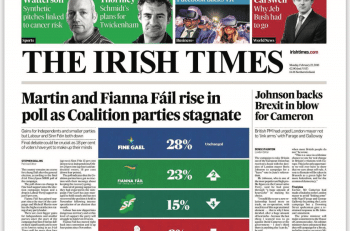
    The story of an election is much more than a few headlines, but the Irish Times front pages mercifully, if languidly, devoid of the kind of blatantly partisan positioning seen elsewhere, provide in hindsight a neat narrative of the campaign, with the slow realisation that Fine Gael was in trouble, the lack of a clear alternative emerging, and of course, “events, dear boy”. While its columnists and editorials may have declaimed preferences in the run-up to the general election, the Irish Times‘ front page generally affected a more neutral stance, certainly by comparison with the anti-Sinn Féin headlines which dominated the Irish Independent and its Sunday sister during the February campaign. The ‘newspaper of reference’ (formerly “of “record”) began the month in ‘phoney war’ mode, leading on Monday 1 February with coalition plans to “target home buyers and parents in poll pledges”. On the Tuesday, with still no election date declared, the story was “Taoiseach prepares Fine Gael ministers for election”. Perhaps ominously, on both days the below- the-fold story concerned the revelations regarding “Grace” a young woman with intellectual disabilities abused while in HSE care in a foster home. The story would feature again several times during the month and, by the end of the campaign, would threaten to inculpate Michael Noonan. Wednesday’s paper finally brought the official election notice, leading with Fine Gael ministers outlining their election promises, but the shine was short lived. Thursday, and the first election poll, brought “disappointing news for Coalition parties”. Much of the remainder of the campaign was spent trying to push back against those low poll numbers, which stubbornly refused to rise. By the first weekend, Fine Gael had announced a “tax U-turn to hit voters earning €100K” (the top 10% of all earners, though Irish Times readers would be better paid than the average). The election narrative was dominated at first by Fine Gael (at least on the front page) but it changed dramatically in the second week. The murderous Regency Hotel rampage called attention to cuts in Garda numbers and resources and Fine Gael, which prides itself as a law and order party, found itself on the back foot. At one point Sinn Féin’s Mary Lou McDonald attacked the government for being soft on crime during an RTÉ radio debate. By the end of the week, the lead story that Garda “may be issued with new weapons” helped to restore marginally Frances Fitzgerald’s battered image, but you know you (we?) are in trouble when Sinn Féin are attacking you from the right on crime. Meanwhile, bubbling below the fold, the news was no better. Lowry, Drumm and Luas strikes festered, and the Times awarded the first TV debate to Micheál Martin. Week Three began with Labour striking out to create a separate identity, promising “an abortion vote in any new deal” – definitely a plus for liberal Irish Times readers. Smaller parties got their first acknowledgement the following day, as the lead reported they did best in the previous night’s debate. For the rest of the week, it was almost as if the Irish Times tired of the “boring” election campaign, with more conventional “newsy” lead stories on an HSE inquiry into baby deaths, welfare benefits for migrants, and Brexit. Week Four began with the writing on the wall, summarised in a single Monday headline “Martin and FF rise in polls as Coalition stagnate”. Tuesday the paper reported Kenny and Martin had “equal backing in race for Taoiseach”, and the final TV debate failed to resolve anything for this hard-to-please newspaper as “leaders fail to land killer punch”, before Kenny’s “last-ditch call for vote in favour of stability.” Below the fold on the same day, the first mention of Sinn Féin in a front-page headline volunteered no favours: “Canvasser for Adams owns hay shed where ‘Slab’ Murphy cash was found”. ‘Slab’ was also the subject of one of the few passionate editorial columns (now perhaps self-deprecatingly titled “the Irish Times view”). Others quite reasonably despaired of the “short election, short of vision”. But while front pages covered national trends, debates and polls, and columnists inside the paper from Una Mullally (who, surprisingly for someone with a political agenda, gave up interest) to Breda O’Brien (vote for people of conscience, if you know what I mean) via Fintan O’Toole (who in the end detected an unlikely victory for social democracy) and Noel Whelan (who again somehow spotted the Fianna Fáil revolution implausibly early) ventilated partisan viewpoints, perhaps the most concise reportage on what happened on election day was by religious affairs correspondent Patsy McGarry, who on the day of the count reported from the north inner city, less than ten minutes from Tara St in a neighbourhood where few read the Irish Times, and fewer would share its editorial concerns: one, a hooded man, was picking up rubbish and putting it in a black plastic bag.“I didn’t vote. I don’t have a voting card. I was abroad for five years. It’s not important at all”. Gerard Cunningham

    Loading

    Read more

  • Posted in:

    Responsive parties don’t want reform, responsibility or even power

    The election is over, but the prospect of forming a government is still somewhat distant. This probably shouldn’t surprise us. Apart from the outgoing Fine Gael-Labour government none of the other parties were really proposing to go into government. Their campaigns were based on a critique of the incumbent government. The Irish people roundly rejected the outgoing government. But it is not clear what positive choices the voters were making, if any. The result was remarkably similar to the result of the local elections in 2014. Local elections are regarded as second-order elections, in which voters aren’t making a decision on the choice on offer, rather making a judgement about the government of the day. These are protest elections. In 2016 each party came within 1.5 percentage points of their result in the local elections. This Dáil will have the appearance of a protest meeting. It’s not just the Trotskyite left, but also Sinn Féin and many independents. It is not that these don’t have any interest in policy – they do – but they have no interest in taking responsibility for policy delivery. At the moment Sinn Féin repeats relentlessly that it will not compromise its principles. We have rarely seen so many on the left anywhere greet the prospect of a right-wing government (of Fianna Fáil and Fine Gael) with such jubilation. But, problematically, they are in effect telling their voters – the ones living in hotels, or lying on hospital trolleys, or waiting for treatment – that they don’t matter. Those people will have to wait five years until the party is bigger, because their political movement’s long-term growth trumps effecting real change to people’s lives through compromise. These are ‘responsive’ politicians, responsive to every real or perceived grievance on the part of the citizens they represent. Populists on the left and right offered voters simple solutions to these grievances. All we needed to do was tax the rich, burn bond-holders, spend more money and everything would be solved. They appear to believe that we live in a world without external constraints. These parties and independents were not only responsive to voters’ concerns, they fed them. They sought to say to voters that any problems experienced by them or their own community were the direct responsibility of the state. Though many rise up as ‘community activists’, by being so demanding of the state they are actually disenfranchising their communities. The government parties’ politics were ‘responsible’. The Greens took responsibility. Labour took responsibility. Certainly they made mistakes; in pursuit of ‘responsibility’ they were often too anxious to please markets and Europe. They ignored, or weren’t responsive to, the often genuine concerns of voters. But surely the establishment parties’ unwillingness to promise the undeliverable wasn’t one of their mistakes? Between the harsh realism of ‘responsible’ politics and the utopianism of the ‘responsive’ politics, languish ordinary people who struggle with increasing insecurity. Issues such as rural services saw the rise of independents, issues such as the affordability of childcare, homes, and transport led to ‘responsible’ parties seeping votes to ‘responsive’ parties who have no real solutions. The ‘responsive’ don’t want reform, they want to protect failing systems. They offered few ideas beyond investing more money into services. That we already spend above OECD average proportions of GDP on health appears not to matter. They want to protect poorly designed redistributive payments that help create a small underclass so removed from society that many of us cannot actually understand them. Accepting that people’s diminished disposable income, which affects their ability to afford consumer goods – atter at-screen TVs – is a genuine problem that the state needs to care about, the ‘responsive’’s answers to issues such as the housing crisis are firmly rooted in the twentieth century – rent controls and rent allowance. They are more interested in protecting failing teachers than helping the children they damage. All their answers deal with the symptoms of inequality, accepting the disease of inequality of opportunity as if it is the natural order of things. If our politicians are going to be ‘responsive’, voters need to start to take responsibility. We should avail of the time over the next month or so when there is no ‘government’ to reflect on whether punishing parties who make compromises is going to deliver anything other than more fantastic promises by parties who eschew power and, especially, its responsibilities. Eoin O’Malley

    Loading

    Read more

  • Posted in:

    Are you content, or angry?

    Will the 2016 election bury the idea that the left-right divide is the key one in politics? For most of the 20th century choices facing voters in Europe were to go for parties that said they’d tax more and spend the fruits on public services (the left) or those who would provide fewer public services and aim to take less in tax (the right). What we might consider the centre has shifted about a bit. From the 1950s to the 1970s most, even the right, agreed to tax and spend more. From the 1980s the centre shifted right. All this time most parties were identifiable on this left-right dimension. Voters too could usually identify themselves on this scale. If you were working class you tended to vote left, if you were middle class you tended to vote right. Sometimes the middle classes who worked in the public sector would vote left, and sometimes the left was too left or the right too right for their ‘natural’ group to support it fully. Then there was a convergence on the right, and so in the UK the Labour Party became New Labour, and essentially became a right-wing party. In Ireland wily Fianna Fáil’s shifting policies offer a good barometer of which direction the ‘centre’ is going. In the last decade, particularly since the Great Recession in 2008, left and right have become less meaningful as an explanation of what divides the parties. While Bernie Sanders and Donald Trump appear to have little in common, they are both appealing to voters concerned about the same crisis. Those voters are demographically very similar (white and working class). While Trump and Sanders interpret the crisis in different ways – one a crisis of capitalism, the other a crisis of border control among other things – they agree in many ways. They both rail against a corrupt political and business elite, they both claim to represent the ordinary worker, they agree on protectionism in trade. More than anything they are both angry. They represent the frustrated in life. It is this emotion that may be the main denominator in elections. Rather than left-right, parties can be distinguished by whether they are angry at the establishment or are part of it. If we look at the rise of UKIP we can see that the party’s support comes at the expense of what Labour might have thought its core supporters – the working class. Labour was (and perhaps still is) seen as a part of the metropolitan elite. The party divide in Ireland was always hard to understand. There wasn’t a strong left-right divide, but it was Fianna Fáil’s genius that it could simultaneously portray itself as a party of the ordinary man AND be the main party of government. Bertie Ahern used to talk about the government as if it were some third party, not the organisation he was leading. In this election Fianna Fáil still likes to portray itself as the party of the worker, painting Fine Gael as a party of the rich. But it’s not angry. It’s a part of the establishment. Labour is trying to sound as if it represents the frustrated. Its ‘Standing up for Ireland’ slogan is designed to pit it on the side of the ordinary against some elite, but it is not plausible, having campaigned to deliver Labour’s way not Frankfurt’s way in 2011. It has for some time been a party that gets much of it support from the middle classes. And Fine Gael is happily appealing to those in Irish society who are content. The other side are the frustrated: people who feel unfulfilled and unable to do anything about it. It’s a toss-up whether the parties representing them will be on the left or right, but in Ireland they tend to be on the left. Shane Ross and his alliance of independents position themselves as anti-establishment rather than obviously left or right. Renua will attract some of the angry on the right, who perhaps see Ireland as being ruled by a liberal elite. Sinn Féin pitches based on the premise that there is a cartel of bankers and politicians who rule Ireland for their own interests, a proposition shared by the alphabet soup parties on the left. This is made more plausible by the banking crisis. Sinn Féin talks of a two-tier recovery “that benefits [the government] and their friends at the top, not the majority of hard-working, fair-minded Irish citizens”. These are sentiments that one could hear a Le Pen, a Trump or UKIP venting as readily as an Alexis Tsipras or Pablo Iglesias. The main difference distinguishing left and right internationally, which no Irish parties have focussed on, is immigration. It’s to Sinn Féin’s credit that it never used immigration, especially given it is a populist nationalist party. Many young working class men hold views that make them ripe for anti-immigrant politics but Sinn Féin’s nationalism (and Ireland’s history of emigration) makes it dif cult to be an anti-immigrant party. But parties can’t be anti-establishment forever. What happens when the parties representing the frustrated get into power? They usually disappoint. Eoin O’Malley Eoin O’Malley is the director of the MSc. in Public Policy at Dublin City University

    Loading

    Read more

  • Posted in:

    Villager February 2016

    Electi On Right, Villager thinks there’ll be a hung Dáil. Fine Gael and Fianna Fáil will struggle to work out whether they should coalesce, risking their exposure as ideological charlatans and the long-term growth of Sinn Féin. Another election within a year. The prognosis is tentative since around here there is no worse crime than a discredited prediction. Quite a bit at stake In which spirit… so Bernie Sanders and Donald Trump come out punching from New Hampshire and it’s cockle-warming to see the Bush and Clinton dynasties with their inequality-indulgent ideas formed a generation ago, in serious trouble, even if it does signal the return of the Angry White Man, and his supporters. Sanders’ agenda, of course, has obvious appeal in the right-on Village while Trump is dangerous in an old-fashioned FASCIST way. Assuming for the sake of mischief a Sanders-Trump election-off, for Villager the victor can regrettably (and terminally) only be Trump. Sanders is too ugly and Trump too rich for any other upshot. So what happens then? The only force in global volatility that is more unhinged than Trump is Islamic State whose principal religio-geo-strategic goal is dooms-day precipitated by a battle in Syrian city of Dabiq, near Aleppo. It is here, the Prophet reportedly said, that the armies of Rome (ie the West) will set up their camp. The armies of Islam will meet them, and Dabiq will be Rome’s Waterloo. After its battle in Dabiq the caliphate, already in 2016 nicely ensconced under Abu Bakr al-Baghdadi, will expand and sack Istanbul. An anti-Messiah will come and kill a vast number of the caliphate’s ghters, until just 5,000 remain, cornered in Jerusalem. Then Jesus (Jesus!) – the second-most-revered prophet in Islam – will return to Earth, whack the anti-Messiah, and lead the Muslims to victory. After a series of domestic putsches and foreign-policy cataclysms Villager foresees an insurgent Trump, toupée to the sun on a white charger leading the Crusaders into battle at Dabiq. He will lose but be revealed as the Anti-Messiah before final wipe-out at Jerusalem. It is not clear whether the Donald will consider the big new status recompense for the loserism. Jesus and Mohammed will together sort out the souls and the Bushes’ and Clintons’ Wall Street millions will be useless to them. Hello you Former Anglo CEO, David Drumm, is to wing his way back from breaking rocks in a Federal penitentiary, with Fintan O’Toole’s misplaced endorsement for a man incarcerated in the lucre-lionising country to which he has fled, blowing up a tail wind. Drumm has announced that he hopes to wear a tag rather than go to prison here. Villager has an idea. How about wewear the tag and he gives us back the money? Valentine wishes The words ”My heart is, and always will be, yours” from ‘Sense And Sensibility’ have been voted the most romantic line from romantic literature, film and TV drama. They are uttered by Edward Ferrars to Elinor Dashwood in director Ang Lee’s 1995 screen version of Jane Austen’s classic novel with Emma Thompson’s Oscar-winning screenplay,. It was the top choice of 2,000 inane British women who were polled for the cliché-blind TV channel ‘Drama’. Villager resolves to try it out on Mrs Villager. The scene in the 1997 epic ‘Titanic’ where a frozen, fearful and (Villager was happy to note) doomed Jack, played by Leonardo DiCaprio, tells his effervescent Rose played by Kate Winslet, ”promise me you’ll survive” (inevitably) came third. Bliss and the insolvent luxury-car company ‘Former Model’ Glenda Gilson opened up to ‘VIP’ in a February cover photoshoot about her life a year since marrying ‘Rob McNaughton’. The cover (Villager claims never to get beyond it) gushes: “After 18 months of wedded bliss the gorgeous star of Xposé reveals that staying in is her new going out”. Admittedly the former vainquese of bearded developer Johnny Ronan has a lot to stay in from. Gilson mystifyingly fails to mention that during her blissful year she was barred from acting as a company director for five years. Glenda and her brother Damien were in charge of Gilson Motor Company Ltd until 2011 when it was wound up by the High Court for failing to pay €141,937 to the Revenue. Judge Paul Gilligan said Glenda was “deceived” by her sibling in the “improper way he ran the affairs of the business” which traded in high value vehicles and operated a car parking and valeting service at Sir John Rogerson’s Quay. Some of the money is owed to Ronan, who has – in other news – expressed the view that NAMA operates on the spiffing principle of Arbeit Macht Frei. you get the Tsar you deserve Ronan and his former business partner in Treasury Holdings, Richard Barrett, are back in business and back in the media, as if they had never cavorted malignly around boomtown threatening all-comers (Barrett once said he “had his foot on the throat” of poor Chicago-nurtured Garrett Kelleher) and in the end cost us all a packet. Barrett was even allowed to drawlingly pontificate on the Marian Finucane radio programme, about his vision for social housing something he has in the past been very reluctant to provide in Treasury schemes. He told Marian, always agog at a bit of developer vim, “There is an enormous humanitarian crisis of epic proportions which is causing a great deal of human suffering. It is proportionally much larger than the Syrian refugee crisis” with up to 300,000 people on the housing list. Barrett also tells a provocative anecdote of a local authority renting “a house at €8000 a month on one of Dublin’s two best roads to house a homeless mother with four children, costing the state a fortune”. But, intriguingly, he has the answer: “I have formed a series of investment companies, (in Housing, Social Housing, Health Care, Renewable Energy) [all, for some reason, called Bartra]. We will build these facilities renting them to the Irish Government”. He sees it as a sort of “social

    Loading

    Read more

  • Posted in:

    Election 2016

    In 2011 we wrote in this space, “You would think from our recent history of some of the most notoriously bad governance on the planet, that we would have learnt that our political classes need to be replaced. In fact, this election time we see no new ideas”. Sadly democracy in Ireland needs an overhaul every bit as much now as it did in 2011. Village is disappointed at the quality of politics, across the range. It’s easily diagnosed: Fine Gael is open to regressive policies and cronyism. However, at least on its own terms it deserves credit because it has consistently stuck to its agenda of (unimaginative) economic orthodoxy and because Enda Kenny has proved relatively competent, in the face of scepticism, including from this magazine. In 2011, we stated, “ Perhaps it is a unique merit of Fine Gael that if it is elected with a mandate, this time it may actually govern as it has campaigned. The electorate will be able to assess whether what it voted for was what it wanted”. This edition of Village explores at length the extent to which the coalition government delivered on its Programme for Government. It’s a fair test and it shows that, beyond promoting economic stability, the Government has been a disappointment. Labour certainly does not have the Fine Gael appeal of consistency. It never does what its manifestos promise. Worse, a number of its senior TDs have allowed themselves to appear smug and ideologically jaded or even, in Alan Kelly’s case, dangerous. Because of the elasticity of its conscience Labour has long attracted the wrong type of representatives. Fianna Fáil is tainted by its reckless past and the incoherence of its platform. It believes serving the people, parish and business in equal measure is viable. It has learnt little beyond the need to regulate the banks. Sinn Féin’s commitment to a Left agenda is unclear bearing in mind its defining preference for irredentist nationalism over ideology, its centrist pragmatism in the North and its willingness to coalesce with Fianna Fáil. Its performance at local-authority level is not impressive or particularly leftist. It is cultist, and ambivalent about democracy and transparency, and its leaders lie casually about its, and particularly its leader Gerry Adams’, past. Renua seems like a somehow unendearing chip off Fine Gael’s Christian Democratic block, with a penchant for propriety. The Independent Alliance (dubbed Shane Féin) is utterly incoherent of policy and membership. If ex-stockbroker Mr Ross and turfcutter Michael Fitzmaurice ever breathed an atom of the same political air, Village cannot imagine where it was. Village has a weakness for the Social Democrats, whose mild platform is essentially the same as Labour’s, though strangely more pro-business, but whose small membership is more prepossessing. Its antipathy to water taxes is expedient but regrettable. The radical Left offers the huge appeal of integrity and seriousness but its opposition to property taxes is inexcusable, and its focus on opposition to the loathed water taxes rather than a broader anti-inequality platform, including opposition to the iniquities of Nama, corruption and the resurrection of the developer classes has diverted its revolutionary ideology. The Green Party’s policies are often radical, and its agenda mature, but it is not hard-minded and it achieved so little in the last government that it is difficult to be enthusiastic. To the extent that we have not afforded space in this edition of Village to the policies and protagonists of most of these parties, it is because they simply don’t offer enough to justify it. Village believes equality of outcome, sustainability and accountability are the most important policies; and it is difficult to be optimistic about their immediate Irish prospects. Laboured machinations over the fiscal space are ephemeral, though most of the other media address little else. Reflecting the need for a vision of society as well as economy this edition focuses on the coalition’s delivery across a number of departments that promote equality, sustainability and accountability, though we do have articles by Constantin Gurdgiev, Michelle Murphy and Sinead Pentony on the iniquitous handling of the fragile economy. We consider Education, Health, Social Welfare, Environment including climate change, Small Firms policy, and Accountability. These departments make life worth living. We systematically assess whether they achieved the goals set by the Government for each of them when it took office. In the end the conclusion is that they have underperformed. And so therefore has the unimaginative, regressive and stolid Government behind them. Against this backdrop, we would again not presume to advise readers where to direct their votes. However, we can say the non-ideological, non-visionary parties of the pragmatic centre hold little appeal, even when mitigated by somewhat more thoughtful ones. A coalition of the parties of the Left, radical Left and the Greens would, as always, best promote Village’s agenda, if no doubt imperfectly.

    Loading

    Read more