equality

Random entry RSS

  • Posted in:

    Sinn Féin: not quite yet.

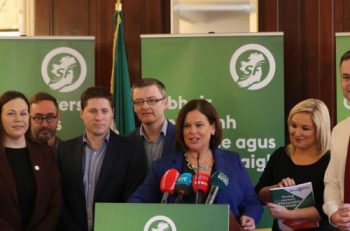
    Sinn Féin’s exciting economic and social agenda needs to be weighed against its ambivalence on violence, its cultism and its environmental weaknesses. By Michael Smith. Village believes equality of outcome, sustainability and accountability are the most important policies.  So how does, now rampant, Sinn Féin fare under these criteria? Of course Sinn Féin has been attacked for the alleged profligacy of its manifesto. For me its manifesto is an impressive piece of work and the high point of Sinn Féin’s offering. Nevertheless, economically, it uses smoke and mirrors and it is not clear by how much it would exceed the alleged fair-weather fiscal space of €11bn.   The Economy Sinn Féin plans to abolish the USC for incomes under €30,000 (costing €1.2bn)  and abolish the local property tax (costing €485m). It would increase stamp duty on commercial property and introduce a 15.75 tax rate on employers’ PRSi on salaries over €140,000. It would increase CAT from 33% to 36%.  It would impose  a 1% wealth tax (over €1m) and a 5% high-income levy.  Exciting and progressive stuff. It would spend an additional €6.5bn on house-building and €1.6bn on health over a five-year government, It would giveaway €2.4bn in tax reductions every year, and increase overall taxation by  €3.8bn annually It claims it will run a surplus every year, rising to €3.4bn by 2025, and misleadingly claims that the Department of Finance has somehow endorsed its package as a whole. This generation has been so profligate in terms of consumption and environmental degradation that it should be aiming to live more within its means and only to borrow for the benefit of the rising and future generations. To this end, Sinn Féin’s economic and social manifesto seems a proportionately radical approach. It is regrettable it is not proposing increases in capital gains tax, even on windfall land rezoning profits, and it is offensive that a republican party would not tax property, an atavistic regression to the Irish obsession with the land, ill-befitting a modern party with left aspirations.  Its proposals on REIT and IREF property vehicles are informed and appropriate.  It proposes increasing the Dividend Withholding Tax (DWT) for REITs and IREFs from 25% to 33%, applying a rate of 33% Capital Gains Tax on all property disposals by REITs and IREF and applying the full rate of commercial stamp duty on REITs and IREFs . This is targeted stuff: someone in Sinn Féin’s been talking to subversives in real estate. However, it again betrays a lack of seriousness for a socialistic party in eschewing increases on our 12.5% corporation taxes, or financial transaction taxes.   Of course the manifesto is not everything, particularly in circumstances where coalition is its only route to government.  Sinn Féin’s commitment to actually implementing a radical left agenda is unclear bearing in mind its defining preference for irredentist nationalism first over socialist ideology second, and its willingness to coalesce with Fianna Fáil or even Fine Gael.  Track Record Nor is its track record in power impressive.  Its performance at local-authority level is consistently banal.  In Northern Ireland, apparently unbeknown to Mary Lou McDonald, there seem to be more homeless per capita than in the Republic (a 2017 report from the Northern Ireland audit office, for example, said that “since 2005-06 around 20,000 households each year have presented as homeless with an average of 50% accepted as statutory homeless“; and its health service is by far the worst in the UK.  The governance Sinn Féin has provided North of the border is not distinctive or particularly leftist. Dysfunctionalities More generally Sinn Féin is cultist, over-disciplined and secretive, hitched to supportive plutocrats in the US,  and ambivalent about democracy and transparency.  Its internal elections never seem fully open.  It had a serious internal bullying problem. Its leaders lie casually about its, and the IRA’s, past.   It was certainly the case in the past that Sinn Féin leaders deferred to the IRA army council.  It is alleged, with some evidence – e.g. Máirtín O’Muilleoir’s consultations with veteran republicans as Stormont collapsed, and Mary Lou McDonald’s volte-face on a border poll – still to be the case. If it is no longer the case – and this is definitive – at the very least Sinn Féin should explain when and how the transition occurred. Many Sinn Féin leaders accept that overall the IRA campaign, which killed 1800 (out of 3500 killed in total during ‘the Troubles’ was a mistake, despite the systemic and evil provocations.  The single biggest move that might attract nay-sayers to Sinn Féin would be to apologise for its largely blind support for the inexplicably still-undisbanded IRA. As it is, it is vulnerable to the, sometimes disingenuously contrived, efforts of the media and other political parties, to highlight the litany of Sinn Féin ambivalence to IRA violence, such as the focus on its dubious role in imputing criminality to Paul Quinn who the IRA appear to have murdered, after the cease fire.   Nationalism, particularly irredentist nationalism, is a dead end and ultimately incompatible with equality which seeks to eliminate barriers, including borders, to treating people equally. In Sinn Féin’s case nationalism has taken the shape of support for violence.  It seems to me that violence, in the North, verged too often on the anti-egalitarian.  If you support shooting someone you are in effect saying not alone are they not equal, or somehow worth less, you are saying they are worth nothing.  That was a bad start for an egalitarian agenda. If not sectarian, Sinn Féin is at least tribal. It is systematically scathing of Unionism and it is anti-British.   Whatever about the vicious lies told casually about Paul Quinn, Mary Lou McDonald took the opportunity to march behind an “England get out of Ireland” banner at last year’s New York St Patrick’s day and stated that Slab Murphy, convicted on overwhelming charges of tax evasion, was “a good Republican”. Sinn Féin is still the party of anti-Black-and-Tan-bandwagonning and the late-night Tiocfaidh.   Its efforts to reach out to Unionists in the North rarely seem tailored to actually appeal to sceptical Protestants. Even in the South it is divisive. Sinn Féin’s campaign rhetoric has not

    Loading

    Read more

  • Posted in:

    Equality over freedom

    Politics is a continuum from equality to freedom. If freedom is the vertical axis of a graph and equality the horizontal axis, every society – and every citizen – decides where the balance should be. A libertarian society tending towards survival of the fittest will not foster equality; an egalitarian society may need to be enforced by a strong state to the detriment of individual licence, and so on. Philosophers from Tocqueville to Hayek to mainstream liberals accept there is a trade-off. Village tends to the egalitarian end of the scale: truly free equality, after education and reflection – precise processes for which have been touted by many modern philosophers – is a mature and more stable goal than equal freedom. Workaday politics can be charted and defined on the graph. However, the same political action can be justified by different points on the graph. Issues like divorce, gay marriage, and abortion can be deemed imperatives of either freedom or equality. In this respect the language used is not a definitive indicator of the politics. A campaign can claim to be about equality but in fact on analysis be defined by positions only of freedom. Any campaign fronted by Simon Harris or Leo Varadkar – agents above all of the propertied, of the status quo for the wealthy – is unlikely to be rooted in any real substantive equality. It is perfectly legitimate to campaign for gay marriage or abortion because you want yourself or others to exercise rights to freedom to get married or have an abortion. Telltale signs if you do so you may include that you are less likely to make common cause with campaigns for others suffering discrimination of all sorts. You may ignore issues like racial equality, Travellers rights; you may express no concern about economic, social and educational inequalities. It is legitimate but it is not Village’s political motivation of preference. For Village recent referendums reached the right solutions but were disappointingly rooted in the politics of freedom rather than that of equality. The egregious wrongs in Irish society are best resolved by solutions driven by equality. This society above all facilitates those who are economically adroit. It provides opportunity for people who are strong; worse still it provides opportunity for them to make mistakes (trashing the environment is the one posterity will most register). It provides very little vision as to how they should exercise their freedoms. – this is in part the problem of 100 channels but nothing on the television. But on a societal scale. It is now time to move on to new agendas that are really radical. These include: agendas of radical redistribution of wealth in society, of radical changes to the opportunities available to those who have suffered traditional discrimination, including (still) to women and to those of minority sexual orientations, to racial minorities including Travellers; of educational opportunities facilitated by positive discrimination so even (or especially) the poorest in society can be whoever they want to be; of redistribution of power so it is exercised at the lowest, most local, most democratic levels; of attenuation of property rights so they are exercised in the common good. The goods in society should be distributed by that society so those least well off are most compensated. Everyone in society is morally equal, they should be treated by society in a way so they can participate in the fruits of the earth equally. It is a myth that the fruits of the earth are distributed in accordance with merit – they have been accumulated largely by force and luck. The idea that in 2018 a child’s future is determined by the time it reaches two years old is an abomination. Ireland is growing up politically. Ireland has waved good-bye to the invidious influence of an unrealistic Church and voted the right way on divorce, gay rights and abortion. However, these are really liberal causes focused on issues of identity. It is time we addressed the issues of endemic inequality enshrined down the generations. As regards the Constitution we do need to abolish Article 41 which recognises the woman’s life within the home, so devaluing women who choose not to work within the home; and to eliminate the part of the preamble which invokes the Constitution “in the name of the Holy Spirit”. Indeed the Constitution’s premises relate to another era and the whole document should be reconceived. More generally, materialism, capitalism and competition have had their day, it is time to welcome in a new agenda – of equality of outcome/condition: equality of wealth and power, of quality of life, of environment, of education, of fulfilment and happiness, of respect and opportunity. This should be achieved through politics and laws. The constitution should be amended to reflect it too. The most radical change would be to enshrine equality of outcome/condition as a constitutional imperative across the range.

    Loading

    Read more

  • Posted in:

    Villager February 2018

    Listen up around what they’re at Villager likes nothing more than a shafted preposition. Most of the articles that come in to this magazine are from academics writing ‘around’ their subjects. They go into Village’s file of death along with cover letters for CVs that sign off cheers. So he was thrilled to see the Irish Times say of Nama that is lending €384m to allow developers to “build out projects”. Zagantagonism It’s been a bad month for Rugby schools. Paddy Jackson, the Kiely’s set-to, the illicit publication of the letter from Eunan O’Carroll. And now Frank Armstrong. The editor and half the Champagne socialists/ environmentalists whose whimsies fill the pages of Village have been taken aback by young Armstrong and his piece in the current edition ripping apart Gonzaga College, alma mater to non-conformist and unbulliable egos of all sorts, from Ranelagh right as far as Bray. Hypocrisy on Equality Talking of which it was amusing to see Michael McDowell bemoaning inequality – “the rich getting far richer” in the Sunday Business Post where he ties down an, unpaid, column. When he had power he was largely an agent for liberalism – and inequality, even claiming the economy “demands inequality in some respects”. In 2004 he told the Eonomist Survey of Ireland that he “sees inequality as an inevitable part of the society of incentives that Ireland has, thankfully, become”. He was quoted by The Economist magazine as offering a robust defence of the gap between rich and poor in Ireland. And he told the Irish Catholic that “a dynamic liberal economy like ours demands flexibility and inequality in some respects to function”. It was such inequality “which provides incentives”. He said: “As far as I am concerned liberal politics and liberal economics go together. In a liberal society, equality of opportunity is an equal opportunity to become unequal. A society which legislates and controls in every way to create some sort of mathematical equality just doesn’t work”. In his pomp he believed: “Driven to a complete extreme, the current rights’ culture and equality notion would create a feudal society”. McDowell sat at the Cabinet table for a decade while the country was run – to disastrous long-term effect – in the interests of elites and cartels, including the legal one he still feeds off. McDowell pulled the plug on the Citizen Traveller campaign when it dared to be controversial. He delayed and censored the reports of his department’s own inspector of prisons, Judge Dermot Kinlan. Dodgy Donegal There is still no sign of a date for the High Court case being taken by Michael McLoone, former County Manager in Donegal, represented by barrister Michael McDowell, over a 2014 Village article titled ‘Dodgy Donegal Planning’, alleging improper behaviour in Donegal County Council’s treatment of planning matters. Nor is there any sign of the Department of the Environment’s report into the activities detailed in the impugned Village article, though it has been promised for years. Loughinisland threats Village has received correspondence from the Hawthorns, Ronnie and Hilary saying they will take legal action over the naming, in these pages, of Ronnie as chief suspect for the Loughinisland massacre in 1994 when six Catholics watching a world cup match were gunned down in a pub. The Hawthorns’ concern vacillates between defamation and privacy. But they seem to be having trouble getting anything beyond a few emails together. Colgan threats And Michael Colgan has apparently initiated proceedings against Village for “defamation of character”, though Village hasn’t been served with anything so we’re not really sure. Colgan alleges a recent editorial implied he was guilty of serious crimes and rape. Village claims it was accusing him of harassment. Unthreatening After all that hassle Villager often wonders if it isn’t better to just say nothing. Then you can become as popular as William and Kate, Royal heirs in waiting, who have literally never saidanything anyone can remember. Kith and Quinn Villager never gets cross, never raises his voice. But he hates those Quinns. Complaints by Sean Quinn jnr and his wife Karen Woods about a recent failure to pay some of their €100,000 annual living expenses should be seen in the context of a “scheme of misappropriation on a grand scale”, the High Court has been told. Some €10m has been extracted from a company in India “and we don’t know where that has gone”, Barry O’Donnell SC, for the special liquidators of Irish Bank Resolution Corporation, said. Documentation from India and Hong Kong showed “a scheme of misappropriation” was executed, over time and especially in 2010, at the instigation, and for the benefit, of members of the Quinn family. The transactions at issue “have never been explained” and while the family maintain they had no idea what was going on, that is “wholly implausible”, he said. This, and the fact Quinn and his wife are receiving close to €100,000 annually in living expenses, was of concern to the bank and it was “imperative” the matters were addressed. Villager absolutely begrudges them their 100k. If he had his way the radical left would have picketed the likes of the Quinns instead of faffing around harassing water-meter installers. And he wants to know where Peter Darragh Quinn, a nephew of the bankrupt former billionaire, on the run five years after an arrest warrant was issued for him, is. Ireland biggest environmental mess by a landslide In July 2008, the Court of Justice of the European Union (CJEU) ruled that Ireland had failed to carry out a proper assessment for the 70 turbine Derrybrien wind farm which was built in the early 2000s. The Government has yet to carry out the assessment on the site. The construction work on the wind farm led to a 2km landslide in October 2003, which the Commission itself has called “environmentally devastating”. The incident caused 450,000 cubic meters of peat to slide down the mountainside, which was washed into the local river systems. The European Commission has now requested that the

    Loading

    Read more

  • Posted in:

    If not zeal then logic

    It could not be clearer. The Irish Human Rights and Equality Commission Act 2014 says that public bodies must, when they are preparing strategic plans, assess and identify the human rights and equality issues that are relevant to their functions as policy maker, employer and service provider. Public bodies must also identify the policies and practices that they have in place or that they plan to put in place to address these issues. We can only assume they meant it when they enacted the legislation, two years ago now. The excitement could, therefore, hardly be contained as the Department of Education and skills was first out of the traps with its new statement of strategy. All other Government Departments are still in the process of finalising their own new statements of strategies. They lag behind education, hot off the press with its ‘Action Plan for Education 2016-2019’. The statement of strategy opens with a picture of a smiling minister Richard Bruton and his commitment that “we can work together with all the people who work in and depend on the education and training service to, collectively, make it into the best in Europe”. This ‘best in world’ stuff is cringe-inducing but, whatever, how did it manage the new public sector duty? It is worth setting it out in full. It comes under the less than promising subheading “ensuring equity”. Equity, it must be remembered, is about fairness, not the more particular, more ambitious equality, not even human rights. It goes like this… “As part of their public sector duty, public bodies are required to consider human rights and equality issues relevant to them. In preparing this document, such issues were considered and individual actions address matters specific to the education and training sector. Ensuring access to an equitable system is a driving force throughout the Department’s work”. That’s it. It feels like a crude two fingers to the legislation, to the Oireachtas that enacted it, and to anybody who had naively entertained expectations deriving from the legislation. Human Rights don’t even get another mention in the 64- page document. Equality gets a mention as it is part of the name of the Deis (Delivering Equality of Opportunity in Schools) initiative and, under Goal 2, where the statement of strategy complacently recites that “we have made considerable progress in advancing equity and equality of opportunity”, but does deign to acknowledge that “significant challenges remain if we are to ensure that children and young people from different backgrounds are adequately supported so that they can experience success in the education system”. Anything vaguely equality-related is squashed into Goal 2 of the strategy statement which is to improve the progress of learners at risk of educational disadvantage or learners with special education needs. Goal 2 has 18 actions. This compares with 35 actions under Goal 1 to improve the learning experience and success of learners, 29 actions under Goal 3 to help those delivering educational services to continuously improve, 37 actions under Goal 4 to build stronger bridges between education and the wider community, and 20 actions under Goal 5 to improve national planning and support services. The Irish Human Rights and Equality Commission has produced limited but clear guidance on implementing this public-sector duty. The steps required include: Undertake an assessment of human rights and equality issues that are relevant to its functions, to the services it provides and to its employees. The Department of Education and Skills Statement of Strategy demonstrates no evidence of such an analysis. Consult broadly with employees, managers, trade unions, individuals and communities accessing and using the services, and other key stakeholders, which may be affected by inequalities and human rights issues. The Department of Education and Skills received submissions from 600 individuals and groups but there is no evidence that any of these related to equality and human rights or the public-sector duty. Screen and analyse policies and programmes from a human rights and equality perspective, identifying which existing policies and programmes are particularly relevant. The Department of Education and Skills Statement of Strategy demonstrates no evidence of such screening or analysis. Develop action plans on human rights and equality with defined actions and responsibilities. The Department of Education and Skills Statement of Strategy demonstrates no evidence of such an action plan. So, what next? The Irish Human Rights and Equality Commission, in its guidance, states that where it “considers there are failures to fulfil the Public Sector Duty, it can invite a public body to carry out an equality and human rights review of the work of the organisation and prepare and implement an action plan”. Logically then, the only outstanding matter now is when will the Irish Human Rights and Equality Commission act? Niall Crowley

    Loading

    Read more

  • Posted in:

    Unruly

    What is meant by the Rule of Law and is such a concept honoured in Ireland today? I believe that the rule of law though arguably an unqualified good is not being adhered to in this state save mostly by the judiciary and that the legal system and erratic observance of legality by state officials renders our democracy fragile. In my view Ireland draws close to that amorphous notion, a failed state that cannot in reality uphold the rule of law. This opinion piece will not be a comprehensive pathology but will point out many of the salient practical features which show how the rule of law is breaking down. The Rule of Law: Theoretical Incoherence? We first need to probe the many senses in which the rule of law is described. Joseph Raz, a legal positivist who believes in “perfectionist liberalism” has suggested that the rule of law is merely a kind of shorthand description of the positive aspects of any given political system. From a different vantage point the fundamentalist Christian legal philosopher John Finnis considers that the rule of law is: “[t]he name commonly given to the state of affairs in which a legal system is legally in good shape”. Another philosopher Brian Tamanaha chimes to negative effect that the rule of law is “an exceedingly elusive notion” which leads to “rampant divergence of understandings” and is similar to the amorphous concept of Good in that “everyone is for it, but has contrasting convictions about what it is”. At bottom, there is no consensus: it is elusive at best: a form of smokescreen or professional hypocrisy at worst. But let us endeavour to be constructive. For example Carothers, though sceptical, adds a worthwhile positive definition of the rule of law as: “a system in which the laws are public knowledge, are clear in meaning, and apply equally to everyone. They enshrine and uphold the political and civil liberties that have gained status as universal human rights over the last half-century. In particular, anyone accused of a crime has the right to a fair, prompt hearing and is presumed innocent until proved guilty. The central institutions of the legal system, including courts, prosecutors, and police, are reasonably fair, competent, and efficient. Judges are impartial and independent, not subject to political influence or manipulation. Perhaps most important, the government is embedded in a comprehensive legal framework, its officials accept that the law will be applied to their own conduct, and the government seeks to be law-abiding”. Now let us stress-test certain aspects of this detailed expurgation against the patient – in this context Ireland Inc. Yes of course rights exist in our still fine, if shopworn, constitutional matrix and are enforced by the courts in many instances but there is also an undue deference to the executive that has led to the non-enforcement of social and economic rights particularly the right to housing by the courts. There is an excess of judicial caution on other rights-based claims, particularly where issues of financial iniquity and the countervailing amorphous blob, public policy, are implicated. There is also widespread violation of privacy by the state and its police force, in particular. The overly sanguine way we as a nation have accepted, in effect, what has been police and state criminality with respect to privacy for the last thirty years without widespread outcry is baffling. At least there are signals of an upsurge in civil disobedience, which when peaceful, as Habermas, the German sociologist of critical theory and pragmatist, would contend, leads to a vitalisation of democracy. Not here. Further, the scandal that is our banking structures, the disgrace of the banks varying interest-rate repayments in breach of agreements, the sometimes unconscionable evictions, are not conterminous with the rule of law. NAMA is a mess formulated by the neoliberal club which did its best to avoid a proper new deal for the Irish people. The banking inquiry was a poorly performed French farce. What is desperately needed is a right to housing. Eviction should be rare, require rehousing, and should only follow meaningful intervention by an arbitrator who can determine whether the consumer can repay and whether the bank – with or without the enlistment of a vulture fund – is bundling the mortgage at a bargain-basement rate to private-law profiteers. Further, many of our state institutions have major structural problems. The Garda are not progressive in training and intent: they do not seek justice or the truth, but rather a result. They, at times spin, embellish or at worst, manufacture evidence – and, to be candid, at times act criminally and in violation of the rule of law. Finally, there are limited independent checks and far too close a nexus between politicians and the police. The recent moving of the deckchairs by the Garda Commissioner will not change the culture or training of the force, its group think or, arguably, its competence. It needs a radical ovehaul and a redirection so primarily promotes truth- seeking, investigative process. The impartiality and independence of our judiciary needs at times to be severely questioned because there is far too close a nexus between politics and judicial appointments. Though most are appointed on merit, many of our judges are appointed for their proximity to political parties. Further, some judges have an aggrandised sense of themselves: certainly they are not servants of the state as that is not a judicial function, but rather, they are the servants of the constitution which is a bulwark to protect the people against state excess. Judges also need, in the interest of public confidence as to their impartiality, to declare their share-holdings and indebtedness to the banks. Moreover, parts of the government left itself open to the accusation, during the bugging crisis, that it was also mired in corruption. In the strictest sense it observed the rule of law but, in manner, it laid itself open to the criticism levelled elsewhere by the late great Christopher Hitchens of being crypto-fascist, pursuing a

    Loading

    Read more

  • Posted in:

    Let’s despatch the Eighth

    One morning recently I woke up to abusive tweets. “What is it with lesbians hating unborn babies?? Please explain!”. “Why so many lesbians pushing abortion when they should never really need one??!!!”. As a long-time feminist campaigner and Convenor of the Coalition to Repeal the Eighth Amendment, vulgar interactions from anti-choice supporters are inescapable. I’m too long in the activist tooth to let them bother me (much), but this latest batch does make me wonder. Why is “lesbian” used as a term of abuse, and what has it got to do with “hating” babies, or women, or men, or indeed anything else? I’d like to tweet back (but I don’t): “Look here, you with the vituperative tweet finger, I’m a feminist, lesbian, radical Irish grannie (of two, so far), and I’m pro-choice because I believe in equality, in human rights, in justice, and in a world where all women, everywhere, including my daughter and my granddaughter, have the right to make decisions for ourselves about our bodies and our reproductive lives. It’s a national issue, it’s global and it’s also very personal. So there!”. The Coalition to Repeal the Eighth Amendment was set up in recognition of evident and popular demand for change. Our members include trade unions, pro-choice and feminist groups, human-rights organisations and many other NGOs and groups. The next year or so will be vitally important in advancing this issue. It has become a real election issue. If political soundings are to be believed, we can expect a “national conversation” after the election in the form of a Citizens’ Convention, followed by a referendum. It is hard to exaggerate the ‘chilling’ impact of the Eighth Amendment on women, on doctors in preventing them from working in the best interests of their patients, and on our society as a whole. What does it say about respect for women and our capacity to make our own decisions about our lives? What does it say about respect for human rights principles? Successive Governments have ignored robust criticism of the Eight Amendment from UN and other international human rights bodies. Even as I write, there’s a woman setting off from Sligo or Kerry or Wexford or Dublin on that dismal journey to the UK for an abortion she can’t obtain here with the support of her partner, her family, her friends, her GP. There’s another woman getting off the plane on her lonely trek back, and another desperately trying to find the money or the vital travel documents, or whatever else she needs to go abroad for an abortion. Every day, at least ten women are forced to go through this exhausting and demeaning process because the law and the health services fail to provide for women’s full reproductive needs and rights. We have no idea how many more women are in tears and desperate because they don’t have the resources of money, travel papers, childcare, time off work, good enough health and capacity, or whatever it is they would need to be able to make the journey. We predicted the direct and dangerous implications of the Eighth Amendment for women when it was introduced into the Constitution in 1983. We have learned with terrible sadness and anger of women dying. We have had to bear unwilling witness to innumerable personal tragedies dragged through the Courts and exposed in the media. As women, the Eighth Amendment ensures that our human rights are consistently breached during pregnancy by making a dangerous, unworkable distinction between our lives and our health. It denies us life-saving treatment such as chemotherapy. It forces us to remain pregnant against our will, even in cases of rape, incest and where a fatal foetal abnormality has been diagnosed. The Eighth Amendment puts our health at risk, denying us options even when the outcomes are clearly long-term and debilitating. It discriminates against poor and marginalised women and all those who cannot travel abroad for an abortion. Disgracefully, it criminalises women for the ‘procurement’ of an abortion, including women who obtain the abortion pill, the safest and most straightforward means of abortion. It criminalises medical professionals who assist women to do so. It places punitively strict parameters around the crucial information that reproductive health services can provide. It’s clear that the Eighth Amendment no longer reflects public opinion, with poll after poll showing strong support for its repeal. While we certainly don’t underestimate the amount of work to be done, our members are committed to the battle ahead. With public support we will campaign vigorously for repeal of the Eighth Amendment. In 2016, we don’t think that’s too much to ask. Do you? Ailbhe Smyth Ailbhe Smyth is Convenor of the Coalition to Repeal the Eighth Amendment

    Loading

    Read more

  • Posted in:

    Maybe Equality

    The Government would be happy to go to the polls wrapped in the mantle of a ‘Yes Equality’ Government. The Government delivered on the marriage equality referendum. We had the referendum to beat all referendums and same sex couples can now get married, their relationships affirmed as equal. This was a remarkable achievement. Eamon Gilmore called it “the civil rights issue of this generation”. However, is it enough for Fine Gael and Labour to don the mantle of a ‘Yes Equality’ Government in search of a vote? Aodhán O’Riordáin, Minister of State at the Department of Justice and Equality, tried to keep the feeling warm. A month after the referendum he declared the report of the working group on direct provision for asylum-seekers, set up by his Department, as another “Yes Equality moment”. This sorely diminished the mantle and, indeed, any correlative right to don the mantle. The recommendations of this report were far from any ideal for equality and human rights. The report essentially permitted continuation of this inhumane direct provision system for receiving and accommodating asylum-seekers. Only those asylum-seekers serving five years or more in the system were to be released. The mantle has since been further sullied as even the limited recommendations have not been implemented. Direct Provision is not the only serious human rights violation that this Government has countenanced. RTE’s Prime Time exposed the gross abuse of people with disabilities living in Áras Attracta. Political disapproval owed yet action was absent. The Government ignored the 2011 Congregated Settings Report that recommended that “people with disabilities living in congregated settings move to community settings within seven years”. It ignored the costed submission of the HSE, made in 2015, seeking some €250m to implement the report. Whenever it came to money, this Government evinced little interest in donning the ‘Yes Equality’ mantle. The treatment of the Traveller community reflected a rejection of equality and human rights by the Government. There was an extraordinary disinvestment in the Traveller community. The education budget specifically allocated to Travellers was reduced by 87% and the accommodation budget by 85%. This happened despite significant educational inequality for Travellers and the scandalous, often dangerous, living conditions they continue to endure. The tragedy of ten lives lost in the fire on the temporary Traveller halting site in Carrick-mines was not unpredictable. Even tragedy, however, failed to secure any reinvestment in the Traveller community. People with disability fared badly. Their prospects for independent living receded. The Mobility Allowance and the Motorised Transport Grant for people with disabilities were cut. The Minister for Health and Children axed these schemes in 2013 because criteria governing the schemes were found to be in breach of the Equal Status Act in a case heard by the Equality Tribunal in 2008. The Minister did not have to axe the scheme. He promised the issues would be resolved quickly but some people with disabilities remain on the schemes found to be discriminatory and no new scheme has been provided for the many others now precluded from access to these vital supports. The schemes were central to participation in society and to ensuring people do not become trapped in their own homes. Lone parents didn’t fine it was a ‘Yes Equality’ Government. Changes to the One Parent Family Payment caused stress and hardship for many families, that are much more likely to experience poverty and social exclusion than others. 63% of them experienced enforced deprivation in 2013. The Government effectively ended access to the One Parent Family Payment in 2015 for lone parents whose youngest child is seven or over. The financial losses for working lone parents are so significant that they are likely to give up part-time employment. Trans people, on the other hand, did get some of the ‘Yes Equality’ treatment. Legislation secured legal recognition for them in the gender with which they identified. This was on foot of legal action taken by Lydia Foy to assert her rights. The legislation, despite its failure to respond adequately to young Trans people, compares well with the most progressive approaches to the rights of Trans people at a European level. The legislation to ensure 30% of all candidates of each party in national elections are women is progressive. There was a touch of the ‘Yes Equality’ about this. It did not cost money but it is clear that it is causing some significant pain in male bastions. The same commitment did not extend to private-sector boardrooms, despite proposals from the European Commission for a 40% quota of the under-represented gender on corporate boards. And that ‘Yes Equality’ feeling drained away with the failure so far to address women’s reproductive rights by repealing the iniquitous Eight Amendment to the Constitution that has put women’s lives and health at risk. This Government did inject some of the resources cut by the previous Government from the budgets of the Equality Authority and the Irish Human Rights Commission back into the equality and human rights infrastructure. Nothing, however, is ever straightforward when it comes to this Government and equality and human rights. The additional resources were only made available to a new, merged body, the Irish Human Rights and Equality Commission. It seems this potential ‘Yes Equality’ moment was actually more about sweeping equality under the human rights rug. Equality and human rights re ect two very different traditions. Equality is focused on achieving outcomes of equality for the different groups that make up society. Human rights are about minimum standards to be enjoyed by all individuals in society. In merging the two traditions there is much talk of the logic of equality being a human right. When equality is limited to being a human right it is confined to formal equality. Formal equality is only about equal treatment and non-discrimination. Not about outcomes. A merger of the Equality Authority and the Irish Human Rights Commission, based on such an understanding of the relationship between human rights and equality, diminishes any capacity for or drive towards the more substantive forms of equality that so many groups in our society aspire to and

    Loading

    Read more