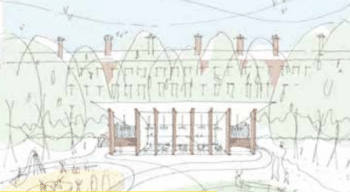
Norma Smurfit is now proposing a €2m pavilion for the west side of Merrion Square in Dublin. The plans will go before the full council at its April meeting, to see whether they should move forward and should go out to public consultation.
If there’s been one new idea introduced into the discourse by the 2016 commemorations, we haven’t registered it. The Rising was an irrational response to a colonialist foe. The proper approach would have been to analytically survey the strengths and weaknesses of the occupying power, and to have respectively avoided and exploited them with the view of achieving specific military and then political goals. The fact the Rising was a martyrdom, with in Pearse’s case a Resurrectionist underpinning, is a very bad start to a nation. This has been debated for its ethical ramifications but the political ramifications have been more dangerous and pervasive. The indulgence of mythology in politics pervaded the civil war and the parties it spawned, the 1937 Constitution and the perpetuation of non-specific Republicanism with no stress on parties that would actually stand for something like an ideology, most obviously a left or right agenda, or the data-and-evidence-based policies it might have spawned. Connolly himself considered some of the revolutionaries were motivated, according to Edward Townsend in his recent history of the Rising, by “either vacuous romanticism, or a mindless commitment to ‘physical force’ without social content’”. The Proclamation came nearly a century and a half after the American Declaration of Independence and the French Declaration of the Rights of Men. It should have been more secular and more explicitly egalitarian. While celebrating the training of its “manhood”, it did at least summon both men and women to the cause, though why it didn’t just refer to people is a good question, the phrase “suffrages” suggests some form of parallel franchises may have been intended, and worst of all for some (ungallant?) reason Cumann na mBan’s role is not registered in the Proclamation, though it is generally recognised as the unsung third participant in the Rising. The Proclamation should not have summoned in aid any (expansionist German) gallantry from Europe, assuming it was viscerally anti-colonial. It is not difficult to summon declaratory or constitutional principles. It was not then and it is not now. The principles must be transcendent. They must not date. Equality, Freedom, Sustainability, Efficiency, Openness would have done it. Article I of the Declaration of the Rights of Men [sic] isn’t bad: “Men [sic] are born and remain free and equal in rights. Social distinctions can be founded only on the common good”. Not getting it quite right (and the replacement of the brutally executed culturally imaginative 1916 leaders by mediocrities and religious zealots) opened the door to the mean weirdness of the 1937 Constitution which is invoked in the name of the holy spirit “from whom is all authority” and recognises the special position of its womanhood but only because of “her life within the home”, and the associated “duties”. If Ireland in 2016 is not serious about either ideology or policy it is in part because the grounding documentation of the republic depends on mythology, on religion, on machismo. None of our politicians seems imbued with an iota of political philosophy and it passes for a credo to believe in a Republic (as opposed presumably to a monarchy) without any positive definition of what precisely that imports, for then, for now, forever. This is no small thing. 100 years on we still have parties with no ideology and no driving policies. We have a short-termism which survived one of the worst governments in the history of the state. We have as our two biggest parties, dinosaurs almost indistinguishable the one from the other. We have a Labour Party which is prepared to sell out a fundamental vision each time it enters government and we have radical left parties that prefer to campaign on opposition to water and property taxes rather than promote the simple internationalist socialist message of equality. Indeed ironically this ‘revolutionary socialist’ stance is rooted in the campaign-for-the sake-of-it mentality that drove most of our revolutionary conservatives. The proclamation and its idealistic progenitors looked to the past and the present. Their analysis was not inaccurate. But they did not lay down any or any adequate template for the future. Their lack of interest in doing so partly explains the lack of interest of our current political generation in doing so. 1916 has left us bereft in 2016.
Village is a campaigning magazine. Two of its key agendas are equality and sustainability. Two thoughtful and evidence-based champions of these issues are respectively Oisín Coghlan of Friends of the Earth and Rory Hearne of Tasc, standing for the Trinity and NUI panels. We decided to give them some space. In the same spirit NUI voters might want to avoid voting for Michael McDowell (strangely endorsed recently by LGBTI campaigner, Katherine Zappone TD, who – if she had any interest in Equality would know better). McDowell, a former AG and Minister for Justice who campaigned against the abolition of the Seanad in the referendum on the issue in 2013 told the Irish Times his campaign will focus on the need to reform the Seanad and open up the election to the entire voting population. He was the legal advisor to the working group chaired by former senator Maurice Manning, which recommended sweeping changes in how the Seanad is elected. To Village, however he will always be remembered as an icon for the privileged attacking the right of the not so lucky to equality. In 2004 he told the Economist Survey of Ireland that he “sees inequality as an inevitable part of the society of incentives that Ireland has, thankfully, become”. That seems to put him in the disgraceful – and almost unique – position of endorsing inequality. He also attempted to remove Niall Crowley as activist CEO of the Equality Authority, when he was Minister for Justice. As regards anti-corruption McDowell was responsible for subverting the Centre for Public Inquiry so that it collapsed in 2005 as a force for aggressive investigation of corruption. Just as bad is the self-absorbed way he collapsed the PDs, itself the most self-absorbed economically right-wing force in Irish politics, when he, as leader, lost his Dáil seat. In short he was a towering force for now discredited deregulation and he should take the consequences. McDowell has ugly baggage, He should not be elected on a a platform that attempts to re-invent him as primarily a force for Seanad reform. Just one of the three outgoing NUI senators, Ronan Mullen, is seeking reelection. The other two, Feargal Quinn and John Crown, are not running again. Current Trinity Senators, Prof Ivana Bacik, David Norris and Prof Sean Barrett are all standing again in this election. Norris, a long-term campaigner on progressive issues, is the longest-serving senator on the panel, while Bacik is Reid Professor of Criminal Law in the Law School, and a former TCDSU President. She is a solid and excellent candidate with an unimpeachable record on both equality and the environment; and she is a generous contributor to Village. The poll for the rotten Seanad boroughs of Trinity and the NUI closes on 21 April. Oisín Coghlan (Trinity) I’m running to push climate action and social justice up the political agenda. Climate change is the biggest challenge humanity faces. But our political leaders downplay the need for action. And they are failing to grasp the opportunities for Ireland in the transition to a fossil-free future. I’m not naïve enough to think electing one Senator who prioritises climate change will be enough to tip the balance in favour of Ireland taking serious climate action. I’ve spent 20 years working for organisations campaigning for progressive change of one sort or another on issues from Israeli human rights abuses in the Occupied Palestinian Territories, to Irish aid and trade policy, to climate change. And it’s clear from cases where Ireland has adopted a progressive stance, whether on Apartheid, East Timor or overseas aid that among the essential factors for success, apart from a compelling cause, have been inspiring and persistent campaigning and the mobilisation of a big enough civil society coalition to outweigh whatever vested interests or bureaucratic inertia have their fingers on the other side of the scales. But parliamentarians have a role too, amplifying civil society voices, questioning ministers and officials, proposing legislation and policies. And Trinity Senators in particular have a long tradition of using the role as a campaigning platform. Moreover, the Seanad is not supposed to be a creature of political parties, they have simply used the votes of local councillors to hijack the ‘vocational’ panels. The Seanad it is supposed to represent the different strands of Irish society. I think at least one of our 60 Senators should represent Ireland’s proud tradition of global solidarity and the new imperative of climate action. If elected I will be an energetic, independent voice for a healthy environment, a stronger democracy and a more equal society. Oisín Coghlan is Director of Friends of the Earth, Ireland, but is standing as an independent. www.oisincoghlan.com. Rory Hearne (NUI) There are 1600 children living in emergency accommodation in Dublin alone and 8000 children attended the Capuchin day centre to get a hot meal last year. Tens of thousands of families face the threat of eviction. At the same time the wealthiest in this country increased their wealth by €34bn since 2010. We have a grossly unfair society where the wealthiest 20% of households have 70% of all the wealth in the country. This is not the Republic that was aspired to in 1916 and it is certainly not a Republic that guarantees, as the Proclamation outlines, “equal rights and equal opportunities to all its citizens” and “cherishing all of the children of the nation equally”. Successive governments since the foundation of the state have failed to provide for the basic social and human rights of all citizens – particularly our most vulnerable and disadvantaged communities. Taoiseach after Taoiseach, political party after political party, prioritised the needs of their big business cronies and funders, developers, multinational capital, the priviledged and wealthy in Irish society, and through the austerity years, they prioritised the banks, European finance and vulture funds. We need a new approach to politics that prioritises social and economic equality, social justice and true democratic participation. It wasn’t an easy decision to stand. The
The two big parties no longer think big. The bigger parties attract an older (more reliable?) vote while the apparently more radical parties capture the younger and more socially disadvantaged vote The elephant in the room at the so-far abortive meetings in Leinster House to form a viable government is the presence of a once popular leader now entirely without credit. Enda Kenny even assumed a very low profile in the centenary commemorations of the 1916 Rising. His presence was easily overshadowed by that of President Michael D Higgins – who occupies a position of symbolic power in our modern day republic. The Independent TD and commentator Shane Ross understood this very well when he stated that he was gazing at a “political corpse” when he was part of the first discussions with the acting Taoiseach. Independents have, and need, a keen nose for public opinion since they have no big political-party apparatus designed to keep them informed. Ross was then extensively criticised for his use of language by the politically correct classes who felt he had disrespected the office of Taoiseach as well as by the supporters of a wounded Fine Gael. Ross is in substance correct. It is virtually impossible to install a new government if it involves putting Enda Kenny in as its head. To do this would be to truly pervert the course of public opinion, as expressed in the general election. If things are changed utterly then it is because the election of 2016 delivered a hammer strike from the electorate to both Enda Kenny and the Fine Gael party. Willie O’Dea, one of the brightest men in the Dáil, also captured this point well in a recent article in the Sunday Independent. By coincidence the same paper has produced a poll which shows that Micheál Martin, not Enda Kenny, is the one most favoured by public opinion to be the next Taoiseach. A large section of the media and commentariat expressed surprise at the scale of Fine Gael’s defeat – it seems the more comfortable members of the commentariat fell for the Fine Gael spin that Labour would lose but Fine Gael would hold its own. The failure of the Fine Gael-led government started with the water-charges fiasco and continued into the election where Kenny made a pre-eminent contribution to the party’s defeat. He cannot escape blame on this front. It also appears that he has at least three hungry wolves within his own ranks who wish to replace him – Leo Varadkar, Simon Coveney and Frances FitzGerald. Enda Kenny was comprehensively outshone in the TV debates during the general election by Micheál Martin despite the fact that he has spent the past five years strategically blaming Martin and Fianna Fáil for all of the problems that beset the country. It simply did not work. The public has moved on from the blame game, even if Fine Gael has not. Moreover, Kenny told people they would not understand economics at the start of the campaign and towards the campaign’s end delivered the immortal insult that people who did not like him or his policies were ” whingers”. Fine Gael continue to defy public opinion by presuming, in the post-election discussions, that the party must be part of any government that is formed. Caretaker Taoiseach Enda Kenny has now been defeated on three occasions – all three defeats have been very clear, public and formal – first in the election and twice now in the Dáil on votes to determine who should become Taoiseach. There are signs, with over 40 days gone since the general election, that the public is wearying of the posturing and pranks of the political class as they collectively fail in the task of government formation. The first casualty of jadedness from the public will be the independents who will see the fools’ pardon extended to them in the election withdrawn if either no government is formed or an election ensues. One of the most dangerous statements issued so far was by Fine Gael’s Richard Bruton who stated on Morning Ireland that he would consider the formation of a Fine Gael minority-led government but not participate nor contemplate its polar opposite a Fianna Fáil-led minority government. Fine Gael, including its fabled leadership contenders, seems to believe that the party has some sort of divine right to be in government. Leo Varadkar, for all his faults in Health, seems to have got it right when he acknowledged openly that no government could be formed unless it combined the parliamentary numbers of both Fianna Fáil and Fine Gael. The numbers and the logic of the general election are pointing that way but neither of the two big parties wishes to accept that its rival should lead in the political equation: Fianna Fáil + Fine Gael = Stable Government. Well before the election result was known I indicated my own view that if the two big parties were in touching distance of each other, in levels of political support, then there was a real chance that there could be a Fianna Fáil- Fine Gael partnership government – with even the possibility of a rotating Taoiseach. The fact that this prediction, if you like, has not happened so far is because of internal institutional resistance to the concept, or competitive rivalry, from both parties. There is also a huge, in my belief, misplaced fear in both parties that by forming such a government they will leave a wide-open door for Sinn Féin to become the major force in opposition and the government in the election that follows. This conservative-mindedness, or risk aversion, by the two big parties is precisely the reason they have both so far lost support to Sinn Féin, anti-austerity parties, and a broad, if inchoate, collection of independents.The two big parties no longer think big in terms of their ambition. The bigger parties attract an older (more reliable?) vote while the apparently more radical parties capture the younger and more socially
What’s your geographical and professional background? I am originally from Carrickmacross, Co Monaghan, but moved to Dublin over 20 years ago. I have worked as an English and Music teacher in St Tiernan’s Community School in Dundrum for the past 16 years. How long have you been in the Greens and how did you first get involved? My husband and I joined the Green Party shortly after the birth of our first child, Turlough, in 2007. I got involved for the sake of his future and the future of all of our children. They were, to me, the only party looking to the long-term. Are you on the practical or radical wing? I don’t think the two are mutually exclusive. I believe in practical, long-term sustainable solutions, but I also think we really have to change the way we think and do politics before we can implement the solutions. What motivates you? Looking at things in an innovative way, seeking solutions, and my children of course! What is your political priority? To provide a voice for real equality of access to quality education for all. How would you reform education? We don’t just need more investment in education we need innovation and creativity and a more user-friendly system for all. We need to formally incorporate wellbeing into the curriculum so that the way we teach our children is more individualised for each student. Teachers are under-resourced and over-stretched and that needs to change too. What instrument do you play? I sing and I also play the piano. How would you get more women into politics? Show them it is possible to effect change and reform systems, and make it possible to have quality family time. How comfortable are you debating the fiscal space? It’s another complex label for something reasonably straightforward. To the detriment of other issues, it dominated the first week or so of a short general election campaign. What simple changes could best be made to health policy? The simplest and most effective change would be to integrate effective mental-healthcare services into mainstream health and education policies. What is your environmental priority? We have to strive to meet our 2030 emissions reductions targets. If we don’t it will cost us a lot of money – nobody is spelling this out. The previous government would sooner incur fines than come up with solutions. What are the biggest local issues in your constituency? Equal access to quality education and childcare are huge issues for families and people are genuinely stressed, worried and losing sleep over these issues. Providing effective crime-prevention is also a big concern for many. What is your political philosophy? Everything is interconnected. We need to bear this in mind when tackling problems and providing solutions. How would you describe yourself on a left-right or liberal-conservative scale? I am not into political labels. Actions speak louder than labels. Do you believe in equality and if so which type eg opportunity, wealth or outcome? I strongly believe in equality of opportunity. Nobody should be at a disadvantage in life because of where they were born, their socio-economic circumstances, their gender or race, and so on. I think that’s the Government’s duty to the next generation: to ensure equality of opportunity. How many hours a week have you been devoting to Council work? Every hour that was feasibly possible! Did the Greens do a good job in government? Yes and no. The Greens were tasked with dealing with an economic collapse that was not of their making. It would have been very easy to walk away from that saying it wasn’t our fault, but they didn’t, and they knew they’d take a hit for it. Balancing the books was never going to be easy, but every budget that the Greens were involved in was progressive, at least, which can’t be said of the outgoing Government. Many of the Greens’ achievements that were tangibly good were lost with poor communicative messaging. What lessons have they learnt? To be extremely cautious about going into Government again and be absolutely insistent on a dividend of delivery of green policies. To communicate in a clearer way that the green message is one of social justice. How would they do it differently a) in a future government and b) if negotiating a role in government in the 2016 Dáil? We will insist on a progressive policy platform, one that looks to the long term, and exploits the green economic transition that will happen in the next 50 years. The party has learned lessons from its time in Government, and we will tread carefully if the opportunity arises again. How much of the Green vote was for the Greens and how much for the environment and oppositionalism? I think there were two elements to the Green vote: a vote for the party itself and a vote for the environment. There has been a Green voice missing from the Dáil for the last five years. Nobody was raising environmental issues. They wanted that Green voice back in the Dáil, and they trusted the Green Party to be that voice. I also believe the vote was due to the hard work we have been doing in our communities across the length and breadth of the country. What would the Greens do about quality of life? Our first priority would undoubtedly be ensuring that every citizen has access to a warm, comfortable, affordable home. This would involve an ambitious state-backed building scheme to deliver the housing stock needed. We would also ramp up the home retrofitting scheme that was introduced during our time in Government, so that the elderly or at risk can have their homes insulated. Another priority would be childcare. These are critical issues that need to be addressed. great sense of happiness, relief and satisfaction that the hard has paid off. Many of them worked alongside me for the past 5 years. I personally feel a tinge of sadness that both my parents did not
A senior member of administration at NUI Galway has made a complaint under the 2014 whistleblower Act about alleged irregularities in the appointment of people to senior teaching and administrative positions. The controversy is the latest in a succession of rows between staff and management at NUIG which has seen the Equality Tribunal make serious findings of gender discrimination against the college. Other cases by women alleging discrimination are making their way through the tribunal and at least one has been lodged with the High Court forcing the embattled NUIG president, Jim Browne, to issue a statement in recent weeks insisting that he has no evidence that discrimination is widespread within NUIG. He was responding to a letter from the vice-president of SIPTU, Gene Mealy, which represents more than 700 workers in NUIG, claiming that “widespread problems of discrimination persist across all grades of staff” and that there has been “a proliferation of precarious employment contracts which we believe are inherently discriminatory”. The union criticised management for failing to engage with the State’s industrial relations machinery. Browne rejected the assertions by Mealy and urged the union to “bring any evidence of discrimination to the attention of our director of HR and organisational development, Chris McNairney. I am sure he will investigate them thoroughly and professionally”. Regular reports in the Connacht Tribune posed questions over the appointment of consultants, Results Through People Ltd., at a cost of €180,000, by the School of Law for just 22 months work. Last year PR firm Drury/Porter Novelli, was commissioned to supplement the five person NUIG communications department when the college became the centre of an international media storm over a health questionnaire for job applicants which included questions about women’s menstrual cycles, and gynaecological and prostate problems. The union committee has also expressed a lack of confidence in the independence of the newly appointed vice-president for equality and diversity. Ann Scott, formerly of Dublin City University and Liverpool John Moore University, who was appointed to the position in recent months at an advertised annual salary of between €106,000 and €136,000. The remuneration also annoyed lecturing and other staff who have witnessed a sharp growth in contract-based, low paid employment since Browne took up the president’s position in the late 2000s. Suspicions of an “old boys club” at NUIG emerged in a survey last year which found that male and female staff used terms such ‘misogynist’, ‘aggressive’, ‘toxic’, ‘bullying’ and ‘cronyist’ to describe the culture at the college. Similar allegations of discrimination and improper promotions have been made at UCC, DCU and UL as third level administrators pursue an aggressive embrace of the corporatist model so widespread in British and US colleges.
O’Connell Street is the epicentre of Irish Constitutional Nationalism and its GPO the principal locus for the Easter Rising and the Proclamation of the Republic. So how’s it doing?
Each revolution, including Euromaidan against President Yanukovych, has brought disappointment. The oligarchs remain dominant, led by President Poroshenko, the richest man in the country’ Stalin’s policy of de-Kulakisation killed between two and seven million Ukrainians and annihilated the fabric of village life