Archives

OK

Random entry RSS

Loading

  • Posted in:

    Election Times

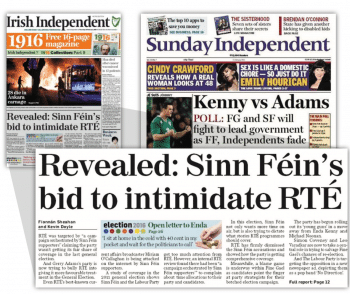
    The story of an election is much more than a few headlines, but the Irish Times front pages mercifully, if languidly, devoid of the kind of blatantly partisan positioning seen elsewhere, provide in hindsight a neat narrative of the campaign, with the slow realisation that Fine Gael was in trouble, the lack of a clear alternative emerging, and of course, “events, dear boy”. While its columnists and editorials may have declaimed preferences in the run-up to the general election, the Irish Times‘ front page generally affected a more neutral stance, certainly by comparison with the anti-Sinn Féin headlines which dominated the Irish Independent and its Sunday sister during the February campaign. The ‘newspaper of reference’ (formerly “of “record”) began the month in ‘phoney war’ mode, leading on Monday 1 February with coalition plans to “target home buyers and parents in poll pledges”. On the Tuesday, with still no election date declared, the story was “Taoiseach prepares Fine Gael ministers for election”. Perhaps ominously, on both days the below- the-fold story concerned the revelations regarding “Grace” a young woman with intellectual disabilities abused while in HSE care in a foster home. The story would feature again several times during the month and, by the end of the campaign, would threaten to inculpate Michael Noonan. Wednesday’s paper finally brought the official election notice, leading with Fine Gael ministers outlining their election promises, but the shine was short lived. Thursday, and the first election poll, brought “disappointing news for Coalition parties”. Much of the remainder of the campaign was spent trying to push back against those low poll numbers, which stubbornly refused to rise. By the first weekend, Fine Gael had announced a “tax U-turn to hit voters earning €100K” (the top 10% of all earners, though Irish Times readers would be better paid than the average). The election narrative was dominated at first by Fine Gael (at least on the front page) but it changed dramatically in the second week. The murderous Regency Hotel rampage called attention to cuts in Garda numbers and resources and Fine Gael, which prides itself as a law and order party, found itself on the back foot. At one point Sinn Féin’s Mary Lou McDonald attacked the government for being soft on crime during an RTÉ radio debate. By the end of the week, the lead story that Garda “may be issued with new weapons” helped to restore marginally Frances Fitzgerald’s battered image, but you know you (we?) are in trouble when Sinn Féin are attacking you from the right on crime. Meanwhile, bubbling below the fold, the news was no better. Lowry, Drumm and Luas strikes festered, and the Times awarded the first TV debate to Micheál Martin. Week Three began with Labour striking out to create a separate identity, promising “an abortion vote in any new deal” – definitely a plus for liberal Irish Times readers. Smaller parties got their first acknowledgement the following day, as the lead reported they did best in the previous night’s debate. For the rest of the week, it was almost as if the Irish Times tired of the “boring” election campaign, with more conventional “newsy” lead stories on an HSE inquiry into baby deaths, welfare benefits for migrants, and Brexit. Week Four began with the writing on the wall, summarised in a single Monday headline “Martin and FF rise in polls as Coalition stagnate”. Tuesday the paper reported Kenny and Martin had “equal backing in race for Taoiseach”, and the final TV debate failed to resolve anything for this hard-to-please newspaper as “leaders fail to land killer punch”, before Kenny’s “last-ditch call for vote in favour of stability.” Below the fold on the same day, the first mention of Sinn Féin in a front-page headline volunteered no favours: “Canvasser for Adams owns hay shed where ‘Slab’ Murphy cash was found”. ‘Slab’ was also the subject of one of the few passionate editorial columns (now perhaps self-deprecatingly titled “the Irish Times view”). Others quite reasonably despaired of the “short election, short of vision”. But while front pages covered national trends, debates and polls, and columnists inside the paper from Una Mullally (who, surprisingly for someone with a political agenda, gave up interest) to Breda O’Brien (vote for people of conscience, if you know what I mean) via Fintan O’Toole (who in the end detected an unlikely victory for social democracy) and Noel Whelan (who again somehow spotted the Fianna Fáil revolution implausibly early) ventilated partisan viewpoints, perhaps the most concise reportage on what happened on election day was by religious affairs correspondent Patsy McGarry, who on the day of the count reported from the north inner city, less than ten minutes from Tara St in a neighbourhood where few read the Irish Times, and fewer would share its editorial concerns: one, a hooded man, was picking up rubbish and putting it in a black plastic bag.“I didn’t vote. I don’t have a voting card. I was abroad for five years. It’s not important at all”. Gerard Cunningham

    Loading

    Read more

  • Posted in:

    The language of Ballymagash

    The Fianna Gael area rep was practisin’ his language, goin’ forward. He was glad you had asked the question but would you please let him finish. He didn’t interrupt you. Can you hear him at the back? He would have no hand, act or part in this coalition. That was a redline issue. Nothing was agreed until everything was agreed. There was not a scintilla of evidence that the scal space was what the other guy said. A lot done, more to be done. Together let’s take the next steps forward and Let’s Keep the Recovery Going. Your hard work is working. Ireland’s working again. Now let’s keep it working. Working for you. Working for him. Working for Work. He was Standing Up for Ireland’s Future and Standing up for working families. An Ireland for all. Building a better future. A future you can believe in. Change you can believe in. Belief you can change in. New sports facilities you can change in. Changing Ireland for a changing Ireland. Not the same old, same old. New roads. No potholes. Bringing no potholes to the hard-working people of this constituency. The way forward. The Straight Road is Shortest, he mused. The long man for the long road. An end to the road to the end, for all. Democracy, republicanism, government a health service for all. Let’s keep the wheels moving: Real Plan Better Future. Making 2016 a year to believe in. Your Future, Our Future. A future for our children. A future for our county. A future you can believe in for your community. Your community, your team, your future. He had a five-point plan, a three-point programme, a contract with the people, he wanted a charter for the people, ordinary people, ordinary working people, ordinary families. A voice for you, a voice for our young people, a voice for older people. A voice that will he heard. A voice that will be heard in Dublin. No way in the wide earthly world. A voice at the table. Rewarding work, real change not spare change. A people’s debate. The people’s party. The people’s person. The republican party. The people’s republican party. An Ireland serving the people. A convention inside a commission inside an inquiry, inside a tribunal. What did he bring to the table: Integrity, Courage, Experience. And a record of delivery. Delivering on local issues with a national impact. His record stands for itself. Vote for experience and common sense. Jobs, Education, Health. People Who Deliver. Delivery you can believe in. Active in the country. Active in the county. Activism you can count on. Difference you can rely on. County country. Core values. Going forwards not backwards. Help him to help you to help ourselves. In these serious times you need a serious candidate. Action speaks louder than words. Keeping it real. Bringing the Motorway to Molahiffe. Bringing the Luas to Listowel. Bringing the DART to Dingle. Vote 1, 2, 3 in order of your preference. Never merge, never go into coalition with Fine Fail. Identical. For (nearly) a hundred years.

    Loading

    Read more

  • Posted in:

    Bouquets to Boulders

    It is critical that the next Government have a credible and robust National Traveller and Roma Inclusion Strategy. This will depend on political will. The last number of months have been particularly difficult for Travellers and Traveller organisations. In October 2015 we witnessed the horrific deaths of 10 Travellers in a fire at a below-standard halting site in Carrickmines. There was a general outpouring of sympathy for the bereaved Traveller families which seemed to break through the barriers of negative stereotype. Soon, however, we were forced to watch the bouquets turn back into boulders as the local authority failed to implement its plans to accommodate the bereaved families due to objections from local residents. This unleashed shocking levels of anti-Traveller hate speech on the airwaves and on social media. Meanwhile the families were left to live on a car-park while they buried their loved ones. In November 2015 Traveller ethnicity was discussed in Dáil Eireann for the first time. The Government told the Dáil that Traveller ethnicity would be dealt with in their new National Traveller and Roma Inclusion Strategy. But we had to watch the Minister for Equality, who had promised to deliver on this issue, back down. He blamed ‘focus group led’ politics. This disappointment was followed in January this year with the spectacle of riot police evicting Travellers from a Traveller halting site in Dundalk. This was apparently for their own safety. Ministers refused to get involved in local authority operations. The Government was exposed as having no plan for Travellers and Roma. The last Government told the United Nations that poor education outcomes for Traveller children and third-world living conditions for Traveller children would be dealt with in the new National Traveller and Roma Inclusion Strategy. However, It succeeded in putting Traveller issues on hold, just long enough to get to the General Election. The week before the election Travellers and Traveller organisations were involved in a round of consultations with the Department of Justice and Equality on the National Traveller and Roma Inclusion Strategy. It was ironic that outside these consultations, in the real world of General Election campaigning, Traveller issues were barely mentioned. Considerable space in print, on the broadcast media and on Social Media is readily available to decry Travellers and to blame many of the ills of society on them. However, when it comes to political discourse the space available seems to shrink. Travellers and Traveller organisations have been engaging with the State for 30 years now. In this time there have been significant milestones. The 1995-Government-appointed Task Force on Travellers was the first to provide a comprehensive agenda of policy proposals for equality for Travellers based on a recognition of the distinct culture and identity of the Traveller community. The 1998 Employment Equality Act and the 2000 Equal Status Act introduced, for the first time, a system of redress for people experiencing discrimination in employment and in the provision of goods and services, including Travellers. In 2010 the First All-Ireland Traveller Health Study was published which acknowledged the critical role that living conditions play in determining unacceptably-poor Traveller health levels. What we have failed to see in the last 30 years is the implementation of policy in accommodation, health, education and employment. Many of the recommendations of the 1995 Task Force report remain to be implemented. There has been little tangible improvement in the standard of Traveller living conditions. Travellers and Roma represent a small percentage of the total population. It is not beyond our means to ensure equality and human rights for Traveller and Roma. We need leadership that Travellers can believe in. We need Government to commit to implementing a National Traveller and Roma Strategy that: 1. Provides safe, culturally-appropriate accommodation for all Travellers and Roma. 2. Supports positive action to enable labour-market participation and employment for Travellers and Roma. 3. Reinstates and grow resources to ensure participation by and outcomes for Travellers and Roma in culturally appropriate education at all levels. 4. Implements the recommendations of the All- Ireland Traveller Health Study. 5. Recognises the distinct ethnic identity of the Traveller community and addresses the practical implications of this in policy, programmes and services. 6. Addresses deprivation among Travellers and Roma in an integrated strategy for economic equality for these communities. 7. Funds Traveller and Roma organisations to give voice to the issues faced by their communities and to participate in decision-making that affects them. 8. Promotes a campaign of public education to combat racism and to stimulate a valuing of ethnic diversity. 9. Builds capacity in the public sector to respond effectively to cultural diversity and to implement the public-sector duty to promote and implement equality and human rights. Ronnie Fay Ronnie Fay is Director of Pavee Point

    Loading

    Read more

  • Posted in:

    Celtic Tiger 3.0: Yea

    General election 2016 rose up with a bang and ran out with a sizzle. Days before the voting started and well before the results were known, two simple facts of life took hold over anyone’s rosy expectations for the future as heralded by the political campaigns – Left, Centre and Right – of the imaginary political spectrum that demarcates the insular and parochial Irish intellectual milieu. Firstly, virtually every party and every candidate, save for a handful of disparate voices, have now moved into Celtic Tiger 3.0 mode: promising lower taxes, more spending and a perpetual and forever-strengthening recovery. Secondly, GE 2016 lacked policy ideas about as much as the Sahara Desert lacks rain. Fianna Fáil and Fine Gael. Again. But now together. The Governing Coalition chose to do address its electorate from the perspective that policy continuity and stability (read: predictability) are the key drivers for future success. The challenging and challenged Centre-Left, led by FF, took to a traditional Irish oppositionalism, shouting loudly: “Not enough being promised and even less delivered!”. Sinn Féin opted for the complacent and comfortable “We are not them, but we promise even more” line. On the fringes of the spectrum, where smaller parties and the Independents struggled to get their voices out, there were ideas, debates, ideologies, ideals and un-Irish (at least according to the political elites’ metric of authenticity) integrity and passion. This was the small planet where oxygen owed, orbiting the Death Star of the status quo. But the planet was not big enough or perhaps the oxygen just inadequate. And it was not aided by the analysis coming from ‘outside’ the politics tent some-where deep within. Thus analysts who are academic and unaligned (at least ostensibly) opted to apply their usual policy models to the raw ideas often advocated by the newer political groups. On occasion this analysis was outright partisan, slating and praising similar proposals based solely on which party was doing the proposings. At times, things got ad hominem; at times: hysterical. An example of the latter was a research note from one of Ireland’s premier asse-management companies shouting about the risks of political instability that could be visited upon the Irish economy should the current Coalition be supplanted by a weaker form of Eurogroup parrot. Amid all this low-brow circus, few analysts and even fewer political leaders bothered to notice just how out of touch with the modern reality Irish politics has become. A country of 4.8 million people, drained of its power to influence the course of Europe and self-deprived of its will to chart an independent economic policy in the style of, say, Switzerland or even Denmark or Holland, Ireland is now navigating the high seas of global economic fortunes, rudderless. As noted passim during the ‘leaders’ debates of General Election 2016, over half of the Irish recovery miracle of 2014-2015 was passed down to us from high Frankfurt’s ECB offices. Euro devaluation, negative government-debt yields, ample bank liquidity and historically low interest rates. Together the beneficence of serendipity has sustained our exports, kept in check our imports, underpinned the temporary solvency of our banks and maintained a cap on mortgages and SME-debt arrears. About a quarter of our Celtic Phoenix story has been written by the US Fed and the eternal (we hope) dysfunctionality of the US taxation regime that enabled both strong demand for Multinational (MNC) production off-shoring from, and exports on-shoring into, North America from Ireland, while at the same time doing zilch to reduce the stonking incentives for Ireland-bound tax inversions. Having swallowed a propaganda pill of recovery, Irish consumers underwrote the rest of our growth, pushing up domestic consumption and forgetting (for now) the gargantuan rock of debt still hanging around their necks. Alas, the problem with the Celtic Phoenix – the very foundation of the Government’s ‘continuity = recovery’ thesis and the opposition’s ‘tax-less-spend-more’ proposition – is that its existence owes nearly everything to what happens outside the Dail and Merrion Street. Having ignored the changing world around us, our political elites have not only confirmed their provincial and insular nature, but put at risk Ireland’s economy and society. This will become evident in the next year or two. Let me explain why. Recent media and pundit coverage of the global economy, and of advanced economies, has focused on the rising degree of uncertainty surrounding growth prospects for 2016 and 2017. Much of the analysis is weak, tending to replay the clichés of the risks of ’monetary policy errors’, ‘emerging markets rot’, and ‘energy sector drag’. But the real four horsemen of the economic apocalypse are loudly banging on our castle gates. These four horsemen are: 1.Supply-side secular stagnation (technology-driven productivity growth slowdown); 2. Demand-side secular stagnation (demographically driven slump in global demand); 3. Debt overhang (the legacy of boom, bust and post-bust adjustments); and 4. Financial fragility(the risk of a major crisis brewing within the highly interconnected and interdependent global financial system). In this world neither monetary nor fiscal policies, defined within the constraints of traditional practices, work. Neither supply-side nor demand-side economics hold any serious answers. To see this consider Japan. By Keynesian standards, the country with Government debt at 248 percent of its GDP should be a roaring success. All of this stimulus should have produced at least a speck of sunshine on the dour growth horizon. And by monetary policy standards, Japan should be a roaring success – the Bank of Japan is now running negative interest rates, having pioneered zero-bound rates in February 1999. It has a balance sheet (a metric of quantitative easing) of 76% of GDP. Alas, latest forecasts put growth projections for Japan at 1% in 2016 and 0.45% in 2017. This is the equivalent of firing up a nuclear reactor to get kettle boiling. Next, consider the ‘stronger’ economic fortress, the US ,to whose fortunes Ireland is hip-linked through our (er… not quite OUR) exporters and investors. Here, the Congressional Budget Office’s latest forecast is that tbe budget deficit will rise from 2.5 percent of

    Loading

    Read more

  • Posted in:

    Responsive parties don’t want reform, responsibility or even power

    The election is over, but the prospect of forming a government is still somewhat distant. This probably shouldn’t surprise us. Apart from the outgoing Fine Gael-Labour government none of the other parties were really proposing to go into government. Their campaigns were based on a critique of the incumbent government. The Irish people roundly rejected the outgoing government. But it is not clear what positive choices the voters were making, if any. The result was remarkably similar to the result of the local elections in 2014. Local elections are regarded as second-order elections, in which voters aren’t making a decision on the choice on offer, rather making a judgement about the government of the day. These are protest elections. In 2016 each party came within 1.5 percentage points of their result in the local elections. This Dáil will have the appearance of a protest meeting. It’s not just the Trotskyite left, but also Sinn Féin and many independents. It is not that these don’t have any interest in policy – they do – but they have no interest in taking responsibility for policy delivery. At the moment Sinn Féin repeats relentlessly that it will not compromise its principles. We have rarely seen so many on the left anywhere greet the prospect of a right-wing government (of Fianna Fáil and Fine Gael) with such jubilation. But, problematically, they are in effect telling their voters – the ones living in hotels, or lying on hospital trolleys, or waiting for treatment – that they don’t matter. Those people will have to wait five years until the party is bigger, because their political movement’s long-term growth trumps effecting real change to people’s lives through compromise. These are ‘responsive’ politicians, responsive to every real or perceived grievance on the part of the citizens they represent. Populists on the left and right offered voters simple solutions to these grievances. All we needed to do was tax the rich, burn bond-holders, spend more money and everything would be solved. They appear to believe that we live in a world without external constraints. These parties and independents were not only responsive to voters’ concerns, they fed them. They sought to say to voters that any problems experienced by them or their own community were the direct responsibility of the state. Though many rise up as ‘community activists’, by being so demanding of the state they are actually disenfranchising their communities. The government parties’ politics were ‘responsible’. The Greens took responsibility. Labour took responsibility. Certainly they made mistakes; in pursuit of ‘responsibility’ they were often too anxious to please markets and Europe. They ignored, or weren’t responsive to, the often genuine concerns of voters. But surely the establishment parties’ unwillingness to promise the undeliverable wasn’t one of their mistakes? Between the harsh realism of ‘responsible’ politics and the utopianism of the ‘responsive’ politics, languish ordinary people who struggle with increasing insecurity. Issues such as rural services saw the rise of independents, issues such as the affordability of childcare, homes, and transport led to ‘responsible’ parties seeping votes to ‘responsive’ parties who have no real solutions. The ‘responsive’ don’t want reform, they want to protect failing systems. They offered few ideas beyond investing more money into services. That we already spend above OECD average proportions of GDP on health appears not to matter. They want to protect poorly designed redistributive payments that help create a small underclass so removed from society that many of us cannot actually understand them. Accepting that people’s diminished disposable income, which affects their ability to afford consumer goods – atter at-screen TVs – is a genuine problem that the state needs to care about, the ‘responsive’’s answers to issues such as the housing crisis are firmly rooted in the twentieth century – rent controls and rent allowance. They are more interested in protecting failing teachers than helping the children they damage. All their answers deal with the symptoms of inequality, accepting the disease of inequality of opportunity as if it is the natural order of things. If our politicians are going to be ‘responsive’, voters need to start to take responsibility. We should avail of the time over the next month or so when there is no ‘government’ to reflect on whether punishing parties who make compromises is going to deliver anything other than more fantastic promises by parties who eschew power and, especially, its responsibilities. Eoin O’Malley

    Loading

    Read more

  • Posted in:

    FF won’t see coalition as an ideological issue and FG is glued to stability

    The most extraordinary coalition formed in Ireland was the first one, in 1948. It involved Fine Gael and a then-new party headed by Sean McBride, Clann na Poblachta. The Clann was a lively mixture of liberals, left-wingers and Republicans with a deep immersion in the IRA. The surprise with the Clann was that its youthful enthusiasm and vigorous campaigns against partition very nearly toppled De Valera from his then hegemony over Irish politics. McBride himself was a former IRA Chief of Staff who subsequently cut out a career for himself as an international eminence becoming a Nobel Prize laureate and founding member of Amnesty International – the campaigning global Human Rights body. Because of lingering republican bitterness against General Richard Mulcahy’s role in the civil war, Mulcahy, the Fine Gael leader, stood aside to facilitate a coalition with the Clann and its tooth and claw republican militants. John A Costello became Taoiseach in the coalition instead. The point of all of this is to illustrate that, from the very outset, coalition formation in Ireland has been a pragmatic business where big parties and small ones dispense with ideological or philosophical differences in order to provide an alternative government and run the country. Down the years few, if any, Fine Gael or Labour leaders worried too much about the differences of left and right when it came to forming a government designed to extract Fianna Fáil from prolonged periods in power. In 1989 Charles Haughey led Fianna Fáil for the first time ever into a coalition arrangement with the Progressive Democrats, stating cheerily: “Sure, it was only me that could have done it”. His party colleagues resisted it furiously believing non-participation in coalition an absolute core value for the party up to that point. The bitterness of doing this coalition was magnified by the presence of Des O’Malley and his new party – composed of individuals who had fought Haughey, then split from him to create their own party. For Haughey it was just another deal but for the Progressive Democrats, who claimed to be policy-focused, it was about taxation and other precious policy items, including a public Tribunal into the goings on in the Beef Industry. Haughey worked hard to save his own skin and persuade his ministerial colleagues of the merits of going into coalition. Apparently at one stage in the discussions around the cabinet table he held out his arms sideways demanding in relation to the opposition: “D0 you want to give them all of this?”. Shortly afterwards the new Taoiseach Albert Reynolds formed a coalition with the Labour Party which followed an election in 1992 which featured advertisements generated by Fianna Fáil scaremongering about a left-wing takeover of the country by Labour. This was no small tactic and involved giant billboards and full-page newspaper adverts in a bid to frighten voters in a move that was redolent of the ‘red scare’ tactics of the 1950s and 1960s. During the actual campaign my father, the late Brian Lenihan Senior. When all about him were these banner advertisements called for an alignment with Labour rather than the PDs. His rationale was that Labour were more compatible with FF than what he viewed as the “Thatcherite ” Progressive Democrats. He was dismissed by the party bosses during the campaign only to find himself instrumental, behind the scenes, after the election in putting the coalition deal with Labour together. Albert Reynolds, a businessman, proved to be very pragmatic when faced with the post-election numbers and getting back into power. My father had key relationships and friendships within the Labour Party and within the labour movement generally. These relationships and ability to communicate became vital to the formation of this government. When people set out to cross party divides there is a need for credible and dependable intermediaries who can give assurances on policy and how the share out of ministries will play out when the negotiations get real. This was my own experience when I set out, at the request of Bertie Ahern, to put in motion the process of having a coalition with the Green Party in 2007. In fact the groundwork had begun in the immediate aftermath of the 2002 election. Ahern was already entertaining doubts about the future sustainability of the PD coalition because of problems with both policy and numbers. I knew a number of the key figures in the Green Party, including Trevor Sargent and had been in university with both Eamon Ryan and John Gormley. Part of the reason for having a coalition with the Greens was a concern within the party about the right-of-centre nature of the PD coalition, as well as a fear that the party was already becoming too visibly identified with the building industry and big capital. It was also made easier by the overarching atmosphere of mainstreaming environmental or green issues. When the post-election numbers showed a Green coalition was necessary Bertie pressed the buttons and appointed a skilled and experienced team of negotiators so that his own ministers were locked into the items agreed with the Greens. The government itself worked well together though it has to be said it was much more difficult for the Greens to get the coalition deal past their activists than it was for Bertie to get it past his parliamentary party. Rural TDs were the most resistant regarding Green policies on farming incentives as tantamount to treason. In the event they overcame their difficulties. As with the previous Labour Coalition, outside of the main negotiations, a series of reliable and discreet intermediaries were on hand to smooth out any issues that arose in the talks. Ahern himself was a very accomplished negotiator. General Election 2016 has been dominated by speculation of a grand coalition between the once very dominant big parties of Fianna Fáil and Fine Gael. The fact that both parties combined now count for slightly less than 50% of the popular vote has hastened a frenzy of speculation about such a

    Loading

    Read more

  • Posted in:

    History explains our Parochialism

    In the 2012 documentary ‘Dreamtime Revisited’ poet-philosopher John Moriarity climbed Derada Hill in his adopted home of Connemara. Observing its hinterland he remarked that all about him was crooked, from the contours of the Oranmore River to the crooked coast towards the Aran Islands and the crooked horizon of the Twelve Bens. He calls this his “wonderful crooked world”. In most of the country that elliptical scene is familiar. And it seems to have found a reflection in a human character where straight lines are avoided: in our literature language has been distorted and remade; traditional Irish music allies bewitching interchange between minor and major keys with polyrhythmic time; in day- to-day exchanges a sense of humour is often prized above other qualities, including honesty. Travelling west from the Pale into wilder terrain these qualities grow more pronounced: mythos overwhelms logos in the sodden bog of collective memory. In France terroir connotes the long-standing relationship between a people and their landscape that is said to impart distinctive flavours to the food and wine produced there. In Ireland, where gastronomy has traditionally been awarded a low priority, terroir might be observed in linguistic and musical dissonances that spring from the undulating, even chaotic, landscape. We talk about what the Dutch would do if they lived in Ireland, but perhaps they are a product of the straight lines on their sunken horizon, and the practical concern of keeping the ocean at bay. Perhaps they would simply do surprisingly little. Even the Irish weather, grudgingly benign at least until recent times, finds a reflection in the periodically sullen and infuriatingly inconsistent Irish temperament. We might all recognise its description by Samuel Beckett’s character Molloy: “I know it was warm again the day I left but that meant nothing in my part of the world where it seemed to be warm or cold or mild at any time of the year”. The poor quality of the built infrastructure here would be insufferable in other parts of Europe at a similar latitude where it has been built to endure harsher winters. Ireland is on the periphery of Europe and this contributes to the strangeness of its culture and the fact that it takes a status quo, bordering on the ridiculous, for granted. Observed empirically, to some extent Ireland retains the political economy of a post-colonial outpost, now a tax haven. Une isle derriere une isle according to one French geographer – spared both Roman conquest and barbarian hordes – the country did not join the European mainstream. Ireland was a repository of learning and mysticism during a brief golden age, then passed into a millennium of obscurity before a shuddering encounter with an advanced civilisation from the neighbouring island. The ensuing appropriation imposed a system of individual private property ‘from Heaven to Hell’ distinct from what had been characteristically communal arrangements under native Brehon Law. Being the victim of the first adventure of the British Empire also necessarily generated an antipathy to rules and laws, since they were imposed in the interest of the coloniser, not the natives. Sui generis, Ireland is the only country whose population was greater in the 1840s than today, due to the Great Famine and its legacy. The unique trauma of starvation and forced emigration led to short-termism, and the ascendancy of expediency over ideology or even ideas. A current legacy of this attitude is the ingrained hostility to planning and indeed environmentalism: “you can’t eat the landscape”. The Irish Nation is a product of the late eighteenth century when the movement of the United Irishmen failed to unite all creeds: simultaneously in 1795 the orchestrated emergence of the Orange Order and of Maynooth University that created a quasi established Catholic Church put paid to the aspirations of Wolfe Tone and his colleagues. The Old English descendants of the Normans and the native Gael coalesced inviolably in the end, to form an overwhelmingly Catholic nation. The Normans might now be perceived as having tempered a native tendency towards the fast and loose, but contemporary English observers bemoaned the cultural slippage that attended the medieval wave of colonisation: as if the rivers flowing from the hilly regions inhabited by the Gael imbued the plain-dwelling Normans with their characteristics. The Protestant New English who arrived primarily in the seventeenth century descended into a familiar decadence albeit preserving a singular sectarian identity by avoiding miscegenation. Only in the North east corner, within the cultural orbit of lowland Scotland, did a distinct culture emerge. Ireland’s dramatic landscape is not unique, but what is unusual is first an isolation from and then a quite sudden absorption of its substantial population (by comparison with the equally untamed Scottish Highlands for instance) into as advanced a polity as early modern England’s. An Irishman Other has long acted as a foil to the sober, judicious Englishman and often revels in his allotted role as revolutionary misfit, bard and poet. From this we might trace a cultural tolerance of drunkenness. The contradictions between the two cultures engendered a great cultural ferment that ani- mated an Irish literary Renaissance that began at the end of the nineteenth century. In its wake Irishmen were awarded a remarkable four Nobel Prizes for literature, and this with James Joyce, widely regarded as the pre-eminent novelist of the twentieth century, missing out. Even a century later what seem parochial themes resonate beyond our shores such that an unremarkable rock band like U2 compose songs that connect with a global audience. But translate the crookedness of the Irish character into Irish politics and what do we find? If in literature the distortion of language can be art, in politics it is artifice. Corruption, famously found by the Mahon Tribunal to be “systemic and endemic” is the unreconstructed manifestation, but there are other more insidious twistednesses. They have spawned the laxity whereby a politician can say one thing to one crowd and another to the next. Enda Kenny can assert Ireland’s commitment to Climate Change while

    Loading

    Read more

  • Posted in:

    The Crookedness of Irish Politics.

    By Frank Armstrong. In the 2012 documentary ‘Dreamtime Revisited’ poet-philosopher John Moriarty climbed Derada Hill in his adopted home of Connemara. Observing its hinterland he remarked that all about him was crooked, from the contours of the Oranmore River to the crooked coast towards the Aran Islands and the crooked horizon of the Twelve Bens. He calls this his “wonderful crooked world”. In most of the country that elliptical scene is familiar. And it seems to have found a reflection in a human character where straight lines are avoided: in our literature language has been distorted and remade; traditional Irish music allies bewitching interchange between minor and major keys with polyrhythmic time; in day-to-day exchanges a sense of humour is often prized above other qualities, including honesty. Travelling west from the Pale into wilder terrain these qualities grow more pronounced: mythos overwhelms logos in the sodden bog of collective memory. In France terroir connotes the long-standing relationship between a people and their landscape that is said to impart distinctive flavours to the food and wine produced there. In Ireland, where gastronomy has traditionally been awarded a low priority, terroir might be observed in linguistic and musical dissonances that spring from the undulating, even chaotic, landscape. We talk about what the Dutch would do if they lived in Ireland, but perhaps they are a product of the straight lines on their sunken horizon, and the practical concern of keeping the ocean at bay. Perhaps they would simply do surprisingly little. Even the Irish weather, grudgingly benign at least until recent times, finds a reflection in the periodically sullen and infuriatingly inconsistent Irish temperament. We might all recognise its description by Samuel Beckett’s character Molloy: “I know it was warm again the day I left but that meant nothing in my part of the world where it seemed to be warm or cold or mild at any time of the year”. The poor quality of the built infrastructure here would be insufferable in other parts of Europe at a similar latitude where it has been built to endure harsher winters. Ireland is on the periphery of Europe and this contributes to the strangeness of its culture and the fact that it takes a status quo, bordering on the ridiculous, for granted. Observed empirically, to some extent Ireland retains the political economy of a post-colonial outpost, now a tax haven. Une isle derriere une isle according to one French geographer – spared both Roman conquest and barbarian hordes – the country did not join the European mainstream. Ireland was a repository of learning and mysticism during a brief golden age, then passed into a millennium of obscurity before a shuddering encounter with an advanced civilisation from the neighbouring island. The ensuing appropriation imposed a system of individual private property ‘from Heaven to Hell’ distinct from what had been characteristically communal arrangements under native Brehon Law. Being the victim of the first adventure of the British Empire also necessarily generated an antipathy to rules and laws, since they were imposed in the interest of the coloniser, not the natives. Sui generis, Ireland is the only country whose population was greater in the 1840s than today, due to the Great Famine and its legacy. The unique trauma of starvation and forced emigration led to short-termism, and the ascendancy of expediency over ideology or even ideas. A current legacy of this attitude is the ingrained hostility to planning and indeed environmentalism: “you can’t eat the landscape”. The Irish Nation is a product of the late eighteenth century when the movement of the United Irishmen failed to unite all creeds: simultaneously in 1795 the orchestrated emergence of the Orange Order and of Maynooth University that created a quasi-established Catholic Church put paid to the aspirations of Wolfe Tone and his colleagues. The Old English descendants of the Normans and the native Gael coalesced inviolably in the end, to form an overwhelmingly Catholic nation. The Normans might now be perceived as having tempered a native tendency towards the fast and loose, but contemporary English observers bemoaned the cultural slippage that attended the medieval wave of colonisation: as if the rivers flowing from the hilly regions inhabited by the Gael imbued the plain-dwelling Normans with their characteristics. The Protestant New English who arrived primarily in the seventeenth century descended into a familiar decadence albeit preserving a singular sectarian identity by avoiding miscegenation. Only in the north east corner, within the cultural orbit of lowland Scotland, did a distinct culture emerge. Ireland’s dramatic landscape is not unique, but what is unusual is first an isolation from and then a quite sudden absorption of its substantial population (by comparison with the equally untamed Scottish Highlands for instance) into as advanced a polity as early modern England’s. An Irishman Other has long acted as a foil to the sober, judicious Englishman and often revels in his allotted role as revolutionary misfit, bard and poet. From this we might trace a cultural tolerance of drunkenness. The contradictions between the two cultures engendered a great cultural ferment that animated an Irish literary Renaissance that began at the end of the nineteenth century. In its wake Irishmen were awarded a remarkable four Nobel Prizes for literature, and this with James Joyce, widely regarded as the pre-eminent novelist of the twentieth century, missing out. Even a century later what seem parochial themes resonate beyond our shores such that an unremarkable rock band like U2 compose songs that connect with a global audience. But translate the crookedness of the Irish character into Irish politics and what do we find? If in literature the distortion of language can be art, in politics it is artifice. Corruption, famously found by the Mahon Tribunal to be “systemic and endemic” is the unreconstructed manifestation, but there are other more insidious twistednesses. They have spawned the laxity whereby a politician can say one thing to one crowd and another to the next. Enda Kenny can assert Ireland’s commitment to Climate Change

    Loading

    Read more