General
-
-
by Village
‘if you want to understand life, don’t think about vibrant, throbbing gels and oozes, think about information technology”. ‘Philosophers already speculate about a situation where you download your brain’s entire contents into a computer and the computer does the thinking for you after you are dead’ Sitting in Richard Dawkins living room is pleasant. The first thing you notice is the volume of books blanketing every wall. On the top shelf I spot a copy of ‘The God Delusion’. Nietzsche may have declared the death of god over 130 years ago, but Dawkins is perhaps the most famous exponent of the view that secularism is the only rational option when it comes to a belief system. Due to the wave of controversial publicity this book received, when it was published in 2006, many people still see him as an angry, arrogant atheist but in person the man himself is placid, courteous, a perfect old-school English gentleman, speaking in slow, authoritative, sentences: a skilled debater, and a fountain of knowledge. Dawkins’ area of expertise indeed is not religion, but evolutionary biology. His latest erudite book: ‘The Magic of Reality – How we know what’s really true’ roves far from this base. Teaming up with the illustrator Dave Mc Kean, the book – peppered with cartoon-style images – explains the science behind natural processes such as earthquakes, rainbows, evolution, space and time, and how languages are formed. Everywhere he distinguishes between myth and reality, fact and fiction, encouraging children to ask rational questions about why things happen on this planet. For example in the first chapter entitled Who is the first Person? Dawkins explains the myth of the Garden of Eden. He then goes on to explain, in a very simple way, the theory of evolution. Most scientific concepts are intelligible to children, says Dawkins, and his book aims to prove it. “I think evolution doesn’t enter the national curriculum until the age of about fourteen, it’s part of my ambition to get that changed. Some people think it’s a concept too difficult for children to grasp. I disagree”. While Dawkins wants to discourage the notion of spells and supernatural magic, he says he is well aware of the value that myths play in cultural and historical heritage, and literature. “The Old Testament and The Greek and Norse Myths – I could have added the Celtic Myths, which are beautiful – these are all important tales for understanding English literature. Children should know the mythical background to literature: you can’t read Keats without knowing The Greek Myths for example”. You sense somehow that this latest book is a little tamer and won’t cause the sort of controversy or notoriety that characterises some of Dawkins’ other books. For example, ‘The Selfish Gene’, (written in 1976, selling a million copies) was misinterpreted by many readers. In the book Dawkins postulated a revolutionary biological hypothesis, entitled the selfish gene theory. This stated – in Darwinian terms – that everything that human beings do is driven by genes which are necessarily inherently selfish in order to maximise their chances of survival. However, the book also goes on to to explain how altruism is an evolutionary trait, and why it is of benefit to mankind to act with kindness. How does Dawkins react to people who misinterpret his work? “It seems to me these people read the book by title only, and they assume they have read the book when they have only read the title”. I ask him about the woman in Australia who wrote him a letter after reading the book, telling him she thought her life wasn’t worth living and who tried to commit suicide. “Well if you come at life from a religious point of view and you feel your life has a purpose, and you’re then subsequently told that you’re a survival machine for your genes, it makes you feel futile and sort of useless. But you have to overcome that by realising that that’s only the interpretation of a Darwinian view of why you are here, but we can each make our own purposes in life, and we do. The purposes we have in life are varied, they could be: to write a book, to learn to play the piano, to get married to a certain person. In our day-to-day existence we don’t feel as though we are survival machines for our genes”. Dawkins declared in his 1986 book ‘The Blind Watchmaker’: “What lies at the heart of every living thing is not a fire, not warm breath, not a spark of life. It is information, words, instructions…. if you want to understand life, don’t think about vibrant, throbbing gels and oozes, think about information technology”. When I ask him how far technological advancement will change the human mind, he is reluctant to make predictions without evidence, but is keen not to underestimate the potential power that computers may have in the future. “The whole molecular genetics revolution since Watson and Crick (the scientists who discovered the double helical structure of the DNA molecule in 1953) has been the digitisation of life, and it is astonishing, revolutionary. So a large part of biology – genetics – is information technology. Brains haven’t got that far yet. But it is possible that in the future computers will increasingly take over brain function. Philosophers already speculate about a situation where you download your brain’s entire contents into a computer and the computer does the thinking for you after you are dead. These are all science-fiction-type speculations that are not totally to be ruled out. If computers/ robots/ machines are given the capacity to reproduce, then they could evolve”. Dawkins coined the word ‘meme’ back in 1976. He argues that running parallel with our genetic evolution, is a cultural evolution in man. Just as genes jump from body to body, via sperm and egg, so too memes (ideas) pass from brain to
-
by Village
What happens when the Guards don’t support the Government and the media won’t report the Guards? One of the most frustrating and revealing aspect of the war over turf cutting – and there are many – was the media’s failure to report what actually happened on the night of Wednesday 20 June 2012 at Clonmoylan Bog in County Galway. According to the media ‘Protesters maintain officials from the National Parks and Wildlife Service (NPWS) yesterday tried to remove machinery belonging to turf cutting contractor Michael Darcy from a field outside the conservation zone. But when an excavator, worth about €60,000, was destroyed in a blaze after it was detained, Mr Darcy collapsed and was taken to hospital. A deal was brokered and a stand-off called off when it was agreed to return the remaining machinery to Mr Darcy.’ Sympathy for the turf cutters abounds in the national and international media. In countless rural papers we hear about ‘freehold’ and ‘rights’, as with this from the Galway City Tribune: ‘That disjoint is also responsible for the awful scenes on Clonmoylan bog over the last week, where ordinary people – law-abiding citizens – find themselves subjected to the full rigours of the law for continuing to do something that their fathers and forefathers did before them.’ What actually happened that night? Ming’s flash mob were called in – and there are hundreds on the text list – when the NPWS made an attempt to seize the machinery on the bog. The gardai could have prevented the crowd from assembling as the vehicle was being put on the lorry if they had stopped them at the top of the road – but instead they allowed them down to obstruct the vehicle leaving. NPWS Offcials were then trapped in their jeep all night, lights shone on them, sods of turf thrown at the car. And the Guards just walked away. The Offcials were actually trapped in the jeep when another machine went up in flames – much less being responsible, as one media report had it, from a botched hot wiring. Again and again the Guards have openly sided with the turf cutters, refusing to escort Rangers on site, making it clear where they stand. This is Government policy and the Guards are refusing to implement it. So we have mob rule. And imprisoning the NPWS Offcials in the car is kidnapping. The trouble with mob rule is that it turns ordinary law abiding citizens into criminals – and it denies us the right of protection for individual liberty and safety upon which any society rests. Ming, an elected TD, is well behind all this – and the media, who knew damn well what happened that night, never reported the truth. It’s sick. And its dangerous. =========== This Blog was revised on 12 July, 2012
-
Posted in:
The complex gender economy
by Village
Basically, tax, labour-market and benefit changes that hit low-income groups damage women hardest – Sinéad Pentony
-
by Village
Among all the column inches given to the abortion debate in Ireland in recent months, the most bizarre opinion is that a pregnant woman whose life is at risk will get all the support and care that she requires within this State. More than 5,000 women called the Irish Family Planning Association (IFPA)’s helpline in 2011 and hundreds of women attended our pregnancy-counselling sessions or post-abortion care services. Among these were women with serious medical concerns and women in need of life-saving abortions. None of these women had abortions in Ireland. Indeed, the IFPA is not aware of any lawful abortion that has been carried out within the State. Nor is the Government: in argument before the European Court of Human Rights in the A, B and C v Ireland case, the State could not point to a single lawful life-saving abortion that had been carried out. Pregnant women, even those who are seriously ill, travel to the UK to access abortion services. What the Court described as “a striking discordance between the theoretical right to a lawful abortion in Ireland and the reality of its practical implementation” is the lived reality of many women. It is no comfort to women who are denied life-saving services here and obliged to travel to another state to avail of them that Ireland has a low rate of maternal mortality. Other states that have comparable maternal mortality rates and equally good or better maternity services have similar rates of abortion to Ireland. But they do provide lawful abortion. No other country in Europe makes the distinction that is made in Irish law, permitting abortion to save a woman’s life, but not to preserve her health. From the perspective of a medical services provider, there is no bright line between life and health. The serious risk posed to pregnant women’s health—for example by heart and vascular diseases, pulmonary diseases, kidney diseases, oncological, neurological, gynaecological, obstetric and genetic conditions – may become a risk to life in particular circumstances. Pregnancy may exacerbate the risk to women of pre-existing conditions e.g. epilepsy, diabetes, cardiac disease, auto-immune conditions, severe mental illness. Best medical practice is to intervene when a serious health-risk presents, rather than wait for a situation to deteriorate. But women living in Ireland whose pregnancy causes risks to their health must leave the state to access such interventions. Women who make this journey do so without medical files detailing their medical history or proper referral by their doctor. A doctor would not expect any patient to access any other medical treatment in this way, particularly in the case of a patient with a life-threatening illness or possible future complications. The government has established an expert group to recommend a series of options to implement the A, B and C judgment. Ms C in the A, B and C case found she was pregnant while she was receiving treatment for cancer. The Court found that Ireland had violated the rights of Ms C. Addressing the violation of Ms C’s rights is the least complicated aspect of the expert group’s task. Clare Daly’s Medical Treatment Bill 2012 has demonstrated this. The more complicated task is to address the other issues raised by the judgment, specifically when a woman’s health and well-being are at issue. Ms A and Ms B argued that their well-being was at risk if they continued with the pregnancies. Not only did the Court accept that all three women had experienced stigma and isolation, and that the necessity to travel to the UK caused them significant psychological, financial and physical hardship, the Court also found that there had been an interference with the rights of Ms A and Ms B under the European Convention on Human Rights. Only a considered disregard for the Convention would limit the Government’s response to the judgment to the finding of a violation of the Convention in the case of Ms C, and ignore the health and well-being of women in the situation of Ms A and Ms B. While we await the Government’s response, women in all circumstances continue to travel to the UK to avail of abortion services. Niall Behan is CEO of the Irish Family Planning Association
-
by Village
Government covering up for pulling of planning inquiry By John Gormley May 2012 Village “it was Phil Hogan who, even before he took office, told Village that many of the accusations contained in the files were ‘spurious’ I know how Tom Gilmartin must have felt listening to Pádraig Flynn speaking on the Late Late. You’ll recall that this was the evening that Pee just couldn’t stop talking about how difficult it was to keep three luxury homes and in the process also ‘dissed’ the developer, Mr Gilmartin, who had given him money. Gilmartin, who was described by Flynn as being “out of sorts”, took umbrage and decided to spill the beans to the tribunal. I can guess how Gilmartin felt because I had similar feelings of annoyance when a succession of government ministers decided to discredit my efforts to deal with the planning difficulties in this country. Claims that I hadn’t done “an ounce of work” on planning enquiries were repeated by Ministers Alan Kelly, Chief Whip Paul Keogh, Minister Phil Hogan and Minister Jan O’Sullivan, all of them perfectly on message, all of them equally misleading. Rather than let the sleeping dog lie, the government had decided to give this particular former minister an unmerciful kick. Did they really believe I wouldn’t react in any way? Listening to Phil Hogan talking on the issue on Newstalk one morning I tweeted that Minister Hogan “was talking bull”. That’s not exactly a revelation, you might say – Phil regularly indulges his penchant for talking twaddle. But this was different even by his own egregious standards. To turn a story completely on its head takes some neck. So, for the record, I’d like to list what I had done as minister on the planning inquiries and what exactly Phil Hogan had in front of him on taking office. When Minister Hogan took office he had: a) an extensive dossier prepared by planning officials in the Department following an internal review of the complaints (Nov 2009) b) a series of reports from the Managers in each of the local authorities submitted in response to a formal request from the Minister using his statutory powers under the Planning and Development Acts c) terms of reference for a panel of planning consultants to carry out independent reviews in the six local authorities d) a completed tender process to select this panel of consultants e) letters of appointment ready to be issued to the members of the panel And here’s the exact chronology of what occurred: 2007-2009: Various complaints received about planning practices in a number of local authorities. No process existed in the Department for dealing with such complaints and they were usually referred back to the local authority in question. 2009: I asked the Department to examine the complaints with a view to developing a more robust system of dealing with information brought to my attention concerning planning practices. September 2009: I requested a report from the Donegal County Manager under section 255 of the Planning and Development Acts, on foot of a complaint received. November 2009: An internal review of complaints against 11 local authorities was completed by planning officials. A dossier containing the Department’s analysis of each complaint was provided to me, as Minister. Late 2009/early 2010: I decided that further action was appropriate in a number of cases, including a review by independent consultants of planning practices in some of the local authorities. I then began work with Department officials to develop the most appropriate format for such reviews. 21 June 2010: I announced the commencement of the reviews. Using powers under section 255 of the Planning and Development Acts – for the very first time, I issued six local authorities with formal requests for reports on the issues raised: Dublin City Council, Carlow County Council, Galway County Council, Cork City Council, Cork County Council and Meath County Council. 16 July 2010: Reports are received from the Managers of each local authority. It should be noted that a report had already been received from Donegal County Council on foot of earlier request. 24 September 2010: Invitation to tender is issued by the Department for the appointment to a panel of expert planners to carry out independent reviews in each of the seven local authorities. 22 October 2010: 40 tenders were received from a large number of expert planners seeking appointment to the panel. November/December 2010: Department officials carried out assessment of tenders received. 12 January 2011: The Department recommended the appointment of 6 of the 40 applicants 17 January 2011: I approved the Department’s recommended panel and approved the issue of letters of appointment. 19 January 2011: The six successful bidders were informed of their appointment to the panel and asked to submit a tax clearance certificate. 22 January 2011: I resigned as Minister and the six successful bidders received no further correspondence from the Department And below is a list of the issues to be examined. Dublin City Council: Complaints from An Taisce that the City Council was not adhering to policies in its development plan, specifically in relation to tall buildings. Carlow County Council: Report from the Local Government Auditors highlighted weaknesses in the procedures followed by the planning department. Galway County Council: Complaints from An Taisce that the County Council was not adhering to policies in its development plan in granting planning permissions – a large proportion of permissions have been overturned on appeal to An Bord Pleanála. Cork City Council: Procedures around the holding of pre-planning consultations have been highlighted by the Ombudsman. Cork County Council: Complaints have questioned the appropriateness of a procedure of liaison between the planning department and councillors on specific planning applications. Meath County Council: Complaints received concerning adherence to development plan policies. Donegal County Council: Complaints received about processes followed in the planning department. I think it’s pretty clear from the above account that practically everything that could have been done was done in relation
-
by Village
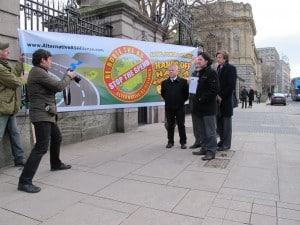
The heroic but failed champion of Tara is leading the campaign against a motorway near Newgrange Vincent Salafia is back with a “Save Newgrange” campaign. A man with a panache for publicity, the populace associates the 43-year old with the Tara/ M3 and Carrickmines Castle campaigns. Now he is to address plans for a Slane bypass within a half kilometre of the boundaries of the World Heritage Site at Newgrange. Given the history of 22 road fatalities in Slane – caused primarily by articulated lorries – there are good reasons why Slane’s residents want trucks to bypass their town. The NRA’s costly plan effectively delivers a motorway parallel to the M1, at one point only four miles distant, while causing significant environmental impacts once again in the Boyne Valley, making this the third motorway in the valley. It cuts between Slane and the Brú na Bóinne complex of Knowth, Dowth – and closest of all to Newgrange, Ireland’s most famous pre-historic site. There appear to be serious questions about Salafia’s suitability to front this campaign. He has a history of falling out with campaigns over the years. As far back as 2004 Phoenix Magazine commented that he “seems to foment trouble in his own camp wherever he gets involved”. It also noted that in 2003 “Salafia was accused by then An Taisce press spokesman, [Ruadhán] Mac Eoin (one of the co-authors of this piece), of censoring An Taisce press releases from the Carrickminescastle.org discussion forum, of which Salafia was the moderator”. Endless self-referential and often abusive emails were exchanged between assorted environmentalists pleading with Salafia to co-operate with mainstream heritage groups, and Salafia and a small group of his cohorts. Salafia, for example, was accused of subverting an attempted alliance called the Friends of Carrickmines. Now in 2010, Salafia has another campaign. Once again cyberspace reverberates with personalised environmental vituperation and Salafia is being accused afresh of censorship, removing comments and distorting information. Meanwhile Salafia himself has just issued a press release, implicating others in cyber-attacks, stating “a complaint has been filed with the Garda Bureau of Fraud Investigation’s Computer Crime Investigation Unit, and Facebook Ireland, on behalf of the Save Newgrange campaign, alleging harassment, intimidation and cyber-stalking by the Bypass Slane Campaign”. It also complains “there has been a coordinated smear campaign against the Save Newgrange group” and that “attacks are increasing in intensity and malice”, before calling for “an investigation into the conspiracy, including links to the Fianna Fail party”. Salafia for his part says that, “the website is for supporters of the campaign only…we directed people to go to Boards [website boards.ie] and have those discussions” and that it is not a discussion forum. As far back as 2001, the Sunday Business Post had carried a report titled “Hacker destroys Brehon Law research website”, detailing how Salafia had made a complaint to the Garda computer crime division that his website had mysteriously been attacked. How then does this heritage hero get so enmired in bitterness and fractiousness, having apparently split or been ejected from four high-profile environmental campaigns – “Carrickminders”, “Save Tara Skryne Valley”, “Campaign to Save Tara”, and most recently, “Shell 2 Sea”? He told Village “the thing is, in every single campaign in Ireland, there are always disputes: that’s just the nature of campaigns. It was the nature of the revolution in this country”. Vincent Salafia first came to prominence in September 2002, as an occupation began at the Carrickmines Castle archaeological complex in county Dublin. At this stage Salafia was intermittently using the name “Michael O’Toole” (confusingly, his birth name; he also passes as Ó Tuathal). At the outset of the Carrickmines campaign, Salafia had bravely indicated he would be the plaintiff in the proposed High Court action. He indicated he was a lawyer. Yet ultimately these cases were taken by fellow heritage activists Dominic Dunne and Gordon Lucas – with a subsequent case taken by Michael Mulcreevy. While he had legal training in Florida, Village understands that although he applied many years ago to the Florida Board of Bar Examiners, he has yet to gain full qualification. Very early on at Carrickmines differences emerged between the campaigners. Around this time the first of multiple reports emerge of Salafia leaving behind debts, particularly to well-meaning environmentalists for rent. An unconscionable inability to work with others was gaining traction, with the proceeds from a benefit gig providing a source of acrimony here; a borrowed generator going missing there; and unapproved statements proving divisive thither. According to Phoenix Magazine in 2004, Salafia was “booted out as a spokesman by the rest of the Carrickminders after several solo runs to the media”. In December 2003, while court action was underway, a press advisory was issued by Carrickmines plaintiff Dominic Dunne and others, stating Salafia “had no consent to either act on our behalf or imply any approval to do the same”. It also claimed “certain statements by him [Salafia] alluding to speak on behalf of others have been unreliable and misinformed”. Three years later in 2006, in the last of the three Carrickmines court cases, Salafia was once again turning up outside the Supreme Court, briefing the media. Once again a contradictory advisory was issued by Dominic Dunne. Salafia told Village that Carrickminders voted “democratically” for his continued involvement in the campaign, but others dispute this. One of the more remarkable rows regarding Salafia took place in May 2004, involving the “Save the Tara-Skreen Valley Campaign”. Again campaigners issued a “please do not publish” press advisory, stating Salafia did not have either “consent or authority” to make press statements on behalf of the campaign or its individual members. As was reported in Phoenix, any committee members who voted for such action “got a solicitor’s letters from Salafia”. As at Carrickmines, Salafia had held himself out as the litigant for a legal action – while also promoting himself as spokesman. Village understands Salafia’s legal letters essentially accused the members