General

Random entry RSS

  • Posted in:

    Sinn Féin alone

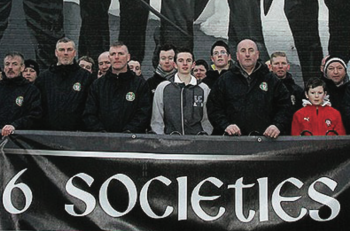
    Republicanism is fragmenting. That was  seen on Easter Sunday, when at least eight Republican groups held commemorations on Belfast’s Falls Road. At protests in the North, it is common for various ‘dissident’ groups to have more presence that mainstream Sinn Féin. That party has a much smaller activist base than a decade ago. Paradoxically, as that base has shrunk, the vote has increased. The exodus of members has not affected the vote. That was seen most starkly in last year’s assembly election for North Antrim. A councillor and 17 other activists resigned in protest when the party forced assembly Member Dáithí McKay to resign. Monica Digney, an able and respected former councillor, and one of those who had resigned, stood as an Independent. Sinn Féin’s vote increased by just under 3%. Digney polled just 435, lagging behind the Green Party. That is a stark version of trends across the north. A few years ago, even Sinn Féin strategists believed the vote had plateaued, and might even fall back. In last year’s Westminster election, Sinn Féin took 29.4% of the vote. That was a 4.8% increase in a year. The terminal decline of the SDlP has been hastened. Sinn Féin took the SDlP’s two perceived strongholds: South Down and, of greater importance, Derry. That is not to deny the importance of the exodus. There is a disillusionment with Sinn Féin. An Easter statement from Óglaigh na hÉireann prisoners sums up the dissidents’ problems: “It’s clear that presently the revolutionary Republican community appear to be facing challenging times and lack strategic direction in response to these events”. The largest single non-Sinn Féin grouping are the 1916 societies. There have spread out of their initial base in East Tyrone across the North, and into the South. They have a sizeable membership, mostly of an older generation, but they also have a small but significant membership from the post-IRA generation. They are an excellent symptom of how widespread the malaise in Republicanism is. They have engaged in some co-ordinated activity, such as calling for an all-Ireland Referendum on unity. However, their main activity is commemorations. This is the only activity on which all non-Sinn Féin Republicans can agree. They certainly cannot on a central debate for Republicans: whether or not there should be an armed campaign. Most are opposed. some, mostly from the anti-armed-campaign cohort, are becoming involved in community issues as individuals or through different organisations. There is no issue about which ‘dissidents’ can coalesce. In 1969-70, the Republican movement split into ‘official’ and ‘Provisional’ wings. (The ‘Provisionals’ became today’s Sinn Féin, while the remnants of the ‘officials’ are the Workers Party). The ‘Provisionals’ derived from the anger of many young Catholics, and a belief that the IRA had spent too much time on left-wing politics rather than preparing to defend catholic areas. This time, there is no single big issue to divide Republicans. There is a generalised unhappiness at Sinn Féin’s acceptance of Stormont and the PSNI. In some cases, unhappiness has spilled over into demoralisation. Some in Sinn Féin dismiss ‘dissidents’ as criminals. That is not to say there are not criminals using dissident groups as a cover; and others who, their war over, have turned to criminality but it is not the central case. The dissident groups are fragmented. The new IRA and the continuity IRA are continuing their campaign, while Óglaigh na hÉireann has called a ceasefire. All armed groups are riddled by infiltration by security-force agents. However, they have found a certain niche in carrying out punishment attacks. These grew by 60% between 2013 and last year. They are popular among a significant layer of the population in Catholic working-class areas. Part of the reason is the traditional hostility between the catholic minority and the police in the Northern state. Part is also that punishment attacks offer ‘quick x’ justice, without the necessity to take the time taken by a formal court system. Police seem willing to let punishment attacks continue, as long as the victims are perceived ‘hoods’. Vigilantism, though, is not a basis for building organisations that will be a serious alternative to Sinn Féin in Catholic areas. Sinn Féin could probably benefit from a bit of coherent opposition from people whose political premises, at least viscerally, it identifies with. Anton McCabe

    Loading

    Read more

  • Posted in:

    The strong centre

    Paschal Donohoe is a decent man: modest, cultured, the cleverest man in the room, according to a senior Fianna Fáil figure who spoke to Fiach Kelly in the Irish Times recently: the man other politicians envy, and a safe pair of hands. At 43, he has graduated with first-class honours from Trinity college, lived abroad, pursued a career in the private sector and risen without obstacle from local politics in Dublin city council to the heights of government, and the Ministry of Finance. Unlike his even younger boss Leo Varadkar he doesn’t have the sheen of a cultivated image. he has never attracted any suspicion of impropriety, never been excoriated, even in the unpleasant role of frugal Minister for Public expenditure (which he sure-footedly merged with the Finance brief when he took it over). When Village interviewed him he was open, generous with his time, eloquent. He reads progressive Irish fiction, has some quirky tastes, knows what is going on in his constituency about whose substandard welfare he remains committed. He even says he reads Village. Village’s agenda is equality, sustainability, accountability and it is wide and all-embracing enough that any political force, as Mr Donohoe certainly is, can be assessed against its imperatives. He is certainly in relative terms a model of accountability and openness. But what of equality and sustainability? Paschal Donohoe serves the politics of Fine Gael faithfully. He implies that Fianna Fáil is economically fickle, not always pro-european or outward looking and, increasingly implausibly now, that its attitude to ethics is demonstrably inferior to that of Fine Gael. He believes in Europe, the Open Society of Declan Costello, in an embracing attitude to outsiders. He believes in a balance between the markets and the state and, creditably from the perspective of this magazine, thinks the momentum has moved too far to the markets and needs to move back to the state, globally at least. He takes a robust attitude, as did his hero Declan Costello, to the obligations of the state. It will intervene to incentivise or nudge those who do the right thing, it will not perpetrate evil itself. He was passionate in defending the coherence of this attitude, in his interview. Mr Donohoe believes in the rights of property but will interfere at the edges, as with site-value and sugary drinks taxes. The state needs to plan systematically for development of its own lands. On national planning he was reluctant to stay how he would stop unsustainable development – such as the sprawl of Dublin into counties Meath, Wicklow, Kildare and beyond, as opposed to merely incentivise and encourage sustainable development – for example of cities and towns outside Leinster. He does not seem engaged by the environmental and climate-change agendas, though he knows its rhetoric. He rarely acknowledges, in policy, that Ireland is the laggard in Europe on climate, plastic waste and many other environmental performances. He does not seem zealous to revive the across-the-board indicators of social and environmental success, not just economics, that even the Fianna Fáil and Fianna Fáil-Green governments toyed with a decade ago. Failing them, it is likely we will continue to be a model of unsustainable, joyless growth, a paradigm of how to nearly get it right. As to equality, Mr Donohoe is exercised by the plight of those who cannot put themselves in a position to benefit from the equality of opportunity that those with strength crave. He knows from his Dublin central constituency that intergenerational inequality is difficult to mitigate. But his credo is equality of opportunity and he and his party are never going to be forces for radical redistribution, for equality of outcome. He is a decent man of the “strong centre”. He and his party have done some service bringing back elusive economic success to this country bankrupted by the now shiny principal opposition party. It has been argued that Fine Gael, with its visceral fetish for the rights of property, so well-enjoyed by its protagonists and indeed its voters, is ill-equipped to deal with the crises of housing and homelessness that do much to undermine the fabric of society in 2018. It is ideologically too wedded to the private sector to provide homes on the scale required on public lands. Mr Donohoe, in fairness, claims that he has far-reaching proposals to do just that. We’ll see. Ireland is lucky to have such an open, decent, youthful and thoughtful politician in the Department of Finance as the risen fiscal pendulum suggests we can once again explore a national Vision. But it is impossible to be radical from the centre, however strong, and – for Village, Mr Donohoe would do well to address the social and environmental agendas as stringently and competently as he continues to promote and foster the purely economic agenda.

    Loading

    Read more

  • Posted in:

    Villager May 2018

    No Catholics or bastards please, we’re British Villager despises royalty, as anyone who believes in equality, merit or good taste, must. Interesting though that new-born Prince whatsit will come in fifth in line to the “throne”. Time was the new “Prince” would have been advanced to it over his older sister (Princess whatsit), as a male. The Bill of Rights 1689 and the act of settlement 1701, restrict succession to the legitimate Protestant descendants of Sophia of Hanover, of which there are over 5000, who are in “communion with the Church of England”. Spouses of Roman Catholics were disqualified from 1689 until the law was amended in 2015. The succession to the Crown Act 2013 leaves succession to the Crown no longer dependent on gender for lucky heirs born after 28 october 2011. With such incremental progress it will only be a few aeons now before the monarchy passes for democratic. INMajor trouble 23 years ago Vincent Browne got €90,000 in a private settlement with the state because the Garda tapped his phone over an eight-year period in part believing he was talking to IRA leaders for Magill Magazine. a decade earlier journalists Geraldine Kennedy and Bruce arnold were awarded £20,000 in the high court after their phones were tapped for a short period, for absolutely no reason. So how much will the around 200 lucky victims of Leslie Buckley’s version of phone-tapping – data breach – collect? INM has a cash pile of €90m but a stock-market value of only €110.9 million valuing INM in effect at less than €20 million, plus the cash. The problem is that 200 complaints of data breaches could easily hoover up most of that sum. O’Brien has spent €500m building up his stake, partly to show the O’Reilly family what good management looked like and er partly to boost his popularity, but his holding is now worth only €33m and shares are down 40% over the last year. This is an investment even worse, though not nearly as predictably so, as one in Village Magazine over the last decade. STabbing the competition On 22 april The Sunday Times (Irish edition) unkindly editorialised that the INM group was leaking selective extracts from the 240-page affidavit of the ODCE on which it has grounded its application for the appointment of high court inspectors who would examine various allegations against the media group and its former chairman, leslie Buckley. In particular, The Sunday Times claimed that INM was strangely silent on the allegations leaked from the affidavit that the largest shareholder, Denis O’Brien, had access to sensitive commercial information, courtesy of communications minister, Denis Naughten, before other shareholders. But ironically The Sunday Times is part of the Rupert Murdoch stable, news International, which was forced to close down its News of the World brand in 2011 in the light of damning revelations that some of its senior editorial staff had condoned the widespread tapping of phones and other criminal offences. At one point former Taoiseach, Bertie Ahern, soon after his inelegant departure from office in 2008 amid evidence of financial wrongdoing, graced a TV advertisement for the News of the World from inside a kitchen cupboard, his most ignominious television appearance until the recent Tim Sebastian interview. The Sunday Times was famously less than wholehearted in pursuing the politician for failing to account for over £200,000 unexplained in various bank accounts while he was Minister for Finance in the 1980s. ahern cultivated Murdoch whose sky division famously obtained rights to cover the Ryder cup in Ireland under Bertie’s premiership. Equally intriguing is the insistence by O’Brien that the leaks to INM from the affidavit came from the ODCE rather than from the copy provided to the newspaper organisation in which he is the largest, though – significantly – non-controlling, shareholder. The leaks came from people close to the non- O’Brien wing of INM. Radio Caroline ended party early Chris Donoghue, Niall O’Connor and Ed Carty have joined the ranks of independent journalists who now advise government. Government Press advisor Nick Miller once toiled for regional titles such as the Kerryman, Tullamore Tribune and Evening Echo. Now the one-time series producer of RTÉ’s ‘The Sunday Game’, and regular voice of ‘It says In The Papers’ on ‘Morning Ireland’, Caroline Murphy, has become press advisor to Minister for Justice Charlie Flanagan. She is of course married to Sean O’Rourke, presenter of RTÉ Radio 1’s flagship current affairs programme, the ‘Today show’. The formidable Murphy described some years ago to the Irish Times how she fell for the uncontroversial presenter: “We met around 1983, when I had a singles BBQ in a house I’d bought in Killiney: everyone invited had to bring a friend of the same sex and Fintan Drury (later chairman of the RTÉ authority who resigned because of a conflict of interest over rights to cover the Ryder cup) brought Seán. He was still there with Fintan at 2am when I threw them out – Seán was shocked. I couldn’t believe anyone would think it wasn’t my right to say the party’s over”. Murphy told the Irish Independent her work at the national broadcaster has been “marginal” in recent years. Neutering neutrality Cosying up to NATO is now de rigueur inside ‘modern’ Fine Gael. Four of the party’s MEPs, Seán Kelly, Brian Hayes, Deirdre Clune and Máiread McGuinness, advocate a policy which would see us dilute neutrality by falling in line with deepening EU military co-operation. In a statement issued to accompany the launch of a discussion paper ‘Ireland and the EU: Defending our common european home’, by Brian Hayes on 9 March, the MEPs stated, “We want to make it clear that we do not support the creation of an EU army. However, Ireland can do so much more in collaboration with our EU partners in the area of security and defence”. These MEPs have not gone off on a frolic of their own volition. This is now FG and Varadkar’s euro-military policy. Ironically, the Taoiseach is known to

    Loading

    Read more

  • Posted in:

    Paschal Donohoe: Minister for Finance, Public Expenditure and Reform

    I interview the charming, chatty and firm Minister for Finance in the Department of Finance on a bright Wednesday in late April. He has just benefited from a profile in the Irish Times which of course likes his supposed toughness, especially when public-sector-pay talks loom, and which quotes a senior Fianna Fáiler praising him as “the cleverest man in the room” (even when Varadkar is in it). It also notes that despite his “Hello, Everybody” manner, “Business and interest groups that come into contact with him leave impressed with his knowledge and command of his brief. These are the traits that other politicians note and envy”. Donohoe is, then, an Irish Times sort of guy. Arranging the interview was straightforward, and his handlers, particularly Deb Sweeney, efficient and unstuffy. He gave me more time than had been allocated, and a book, ‘The Value of Everything, Making and Taking in the Global Economy’ by Mariana Mazzucato (2018), as I was leaving. He was still engaging about his favourite works of literature as I was in the end ushered down a corridor and out into the sunlight. Mazzucato, in her book, claims that many advanced western countries, in particular the US and Britain, now confuse those who create value for those who extract it or destroy it, leading to impoverished and unhappy societies, soaring inequality and declining growth. I conclude the gift was well-judged. On his Political Philosophy… “My political philosophy is a politics of the very strong centre. I look at the opportunities and chances that I’ve had in life by virtue of the school that I went to and the upbringing that I’ve had. I believe that should be available to everybody in our country. I believe that, in order to make that happen, we need to have an open society and a diverse economy. I want to see an Ireland that is inclusive, that can welcome people and make them feel at home, and I strongly believe in a mixed economy. I believe we need both strong governments and strong markets and I think either on its own cannot achieve what citizens need”. On his Economic Philosophy… “My economic philosophy then springs from that. I believe in a resilient and mixed economy. I believe that markets can do some things well and I believe government can do many things well. If you look at the kinds of new economies that are being developed and the new challenges that are developing, we can only respond to them if both the State and markets play their role. We have seen, to the great cost of our citizens in particular, what can happen if markets become unbridled; and we have seen at other times in history what can happen if the State is expected to do everything; and I don’t believe either work. I believe the global balance needs further shifting at the moment – in favour of the State. I believe that we get the balance about right here in Ireland but I believe that we are going to need to continue to support supranational organisations like the European Union, like the WTO, like the OECD, to help nation states respond back to new challenges like artificial intelligence and to the de-globalisation agenda that is now beginning to develop. I believe very strongly in equality of opportunity but I’m very conscious at the moment that that credo is being challenged by developments within the market economy – if we keep on encouraging our citizens to believe they have equality of opportunity and then, generation by generation, that equality of opportunity is not realised, it poses very serious questions for citizens regarding how they feel about the State. Because if, from generation to generation, that opportunity is not realised or even offered the prospect of citizens either blaming themselves or the system and the State for not offering that agenda poses really grave challenges for how we organise our liberal democracies. I unfortunately believe some of those risks are beginning to materialise elsewhere at the moment”. On equality of outcome… “I think equality of outcome is something that is very, very difficult to achieve because I think it runs against the grain of initiative and individuality that I ultimately believe has a very important role to play in our society as well”. As to whether equality of opportunity is desirable… “I think equality of opportunity is more desirable than equality of outcome and certainly in the policies I try to follow and implement in the two jobs I do at the moment it is about trying to realise opportunity. But I’m conscious of the fact that an equality of opportunity agenda doesn’t speak to, or doesn’t help, citizens who are at the margins of our society; and for those citizens a more interventionist approach is necessary on behalf of the State I should say”. As to whether equality of opportunity can be unfair to the extent that people’s capacity for grasping opportunity is sometimes determined by luck and not entirely a product of effort or initiative… “And this is why I accompany my support of equality of opportunity with a strong support for the necessary role for an enabling and strong State. The difficulty that the equality of opportunity agenda has is when it runs into the chance of birth or runs into intergenerational inequality, and this is why I believe we need an active and enabling State alongside regulated and flourishing markets. I would be supporting the interventions that we have at the moment. I do not think that the agenda of positive discrimination is one that can command ongoing support here in Ireland and so this is why I support the State playing a more active role in the management of land, why I support for example property taxes. It’s why I support a a progressive tax code. Because without having those things in place you can’t offer the support that is needed to deliver the funding for an active State”. On difference in emphasis from Michael Noonan’s… “As

    Loading

    Read more

  • Posted in:

    From Naughten to Neachtain: nothin’ worth notin’

    It is not a question of whether, but how many, more people will become embroiled in the developing row between Independent News and Media and the Office of the Director of Public Enforcement (ODCE). The battle should more accurately be described as one between the biggest shareholder in INM, Denis O’Brien, his appointed chairman to the company and confidant, Leslie Buckley, and Ian Drennan the director of the ODCE who is seeking to appoint High Court inspectors to examine aspects of the media corporations’ governance. In the latest twist to the saga the Minister for Communications, Climate Action and the Environment, Denis Naughten was almost forced to fall on his sword after it emerged that he gave commercially sensitive information to lobbyist, Eoghan O Neachtain, indicating a probable referral of the attempted media purchase of Celtic Media Group by INM to the Broadcasting Authority of Ireland (BAI). Heneghan PR for whom O’Neachtain works, was acting for INM when the lobbyist made the call to Naughten in November 2016, and company boss, Nigel Heneghan, promptly informed his client Leslie Buckley about the news that a referral to the BAI was likely. Buckley immediately passed it on to O’Brien, who controls 29.9% of INM, but apparently did not extend the same courtesy to other board members at the time. When asked about a possible referral by him of the Celtic Media purchase proposal to the BAI by Independent TD Catherine Murphy and Brian Stanley of Sinn Féin three weeks after the phone call with the lobbyist, Naughten had refused to confirm his likely course of action to the Dáil. In the normal course of events, in a normal democracy, a minister passing on such market-sensitive information to a company, or in this case to its largest shareholder, would precipitate a thorough investigation and probably a ministerial head on a plate. Not so in this case. Incredibly, the independent minister insisted that he was only expressing a ‘personal opinion’ to O’Neachtain, whom he said he knows socially from Connacht rugby circles. He confirmed that he had taken no notes of the call. He also said that he met Buckley at an event organised by INM in May 2017 just a month before INM cancelled the acquisition of Celtic Media and just before the minister was to determine whether the deal should proceed. He told the Dáil that he was “trying to recall the detail of that but I do not recall him (Buckley) raising with me at that stage” the issues pertaining to the Celtic Media purchase. In his affidavit to the High Court, heavily leaked, Drennan has suggested that the minister’s action may have breached corporate governance rules insofar as commercially sensitive information was provided to just one shareholder of INM in advance of the likely referral of the Celtic Media purchase to the BAI. By fully supporting the minister, Leo Varadkar may well find himself the focus of criticism further down the road by the corporate watchdog for pre-empting an investigation by the High Court inspectors he is seeking to have appointed to investigate a string of alleged serious, including criminal, behaviour in INM. Varadkar has until now managed to avoid any entanglement in the uncomfortable and controversial relationship between O’Brien and Fine Gael, going back to the mid-1990s when the businessman won the hugely lucrative second mobile phone licence with the assistance of then communications minister, Michael Lowry. The party managed to clear its debt within a few years and although its main fundraiser, Lowry, was forced out in the wake of the Moriarty tribunal investigation, the links between O’Brien and senior party figures, including former leader Enda Kenny and current EU commissioner, Phil Hogan, has long persisted. The main opposition parties have concentrated on this potential exposure of the Taoiseach to the ongoing dispute between the INM and the ODCE, which is investigating an alleged data breach by the company affecting senior staff, journalists, lawyers and others as well as issues over the, since abandoned, attempt by Buckley to get INM to buy Newstalk, the radio station controlled by O’Brien. According to a protected disclosure by former INM chief executive, Robert Pitt, Buckley tried to get the board to pay substantially more for Newstalk than he and his advisors thought it was worth. O’Neachtain, of course, is a former press officer for Fianna Fáil and once toiled day and night to defend Bertie Ahern as he sought to explain his inexplicable financial arrangements to the Mahon Tribunal during the period he was a finance minister, without a bank account. No doubt he knows where other Fianna Fáil skeletons are buried and indeed must be aware of a thing orf two about Fine Gael having advised Enda Kenny during his term at Taoiseach. But Fianna Fáil is also holding fire because it does not want to provoke a general election which would edge closer if Naughten were forced out of cabinet and government, potentially weakening the wafer-thin voting balance in the current Dáil. Besides, following the next election the party may need the support of independents like Naughten. Sinn Féin is reluctant to do anything which could jeopardise the stability of government in advance of the referendum to repeal the 8th amendment in late May. Frank Connolly

    Loading

    Read more

  • Posted in:

    Ireland, Italy and the Disclosures Tribunal

    Leonardo Sciascia was an Italian political journalist, an elected radical member of parliament and the most prominent anti-mafia critic. All of this features in his famous detective novels which are in fact anti-detective novels or works of political observation. Coupled with his masterly analysis of the assassination by the Red Brigade of the Christian Democrat conciliator and former Prime Minister Aldo Moro they amount to a sustained critique of Italian and Sicilian political and cultural life. They reflect the complex interstices of corruption and collusion between extreme-right-wing Catholicism, organised crime and the shadowy self-protection syndicates of big business, politics, a malevolent state bureaucracy and crime. His books show the lethal effects of innuendo, smoke, mirrors and sighs, the nefarious rumour mill, shadows. Sciascia was a specialist in the mafia and he demonstrated how they kill and destroy. First they isolate, disempower and then denigrate. They in effect demonise their prey. And those who seek to investigate them, such as Judge Giovanni Falcone, who act on principle are destroyed in the process. This is exquisitely detailed in ‘Equal Danger’, his best book. In Sciascia’s fiction, it is the detective, not the murderer, who is isolated and suspected. Ironically in the end Sciascia attacked the crusading judges as putting civil rights at stake in an article, when he was dying, that irredeemably punctured his reputation, by attacking Falcone as a celebrity judge. This is deeply relevant to Ireland. Our mafia are our corrupt politicians, bankers and lawyers and the toxic relationship of our shadow state of governance between the police and the justice department. Those who challenge corruption or blow the whistle are reputationally destroyed, personally attacked, framed, driven to self-destruction or simply disposed of. Ireland is Italy and “equal danger” a cautionary text. The smearing of the state knows no boundaries and frequent collusion with Tulsa a criminal conspiracy maintained by many lawyers who should be disbarred. Another Sciascia theme, particularly evident in his most famous text, ‘The day of the Owl’ is the Sicilian trait of anomie or indifference. A shrug of the shoulders. It is what it is. Life moves on. Principle, justice and the truth are a waste of time. In controlled societies such as Ireland and Italy Sciascia’s books show the lethal effects of innuendo, smoke, mirrors and sighs, the nefarious rumour mill, shadows, in Italy trivialisation amounts to a resigned admission that the victims of crime had it coming to them in some obscure way. It betrays a desire for yourself not to go the same way. Being principled in an unprincipled society is very difficult. We know more than 10 black sacks of shredding left the office of the Commissioner under the supervision of a superintendent who has given evidence twice already to the Tribunal. The phone of the two past heads of national intelligence, Callinan and Ms. O’Sullivan are gone…vanished, destroyed. Yet no issue of the destruction of crucial evidence seems to be of concern to the Tribunal. It was the husband of the former Commissioner O’Sullivan who was appointed to take charge of the investigation into Superintendent Taylor. The phone of the Superintendent was taken but that crucial evidence too is lost. It seems to be simply a matter of no consequence. A judge whose orientation in private practice was prosecutorial and who, on the bench, has been somewhat indulgent of changes to evidential exclusionary rules to the advantage of fact-gathering gardaí, risks steering a Tribunal away from the glaringly obvious criminality of the highest level of the Department of Justice and the police. Moreover Maurice McCabe is represented at the Tribunal by former Minister for Justice Michael McDowell SC, a long-time and visceral political defender of the police and law and order. If I were McCabe I would contemplate refreshing my legal representation and wonder how the now ascendant narrative is that a cock-up rather than obvious state criminality smeared him. He should dwell on whether it was in fact appropriate for him to concede that the evidence established that the inclusion of the false allegation against him of rape in the 2013 Tusla report “was some form of cut and paste error”, and that the error was not the result of any deliberate action or ill will. And he should consider how the damning evidence of the press secretary Dave Taylor was not addressed first, as the Tribunal’s first module, as dictated by the terms of reference; and how the sequence of modules was altered so the less clearcut Tusla model was heard first. Instead the Tribunal opened with an arbitrarily selected series of smokescreen narratives implying a cock-up by Tulsa, and culpability for outlying zealot Callinan perhaps. Noel Waters, former Secretary General of the Department of Justice, has suffered from amnesia. In his evidence to the Tribunal he declared he could not remember, on nearly 50 occasions. Most damningly, he spoke to Nóirín O’Sullivan at a crucial moment during the O’Higgins Commission which in 2015 was looking at allegations of poor policing in Cavan/ Monaghan made by Sergeant McCabe, phone records indicate. However, neither Waters nor O’Sullivan can remember the 14-minute call on May 15, 2015. The crucial moment was when O’Sullivan’s lawyers were asked by the commission to confirm that they had been instructed to attack Sergeant McCabe’s motivation, and the commission adjourned briefly so that she could be contacted. The Tribunal had previously heard that O’Sullivan “sought time to speak to the Department of Justice” before confirming her original instructions. The Department has maintained neither it nor then Minister for Justice Frances Fitzgerald had prior knowledge of, or input into, the legal strategy. Waters said he could not remember the call, and insisted the Department had played no role in the strategy. When it was put to him by Tribunal counsel, Diarmaid McGuinness SC, that it was reasonable to assume he and O’Sullivan discussed what was occurring at O’Higgins that day, Waters replied: “I have to say in response that I have no recollection of that at all”.

    Loading

    Read more