International

Random entry RSS

  • Posted in:

    Sex-abuse musical chairs

    Chair of UK investigation (IICSA) changes suspiciously often as it investigates role of MI5 and MI6 in protecting paedophile networks under pressure from hypnotic cover-up powers of the British establishment

    Loading

    Read more

  • Posted in:

    US and EU

    All States and aspiring States have their ‘myth of origin’ – that is a story, true or false, of how they came into being. The myth of origin of the European Union is that it is fundamentally a peace project to prevent wars between Germany and France. Most wars are civil wars, not inter-State ones. One can make a plausible case that the EU contributed to the Yugoslav civil war in the early 1990s by recognising Croatia and Serbia as sovereign States within their internal-Yugoslav administrative boundaries, without any consultation with the large Croat and Serb national minorities that found themselves on the ‘wrong’ side. This was against all the norms of international law governing the recognition of new States. And did not the EU contribute to the Ukrainian civil war since 2014 by pushing an EU “economic partnership” agreement on Kiev and working with the US to lever Ukraine and the Crimea out of Russia’s sphere of influence? An important new book by University of California historian Ivan T Berend, ‘The History of European Integration, a New Perspective’ (Routledge, 2016) uses the American national archives for the first time to show that the EU’s own historical origins lie in war preparations rather than peace strivings. America was the original demiurge of European supranationalism. Europe was divided between East and West following World War II. The Cold War between the US and USSR took off in the later 1940s and the possibility of it turning into a real, ‘Hot’ War persisted until the 1980s. In the later 1940s American policy was to push Europe’s former imperial powers towards economic and political integration with one another. In 1947 the two Houses of the US Congress passed a resolution that “Congress favours the creation of a United States of Europe”.That same year US economic aid to revive Western Europe under the Marshall Plan was premised on support from the recipients for economic and political integration. “Europe must federate or perish”, said John Foster Dulles, later US Secretary of State.  In 1948 the American Committee on United Europe was established, supported by the Rockefeller and Ford Foundations. For years the Central Intelligence Agency (CIA) channelled money to the European Movement. That movement’s national sections became the main non-governmental lobbyists for ever further integration in the different European countries and have remained so to this day. In 1949 at the time of NATO’s formation the US wanted a rearmed West Germany as a member. This greatly alarmed France, which had been occupied by Germany only five years before. Jean Monnet, who was America’s man in the affair, came up with the solution. Monnet and other technocrats had been pushing schemes of federal-style supranationalism for Europe since the end of World War I in 1918. These had had no effect in preventing World War II, but in the new situation post-1945, with America now supporting Euro-federalism as a bulwark against communism, Monnet and his colleagues saw their opportunity. To assuage France’s fears of German rearmament Monnet drafted the Schuman Declaration, named after France’s Foreign Minister Robert Schuman, proposing to put the coal and steel industries of France, Germany and Benelux under a supranational High Authority as “the first step in the federation of Europe”. This led to the European Coal and Steel Community Treaty of 1951, the first of what were to become the three supranational Community treaties – the other two being the Atomic Energy Treaty, which gave us EURATOM, and the European Economic Community Treaty, which gave us the EEC. A federation is a State, so the political aim of establishing a European State or quasi-superstate under Franco-German hegemony was there from the start. The preamble to the German Constitution, adopted in 1949, speaks of Germany as “an equal partner in a united Europe”. Far from European integration being a peace project therefore, the historical fact is that the first step towards supranationalism in Europe, the 1951 European Coal and Steel Community, was advocated and supported by the US to facilitate German rearmament in the early years of the Cold War, and to reconcile France to that fact. The EU celebrates 9 May 1950, the date of the Schuman Declaration, as “Europe Day” each year.  Jean Monnet became secretary of the supranational High Authority which ran the Coal and Steel Community. This was the predecessor of today’s Brussels Commission. Forty years later, in 1992, the central political purpose of the single currency, the euro. was to reconcile France to German reunification following the collapse of the USSR. This was Monetary Union for Political Union or, put crudely, the Deutschemark for the Eurobomb, with Germany and France as effective joint hegemons of the European Union that was first mooted in the 1992 Maastricht Treaty that gave us the euro. Following the Coal and Steel Community Treaty and against the background of the 1950-51 Korean War, the French Government, again pushed by the Americans, produced an ambitious plan for a European Defence Community (EDC) in 1952. As Monnet put it in his Memoirs, “Now the federation of Europe would have to become an immediate objective. The army, its weapons and basic production, would all have to be placed simultaneously under joint sovereignty. We could no longer wait, as we had once planned, for political Europe to be the culminating point of a gradual process, since its joint defence was inconceivable without a joint political authority from the start”. This proposed European Defence Community was to have a European Army, a European Defence Minister, a Council of Ministers, a common budget and common arms procurement under the overall aegis of a European Political Community. The treaty establishing the EDC was ratified by the German Bundestag, but it caused a political storm on the Right and Left in France and in 1954 the French National Assembly narrowly rejected it. Chastened by this setback the Euro-federalists decided henceforth to play down their ultimate goal of political integration and to stress economic integration as the supposed route to

    Loading

    Read more

  • Posted in:

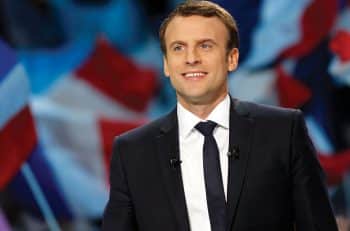
    Macron: Elected, not chosen

    In the Bible, Emmanuel is the name of the Messiah, the one who comes to save men. How ironic to see that the man who appears to save France from a far-right cataclysm bears this name. With a second round win of 66,1% against Marine Le Pen, the economic liberal candidate Emmanuel Macron of En Marche! (EM) was elected as the eighth president of France’s Fifth Republic on May 7, succeeding François Hollande, for whom he had acted as special counsellor and Minister for the Economy. However, France had never been so far from choosing someone to rule the country. Nearly half of those who voted Macron did so without supporting him. As fifteen years ago, in the 2002 presidential election, when president Jacques Chirac faced Jean-Marie Le Pen, the French people were forced into the decision to unite against the far-right. But there was a big difference: in 2017, to see Marine Le Pen in the second round of the election wasn’t a surprise. The National Front (FN), founded by Second World War collaborationists, made significant headway in the European and municipal elections in 2014, then in regional elections in 2015, and there have never been so many towns ruled by the party. Inside those towns, changes have begun: budget cuts for culture, for charity, and increases for security. One mayor even decided to re-arm local policemen. People were warned. Le Pen’s use of divisive and inflammatory language is dangerous. Perhaps prefiguring her loss she declared some days before the run-off election : “My voice was but the echo of the social violence that will explode in this country”. She was surly and dishonest in the second-round debate against Macron. TV viewers were afforded an unnerving opportunity to see how aggressive Le Pen was and how ill-versed she was on several subjects, including the monetary situation after a potential departure from EU. Not so long ago a French journalist and his cameraman were attacked by security guards after trying to ask Marine le Pen a question over allegations her security guard was paid as a parliamentary aid. The EU’s corruption watchdog accused Le Pen of using €340,000 of European funds to carry out non-Parliamentary work for the National Front. Le Pen said she wouldn’t even attend before the Paris prosecutor dealing with the matter until the election is over. Though clearly the blame does not attach directly to Le Pen, it is significant that some – apparently Russian agency – saw fit to hack and leak Macron emails on the eve of the election, and that the FN was not outraged. It may be a foretaste of darker days for democracy.     They were warned and still the FN got into the second round of a presidential election, ultimately gathering more than 20% of the voters. Jean-Marie had obtained 17% in the first round. Spontaneous protests of tens of thousands of people erupted across the country the day after that vote took place. A week after the 2002 first round, a million French citizens took to the streets, turning traditional May Day workers’ rallies into anti-Le Pen protests. The far-right leader was then demolished in the second round – improving his share of the vote by less than one percentage point; this year, there were few convulsions and Marine Le Pen obtained around a third of the second-round vote. Fifteen years ago, people blamed non-voters, and divisions among leftist candidates. In 2017 the explanations are less attractive. People didn’t react, or not as much as for François Fillon, whose demise was probably largely because of ‘Penelopegate’, when he was accused of paying his wife for fictitious activities by French newspaper Le Canard Enchaîné. If Marine Le Pen had been elected on May 7, it would have been a political earthquake, but because French society changed its view on politics, at least as much as because of the actual result that symptomised it. For the first time since the end of World War II, the results of this election broke France’s ancestral duellist politics. The country that invented the word ‘Left’ and ‘Right’ in politics, based on the position of the chairs in the Parliament after the Revolution, suddenly decided to blow away these two fragile notions. François Fillon, the candidate of the Républicains, was shot down by corruption allegations. On the Left wing, Benoît Hamon’s victory in the primary elections of the Parti socialist (PS) against former Prime minister Manuel Valls was a surprise and he carried the hopes for disappointed lefties indignant at Hollande’s economic liberalism after he turned in 2014. His goal was to create “a desirable future” and “make France’s heart beat again” and he was the only candidate, with radical leftist Jean-Luc Mélenchon, to make the environment a central concern. But he got nowhere, when so many socialists, including Manuel Valls himself, decided to join Emmanuel Macron. The man who claimed to be “neither right nor left” finally killed and buried the left, or part of it. The PS have to face up to wholesale defections, and undoubtedly be torn apart during the next parliamentary elections in June. Many were frightened to see the FN in the second round for the second time, but Emmanuel Macron, definitely saw this as a blessing from God. To face a far-right leader is a great opportunity in a country where a majority of voters will, where strategy requires it, vote for political opponents to defend the democratic values of a Republic. That explains the beaming face of Macron, when he addressed his supporters on the night of his first-round, even though his score was just two percentage points bigger than Le Pen’s (24% against 21.7%), and repaired with his celebrity mates to dine at La Rotonde. It also explains how preoccupied Macron was when he knew that not all the losing candidates called their electors to vote for him. François Fillon and Benoît Hamon did, but Jean-Luc Mélenchon didn’t. Actually, he didn’t say anything and looked exhausted. In

    Loading

    Read more

  • Posted in:

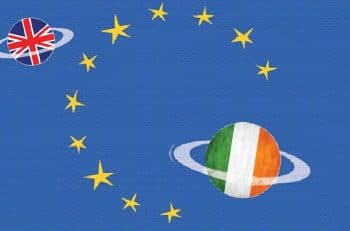
    The logic of following the UK out

    If Britain leaves the EU single market and customs union while the Republic stays in the EU, the North-South border within Ireland will become an EU land frontier, with customs controls inevitable and possibly passport controls. EU-based laws and standards, for example in relation to crime and justice, would prevail in the South and British-based ones in the North. Logically therefore the only way to avoid adding new dimensions to the North-South border post-Brexit is for Brexit to be accompanied by Irexit. This thought may be so novel it will shock many. EU membership has brought Ireland good things. Most Irish people have positive attitudes towards it. But if the North is leaving the EU along with Britain we should be able to consider dispassionately the advantages of leaving too – and the drawbacks of remaining in it without the UK as a fellow member. Irexit clearly has some benefits. It would save us money for one thing. Since 2014 the Republic has become a net contributor to the EU Budget: for the previous forty years we were major net recipients of EU cash, mainly through the EU’s Common Agricultural Policy. From now on money from Brussels will be Irish taxpayers’ money recycled, as is already the case with the UK. This removes what hitherto has been the principal basis of Irish europhilia, official and unofficial – namely cash. That has always been more important here than ideological enthusiasm for Eurofederalism or ‘the EU project’. If the Republic remains in the EU post-Brexit it will have to pay more to the EU Budget as its proportionate contribution to help compensate for the loss of the UK’s annual net payment. On the other hand a bonus of leaving is that we would get our sea fisheries back. The value of annual fish-catches by foreign boats in Irish waters is a several-times multiple of whatever money we have got from the EU. As regards trade and investment, the Republic sends 61% by value of its goods exports and 66% of its services exports to countries that are outside the continental EU26, mostly English-speaking. It gets two-thirds of its imports from outside the EU26. The USA is the most important single-country market for the Republic’s foreign-owned firms and the UK for its Irish-owned ones – the latter being especially important for employment. The UK and US markets together are comparable in importance to that of the EU26 post-Brexit. Taking other English-speaking markets into account makes trade with the English-speaking world much more important for the Republic than the EU26, with Britain gone. This is a consideration also for foreign investors coming to Ireland. Economically and psychologically, Ireland is closer to Boston than Berlin, and to the UK than Germany. This puts exaggerated talk of the EU’s ‘giant market of 500 million’ in perspective. That shrinks anyway to 435 million with the UK gone. Some 7 billion people live outside the EU. It is not of course a question of the Republic having to choose between one export market and another if it should decide to leave the EU along with the UK. If common sense prevails in the negotiations, there should be continuing free trade between the Republic, the EU and the UK in the context of any Brexit or Irexit. Without Britain beside her in the EU Council of Ministers the Republic would be in a weaker position to defend its low rate of company profits tax, important for attracting foreign investment, for which Germany and the Brussels Commission are now gunning. It would be less well able to defend its fishery interests, its trade interests, its distinctive Anglo-Saxon-based traditions in the area of law and justice, which the EU aims to harmonise, and its military neutrality. The main argument for staying in the EU when the UK leaves is the negative one that we are members of the Eurozone while the UK is not. When the euro was established in 1999 our politicians decided to adopt the currency of an area with which we do just one third of our trade. They thought at the time that Britain would be bound to adopt the euro-currency too and that by going first they would show how “communautaire” they were. The Republic now desperately needs to get its own currency back so that it can devalue it along with sterling and the dollar, and not be stuck with an implicitly overvalued euro that is hitting its exports and encouraging competing imports. Failing that the North-bound shopping queues will grow. This is why Dublin should aim to leave the Eurozone and re-establish an Irish currency in a planned concerted manner, negotiating its departure with Germany, the UK and the ECB in private behind the scenes as part of its move to leave the EU along with the UK, rather than be forced to abandon the euro anyhow in some future Eurozone financial crisis. The UK will presumably revert to its traditional cheap food policy when it leaves the EU. Contrary to some Irish commentary, there is nothing immoral in a country importing its food from wherever in the world it can buy good quality products cheaply. At the same time the British Government will want to support UK farmers for political reasons, presumably by means of direct farm subsidies to replace the price supports they now get from the EU’s CAP. Nearly half the Republic’s agricultural output goes to the UK market at present, so such a development will have major implications for us. Will Irish farm producers be displaced in the UK market post-Brexit by New Zealand lamb, Brazilian beef, American chicken etc? These are the main reasons why the focus of intelligent Irish policy should now be on negotiating a comprehensive deal with London for this State to leave the EU along with the UK, while maintaining maximum free trade with both EU and UK post-Brexit. Such a deal should guarantee continued free access for Irish food exports to the UK

    Loading

    Read more

  • Posted in:

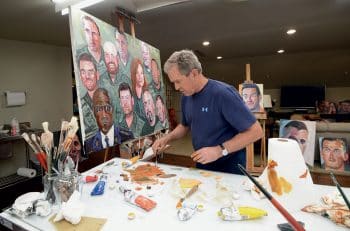
    Brushstrokes of a war criminal

    Donald Trump conjures such intense images that it is difficult to frame recollections of a man who made him possible. What memories flood back in your mind’s eye when you think of his Republican predecessor? Weapons of Mass Destruction? That awful expression, like a ghost stirring at the back of your mind? Perhaps you smile? Cringe? Do you imagine him as the strong president standing amid the rubble of the World Trade Center, bullhorn in hand, shouting that “the people who knocked these buildings down will hear all of us soon”? Perhaps as the struggling guy-next-door mispronouncing words like ‘nuclear’? Or perhaps as the most powerful man in the world giving a press conference in Baghdad in the waning hours of his presidency, ducking at the last minute while a shoe, thrown by an Iraqi journalist, sails past his head? The man who smashed international law and the Constitution of the United States has recently been feted by even ‘liberal’ television talk-show hosts like Jimmy Kimmel and Ellen De Generes. It doesn’t matter; it’s all in the past. Shush! Marvel at his nice paintings, almost professional! Bush’s book of his paintings of servicemen, ‘Portraits of Courage’ currently sits atop the New York Times bestsellers list. Was there never a moment, in the words of Gore Vidal, when television’s cold, distorting eye was not relentlessly projecting a funhouse view of the world? “Pleikus” declared McGeorge Bundy, Lyndon Johnson’s National Security Advisor, “are like streetcars. Wait long enough and one will come sooner or later”. Bundy was referring to an incident during the Vietnam War when enemy soldiers attacked a poorly defended US military base in Pleiku, Central Vietnam. It was the pretext for President Johnson escalating the war in Vietnam, with disastrous results. Bush’s ‘Pleiku Incident’ was without doubt 9/11. In the 18 months after this attack, Bush set the US down a long road of unilateralism and ambivalence to international law and treaties. His administration declared the doctrine of “preventive war” and designated suspects captured in the War on Terror as “enemy combatants” – concepts unknown under international law. At the time of its establishment in January 2002, Secretary of Defense Donald Rumsfeld said Guantanamo was established to detain extraordinarily dangerous people, to interrogate detainees in an optimal setting, and to prosecute detainees for war crimes. In reality, the site has long been used for indefinite detention without trial. The first international treaty to sense the acrid cigar-breath was the Anti-Ballistic Missile Treaty. Signed with the Soviet Union in 1972 to ease Cold War tensions, Bush signalled his unilateral – in other words unlawful – intent to withdraw from it in December, 2001. Worse was to follow. Adrift now, Bush then declared in May, 2002 that the US was no longer bound by the 1969 Vienna Convention on the Law of Treaties which governs treaties between states. The International Criminal Court (ICC) is a permanent court, founded in 2002 by the Rome Statute to “bring to justice the perpetrators of the worst crimes known to humankind – war crimes, crimes against humanity, and genocide”, especially when national courts are unable or unwilling to do so, was next on the chopping board. Signed by President Clinton in December, 2000, Bush then took the astonishing step of retroactively un-signing it in May, 2002. The institution clearly panicked Bush, especially given what direction he knew US foreign policy would shortly take him and his buddies. Petrified of inadvertently doing something which might be construed as US acknowledgement of the ICC, Bush even barred US diplomat Richard Holbrooke from attending the court to give expert evidence in the trial of Serbian warlord, Slobodan Milosevic. This act alone ought to have warned everyone that even then Bush was dreaming of war and was taking steps to ensure that neither he nor any of his cronies could ever be hauled under the court’s scrupulous gaze. To make doubly sure, in August, 2002 Bush signed the American Services Members Protection Act which authorised the US to use force to free any member of its armed services arrested and detained at The Hague for war crimes. The Dutch government dubbed this the Netherlands Invasion Act. The bellicosity only increased. In November, 2002, furious that the international community would not support his Iraq war Bush issued an ultimatum: if the UN wouldn’t take action against Iraq, the US would, thus shredding international law which since 1946 had required that the UN Security Council issue a Resolution in favour of war before it could be initiated. Enemies now seemed to be everywhere, chief among them North Korea. The combined delicate efforts of both South Korea and Bill Clinton during the 1990s to bring North Korea in from the cold were blithely jettisoned as soon as Bush took office. Bush publicly declared that he “loathed Kim Jong Il” and that North Korea was now part of the ‘Axis of Evil’, alongside Iraq and Iran. Predictably alarmed, North Korea then withdrew from Nuclear Non-Proliferation talks and ejected weapons inspectors in January, 2003. When war came to Saddam in March, the North drew the obvious conclusion: the only way to deter the Americans was to acquire nuclear weapons. The catastrophic ‘Shock and Awe’ invasion of Iraq premised on the lie that Iraq possessed weapons of mass destruction generated the human horror of up to a million civilian deaths. When Iraqis rebelled against the invasion the US reacted with torture as in Abu Ghra’ib and massive violence in, for example, Fallujah and exploited sectarian divisions to maintain its fading power. The United Nations Special Rapporteur on torture, Professor Manfred Nowak, remarked on German television in January 2009 that Bush had lost his head of state immunity and under international law and that the US could start criminal proceedings against all those involved in these violations of the UN Convention Against Torture. It was a minority view, or at least a view that was in the minority amonth those in a position to do

    Loading

    Read more