• Posted in:

    Seeya print

    The recent Audit Bureau of Circulation (ABC) figures for newspaper sales for January-June 2016 show an alarming decrease for nearly all Irish newspaper titles, with the demise of the industry itself now, for many, inevitable. Of the national newspapers, The Irish Times dropped 5.5 percent compared to the first half of last year, The Irish Independent is down 6.4 percent, The Irish Examiner 6.7 percent and The Evening Herald 8.4 percent in the same period. Most daily tabloids are down, apart from the Irish Sun, which saw a rise of 4.6 percent year on year. The Sunday Independent dropped 6.7 percent year, The Sunday Business Post 3.5 percent, The Sunday Times 6.4 percent and The Sunday World 8.9 percent. The Irish Mail on Sunday fell by 7.2 percent while the Irish Sun on Sunday recorded the only rise in circulation at +9 percent. Overall, the circulation of daily print titles was 5.7 percent lower and of the Sundays 6.3 percent lower. Globally, the threat to newspapers is epidemic. In May 2016, the 121-year-old Tampa Bay Tribune, Florida, ceased publication; in March, the London Independent and Independent on Sunday ceased their print publications and November 2015 saw Russia’s only independent English-speaking title The Moscow Times end its daily edition in favour of a weekly format. In 2013, The Washington Post was sold to Amazon.com founder and chief executive Jeffrey P Bezos for $250m. In September 2010, the Chairman and Publisher of The New York Times announced to an International Newsroom Summit that: “We will stop printing the New York Times sometime in the future, date TBD”. The Guardian, whose web edition is the world’s second most popular English-language newspaper website – after the Daily Mail online, has shed 200 jobs and clocked up losses of £69m for the last financial year with falls in both print and digital revenue leading to an £8m fall in total turnover to £209.5m. Digital revenues were £81.9m, down almost £2m from the preceding year as Facebook and Google ate up the bulk of the money it had made from mobile advertising. Based on current trends, commentators have predicted that only the Sunday and weekend newspapers will survive in a culture immersed in Facebook, Twitter, Snapchat and Youtube and with the proliferation of citizen journalism offering free ‘news’ content. What New Media offer is ‘free’ news as it happens from an infinite number of sources around the globe; in the age of New Media, traditional values of accuracy, accountability and professionalism are at risk from unverifiable facts, unconfirmed sources and the constant need for instant news; and gossip. With daily newspapers, today’s news is essentially yesterday’s, or this morning’s at best. Newspapers have made a concerted effort to shift content towards analysis and commentary, but this hasn’t been enough. What the recent ABC gures don’t reveal is where these disenfranchised readers are migrating. The loss of newspaper revenue may be partly attributable to growing internet usage and online culture, but this does not necessarily mean those same readers are now reading news online. A decline of 10,000 readers for a national newspaper does not equate to an additional 10,000 people reading or accessing news online. Youtube, Facebook, Twitter and other social media account for most internet usage, so perhaps not all migrated readers/users will be regular perusers of the Guardian online edition. A ‘cornerstone of democracy’ for over 400 years is now in danger of imploding. Attempts by newspapers to embrace New Media by offering pay walls for access to online content have so far been largely unsuccessful (though the Guardiannow boasts 50,000 ‘subscribers’); cynics point to the obvious – there is simply too much ‘free’ news to be harnessed online. Print Media’s only hope is to reinvent their current business model and somehow embrace their biggest rivals. What that does for journalism is another story. Ken Phelan

    Loading

    Read more

  • Posted in:

    Controlling the s****

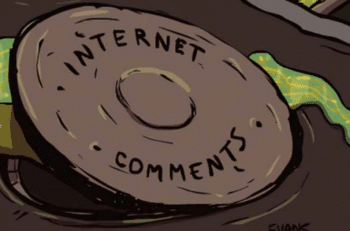
    Not too quietly, but without a great deal of fuss, NPR (National Public Radio), the American public radio network, killed commenting on its website in mid-August. In a statement announcing the change, the network explained that an analysis had revealed that only a fraction of one percent of their monthly 25 to 35 million audience was making use of the comment facility on their website. Over a three-month period, only 2,600 people had left a comment – 0.003% of the 79.8 million NPR.org users who visited the site during that period. On 23 August, after eight years, the boards went silent, joining may other North American news sites which have decided that reader comments just aren’t worth the bother. That isn’t to say that NPR no longer talks to – and listens to – its audience. The network runs a daunting range of social media accounts, including more than 30 Facebook pages and 50 Twitter accounts, as well as accounts on Snapchat, Instagram, and Tumblr. Its primary Facebook account reaches over five million readers. Individual journalists also run their own social-media accounts. In Ireland, media outlets have taken a variety of approaches to commenting, from free-for-all to no comment capability at all. Differing defamation regimes also affect how commenting is managed. The courts are still working out the niceties of when a reader comment is published by a website, and when the website becomes liable for defamatory content, so different publishers have taken different approaches to ensure their comment sections stay within the bounds of the law as they see it. The need to police harassment and trolling by site users also influences those editorial decisions. Trolling has little to do with Scandinavian ice giants, rather, trolling was the act of fishing for comments, baiting users with inflammatory statements, analogous to how one might fish by trolling bait along a riverbank. So for example, the Independent website requires commenters to register, either using Facebook or Google Plus (both of which have real-name policies), or by registering, using an email and password combination. In theory, such measures can reduce harassment and aggressive posting, but the ease with which throwaway email addresses can be created reduces its effectiveness. Sister publication the Herald doesn’t host commenting on its stories at all, while the Irish Daily Star (through its online vehicle Buzz.ie) simply requires users to provide a name and email address before posting comments on tits stories. Both the Star and the Independent require – labour-intensive – pre-moderation, so commenters have to wait and see if their insights and observations are deemed worthy before they are shared with the world. Pre-moderation has the advantage of reducing harassment and improving the tone of the comments sections, but it does mean that the publication becomes liable for any defamatory statement that slips through. The Examiner requires registered users to log in (using any of their Facebook, LinkedIn, Twitter, or Google Plus identities, or by registering an email and password combination), but in most cases doesn’t offer an option for readers to comment on stories. Registering does, however, allow the Examiner to collect data on what stories readers are interested in, and to tailor news alerts on phone and tablet apps. Like the Examiner, the RTÉ website offers users the opportunity to register, but this is in order to access and keep track of programmes on the RTÉ Player across different devices. No commenting facility on its news or entertainment offerings is available. RTÉ does ask for a lot more data than most sites during registration (full name, gender, date of birth, and location). The Irish Times, meanwhile, limits commenting to paid subscribers. The Sunday Times, through its Times of Ireland daily product, is behind a hard paywall, which also has the effect of restricting access to comments. This raises the intriguing question of what might happen when trolls – who have paid their subscription fees – cross the bounds of acceptable speech. Is moderation made more difficult when it could lead to a potential loss of revenue? Are those with disposable income to cast at social media more reticent online than those with nothing to lose? In summary, although most Irish traditional news outlets offer some form of reader participation, there are heterogeneous requirements before comments can be left on sites. The particular software solutions managing comment sections can also act as an impediment to commenting (the Examiner site in particular was extremely slow in loading comments) and premoderation can lead to delays which reduce the likelihood of participation. With news outlets that were actually born on the web, commenting seems much more vigorous. While The Journal, for example, requires a sign-in with Facebook or Twitter, comments are not as a rule pre-moderated (although on some controversial stories, commenting is disabled). Joe.ie/Her.ie do not offer a comment facility. Broadsheet, arguably the site most dependent on comment, is mostly unmoderated, although software may occasionally stop a comment until it is vetted by a staff member, if for example it is from a previously unknown account, and presumably if it contains any of a list of blacklisted phrases. Broadsheet articles are often little more than a handful of sentences, linking to a tweet or facebook entry, and the real reason readers stay is to read and join in commenting. That audience, in turn, can expect an occasional longer article, including some longform journalism running to several thousand words. The free-for-all spirit in the Broadsheet comment section is strongly reminiscent of the culture of early bulletin boards, dating back to the earliest days of the internet, before Tim Berners-Lee came up with the idea of the web. In the early days of the internet, there was no world wide web, and there were no newspapers online. But there were discussion groups, first with emails carbon copied to multiple recipients, then with mailing lists managed through central subscription-software listservs, and eventually, through user networks anyone could subscribe to. The Users Network (Usenet) was built on earlier electronic bulletin

    Loading

    Read more

  • Posted in:

    Controlling the s****

    Most Irish traditional news outlets offer some form of reader participation but there are heterogeneous requirements before comments can be left on sites

    Loading

    Read more

  • Posted in:

    Wireless is Wiremore

    Rupert Murdoch’s proposed move to buy up the Wireless Group (formerly UTV’s non-television assets) as June drew to a close has livened up the stolid Irish radio market with the introduction of a sharp new player. The cash offer of 315p per share has added summer excitement to a radio market so settled in its ways that the highlights of Newstalk’s new Autumn schedule, announced just days before, were the addition of crime journalist Paul Williams to the morning line-up, and George Hook’s move from the evening drivetime show to a lunchtime slot, as the station once more persuades its heaviest hitter to postpone his retirement. On the face of it, the purchase of a handful of regional radio stations should not trouble national broadcasters Newstalk and RTE much, but with prospects in Dublin (FM104), Cork (96FM), Limerick (Live95FM) and Galway (Galway Bay FM), Murdoch’s NewsCorp now has an on-air presence in all Ireland’s major urban radio markets. The offer, which values the entire company at £220.3m, represents a premium of 70% over the quoted price at close of business the day before the offer. The jewel in the crown is undoubtedly talkSPORT, a London-based sports-radio network, which holds valuable football broadcasting rights. The radio deal, which adds to Murdoch’s existing presence in the Irish market through ownership of the Sunday Times and Sun newspapers, and online news agency Storyful, will have to be cleared by competition authorities in both the UK and Ireland, and by the Broadcasting Authority of Ireland, which looks at how “plurality” is affected. However, it is unlikely that the deal will face any serious regulatory hurdles in Ireland. A review of media-mergers procedures, which began in 2008 and continued under the last government, led to a set of guidelines published in May 2015 which seem unlikely to hinder the proposed deal. By way of illustration of the Irish view of media controls, the Irish Times deferentially reported on July 1, the day after the NewsCorp announcement, that an independent report commissioned by the Broadcasting Authority of Ireland into media ownership and diversity had concluded that ”the decision by businessman Denis O’Brien to increase his stake in Independent News and Media (INM) did not lead to a ‘material reduction in plurality’”. Between 2012 and 2014 O’Brien increased his stake in INM from 22% to 29.9%. In contrast, an unpublished report to the EU commission, obtained by RTÉ’s ‘This Week’ programme in April, studied media plurality in Ireland and 18 other EU states, and found Ireland was exposed to a “high risk” of concentration in media ownership, as a result of a lack of specific legal barriers to concentrated ownership. In fact, by introducing a strong new force to the Irish market, with interests in both print and broadcast assets, NewsCorp could argue that it is a boon to competition, offering a space for alternative voices to those on stations owned by O’Brien’s Communicorp and the state broadcaster. “The Wireless Group represents an opportunity for us to take advantage of its strong radio presence to build on our growing digital success story and to bring some of the best journalistic and broadcasting talent into one group”, said News UK’s famous chief executive, Rebekah Brooks, “This acquisition will allow us to increase engagement for both businesses through the cross-promotion of our brands and the use of our respective talent. We also look forward to collaborating in the expansion of the Wireless Group’s digital audio and international assets, which offer new opportunities for our businesses in the UK and globally”. That cross-promotion should mean, at the very least, lots of voices from the Sunday Times and Sun newspapers on air, discussing the latest developments in everything from politics and show business to crime and sports. With its portfolio of Irish radio properties in hand, NewsCorp could find itself in a position to make a credible bid for a national licence in future BAI rounds. This would present a real challenge to the RTÉ/NewsTalk duopoly. Or NewsCorp could consider newly syndicated programming in the meantime, perhaps providing a central lunchtime or drivetime programme with a national news focus, broadcast on several stations simultaneously. RTÉ has the brand strength to see off such competition, even if it does lose some listeners to the newcomers, but suddenly Newstalk has a much bigger problem than who to hire to replace Ivan Yates and George Hook.  By Gerard Cunningham

    Loading

    Read more