• Posted in:

    Telling the story of Easter 1916

    Patrick Pearse loved his students not wisely but too well, if you know what I mean – what with writing poems about kissing them on the mouth and relocating his school from the healthy hustle-bustle of Ranelagh to dark woodlands in Rathfarnham. Oh, and his students didn’t necessarily reciprocate the affection: a teenage James Joyce dropped out of Pearse’s UCD Irish-language lessons because the teacher was an ideological bore. That’s just a sample of the titbits you’d pick up from Colm Tóibín’s long essay on 1916 in the London Review of Books, arguably this season’s archetypal commemorative/explanatory text from Ireland’s media/ intellectual establishment. Whether you regard it as barrel-scraping to discredit the Rising or an exemplary eye for the telling detail is a matter of taste – if you’re like me, you might reckon it’s a bit of both – but one can’t help but notice the contrast between Tóibín’s forensic litany of Fenian foibles and failings and his breezy flypast of, say, World War I. In the writer’s brief telling, the war was on the verge of Bringing Us All Together, something Pearse and the boyos couldn’t abide and wouldn’t permit: “Britain was merely the supposed enemy. The population of the two countries spoke the same language after all, and had the same education system. Many Irish people moved back and forth between Ireland and England seeking work; many in Ireland also had family in England. While most in the south of Ireland actively or tacitly supported Home Rule, Home Rule was postponed until the war ended. It looked as though the two islands were going to join forces in the war effort. (More than 200,000 Irishmen eventually volunteered in the First World War. Although conscription was threatened in Ireland, it was never actually introduced.)” Recall that Tóibín is addressing, in part, an international audience that may be getting its first substantial account of the Rising, that his article is billed as “Colm Tóibín tells the story of Easter 1916”; this audience will hear nothing from him of the consequences for Home Rule of the Ulster crisis, of Irish carnage in the war, nor of the massive, life-saving popular movement that arose in part from the Rising to resist conscription in Ireland, conscription that was not merely ‘threatened’, but introduced in legislation. Some contexts are, it seems, more worthy of contextualising than others. As the brilliant blogger Richard McAleavey writes: “Questions about whether Pádraig Pearse, say, was a fanatic, or a repressed paedophile even, are intended to psychopathologise any kind of radical political action or thought. They are intended to draw attention away from consideration of the real material conditions and political considerations that produced the Rising, lest they might be used to draw the wrong kind of parallels in the present”. Material conditions? In 17,000 words, Colm Tóibín’s only mention of Dublin’s infamous slums is in a quote from arch-revisionist historian David Fitzpatrick, who says the rebels must have staged the ght in the midst of the city’s poor to ensure maximum casualties among them – as though it were the rebels who loaded the shells into the Helga’s guns, or the rebels who went house to house in North King Street murdering young men. These and other aspects of, shall we say, imperial ‘agency’ have been largely neglected throughout recent commemoration and coverage, in favour of relentless scrutiny of the Rising’s leaders. Just below the achingly familiar debate about the Easter Rising – was it an act of visionary heroism or an act of perverse terrorism? – there lurks a more interesting series of questions about its relationship to what came after. And those are the questions that can lead us beyond dry argument and actually help us understand who commemorates what in the Ireland of 2016, and how those commemorations have played out and continue to play out in the state and corporate media. Thus you can be on either side of the heroism/terrorism split and still hold (tightly or otherwise) any of the following views: (1) the state(s) in which we reside today can be understood as a direct and roughly intentional outcome of the Rising and its guiding lights; OR (2) Ireland over the last century has been a fumbling, contingent, contradictory and ultimately limited effort to fulfil the Republic of 1916; OR (3) the Irish revolution launched at Easter 1916 was firmly defeated in the Treaty and thereafter by an elite that concealed its continuity with the ancien régime behind reluctant memorials to supposed revolutionary heroes. (There are other positional alternatives and variations on all points of the political spectrum but these seem to me to be the major tendencies.) Official and media Ireland prefers to hold and host tiresome debates about the Rising itself (Kevin Myers? Bob Geldof? Really?) rather than any really clear exploration of where we live today in relation to it. Positions number 1 and 2 are generally implied rather than directly stated, with a little frisson of excitement when the likes of Michael D. Higgins suggests that the truth may lean further towards 2 than 1 – a sort of “a lot done, more to do” view of a Republic that still awaits its full and complete child-cherishing achievement. In mainstream media, position 3 – that there was a successful counter-revolution – is almost unthinkable, or at least unspeakable, residing outside the realm of acceptable discussion. And yet it seems to me that it lurks with influence on both the right and left wings of Irish politics. The more or less overt Redmondism of John Bruton and other conservatives – often more Redmondite than Redmond himself – contains an implied celebration of the ‘restoration’ of constitutionalism in Ireland, coloured by regret over militant republicanism’s recrudescence in the Northern Troubles, but not reliant on that regret for its critique of the rebels of 1916-21. The left-wing, pro-Rising version of position 3, alleging that there was a successful counter-revolution in Ireland, is more openly and interestingly embraced. Important gures on

    Loading

    Read more

  • Posted in:

    The Irish Times won its struggle for trust on the Centenary

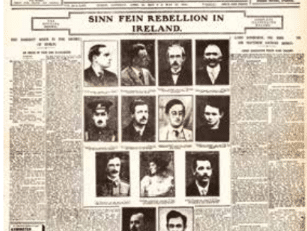
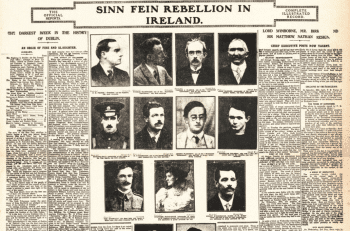
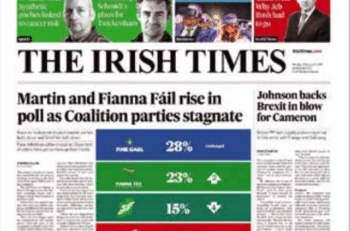
    The Irish Times has had a mixed 1916 commemoration. Even its own audiences seem hardwired to expect a certain bias from the newspaper of reference, but one particular decision – or probably a non-decision no one ever thought to check for unfortunate implications – certainly didn’t help. For its 1916 anniversary issue the paper produced a replica cover from 100 years ago, but decided to cut the original banner headline: ‘Sinn Fein Rebellion In Ireland’. The page-two explanation – that broadsheets aren’t what they used to be, and the resized 2016 dimensions (half the size of the 1916 original) meant the original would no longer t in its entirety and, although it had been shrunk somewhat, any further reduction in print size would render it unreadable, and something had to go… convinced some, but left others unimpressed. If space was the only issue, then why leave two mastheads on the front page, one modern and one vintage? Assuming the plausible explanation that it was a design decision, and nothing more, the online row it generated speaks much about the perceived trust issues the paper has with its audience. Irish Times journalists are prone to complain that their paper is often held to a higher standard than others, and that may be the case, but it is also a backhanded compliment. Its readers expect more from it, and are therefore more inclined to complain when it does not live up to expectations. The Irish imes garners complaints because what the Irish Times says matters to its in a way that most other newspapers do not. Being an opinion leader comes with a price. Twitter media accounts come in two avours. There are those that engage, joining in conversations with followers over the stories of the day, even on occasion adding their contributions to the joke of the day on the medium, and there are those that broadcast, casting their bread upon the waters for others to consume, but never acknowledging that the audience is talking back. Irish Times’ editor Kevin O’Sullivan falls into the latter category. His twitter stream is a list of links to articles he finds it worth highlighting, mostly from his own publication, occasionally from farther afield. While it is assumed that O’Sullivan curates his own Twitter account, he does not engage with his followers online, or share his thoughts on the news of the day, beyond a brief “interesting” or “scintillating” appended to a story link. And since he does not share his thoughts in detail, the only insight into the thinking of the man helming the paper of record derives from the stories he deems worthy of sharing. Irish Times 1916 coverage, as highlighted by its editor in the period from Patrick’s Day to the end of Easter Week, was colourful and varied, with thinkpieces by regular and occasional columnists (Fintan O’Toole on Shaw and Casement; Niall O’Dowd on the American input to rebellion; though oddly, no one expurgating the German contribution). Beyond this, the Irish Times chose to reproduce a letter from Francis Sheehy-Skef ngton to Thomas MacDonagh making a case for pacifism, an offbeat Q&A by cynical Frank McNally: “To question the Rising is to be found guilty of unIrish activity”, Eunan O’Halpin was mean about the Proclamation (“a speech not a Proclamation”), atheist Donald Clarke goaded that it didn’t need to be atheistic, and Miriam Lord wished fervently that we could hold an Easter party every year. Diarmuid Ferriter appeared here and there with as usual more good history than acute insight. Some ideas that sounded like cringe-inducing embarrassments, such as the new proclamations created by schoolkids, generated genuine wonder. What does it say of a modern nation if children are calling for an end to homelessness while ministers hide behind constitutional guarantees of private property? On the new-media side, a particular highlight must be the Irish Times’ Women’s Podcast on Margaret Skinnider, volunteer, sniper, school- teacher, trade unionist, and would-be hotel bomber (of the Shelbourne – the newspaper’s readers may have pondered that it might as well have been the Irish Times itself). The Irish Times has even produced a book called unexcitingly the ‘Irish Times Book of the 1916 Rising’. And then there was its own 2016 Proclamation, with dodgy prose: “First among our values is the belief that every citizen must have both [sic] the legal, civic [sic] and political rights necessary for full citizenship”, but a progressive core: “we commit our governments to a continuing process of reducing inequality”. If schoolchildren came out with a simple vision of an Ireland where no one is homeless, the Irish Times’ editorial proclamation for 2016, attempting to cherish all its children equally, had the look of a family Christmas tree, with everyone adding their favourite bauble to the decorations until it became top-heavy, over-owing with good wishes, inclusiveness, and a feelgood spirit that made it look like an out-of-shape heavyweight next to the Spartan declaration of a century ago. Perhaps a little like the Irish Times itself. Gerard Cunningham

    Loading

    Read more

  • Posted in:

    Election Times

    he Irish Times, like the rest of us, got bored and took some time to realise Fine Gael was on its uppers

    Loading

    Read more

  • Posted in:

    Biased media, Election 2016.

    By Harry Browne. During the election campaign the mainstream media confirmed their bias against the real left and Sinn Féin   From the point of view of the media, one of February’s biggest stories almost got lost in the election chaos. On Friday, February 19th, one week before polling day, the newspaper circulation figures for the second half of last year were published. In one sense, the story was a bit of a non-story: newspapers continue to sell fewer and fewer copies – the roughly 40 per cent collapse of sales that we’ve seen over the last decade or so was certainly accelerated by Ireland’s economic implosion; but whatever recovery somebody out there is enjoying, it’s not bringing newspapers back into our lives – they were down a few more per cent. That should be the starting point of any discussion about how newspapers covered the general election. This may indeed have been, as several commentators such as Oliver Callan have suggested, the most sensationalist, the most biased, the most trivial newspaper coverage of an election in the history of the State. Maybe. Whatever. There can be little doubt, though, that it was the most irrelevant. You can shout all you like about how much the journalism of the Irish daily press gets read online. “We’ve got more readers than ever (now if we could only get them to pay)” is a common refrain in the shrunken corridors of the press. The fact is that most of those readers are no longer committed to getting their news and views from any given paper, but rather they dip in and out, often critically. I suspect that on the day those circulation figures were published, more people saw a social-media post full of mockery, outrage or bemusement at the Irish Independent’s latest front-page denunciation of Sinn Fein than actually paid for a physical copy of that page. Since I merely saw an image on my phone, I still have no idea what Gerry Adams was planning to do with my pension. Is there a connection between the press’s hysteria this time around and the steady withering away of its relevance? I suspect as much. Like troubled children, the less attention we pay them, the louder they scream. Election seasons have always seen journalists at their most pompous and self-important: in the better class of newspaper the consequence is an obsessive-compulsive commitment to ‘fairness’. I can remember, back in the 1990s, a team in the Irish Times newsroom dedicated to measuring (literally, like with rulers) the coverage given to each party in a general election, with various formulae to adjust for the unfortunate fact that all column inches are not created equal. Other papers, of course, take a different approach. If there’s one thing we can say for certain about, say, the Indo’s notorious treatment of this election, it’s that they got us to notice how important they are. Once you understand the desperation of the press’s attention-seeking in its much-reduced state of health, it’s easier to understand why, for example, the Regency Hotel shooting managed to displace the election from page-ones for most of a week. If there’s one thing that the press does even more self-importantly than elections, it’s crime. This has little to do with the wonderful, generous resources gifted by Denis O’Brien and Rupert Murdoch to the investigation of wrong-doing and a lot to do with the impotence of convicted criminals to use the defamation laws to protect themselves. (No reputation to protect, no case, scumbag.) The hotel shootings showed definitively that crime journalism in Ireland is RELEVANT – more so even than the gardaí, who were absent while the crime-hacks and -snappers were very much on the scene. And when it came time to segue from “Hey, remember us! We’re newspapers! We cover crime!” to “Hey… elections!”, there was the lovely little link of Sinn Féin’s position on the Special Criminal Court. It seemed remarkably difficult to get anyone to recall a principled, non-Republican reason to oppose no-jury trials. So, even short of a major definitive research project, we can pretty safely say, that compared to times past, (1) newspapers are less relevant and (2) people are more inclined to see through media bias. (Check out Dr Rory Hearne’s research with water protesters to confirm the latter point.) However, this is not the same as saying (1) the media are irrelevant and (2) media bias doesn’t matter. When RTÉ – which unlike newspapers has a statutory obligation to be fair, to which it pays often hilarious lip-service – allowed crime-hack Paul Williams on the Late Late Show to use the issue of the Special Criminal Court to denounce Sinn Féin and its voters, on the very same day that he and we learned of his shrinking circulation relevance, it was not only a disgrace, it was most probably consequential for the election outcome. With the best will in the world – and even a half-decent will is a rarity – Sinn Féin and its voters remain another country for the vast majority of the established professionals in the Irish media. On his last NewsTalk broadcast before the election moratorium, George Hook recalled covering Mary-Lou McDonald on a canvas in Cabra: he scraped the phrase “working-claaaass peeeople” over his tonsils as if he were describing a particularly dangerous safari. When the diverse regional accents of the various returning officers are a source of novelty and excitement on election-count days, you know the media have got a problem of uniformity. John Bowman turned up on RTE radio before the election with what academic Dr Conor McCabe described aptly as “the most Irish middle-class statement ever”. Bowman said: “I caught the election bug back in school when I was on the number 10 bus from Ballsbridge to Belvedere College, and the bus would pass by a sign outside the offices of the Irish Times…”. The problem is not Bowman personally, of course, but the fact that his background remains highly

    Loading

    Read more