Politics

Random entry RSS

  • Posted in:

    The 1962 IRA Ceasefire: Lessons for Today. By Des Dalton.

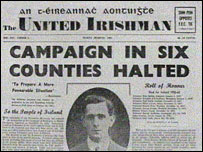
                                                                    The author of this article, Des Dalton, was a member of Republican Sinn Féin for over thirty years, serving as President from 2009-2018. He resigned from Republican Sinn Féin in March 2021 following an interview he gave to the University of Liverpool’s Institute of Irish Studies Civic Space in which he stated that the ongoing armed actions of republican groups such as the CIRA and New IRA could not be justified in present circumstances and were counterproductive. He holds a BA Hon in English and History from Carlow College.  The 1962 IRA Ceasefire: Lessons for Today. By Des Dalton. Sixty years ago, on February 26, 1962, the IRA announced the end of ‘Operation Harvest’, or as it has become known in popular parlance the ‘Border Campaign’.’ The statement, penned by the Chief of Staff of the IRA, Ruairí Ó Brádaigh, set out the reasons for ending the campaign. The thinking and conditions which informed the IRA leadership’s decision to end its campaign are not merely of historical interest but are relevant to Ireland of 2022. Today there are a small section of traditional republicans, namely Republican Sinn Féin and Saoradh, who conflate the continuance of sporadic armed actions, however ineffectual and counterproductive, with keeping faith with traditional republican goals and ideals. They base much of their ideology on a reading of republican history that is deeply flawed. Such an attitude and lack of historical understanding contrasts sharply with the IRA leadership of sixty years ago, who in announcing the end of their military campaign, did not signal any political retreat or compromise on the IRA’s core republican goals of securing a British withdrawal and the end of partition. For them the demarcation lines between the practical considerations of the means, and the principles and ideology of the end, were crystal clear. They were secure in their republican beliefs based on a sound historical understanding of the physical force republican tradition and their place in it. The attitude of the IRA leadership in 1962 to the continuance of an armed campaign in unfavourable conditions was not unique. Similar discussions and analysis were grappled with and acted upon by IRA leaders such as Tom Barry, Frank Aiken and Liam Pilkington in 1923. It can be argued that in 1972 and 1975 Republican leaders such as Dáithí Ó Conaill and Billy McKee also proved capable of separating the means from the end in calling military cessations. In each case, adherence to core republican demands was reaffirmed while practical decisions on the efficacy of continuing an armed campaign were made coldly and logically. The IRA launched its military campaign, which it labelled ‘Operation Harvest’ at midnight on the night of December 11/12, 1956, with a series of attacks across the Six Counties. From Torr Head in the far north of Antrim to Derry City, Magherafelt, Co Derry, Enniskillen, and other points around Lough Erne, Armagh attacks were carried out on a variety of targets from electricity powers stations, a courthouse, custom and B Special Huts, bridges and the British Army’s Gough barracks in Armagh, with varying degrees of effectiveness and success. Nevertheless, as J Bowyer Bell points out: “Ineffectual or not, the scale of the attacks, the presence of Cork men at Torr Head, and the possibility of further action had a sobering effect on the authorities at Belfast”. By the end of 1961, despite a slight increase in attacks, mainly cratering of bridges, the cutting of the Dublin-Belfast rail line and the levelling of custom posts, it was increasingly evident the campaign was faltering, as Bowyer Bell noted “…the final spurt had still not reached a level beyond nuisance value”.  All the measures of a functioning and effective republican movement were showing in the negative. The Garda Special Branch estimated IRA membership at 1,000, which according to Matt Treacy was “smaller than at any time since 1957.” Sinn Féin had a membership of approximately 5,000 members, with 336 cumainn. The movement’s paper the United Irishman, was printing 60,000 copies per month, half of the monthly print run in 1957. The number of active IRA volunteers had declined to about 50. The number of IRA operations had declined from a high of 341 in 1957 to 27 in 1959.In the October southern Irish general election Sinn Féin lost the four TDs it had seen elected in 1957, polling only 3% of the total poll, which had a profound effect on the morale of the remaining volunteers in the field. The introduction of Military Courts in November 1961, by the then Justice Minister, Charles J Haughey, is often perceived as the final nail in the coffin. In and of itself the introduction of increased draconian measures would not end the IRA’s campaign, but they certainly added significantly to an already growing list of problems. Then IRA Director of Operations, Mick Ryan, in his memoir, My Life in the IRA, says that even before the Military Courts were set up, the Army Council had decided to end the campaign “with minimum loss of prestige, men and ammunition”. By the end of the year, Ó Brádaigh, his Adjutant General, Martin Shannon and Mick Ryan were the only members of the IRA’s GHQ still at large. When they met at the end of December their situation was bleak. According to Ryan “Police activity was intense, our billets had almost dried up, and the few that were still open to us were under regular surveillance. Free State intelligence had an almost complete breakdown of our structure or what was left of it.”  Ryan estimated that by this point the arsenal of accessible and serviceable weapons numbered about twenty, with little or no transport or finance available. Ruairí Ó Brádaigh’s biographer, Robert W White states that it was Ó Brádaigh’s assessment at this point that “without a

    Loading

    Read more

  • Posted in:

    Shot at by a handkerchief. A review of 'One Para' at the New Theatre, Dublin. By David Burke

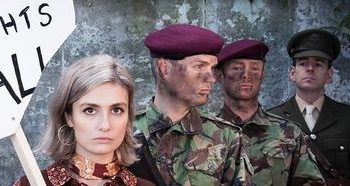
    When Stephen Spielberg was making ‘Schindler’s List, in the early 1990s, he invited some of the Holocaust survivors who had been saved from the gas chambers by Oscar Schindler onto his movie set. The guests mingled with the actors and crew during a break. Amid all the lights, the electrical wires criss-crossing the set,  the extras who were playing the SS chatted amicably with each other. Someone noticed something odd: the SS group – and they alone – were being shunned by Spielberg’s special guests, the survivors. This was because the extras looked so much like the real thing, they exuded a cruelty that, nearly half a century later, disturbed the visitors. I felt something similar watching  the actor playing Sergeant Hutton of 1 Para during Gerard Humphrey’s riveting new play about Bloody Sunday, ‘One Para’ at the New Theatre. Andrew Kenny plays a foul mouthed, racist bigot who bullies one of his more junior colleagues, Scarrif, urging him to shoot at the unarmed and harmless civil rights marchers in the Bogside. His bragging about his colonial exploits in 1 Para is a whirlwind education in the crimes committed by men like him. Every so often he cracks a crass joke or make a jibe that should make the audience wince but something more disturbing happens: there is nervous laughter. The audience out in the dark is cowed by Hutton. If you want to know what Stockholm syndrome is like, go and see this play. Sergeant Hutton on internment and the Ballymurphy massacre: We sorted Belfast out in one night… You saw the photos put up on the wall in the corporal’s mess. .. we swept down the Black Mountain straight into Ballymurphy and shot forty bogwogs – we wasted eleven of them. Victor got himself a priest and all. He won the regimental sweepstake! The UDR wallahs told him he should put in for a bounty! While the menace and darkness of this 75 minutes play shoots at the audience through the mouth of Kenny, the piece works because each cast member hits their target dead centre. The overarching ingredient, however, is the crisp dialogue Gerry Humphreys places in their mouths. He manages to convey the complexities of  Brigadier Frank Kitson, the MRF death squads, the Ballymurphy and Bloody Sunday massacres with rapid fire shots of succinct dialogue that hits you in the solar plexus. He has a genius for boiling down the complex into brilliant historical one liners. When Hutton is asked about his actions by a military police officer he barks: “I am a professional soldier. If I had not shot – I truly believe he would have shot me! The military police officer snaps back at him: With a handkerchief? Humphreys sprinkles the script with the occasional piece of humour to lighten the brutal dialogue, but he does so with such subtlety and deftness that he never once crosses the line or disturbs the equilibrium of what is a deadly serious issue. One Para is directed by Anthony Fox. The set design is by Robert Ballagh. The show continues until the weekend. If you can, catch it. The run comes to an end on Saturday. OTHER STORIES ABOUT BLOODY SUNDAY, THE BALLYMURPHY MASSACRE, BRIGADIER FRANK KITSON AND COLONEL DEREK WILFORD ON THIS WEBSITE: Bloody Sunday: Brigadier Frank Kitson and MI5 denounced in Dail Eireann   The covert plan to smash the IRA in Derry on Bloody Sunday by David Burke Soldier F’s Bloody Sunday secrets. David Cleary knows enough to blackmail the British government. Learning to kill Colin Wallace: Bloody Sunday, a very personal perspective Lying like a trooper. Internment, murder and vilification. Did Brigadier Kitson instigate the Ballymurphy massacre smear campaign? Where was Soldier F and his ‘gallant’ death squad during it? Another bloody mess. Frank Kitson’s contribution to the wars in Afghanistan and Iraq. 300,000 have died in Afghanistan since 1979. Lying like a trooper. Internment, murder and vilification. Did Brigadier Kitson instigate the Ballymurphy massacre smear campaign? Where was Soldier F and his ‘gallant’ death squad during it? A Foul Unfinished Business. The shortcomings of, and plots against, Saville’s Bloody Sunday Inquiry. Kitson’s Private Army: the thugs, killers and racists who terrorised Belfast and Derry. Soldier F was one of their number. Soldier F and Brigadier Kitson’s elite ‘EFGH’ death squad: a murderous dirty-tricks pattern is emerging which links Ballymurphy with Bloody Sunday. A second soldier involved in both events was ‘mentioned in despatches’ at the behest of Kitson for his alleged bravery in the face of the enemy. Mentioned in Despatches. Brigadier Kitson and Soldier F were honoured in the London Gazette for their gallantry in the face of the enemy during the internment swoops of August 1971. Soldier F, the heartless Bloody Sunday killer, is named. Mission accomplished. The unscrupulous judge who covered-up the Bloody Sunday murders. Soldier F and other paratroopers have been protected by the British State for five decades. None of them now face prosecution. This perversion of justice began with the connivance of the Lord Chief Justice of England and Wales, John Widgery, a former British Army brigadier, Freemason and oath-breaker. Counterinsurgency war criminals, liars and cowards: Kitson and Wilford, the brigadier and colonel who led the soldiers who perpetrated the Ballymurphy Massacre. Brigadier Kitson’s motive for murdering unarmed civilians in Ballymurphy. The McGurk’s Bar cover-up. Heath’s Faustian pact. How a British prime minister covered up a UVF massacre in the hope of acquiring Unionist votes to enable the UK join the European Economic Community, the forerunner of the EU.

    Loading

    Read more

  • Posted in:

    Twitter, Censorship and the mass murderer David Cleary (Soldier F). By David Burke.

    The musician Feargal McCann has followed the saga revolving around the mass murderer David Cleary. McCann’s father Joe, was shot  by paratroopers in 1972, only ten weeks after Bloody Sunday. Cleary, better known as ‘Soldier F’, was one of those responsible for the Bloody Sunday massacre of innocent unarmed civilians. Cleary shot Patrick Doherty while he was lying on the ground crawling away from him. The bullet tore up the man’s spine. As he lay crying out in pain, Barney McGuigan, stepped forward with a white handkerchief looking to help him. Cleary dropped to one knee, aimed his rifle and shot McGuigan in the head. Cleary was named in the House of Commons by the leader of the SDLP, Colum Eastwood, last year. This circumvented a ban on naming him which had been issued by a court in Belfast. Last week Cleary was named by Peadar Tóibín in the Dail. The ban does not apply in the Republic of Ireland. Village reported Deputy Tobin’s speech later that night.  Feargal McCann read the story and transmitted a tweet about it. Twitter has now locked McCann’s account. In addition, it is stipulating that by deleting the tweet, McCann acknowledges that he ‘violated’ Twitter rules. Twitter might point out that there is a court order in place which prohibits the naming of Cleary, albeit one that only applies in the UK. No doubt, Twitter might argue further that since tweets are international, McCann’s transmission could have been read inside the UK, and hence they had no choice but to shut the musician’s account down. The consequences of such an argument could be far-reaching. If, for example, a Russian Court bans any coverage of Pussy Riot or other dissidents, will Twitter enforce any such ban? And what about Kim Jong-un? If he or a North Korean court banned the naming of the assassins of his half-brother, Kim Jong-nam,  would Twitter lock the account of a person in Ireland who named the killers? Or is Twitter merely going to enforce injunctions about a mass murderer like Cleary who shot innocent Irish people? The pages of Village are open to Twitter to respond. Eamon de Valera invented the concept of the ’empty formula’ to get around having to take an oath of allegiance to the Crown in 1927. Those suspended or locked down by Twitter might draw inspiration from this to get around Twitter’s censorship of their accounts for naming Cleary. It could be called ‘Empty Twitter formula’. OTHER STORIES ABOUT BLOODY SUNDAY, THE BALLYMURPHY MASSACRE, BRIGADIER FRANK KITSON AND COLONEL DEREK WILFORD ON THIS WEBSITE: David Cleary, mass murderer, aka Soldier F, named in Ireland’s parliament. Bloody Sunday: Brigadier Frank Kitson and MI5 denounced in Dail Eireann   The covert plan to smash the IRA in Derry on Bloody Sunday by David Burke Soldier F’s Bloody Sunday secrets. David Cleary knows enough to blackmail the British government. Learning to kill Colin Wallace: Bloody Sunday, a very personal perspective Lying like a trooper. Internment, murder and vilification. Did Brigadier Kitson instigate the Ballymurphy massacre smear campaign? Where was Soldier F and his ‘gallant’ death squad during it? Another bloody mess. Frank Kitson’s contribution to the wars in Afghanistan and Iraq. 300,000 have died in Afghanistan since 1979. Lying like a trooper. Internment, murder and vilification. Did Brigadier Kitson instigate the Ballymurphy massacre smear campaign? Where was Soldier F and his ‘gallant’ death squad during it? A Foul Unfinished Business. The shortcomings of, and plots against, Saville’s Bloody Sunday Inquiry. Kitson’s Private Army: the thugs, killers and racists who terrorised Belfast and Derry. Soldier F was one of their number. Soldier F and Brigadier Kitson’s elite ‘EFGH’ death squad: a murderous dirty-tricks pattern is emerging which links Ballymurphy with Bloody Sunday. A second soldier involved in both events was ‘mentioned in despatches’ at the behest of Kitson for his alleged bravery in the face of the enemy. Mentioned in Despatches. Brigadier Kitson and Soldier F were honoured in the London Gazette for their gallantry in the face of the enemy during the internment swoops of August 1971. Soldier F, the heartless Bloody Sunday killer, is named. Mission accomplished. The unscrupulous judge who covered-up the Bloody Sunday murders. Soldier F and other paratroopers have been protected by the British State for five decades. None of them now face prosecution. This perversion of justice began with the connivance of the Lord Chief Justice of England and Wales, John Widgery, a former British Army brigadier, Freemason and oath-breaker. Counterinsurgency war criminals, liars and cowards: Kitson and Wilford, the brigadier and colonel who led the soldiers who perpetrated the Ballymurphy Massacre. Brigadier Kitson’s motive for murdering unarmed civilians in Ballymurphy. The McGurk’s Bar cover-up. Heath’s Faustian pact. How a British prime minister covered up a UVF massacre in the hope of acquiring Unionist votes to enable the UK join the European Economic Community, the forerunner of the EU.

    Loading

    Read more

  • Posted in:

    David Cleary, mass murderer, aka Soldier F, named in Ireland's parliament. How will Twitter respond?

    Deputy Peadar Tóibín, leader of Aontú, referred to Soldier F by his real name, David James Cleary, in  Dáil Éireann, the Irish parliament, yesterday (9 February). Cleary was a cruel, cynical and clinical killer. He shot Patrick Doherty in the buttock on Bloody Sunday while he was on the ground crawling away from him. The bullet tore up his spine. As Doherty lay crying out in pain, his life draining away from him, Barney McGuigan, an exceptionally brave and humane man, stepped forward with a white handkerchief looking to help Doherty. Cleary dropped to one knee, aimed his rifle and shot McGuigan in the head. A UK injunction prohibiting the naming of Cleary does not apply in the Republic of Ireland.  The Cathaoirleach of the Dáil had no difficulty with Deputy Tóibín’s contribution. Village magazine named Cleary last year in a series of articles about the Ballymurphy massacre and Bloody Sunday. Twitter suspended our account after a tweet we issued named the soldier. Other accounts were suspended too, including one belonging to the brother of one of those murdered on Bloody Sunday. In a move that is the very definition of perversity, the PSNI are threatening to prosecute him. One can imagine the international outcry that will ensue if the force pursues a prosecution. The Irish contingent in the US Congress will be incandescent. There will be an anger that will unify Dáil Éireann as one if they dare proceed.  The fact that Cleary has been named by Deputy Tóibín under Dáil privilege has been tweeted and retweeted by a number of people living in the Republic of Ireland. Cleary’s name is now permanently available on the website of the Oireachtas. It will be interesting to see how Twitter responds this time around. A TikToc with a recent photo of the former 1 Para lance corporal is in circulation. Yet another recent colour photograph has been transmitted on Twitter (the publication of this picture did not lead to a suspension of the relevant, presumably as it went under the Twitter radar.)  Deputy Tóibín’s contribution was made as part of a question he put to the Taoiseach. Micheál Martin had no difficulty with the fact Cleary was named. Deputy Tóibín’s question was as follows: Ten days ago the Taoiseach laid a wreath at the Bloody Sunday Memorial in Derry. At the time and since then the Taoiseach has indicated the families of those who were lost, who were murdered, on Bloody Sunday need to find justice. We are looking at the likelihood that there is going to be an amnesty. If there is an amnesty in the North of Ireland, it means there is no rule of law and that the perpetrators will get away with murder. I attended the 50th anniversary of the Ballymurphy massacre, and speaker after speaker got up on the trailer that day and said the British Government quite simply wants to get away with murder. That is what is happening here. Over recent debates in which I have participated, I have made an effort to name every single victim of the Bloody Sunday massacre, the Ballymurphy massacre, the Springhill massacre, the murders that were researched in Operation Greenwich and those today in the Ombudsman’s report. Is it not shocking that we know the names of the people who lost their lives, the people who were murdered, but we do not know the names of the people who perpetrated those murders. Most people, for example, would not know Lance Corporal David James Cleary, better known as Soldier F, who is accused of murdering civilians on Bloody Sunday. Most people would not know the alphabet of British Army perpetrators of murder. We need to ensure people know their names. The Taoiseach has recounted what has happened, but I am asking him what steps will he take to ensure those names are known throughout the country for the murders they have committed. The Taoiseach responded as follows: In the first instance, I have told the Deputy what we are doing. I do not agree with the amnesty at all and I do not take it as a likelihood. The Irish Government has entered into discussions with the British Government and all of the parties in Northern Ireland in respect of the proposals that emanated from the British Government last year. We have made it very clear we do not accept any unilateral actions in respect of legacy that would represent a breach of the Good Friday Agreement and subsequent agreements. OTHER STORIES ABOUT BLOODY SUNDAY, THE BALLYMURPHY MASSACRE, BRIGADIER FRANK KITSON AND COLONEL DEREK WILFORD ON THIS WEBSITE: Bloody Sunday: Brigadier Frank Kitson and MI5 denounced in Dail Eireann   The covert plan to smash the IRA in Derry on Bloody Sunday by David Burke Soldier F’s Bloody Sunday secrets. David Cleary knows enough to blackmail the British government. Learning to kill Colin Wallace: Bloody Sunday, a very personal perspective Lying like a trooper. Internment, murder and vilification. Did Brigadier Kitson instigate the Ballymurphy massacre smear campaign? Where was Soldier F and his ‘gallant’ death squad during it? Another bloody mess. Frank Kitson’s contribution to the wars in Afghanistan and Iraq. 300,000 have died in Afghanistan since 1979. Lying like a trooper. Internment, murder and vilification. Did Brigadier Kitson instigate the Ballymurphy massacre smear campaign? Where was Soldier F and his ‘gallant’ death squad during it? A Foul Unfinished Business. The shortcomings of, and plots against, Saville’s Bloody Sunday Inquiry. Kitson’s Private Army: the thugs, killers and racists who terrorised Belfast and Derry. Soldier F was one of their number. Soldier F and Brigadier Kitson’s elite ‘EFGH’ death squad: a murderous dirty-tricks pattern is emerging which links Ballymurphy with Bloody Sunday. A second soldier involved in both events was ‘mentioned in despatches’ at the behest of Kitson for his alleged bravery in the face of the enemy. Mentioned in Despatches. Brigadier Kitson and Soldier F were honoured in the London Gazette for their gallantry in the face of the enemy

    Loading

    Read more

  • Posted in:

    Bloody Sunday: Brigadier Frank Kitson and MI5 denounced in Dail Eireann

    This brings me to the appalling and unilateral decision by the British Government to bring forward legislation to prohibit future prosecutions of military veterans and ex-paramilitaries for crimes related to the Troubles and to impose a statute of limitations on Troubles-era prosecutions. Deputy Sean Haughey tonight denounced the activities of General Sir Frank Kitson in Dail Eireann.  The full text of his speech is set out below: The 50th anniversary of Bloody Sunday was marked on 30 January last. As we know, a march for civil rights in Northern Ireland took place in Derry that day. The participants marched for basic civil rights and equality, to be treated equally in a society where the minority were seen as second-class citizens by the government. The first battalion of the British army’s parachute regiment opened fire on innocent civilians, killing 13 people on the day. This followed the killing of other innocent victims by the parachute regiment in Ballymurphy the previous August. These events cast a long shadow over politics in Northern Ireland and this remains evident to the present day. The hastily established Widgery inquiry found the soldiers had started firing only after they had come under attack, among other adverse findings. This was deeply offensive to the families of those killed or injured, but it demonstrates what the establishment in a so-called democratic state can do, if so minded, to arrive at a false and predetermined outcome. The barrister David Burke, in his book published last year entitled Kitson’s Irish War: Mastermind of the Dirty War in Ireland, outlines how Bloody Sunday and other killings of innocent civilians in Northern Ireland by British soldiers were part of a ruthless, dirty war that commenced in 1970, when brigadier Frank Kitson, a counterinsurgency veteran, was sent to Northern Ireland. Burke further outlines how Kitson organised a clandestine war against nationalists and ignored loyalist paramilitaries. How shocking is that? The families of those who were murdered have campaigned for justice ever since. They have three basic demands, namely, a rejection of the Widgery report, an official acknowledgment of the victims’ innocence and the prosecution of the soldiers involved on the day. They campaign tirelessly and have to date been successful in achieving two of their three objectives. The then British Prime Minister Tony Blair established the Saville inquiry in 1998. It totally exonerated the victims and placed the blame firmly on the British army. Subsequently, the then British Prime Minister David Cameron issued a state apology and expressed his deep sorrow for what had happened. As we all know, however, the prosecution of the soldiers has, unfortunately, run into difficulty. The Public Prosecution Service for Northern Ireland announced in 2019 that only one soldier, Soldier F, would be prosecuted, but this was dropped and the matter is now before the courts. This brings me to the appalling and unilateral decision by the British Government to bring forward legislation to prohibit future prosecutions of military veterans and ex-paramilitaries for crimes related to the Troubles and to impose a statute of limitations on Troubles-era prosecutions. This has been widely condemned, rightly so. It was condemned by the Taoiseach in Derry at the weekend, when he said the soldiers involved should face prosecution. It has been condemned by the political parties in Northern Ireland, by victims groups and their families, by several international human rights organisations, including the Council of Europe’s commissioner for human rights and the United Nations special rapporteur, by Michael Posner, US Assistant Secretary of State, and by the Committee on the Administration of Justice in Northern Ireland – the list goes on. This move essentially overturns a crucial part of the 2014 Stormont House Agreement, which was agreed by the British and Irish Governments and the political parties in Northern Ireland. For example, a commitment was given to establish an independent historical investigations unit as part of this agreement. In July of last year, talks were initiated between the parties in Northern Ireland and all of the relevant stakeholders on dealing with the legacy of the past and implementing the provisions of the Stormont House Agreement. These talks should be ongoing and the Irish Government must continue to make known to the British Government its total opposition to these proposals. I would also like to raise another issue in this context. A range of rights-based commitments have been made in Northern Ireland, starting with the Good Friday Agreement and right up to New Decade, New Approach. This is not happening fully. For example, there has been a failure to progress a bill of rights in Northern Ireland. These objectives would give human rights protections to the people of Northern Ireland. In New Decade, New Approach, a commitment was given to establish an ad hoc committee on a bill of rights in Stormont but this has run into difficulty. Various proposals in this area are being obstructed in the Executive and the Assembly, using different veto mechanisms. This is very regrettable. What all of this clearly indicates is that we need full implementation of all aspects of the Good Friday Agreement and subsequent agreements. All of us need to work at that – the British and Irish Governments, the parties in Northern Ireland and Ministers and parliamentarians in these islands, using the bodies established under the Good Friday Agreement, and civic society. We must rededicate ourselves to implementing all of the provisions of the Good Friday Agreement. The role of MI5 was raised by Deputy Patrick Costello of the Green Party We can talk about the Cory inquiry’s hard drives being seized by MI5 and arson at the Stevens inquiry – all these deliberate attempts to cover up the truth.. His contribution in full was as follows: One of the recurring themes when we talk about the legacy issues is the responsibility of the British Government to act. It does have a responsibility and I will get to it in a minute. However, we also have a responsibility here in Dublin. We are co-guarantors of

    Loading

    Read more