Politics

Random entry RSS

  • Posted in:

    Lord Widgery, the judge who covered-up the murders of Bloody Sunday. How and why he did it.

    By David Burke. This article was first published on 2 July 2021. It is republished to mark the 50th anniversary of the publication of Lord Widgery’s infamous report which defamed the victims of Bloody Sunday and exculpated those who murdered them. 1. Brigadier Frank Kitson subverts the law. Brigadier Frank Kitson of the British Army was a so-called counterinsurgency guru. He was sent to Northern Ireland in 1970 to tackle the IRA. The following year his astonishingly indiscreet book, ‘Low Intensity Operations’ was published. In it he explained that there were two ways of administering the law during a counterinsurgency, the first one being that: the law should be used as just another weapon in the government’s arsenal, and in this case it becomes little more than a propaganda cover for the disposal of unwanted members of the public. For this to happen efficiently, the activities of the legal services have to be tied into the war effort in as discreet a way as possible … The other alternative is that the law should remain impartial and administer the laws of the country without any direction from the government. [Kitson (1971), p. 69.] The first tribunal investigating the events of Bloody Sunday – Widgery – is a good example of how the law was used as “just another weapon in the government’s arsenal”. On Monday 31 January 1972, Tory Home Secretary Reginald Maudling announced in the House of Commons that there would be a judicial inquiry into the Derry massacre. That evening British Prime Minister Ted Heath and Hailsham, his Lord Chancellor, asked Lord Chief Justice Widgery to chair it. Widgery had been a surprise appointment as Lord Chief Justice of England and Wales by the Tories the previous year. He was not viewed as a jurist of the first rank by his peers. His career was one which would ultimately descend into bedlam. Private Eye magazine would report that “he sits hunched and scowling, squinting into his books from a range of three inches, his wig awry. He keeps up a muttered commentary of bad-tempered and irrelevant questions – ‘What d’you say?’, ‘Speak up’, ‘Don’t shout’, ‘Whipper-snapper’, etc”. [Private Eye Issue 436, 1 September 1978.] These comments were published two years before he stepped down from the bench. The view expressed by the Eye is reflective of Widgery’s reputation for having been ‘difficult’ by members of the Bar in Britain. ‘Difficult’ in this context is a polite euphemism. Widgery was despised by the legal profession which viewed him as a second rate political appointee who strove to conceal his shortcomings in the traditional manner of the lower tier judge:   by hectoring, pelting and bullying. 2. Judicial compromise The night before Heath asked Widgery to conduct an inquiry, he had expressed his belief to Taoiseach Jack Lynch that Kitson’s paratroopers had behaved properly in Derry. If Heath truly believed what he had said to Lynch, he had an unusual way of showing it. He chose Widgery – a safe pair of hands – and left him in no doubt that he was to pervert the course of justice. At the meeting on 31 January Heath told Widgery that it “had to be remembered that we were in Northern Ireland fighting not only a military war but a propaganda war”. It is hard to conceive of a more compromising comment made by a British prime minister to a senior member of the judiciary, let alone the man at its pinnacle. No matter what way one looks at it, the comment demonstrates a breath-taking lack of esteem on the part of Heath for the independence of the judiciary. Yet Widgery did not rise to his feet and leave the room in protest. Instead, he did what his master bid him to do. 3. An Allegedly Independent Judge pre-judges the Murder Victims by Attending a Meeting at which they were referred to as ‘the other side’ At the same meeting at which Heath had given Widgery his riding orders, the parties to the discussion had also referred to the victims as the ‘other side’. [Para (viii) of minute of meeting of 31 January 1972.]  Moreover, according to confidential notes by a Widgery associate, the “LCJ” [Lord Chief Justice] could be counted on to “pile up the case against the deceased” even though the evidence provided “a large benefit of the doubt to the deceased.” [‘Hidden Truths’ (1998), p. 95. 4. Threats to Muzzle the Ever Compliant British Media In the days after the massacre, the journalist Murray Sayle and his colleagues completed a report which was submitted to the Sunday Times. There was internal opposition to its conclusion, namely  that Colonel Derek Wilford,  who had led 1 Para in Derry on Bloody Sunday, had set out to provoke the IRA into coming out into the open so his troops could wipe them out. Harold Evans, the editor of the paper, decided to ring Widgery. “I said we had done a great deal of interviewing and proposed to publish this Sunday. We also had compelling photographs. I told him I presumed contempt would not apply since nobody had yet been accused. It would be an exaggeration to say he was aghast, but he made it very clear it would be ‘unhelpful’ to publish anything and yes, he would apply the rules of contempt. .. I withheld the article, but that week I took the chance of publishing the shocking photographs by Gilles Peress of unarmed men being shot”.  [Harold Evans,  ‘My Paper Chase, True Stories of Vanished Times’ (Little, Brown and Co, New York, 2009), p 474.] On Sunday 6 February, the paper reported that, “The law is that until the Lord Chief Justice completes his enquiry nobody may offer to the British public any consecutive account of the events in Derry last weekend”. [Sunday Times 6 February 1972.] Heath’s press office rowed in declaring that anything which anticipated the Tribunal’s findings would amount to contempt. This was a highly contentious assertion without

    Loading

    Read more

  • Posted in:

    Updated: The very best (and worst) of British. Simon Danczuk is one of a number of courageous British individuals who has tried to tell the truth about British government crimes in Ireland. He joins the ranks of Colin Wallace, Fred Holroyd, John Stalker, Byron Lewis and John Stevens

    Dolphin Square VIP sex abuse. Dolphin Square was opened in London’s Pimlico in 1936. It soon became a magnet for all sorts of scandal and intrigue:  espionage, political, sexual, not to mention mysterious deaths. ‘Scandal at Dolphin Square’ provides a riveting account of the lives of a rolling maul of fascinating and complex characters. As publicity for the publication accurately proclaims, it was ‘a place where the private lives of those from the highest of high society and the lowest depths of the underworld have collided and played out over the best part of a century’. It was also a cesspit where Prince Andrew’s friend Lord Greville Janner abused children. The two most important chapters in the book, both of which describe the activities of members of a VIP child abuse network, have been ignored by the British press. Cut from the same cloth: the Russian and British press Consumers of the media in the UK, have no appreciation of the extent to which they are kept in the dark about British Establishment scandals. They are completely unaware of the role Buckingham Palace played in suppressing the Jeffrey Epstein scandal for years before it broke in the US media. See: Palace of Discord and Deception. [Updated] Prince William’s officials covered-up his uncle’s involvement in the Epstein-Maxwell sex trafficking scandal. By Joseph de Burca. At the moment, many in Britain are exasperated at the ignorance of the ordinary Russian citizen who is misled by a corrupt Putlin-led media spouting nonsense about Nazism in the Ukraine. If the average Brit knew about what has been going on in Ireland, he and she might not laugh with such disdain at the typically ignorant Russian newspaper reader. The Dolphin Square book will help open a few eyes in Britain about the wretchedness of their ruling classes. However, before I return to Dolphin Square, it may be helpful to look at a few examples from recent history to understand the wider picture which explains how the ordinary British newspaper reader has been left to wallow in ignorance about British establishment crimes in Ireland. The tactic is: injure, insult and ignore. There is a deep well of hurt in Ireland felt by many as a result of the lethal misbehaviour of the British army and intelligence services on this island, a history now more than fifty years in being. Fresh evidence of transgressions continue to emerge with depressing regularity. In recent times, they include reports from the Northern Ireland Ombudsman about collusion between Loyalist paramilitaries and the State involving the murder of Catholics, many of them non-combatants who were simply in the wrong place at the wrong time. The murder of Irish citizens by British State actors is no more news in Britain than Putin’s war crimes in the Ukraine are for ordinary Russians. Astonishingly, there was little or no coverage of the fact that the State paid out £1.4 million to the families and survivors of the Miami Showband massacre. There has been – and continues to be – a pattern of State sponsored injury followed by insult. The insult takes the form of the cover-up after the event. If the cover-up falls apart, then the British press and TV go into ‘ignore’ mode. John Stalker who refused to back down when he discovered RUC-MI5 murder of a teenager. It cost him his career. The late John Stalker, the former Deputy Chief Constable of Manchester, investigated the RUC’s shoot to kill programme in Ireland in the 1980s. He discovered, for example, that the RUC and MI5 had murdered a teenage boy who had stumbled across an IRA arms dump in a hay shed. Stalker refused to back off and was stabbed in the back by his own side. The deepest wounds were those inflicted by his boss, James Anderton,  a man who believed that God spoke ‘to him and through him’. In reality Anderton became an accessory after the fact to the murder of the boy at the hay shed. Stalker was smeared by a corrupt press in Britain, linked to criminality and taken off his inquiry. The killers got away Scot free as did all of those involved in shafting Stalker. Few in Britain could have cared less. Although he cleared his name, Stalker retired from the police early a demoralised man. Byron Lewis, intimidated and vilified for telling the truth about Bloody Sunday David Cleary (better known as Soldier F) was responsible for a large number of the killings which took place on Bloody Sunday in Derry in 1972. Byron Lewis was beside him on the day of the massacre. Lewis killed no one – he was a radio operator. The journalist and broadcaster Tom McGurk conducted an investigation into Bloody Sunday and uncovered a written account by Lewis. He published it in The Sunday Business Post in Dublin. Privately, he supplied additional information to the Irish Government. This, finally, provided the ‘new evidence’ the British government required to establish a fresh inquiry. And what happened to Lewis? Although McGurk was careful not to name him, his identity was leaked – probably by the Ministry of Defence in London to a gang of soldiers who tried to persuade him not to talk to the Savile Inquiry. The soldiers found where he was living. In a case of mistaken identity, his housemate was beaten so badly he was taken to hospital. That same night Lewis’ life was threatened and he had to go into hiding. When he appeared at the Saville Inquiry, attempts were made to tear his character apart. Lewis has never emerged from hiding. And what of Cleary? The British government of Boris Johnson is presently trying to enact legislation so that he and others like him will not have to face murder charges. Fred Holroyd: smeared and vilified for exposing Robert Nairac and the Dublin  and Monaghan bombers of 1974 When Fred Holroyd, a former undercover British soldier, refused to go along with MI5’s murderous collusion with Loyalist paramilitaries in

    Loading

    Read more

  • Posted in:

    Ireland's digital pathways are being used to launch drone attacks

    The debate in Ireland about joining NATO, or some sort of an EU military arrangement, is now on the political agenda like never before. Pro-neutrality advocates argue that the country is sleep walking into a military alignment of one sort or another with Western military powers. They point to the fact that US air force planes routinely transport American soldiers to Europe and beyond via Shannon airport as an example of an erosion of our neutrality. The pro-NATO lobby must be encouraged by the acceptance of the activities at Shannon which contrasts sharply with the anger displayed against Russian naval exercises off our coast earlier this year. What is missing from the debate is a discussion about the fact that Ireland has been playing a key role in lethal US military operations for years. Village described them in an article in 2017 which is as relevant now as it was five years ago. The piece can be accessed here: Technology neutralises our neutrality

    Loading

    Read more

  • Posted in:

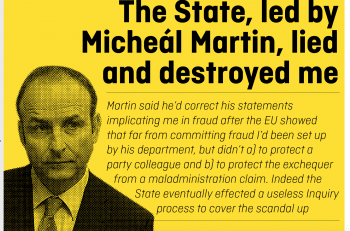
    Frank Mulcahy, the media and Micheál Martin's lies

    The Media’s treatment of the lies: an epic scandal ignored. It was March 1998. The RTE journalist Geraldine Harney informed me that I was to be dismissed by the ISME directors Peter Faulkner and Eoghan Hynes. She was doing the decent thing. Nevertheless, it was a preposterous suggestion and I told her so. However, in June her prediction materialised. Both Hynes and Faulkner demanded my resignation, with threats. The demand being unlawful, I refused to comply.   (On 11 August 1998 Mr Hynes privately, by fax, instructed the incoming ISME chair Seamus Butler, a Longford businessman, to get on side with my removal.)   In September the Irish Times  journalist Barry O’ Keeffe printed a story that I had cheated on my expenses. I was not afforded the opportunity to refute the allegation. He apologised stating that he had been placed under inordinate pressure. There followed  a stream of front-page stories in the Sunday Business Post stating in turn that I had stolen a suit, insurance and pension payments, a 1996 bonus and other frauds. In September too Aileen Hickey in Business Plus Magazine ran a cover story, blazoned ‘Gunning for Mulcahy’. As with Miss Harney it predicted the future. The article referenced pending accusations so sensitive that they couldn’t be revealed at that stage. I had no idea of what I was being accused of, or was expected to disprove.   (In September Seamus Butler offered me £100,000 to resign with threats that I would “never work in this country again” if I did not oblige.)   In October 1998 Irish Irish Independent journalist Gerry Flynn published several intimidatory faxes that I had received from Eoghan Hynes. Flynn had a reputation for being forthright. Initially, the Independent committed to standing by their journalist. They advised,  “we will be fighting your case”. However, in the end management paid Mr Hynes £20,000 simply for publishing his abusive faxes. A form of apology was printed. I was damaged.   (Nevertheless, in October and November the ISME Finance Committee publicly withdrew the allegations. The ISME members dictated that  I was to be fully reinstated by the AGM in April 1999. When Hynes objected, several council members recorded him explaining his corrupt “game plan”. The council member Pat Coen had possession of the tape. His brother was a respected ranking Garda who had been kept in the loop. The tape was my reassurance. I was advised not to react to the daily provocations; to get to the AGM in April.)   On Saturday 26 January 1999 I was walking on Killiney beach at 6.05 (PM) with the civil servant Diarmaid Breathnach when my phone went wild. It transpired that Seamus Butler, had announced on RTE’s early evening news that I had been sacked because I had fiddled my expenses. The story was utter nonsense. Butler had been interviewed by his neighbour the Longford-based RTE journalist Kieran Mullooly. I had not been afforded the opportunity to refute the charge.  The following day I rang the RTE newsroom. George Lee answered. I registered my complaint – orally – at what had occurred. That evening Pat Coen collapsed and died. The tape was secured by his brother, Garda Sergeant Coen, with whom I later spoke. A year on RTE advised that I should have put my concerns in writing. (In February the Revenue Commissioners attended ISME at Butler’s request.  Yet within an hour Revenue walked out believing that they were being used to damage me. On being informed, I arranged to meet the same officials. I provided them with my expenses file and the procedures laid down by Eoghan Hynes which I had followed. They replied, “we were never shown that file”.)   The date for my reinstatement was fast approaching. However, at noon on 5 March 1999 Seamus Butler rang the then Irish Independent journalist David Murphy. Butler apologised for “lying” to him the previous day when he had denied removing the audit signatory Don Curry as an ISME director. He was, he said, making good by offering Murphy a scoop. He disclosed that he had called in the Garda in respect of his latest complaint, namely that I had defrauded the EU Commission. I had no prior knowledge of that allegation whatsoever. Aileen Hickey’s prediction had come to pass.   (In April two gardaí visited my home. I provided them with evidence of the faxed threats and the £100,000 inducement. I directed them to Sgt Coen and the tape recording, to the Revenue Commissioner’s conclusion, to the ISME auditors and the audit signatories who affirmed the vexatious nature of the complaint. We expected that the fraud squad would charge Butler with, at the least, wasting police time.)   On 2 May 1999, as the Garda commenced their investigation, I received a call from the editor of the Irish Times business page Cliff Taylor. He disclosed that he had been invited to the ISME board room the previous Thursday, with the offer of yet another “scoop”, namely that I was to be sacked on 6 May. Consequently, my lawyers threatened an “injunction”.  Butler postponed the board meeting of that day.   (Nevertheless, on 6 May ISME’s solicitors recorded Ercus Stewart SC stating “the board has been forced to dismiss Frank and that has been done. He should have sought an injunction but he didn’t…The only question now is how much he will be awarded by a court”. Clearly ISME had lied to my then lawyers, Binchys, and their lawyer Ercus Stewart SC.)   In November 2005 the daily press reported in passing that the EU courts had penalised Rehab  20 million euros because of its maladministration of European grants.The Department of Enterprise spun the story that that penalty was somehow a win for Ireland. Despite my pleas that something was badly wrong, nobody was inclined to look under the hood. Rehab analogy to ISME What follows is the statement by the National Learning Network, a subsidiary of Rehab in relation to grants under the Human Resources Development

    Loading

    Read more

  • Posted in:

    Silent Defenders

    In a whitewashed barn decked out with Ulster flags, Union Jacks and pictures of the Queen, their leader in charge of this meeting sat at an old table. He pressed a button on a tape recorder. A voice boomed out: I address you as the commander in chief of the organisation, Silent Defenders. Author Ciarán MacAirt investigates a shadowy Loyalist paramilitary group made up of former RUC Specials and British soldiers. He tracks the gang from a newspaper article in March 1972 through British military intelligence files and on to the streets of Belfast in the bloodiest month of the conflict. The paper trail leads to a sectarian gang of Red Hand Commandos, British soldiers of the Ulster Defence Regiment and a series of murders and attempted mass murders of teenagers in north Belfast. But all is not what it seems as there were other killer gangs on the loose… Who were Northern Ireland’s Silent Defenders as we stared into the abyss in the summer of ’72? Visit Paper Trail to find out >> https://www.papertrail.pro/northern-irelands-silent-defenders/

    Loading

    Read more

  • Posted in:

    McKinseygalitarian no more

    March/April 2022 41Then a very terrible thing happened. In February 2017, he announced that he was joining Fianna Fáil which had: “the best team most closely aligned with my politics”. It was Roger Waters leaving Pink Floyd to join Foster and Allen. The young man with the enormous brain who had come racing in to rescue us from the Banks, the IMF and Fianna Fáil had decided that the only way you solve the problem of Fianna Fáil was by joining it. Donnelly’s idea of the “best team” now included Willie O’Dea and Pat ‘the Cope’ Gallagher.Donnelly seems really to be one of those people who thinks you can transcend ideology by being the smartest person in the room. The problem with Ireland wasn’t a structural one – our gross disparities of wealth and fanatical adherence to low corporate tax rates.. The real problem was that Stephen Donnelly wasn’t on the committee running the country. A man of enormous importance in his own mind, he genuinely believed back in 2008-11 that the solution to Ireland’s banking crisis would have been to have himself in the room when the big decisions were made. When he joined the cabinet as Minister for Health in 2020, all that was solved. Given this mentality, it’s no surprise he stepped forward to lead our health service through the Covid apocalypse or that he appears unlikely to be the one to deliver the free universal health care which everyone now pretends to be in favour of. He has given us many amusing moments, though, for which we must thank him. My personal golden Stephen Donnelly moment was when he told a television journalist that children were more likely to catch Covid on a trampoline than they were at school. I think that’s what he said.Even were he to be forced to fy into political exile in a second-hand helicopter it wouldn’t knock of a fitter of his granite opinion of himself. His political career probably won’t fnish in exile unless it’s the sort where some international think tank or European institution pays him to think important thoughts in Brussels or New York. But the thoughts won’t be of us. just one of twenty TDs to vote for Clare Daly’s early bill proposing a referendum to repeal the 8th Amendment. The entire Labour Party voted against, while Sinn Féin abstained because their Ard Fheis had not yet voted – though it soon afterwards did – for repeal, butDonnelly voted yes. When the Social Democrats were formed in 2015, Donnelly was announced as one of the party’s three co-leaders. He easily retained his seat in the 2016 general election but bizarrely told the media in early September 2016 that he was leaving the Social Democrats to again sit as an independent. “Some partnerships simply don’t work”, was all he had to say. It’s the sort of thing withered male academics tell friends over bottles of good red wine after their wife has found them naked with their students in the hot tub. One guessed that there had to be more to it. I mean, he’d only been a member of the Social Democrats for a little less than fourteen months. One imagined perhaps some vicious internal Social Democrat power struggle? I picture two very well-mannered people, both with the weekend Irish Timesrolled up under their arm, racing to get the last of the anchovies in Sheridan’s, Galway. Around that time he was interviewed in this magazine by egalitarian Niall Crowley who found yes Donnelly was sort of egalitarian too. “Are we short of political vision? Yes. Do we need more political vision? Yes. Would the public respond positively to this? Yes… politicians need to get better at laying it out”. He seemed afre at the end of the interview. McKinseygalitarian was the headline.When management consultant Stephen Donnelly strode majestically onto the Irish political stage just before the 2011 general election I was impressed. I particularly remember an appearance on Tonight with Vincent Browne during which he was asked if there had ever been an example, in the history of the world, of a country which had cut and taxed its way out of an economic slump. Donnelly answered without a blink: England during the industrial revolution, in the immediate aftermath of the Napoleonic Wars. By the time of this television appearance – I can still see the brothel-red background which was just one of the things which made that show so memorable – Donnelly had been elected as an independent TD for Wicklow in a campaign directed by his protégé and acolyte Niall O’Tuathaill, who in the last two general elections was the Social Democrats candidate in the Galway West constituency. It was aided too by paid PR consultant Conor Dempsey who years later got into a little trouble over too assiduously, and unpaid, promoting Donnelly’s interest on Twitter.Donnelly’s smartness appeared to be part of a refreshing political reset after the years during which Irish politics had been dominated by Fianna Fáil, a party which during Brian Cowen’s Taoiseachship often gave the impression that if its IQ dropped one point it might turn into a piece of hairy bacon. Donnelly continued to impress during his frst Dáil term when he was McKinseygalitarian no moreThe Enormous Mind of Stephen Donnelly at work for Fianna Fáil and the country in time of post-CovidBy Kevin HigginsPOLITICSThe young man with the enormous brain who had come racing in to rescue us from the Banks, the IMF and Fianna Fáil had decided that the only way you solve the problem of Fianna Fáil was by joining it

    Loading

    Read more