Politics

Random entry RSS

  • Posted in:

    Big-party conservatism led to rise of others

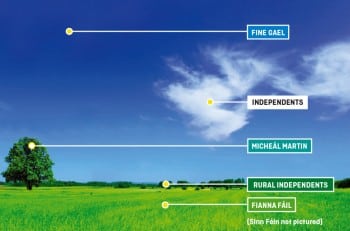
    The two big parties no longer think big. The bigger parties attract an older (more reliable?) vote while the apparently more radical parties capture the younger and more socially disadvantaged vote The elephant in the room at the so-far abortive meetings in Leinster House to form a viable government is the presence of a once popular leader now entirely without credit. Enda Kenny even assumed a very low profile in the centenary commemorations of the 1916 Rising. His presence was easily overshadowed by that of President Michael D Higgins – who occupies a position of symbolic power in our modern day republic. The Independent TD and commentator Shane Ross understood this very well when he stated that he was gazing at a “political corpse” when he was part of the first discussions with the acting Taoiseach. Independents have, and need, a keen nose for public opinion since they have no big political-party apparatus designed to keep them informed. Ross was then extensively criticised for his use of language by the politically correct classes who felt he had disrespected the office of Taoiseach as well as by the supporters of a wounded Fine Gael. Ross is in substance correct. It is virtually impossible to install a new government if it involves putting Enda Kenny in as its head. To do this would be to truly pervert the course of public opinion, as expressed in the general election. If things are changed utterly then it is because the election of 2016 delivered a hammer strike from the electorate to both Enda Kenny and the Fine Gael party. Willie O’Dea, one of the brightest men in the Dáil, also captured this point well in a recent article in the Sunday Independent. By coincidence the same paper has produced a poll which shows that Micheál Martin, not Enda Kenny, is the one most favoured by public opinion to be the next Taoiseach. A large section of the media and commentariat expressed surprise at the scale of Fine Gael’s defeat – it seems the more comfortable members of the commentariat fell for the Fine Gael spin that Labour would lose but Fine Gael would hold its own. The failure of the Fine Gael-led government started with the water-charges fiasco and continued into the election where Kenny made a pre-eminent contribution to the party’s defeat. He cannot escape blame on this front. It also appears that he has at least three hungry wolves within his own ranks who wish to replace him – Leo Varadkar, Simon Coveney and Frances FitzGerald. Enda Kenny was comprehensively outshone in the TV debates during the general election by Micheál Martin despite the fact that he has spent the past five years strategically blaming Martin and Fianna Fáil for all of the problems that beset the country. It simply did not work. The public has moved on from the blame game, even if Fine Gael has not. Moreover, Kenny told people they would not understand economics at the start of the campaign and towards the campaign’s end delivered the immortal insult that people who did not like him or his policies were ” whingers”. Fine Gael continue to defy public opinion by presuming, in the post-election discussions, that the party must be part of any government that is formed. Caretaker Taoiseach Enda Kenny has now been defeated on three occasions – all three defeats have been very clear, public and formal – first in the election and twice now in the Dáil on votes to determine who should become Taoiseach. There are signs, with over 40 days gone since the general election, that the public is wearying of the posturing and pranks of the political class as they collectively fail in the task of government formation. The first casualty of jadedness from the public will be the independents who will see the fools’ pardon extended to them in the election withdrawn if either no government is formed or an election ensues. One of the most dangerous statements issued so far was by Fine Gael’s Richard Bruton who stated on Morning Ireland that he would consider the formation of a Fine Gael minority-led government but not participate nor contemplate its polar opposite a Fianna Fáil-led minority government. Fine Gael, including its fabled leadership contenders, seems to believe that the party has some sort of divine right to be in government. Leo Varadkar, for all his faults in Health, seems to have got it right when he acknowledged openly that no government could be formed unless it combined the parliamentary numbers of both Fianna Fáil and Fine Gael. The numbers and the logic of the general election are pointing that way but neither of the two big parties wishes to accept that its rival should lead in the political equation: Fianna Fáil + Fine Gael = Stable Government. Well before the election result was known I indicated my own view that if the two big parties were in touching distance of each other, in levels of political support, then there was a real chance that there could be a Fianna Fáil- Fine Gael partnership government – with even the possibility of a rotating Taoiseach. The fact that this prediction, if you like, has not happened so far is because of internal institutional resistance to the concept, or competitive rivalry, from both parties. There is also a huge, in my belief, misplaced fear in both parties that by forming such a government they will leave a wide-open door for Sinn Féin to become the major force in opposition and the government in the election that follows. This conservative-mindedness, or risk aversion, by the two big parties is precisely the reason they have both so far lost support to Sinn Féin, anti-austerity parties, and a broad, if inchoate, collection of independents.The two big parties no longer think big in terms of their ambition. The bigger parties attract an older (more reliable?) vote while the apparently more radical parties  capture the younger and more socially

    Loading

    Read more

  • Posted in:

    Money and Machismo drive the autocratic Russian President.

    As we know well in Ireland cash is one of man’s greatest temptations. It’s a recurring theme in Russia. In the venal world, for example, of Fyodor Dostoevsky’s ‘The Idiot’ (1869) most of the characters succumb to greed. General Ivolgin desires money to support his addiction to alcohol and to allow him to spend time with his mistress. Lebedev is willing to put his hands into a fireplace to retrieve a package that Nastassya Filippovna has discarded, with 100,000 roubles inside. In the society of The Idiot, money not only creates one’s fortune it also obtains one a bride. ‘Bids’ for Nastassya Filippovna range from 75,000 roubles to 100,000 to over a million. Money, then, is a clear symbol of the perversion of human values in the novel. Russia fell into a similar stupor at the end of the Cold War when excessive wealth corrupted Russian politics as Boris Yeltsin amply filled the role of the Idiot, his powers declining in a haze of vodka as the plot unfolds. It was out of this pit of iniquity that Vladimir Putin rose to power, the short but muscly former KGB officer emerging from obscurity to become prime minister and then being elected President in 2000 when Yeltsin finally lost his reason. The US embassy cables published by WikiLeaks in 2010, revealed that American diplomats considered Putin’s Russia had by then become “a corrupt, autocratic kleptocracy centred on the leadership of Vladimir Putin, in which officials, oligarchs and organised crime are bound together to create a virtual mafia state”. A 2007 CIA report estimated Putin’s wealth at $40bn. Indeed the one-time biggest foreign investor in Russia, Bill Browder, told Business Insider that Putin was worth $200bn, making him the richest man in the world. He claimed “the first eight or 10 years of Putin’s reign over Russia was about stealing as much money as he could”. A BBC Panorama investigation earlier this year showed he has a $1bn palace on the Black Sea Coast. Funds for it were diverted from the superrich who thought it would be spent on healthcare. But of course for most Russians, after a decade of buoyancy, all is not good on the cash front because of Ukraine-fallout sanctions, and the collapsing currency and oil prices. The Russian economy shrank 3.7 percent in 2015, and 4.1 in 2014 in rouble values, but in dollar terms it is 40% below peak. Oil prices rebounded in early February to above $35 per barrel but they had peaked in 2012 at close to $110 (when oil and gas constituted 52% of government revenue) and government forecasts are based on €50. Real wages fell 10 per cent year-on-year in December, the 14th consecutive month of contraction. Russia is running an unsustainable budget deficit of almost 5%. Soon a key threshold will be reached where over 50% of an average income is spent on food. Putin’s dastardliness and vulnerablity to exposé is even more drastic on the security front. For example, it has been alleged that, presumably under the direction of Putin, the Russian secret services, the FSB, bombed apartment blocks in Moscow in 1999 killing almost 300 people and pinning the blame on Chechnyan separatists. Of course, Putin was able to use the war in Chechnya to good propagandistic effect but he may have created hostages to fortune, even in furtive Russia. Such tactical ethical nihilism might have appeared in another of Dostoevsky’s extraordinary novels, Devils (1872). Towards the end one of the conspirators Lyamshin is put on trial and asked, “Why so many murders, scandals and outrages committed?”. He responds that it was to promote: “the systematic destruction of society and all its principles; to demoralise everyone and make hodge-podge of everything, and then, when society was on the point of collapse – sick, depressed, cynical and sceptical, but still with a perpetual desire for some kind of guiding principle and for self-preservation – suddenly to gain control of it”. Destruction and demoralising animates much of Putin’s policy from Crimea to Ukraine, Syria to Chechnya. Russia consistently operates standards that are more indiscriminate than Western military powers. Last September Putin shocked the world by weighing into the Syrian conflict with air strikes against rebel-held targets. Controversially the primary targets did not seem to be ISIL. An article in Time magazine by Timothy Snyder argued that the motivation for Russia’s intervention in Syria was to turn Europe into a ‘refugee factory’, compelled to accommodate many more beleaguered victims than have already arrived. This is based on the credible assessment that the Putin views the stability of the European Union as a threat to Russia. He will also have appreciated the opportunity to create a client authoritarian regime in the Middle East and to play to a growing anti-Islamic gallery in Europe, particularly in the former Soviet Union. Ironically, Putin started as a centrist in Russian terms. However, he was threatened by nationalist support for electoral protests against his regime in 2011-12, and now by economic instability and public poverty. If Putin fails to deliver in Ukraine, there is a probability of a challenge to his authority from a more radical nationalist agenda. Confronting Putin may be the greatest geo-political challenge that Europe has faced since the end of the Cold War. Machismo, personal and political, is a big part of his schtick. Whether it’s bare-back horse-riding, descending in a deepwater submersible, posing with a massive pike he’s just caught or a tiger he’s tranquilised, or drinking 24-year-old vintage wine with Berlusconi he’s not notably alive to his feminine site. It’s Haughey for the twentieth-century, gone global. He divorced in 2014 and is now living with a fecund gymnast. Man-on-Man buddy of Trump. Antagonist of Elton John. Scathingly self-righteous denier of any connection with the characteristic polonium poisoning of Alexander Litvinenko in London, despite the finding of a former English judge that he had “probably authorised it” and the dead man’s allegation that “the howl of protest from around the world will reverberate, Mr Putin in

    Loading

    Read more

  • Posted in:

    Independence in a Vassal State

    In his 1976 poem, ‘A Part of Speech’, Joseph Brodsky says Russian narratives of the future and of history are informed by language, not facts. “… and when “the future” is uttered, swarms of mice rush out of the Russian language and gnaw a piece of ripened memory which is twice as hole-ridden as real cheese”. Current events in Ireland import his observations to our own milieu. March and April mark the peak of the Centennial celebrations season in Ireland – the months of remembering, interpreting and occasionally re-writing the already troubled historical narratives of the nation to reflect the distant 1916 Easter Rising. The ripened memory is hole-ridden by interpretations and narrations, though the factual history of the event could easily be explained in simple timelines. Thus the focus of many analysts has drifted from the original Easter Rebellion to the future. The culmination of this was a rather simple, yet far-reaching, observation by President Michael D Higgins that modern Ireland is a society that has yet to achieve the core perceived objectives of the Rising: the story of Ireland is still being told. This notion of Irish sovereign incompleteness, one hundred years from the Rising, is an important and complex one. To some, extracting relevance from the Rising means projecting historical myopia into an evolving future: the ideal of national independence defined by physical boundaries. Nationalist rhetoric, historically apt, but backward-looking, has been one of the significant themes in the Centenary. For others, including myself, relevance is less about the ideals of the original Rebellion, and more about the nature of the Irish state and its elites within the context of the modern reality, framed forcefully by the memory of the Global Financial Crisis. Put simply, irrespective of the wishes of the 1916 leaders and the generations of Irish national leaders who followed them today’s Ireland is, economically-speaking, a vassal state, dependent on fortunes, choices and policies determined well beyond our shores. Perhaps the saddest part of this truth is that this state of affairs is the direct outcome of the willful co-opting of Irish elites by our external masters: the technocracies of Europe and the Multinational Corporations. As in 1916, today Ireland has little control over its own destiny. And just as in 1916, there is only a small minority of the Irish people willing to confront this reality. No matter what the Irish President declares about the ‘Irish story’ being a continuing saga, we are subjects of the world order that our leaders, aided by the silent majority of us, have not the will to alter. Still less the capacity. Over the hundred years that separate the Easter Rebellion and today, Ireland has travelled an impressive path of economic growth – a path that is still new but which is celebrated today as our major achievement. However, attributing the economic success of today to the struggle for independence in the past is a false narrative. Apart from the fact that on average Irish citizens were doing well before the Rising, asserting Ireland’s economic independence from the UK required a period of painful and exceptionally protracted misery that stretched from the Rebellion into the early 1970s. When we finally did get growth to ourish, we squandered its fruits. And though we have growth it has not yielded independence. The economic renaissance after 1973, attributed to TK Whitaker-promoted economic openness and FDI-focused development, did not mark meaningful economic sovereignty for the country. Rather it represented a shift in Irish economic dependency from reluctant participation in UK-centric trade, investment and labour markets to an enthusiastic embrace of the EU as an opportunity for the beggarthy-neighbour model of tax arbitrage policies and to comprehensive prostration to corporate markets, first represented by the ‘civilised’ foreign direct investors, lately – by the blackmail-wielding bondholders and vultures. The overall outcome was belated prosperity, but also atrophying leadership. Economic growth came with policy de a- tion through Social Partnership, the perceived and real demands of FDI, and reliance on the importation of social, cultural and economic ideas (and institutions) from the EU. A nation once subjugated to the UK found itself subjugated to a virulent blend of nationalism and religion and, finally, to yet another set of hegemonies.By the end of the 1990s, the Irish model of commerce, traditionally defined by the triumvirate of the local councilor, local priest and local bank manager presiding over economic resources gave way to the Social Partnership model where those three agents were supplemented by a motley crew of social and business groups and state bureaucrats whose sole preoccupation was to make sure that the wishes of the MNCs and Brussels were not trampled by mere local selfishness. The fruits of 100 years of striving for independence is an economic culture of dependency. Which, in cold and impersonal language of economic statistics, looks like this: In 2014, Ireland spent more than the EU and euro-area average as a percentage of GNP – 0.87-0.88% – on social housing, against the Euro area’s roughly 0.72%. In return, we got a spiralling homelessness crisis and a ratcheting length and duration of social housing queues. We posted the second highest GDP per capita figure, based on EU purchasing power parity, but only average (for the euro area) levels of actual real individual consumption. We got the fastest growing economy in the EU, with OECD-topping investment figures. But we also have average or below average growth rates in construction spending (+3.1% in the first nine months of 2015 compared to the same period of 2014) and our companies’ investments in machinery and equipment was down almost 18%. In fact, January- September 2015, total investment growth, excluding intellectual property – domain of smoke and mirrors generated by the tax-shifting MNCs – was down 9.5%, just as official total investment figures for the economy were up 26.8%. Consider the following simple exercise. We used to believe that the true state of the Irish economy was described by our Gross National Product (GNP) because, unlike GDP, it ‘accounts’ for profit

    Loading

    Read more

  • Posted in:

    Yes to history, no to commemoration

    Commemorations for the centenary of the 1916 Rising are well underway. This anniversary is being marked in a much less sanitised way than previous significant Easter Week commemorations. This is very welcome. For far too long, ceremonies celebrating the 1916 Rising were based on a highly simplified, monochrome account of history: Rebels good, Brits bad, civilians ignored. We did not see pictures of dead bodies. Few official accounts mentioned the deaths of women and children caught in the crossfire. This time around, things are different. The vital research work of many historians and others has contributed greatly to the generation of this more complex understanding of the 1916 Rising. We now know that approximately 488 people were killed during Easter Week. Of these, 40 were children, and over 200 were civilians. There were about 120 British soldiers killed, and 60 rebels. These numbers are as significant as the numbers we have traditionally associated with commemorations marking Easter Week: the seven signatories of the Proclamation, and the 16 men executed. It is timely to reflect on four key themes which should shape, and to some extent are shaping, the centenary commemoration process: de-militarisation; contextualisation; inclusivity; and humanisation. Commemorations should not be over-militaristic, nor should any death or killing be ‘celebrated’. This is even more necessary in the wake of the recent Brussels atrocity which showed the immense human tragedy of mixing religion, politics and violence. The events organised throughout Dublin for Easter Monday under the ‘Reflecting the Rising’ banner were far more in keeping with an inclusive spirit of commemoration, than the military parade that took place on Easter Sunday. In a similar spirit, commemorations should reflect the context of the time. The rise of important social movements, in particular the trade union and suffragette movements, as well the Irish cultural revival, should be marked alongside the nationalist struggle. The commemorations must be inclusive. Where official ceremonies include religious services, these must be carried out with respect for humanists, atheists and people of minority religions. Similarly, commemorations must be inclusive of both women and men. We now know, from the great work of feminist historians, that 77 women involved in the 1916 Rising were arrested along with their male colleagues at the end of Easter Week. Inclusivity also means remembering the many thousands of Irishmen who fought and died in World War I, but whose lives and deaths were not officially commemorated for many decades after independence. Commemorations must become humanised. It is welcome to see this happening in this centenary year. Many official and unofficial events have incorporated the telling of individual eye-witness accounts: some noble, some tragic, some humorous, and some poignant. These include stories like that of Catherine Byrne, who jumped through a side window of the GPO to join the male Volunteers inside. They include that of two-year old Sean Foster, who was shot dead in crossfire while being wheeled in a pram by his mother Katie on Church Street, and whose father had died on the Western Front the year before. In bringing these stories to the fore, we come closer to realising the past and to remembering the dead in a respectful and inclusive way. It is very welcome to see these four themes informing the 2016 commemoration process. Yet it appears that they are not embraced universally. The Glasnevin Cemetery Trust has carried out hugely important work in compiling accurate data on all the 488 people killed during the 1916 Rising. It is constructing a Necrology wall to mark all of their deaths in a non-judgemental fashion. It is unfortunate that some of the 1916 Relatives Association do not support this approach to commemoration. And that there was some scuffling at the recent unveiling. It seems that, for them, even 100 years on, there is still a hierarchy of grief. Those who still seek to elevate some deaths over others are themselves harking back to the old monochrome view of Easter Week. Their view should not prevail. The reality is that the concept of ‘commemoration’ is always problematic. Ultimately, we should not seek to replace ‘history’ with ‘commemoration’. Commemoration is a largely artificial concept, itself tending towards sanitisation. History is messy, complex, ambiguous and contradictory. The history of the 1916 Rising should be marked and remembered in a way that is appropriate to that reality. Accurate historical research, inclusive contextualised events, and vivid eye-witness accounts should replace empty commemorative ceremonies. Our process of marking the 1916 Rising should be de-sanitised, to reflect the real complexity of the history of the struggle for Irish independence. Ivana Bacik

    Loading

    Read more

  • Posted in:

    Re-Ligion!

    Michel A aq (1910-1989) was the principal ideologue of the pan-Arabist Ba’ath Socialist party which still rules Syria, as it previously did Iraq under Saddam Hussein. Although born Christian, he believed Islam to be proof of Arab genius and allegedly converted before his death in Baghdad. The Arabs were a motley collection of illiterate warring tribes inhabiting the Arabian Peninsula until the Prophet Muhammed (570-632 CE) and his successors built an enduring empire with extraordinary speed. The early Muslims were not only successful warriors conquering territory from Spain to Persia but also projected a ‘soft’ power allowing them to convert subjugated peoples. The era brought great advances in philosophy, art and mathematics and was marked by a tolerance unknown in Christendom. The Qu’ran itself was the first book written in Arabic, and according to the historian Albert Hourani Muslims believe Arabic is revealed in it; it certainly ushered in a great era of literacy. It is perhaps unsurprising that contemporary Arabic political movements have expressed themselves in the idiom of Islam however diverse that inheritance is. Furthermore the failures of Arab nationalism especially under Egypt’s Gamal Abdel Nasser (1918-70) appeared to make Political Islam the answer to the project of throwing off the economic and cultural shackles of imperialism, and confronting Israel. The brutalisation of the Middle East through internal repression and outside intervention has shaped the emergence of ISIS, but its unsophisticated ideology has an historical trajectory. Likewise Christianity has had a lasting influence on the idea of Irishness: first because Christianity’s arrival in Ireland brought with it literacy (Ogham script hardly qualifies) that generated a seismic cultural awakening; second, and another source of pride, Irish Christians performed vital missions in restoring Christianity to Britain and other parts of Europe; third, the Reformation in Britain occurred simultaneously with its second wave of colonisation of Ireland, creating an effective method of creating a ruling caste; fourth, the decline of the Gaelic language left Catholicism as the most obvious point of cultural differentiation between the Irish and English. Thus in George Moore’s novel ‘The Lake’ Father Moran opines: “Religion in Ireland was another form of love of country and if Catholics were intolerant to every form of heresy, it was because they instinctively felt that the questioning of any dogma would mean some slight subsidence from the idea of nationality that held the people together”. He continues: “Like the ancient Jews, the Irish believed that the faith of their forefathers could bring them into their ultimate inheritance”. Moore himself eventually renounced Catholicism, just like the main character in the novel Father Gogarty who says: “my moral ideas were not my own. They were borrowed from others and badly assimilated”. Gogarty bemoans the Church’s attitude to women, recalling how “at Maynooth the tradition was always to despise women”. Well before Irish independence in 1922 the Catholic Church held a firm hold over Irish society especially in the crucial sphere of education. Maynooth was estab- lished in 1795 and Irish primary education had become increasingly denominational by the end of the nineteenth century. To some extent this suited the British administration as it recognised the Church as a force of conservatism that would protect private property against social revolutionaries. James Joyce also violently repudiated Catholicism. He wrote to Nora Barnacle in 1904: “Six years ago I left the Catholic Church, hating it most fervently … Now I make war upon it by what I write and say and do. I cannot enter the social order except as a vagabond”. In ‘Portrait’ he resolves: “I will not serve that in which I no longer believe, whether it calls itself my home, my fatherland, or my church: and I will try to express myself in some mode of life or art as freely as I can and as wholly as I can, using for my defence the only arms I allow myself to use – silence, exile and cunning”. It took artists of the stature of Joyce and Moore to escape their Catholic upbringings. Unfortunately most of the revolutionary generation rapidly conformed and thereby stamped out the pluralism, feminism and even vegetarianism that animated the more free-thinking period before hostilities began. One of the most powerful ministers in the first government, Kevin O’Higgins, remarked: “we were probably the most conservative-minded revolutionaries that ever put through a revolution”. That it should have been an ‘Easter Rising’ that kicked off the affair is revealing. There was an obtuse connection drawn between the crucifixion and resurrection of Jesus and the blood sacrifice and emergence of an Irish nation state. Remarkably, in the wake of the Rising such illustrious revolutionaries as Roger Casement, Countess Marckievicz and James Connolly converted to Catholicism. The Civil War between two children squabbling over the spoils of a new state imported no relevance for the relationship with the Church. Observers were already noting the “sombre bodyguard of priests” surrounding de Valera as he ascended political platforms in the early 1920s; and the first Cumann na nGaedheal administration (1922-32) alienated many erst- while progressive supporters, including WB Yeats, by bringing in a ban against divorce in 1925. We now know that the Catholic Church was virtually untouchable in its position of power in Ireland until the 1990s when the staggering effect of sexual repression and a culture of impunity became apparent. The same-sex marriage referendum last year affirmed that the once vice-like grip was no more: only Roscommon voted against the proposal, despite the Church’s opposition. It remains firmly entrenched in education but such is the prevailing distrust for priests in particular that this situation is unlikely to endure much longer. Moreover, Irish people are no longer drawn to the priest’s house or convent as they were in droves. The Church simply does not have the personnel to project its message any longer. Of course there are residual defenders of Catholic conservatism in the Iona Institute and the broader Pro-Life movement. But the abuse scandals seem to have changed most Irish people’s outlook and the Pro-Life movement now looks

    Loading

    Read more

  • Posted in:

    Nationalists as Real Men

    In 1909 Patrick Pearse wrote a short six-verse Irish-language poem, ‘A Mhic Bhig na gCleas’, translated into English as ‘Little Lad of the Tricks’. A relatively disposable piece, it has since gone on to have an infamous status; proof for many that Pearse had dark sexual proclivities: … Raise your comely head Till I kiss your mouth: If either of us is the better of that I am the better of it. There is a fragrance in your kiss That I have not found yet In the kisses of women Or in the honey of their bodies… Ruth Dudley Edwards’ 1979 revisionist biography, ‘The Triumph of Failure’ makes much of this poem, presenting it as evidence of Pearse’s supressed tendencies. And later works have echoed her, to the point that the trope of Pearse-as-Paedophile is now standard fare among Irish historians. Similar speculations have also been made about Eoin O’Duffy and even about Michael Collins. Such tabloid innuendos, though, ignore a central truth about Irish nationalists in the early years of the twentieth century: masculinity mattered for them. Not in the sense of private peccadilloes, but as a key part of their public ideology. Masculinity did much work for organisations like Sinn Féin and the Irish Volunteers, allowing them, as it did, to imagine what national sovereignty and the end of British colonial rule would look like. It allowed them to analyse that British rule as an effeminising influence on Irish men. And it allowed them to attack opponents, such as the Irish Parliamentary Party, as unmanly traitors. The heavy emphasis on masculinity also does much to explain how and why women and leftists were systematically frustrated in their efforts to influence the national movement; imagining the nation as a male fraternity was a convenient way to dismiss feminism or socialism as divisive ideologies that pitted brother against brother. In another of Pearse’s most famous texts, ‘The Murder Machine’, the educator-nationalist railed against the British state schools in Ireland (the “machine”). And in a telling passage, Pearse denounced the contemporary school system as worse than “an edict for the general castration of Irish males”. Anglicised Irishmen, he said, are “not slaves merely, but very eunuchs”. For Pearse, Irish men had been emasculated by British colonialism and by the slow parallel process of Anglicisation. These were common anxieties among almost all Irish nationalists. A recurring theme in Gaelic League publications was that the Irish, by abandoning their native language, had become de cient and deformed and no longer real men. As one turn-of-the-century Gaelic Leaguer said, if the Irish continued to speak only English, then “we can never be perfect men, full and strong men, able to do a true man’s part for God and Fatherland”. The movement to revive the Irish language was thus imagined as a process of reasserting a purified male power and was often associated with a recovery of sovereignty and strength. When the Irish Volunteers were established in 1912, many of their founding members had already imbibed the thinking that saw national revival and masculine revival as two parts of a broader whole. Writing in the Irish Republican Brotherhood’s Irish Freedom newspaper in July 1912, Ernest Blythe, a government minister in the 1920s, discussed the contribution that the Volunteers would make to healthy Irish masculinity. While he criticised the weak “ abby men” that predominated in Ireland, he also spoke of a subterranean manliness still surviving, he said, thanks to both militant nationalists “but also those whose thoughts have gone no further than the running and leaping and hurling which they delighted in”. The future Irishmen, whom physical-culture and physical-force enthusiasts such as these would birth, would be noticeable by their “mighty lungs and muscled frames”. The Volunteers were “the rebirth of manhood unto this Nation”. Their muscular masculinity would replace the abby weakness of Ireland under British rule. Talk of masculine power continued to circulate in the years after the Rising. Indeed, Ernie O’Malley, a medical student turned IRA soldier, later remembered that one positive effect of the war was that the “familiar stage-Irishman had disappeared”, replaced by the confident, armed men of the IRA. The rhetoric of heroic men standing together for the national interest, also lent itself to suppressing the ‘wrong’ kind of politics. A 1921 pamphlet on ‘The Labour Problem’ published by the Sinn Féin-allied Cumann Léigheachtaí an Phobhail presented socialism as an intrusion into the national fraternity of men: “Labour… is like a virulent foreign element in the social system… whatever else we are, capitalist or worker or neither, we are all Irishmen interested beyond anything else in the welfare of our common country, and as an Irishman speaking to Irishmen I put it that these industrial conflicts, if continued, will inevitably impair, if not utterly destroy, our common country”. Feminism was denounced in almost the exact same terms. The tourism-friendly version of Irish nationalism that has featured in the ‘Decade of Commemorations’ has received a large dose of justified criticism. With the government promoting an image of romantic, if depoliticised Irish rebels, it is worth remembering, first, how much Irish nationalism was a product of the encounter with British colonialism. Second, the State that emerged from this national struggle was noticeably coercive, particularly when it came to female citizens or left-wing politics. Masculinity, and the nationalist desire to create a harmonious nation of muscular men, was central to all of that. Masculinity matters. Aidan Joseph Beatty Aidan Joseph Beatty is Scholar-in-Residence at the School of Canadian Irish Studies, Concor- dia University, Montreal and author of ‘Masculinity and Power in Irish Nationalism, 1884-1938’. aidanbeatty.com

    Loading

    Read more

  • Posted in:

    Retrograde results reflect recalcitrant republic

    The recent General Election was a very good one for Sinn Féin. We increased our number of TDs from 14 to One thing is clear: the after-math promises to be far more interesting than the insipid election campaign, a campaign defined by the monotony of the government’s ‘Keep the Recovery Going’ message. It may have resonated with the select few, but most reacted with an incredulous, ‘Are you for real?’ The employment figures may be up, but the people in jobs are still feeling the pinch eight years after the crash. Meanwhile, our public services appear to be getting worse. Most people – even those with private health insurance – have experienced the horror of watching a loved one on an A and E trolley. The opposition parties sensed that change in the public mood. Fianna Fáil, with its finger back on the public pulse, devised a set of policies that reflected people’s concerns. To be fair, this wasn’t just Fianna Fáil focus-group politics. Micheál Martin, as comes across in his recent Village interview, does have a commitment to social justice and has steered the party to the left of Fine Gael. The ideological differences may be slight but they are discernible and make a coalition less likely. There are, of course, other mercenary reasons why the grand coalition may not happen. Fianna Fáil won the election. It wasn’t a knock out, but it had/has Fine Gael on the ropes. A rematch at its time of choosing would suit it much better than it would a demoralised, soul-searching, Fine Gael party, which has fundamental problems. Inevitably, there will be a simplistic focus on the party leader. In post-election interviews pledges of allegiance to Enda from cabinet ministers have been noticeably absent or halfhearted. Big Phil, his protector in chief, is no longer around to sort out any of the renegades. The heave seems inevitable. Will it come to that? Or will it be a dignified resignation like Eamon Gilmore’s. The former Labour leader was treated mercilessly by Joan Burton who in turn will find her leadership questioned by the party faithful. The Labour Party’s mauling by the voters was entirely predictable. Bleating on about having to make hard decisions doesn’t win you much sympathy, as the Greens discovered last time out. Labour calculated that, having lost the working class vote to Sinn Féin and left-leaning parties, it could count on the socially liberal middle classes for support. The fact is that abortion has been shown not to be a defining issue either way. Those who wanted to repeal the eight amendment didn’t get a tail wind, and those vehemently opposed to abortion, like Lucinda Creighton, were kicked out. Likewise, the marriage referendum was seen as eaten bread. Fine Gael and all other parties had managed to appropriate that liberal space effectively – sure we’re all liberals now, some having got here a bit later than others – but who cares. Other electoral tactics back red. The political Banking Inquiry simply muddied the waters and showed that the last government had few options, and that the same pro-cyclical expansionary policies were advocated by all the parties. The Green resurgence owes much to the hard work and unstinting optimism of Eamon Ryan. Not even his narrow loss in the European elections could stop his gallop, and indeed it proved to be a blessing in disguise. He and Catherine Martin are the dream team: a moderate, articulate and photogenic pair, who have the capacity to provide a platform for further green success. Like other newly elected candidates, the Greens will hope that another election won’t happen too soon. But the signs on that front are not good. The rejection of Eamon Ryan’s proposal for co-operation amongst the opposition parties means that the new dawn for Irish parliamentary democracy will have to wait. Those who think that this election will result in a new Borgenesque Danish parliament of progressive legislators are delud-ing themselves. Instead, we may revert to the worst type of parish-pump horse-trading that the country has ever witnessed. We don’t have a Scandinavian list system; we have proportional representation with the single transferrable vote, an electoral system that has resulted in an array of independent political efs. Right now, shopping lists the length of your arm (in the case of the Healy Raes – the length of two arms) are being prepared for the highest bidder. It all promises to be unseemly and retrograde, and will be, perhaps, the best reflection of where we are as a nation in the centenary of 1916. John Gormley

    Loading

    Read more