



Politics

Random entry RSS

  • Posted in:

    Rape Disgrace

    Ratify Instanbul Convention challenging gender stereotypes, and demanding that Garda respond immediately to calls and that all victims have access to special protection

    Loading

    Read more

  • Posted in:

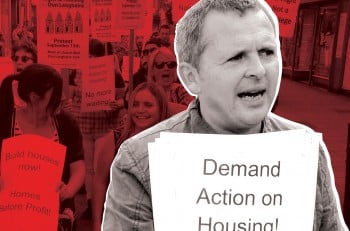
    Issues-driven socialist. Michael Smith interviewed Richard Boyd Barrett

    Richard Boyd Barrett is TD for Dun Laoghaire for the Trotskyist People Before Profit (PBP) Party. He is a member of the Socialist Workers Party and will stand for the alliance of that party with the Socialist Party (SP), to be called AAA-PBP in next year’s general election. He is the son of eminent thespians, Vincent Dowling and Sinéad Cusack. He was adopted and grew up in Glenageary, attending St Michael’s School. He is issue-oriented and self-effacing though usually eloquent and has managed to avoid personal scandal throughout his time in politics. Boyd Barrett has a long record of campaigning for improved local services, social housing, youth and community amenities, workers rights and jobs. I met him in his huge office in Agriculture House on Kildare St. The size is no doubt in proportion to its distance to some other accommodations actually in Leinster House, perhaps reserved for politicians closer to the beating heart of government. He is friendly, original, clever and bright-eyed, though in a rush this morning. I wonder what his background is. “I grew up in the Dun Laoghaire area from a middle-class background, with no particular intention of getting involved in politics but started to get involved in it through the music scene, it was all about music and clothes, and I was involved in punk”. I ask if he was one of the Dun Laoghaire Shopping Centre gang and he actually admits it. “I spent a lot of time there. It was great fun”. I don’t say that I remember getting into a scrap with a horde from there in 1978 and finishing up with a pint of gob on my neck, a pint which in my mind’s eye remains as fresh and green as when dispatched. Richard is probably too young to have been behind this, I reflect, and try not to think about it any more. Plus he’s chair of the Irish Anti-War Movement. He says punk was great fun. He had the punk hair, “Statue of Liberty hair, tartans, bondage jackets”. It was political. “There was a political dimension: anti-racism, anti-nuclear, all that“. He got involved in politics initially while a student. He studied English, Philosophy and Psychology in UCD and got a Master’s in English Literature. He’s a big fan of James Joyce, and has given talks about him. And he’s very passionate about “Shakespeare and romantic poetry and you know, everything”. He still reads fiction and poetry. He says his political philosophy is “Socialist” and I ask how important is equality and what does he mean by it. “I dunno that’s sort of technical jargon to me”. He sighs. “Equality is when everybody has the same access to resources, services, opportunity and the income capable of giving them a decent and dignified existence”. To what extent to you have to compensate for the disadvantages of birth? “I want to remove the disadvantage, to change the conditions that lead to it. That’s what being a Socialist is about. If you begin with less resources you should be compensated to bring about an equal playing field”. I note that he’s just given a speech about equality-proofing the finance bill and ask what the best measures of equality are – eg the Gini Coefficient – but it’s not his thing. He’s good-natured about this. “If you don’t have proper housing, decent services and infrastructure you’re at a big disadvantage”. When asked he says that his first actions if he were Taoiseach would be to deal with housing. He’s more interested in the manifestations of inequality than the theory of it. “The practical battle for equality”. So what does that mean? First of all he’d take housing, health, education and basic services out of the private sphere and provide them as a right, not for-profit, speculated on and commodified. He’d have participatory direct democracy. I suggest taxes should rise. Because of the concentration of wealth over the last decades in the hands of a few he envisages wealth taxes. And financial-transaction taxes and taxes on higher incomes. He says he’s “not majored” on Capital Acquisition and Capital Gains Taxes, which seems to me like an error: “Our strategy is to capture it through a wealth tax”. It would be on assets over a million euro, not on the family home”. He’s determined to acutely distinguish the family home from property assets. I suggest that just as income is an impure but useful indicator of wealth because some people have debts or maintenance commitments, that a valuable family home is an impure but useful indicator of wealth, and therefore should be taxed, but he will have none of it. “There are huge anomalies – and all the reports including Credit Suisse’s show there’s a connection between wealth and high income”. I suggest there must be a correlation between having a big house and wealth but he insists: “not particularly. In my area, Ballybrack and Sallynoggin, working-class areas, houses have a high value and it’s the same for the rest of Dublin and urban centres generally”. I suggest that if it’s legitimate to tax to redistribute to promote equality that it’s also legitimate to tax for other progressive policies such as reducing pollution or unhealthy eating. His answer is strong if unfashionable. “I don’t subscribe to the neoliberal view that tax can be used to incentivise behaviour. Taxes are to achieve redistribution of wealth”. Bluntly he does not think property and water taxes are a good idea in principle or otherwise. “No-one should never be charged for water. If you do, privatisation will inevitably follow. So I’m against it for that reason. It’s a basic need not a commodity”. I ask him for his political heroes and he volunteers Connolly, Larkin, Marx and, when probed for someone (fairly) contemporary, John De Courcy Ireland – “a big local influence”, maritime historian, founding member of Irish CND and and one-time member of tbe Labour, Workers’ and Socialist Workers’ Parties. Non-political heroes? “I’ve mentioned Joyce”. He laughs: “Jeez

    Loading

    Read more

  • Posted in:

    Was it for this? The legal profession is anti-competitive, over-priced and more influential than is healthy in a Republic.

    It has traditionally been difficult enough to like lawyers, except your own. Ask any taxi driver. And now this. The Legal Services Regulation Bill The consumers’ website ‘Rate-Your-Solicitor.com’ was a window on frustrated public legal detestations. It was closed in 2012. Guess by whom? On the order of a judge because it contained defamatory material about one individual. The forerunner of the Law Society of Ireland (LSI), the solicitors representative body, was the suggestively named Law Club of Ireland, founded in 1791. Some would say the LSI is still too like a club, too little like a machine for justice. Solicitors have been mollycoddled. In her book Bust (2010) Dearbhail McDonald showed some of what this meant: “A roll-call of dodgy solicitors has been hauled before the Solicitors Disciplinary Tribunal (SDT) and into the courts, heaping shame on the legal profession and calling into question the efficacy of the LSI’s regulation of solicitors”, she wrote. For instance, Michael Lynn who fled Ireland in 2007 after the LSI closed down his firm and asked the High Court for a bench warrant for his arrest is now incarcerated in Brazil facing extradition. Lynn had used clients’ funds to fund his extravagant lifestyle, and abused solicitors’ undertakings in order to obtain multiple mortgages on the same properties. Thomas Byrne’s practice was also closed down by the LSI, and he is currently serving twelve years in jail for fraud which involved stealing from clients and abusing undertakings to a value of almost €60 million. Like Lynn, Byrne also had a history of previous misconduct. The LSI had prohibited him from being a sole signatory on client accounts in 2002. Then in 2005 it found that €1.7 million was missing. Incredibly he was merely fined €15,000 and allowed to continue in practice, a sanction which was not appealed by the LSI. At times the LSI may exercise poor judgement in pursuing certain practitioners, and failing to adequately examine the motive of a colleague who initiates a complaint. The Kenmare-based solicitor Colm Murphy recently claimed in a detailed submission to the Supreme Court, that his striking off was based upon spurious and inaccurate information which was provided by the LSI and SDT to the High Court ten years ago. The claim by Linda Kirwan of the LSI that he had breached an undertaking he had supposedly given to the President of the High Court was instrumental in his strike off. In an affidavit seen by Village, Kirwan insisted that she had been in the High Court on the day the undertaking was supposedly given. It was only after Murphy was struck off that she admitted, on affidavit and in a letter to Murphy in 2010, that she was not in fact in the court when the supposed undertaking was made. No such undertaking is recorded in the order from the court issued on the day in question. Murphy was also able to prove, again following his strike off, that the LSI had in part relied on a document forged by rogue Frank Fallon who was subsequently jailed for two seven-year terms. The problems are not all down to fraud. Conflicts of interest are the issue for the biggest firms. Arthur Cox, Solicitors, did well from the Fianna Fáil/Green government and no less well from its successors in Fine Gael/Labour. Arthur Cox has been perceived as guruishly close to Fianna Fáil: at one stage the Irish Independent’s Sam Smyth even speculated that Brian Cowen might ultimately join Cox’s, headed by his college class-mate Eugene McCague. In 2010 Arthur Cox was engaged by the NTMA to draft the legislation creating NAMA after it submitted the lowest tender for the services though there was no reason the work could not have been handled by the Chief State Solicitor’s. At the time Arthur Cox commented, ‘‘Once Nama is established, there is undoubtedly potential for conflicts of interest to arise for any firm working with NAMA in its transactions with banks and property owners. This is not what we have been appointed to do”. Nevertheless the Comptroller and Auditor General reported that from ” According to the Competition and Consumer Protection Commission (CCPC), the proposed legislation to regulate solicitors and barristers was subject to a veto from those professions over its provisions: “The views of the Law Society and the Bar Council have been privileged over those of the consumers of legal services – the clients of the legal profession”. September 2009 onwards, Arthur Cox was billing NAMA for €40,000 per month, its biggest retainer. The Department of Finance and its agencies paid a staggering €15m to Arthur Cox alone over the five years to 2012 for legal advice on the bank guarantee scheme, recapitalisation issues, nationalisation, NAMA, restructuring plans and the eligible liabilities guarantee scheme. Law Society Regulations for solicitors state that ‘‘if a conflict of interest arises between two clients in a matter in which the firm is acting, the firm must cease to act for either client in that matter.” However, in exceptional circumstances, one of the clients may consent to the other client remaining. Arthur Cox claims to operate ‘Chinese Walls’ for such clients. For example, once the legal advisor to Anglo Irish Bank, Arthur Cox discontinued to provide legal services to them when hired by the Government to advise on the Bank Guarantee. But it continues to advise Bank of Ireland. Even when that makes it lawyer for the sellers of loans (Bank of Ireland) and for their purchasers (NAMA). More recently though none the less controversially Arthur Cox also represented Siteserv and Millington (Denis O’Brien) both during the sale of Siteserv. An internal investigation found there was no conflict of interest. The LSI is nowhere close to being able to call Arthur Cox to account for conflicts of interest. 187 complaints were received by the LSI in 2012, an increase of over 30% on the preceding year. Its Tribunal made referrals to the High Court in 57% of the cases. Conveyancing, at 56%, dominated

    Loading

    Read more

  • Posted in:

    Profile: Treasury Holdings and Johnny Ronan

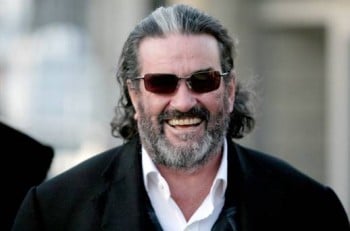
    The Treasury boys are back.  Without Treasury. Great.  Richard Barrett is reported to be deploying two billion euro of investment in property and Johnny Ronan has paid Nama back and is back in business all  over town.  He’s even found time to make reference to Nazi slogans in pinpointing the injustice done to him by Nama and to get the Banking Inquiry to pull its criticism of him, lest he perhaps injunct it from publishing. The Irish Times misreported in September 2015 (and has still not corrected the error) that Treasury had “exited Nama” but in fact Treasury went bankrupt owing €2.7bn, €1.7bn to Nama alone.  This suggests they cost the country around €7oom. Johnny Ronan may have bought out his personal loans but Treasury benefited from the socialised capitalism for market losers that is the bankruptcy regime.  No swaggering market icon, Treasury. Treasury  – Johnny Ronan and Richard Barrett, inspired awe and respect in financial, political and media circles but I have had reason to be circumspect, myself, over the years. Johnny is an accountant whose father was a wealthy pig farmer in Tipperary and whose cousin is Vita Cortex’s Jack Ronan. Richard comes from a family of Ballina millers. They were at school together in Castleknock College. Treasury once had little Dublin at their feet. I first met Richard and Johnny in the mid-nineties when they were developing the Hilton (subsequently Westin) Hotel on Dublin’s College Green. I was opposing their plan for the biggest destruction of listed buildings in Dublin since the 1960s. After they got their permission from An Bord Pleanála, an academic advised us that they should clearly have carried out an Environmental Impact Assessment (EIA) because of the significant “nature, size and location” of the ‘project’. We decided the scheme was unsustainable and uncivilised, Treasury’s attitude cocky and the planning authorities’ flouting of the law on EIA outrageous – so we would attack their scheme in the courts. Treasury, it was said, were vicious, and were involved in twenty-six other sets of litigation around town. An Taisce, which I had been representing, didn’t want the risk of a devastating legal-costs order, we didn’t want the inevitable PR storm to blow away vulnerable individuals and we didn’t want personal legal liability for costs, so we formed a company. We had little time so we got a pre-formed ‘shelf’ company, the chivalric-sounding, “Lancefort’. After 47 appearances in the High-Court and six days in the Supreme Court, Lancefort lost its case on the primary ground that, although it was okay to litigate through a company that had not even existed at the time of the Bord Pleanála decision which it was challenging, the protagonists in the company, primarily I, should have raised the need for an EIA before An Bord Pleanála. The chief justice Ronan Keane seemed to imply I had known of the point at the time, even though I did not, and there was no evidence to that effect. Usually the Supreme Court is very careful not to invent or infer false facts. Furthermore European law clearly states it is the obligation of the authorities to conduct the EIA. The Lancefort decision is generally, by academics and practitioners, accepted as wrongly-decided. Since that time – 1997 – EIA (and its plan-focused counterpart (SEA)) has taken off as a tool for residents and environmentalists in assessing the impact of what is being imposed on them – if only because it often requires photomontages of the proposed schene and an indication that the developer fully considered the alternatives. During the campaign we were assailed by Treasury and their PR team – and I guess since Johnny Ronan reckoned we cost them 6m Euro, we were fair game. Irish Times environment correspondent, Frank McDonald, is sometimes one of the most acute and courageous commentators on these matters. But he was close to Richard Barrett – as well as to some of us in the campaigning sector, and he wrote several damaging reports including pieces misrepresenting our European Law stance in a way that was likely to annoy Irish judges, mis-stating the numbers of listed/historic buildings on the site and giving extraordinary coverage to the supporters of the scheme – including a fawning profile of the ‘conservation’ architect who was writing off the value of some of the buildings to the benefit of Treasury, in an interview under the headline “Keeper of the Past”. When we lost the case Frank McDonald in the Irish Times quoted Richard Barrett saying “his [ie my] house is gone” and that “I” faced legal costs of £1m. In fact we were always going to escape the costs of the case because the company was a separate vehicle from its directors, which at various stages included, apart from me, heritage activists Garret Kelly, Ian Lumley, Tony Lowes and in the end my gamey brother. Nonetheless Lancefort finished up comprehensively liquidated. Treasury later boasted that “certain opponents of ours have underestimated our ability to cause legal havoc to their detriment”. Probably true. At one stage when the publicity was bad and the case looked fragile, we had discussions with Johnny Ronan about settling our case and it appears some of our lawyers got further with instructions we gave them than we had understood. We were then skewered by Matt Cooper in the Sunday Tribune and Cliodhna Ó’Donoghue, editor of the property section of the Irish Independent, in aggressive but not entirely unfair features that made it sound like we were seeking money for ourselves rather than building-conservation causes (which we were not). We had discussed a wide range of possible resolutions ‘without prejudice’ and got nowhere close to agreeing any of them. It emerged a little later that Cliodhna Ó’Donoghue was the beneficiary of a glittering Italian trip paid for by Treasury in 1998, an extravaganza involving a Pavarotti performance I seem to recall. I was invited by current affairs magazine, Magill, to write about all this for a new ‘rant’ column it was

    Loading

    Read more