Ireland

Random entry RSS

  • Posted in:

    UNrealistic

    At the end of last September, under the shadow of the glimmering New York skyline overhead, the world celebrated the dawn of a new era. The UN Summit on the Sustainable Development Goals (SDGs) concluded with a massive party in Central Park, graced by the presence of superstars such as Ed Sheerin and Beyonce. The party was sponsored by Gucci, Citi, Unilever, Google and others. Many of their super-rich executives could well have been watching the party from their high-rise apartments in that most elegant part of the planet. Some people had paid upwards of $10,000 for VIP passes to the party. All proceeds went to charity, of course. There was no whiff of a world on the brink of collapse, threatened environmental destruction and violent extremism, the one that had been so eloquently articulated by Pope Francis in his landmark address to the UN General Assembly the previous day. The gap between the optimistic, almost euphoric atmosphere in some UN quarters and the pessimistic, almost despairing perspectives of others, including Pope Francis, was palpable at the Summit. On the one hand, famous business moguls, UN officials and many states, including Ireland, lined up to hail the goals as a new beginning. On the other hand, many wondered whether yet more goals would make any difference at all or even whether they would take us in the wrong direction altogether. Whatever your perspective, the SDGs are now a universally agreed UN document. For the most part, they set out important objectives for the world, 17 in all. They point to all the critical areas of human development that must be addressed if we are to tackle inequality, poverty and environmental destruction. They set 167 indicators of progress which are to be monitored and followed up annually. Importantly, for the first time ever, they promise to “leave no-one behind” and put a deadline of 2030 on achieving that goal. While as individual objectives the SDGs are desirable, as a global policy framework they are deeply flawed in at least four ways. Firstly, the sheer number of goals agreed and the lack of real interconnection between them has turned them into a shopping list. Everything becomes equally important. Yet the truth is that global imperatives exist. There are critical enablers which everyone needs to address alongside second-level priorities, which can be reached only on condition the first are being achieved. So the SDGs create a kind of policy fog in which it is hard to see the wood from the trees. Secondly, despite years of debate, the goals fail to resolve the decades old conundrum of sustainable development. This is the fact that ‘economic’, ‘social’ and ‘environmental’ dimensions do not really sit side by side or form interlocking circles. The ‘economic’ and the ‘social’, in reality, are dependent on the ‘environmental’. We need to move away from the inadequate cliche of interlocking circles to a ‘doughnut’ model as put forward by Oxfam. There is no overarching agreement in the SDGs that we need to move towards a world which lives within planetary boundaries. This is a real opportunity lost. Thirdly, however worthy the SDGs are, they are weak voluntary initiatives rather than an international treaty. Of course, voluntary initiatives have an important role in setting norms, but they only thrive when the environment is conducive to their realisation and are matched by strong implementation measures. The goals are debilitated by dysfunctional power structures, which render them a side-show, if not quite irrelevant to the main drivers of power. Unfortunately, important policies are being actively promoted by the same states that signed up to the SDGs and whose actions elsewhere directly contradict many of the goals. One alarming example is the emerging rules on global trade and investment, epitomised by the Transatlantic Trade and Investment Partnership (TTIP), which is being negotiated between the EU and USA. Controversial proposals within TTIP include Investor State Dispute Settlement mechanisms. These will effectively facilitate MultiNational Corporations to circumvent domestic court systems and sue sovereign states through a confidential arbitration mechanism in challenging governments for introducing regulations that in multinational businesses’ view harms their interests or profit margins. This raises concerns about the state’s right to regulate on a wide range of public policies, including extreme poverty and environmental standards. SDGs do not even enter into these negotiations. Another example is continued state subsidies and investments in fossil fuels. If remaining below the agreed 2°C-increase target for global temperatures is to be possible, a basic pre-requisite for the SDGs, 80% of known remaining fossil fuels need to remain under ground. Yet in 2014 the global economy missed the decarbonisation target needed to limit global warming to 2°C for the sixth year running. Fourthly, the respective roles of the state and the private sector in SDG development and implementation is deeply concerning. The visibility of the private sector and the pledges made in New York reflect the way that major corporations have managed to skew the agenda. One official pledge made by MasterCard at the SDG Private Sector Forum to bring 500 million people in the developing world into the credit market, thus enabling them to achieve Goal 8, is indicative of this. A pick-and-mix approach to the SDGs is already evident, facilitating corporations to use them to their marketing advantage while not addressing basic human rights and issues such as lack of accountability. The UN appears to have already relinquished control of its own message about the SDGs to the corporate sector through its ‘Global Goals’ campaign. This was launched during the Summit. In signing a licensing agreement for the Goals with key sponsors such as Gucci, Citi and others, it effectively delivered the SDGs, a key global public good, into private ownership. A clause in the campaign agreement means that those who use the goals’ branding must do so in ways which do not damage the partner brands. Technically speaking, therefore, if an NGO such as Trócaire or Christian Aid, draws attention to the systemic problems of corporate power whilst using the goals’ branding, they are in breach of the licence. Though it

    Loading

    Read more

  • Posted in:

    Review: Faith in Politics by John Bruton

    John Bruton (Taoiseach 1994-7, Minister for Finance 1981-2, 1986-7) has a book out. His publisher, Currach Press, suggested journalists might like to interview the lively former Taoiseach. I signed up and an appointment was arranged. The morning of our interview the man from Currach texted to say Bruton was concerned it should be primarily about the book and then half an hour later to say there was bad news, Bruton would not do it and he would not say why. I said I’d do it by email and was mostly interested in the book. Currach said they would get back to him. But I heard no more. Rude. Maybe he was worried I’d ask him about Cherrywood. In 2006 Bruton told the Mahon (Planning) Tribunal that a donation of £2,500 to him as party leader was received from Monarch Properties in November 1992, during the general election campaign. At that time I was campaigning against a make-or-break rezoning scheme being pursued by Monarch for 234 acres in Cherrywood, Co Dublin. Most Fine Gael County Councillors had not supported the rezoning in 1992 but they would vote for it in 1993: in addition to Bruton, nine out of the 12 FG Councillors who would talk to their party’s internal Inquiry in 2000 admitted receiving money from Monarch or Frank Dunlop (or both) in the 1991-1993 period when I was concerned with the Cherrywood vote. Monarch’s boss, Phil Monahan, had told me he was paying Councillors for rezonings and that many of the Fine Gaelers would vote against it in 1992 but in favour (when it really counted) in 1993. Monarch was duly found by the tribunal to have obtained the rezoning corruptly. During the 1997 general election campaign, the party received a further cheque for £3,800 from Monarch Properties. Later Bruton said he had not tried to “whip” Fine Gael Councillors on 78-member Dublin County Council though he had pressured his 19 party councillors to act coherently when he met them in September 1993: Councillor Mary Muldoon told him that acting coherently would require the minority of non-rezoners moving to back the majority of rezoners. The Council rezoned the Monarch lands shortly afterwards, in November 1993. According to leaflets we produced at the time FG voted 7:7 on the up-zoning in 1992. By 1993 their vote was 12:5 in favour. Why did so many change their minds? The torpid tribunal never asked. Frank Dunlop informed the planning tribunal that he had told Bruton about demands for a £250,000 bribe made to him by a Fine Gael councillor, Tom Hand, to rezone the Quarryvale development. Dunlop testified that Bruton replied, “There are no angels in the world or in Fine Gael”. Bruton vehemently denied this but, following further inculpatory evidence at the Tribunal, returned and conceded that “it gradually came back to me”, that Dunlop, “did say to me something about a councillor looking for money”. He acknowledged that he did not investigate the matter because he had found the story told to him by Dunlop “exceptionally hard to believe”. Anyway the book: Faith and Politics: I couldn’t really see the connection. Bruton is is an intellectual by Irish political standards but he’s wrong to endorse GK Chesterton’s illogical comment that “When a man stops believing in God he doesn’t believe in nothing, he believes in anything”. It is good to see an assiduous Christian Democrat recognise that freedom is no alternative to ethics, as it says nothing about how we should treat one another. He’s right the Rising probably held back a 32-County consensual Republic, and that support for “our gallant [Axis] Allies in Europe” weakened our case for independence, at the 1919 Paris Peace Conference. He’s right that the obligation on Northern MLAs to declare themselves Nationalist or Unionist is now holding back a new politics that transcends history. He’s wrong to even contemplate that we can burn all the fossil fuels left in the world. I hadn’t realised how consistently the EU had emphasised the need for economic and monetary union and (as far back as the 1971 Werner report) that it would involve EU involvement in domestic economic policy. It’s interesting that a man of Bruton’s experience considers a third party in coalition can mitigate tensions. Sometimes he is demonstrably illogical as where he claims that 30 minutes daily spent on religion in schools has not reduced Irish educational attainment because we have been doing it for generations and the reductions are only recent; but then claims that teaching Irish, which we have also been doing for generations, has reduced educational attainment. Some of his articles seem hastily put together, like the ill-thought- through views on ‘waste’ and the half-baked views on Ireland’s “strengths and weaknesses”. And more generally it’s unwise for an ex-Taoiseach to preach the need for Irish people to do more with less when he has a public-sector pension of €141,849 and, perhaps because he’s getting a six-figure salary as president of the IFSC, to obtusely advocate reining in regulation of the banks. Michael Smith

    Loading

    Read more

  • Posted in:

    Legal affairs

    Village is loth to get into the salaciousness that drives the professional classes in decadent Dublin. Nevertheless the integrity of the judiciary, and indeed the perception of that integrity, has to be beyond doubt and a story unfortunately came our way which challenged it, anonymously, and was accompanied by affidavits submitted for in camera family proceedings. A bankrupt developer with an alpha personality and omega ethics alleged in the affidavits, which he was never allowed to open in court, that Irish High Court and Supreme Court judgments against him were tainted with bias because the lead Supreme Court judge in his case had an alleged affair affair with the High Court Judge who determined the matter originally, and that the Supreme Court judge anyway had shown in dealings with him in the judge’s former life as a barrister, that he despised him. The developer’s affidavits are clumsily drafted and he is careless as to whether the relationship may have continued at times when the Supreme Court judge heard the action – on occasion fudging the tenses about the timing of the relationship. Nevertheless as a matter of fact the relationship had ended by the time of the Supreme Court hearing, even if it had subsisted, insignificantly and irrelevantly, during the High Court hearing. The High Court judgment was persuasively damning of the developer personally, finding he had deliberately and fraudulently failed to make certain disclosures and misled the court and his ex-wife. The developer claimed he had been in the process of preparing disclosures when a settlement was reached that obviated the necessity for him to make the disclosures. But the High Court, on the facts, said there was no evidence of this. He had engaged in litigation misconduct. The appeal was fast-tracked to the Supreme Court but took four years to be heard. At the last minute, the Supreme Court panel of judges was apparently changed, with the particular Supreme Court justice who had allegedly had the affair stepping in to replace a judge who had been originally listed to sit. The developer claims to have been wrong-footed by the change between the judges and would have aimed to pre-empt the Supreme Court judge sitting on the matter had he known he intended to do so. He claims he had already advised his solicitor of the potential for the judge being compromised. His legal team noted that day one of a two-day appeal was already over, and they didn’t dare question the judicial etiquette. The Supreme Court upheld all the High Court’s substantive reasoning. When the judge endorsed his alleged former lover’s strong judgment without – according to the developer – “canvassing” all the developer’s fundamental grounds, the developer sought redress on grounds that there was a reasonable suspicion of objective or apprehended bias. Justice must not just be done but be seen to be done, was the cry. However, these days thankfully an alleged affair between judges that may have been finished for years does not constitute, or rather does not necessarily constitute, a reason for the appellate judge to refuse to hear an appeal of his former lover’s judgment. For obvious reasons the developer had difficulty getting any Irish lawyers to take on his prurient case. In the end he sought help from UK barristers but ultimately the Official Assignee in Bankruptcy successfully objected to the developer taking a judicial-bias challenge because he was bankrupt and therefore lacked the standing to take the case. The Assignee in Bankruptcy took the reasonable stance that even if the judgments were overturned it would not be appropriate for the Assignee, who alone could take the decision do so, to refight the substantive issues of fraud, failed disclosure etc on the part of the dubious developer. Even if the unsubstantiated allegation of bias could be proved, it would achieve nothing, for the case was not worth re-running. Michael Smith

    Loading

    Read more

  • Posted in:

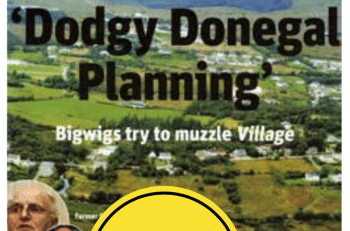
    Planning in Donegal

    Gerard Convie is a man who wears sober ties and measures his words. He worked for the County Council in Donegal, once Ireland’s most beautiful and wildest county, as a senior planner for nearly 24 years. He has claimed that during his tenure in the Council planning irregularities were perpetrated by named officials at the highest level in the Council. He claims these included former Manager Michael McLoone – who has initiated defamation proceedings against Village magazine (though we’ve heard nothing in a year) – as well as named county councillors. Convie had a list of more than 20 “suspect cases” in the County, a ‘cesspit’. Two years ago the government initiated a review of his allegations. Then a Minister dismissed them as lacking substance and closed it down. Convie claimed this made him look bad and sued. And got a payout and – in September – , the appointment of a senior lawyer, Rory Mulcahy to look into his allegations. The ‘review’ [by god is this not an Inquiry or Tribunal] is non-statutory ie makey-uppy and Minister Alan Kelly has reserved the right for himself or his successor not to publish its findings. So he has provided in surprisingly hazily- drafted terms for review of “all written allegations received in the Department in relation to certain planning matters n [sic] respect of Donegal County Council”. Originally the terms contained a confidentiality clause but following further correspondence this seemed to disappear. In November, Convie expressed his concern that his evidence may be shared beyond the ‘review” and said he considered the change may represent “bad faith” and even “affect my continued cooperation with the exercise”. The terms also fail to make it clear if it will address impropriety ie corruption or just ‘bad practice’’ie incompetence though if it does not address impropriety it’s possible that Convie will feel slighted and have another payday.

    Loading

    Read more

  • Posted in:

    If we can borrow it, we will spend it

    Two recent events highlight the true nature of the ongoing Irish economic recovery. Firstly, ahead of the infamous Ireland-Argentina Rugby World Cup match, the press office of the main governing party, Fine Gael, produced a rather brash infographic. Charting projected growth rates in real GDP for 2015 across all Rugby World Cup countries, the graph put Ireland at the top of the league with 6.2 percent forecast growth. “FACT: If the Rugby World Cup was based on economic growth, Ireland would win hands down”, shouted the headline. Having put forward a valiant performance, the Irish team went on to lose the game to Argentina, ending its incipient ascendancy. Secondly, within weeks of publication, Budget 2016 – billed by the Government as a programme for the ‘New Ireland’ – has been discounted by a range of analysts, including those with close proximity to the State, as representing the return of a fiscal policy of …electioneering. Worse, judging by the public opinion polls, even the average punter out there has been left with a pesky aftertaste from the political wedding cake produced by Merrion Street on October 13th. Tasteful or not, the public gloating about headline growth figures and the fiscal chest-thumping that accompanied Budget 2016 did not stretch far from reality. Official growth is roaring, public finances are in rude health, and the Government is back in the business of handing out candies to kids on every street corner. The air is filled with the sunshine of recovery and talk about the Celtic Tiger Redux is back on the menu for South Dublin along with the fennelised lamb. Ireland by the numbers On budget day the government projected full-year 2015 inflation-adjusted growth of 6.2 percent followed by 4.3 percent in 2016. Extraordinarily optimistic, “one minister acknowledged that the growth figure for this year is likely to end up nearer to 10% than the 6.2% estimated just 6 weeks ago”, according to a story on the front page of the Sunday Business Post in late November. Much less optimistic, the IMF has the figures at 4.9 percent and 3.8 percent, respectively. Still, this ranks Ireland at the top of the advanced economies’ growth league, with second place Iceland at 4.8 percent and 3.7 percent, respectively. The only other advanced economy expected to post above 4 percent growth in 2015 is Luxembourg. Which is dramatically telling: of all euro-area member states, the two most exposed to tax optimisation schemes are growing the fastest. Though only one has a Government gushing publicly about that fact. No medals for guessing which one. The problem is: the headline official GDP growth for Ireland means preciously little as far as the real economy is concerned. The reason for this is the composition of that growth by source and, specifically, the role of the Multinational Corporations trading from Ireland. We all know this, but keep harping on about the said ‘metric’ as if it mattered. Based on the figures for the first half of 2015 (the latest available through the official national accounts), the Irish economy grew by €6.4 bn or 6.9 percent in real GDP compared to the first half of 2014. Gross National Product, or GDP accounting for the officially declared net profits of multinational companies, expanded by a more modest 6.6 percent over the same period. Other distortions arising from this structural anomaly at the heart of the Irish economic miracle are the effects of foreign investment funds and companies on the capital side of the National Accounts. Back in 2014 the European Union reclassified R&D spending as investment, superficially inflating both GDP and GNP growth figures. Since then, our investment has been booming, outpacing both job creation and domestic public and private sector demand. In more recent quarters, capital investment has been outperforming exports growth too. Which compels a question: what are these investments about if not a tail sign of corporate inversions past and a forewarning of the changes in the pattern of economic output in anticipation of our heralded ‘Knowledge Development Box’? Beyond this, the legacy of the financial crisis has compounded the artificiality of growth statistics. Irish ‘bad bank’, Nama, and its vulture-fund clients are aggressively disposing of real estate loans and other assets bought at regrettable cost to the taxpayer. Any profits booked by these entities are counted as new investment here. Once again, GDP and GNP go up even if there is virtually nothing happening to buildings and sites which are being flipped by these investors. And while we are on the subject of the old ways, last month Ireland was announced as the domicile of choice for an upcoming merger between Pfizer and Allergan – two giants of the global pharma world. Despite numerous claims that Ireland no longer tolerates so- called ‘tax-driven corporate inversions’ (a practice whereby US multinationals domicile themselves in Ireland for tax purposes), it appears that we are back in the old game. Just as we are apparently back revenue shifting (another corporate tax practice that sets Ireland as a centre for the booking of global sales revenues despite no underlying activity taking place here), as exemplified by the Spanish Grifols announcement earlier in October. Just when we thought we were out they pull us back in! All of these growth sources also benefit from the weaker euro relative to the dollar and sterling, courtesy of ECB printing presses. Looking at the national accounts for January-June 2015, Gross Fixed Capital Formation accounted for €3.8 bn or almost 60 percent of total GDP growth over the last 12 months, and nearly three quarters of total GNP growth. In simple terms, the real economy in Ireland has been growing at closer to 3.5 or 4 percent annually in 2015 – still significant, but less impressive than the 6-percent-plus figures suggest. exchequer kindness Still, the above growth has worked well for the Irish Government. In the nine months up to September 2015, Irish Exchequer total tax receipts rose a strong €2.75 bn, or 9.5 percent year-on- year.

    Loading

    Read more

  • Posted in:

    The limits of Aestheticism

    Robert O’Byrne is an aesthete – possibly Ireland’s only one, a writer specialising in the fine and decorative arts. He is the author of more than a dozen books, among them ‘Luggala Days: the Story of a Guinness House’; a biography of Sir Hugh Lane; ‘A History of the Irish Georgian Society’; a ‘Dictionary of Living Irish Artists’ and ‘the Last Knight: A tribute to Desmond FitzGerald, 29th Knight of Glin’. In addition to really loving things that relate to the Guinness and FitzGerald Families and the Irish Georgian Society (IGS) which they have led, he writes a monthly column for Apollo magazine and also contributes to the quarterly Irish Arts Review. He publishes a blog called “The Irish Aesthete. This is not an oxymoron”. Tragically for O’Byrne, of course, it is. But this is the least of the issues currently challenging his sensibility. The ascent to pure aestheticism inevitably took some time. After an international childhood and schooling in Gonzaga, during its own aesthetic epoch, he served in a Jesuit novitiate in the early 1980s. In 1986 O’Byrne became the first director of a pilot project in music promotion, Music Network, which some years ago scooped a U2 funding jackpot. In the 1990s he worked as a staff journalist for the Irish Times, often writing about fashion: “Robert O’Byrne’s three-part series on major trends for the season ahead: think long, think luxuriant, think languorous”. He scraped an extended niche for himself arbitrating style more generally: “the most shocking feature of the cluster of Carrickmines houses sold in Dublin last month for some £1 million each was not the price paid nor the speed with which the properties were reserved, but the unrelieved banality of their design”. At the height of the debate on one-off housing debate in the early 2000s he wrote – reflecting his peculiar if consistent focus – ignoring considerations of good planning or sustainability that: “the debate needs to be not about whether development should take place, but about the design and character of that development”. And sometimes he took his taste out of the stuffy walls of journalism onto the streets. In September 1998 he could be found launching ‘Dublin Style: An Insider’s Guide to Shopping’. In the mid to late 1990s he impurely served as the Times’ gossip columnist, hosting a horrible page at the back of the Weekend supplement that mirthlessly celebrated the country’s nouveaux glitterati. He also covered antique and art sales for the Irish Times, with some style. The Irish Times still indeed allows him the occasional essay such as a recent erudite sashaying review of a book on the history of Irish wallpaper, for which all proceeds go to the IGS, though neither O’Byrne nor the Irish Times felt the need to declare his connection to the IGS. O’Byrne’s prose is often original and the judgement sharp, in his columns and on his blog. The blog has a cohort of fans, often genuinely double-barrelled, who outdo one another in obsequiousness. Not unrepresentatively, during 2015 the Irish Aesthete will be visiting one Irish town every month – to berate its architectural neglect. O’Byrne has lots of considered opinions. In a recent collection of essays concerning the FitzGeralds of Carton House, he was hammered by Dr Terry Dooley of Maynooth for criticising its late housing-estate strewn incarnation as one of those “ill considered conversions into spa hotels and golf resorts”. However, his usual percipience can let him down as when he equivocated in the controversy over the recent removal of sculptural busts from the entrance hall at Bellamont Forest House in Cavan, despite the evidence proving them to be integral to the design of this internationally important house by Sir Edward Lovett Pearce. Crucially, O’Byrne himself moved to the rarefied setting of Palladian Ardbraccan House near Navan where he lodges in one of the wings. As befits an aesthete whose oeuvre so often touched on its members, and its causes, O’Byrne is Vice President of the Irish Georgian Society (IGS), a membership organisation whose purpose is to promote awareness and the protection of Ireland’s architectural heritage and decorative arts. A fully illustrated book by Robert O’Byrne on the society’s first 50 years was published in 2008 and he has comprehensively ingratiated himself. If anything all had been looking well for his further elevation. O’Byrne was until recently the IGS’s representative on the board of the Alfred Beit Foundation which owns the Palladian Russborough House in Co Wicklow. Sir Alfred Lane Beit, honorary Irish citizen, was a British Conservative Party politician, art collector and philanthropist – nephew of Alfred Beit, a South African mining millionaire from whom he inherited a vast fortune including a large number of Old Master paintings. In 1952, he and his wife, Clementine Mitford, moved the art collection to Ireland. It comprises many of the paintings assembled by the Beit family from the late nineteenth century. While he eventually presented the major works to the National Gallery of Ireland, the remaining collection, along with Russborough itself, was bequeathed to the Alfred Beit Foundation (ABF) which was established in 1976 with a board of trustees. The sale of 350 acres of land at Russborough in 1978 afforded an endowment of almost £400,000 or around €4m in current values. It is not known what has become of this original endowment, but the ABF is known to have been struggling for some time, despite receiving regular handouts from the Apollo Foundation, a London-based trust associated with the Beits, and substantial grants from the Heritage Council and Fáilte Ireland. The ABF has been operating at an annual loss of €300,000 (2013). Certainly this is a problem but there is no sense the costs are being reviewed or that dynamic fund-raising is in place. A substantial salary is paid to a chief executive who oversees an uninspiring, if rising, 24,000 annual visitors to the house. In 2006 a collection of 62 early Italian bronzes was sold for €3.8m and fourteen oriental ceramics were sold

    Loading

    Read more

  • Posted in:

    Planning tribunal legal farce dissipates public funds and fails to address full truth

    Twenty years ago Colm MacEochaidh and I offered a reward of £10,000 for information leading to the conviction of persons on indictment for rezoning corruption. I had spent a year campaigning against a controversial rezoning of attractive fields in Cherrywood, Co Dublin, pushed through in murky circumstances by Monarch Properties which was subsequently found to have acted corruptly. I wanted to get to the bottom of it. We needed to do something dramatic as a) tribunals had been discredited following the weak Beef Tribunal report and b) there was a perception – following an Irish Times investigation by Frank McDonald and Mark Brennock (George Redmond’s son-in-law), billed as ‘Fields of Gold” which had managed to name one, but only one, dead (and therefore defenceless), councillor as corrupt – that planning corruption was a ball of smoke. Our anonymous stratagem was fronted by Newry Solicitor, Kevin Neary. He eventually received 55 separate sources of information. We threatenedthat, unless immunity was granted from prosecution to whistle-blowers and ultimately a tribunal – which we said should be cost-effective and streamlined like the British Scott Inquiry – instigated, we would start naming the people about whom we were receiving serious and verifiable information. We also introduced our informants to journalists who, once they verified the information, printed it. Our best informant was James Gogarty. We visited him in his house in Sutton. He was pleasant but a little cranky, determined to nail his employer for, as he saw it, shafting him on his pension. Gogarty had been persuaded to go back to work for Joseph Murphy Structural Engineering – a building company, after his initial retirement. He was particularly venomous about Joe Murphy Junior who he saw as an upstart. He was bitter that the then Minister for Justice, Nora Owen, was not taking his claims seriously enough and he ventilated about Seamus Henchy, a Supreme Court judge.What he said to us about Owen, Murphy Jr and Henchy had to be taken witha pinch of salt. But what impressed us was the information he had about a bribe he had paid one-time Environment Minister, Ray Burke. For us it was morally certain that the information about Burke was true, since it was backed by documentation and had to be extracted from him, while he really only wanted to moan on about his pension. He was disillusioned with the failure of the Irish Times to take his story seriously and it took some persuasion to get him to talk to any other newspaper but in the end he spoke to the Sunday Times on the eccentric basis it was not Irish. In the end this did not work out and he only really became confident when we linked him to Frank Connolly, then of the Sunday Business Post. A lot of the information we received was rubbish – one man said he knew the burial place of racehorse Shergar but several of the allegations resulted in criminal prosecutions or appearances before the planning tribunal. The pressure built up through Neary’s appearances on the media, Connolly’s articles in the Business Post, some pieces by Matt Cooper in the Sunday Tribune and an article by John Ryan in Magill, ultimately made a tribunal unavoidable, and it was duly established in 1997. In the end it established corruption against Ray Burke and Padraig Flynn and resulted in the resignation of Taoiseach, Bertie Ahern, who made up a cock and bull story about a digout in order to avoid questions about unexplained sums of around €200,000 that passed through his accounts. We never paid the reward as no-one claimed it. The £10,000 went in legal fees. Ultimately, the tribunal found systemic and endemic planning corruption in County Dublin. So far so good. But it had relied too much on two whistle-blowers, Gogarty and Dunlop one of whom was sporadically unreliable and the other of whom was serially mendacious. The judges and lawyers who cost so much and took so long simply didn’t have the nous to investigate the allegations presented to them, forensically. Particularly when Judge Mahon took over from Judge Flood the tribunal found both too much and too little. It found mostly against those whose reputations were already destroyed. It did not make some of the findings that it could have made not just against Bertie Ahern but also against many other senior serving politicians. It also perhaps made too many findings based predominantly on the evidence of the serially dishonest Dunlop. It did not find a street-wise way of analysing evidence where there was not a whistle-blower and much of its proceedings were ill-focused. In the Cherrywood rezoning, for example, a number of councillors had changed their minds and voted for rezoning, after they’d been paid money by the corrupt developer or corrupt Frank Dunlop. They weren’t even asked to explain their changes of mind though, even before we knew that there was any corruption, campaigners had (in 1993) hammered the mysteriously-changed minds as suspicious. Where the tribunal had failed to ask the right questions in several cases the report simply omits the issue, including the failed line of questioning, completely. Someone should research how much money and time was wasted pursuing issues that were never resolved. The judges and their legal teams fell short and were laid bare by an admittedly over-zealous Supreme Court. That is not surprising when you consider the same minds allowed the tribunals to go over budget and over time. The mentality is captured by the attitude of the judges when John Gormley, as Environment Minister, arranged for Mahon to be aided by two other judges. When he asked the judges how much time the extra judicial repower would save, on the assumption they’d divide up the material to be investigated in three, he was told that if anything it would take longer than with one judge only, as they were going to sit together in every case. In the end court decisions have resulted in the unravelling of all adverse

    Loading

    Read more

  • Posted in:

    Trying to run before it can walk

    BID (Business Improvements District, now known as DublinTown) is a not-for-profit quango, funded by hundreds of retailers in an area, 2,500 of which are compelled by the City Council – acting under the Local Government BIDs Act 2006 – to pay an extra rate to it. Businesses must vote in favour of becoming a Business Improvement District in order for it to be established. BID’s role was originally to ensure that an area would be clean, green and accessible. Its chief executive is Richard Guiney formerly prominent in the Dublin City Business Association and its chairman is Ray Hernan, CEO of Arnotts. Itsboard comprises city business people and councillors including myself and Ciarán Cuffe, as well as Rose Kenny, Dublin City Council Area Manager. The problem is that its principal functions are already dealt with by the City Council. Additional tasks undertaken by BID, a US-inspired initiative much promoted by the City Business Association, include intense cleaning such as graffiti removal, managing the Christmas lights, tackling the anti-social behaviour that obsesses its members, organising festivals, collecting waste, ‘lobbying’ and ‘branding’. Ultimately it seems that BID is more concerned with employing marketing companies to gure out what consumers are buying than it is about husbanding ratepayers’ and taxpayers’ money to make the city a cleaner, safer place with. BID is attempting to run before it has shown it can walk. The problem for its beleaguered compulsory members is that its functions are ill-defined and many claim that despite its expansionary intent it is not delivering on its original functions. Business owners in Capel St recently took the BID to court and won their case, and some are now seeking to exit the BID and be free of the extra rate levy. BID has brought us branded quarters like Dame District, Talbot Area District and the Creative Quarter. It even has ambassadors directing the public to top Dublin attractions. It is improper, against a background of suspicion of local authorities and the indictment of the Temple Bar Cultural Trust for the City Council to collect over €2m as an extra rate levy forBID/Dublintown, but to have no audit control on how or where this money is spent, if only because DCC is the overriding rating authority. I have a motion before DCC calling on councillors to instruct the CEO to forensically audit this company. At its most recent EGM a strong group of members including some on the Board challenged the CEO and the chairman about a process that would give the BID company the legal right to borrow moneyand begin to acquire property, including for a €1.5m headquarters in the former TSB on Lower Abbey St. Serious questions were raised by members of the organisation about whether such functions wereultra vires the objects of the company and the terms of the 2006 Act. The meeting collapsed in acrimony over the issue of allegedly dubious proxies. Tempers were further frayed by the secrecy of BID/DublinTown’s salvo with Dublin City Council into the Christmas Market business at St Stephen’s Green in 2014, franchised to an outfit called Milestone Inventive whose shareholders include Enterprise Ireland. Due to its faux-ski-resort tackiness, over reliance on fast food and beer and close proximity to what is already a very busy commercial area, this so-called Christmas market caused great annoyance to many local rate-paying businesses, including many BID members, to the Restaurants Association of Ireland and car-drivers. Dublin City’s CEO, Owen Keegan professed himself “underwhelmed” by it, and it duly made noises about improving for next year. BID/DublinTown company is primarily interested in Dublin’s big-beast retailers: BT, Arnotts, Clearys, O’Carrolls Gift Shop, the Ilac Centre etc. It appears more concerned with employing marketing companies to gure out what consumers are buying than it is about making the environment of the city a cleaner, safer place. While some of this might be admirable in its place, it is undemocratic and perhaps even illegal to do so with rate-payers’ money that has been compulsorily extracted from hard-pressed businesses. It also gets the City Council o the hook for some of its own delinquent services. Unsurprisingly, the CEO of Dublin City Council is not impressed by BID marketing initiatives or its property adventures, but claims to be legally powerless since itis accountable only to its own shareholders. The BID/DublinTown brand with its limited remit is inconsistent with Dublin City’s own brand of promoting Dublin. The arrogance and indifference of BID’s current leadership has ensured the discontent of many BID members and will ensure their downfall or discontinuance. It is marshalling its diminishing credibility to ‘love bomb’ Sinn Féin, frantic to burnish its business credentials, the biggest group on the Council – one time bolsterers of now disgraced Temple Bar Cultural Trust. As a Board member of BID I have little confidence in the company. A Business Improvement District’s mandate is for a maximum of 5 years. A Business Improvement District wishing to continue beyond 5 years must reaffirm its mandate through another ballot, based on a further proposal. I support the bid for freedom. • Mannix Flynn  

    Loading

    Read more

  • Posted in:

    Dissidents and dissenters

    While focus over the past year has been on Loyalist alienation, there is also a significant level of nationalist alienation in the North. Dissident Republicans have small but real support. Far beyond their circles, there is a discontent: a feeling that the Assembly has not delivered, and that the DUP is running government: of dissent. There is no possibility, in the foreseeable future, of either the dissidents or the dissenters significantly eating into Sinn Féin support. A small trickle of recruits is joining dissident groups – despite their weakness on all fronts. Those who claim such groups have no support refuse to recognise a reality they dislike. The dissident groups can operate in a small pool. Support is underestimated because many people will not openly admit to holding an unpopular view. This is analogous to the way that opinion polls understated electoral support for Sinn Féin (and to a lesser extent the DUP) in the past. An older generation of dissidents came from Sinn Féin. To become the largest nationalist party, Sinn Féin dramatically moved to the centre. Its electoral strategists recognised that this meant shedding more hard-line voters. The loss was counterbalanced by taking votes from the SDLP. The more republican voters who left had nowhere to go: the votes taken from the SDLP have reduced that party. The older group which left Sinn Féin is now mostly inactive. Of more current significance is an angry section of Catholic working-class youth which has never accepted Sinn Féin. The dissidents have recruited among them. However, even some young Catholics with jobs consider themselves dissidents. Over the last few months, I have met a scatter- ing of young people who call watch your backs – both of you “ themselves Republicans, but disagree with the strategy of Sinn Féin. Some are in organisations, others not aligned to any. A Real IRA member once explained to me that the peo- ple they were recruiting had been active supporters rather than former members. Most now come from the post-ceasefire generation, tending to be between 20 and 40. Most are from deprived areas, but by no means all. Among dissidents convicted here have people with skilled and white-collar jobs. Militarily the dissident organisations are weak, and riddled with agents. Partly because of what Northern society went through during the Troubles, their military campaign is unpopular. Importantly, the dissidents do not have a cause to mobilise around. There are, though, always dangers of a British government blunder. However, three contentious issues have been resolved. Sixty-three year old Martin Corey from Lurgan has been released: he was a former Republican life-sentence prisoner whose licence was revoked and who was jailed for three years without facing any charges. A dirty protest by prisoners on the Republican wing in Maghaberry prison has been settled. The seriously ill Marian Price, who was a remand prisoner, was released on bail. Dissidents are active on the issue of marches by the Loyal Orders through perceived Catholic areas. These are resented by most residents in those areas, even many who would not call themselves Republicans. Dissidents have members in some of those areas, and oppose the somewhat conciliatory approach of Sinn Féin. There are wider symptoms of discontent than the small dissident groups. ‘1916 Societies’ have developed. These developed first in East Tyrone, the traditional heartland of Northern Republicanism. Initially they attracted an older generation. More recently, they have attracted numbers of young people from the post-Troubles generation. They are a loose network whose only clear policy is promoting Irish unity on the lines of the 1916 Proclamation. Members disagree with Sinn Féin for often conflicting reasons. They disagree on the central issue of Republican tactics: whether or not there should be an armed campaign. They are a network for ex-members of the IRA and Sinn Féin. More generally, there is discontent in the wider Nationalist community. All sections of the community feel the Assembly has not delivered on its initial promise. Among Nationalists, many feel Martin McGuinness is too conciliatory to the DUP. Despite the DUP having moved towards the centre there is a deep distrust of it in the wider Catholic community. Projects which many Nationalists saw as symbolic gains for them like the Maze/Long Kesh Peace Centre and the A5 dual carriageway from Ballygawley in Co Tyrone to Newbuildings, south of Derry City, have been cancelled. All this will have political implications. Of the Nationalist parties, the SDLP’s long decline continues. As Sinn Féin becomes a mainstream party, its active membership has decreased. Could it, like the SDLP ear- lier, lose contact with its electorate, and if so what would the consequence be? Anton McCabe

    Loading

    Read more