Village Magazine

Random entry RSS

  • Posted in:

    Nada from Nama

    The revelation that the National Asset Management Agency (NAMA) has failed to disclose “relevant material” to the Commission of Investigation into its controversial sale of its 11.5 billion (£1.24 million) Project Eagle loan portfolio in the North in 2014 will not come as any surprise. Many NAMA watchers have been wondering how the Commission, headed by retired High Court judge, John Cooke, has been progressing given that it is now more than a year since it was established. It took the previous two years to convince the reluctant former Minister for Finance, Michael Noonan, and then Taoiseach, Enda Kenny, to concede to a formal inquiry into the portfolio sale to US fund Cerberus despite the dramatic and shocking allegations of corporate and political corruption that first emerged in July 2015. At that time, Independent TD, Mick Wallace, told the Dáil that a sum of £7m had been lodged in an Isle of Man bank account in connection with the sale and that it was intended for political and business interests associated with Project Eagle. NAMA executives were not exactly forthcoming about the background to the loan disposal and rejected out of hand the conclusions of the Comptroller and Auditor General (C&AG), in September 2016 that the agency had incurred a loss of a potential €223m (£190m) from the sale. The C&AG, Seamus McCarthy, resisted intense pressure from Noonan, the Department of Finance and NAMA executives and board to withdraw his damning report which then formed the basis of an inquiry by the Public Accounts Committee in late 2016. Its report was even more damning of the agency and of Noonan’s role in permitting the sale to proceed despite knowledge of questionable fee payments relating to it. The finance committee at Stormont carried out its own investigation in 2015 to which many of the parties to the deal gave evidence – although the NAMA chairman, Frank Daly and chief executive, Brendan McDonagh declined an invitation to attend as did the senior staff and advisors of the agency most intimately connected to the Project Eagle sale. Although it was essentially a ‘value for money’ exercise the C&AG report highlighted serious conflicts of interest in the sale process, not least relating to the role of Frank Cushnahan, the former member of the Northern Ireland Advisory Committee of NAMA. The C&AG reported that NAMA underestimated the value of the loans, applied too high a discount and had failed to act when it discovered details of some £15m in “success fees” promised to Cushnahan, US law rm Brown Rudnick and Belfast solicitor, Ian Coulter of Tughans by US fund PIMCO before it withdrew from the sale in March 2014. Since then Cushnahan, Coulter and a former head of asset recovery at the agency, Ronnie Hanna, have been questioned by the National Crime Agency in connection with the deal while former first minister, Peter Robinson and his son Gareth, have also come under scrutiny for their role in the extraordinary Project Eagle affair. Hanna and Cushnahan were arrested in May 2016 while Coulter, a former head of the Confederation of British Industry in the North who was responsible for transferring some £5 million to the Isle of Man in late 2014 after the sale to Cerberus was completed was also subjected to a grilling by the NCA team. Property developer John Miskelly who admitted to the BBC some years ago that he had legitimately paid large sums of cash to Cushnahan, and had secretly taped his exchanges with the business consultant, was also arrested in 2017 as part of the NCA probe. Last month, it emerged that charges may now be brought against two of the nine people under investigation and there is intense speculation as to who, if anyone, will finally be brought to account over a property disposal that helped to Enrich Cerberus and associated accountancy, legal and other professionals at the expense of the public purse. Also intriguing is the recent decision by the DPP to withdraw charges against a former NAMA official who was accused of disclosing confidential information from the agency. In this case, NAMA executives made the complaint which led to the arrest of its former staff member Paul Pugh in 2013. Pugh was charged with intentionally disclosing loan and other details relating to builder, John McCabe and his UK company, McCabe Builders. Pugh was accused of sending the information to Gehane Tew k of London based Connaught & Whitehall Capital UK in June 2012. When the case came to court in recent months the DPP and investigating gardaí said that they were not proceeding with the prosecution for reasons that were not fully explained to the judge or the public. It appears that the NAMA executives whose complaint prompted the arrest of Pugh in the first place are now less than enthusiastic about pursuing the case, despite the five-year investigation into the matter. Not for the first time, NAMA has failed to disclose its reasons for not pursuing this case to conclusion. Frank Connolly

    Loading

    Read more

  • Posted in:

    Embargo

    The lacklustre prose might have tipped you off that all of the above items are from press releases, and so lack the sharpness good newspaper prose should have after subediting. But it’s not just PR-speak that distinguishes these news items. Each one was subject to a news embargo. News embargoes are not unknown in Ireland, and are usually honoured. Sometimes, they are even lifesaving. A few years ago, to pick one example, the Garda press office issued an alert to journalists about an “incident” where a man had barricaded himself inside a house. The brief notice asked journalists to respect a blackout in reporting the incident until it was resolved. Sometimes, based on their assessment of a crisis situation, Garda authorities will ask journalists to cover an event as much as possible, for example as a way of communicating directly with someone who may be listening to a radio. And sometimes, they ask for silence, to avoid inflaming a situation. The barricading incident was resolved without tragedy, and the stand-off was then reported by the press. There’s no way to tell if the embargo helped or not, but it was observed by every journalist who learned about the case. There’s no legal basis for a press-embargo system. It’s just something that evolved over the years. One of the compromises entailed is implied by press releases labelled “check against delivery”. The text of a speech, usually from a Minister or party leader, is leaked in advance to journalists to help them over the pressure of impending deadlines, but on the understanding that the journalist will listen to the speech in case the minister changes what he says at the last minute. Often of course, what the minister says in an off-the-cuff or unrehearsed remark departing from the script is the most newsworthy event of the night. Such a system made sense when print was the dominant news medium, and it took up to eight hours to get a news report from one end of the country to another. When a government or news website can upload the same speech in seconds, and then promote it through social media directly to citizens, the embargo makes less sense. On the (to be honest, not that frequent) occasions when the script contains urgent and newsworthy information, there is no reason why the planned script a Minister is going to deliver should not be reported. And if the actual delivery changes, then that too is news to report. A press embargo should be rare, and only invoked in the public interest. The barricading incident described earlier is an illustration. But instead, it is abused more often than respected. Some embargoed stories, such as an increase or reduction in homeless numbers, are of immediate interest. Many, quite frankly, are not. In addition to numerous speeches by ministers and TDs, among the recent embargo requests I’ve received were the launch of a new website and app by a government agency, tractor testing regulations, the opening of a courthouse, and a speech about the cost of Garda overtime. All worthy and worth reporting in the public interest, but few of immediate interest to the public, and certainly not meriting the spurious importance attached by the word “embargo”. Most of the embargoes in my inbox expire either at midnight, or at 4.30PM. In other words, they are blatant attempts to influence news coverage, hoping to feature prominently on morning newspaper front pages, Morning Ireland, or evening drivetime news broadcasts. What should be a rare occurrence, urging media restraint in the public interest, has instead become a way for press officers to manipulate news cycles. It is time for journalists to ignore embargoes. Gerard Cunningham

    Loading

    Read more

  • Posted in:

    Oldies get it wrong again

    You should stop reading right now. Pay no attention to pretty much every columnist of my generation. We got it wrong. Opinion polls are only as good as the people who interpret them, and we all filter our interpretations though our experience. I first voted in 1983, on the Eighth Amendment, which was approved by two-thirds of those who showed up to vote. Three years later, similar numbers turned out to reject a proposal to allow divorce in Ireland, and seemingly put an end to Garret FitzGerald’s grandly named Constitutional Crusade. It’s worth noting how referendums were back then. In the first 50 years of Bunreacht na hÉireann, we only got up to ten amendments. Since then, in large part thanks to Ray Crotty’s court challenge to the Single European Act, referendums have become almost an annual event, as much a part of the Irish calendar as the Munster Hurling Final or the Christmas Late Late Toy Show. There have been just under 50 referendum votes over the eighty years of the present Constitution. The X Case led to three further referendums on abortion in 1992. There were no good choices on offer, and the voters made the best of a bad deal, accepting votes to allow the right obtain information on abortion and to travel abroad, but rejecting an attempt to row back on the Supreme Court decision on suicide as a threat to life. A decade later, Bertie Ahern’s Fianna Fáil led government tried again, with the twenty-fifth amendment. Again, the government tried to reverse the suicide ruling from the X Case. Voters rejected it narrowly. In the interim, divorce had been introduced by the slimmest of margins in 1995. In each of these referendums, the same faces and voices popped up again and again, rehashing the same arguments. And weirdly, those voices were also raised in the regular referendums on the EU, as the Union expanded and evolved, requiring votes on new Treaties. But generals lose wars by preparing for the last battle they fought, and the tactics that worked in the 1980s have lost their edge. Despite the fear and damnation promised in 2015, Ireland said Yes to marriage equality in 2015. That should have been a warning klaxon that the country had changed. Yet three years later, the same tactics were deployed in the campaign to ‘Save the Eighth’. The old voices at Lolek Ltd, a private company trading under the registered business name “Iona Institute”, and the no longer quite so youthful Youth Defence, misread the country. Maybe the old guard thought that abortion was a harder sell for the reformers than marriage equality. The Repeal movement knew that the marriage campaign was won by thousands of coming-out stories, but conservatives thought that shame would keep women quiet. It didn’t work. Women told their stories, and the people listened. The quiet anger that had been bubbling since a few hundred people gathered quietly outside Leinster House the day after news broke of Savita Halappanavar’s death had not gone away. The No side misread their internal polls, and thought there was a soft Yes vote they could turn to a No. But while the electorate might differ over how abortion might work after the Eighth was gone, they were clear on one thing, the Eighth had to go. Soft support for abortion did not translate into soft support for Repeal. And so we come to this column, and all the columns like it. If generals make the mistake of fighting the last war, journalists make the mistake of reporting the last campaign. Journalists my age, who lived through the referendums in 2002, and 1995, and 1992, and even 1986 and 1983, remember when it was a hard slog. Against all of that, it was easy to write off marriage equality as a one-off fluke. But Ireland has changed. Michael Noonan was a government minister in 1983. Enda Kenny was elected in 1975. The Taoiseach who succeeded Enda wasn’t even born when he first entered the Dáil. Health minister Simon Harris wasn’t born when the Eighth amendment was passed. Invisibly, without the political correspondents and old heads noticing, a new generation took power. The Leinster House lobbies proved to be the greatest echo chamber of them all. Newspapers spoke about how online bot armies would sway votes and distort debate, while activists built “Repeal Shield” to silence abusive trolls (16,000 (mostly US-based) had been blocked at the time of going to press). Analysts derided a distributed movement without clear leaders, because they’ve been looking at astroturf for so long they’ve forgotten what genuine grassroots activism looks like. The grey-haired commentators are left wondering how they missed a revolution. The answer is simple. We got old. The kids have got this now. And I think the country is in good hands. Gerard Cunningham

    Loading

    Read more

  • Posted in:

    Mary, Mary, quite contrary

    By Frank Connolly. Former Minister for Health, Mary Harney, met one of the US firms at the centre of the cervical smear-testing scandal on three occasions in 2008 and 2009. Harney was Minister when US firm, Quest Diagnostics, secured the tender for smear testing in 2008 against the advice of leading Irish cytologists who questioned the reliability of the US laboratories. According to documents obtained by Village from the Department of Health, Harney met representatives of Quest in October 2008, June 2009 and October 2009 although details of the discussions were not revealed. The first encounter took place soon after Quest was awarded the multi-million-euro contract to provide laboratory-testing services to the HSE. It had been checking slides from Irish hospitals for breast and other cancers for some years but with the introduction of national-screening programmes and a significant backlog in Irish laboratories, it was decided to outsource the service to Quest and, two years later, to other US laboratories. Objections raised by Irish pathologists, including by Dr David Gibbons of St Luke’s Hospital, about the poor quality of US tests compared to Irish results were dismissed by the HSE and by Tony O’Brien who was then in charge of the National Cancer Screening Service (NCSS). Dr Gibbons has said that he resigned from the oversight board which supervised the NCSS after his warnings were ignored. O’Brien stood down from his post as Director General of the HSE last month in the wake of the cervical-smear scandal. In 2008, the NCSS awarded the contract to analyse 300,000 Irish smear tests to Quest Diagnostics. Two years later Clinical Pathology Laboratories (CPL), based in Austin, Texas, was awarded a tender to provide laboratory services for CervicalCheck, the programme run by the NCSS. Both firms continue to provide laboratory testing services to the Irish health service. Two months ago, Vicky Phelan (43) from Limerick settled her action in the High Court action against CPL for €2.5m. A smear test by the US firm in 2011 was misdiagnosed and failed to detect her cancer which was not found until three years later. She was not informed until September last that an audit in 2014 had discovered the 2011 misdiagnosis. Emma Mhic Mhathúna was diagnosed with cervical cancer in 2016 after being told that a test of her slides had been wrongly diagnosed by Quest in 2013 and possibly as far back as 2010 when another slide was apparently misread by the New-Jersey-based company. The 37-year-old mother of five children is dying of cancer. In late May, further distress was caused to her when the High Court was informed that Quest was seeking to have her children interviewed by a psychologist to assess the impact her death would have on them. There was significant controversy when Quest was awarded the major testing contract in 2008 – with cytologists and medical laboratory scientists warning that there was already evidence that the US system produced results that were less accurate than the work done in Irish hospitals, including at St Luke’s Hospital and the Royal College of Surgeons in Dublin and Cork University Hospital (CUH). Village has recently learned that an inquiry by HIQA into the incorrect diagnosis of tests of cancer sufferer Rebecca O’Malley was informed by a medical scientist in CUH in 2007, a year before the main contract was awarded to Quest, that there was an unacceptably high failure rate in its test results. The debate over the decision to award the contract to Quest was revived in February 2009 when it emerged that Harney had spent almost a week in the US, including on visits to Texas, Arizona and Washington DC a year earlier, in February 2008 – just months before the contract to Quest was awarded. Most of the media attention focused on her attendance, with her husband Brian Geoghegan, at the Super Bowl football game in Arizona during her trip. She visited several US health facilities including the Mayo Clinic and a cancer-treatment centre in Houston, Texas. The itinerary provided by the Department of Health to Village in recent days does not include any mention of meetings or visits to Quest or any other laboratory testing firms. Details released under Freedom of Information at the time disclosed that the trip cost some €190,000 involving 23 hours of flying time on the government jet at a cost of €163,000, €11,000 on hotel bills, €3,380 on food and drink and more than €11,000 on hiring mini-buses to ferry the seven-member delegation to various venues. Asked about the content and outcome of her meetings with Quest in 2008 and 2009, the Department did not address the question directly but said: “A dedicated team is in place in the Department to oversee and progress the CervicalCheck records trawl. Work is ongoing and the trawl is being informed by the broad terms of reference of the Inquiry being undertaken by Dr (Gabriel) Scally. At this point, however, the Department can advise that following a check of the Minister’s diary database there are three entries relating to meetings between the then Minister and Quest Diagnostics: 9/10/2008; 17/6/2009; 13/10/2009”. Harney, who was the leader of the Progres- sive Democrats during her time as Minister in the Fianna Fáil led government, is expected to appear before the Scally inquiry to explain the contents of her discussions with Quest. She will also be asked to explain her role in the decision to outsource to the US laboratories the testing of slides of Irish women seeking to avoid life-threatening cancer conditions. The decision to outsource the service to US companies was hugely influenced by the estimate by the HSE and the Department of Health that the programme would be significantly more cost-effective than the Irish system at the time. Irish laboratories complained at the time that the tender criteria, whereby applicants must be capable of carrying out large volumes of tests, rendered them unable to compete given the shortage of laboratory scientists although there were training programmes underway. Most of the

    Loading

    Read more

  • Posted in:

    Villager June 2018

    Harris asleep Young Simon Harris seems to think the women of Ireland will stay loyal to him if he just puckers up and adopts the mantra that it was all an honour and done for Mná na hÉireann. The night before the referendum he tweeted in what is being seen as a ‘Song of the Camino’ moment: “will sleep tonight in the hope of waking up to a country that is more compassionate, more caring and more respectful. It has been an honour to be on this journey with you and to work #togetherforyes. See you all tomorrow!”. Unfortunately no-one cares how well the Minister for Health sleeps, they care how well the mistreated patients under his aegis sleep. And Villager has been struggling to get the image of the eager nightcap-topped and pyjama-ed Simon out of his fevered head. Sinna Gáel Sinn Féin’s new leader Mary Lou McDonald has said it wants to form a coalition government after the next election with either Fine Gael or Fianna Fáil. “I want to lead the party into government. I want to do that from the strongest possible position. I want us to discuss, debate, agree with others a programme for government”, Ms McDonald told The Irish Times in an interview. All those years, all that effort, pretending Sinn Féin wasn’t just Fianna Gael for slow learners. The view from Dalkey David McWilliams, a metaphorical bow-tie wearer, sometimes gets a hard times in these columns but his Irish Times Saturday feature packs an economic punch and is always accessible and often entertaining and there’s no worthy ideology he won’t eventually come around to or at least promote. But he’s what Villager’s primary teachers used to call a notice box and he’s often wrong. Recently he said Dublin needs to be like Belfast in its policy on high buildings in its historic centre, to avoid a housing crisis. No expert says height is a solution to the housing crisis. The real problem is one of density in Dublin’s suburbs not height in its uniquely-human-scale city centre. Indeed fiddling around with heights sows confusion and is partly responsible for inertia in the city centre as developers wait for ever greater flexibility in standards and correlative extra profitability for their hoarded sites. McWilliams also said people are emigrating because of housing. But Ireland has net immigration. Armchair planning. The view from Dublin’s South Inner City The ascendant Press Up group has outbid several property developers to buy the Celtic Revival style headquarters of New Ireland Assurance on Dublin’s fast-rebeautifying Dawson Street, a more elegant counterfoil to the jaded global offering of next-door Grafton St. The group led by Paddy McKillen Junior and Matt Ryan is paying €38 million for the two interlinking five and six-storey office blocks. Despite helpful suggestions from the Irish Times’ veteran property correspondent, Jack Fagan, Press Up won’t demolish the buildings, but instead will convert the ground floor into restaurant and other retail uses and to add the usual greedy extra office floor to bring the overall office content to 70,000sq feet. In his day Paddy McKillen liked nothing better than a bit of façade-retention but Junior is cornering the market in historic refurbishments with Roberta’s and Dollard in the former Temple Bar printers that Senior (and Bono and Edge) wanted to demolish a decade ago, and the exquisite Art Deco Stella Cinema in Rathmines for which demolition permission had been granted. A bit of authentic taste will get you quite far in sophisticated Dublin now. And if it’s not real, Pressup can elegantly fake it – as with the (actually newish) Vintage Cocktail Club on Crown Alley, and the ye olde Peruke and Periwig pub on Dawson St and Lucky Duck on Aungier St. No pub paraphernalia for these whizzes, as they reportedly prepare for a stock-market otation, but not, Villager is certain, for a downturn. Weird Norman defines normal Norman Tebbit, the former Chairman of the Conservative Party, has announced that he will be boycotting religious services at Bury St Edmunds, Suffolk, whenever the Reverend Canon Joe Hawes officiates, because the Rev is gay. Lord Tebbit has described him as a “sodomite”, an offensive term. Tebbit, who has been worshipping at the cathedral for nine years, has explained that he finds “it difficult to accept a sodomite as a member of the clergy who will, for example, be called upon to conduct marriage services. I will struggle to attend if he is officiating”. Lord Tebbit discovered that Hawes, aged 52, is in a civil partnership with another cleric, the Reverend Chris Eyden, from a newsletter last March and that he was destined to become the cathedral’s most senior official. “The cathedral has taken this decision and I disapprove of it but I do not wish to damage the cathedral in any way. I will maintain my financial support for it every year because it will be there long after the dean and I are gone”. Tebbit is part of a dwindling generation that deems loving relationships between adults of the same sex to be offensive. What is really sickening is Tebbit’s toleration of an actual sinner, Sir Peter Morrison MP, who served as his Deputy Chairman back in the 1980s. Morrison was a violent child rapist. We need look no further than official British archive records for proof of Morrison’s proclivities. The archives show that on 4 November, 1986, Sir Antony Duff, Director-General of MI5, wrote to Sir Robert Armstrong, Margaret Thatcher’s Cabinet Secretary, after allegations of child abuse had been made by separate sources against Morrison. Morrison had been accused (entirely accurately as it transpired) of child abuse. Duff opined that Morrison was only a minor “security danger”. After the Morrison memo came to light in July of 2015, Armstrong (famed for his use of the phrase “being economical with the truth”), defended his inaction thus: “Clearly I was aware of it…but I was not concerned with the personal aspect of it, whether he should or should not be

    Loading

    Read more

  • Posted in:

    Spooks spooked

    The poisoning of a Russian espionage agent and the naming of a politically coercive company in March 2018 proved a rare set-back for two British apparatchiks. Normally regarded as masters of their craft – and tradecraft – Christopher Steele and Alexander Nix were hoist by their own petard in areas of proven expertise, Espionage and Influencing. Steele’s expertise worked for MI6 (SIS – Secret Intelligence Service) where his career followed a predictable trajectory after Cambridge University, where he studied Russian and was President of the Union – to the SIS section of the Foreign Office, thence to the intrigues of 1990s Moscow. Along the way he made a reputation for being reliable and not given to alarmism. His basic espionage training included military skills in fire-arms and physical endurance, disguise and counter-surveillance. As a professional intelligence officer, Steele’s success rate was high in negotiating with, and ‘exfiltrating’ to, European countries defectors from his host’s intelligence services. His own country’s spies thought so highly of him that at a discreet get together with CIA counter-parts he was described as ‘the real James Bond’. By his 40s he had been recalled to the London Russian desk of SIS, supervising a clutch of Russian defectors, among them Alexander Litvinenko, poisoned by the Russian intelligence service, FSB, in tea-rooms off Grosvenor Square, in revenge for working with SIS. More recently another defector, Sergei Skripal, was also targeted and perhaps brain damaged in revenge as a warning to potential other defectors. Steele left SIS to, along with other ex-colleagues, found a business research firm, Orbis, which in turn was hired by US political interests and allegedly produced, via Steele’s former Russian network, a dossier on Trump which became known as the Dirty Dossier, as it included episodes of The Donald cavorting with Russian call-girls who, among other services, urinated on Trump in the hotel bed once occupied by his rival Hilary Clinton. Which seemed the point of the exercise. Though now being handsomely paid by corporate interests, Steele’s past as a skilled agent came back to haunt him when his authorship of the dossier was made public. One of his Russian sources was summarily dragged from a meeting by masked abductors; another source was found dead in his car with a cranial gunshot wound. Steele went to ground with his family, leaving requests with a neighbour to feed the cats … revealing the ‘ordinary life’ many spies inhabit. Weeks later he surfaced in the Orbis offices after, presumably, he had received some kind of assurance from – whoever. No such assurance was forthcoming for Alexander Nix, another achiever who was a co-founder of Cambridge Analytics, ostensibly another business ‘consultancy’ which also dealt in the black arts of power, deception and betrayal. Like Steele, Nix was a high academic achiever. MI6 specifically trained him in and ex-Etonian and Saatchi executive Nigel Oakes in ‘psycho ops’ – developed in the live laboratory of the Northern Ireland conflict, with the aim of inducing paranoia among paramilitaries. With input from security services personnel whose refining of paranoia among Irish paramilitaries had induced self-destruct, Oaks and Nix were plausible in being contracted to win elections by governments floundering in remnants of Empire. In Asia and Africa, Cambridge Analytica plausibly persuaded leaders to give the company vast sums of money and, in some cases, land – in return for mounting psychological campaigns against opponents. In Kenya particularly where politicians were prone to the post-colonial reflex of believing the White Man’s magic was superior to the native version, Cambridge Analytica by its own boasting “wrote speeches [and] honey- trapped – all on camera”. Unable to resist the lure of explaining to a potentially powerful Asian client (full marks to Central Casting) Nix was filmed by a camera left casually in a briefcase at a meeting. The resultant exposure on Channel 4 provoked investigations by the UK authorities, embarrassment for the Conservatives, and for the DUP and UKIP parties which had business relationships with it; and a deeply traumatised Nix being hustled away from reporters by heavies. Steele’s enforced purdah from Orbis and the departure of Nix from Cambridge Analytica seem to point to the enduring tactical importance of using long spoons when supping with devils. Steele can hardly have predicted his dossier on Trump would have generated such a personal backlash as to force his family into hiding to avoid revenge of the type that afflicted his one-time charge, Litvenko. Nix, boaster about the black arts of entrapment, fell foul of an ostensibly wealthy ‘client’ from a Sri Lankan political party seeking guidance. The client was a TV investigations unit, replete with convincing actors, a working camera and sound system. His own methods were used against him to devastating effect. The collateral ruin far exceeded his original success, with Facebook, Twitter and other giants of the digital universe suffering not only losing users and and revenue but attracting legislative penalties sufficient to deter them from making data available to sinister conspirators like Cambridge Analytica. Technology has a price, as Nix and Steele can vouch. Kevin O’Connor

    Loading

    Read more

  • Posted in:

    Israel Politik: Illegal settlement

    After completing his Ph.D in the University of Pennsylvania, the former Palestinian foreign minister, Nabil Shaath, lectured in financial economics at the elite Ivy League Wharton School in the US. Among his students was a brash undergraduate named Donald Trump who did little study, flunked his exams and was expelled from the university. With the help of his very rich father, Trump was readmitted and, despite his poor academic credentials, went on to greater things. “He was not a good student. He dropped out and his academic standard did not come up to scratch. I was teaching advanced corporate finance and he flunked the courses. The idea of this man as President of the US to me shows the decline of American civilisation”. Some half a century later, Trump is leading the latest assault on the historic right of the Palestinian people to their own land, including international recognition of Jerusalem as the capital of their independent state. Last December, President Trump confirmed that he intended to move the US embassy in Israel from Tel Aviv to Jerusalem in a move that deeply angered the Arab world while elating many Israelis who have long had their sights on ultimate control of the holy city, which has been traditionally shared by Muslim, Christian and Jewish religions. The decision to move the embassy to Jerusalem was authorised by the US Congress some years ago but was put on hold by President Barack Obama, who believed the decision could only hamper efforts to find a lasting peace in the region and, in particular, the achievement of a two-state solution with east Jerusalem as capital of Palestine. For the Palestinian president, Mahmoud Abbas, and for Nabil Shaath who acts as foreign relations advisor to him, this divisive action by the Trump administration has confirmed a view they have long held privately: that the US cannot be considered as an honest broker in the search for a just solution to the Middle-East crisis, arguably one of the world’s most egregious human rights scandals. Over recent weeks, 35 Palestinian people have been killed and over 1500 injured by live rounds fired by Israeli army snipers from behind a fortified security fence erected in Gaza. Each Friday thousands of people from the besieged and almost destroyed Gaza Strip have protested for their “Right to Return” to the lands from which they and their families were expelled during the Nakba or catastrophe when the state of Israel was declared in 1948, and over the decades since. The policy of the government led by Benjamin Netanyahu and of the Israeli Defence Forces (IDF) is that the right-to-return protests must be resisted with maximum force, including by the killing of unarmed activists and the maiming of thousands. Already overstretched and under-resourced Gazan hospitals have been unable to cope with the recent slaughter, while their efforts to transfer shooting victims with serious injuries to hospitals in the West Bank have been obstructed by the IDF. Two young men who each had had a leg amputated after suffering severe bullet wounds lost their other leg after doctors were prevented by Israeli authorities from transferring them from Gaza to better-equipped hospitals for treatment. The reason they were refused access to urgent medical care in Ramallah was because their “medical condition is a function of their participation in the disturbances”, the Israeli authorities confirmed. One of the young men, Yousef Karnez, said that he was a trainee journalist and was holding a camera at the demonstration which he sought to document. “I got two bullets. One hit my left leg and crushed it and the other hit my right leg, where it gravely injured my shin. Doctors have already amputated my left leg and I am begging; I don’t want to lost my other leg,”, he pleaded in the days after he was shot in early April. A young journalist, Yaser Murtaja, who was wearing a white ‘Press’ sign on his chest during the same protest on 6t April, was shot dead by IDF snipers and wrongly accused by the Israeli defence minister, Avigdor Lieberman, of being a member of Hamas who had been operating a ‘spy drone’ before he was killed. His claims were denied by the International Federation of Journalists who said that Murtaja had worked for both national and international media over recent years including for the BBC and Al Jazeera, and that his company Ain Media had been funded by the US Agency for International Development. His production company had used drones for aerial filming and he was due to start a new job with the Norwegian Refugee Council two days after he was shot. Nabil Shaath, a Gazan, believes the people of the strip are desperate and the large ‘Right to Return’ protests are a reflection of their appalling living conditions. The electricity in Gaza, where some 2.5 million Palestinians live, is turned off for sixteen hours each day, there is no clean water, and there are severe shortages of food and medical supplies. Efforts to establish a unity government across the West Bank, east Jerusalem and Gaza which commenced last year have so far been unsuccessful due to the inability of the Palestinian Authority (PA) and Fatah (the political organisation led by President Mahmoud Abbas) and Hamas to reach agreement. At the core of their disagreement is the refusal of Hamas, which took political power in Gaza following elections in 2006, to cede control of security to a new government of Palestine. “We have a presidential system in Palestine and the President is in charge of security and foreign relations,” Shaath explains. “Hamas was elected in Gaza in 2006 by popular vote and we accepted that mandate. However, the PA remains responsible for ensuring that the people of Gaza have sufficient finance to cover the costs of education, health, water and electricity. We have now said to Hamas that we can only continue to pay the bills if they agree to complete discussions for a unity government that will include security”. This

    Loading

    Read more

  • Posted in:

    As sad as Assad

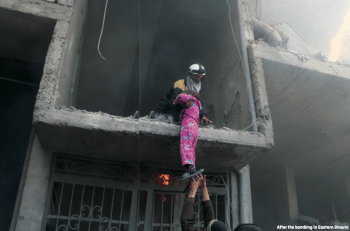
    Unthinkable suffering The Syrian army’s apparent chemical attack on Douma on April 7 was the worst atrocity of an infernal six-week military campaign in Eastern Ghouta. This in turn was the latest horrific chapter in a war lasting seven years which has brought unthinkable suffering to millions of innocent civilians. The relentless bombardment of Eastern Ghouta, backed by Russia and Iran, follows a cruel siege of the area lasting almost five years. These events reflect the most destructive and tragic elements of human nature: when ruthless powers encircle and terrorise the vulnerable, unchecked by any higher authority. The scenes being broadcast from the region are glimpses into an abyss of inhumanity – children being dragged from underneath rubble, parents convulsed with grief, neighbourhoods reduced to debris. The repeated bombing of hospitals and obstruction of aid convoys entering Ghouta are the most depraved aspects of the Syrian army campaign. They are examples of what Holocaust survivor Primo Levi called “useless violence” – suffering inflicted for its own sake and for no other purpose. Putin’s geo-political game Russian President Vladimir Putin has been providing military and diplomatic support to Bashar al-Assad since 2015 when he was losing the Syrian civil war – partly to secure Russian economic interests and partly to assert Russia’s dominance over the US in the region. The civilians of Eastern Ghouta are pawns in Putin’s geo-political game, and it appears he faces little consequence for directing this inferno of mayhem and bloodshed from Moscow. The wholesale destruction of Eastern Ghouta resembles the fate suffered by Aleppo and Homs earlier in the Syrian war and by Grozny, capital of Chechnya, during Putin’s first venture in politicised mass killing, a year into his reign. In each of these war zones the wretched plight of civilians incited him to an extreme of merciless aggression. Putin and al-Assad appear to share a psychopathic relish for attacking the weak. Aerial footage of Aleppo after the worst bombardments in 2016 showed apocalyptic scenes of ruination. The Russian and Syrian forces may as well have dropped a nuclear bomb on this once thriving, exotic city. Night after night on our television screens we are witnessing similar destruction and misery visited upon another mass of civilians, and hearing the same lies from Russian and Syrian officials who deny appalling events that are plain for all the world to see. Footage now emerging of Eastern Ghouta reveals almost a carbon copy of the haunted, hollowed-out cityscape that remains of Aleppo. Syria abandoned Article 1 of the Charter of the United Nations, set out at its inception in 1945, committed members to “tak[ing] effective collective measures for the prevention and removal of threats to the peace, and for the suppression of acts of aggression or other breaches of the peace”. Humanitarian protections for civilians in war zones were enshrined in the UN’s Fourth Geneva Convention of 1949. Grave breaches of these conventions include “wilful killing”, “wilfully causing great suffering or serious injury” and “making the civilian population or individual civilians the object of attack”, all of which have without question been perpetrated on Eastern Ghouta. The UN as it currently stands is nothing more than a politically redundant talking shop for Syria. Hand-wringing about the awfulness of the latest atrocity is invariably followed by diplomatic paralysis. Where power is concentrated most – among China, the US and the EU – moral courage appears absent. The US government, supported by the UK and France, mounted a sharp military response to the chemical assault on Douma, as it did last April when 80 civilians were killed by nerve agents dropped by Syrian army planes in Idlib province. We could ask why the relentless killing of civilians by every other weapon imaginable does not warrant intervention. As before, it is likely that such a measure will not be followed by substantive protections for Syrian civilians who will remain at the mercy of al-Assad and Putin. It primarily served as a show of US military might and of Trump’s willingness to impose a supposed tougher line than Obama on chemical weapons. It   also conveniently shifted public attention from the Mueller investigation into Trump’s alleged links with the Russian administration during his election campaign. An international peace-keeping force The Syrian conflict is a complex and deadly quagmire, involving armies and militias from several countries. Any attempt to resolve it is fraught with risk. And yet the choice to allow this slaughter of innocents to continue is a defilement of our collective humanity. If a large international peace-keeping ground force were based in Syria Putin would be far more cautious in the use of his military power there, and in his sanctioning of al-Assad’s violence. This would require courage from several of the world’s most powerful nations and would involve some risk to the domestic popularity of their leaders. It would be a show of collective strength to cold-blooded autocrats who answer to nothing else. A long-term political settlement is another challenge altogether, but in the interim this would give some protection to civilians caught up in the war. Putin and his allies have been emboldened for too long by having no limits placed on their behaviour and by the implied international attitude that the lives of Syrian civilians are not of much value to the rest of the world. Liam Quaide Liam Quaide is a clinical psychologist and the Green party election candidate for East Cork

    Loading

    Read more